

The European market potential for adventure tourism
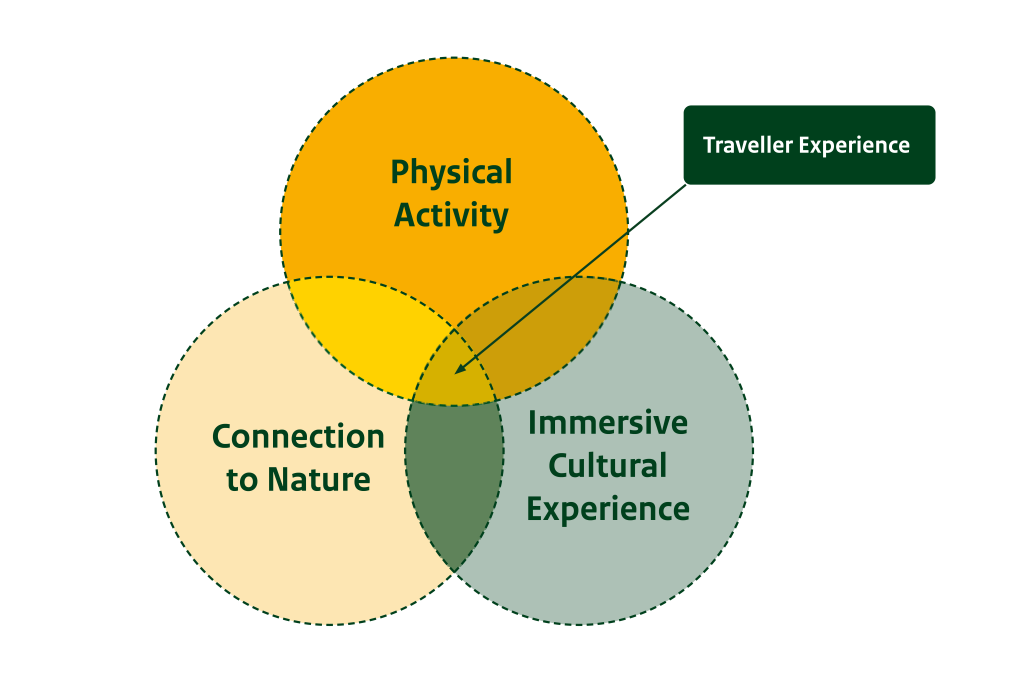
Adventure tourism is about 3 elements: a physical activity, being outdoors in nature and an immersive cultural experience. Europe is a leading region for adventure tourism. Germany and the United Kingdom are the top markets. Enjoying a unique and immersive experience is the top trend for adventure tourism. There are emerging destinations off-the-beaten-track that have much to offer for the curious adventure traveller. New source markets like India and China will shape the adventure traveller market in the future.
Contents of this page
1. Product description: adventure tourism
Adventure tourism is defined as a tourism trip that includes one or more of 3 elements. These elements are physical activity, a connection with the natural environment and an immersive cultural experience. Today, the global trend for immersive experiences has led to a strong focus on the traveller experience as another major part of adventure tourism.
Figure 1: Definition of adventure tourism
Source: Acorn Tourism Consulting, 2025
There are 2 types of physical activity components of adventure tourism, based on the activities people do: soft adventure and hard adventure. Soft adventure makes up the largest number of participants, because these activities are often low-risk and demand little to no prior experience. On the other hand, hard adventure demands higher levels of skill and comes with greater personal risk. But, depending on the traveller or group, a trip can include various soft and hard adventure activities besides cultural and nature-based activities.
Table 1: Soft and hard adventure tourism activities
| Soft Adventure Activities | Hard Adventure Activities |
|---|---|
Definition: Low-risk, widely accessible, limited skill required
| Definition: Higher-risk, demands specialised training/equipment, physically demanding
|
Source: Acorn Tourism Consulting, 2025
As a major tourism segment, adventure tourism overlaps with several other tourism niches: nature tourism, community-based tourism (CBT), cultural tourism, gap year tourism and volunteer and education tourism.
What all these niches have in common is how they depend on sustainability. In adventure tourism, this includes keeping natural environments untouched and protecting cultural heritage through meaningful cultural experiences. Another factor is positive social and economic impacts for local communities. Adventure travellers often have a higher sense of personal responsibility to protect the places they travel to and to make a positive impact on the communities and environments they visit.
Still, some tourism activities are seen as ‘adventure’ but are not as sustainable as other, low-impact activities. Examples are 4-wheel drive (4WD) dune buggying, jet skiing and other water sports using motorised vessels, and also uncontrolled diver numbers at untouched dive spots.
The World Tourism Organization (UNWTO) and the Adventure Travel Association (ATTA) are 2 leading organisations in the adventure segment. Study their research into the sector so you fully understand what adventure tourism is.
Types of adventure tourism experiences
Adventure tourism trips are one of the largest tourism niches in the world today, and there are many types. Trips may have a different focus depending on the traveller's preferences. Examples are a cycling tour that involves visits to local markets, a safari trip combined with kitesurfing, or climbing in the Atlas Mountains combined with homestays at local communities. The table below shows some types of adventure tourism trips available on the market. Use the CBI interactive infographic to help you understand the cross-over niches with adventure tourism.
Table 2: Adventure tourism trips in 2025
| Adventure Tourism Trip | Activities | Details |
|---|---|---|
| The Ultimate Adventure through Sri Lanka | Trekking, wildlife watching, nature, water sports | A 10-night adventure trip to Sri Lanka that includes hiking on jungle trails, visiting wildlife reserves, visiting rural villages, staying in eco-lodges and wild camping by tropical beaches. |
| Walking Cape Verde – Santo Antão & São Vicente | Hiking, homestays, CBT, camping | A 10-night self-guided walking trip on the island trails of Santo Antao and Sao Vicente through arid mountains and lush valleys, finishing with a stay on the beautiful beach of Tarrafal. |
| Mongolia: Nomads of the Steppe | Culture, horseback riding, kayaking, wildlife watching, homestays | A 10-day trip across Mongolia’s extraordinary landscape through grassland and sand dunes, sightseeing, meeting nomadic families and travelling by 4WD vehicle. |
| West Africa Explorer, Senegal, Guinea-Bissau | Culture, nature | A 14-day trip to explore a lesser-visited region of West Africa, travelling to nature areas like the ‘pink lake’ with its resident birdlife, visiting traditional communities, and the holy town of Touba. |
| Cycle the Jordan Trail to Petra | Cycling, cultural tourism, camping | A 7-night trip through the Jordanian desert and remote nature reserves, camping under the stars in Bedouin camps. |
| Kruger Safari and Mozambique Beach Classic, South Africa and Mozambique | Wildlife watching, swimming/snorkelling | An 11-night safari holiday combined with a beach. Stay 4 nights at the Sabi Sand Game Reserve with twice-daily game drives to view the ‘big five’ (lion, leopard, elephant, rhino, buffalo). Spend 5 nights in Mozambique at a beach resort on Ponta Mamoli.
|
| Sri Lanka – Elephants, Temples and Ocean Trails | Trekking, cycling, culture, swimming/snorkelling, wildlife watching, CBT | A 12-day adventure including climbing, hiking, swimming, CBT, visiting an elephant sanctuary and cycling. |
| Guatemala: Tikal and Beyond | CBT, culture, walking | A 16-day trip to Guatemala, exploring the central highlands region full of volcanoes, lakes and traditional Mayan villages. |
The Three Guianas Adventure Tour | Culture, nature, CBT | A 10-night adventure trip through the countries of Guyana, Suriname and French Guiana. Highlights include the Kaieteur Falls, travelling through pristine rainforest and a trip to the old penal colony on Devil’s Island. The trip includes a river cruise and immersion in traditional cultures. |
Source: Acorn Tourism Consulting, 2025
End-market segmentation and consumer behaviour
In the European adventure traveller market there is crossover between the big consumer groups. These are baby boomers (born between 1946 and 1964), Gen X (born 1965-1979), Gen Y or millennials (born 1980-1995) and Gen Z (born 1996-2012).
Adventure travellers can also be classified by level of physical challenge (hard or soft adventure), how they travel (group or independently) and how much money and/or time they can spend on travel. See below for the segmentation by various markers and the characteristics of each consumer group.
Table 3: Adventure Traveller Market Segmented by Demographics, Hard vs Soft, Cash and Time
Segment and Preference | Consumer Group | Budget Type/Time | Characteristics |
|---|---|---|---|
|
|
| This market is dominated by younger travellers aged 18+ who have less money but more time to spend on travel. They often travel during a ‘gap year’, after leaving school and before starting university. Their budgets are small and they want good-value travel experiences. They enjoy experiencing interesting and exciting adventures and like to spend their money locally. |
|
|
| FITs do their own research and make their own travel plans using the internet and word of mouth. They book flights, transport and accommodation through online travel agents (OTAs) or directly with providers, and adventure experiences directly with local operators. FITs are usually small groups of couples, friends/family or retirees. |
|
|
| This segment usually books pre-packaged trips through dedicated adventure tour operators. They like to travel in small groups, meeting like-minded people, and their trips are usually guided. The operator makes all the bookings for the different elements of the trips (flights, local transport and accommodation, adventure experiences). |
|
|
| This traveller segment likes to work with a specialist tour operator to design a holiday that specifically meets their needs. This type of traveller is often a high-end, wealthy consumer and demands high quality throughout the trip. |
Source: Acorn Tourism Consulting, 2025
You can find out more about the different target groups in the specialised CBI studies on baby boomers, Gen X, Gen Y, Gen Z and FITs.
Motivations for adventure travel
Adventure travellers’ main reasons for travelling include exploring new places and discovering exciting new activities. Many prefer to use the professional services of guides, instructors, specialist tour operators or other services. But they are also comfortable finding information online themselves.
The market has changed, and so have tourists’ motivations for adventure travel. These motivations have become more important and are important considerations for the industry.
ATTA’s research into the New Adventure Traveller has come up with key motivations, in order of importance:
- Transformation – personal growth and challenge, accomplishment, achievement, gratitude, mindfulness;
- Expanded worldview – broadened perspective, expanded horizons, cultural understanding;
- Learning – new skills, knowledge and insight, new experiences, enriching overall experience;
- Nature and discovery – environment, beauty of nature, beautiful scenery;
- Mental health – escape and renewal, clear mind, peace and revolution;
- Fun and thrills – adrenaline rush, excitement, feeling alive;
- Connection – bonding, learning about others, meeting new people;
- Meaningful stories – reminiscing, experiences to remember, photos;
- Physical health – exercise, fitness, strength;
- Unique experience – unexpected experiences, going somewhere that others do not go, feeling of accomplishment.
Accessible tourism on the European market
Accessible tourism is the ongoing effort to make sure tourist destinations, products and services are accessible to all people, regardless of physical limitations, disabilities or age. It includes publicly and privately owned tourist locations. The improvements benefit not only people with permanent physical disabilities, but also parents with small children, elderly travellers, people with temporary injuries like a broken leg, and their travel companions. Disabled tourists may travel individually, in groups, with their family or with carers.
Accessibility and adventure tourism
Adventure travellers with and without disabilities share similar motivations for travel. They want to experience personal growth and challenge, broaden their perspective on the world, learn new things and meet new people. Above all, they want to have immersive experiences. To serve the accessibility market, you will need to be very clear about what you can offer them. It is also very important to make clear what you cannot offer.
Here are some tips if you want to serve the accessibility market:
- Audit your tours and see if you can adapt them. For example, add stabilisers to kayaks or offer tours on wheelchair-accessible hiking trails. Consider offering adaptive gear like off-road wheelchairs, sit-skis or harnesses for climbing. Make sure you focus on activities that have no barriers to accessibility.
- Invest in accessible infrastructure. Examples are ramps, wheelchair-friendly vehicles, walking frames and walking sticks. Make sure facilities are accessible, also bathrooms.
- Train your staff. This is important for all staff and guides to make sure they are aware of issues and are sensitive and respectful. Try to develop a culture of ‘yes, let’s find a way’, rather than ‘no, it’s not possible’.
- See what other tour operators do and learn from them. Examples are Planet Abled, who offer customised and group tours across India and Southeast Asia, and Wheel the World, who specialise in fully accessible trips in Latin America.
Tip:
- Read the CBI studies The European market potential for accessible tourism and Entering the European market for accessible tourism products for practical and useful advice to make your tours accessible.
2. What makes Europe an interesting market for adventure tourism?
Europe is an interesting market for adventure tourism because it is one of the largest markets for adventure tourists. According to ATTA, on average the region provides the second-largest number of adventure travellers (22.7%) after North America (25.9%). By country, after the USA (47%) and Brazil (13%) important source markets were the UK (10%), the Netherlands (6%), France (5%) and Germany (4%). India (6%) and Australia (3%) make up the next most important global markets for adventure tourism.
Source: ATTA – 2025 Adventure Travel Trends Insights Report
According to ATTA’s 2025 Adventure Travel Trends Insights Report, other interesting statistics and findings about the global adventure travel market are:
- Average length of stay is 8 nights;
- Average trip price is US$3,000;
- On average, 76% of the total trip cost is spent with local suppliers;
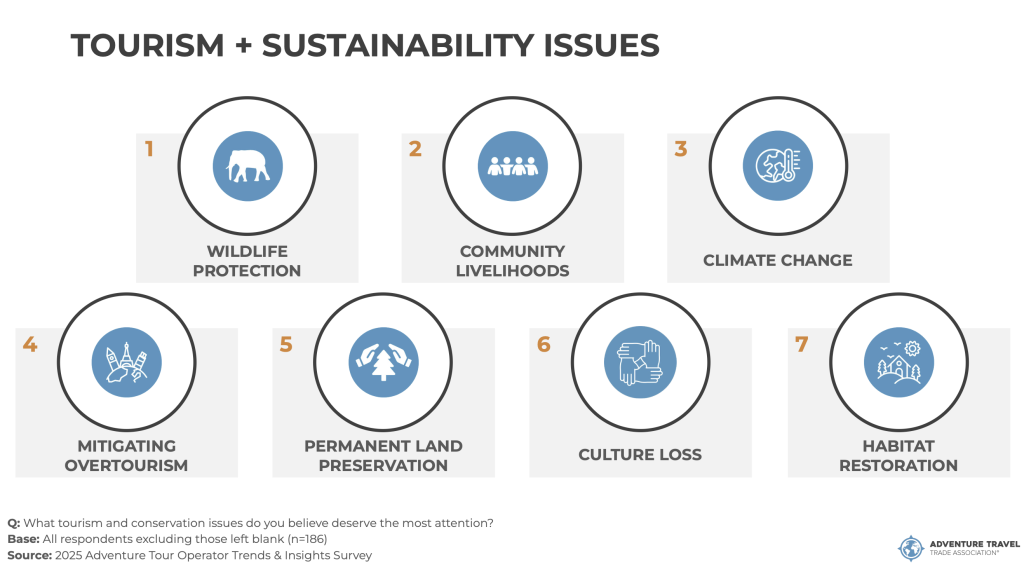
- 49% of adventure tour operators have or are working towards a sustainability certification. The top-3 tourism and sustainability issues are wildlife protection, community livelihoods and climate change;
- Adventure travellers spend around US$227 on local handicrafts and souvenirs;
- Top trending activities for European adventure travellers are safaris/wildlife watching, food, e-bike cycling, sailing and photography (wildlife/nature);
- Northeast Asia, Southern Africa, East Africa and South America are top-trending among developing regions.
Figure 3: The tourism and sustainability issues that are important to adventure tour operators
Source: ATTA – 2025 Adventure Travel Trends Insights
The importance of the European adventure tourism market is also clear from the number of tour operators in Europe. According to CBI, 80% of European tour operators were active in the adventure tourism segment. Wildlife watching is the most-offered activity (55%), followed by walking (46%), nature tourism (39%) and bird watching (34%).
ATTA estimates that the global outbound adventure travel market was worth US$966 billion in 2023. This category now includes 67% of international outbound travellers. This shows that adventure has moved beyond a niche, and become a mainstream mindset. For comparison, ATTA valued the market at $683 billion in 2017, which showed a compound annual growth rate (CAGR) of 6%. This steady expansion makes adventure travel one of the largest and fastest-growing segments of global tourism.
Other recent research by ATTA estimated the market value of US outbound travellers at US$138 billion in 2023, a CAGR of 7.5% for 2017-2023. It also says this outbound market sector will be worth US$200 billion in 2028.
Globally, many experts think Europe’s share of the adventure tourism market is around 37%-39%.
The main message here is that the adventure tourism segment is going through a period of strong growth. This means that local tour operators have many opportunities to attract an enthusiastic market from Europe.
3. Which European countries offer the most opportunities for adventure tourism?
The European countries offering the most opportunities for adventure tourism in developing destinations are Germany, the UK, France, Italy, Spain and the Netherlands. Germany and the UK are the 2 largest markets, based on their large numbers of outbound tourists and various studies.
ATTA’s research into European adventure travellers reveals some interesting data about the adventure travel market. Mainly, it shows that the market is larger and more complex when it comes to attitudes and activities. This data will help local operators target their adventure products more precisely.
The ‘Core Adventure’ market makes up 45% of European outbound international travellers. This number is higher than the global market of 40%. This base market follows globally recognised definitions of adventure travel that focus on a physical activity in nature and/or with cultural immersion. If we look each market more deeply by preference and motivation, we see many differences by country. Full research into the European market will be published towards the end of 2025. Keep an eye on research published by ATTA.
Table 4: European outbound international travellers – market segments overview
| Segment | Description | Top 3 markets |
|---|---|---|
Core Adventure | Core market of adventure travellers |
|
Open to Adventure | Include elements of adventure but may blend it with other preferences like luxury, relaxation and culture. |
|
Adventure Intensives | Travel style is exclusively focused on adventure and exploration, looking for high-energy, thrill-oriented or physically immersive activities. |
|
Nature Enthusiasts | Prioritise nature and wildlife experiences, like safaris, hiking in national parks and ecotourism. |
|
Cultural Explorers | Look only for cultural immersion, like local food, history, arts and heritage. |
|
Experience Samplers | Select many adventure travel styles, combining elements like nature, exploration and active experiences. |
|
Source: ATTA, 2025
‘Open to Adventure’ travellers can provide good opportunities when it comes to both time and money. Their trips are 11 days on average and they spend US$265 per person per night.
Other interesting observations from this research that can help with your business planning:
- Germany is the top country for European adventure travellers. They have a strong desire to take part in most types of adventure travel;
- Spanish and Italian markets are newly open to adventure travel. Germany and the UK have traditionally dominated this market;
- Cultural experiences are especially popular in Spain, Italy and France. These countries are known for their exceptionally strong cultural heritage;
- The UK, a traditional top market for adventure tourism, has a broader interest in adventure rather than targeted experiences.
In 2024 CBI carried out a study into top activities when travelling overseas. It found that all source markets are especially motivated by visiting cities and towns. They are really interested in cultural and immersive activities in urban settings. Visiting cities and towns is not usually considered an adventure activity. But there are many urban cultural experiences that can be combined with outdoor adventures and nature activities that will appeal to this market. For example, a tour that includes trekking in the Andes with urban cultural immersion in Lima and Cusco offers both outdoor adventure and deep cultural insight.
European markets are sustainably minded.
Sustainability is the heart of adventure travel. Source markets more often prefer small-group travel and locally owned activities. Human connection, conservation of nature and preservation of culture are important in adventure tourism. If projects are managed with these factors as top objectives, adventure tourism can be a true driver of sustainable economic development.
Major findings from CBI’s research were that:
- Almost 9 out of 10 respondents would pay more to protect the local environment (89.4% average). Germany, Italy and the Netherlands are the most likely to pay;
- More than half preferred to consume locally sourced products (51.6%). The top markets are Italy, Spain and France;
- Over one-third preferred to go on holiday outside of the high tourist season (35.2%). This creates opportunities for tour operators during the low season and to address overtourism.
Making sure trips are sustainable and benefit communities is essential if you want to attract the European market. If you can maximise your sustainable actions, you will set yourself apart from the competition.
Germany
Germany is the largest outbound travel market from Europe, and the top adventure travel market. There is a range of market valuations, but it is clear that the German adventure travel market is expected to grow. The market is predicted to grow at a CAGR of 15.8%, reaching as much as US$74.3 billion by 2030. Soft adventure activities dominate the German adventure travel market.
CBI research found that in 2024 food and wine (48%), nature (43%) and hiking/trekking (22%) were the top-3 activities related to adventure tourism that German outbound tourists took part in when travelling. In 2025, German travellers said they were going to take part in nature (42%), food and wine (42%) and getting to know the locals (24%). 12% of past and future travellers said they took or plan to take a specific adventure tourism trip.
Source: CBI, Acorn Tourism Consulting, 2025
Being immersed in local cultures and people was a top motivation for travel among German respondents (45.2%), followed by adventure and exploration (31.9%). But they also look for relaxation and escape from routine (51.5%). This means that an adventure trip with many features will appeal to this market.
The German market finds sustainability important when they travel:
- 59.7% felt that choosing local activities to benefit local people was either important or very important;
- 48.5% thought that their environmental impact when they travel to or near a destination was either important or very important;
- Around 2 in 5 German travellers are influenced by an accommodation’s sustainability actions when they choose where to stay.
The German tour operator market is large and mature. Adventure is a big part of tour operators’ itineraries. Typical examples are Berge & Meer, which includes adventure as a theme; Natuerlich Reisen, which offers active holidays in nature; and Global Adventures, which specialises in adventure trips to Africa. ReNatur offers adventure holidays for children and active holidays for the whole family.
The United Kingdom
The UK adventure tourism market is also growing. For 2025-2030 it is predicted to grow at a CAGR of 16.4% and, like Germany, be driven by soft adventure activities. Reports say that younger generations aged under 30 are helping the growth of adventure tourism as they are very enthusiastic adventurers.
British tourists often choose more activities while on an adventure trip than other markets. Top activities among British outbound travellers in 2024 were enjoying local food and drink (46%), nature (28%) and getting to know the locals (21%). All of these are seen as soft adventure when combined with nature and physical activities.
In 2025, food and drink will probably be the most important activity for British outbound travellers.
Source: CBI, Acorn Tourism Consulting, 2025
Adventure and exploration (39.6%) and being immersed in local cultures and people (32.4%) are also important motivations for the British market. People also value time with friends or family (50.6%). This gives opportunities to target multigenerational groups of British adventure travellers. Choosing local activities to benefit locals is the top sustainability action for travellers from the UK. 66.6% said it was either important or very important.
The tour operator market in the UK is the largest in Europe and has a global reach. Adventure tourism is very common across tour operators’ itineraries. Many specialise in ‘adventure travel’ and travel all over the world. Others specialise in regions, like Africa or Asia. Some specialise in certain activities like cycling trips or hiking. Some focus on luxury, budget or solo travel. Examples are Explore UK, KE Adventure Travel, Intrepid Travel, World Expeditions and Kuoni.
France
Like other source markets, the outbound adventure tourism market in France is growing at an estimated CAGR of 17.6% for 2024-2030. This is one of the highest growth rates among all markets after Italy.
Nature and culture are important for the French market. In 2024, nature (37%), food and wine (29%) and getting to know the locals were the top activities. But French tourists like to do many different activities, and interest in most activities is set to increase in 2025. Adventure tourism trips will probably grow from 20% to 27%. This rise shows the growing interest in adventure travel in this market. Interest in cultural activities is also strong in immersive experiences like attending local festivals/fairs (21%) and visits to/interactions with local communities (13%).
Source: CBI, Acorn Tourism Consulting, 2025
The French travel business is large and complex. The largest travel agents include TUI France and the Karavel Groupe, which has several brands. Tour operators that offer adventure tourism include Voyageurs du Monde, Havas Voyages, Voyages d’Exception and Continents Insolites.
Italy
Italy’s adventure travel market is the fastest-growing of the main source markets. It is valued at US$24.5 billion in 2024 and forecast to rise by a CAGR of 18.3% to US$65.9 billion by 2030. As for all markets, growth is being driven by the soft adventure activity market.
Like the French, Italians are especially interested in culture and nature. Top activities in 2024 were nature (35%), food and wine (30%) and attending local festivals/fairs (18%). These are all types of immersive experience. Growth activities for 2025 are also the mostly immersive activities listed above, but also visits to/interactions with local communities. On the other hand, less interest is expected for walking tours. This activity fell from 27% in 2024 to 17% in 2025.
Source: CBI, Acorn Tourism Consulting, 2025
The Italian travel trade is very fragmented, and operators are mostly based in Rome. Tour operators specialising in travel to developing destinations include The Labyrinth, Yana Viaggi and Viaggi Solidali.
Spain
The Spanish adventure travel market is growing and is expected to reach US$35.0 billion by 2030, a CAGR of 16.8% for 2024-2030.
However, unlike the other source markets, Spanish tourists are planning fewer adventure activities on their trips in 2025. Nature is still the top activity (28%), followed by food and wine (25%) and walking tours (20%). But as a nation, they are especially motivated by culture as a reason for travel. So, packaging soft outdoor adventures with immersive cultural experiences will probably appeal to the Spanish market.
Source: CBI, Acorn Tourism Consulting, 2025
Tour operators on the market include Kananga International, offering overland trips to Africa, and Adventure Bug, providing personalised adventure trips with a focus on benefits to local communities.
Netherlands
Dutch people are known for their love of the outdoors, especially cycling, trips in nature and ecotourism. Although there are few statistics about the broader adventure tourism market, the cycling tourism segment is experiencing major growth. This is a good indicator of the interest in adventure activities.
Like the British, Dutch adventure travellers are interested in a range of adventure activities. Nature and the outdoors are especially important to them. Walking tours (49%) and nature (46%) are the top activities in 2024 after food and wine (59%). Interest in nature will probably increase in 2025 to 49%, along with getting to know the locals (25%).
Source: CBI, Acorn Tourism Consulting, 2025
The Dutch travel trade has both travel agents and tour operators. There are many adventure tour operators that attract Dutch adventure tourists. 2 of these are Vamonos and SNP Natuureizen.
Tips:
- Understand that transparent, sustainable actions are important to attract these markets. Check how sustainable your business is and take actions to make sure your business is sustainable. Make sure you show your sustainability credentials on your website.
- To appeal to the different needs of European adventure tourists, make sure you offer a wide variety of packages and experiences. European markets really like to combine the outdoors with immersive cultural experiences.
4. Which trends offer opportunities or pose threats in the European adventure tourism market?
Adventure tourism especially demands authentic and unique experiences. Operators are branching out their product offer to appeal to new traveller groups like women-only, solo and family groups. As the world becomes more accessible, new emerging destinations are entering the market and appealing to curious adventure tourists. Also, new source markets, especially those of India and China, are creating new traveller patterns.
The desire for unique experiences is especially strong in the adventure tourism segment
This global trend is even more important in the adventure tourism segment. Authenticity, cultural immersion and physical activities in beautiful, untouched environments are the very center of adventure travel. Adventure travellers are often more flexible than other tourist types. Also, those who travel independently (FITs) are more likely to be spontaneous and book an experience after they arrive in a destination. Making sure that your business stands out in a crowded arena is a major business task. But you must make sure your experience has all the right elements to attract adventure tourists in the first place.
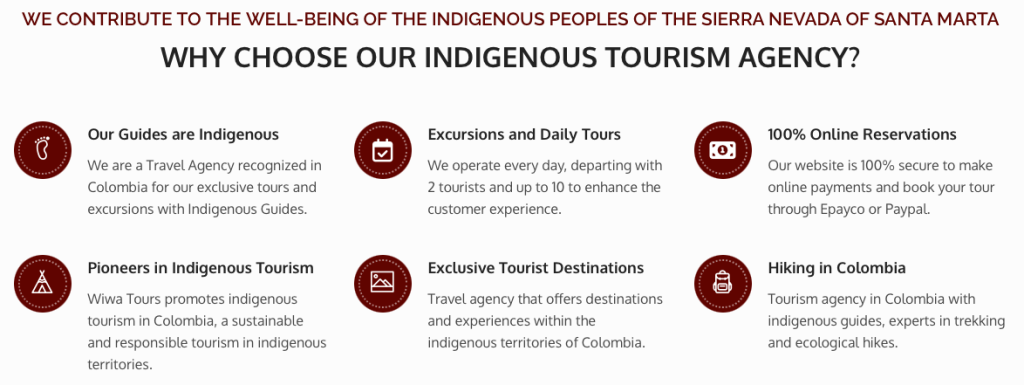
There are many best-practice examples of local tour operators on the market that attract adventure FITs. Wiwa Tour Colombia specialises in cultural and nature tours, and promote enriching experiences around sustainable indigenous tourism. Indigenous tourism is another key tourism trend as there is a growing recognition of, and interest in, indigenous rights and histories. This is a strong USP (unique selling point) for adventure tourists who want to make sure their travel habits make a positive contribution to local people while enjoying an authentic experience.
Figure 10: Wiwa Tours, Colombia
Source: Wiwa Tours Colombia, 2025
Warm Heart Adventures in Malawi is a small adventure tour company based in Cape Maclear on the shores of Lake Malawi. It is women-owned and managed. They offer mid-range accommodations and a variety of adventure activities to take part in, like kayaking, trekking, safari trips and mountain biking. The operator also offers a range of multi-day adventure trips. Involving the local community is important to the operator. They employ local people to organise tours and provide services, but also offer skills training.
Adventure tour operators are diversifying experiences to attract new types of adventure travellers
Adventure travel is becoming more popular and demand for immersive experiences keeps rising. This means that tour operators that offer adventure experiences are attracting new markets by having a variety of products. Families, women travellers, older travellers aged 50+ and the LGBTQ+ markets are all interesting segments for adventure travel providers these days. By changing their products to meet different needs, operators can develop their offer for bigger markets.
Adventure operator Intrepid Travel, one of Europe’s leading adventure tour operators, has been very clever to target its portfolio of tours to different markets. This means they can attract a diverse range of customers. Options include Family, Women’s Expeditions and Solo Travel. They are also careful to tailor their journeys for each group rather than offering a ‘one size fits all’ approach that would compromise the needs of the different markets.
If you aim your tours at a specific group, make sure you focus the activities on that group specifically. Do not just give it a catchy title and hope that it will attract that market. This could lead to disappointed customers and negative feedback.
Trending adventure destinations
Adventure tourism is not limited to one or 2 destinations. It can be found in all continents and in most countries. Adventure tourists are naturally curious. Many of them are especially keen to travel off the beaten track to immerse themselves in less-visited places for a truly authentic experience. Emerging destinations have multiple opportunities to attract adventure tourists, as long as they develop immersive, authentic and sustainable products. Have a look at some examples in the table below and see how your product compares.
Table 5: Emerging adventure destinations around the world in 2025
| Emerging Adventure Destination | Description |
|---|---|
| Sierra Leone – Freetown Peninsula | Sierra Leone has emerged from decades of conflict and has worked hard to improve its reputation. After the pandemic, a range of ecotourism initiatives were started, and today there is a range of activities to satisfy adventure tourists. These include wildlife treks in a chimpanzee sanctuary, excellent surfing on white sandy beaches and community-led conservation projects to explore. |
| Peru - Huaraz | Located in the high Andes and known as the gateway to the Cordillera Blanca, Huaraz has a growing reputation amongst adventure travellers for its top-class trekking, high-altitude climbs and less-crowded alternatives to the classic Andean hiking routes. |
| Mozambique – Bazaruto Archipelago and Ponta do Ouro | Mozambique is gaining a good reputation for marine conservation-focused tourism. It is one of Africa’s least developed countries and has long attracted more adventurous travellers. Today, sustainable marine safaris and educational stays at ecolodges are all possible. |
| India – Meghalaya | Meghalaya, located in Northeast India, is becoming more popular. New initiatives to develop tourism infrastructure and safety systems, and the creation of new tourist zones, have contributed to this. Adventure and cultural experiences include hiking in remote regions, cave explorations, and nature immersion in lush, undiscovered landscapes. |
| Guyana | Guyana has long been a destination for the most adventurous travellers. It also has a very good reputation for sustainability. Tourism development is focused on supporting remote community economies and biodiversity conservation. In the dense tropical rainforest, adventure tourists can birdwatch, fish (catch-and-release) in Amerindian villages, and abseil down Kaieteur Falls, the world’s highest single-drop waterfall. |
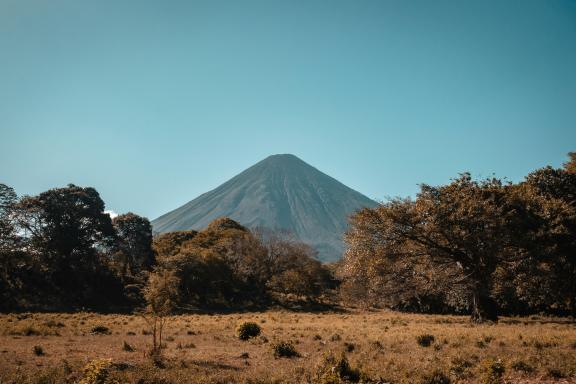
| Nicaragua | Located in a region of extreme biodiversity, Nicaragua’s landscape is protected, and ecotourism is a big economic driver. Ecolodges in places like Ometepe Island make it a rising eco-adventure destination. Volcanic island trekking, kayaking, hiking in rainforest reserves and taking birdwatching boat tours are popular adventure activities. |
Source: Acorn Tourism Consulting, 2025
Figure 11: Ometepe Island in Nicaragua is a trending destination, good for hiking the island’s volcano
Source: Sophie on Unsplash, 2023
New source markets in competition with Europe
Beyond Europe, there are new markets to think about for adventure tourism products. These markets are driven by a continued rise in global mobility and increased spending across various segments. Domestic travel is expected to keep contributing more than 70% of direct GDP, and leisure travel more than 80% of the market.
But fast-growing economies like those in India and China are creating new traveller patterns. International tourism arrivals from these 2 countries alone are set to reach a 25% share of global trips by 2030. Numbers of Indian outbound travellers are expected to triple, while the number of Chinese travellers is expected to double. Their preferences will shape the market over time. That is why it is important to research these 2 important markets. Other markets worth considering are Indonesia and Vietnam. In both countries, people are getting richer and there is better connectivity. There is also good regional proximity with other adventure destinations.
At the same time, the younger generations (millennials and Gen Z) will make up the largest number of travellers. It will be important to meet their changing digital preferences. They will keep demanding immersive experiences, like live events and festivals. They will also rely on social media for information and inspiration.
But you will need to do your research to attract markets outside Europe. This is because they probably have different preferences, motivations and behaviours than European markets. It is also important to understand that you might not be able to target both market sources with your product. So you should think about which market gives you the best opportunities.
Acorn Tourism Consulting Limited carried out this study on behalf of CBI.
Please read our market information disclaimer.
Disclaimer: The statistics quoted throughout this study come from from a range of sources. Because of variations in data collection and presentation methods, figures may not always be directly comparable.
Search
Enter search terms to find market research
Do you have questions about this research?
Adventure travel remains well-positioned to support long-term resilience in destinations that lack a mass domestic tourism base or are looking to attract higher-value visitors. With its emphasis on the outdoors and preference for rural areas, small towns, villages, and uncrowded regions, this sector offers a natural fit for communities seeking sustainable growth. Looking ahead, the European market will be especially important to engage with, with its strong demand for authentic and culturally rich experiences.

Heather Kelly, Director of Research and Knowledge at ATTA
Success in today's travel market comes from authenticity, not imitation. Build your identity through real connections with local communities, prioritise quality over price, and embrace genuine sustainability. Deliver exactly what you promise – no more, no less. True credibility is earned through consistency, not slogans. Unique, meaningful experiences resonate deeper than monuments, and travellers remember the people and stories you introduce them to long after the journey ends.

Khaled Ibrahim, Amisol Travel