
The Dutch market potential for tourism
The Netherlands is an important European outbound tourism market. Dutch travellers have a high interest in visiting low- and middle-income destinations. They speak very good English and are keen on good value, sustainable tourism products. Adventure, cycling, sun and beach, culture, nature, city breaks and round trips are their most favoured tourism products. Dutch nationals of all ages travel, but their needs and budgets vary. Their choice of destination may be affected by climate issues, safety and other risk factors.
Contents of this page
1. Country description: Netherlands
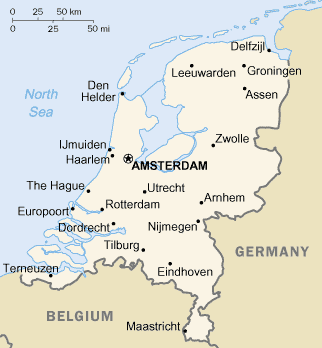
The Netherlands is a small country located in Northwest Europe. It has land borders with Germany and Belgium and a long coastline on the North Sea. Amsterdam is the capital city, and Rotterdam is home to a major trade port. People from the Netherlands have Dutch nationality. Dutch is the official language, but English is spoken widely. Dutch nationals have a very high standard of living.
Figure 1: Map of the Netherlands
Source: CIA World Factbook, 2026
The Netherlands had a population of 18.14 million people in 2026. It is a member of the European Union (EU). The Dutch economy is an open one, driven by trade. GDP grew 1.9% in 2025 and 1.2% year-on-year growth was reported in Q1 2026. Further growth of 1.4% is forecast in 2026 and 1.1% in 2027. The Netherlands’ main trade is goods exports and re-exports through major logistics hubs, such as the port of Rotterdam. Germany is the main export market. Top export products include refined petroleum products, specialised machinery and telecom equipment.
2. What makes the Netherlands an interesting market for tourism?
The Netherlands is an interesting market for outbound tourism. Dutch nationals have a strong desire to travel. They make for one of the leading outbound travel markets in Europe. They are also known to want to visit destinations beyond Europe, including low- and middle-income countries (LMICs). As an advanced and wealthy European country, they also have a high degree of spending power, good air connections to destinations all over the world and a mature tour operator sector.
However, like most of Europe, the Netherlands is vulnerable to inflation, economic uncertainty and weak consumer confidence which may make Dutch travellers more selective, especially for long-haul and higher-risk destinations. The OECD expects Dutch growth to remain moderate. Inflation and geopolitical tensions still create downside risks.
Analysis of the Dutch travel market
In 2024, Dutch nationals made 20.1 million outbound tourism trips, spending €19.4 billion. The average length of a trip was 9.4 days. More than half of all trips were to destinations beyond the Netherlands (55.5%). Dutch nationals also spent more on travel overseas (81.7%) than they did on domestic trips (18.3%).
Table 1: Dutch outbound tourism 2024
| Indicators | 2024 | % Share |
|---|---|---|
| Arrivals | ||
| All Holidays (million travellers) | 36.2 | 100.0% |
| Domestic Holidays (million travellers) | 16.1 | 44.5% |
| International Holidays (million travellers) | 20.1 | 55.5% |
| Expenditure | ||
| All Holidays (million euros) | 23,716 | 100.0% |
| Domestic Holidays (million euros) | 4,338 | 18.3% |
| International Holidays (million euros) | 19,378 | 81.7% |
Source: Central Bureau for Statistics, 2025
It was also reported that 72% of Dutch people aged 15 and over took a summer holiday, with an average of 2 trips in 2024. International travel is therefore very popular among this group of European travellers.
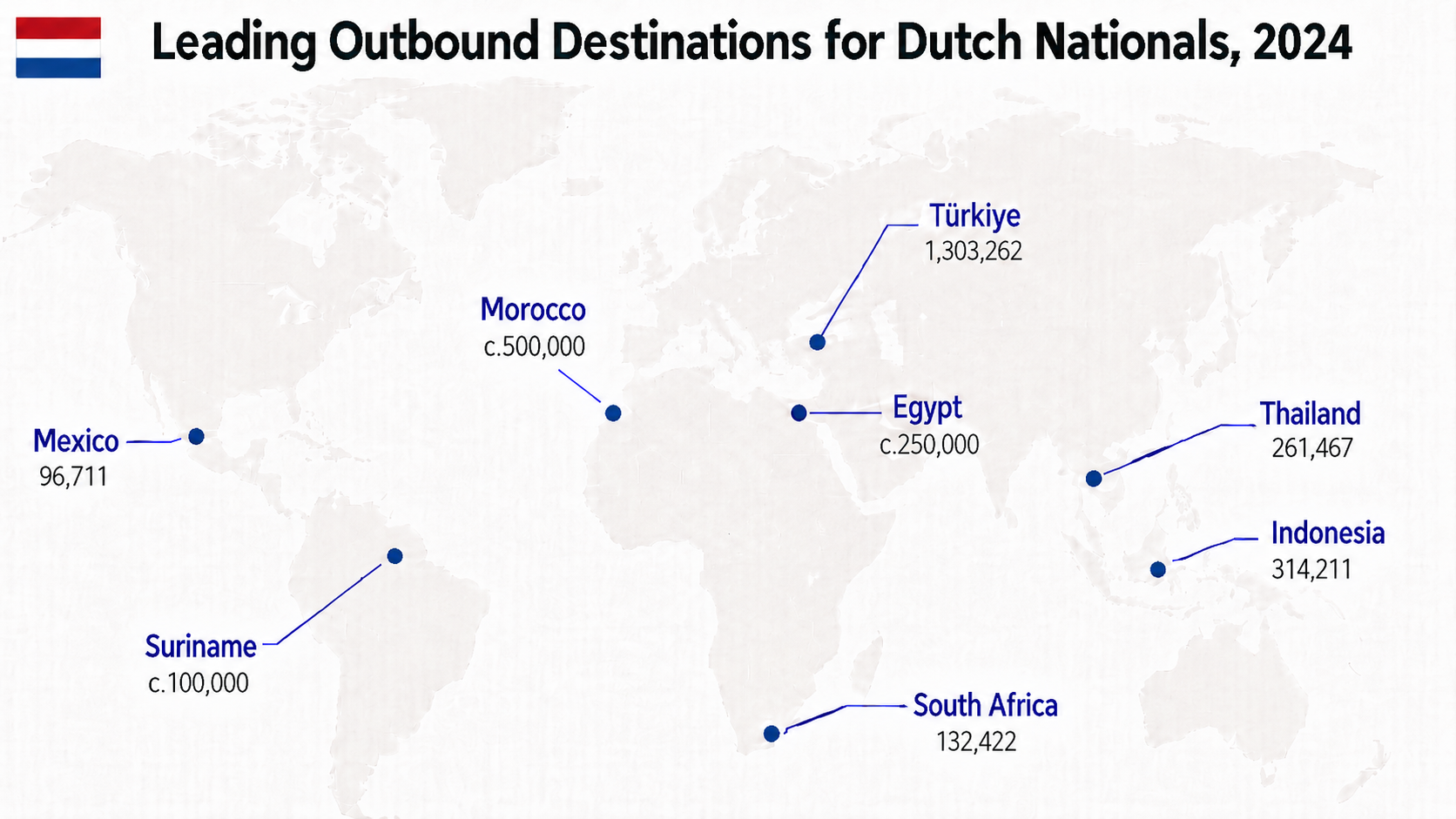
Most Dutch outbound travel is to European destinations. This is common for all European travellers. Easy, convenient access and cost are important when choosing destinations. The most popular LMICs that Dutch nationals like to visit are:
- Türkiye;
- Morocco;
- Indonesia;
- Thailand;
- Egypt;
- South Africa;
- Suriname;
- Mexico.
Arrivals to Türkiye have been rising in recent years. This is because of ease of access, good weather conditions, good marketing by the Turkish tourist board and a strong tourism offer.
Figure 2: Where do Dutch people like to travel?
Source: Acorn Tourism Consulting, 2026
Dutch traveller behaviour, characteristics and travel motivations
Travel is extremely important to Dutch people. However, they are price conscious and want good value. Research shows that affordability is a major factor for 71.6%. As such, destinations that offer value-driven experiences and competitive pricing are more likely to attract the Dutch market.
When on overseas trips, they spend most of their budget on accommodation (40.9%) and around one quarter on food.
Source: CBI, 2025
Many Dutch people speak multiple languages to a good level, particularly English. They are interested in other cultures and careful with their money. The Dutch are direct in their business dealings, and Dutch tourists are no different. Dutch tourists are well-organised when it comes to planning their holidays. They often research trips up to six months in advance. They are very comfortable using the internet to book their trips. Few Dutch tourists still use traditional travel agents to book their trips. AI (artificial intelligence) is sometimes used to plan trips. The platforms Layla and Mindtrip are popular.
When planning trips, Dutch people rely heavily on word of mouth from friends, colleagues and relatives (53%). They also use personal experiences to help shape their decisions (40%). Dutch tourists also use websites that collect customer reviews and ratings, like Tripadvisor, to gather information.
Travel motivations are a mix of relaxation, nature, culture and discovery. Dutch travellers often want a break from routine. However, they also like active and meaningful holidays. Hiking and walking in parks, reserves, cycling tours and birdwatching are popular. These activities are often combined with heritage and cultural activities. This provides opportunities for LMICs to combine landscapes, wildlife, local culture and soft adventure to appeal to this market.
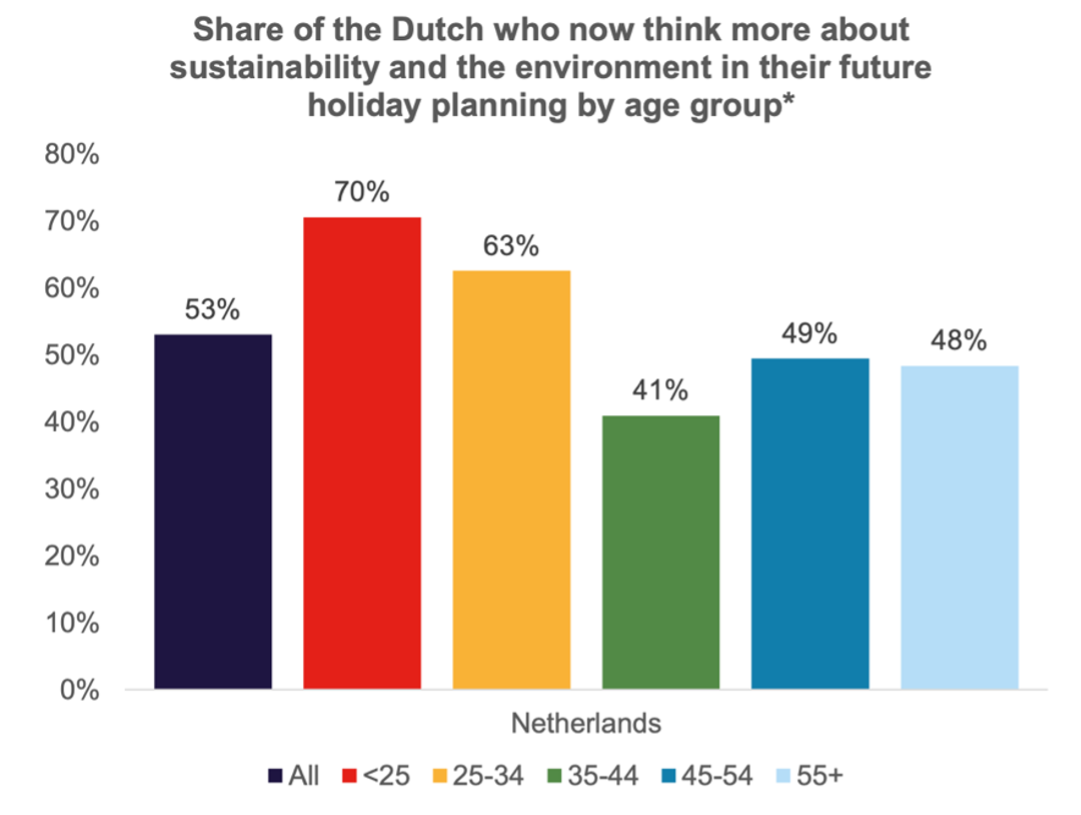
Dutch people are very concerned about the environment and like to travel sustainably. The younger age groups show the strongest intention to change their behaviour when they travel. Actions include using forms of transport other than flying and minimising their use of plastic. More Dutch people are becoming vegetarians (11% of the population), particularly the younger generation aged 18–24. Destinations with good vegetarian cuisines are popular among conscious consumers.
Figure 4: Importance of sustainability to the Dutch
Source: Visit Britain, 2025
For Dutch travellers, sustainability messages work best when they are clear and concrete. For instance, local ownership, fair working conditions, low-impact activities, nature protection and credible certification.
They also enjoy taking part in local activities that benefit local communities (51.3%). Additional EU research found that Dutch tourists like to take practical action to travel sustainably, and that they aim to:
- Take holidays outside of the high tourist season (45%);
- Eat locally sourced products on holiday (44%);
- Reduce waste while on holiday (44%);
- Travel to less visited destinations (43%).
Dutch tour operator insight
Dutch travellers are experienced, well-informed and confident. Many are used to planning trips themselves and know what they want from a destination. They still book through tour operators because they value security, comfort and reliable organisation. This reassurance has become more important in the current travel climate.
Dutch travellers want trips that are structured but not too controlled. They expect good planning, clear communication and dependable service from tour operators and local suppliers. At the same time, they want enough free time to explore independently. The balance between organisation and flexibility is important in the Dutch market.
Nature, culture, cycling, walking and other active outdoor trips perform well. Dutch travellers are interested in discovering new places and moving away from overcrowded or very familiar experiences. They still want to see the main highlights of a destination. However, they also want smaller-scale and lesser-known experiences. Authentic contact with local life is important, as long as it does not feel staged.
There are strong opportunities for local suppliers that understand Dutch expectations. Suppliers need to be reliable, punctual, transparent and able to respond to feedback. The strongest products combine comfort with authenticity, good storytelling and clear local benefits. It is also useful to show how tourism income supports communities and nature.

Jorieke Graven, Impact Coordinator, Sawadee
About Sawadee
Sawadee is a Dutch tour operator that specialises in experiential tourism. It delivers more than 250 trips across 100 countries. It was recently acquired by global tour operator Intrepid Travel, which reports that the Netherlands is Intrepid’s 4th largest source market after Australia, the United States of America (USA) and the United Kingdom (UK). For more information on the Dutch tour operators, download the CBI study Developing your tourism product for the Dutch market.
South Africa, Japan, Indonesia, Sri Lanka, Vietnam, Morocco, Costa Rica, Mexico, Peru and Tanzania are popular countries for Sawadee customers.
Tips:
- Be clear about value from the start. Dutch travellers are price conscious, so show the total trip cost, what is included, what is optional and where travellers may need extra spending money.
- Prepare information early in the booking journey. Many Dutch travellers research trips months in advance. This means it is best to provide detailed itineraries, practical FAQs, travel times, accommodation standards, packing advice and cancellation conditions on your website.
- Use reviews and word of mouth to build trust. Encourage guests to leave reviews on platforms, like Tripadvisor and Google. Use short testimonials that highlight reliability, good organisation, safety and local experiences.
- Work in a direct, reliable and transparent way with Dutch partners. Respond quickly, keep prices and conditions clear, deliver what you promise and be open to feedback from Dutch tour operators and travellers.
- Find out more about the Dutch outbound tourism market and how to do business. You can find lots of tips in the CBI studies 10 tips for finding buyers on the European tourism market and 10 tips on how to do business with European tourism buyers. For practical tips, you can also find out more about entering the Dutch tourism market in the accompanying study, Developing your tourism product for the Dutch market.
3. Which tourism products offer the most opportunities on the Dutch market?
The 6 most popular tourism products in the Dutch market are:
- Adventure tourism;
- Sun and beach tourism;
- Cultural tourism;
- Nature tourism;
- City breaks;
- Round trips or touring trips, including cycling.
Adventure tourism is the largest segment. There is usually crossover between these niches, especially as Dutch travellers often like to do different activities on a trip.
Adventure tourism
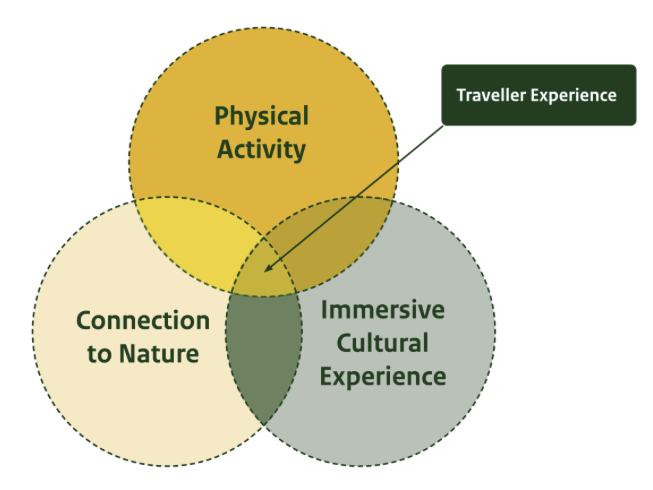
Adventure tourism is probably the largest tourism segment in the world today. It is defined as a tourism trip that includes 2 or more of 3 elements. These are: a physical activity, interaction with nature and a cultural exchange. Today, the global trend for immersive experiences has led to a strong focus on the ‘traveller experience’ as another major part of adventure tourism.
Figure 5: Definition of adventure tourism
Source: Acorn Tourism Consulting, 2026
Physical activities are identified as either ‘soft adventure’ or ‘hard adventure’. ‘Soft adventure’ means there is limited risk or skill required to take part. ‘Hard adventure’ is more risky and usually requires high levels of skill and, sometimes, equipment. Soft adventure is the larger segment as hard adventure accounts for fewer participants and activities. That said, it is reasonably common for soft and hard adventure activities to be combined on one trip.
Table 2: Soft adventure activities versus hard adventure activities
| Soft adventure activities | Hard adventure activities |
|---|---|
|
|
Source: Acorn Tourism Consulting, 2026
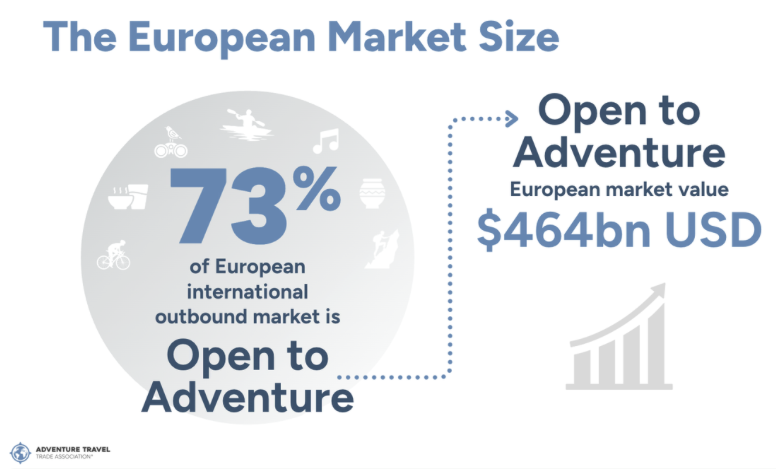
Dutch outbound travellers are keen adventure tourists, especially when they travel to LMICs. Europe is one of the largest adventure tourism markets in the world. It makes up an estimated $464 billion (USD) in outbound spending. Research conducted by ATTA in 2026 found that 73% of European outbound travellers, including those from the Netherlands, were ‘open to adventure’. The interpretation of ‘open to adventure’ differs by market. Some markets value cultural immersion while others prioritise active exploration.
Figure 6: Size of the European adventure tourism market
Source: ATTA Adventure Travel Market Sizing, 2026
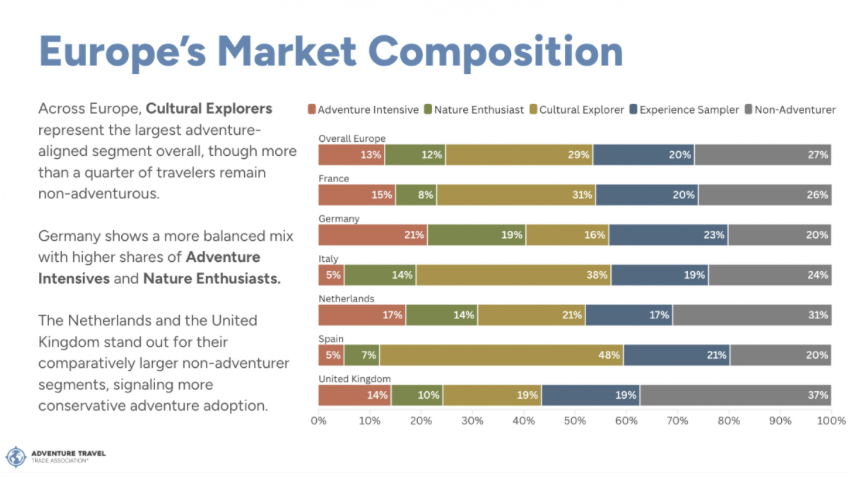
Adventure tourists from the Netherlands were more likely to make adventure the centre of their journey. Exploration and active experiences were their main motivations for travel, above cultural immersion. Relaxation is also a core feature for Dutch travellers. This means they prioritise activity at a slower pace: active days balanced with local experiences.
Figure 7: Adventure tourism market in Europe by travel preference
Source: ATTA Adventure Travel Market Sizing, 2026
Adventure tourism is closely linked to sustainability. This is because its appeal depends on pristine, unspoiled landscapes, thriving wildlife, authentic culture and empowered local communities. More and more adventure tour operators have, or are working towards, sustainability certification. The top sustainability issues are wildlife protection, community livelihoods and climate change. The latter is particularly important for the Dutch market.
For the Dutch market, the ideal adventure travel product is active but comfortable, authentic but safe, structured but flexible. Destinations that can combine hiking, wildlife, cycling, food, culture, community contact and strong sustainability messaging are well placed in the Dutch adventure tourism market.
Dutch tour operators active in the adventure tourism market include Sawadee, Djoser and Koning Aap. You should consult the Dutch tourism associations’ websites to see if you can find good adventure tour operators:
- VVKR tour operators for nature
- VVKR tour operators for safaris
- VVKR tour operators for walking
- VVKR tour operators for cycling
- VVKR tour operators for mountain biking
- ANVR for destinations covered
Sun and beach tourism
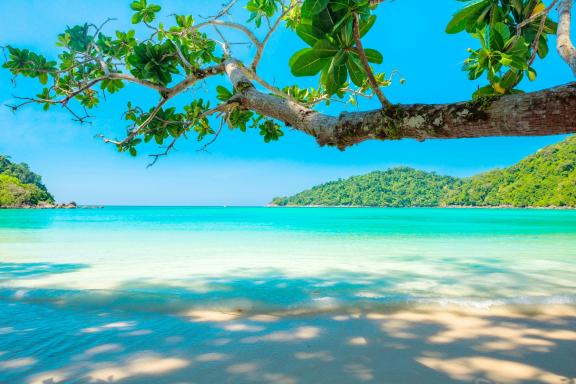
Sun and beach tourism is one of the strongest niches for long- and short-haul outbound travel. This is particularly important for LMICs. This is because many offer warm climates, long coastlines, islands, reefs, lower-cost accommodation, and strong combinations of beach, culture, nature and food. Sun and beach holidays are mainly about relaxation, swimming and beach activities, beautiful scenery and easy holiday logistics. They are often combined with nature, wellness, nautical, culture or adventure tourism.
For Dutch travellers, the main sun and beach market remains Europe, but LMICs are important for winter sun, package holidays, long-haul touring, diving, family beach breaks and beach-plus-culture itineraries. A holiday survey in 2024 found that 15% of Dutch holidaymakers planned to take a beach holiday. Outside Europe, Mexico, Thailand, the Dutch Caribbean, Türkiye, Morocco and Egypt were the top destinations. This shows that demand for sun and beach holidays extends beyond the Mediterranean to all destinations with strong resort infrastructure and warm climates.
Figure 8: LMICs like India have many beaches popular among Dutch travellers
Source: Dharmendra Sahu at Unsplash, 2018
Activities for sun and beach holidays include: swimming, sunbathing, snorkelling, diving, boat trips, kayaking, stand-up paddleboarding, surfing, kitesurfing, beach walks, beach clubs, local food experiences, markets, spa and wellness, excursions to nearby towns, cultural sites and nature areas.
However, Dutch sun and beach tourists also look for other authentic, immersive activities. This gives local tour operators opportunities to provide additional activities. These could be local community visits, agritourism, environmental activities, hiking, fishing and even kitesurfing.
The most attractive beach destinations in LMICs are those that offer more than a resort. Culture and nature, novelty and social interaction, sun and beach, sports, and entertainment are common motivations for sun and beach holidays. This is useful for product development. It shows that many visitors want broader coastal experiences, and not just passive relaxation.
Cultural tourism
Cultural tourism involves travel to experience and learn about the culture of a country or region. This includes features of a destination’s history and heritage, culture, lifestyle, art, architecture and religion. Basically, all things that have shaped the society’s way of life. It is another very large segment of global tourism. UN Tourism estimates that around 40% of all international tourists travel to experience culture in some way.
Dutch nationals are interested in culture. This is deeply embedded in Dutch leisure habits. The Dutch Culture Monitor reported that in 2024, 91% of Dutch people aged six and older had attended at least one cultural activity. It further reported that there were 143.5 million visits to cultural institutions by Dutch people and tourists.
It is clear that for Dutch travellers, long-haul destinations also appeal for history, food, local life, iconic sites and meaningful cultural experiences. This means Dutch travellers are likely to respond well to well-interpreted heritage, museums, architecture, food experiences and local stories. This provides good opportunities for local tour operators. Local tour operators should focus on a wide range of cultural experiences to attract this market. This includes:
- Historic city/town visits and walking tours;
- Museums, galleries and heritage sites;
- Food and drink experiences;
- Hands-on immersive experiences like crafting, music and dance;
- Festivals and living traditions.
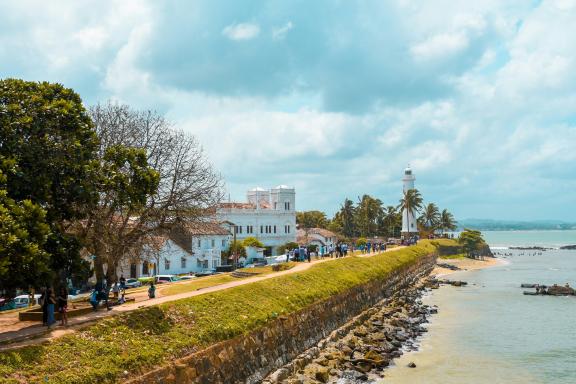
Genealogy, diaspora and shared history is an interesting focus for the Dutch market. There are ties with colonial Dutch heritage. Visits to archives, former trading posts, plantations, forts, sites of colonial architecture and other places that explain Dutch overseas history from local perspectives would be appealing. There are many countries that have links with Dutch heritage. For instance, Suriname is a former Dutch colony. The two countries still share deep cultural, economic and linguistic ties. Other countries include Sri Lanka, Ghana, Indonesia and Brazil.
Figure 9: Galle Fort in Sri Lanka, built by the Dutch in 1640
Source: Nilanka Kariyawasam at Unsplash
The Cultural Heritage Agency of the Netherlands is the Dutch government’s centre of expertise for heritage. It is involved in the International Heritage Cooperation Programme. This programme works with partner countries to preserve, research and make heritage connected to the Netherlands and other cultures more visible.
Local tour operators in relevant destinations should explore what support the Cultural Heritage Agency may offer to help them identify credible heritage sites, archives, stories and expert partners. There may be help to strengthen cultural tourism products.
Other countries, like Morocco, Türkiye and Cambodia, all have rich and varied cultural offers that appeal to long-haul Dutch cultural travellers.
Dutch tour operators in the cultural tourism segment include Djoser, Koning Aap and Van Verre. See the VVKR website for other cultural tour operators.
Nature tourism
Nature tourism is travel in which natural landscapes and the outdoor environment are the main reason for the trip. Sub-niches include:
- Wildlife watching;
- Birdwatching;
- Safaris:
- Rainforest trips;
- Trekking;
- Volcano and mountain trips;
- Conservation-based tourism;
- Stays in ecolodges.
Nature tourism overlaps with ecotourism and adventure tourism. It often includes activities relating to both. For instance, a traveller may take a birdwatching trip, a walking holiday, a safari or a multi-activity rainforest trip and still be part of the nature tourism market.
Cycling holidays can also fall into the nature tourism niche. Dutch travellers are keen on cycle tours. They can be road trips, touring holidays and mountain biking tours. Likewise, community-based tourism (CBT) often takes place in rural, natural locations. This means there is crossover with this niche segment too.
Nature-based tourism can help countries meet economic development goals while supporting biodiversity conservation. It is estimated that 8 billion unique visits are made each year to protected areas worldwide. However, weak protected-area management, pollution, poaching and fragmented landscapes can damage the natural assets that visitors seek.
For LMICs, nature tourism is important because many have high value natural assets. This includes: rainforests, reefs, savannahs, deserts, mountains, wetlands and unique wildlife. These assets can generate income for local communities and businesses. However, the model only works if tourism revenue supports conservation and local livelihoods, rather than causing overcrowding, habitat damage or displacing communities.
The Dutch are keen nature tourists. This is because they are experienced, active and comfortable with independent travel. However, they generally like to combine nature with soft adventure. At the same time, comfort, good guiding and clear sustainability credentials are important. Popular countries for Dutch nature tourists include:
- Costa Rica;
- South Africa;
- Tanzania;
- Kenya;
- Indonesia;
- Thailand;
- Vietnam;
- Sri Lanka;
- Morocco.
The nature market in the Netherlands is large. There are many Dutch tour operators that provide nature tourism holidays, such as SNP Natuurreizen, a major Dutch specialist operator. It offers walking, cycling, family, active round trips and nature-focused holidays. This includes individual and small-group formats. Its activity mix includes hiking, cycling, wildlife and birdwatching trips.
Take a look at the VVKR tour operator listing for nature and the ANVR listing of tour operators by destination.
Urban experiences
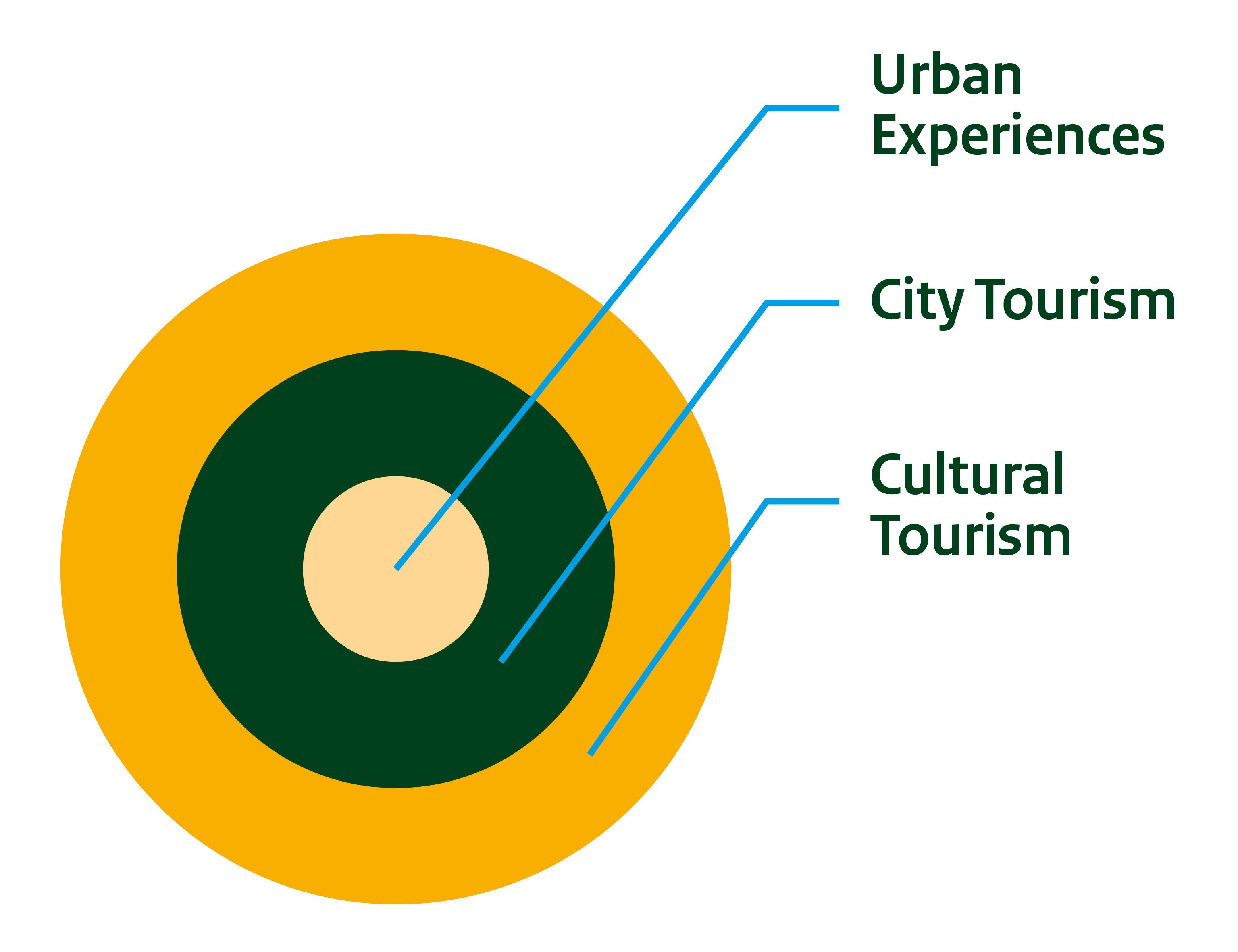
Urban experiences are guided or self-guided tours that take place in urban settings. They are usually in larger towns and cities. They are generally short, between a few hours and a full day. Urban experiences are distinct from similar tourism activities that take place in small villages and communities. These are usually referred to as rural tourism. Urban experiences are part of city tourism. This is part of the larger tourism segment, cultural tourism.
Figure 10: Urban experiences relative to city tourism and cultural tourism
Source: Acorn Tourism Consulting, 2024
The Dutch market is a good one to target with urban experiences. In NBTC’s January 2026 Holiday Sentiment Monitor, 10% of Dutch respondents with holiday plans described their next trip as a city break. Besides this, 60% of Dutch respondents considered flexible cancellation important. A further 66% wanted to stay in a quiet place. This is important for operators designing urban experiences away from crowded hotspots.
Booking.com’s travel trend report has also identified a high degree of Dutch interest in city trips. Its 2024 study described travellers from the Netherlands, Spain and Austria as some of the keenest on city breaks. In 2024, Danish and Dutch travellers prioritised city trips. The Dutch market is receptive to alternative urban destinations. It also noted a shift towards travel outside the high season.
Jakarta in Indonesia and Tirana in Albania are particularly interesting because they show demand beyond the standard Western European city-break circuit.
As part of cultural tourism, activities on an urban break are similar. Culture and history tours, food markets and street life, walking tours, local shopping and evening experiences are popular activities on the Dutch market.
Marrakech, Istanbul, Tirana and Tangiers work well for short breaks as they are convenient to reach from the Netherlands. Long-haul urban experiences in countries like Indonesia, Thailand, Vietnam, Mexico, Peru, South Africa and Tanzania are more likely to be part of a wider itinerary. Think of two nights in a capital, a guided food walk, a historic district tour or a creative neighbourhood visit before or after a beach, nature or round-trip programme.
VVKR has a list of tour operators present in the city trip market.
Round trips
Round trips, or 'rondreizen' in Dutch, are not a specific tourism niche. They are typically multi-stop holidays where travellers move through a country or region, instead of staying in one resort. For Dutch travellers, this usually means a 2–3 week itinerary. It will often combine nature, culture, cities, local food, wildlife, villages, beaches and light adventure. They can be sold as a small-group tour, private tailor-made tour, family tour, single traveller departure, fly-drive, cycling/walking tour or multi-country itinerary.
There is a strong operator market in the Netherlands that supports round trips like this. Dutch operator Djoser specifically markets round trips for groups. It promotes ‘combining individual freedom with organised transport and accommodation’. Sawadee markets its trips as group travel with individual freedom, for families, singles and 22–35s.
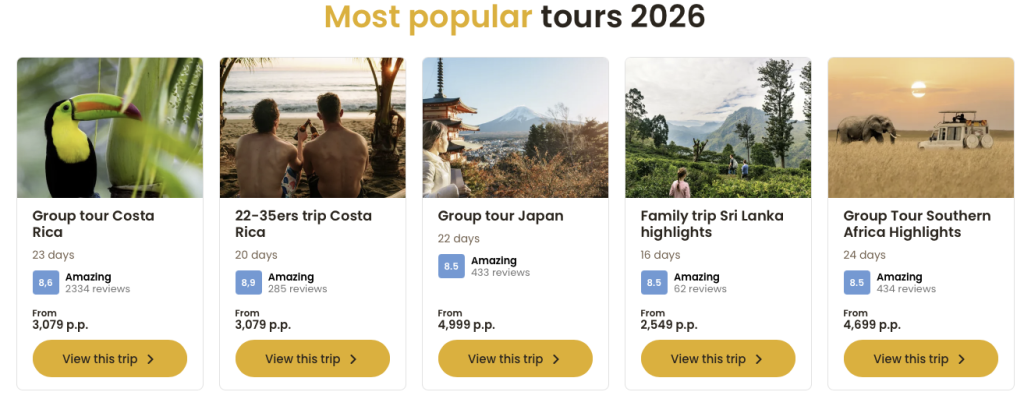
Figure 11: Dutch Operator Sawadee – Group tours
Source: Djoser, 2026
Round trips are one of the most popular travel types in the Netherlands. The Dutch Association for Travel (ANVR) reported in its 2025 summer travel outlook that 16% of Dutch summer holidaymakers chose round trips. They ranked third, behind beach holidays and city trips. This makes touring one of the main organised holiday formats rather than just a specialist segment.
Round trips to LMICs are good for the Dutch market. They help Dutch travellers make efficient use of expensive air travel. Once they fly to Asia, Africa or Latin America, they often want to see several regions in one trip. For example, temples, rice fields and coast in Vietnam; safari, wine regions and coast in South Africa; or rainforest, volcanoes and beaches in Costa Rica.
Dutch tour operators that offer round trips include Sawadee, 333travel and PANGEA Travel. Also look at tour operators active in the round trip market on the VVKR website.
Tips:
- Design trips that combine several experiences into one itinerary. Think about mixing soft adventure, nature and culture. If your product is sun and beach, combine this with food, local life and a village visit for an immersive experience.
- Offer active products at a relaxed pace. Dutch travellers like walking, cycling, wildlife, culture and discovery. However, many still want comfort, safety, free time and good organisation.
- Develop ‘beyond the highlights’ experiences. Add lesser-known neighbourhoods, quiet nature areas, community visits, local markets, craft activities or small-scale heritage sites to help travellers avoid crowded standard routes.
- Create flexible formats for different Dutch travel styles. Offer small-group trips, private tailor-made tours, family departures, single-traveller options, cycling or walking versions. If you can, create 2 or 3 week packages so you can attract the touring market.
- Find out more about each of these specialist tourism niches in the CBI studies. Download each of the market potential and market entry studies for adventure tourism, sun and beach tourism, nature tourism, cultural tourism and urban experiences.
4. Which trends offer opportunities or pose threats in the Dutch tourism market?
Dutch travellers want flexible, good-value trips. However, different age groups have different budgets and expectations. Sustainability, climate comfort and safety are becoming more important when Dutch travellers choose where and when to travel. This section gives practical advice for local operators on pricing, community benefits, weather planning and risk management.
Growing trend for flexible, good value experiences for Dutch travellers of all ages
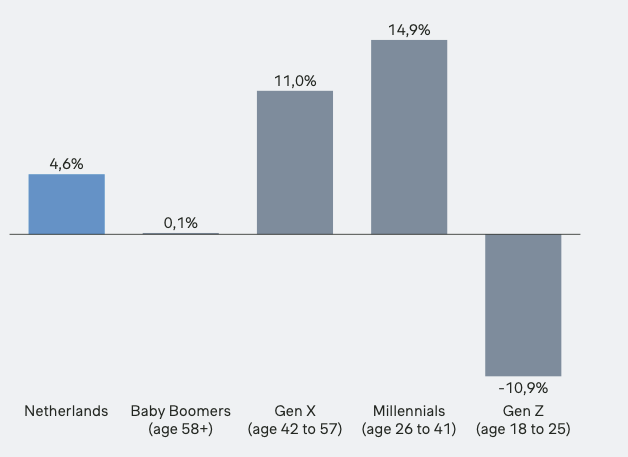
Dutch consumers of all ages are keen to travel. However, budgets differ. Broadly, leisure travel budgets were expected to rise by 4.6% in 2024, driven mainly by Gen X and Millennials. Gen Z still has less money to spend on travel. It is forecast to spend 10.9% less. Nevertheless, it is showing strong and growing interest in travel. This creates opportunities for local operators that offer mid-market and experience-led products. It is becoming more important to not focus on an ‘average Dutch traveller’ profile.
Figure 12: Dutch leisure travel budgets in 2024, compared with 2023
Source: Simon Kucher, Travel Trends Study 2024
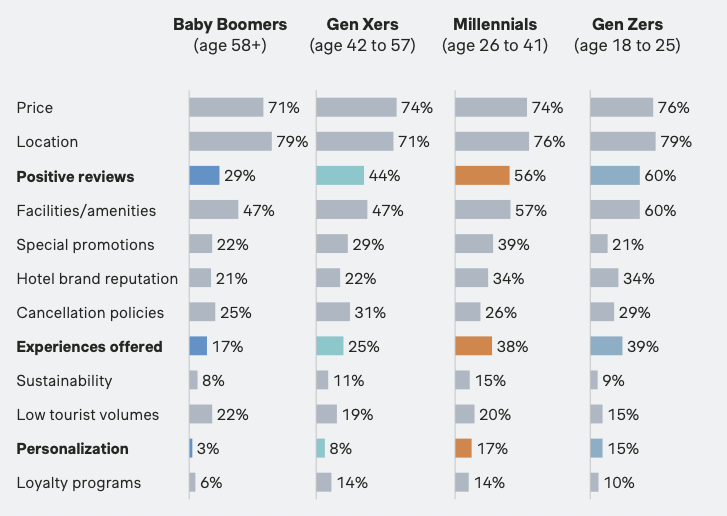
Price and destination are major reasons for booking trips across all generation groups. However, Dutch Gen Z and Millennials travel more often than older consumer groups, despite having lower budgets. They also place more value on experiences, reviews, personalisation, responsible travel and flexibility. Younger Dutch travellers are comfortable comparing prices, checking reviews, using digital tools and looking for trips that feel authentic and good value, as the chart below shows.
Figure 13: Main reasons for booking trips by generation in the Netherlands
Source: Simon Kucher, Travel Trends Study 2024
This links directly to the wider value-for-money trend in the Dutch market. Inflation and economic uncertainty still affect consumer confidence. Consequently, travellers are looking for clear prices, transparent inclusions and flexible booking conditions. All-inclusive, escorted, small-group and modular packages can appeal. They help travellers understand the total cost before they book. This is especially useful for long-haul LMICs. In these, travellers may worry about extra costs, safety, logistics and cancellation risks.
Do your research into the different consumer markets. Identify differences in the Dutch markets. The CBI studies are here to help you. There are studies focused on Baby Boomers, Gen X, Gen Y (Millennials) and Gen Z.
Sustainability interest is shifting from broad ‘green’ messaging to community benefit
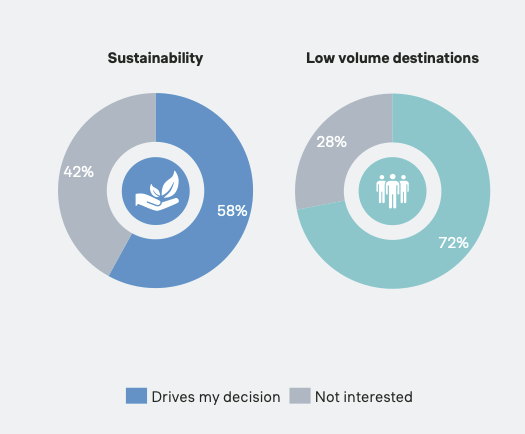
Sustainability is still important. However, the focus is becoming broader than emissions or eco-labels. Booking.com’s 2025 research found that 73% of travellers want their spending to benefit the local community. 69% want to leave places better than when they arrived. 77% seek authentic experiences that represent local culture. Additional research among the Dutch travel community found that, as well as sustainability, less crowded destinations were sought after by 72%. This is a clear indication that the Dutch market values adventure, nature and culture off the beaten track, and that sustainability is an important consideration.
Figure 14: Dutch travellers prefer sustainable and less crowded destinations
Source: Simon Kucher, Travel Trends Study 2024
Embedding sustainability is a strong opportunity for LMICs that can show measurable community benefits through community-based tourism and other relevant experiences. However, operators that make vague claims about sustainability will be unlikely to attract the Dutch market. Read the CBI studies How to be a sustainable tourism business, and 10 tips to go green in the tourism sector to help you on your sustainability journey.
There are lots of tour operators that value sustainability. They will want to work with local businesses that share their values. Study the VVKR list of tour operators specialised in ecotourism. Dutch tour operator Better Places explains how it works responsibly in this video.
For best practices, study this collaboration between Dutch tour operator Positive Impact Travel and Loremi Tours in Uganda. There is a video you can watch too.
Climate, heat and weather risks are changing destination and season choices
The climate is becoming more important in holiday planning for Dutch travellers. Unpredictable weather, heatwaves and geopolitical developments can change where and when they go on holiday. Dutch travellers are more likely to change their destinations (48%) and holiday periods (48%) because of extreme weather. European Travel Commission research found that 81% of Europeans say climate change affects how they travel. Some monitor weather forecasts more closely, seeking milder climates or avoiding extreme-heat destinations.
Local operators in LMICs that can promote cooler seasons, mountain areas, coastal breezes, forest landscapes, early-morning activities and shoulder-season itineraries should take advantage of this. Operators in other parts of the world should make climate comfort more visible. They should do this through itineraries, with clear seasonal advice, realistic activity timings, shaded transport, water access and contingency plans.
Look at what other tour operators do. For instance, Pick Morocco Tours offers a range of practical tips. These include ‘start early’, ‘stay energised’ with snacks and water, and ‘dress in layers’ as temperatures vary. Dung Basket Boat in Vietnam, meanwhile, provides detailed information on understanding the environment, what to wear and how preparation improves the experience. This gives extra confidence to the visitors that you understand their concerns.
Safety, geopolitics and travel advice are shaping confidence in destination choice
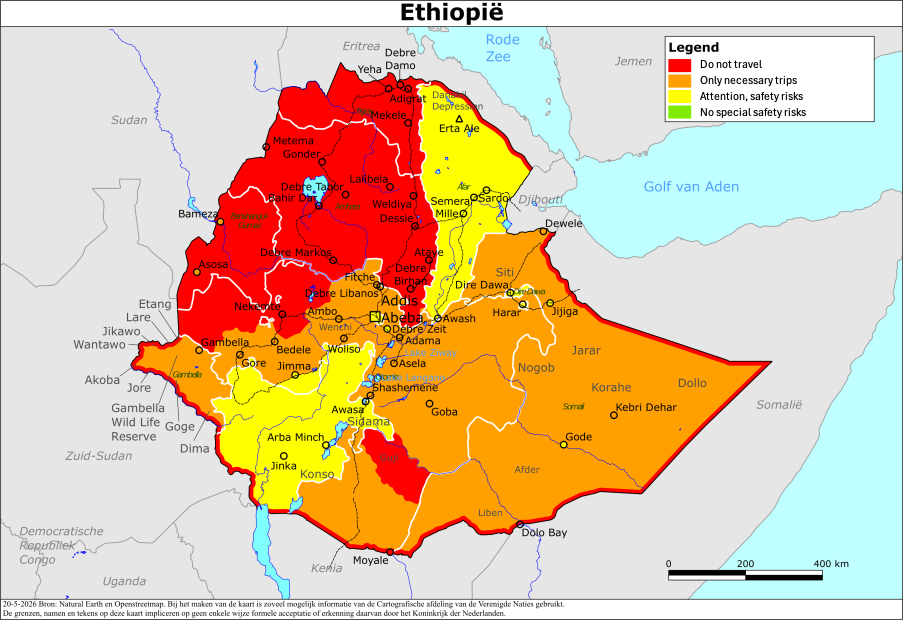
Dutch travellers are more and more exposed to travel-risk information. The Dutch Ministry of Foreign Affairs provides colour-coded travel advice for 226 countries and territories. Green and yellow mean travel is possible, orange means necessary travel only, and red means do not travel. It specifically advises people to only take holidays to countries or areas with green or yellow codes. See what the current travel advice is for your country using the link to the Dutch Ministry of Foreign Affairs above.
Figure 15: Colour-coded advice for Dutch travellers
Source: Dutch Ministry of Foreign Affairs, 2026
This creates opportunities for destinations and operators that can show safety, preparedness and reliable support. Clear pre-departure information, emergency contacts, flexible routing, insured suppliers, safe transport and Dutch/English communication can reassure travellers and Dutch trade partners.
However, destinations affected by conflict, unrest, crime, natural disasters or negative travel advice may lose demand quickly if they do not address the issue quickly, practically or honestly. You should monitor Dutch travel advice, explain regional differences clearly, and be ready to offer alternative routes or postponement options if conditions change.
You should ensure your business is prepared for many types of risk and crises that could affect tourism. Consult the CBI study Practical tips for managing risks in tourism. It explains how to take practical steps to prevent risks where possible, prepare for disruption and respond effectively if problems happen.
Tips:
- Create clear price tiers for different Dutch traveller budgets. Offer basic, mid-range and comfort versions of the same trip. Show exactly what is included, such as transport, meals, guides, entrance fees and cancellation terms.
- Show real community benefits, not general sustainability claims. Include names of local guides on your website. Profile community projects or conservation activities that benefit from the trip and explain how visitors’ money supports them.
- Tell guests about climate comfort and how you will keep them safe. Add practical information to each itinerary on the best season to visit, heat or rain risks, early-start activities, shaded transport, water stops, emergency contacts and alternative routes if conditions change.
Acorn Tourism Consulting Limited carried out this study on behalf of CBI.
Please review our market information disclaimer.
Disclaimer: The statistics quoted throughout this study are drawn from a range of sources. Due to variations in data collection and presentation methods, figures may not always be directly comparable.
Search
Enter search terms to find market research
Do you have questions about this research?
Dutch travellers choose destinations that offer authentic, high-quality experiences, with strong nature, outdoor activities, local connections, flexibility and a clear sense that the trip is genuinely responsible. Their decision is also shaped by safety, destination reputation, value for money and clear explanations of why slower travel or longer stays make the experience better.

Elise Gelderloos, Product Manager and Business Analyst at Better Places
Dutch travellers increasingly seek active, authentic experiences rather than luxury. They want to explore beyond the main tourist routes, stay in small-scale accommodation and travel at their own pace. Interest in holidays that create a positive social impact is also growing. For local tour operators, the biggest opportunity is to offer original experiences, communicate clearly and build trusted partnerships with Dutch buyers.

Kim Nooyens, Chair of the VVKR (Association of Small Scale Travel Organisations)