

Developing your tourism product for the Dutch market
There are good opportunities for tourism businesses in low- and middle-income countries that want to reach the Dutch outbound travel market. It is important to understand Dutch travellers, where they travel, what motivates them and which tourism products have the most potential. Local tour operators should be well prepared for the market. They should also have a good understanding of sustainability, pricing, online presence and product development.
Contents of this page
1. What requirements and certifications must tourism meet to be allowed on the Dutch market?
Businesses that sell tourism products to Dutch international tourists are subject to strict regulations. These rules ensure the safety of their travellers and protect them financially. Local tour operators in low- and middle-income countries (LMICs) need to be familiar with the Dutch travel market’s needs. Sustainability is an important requirement. Being professional and well organised will give you a competitive edge.
What are the mandatory requirements?
Dutch tour operators’ requirements for tourism products in LMICs cover the following:
- The European Package Travel Directive;
- General Data Protection Regulation (GDPR);
- Liability Insurance and Insolvency Protection.
As a first step, you should read the CBI study What requirements must tourism services comply with to be allowed on the European market? You should also familiarise yourself with all the legal, non-legal and common requirements.
What additional requirements and certifications do buyers often have?
The main requirements for dealing with Dutch businesses are: when doing business, the Dutch are professional and well-organised. They are committed to providing a high level of service to their customers. Sustainability is embedded into their business models. To do business with them, you need to understand these requirements and meet their needs.
Requirement for sustainability to be embedded in tourism businesses
Dutch nationals have a good understanding of the importance of everyday sustainability. Travellers like to be sustainable too. However, it is important that sustainability messages and actions are practical, honest and easy to understand. Dutch travellers want to know that their trips benefit local people, protect nature and culture, treat workers fairly, avoid poor animal welfare, and reduce waste, plastic and water use. 52% of Dutch travellers say travelling more sustainably is important. At the same time, 34% are tired of hearing about climate change.
However, there is evidence that Europeans are changing how they travel because of heat and unstable weather. 81% of Europeans say the changing climate affects how they travel. You should give clear, seasonal advice and have backup plans for extreme weather. This is not just environmental. It also provides safety and reassurance for Dutch tour operators and travellers.
Sustainability certification helps Dutch travellers verify what local providers say they do. The Travelife for Tour Operators scheme has a high profile in the Netherlands. It provides training, management tools and certification for travel companies. Other recognised schemes include Travelife for Accommodation, TourCert and Good Travel Seal.
The Dutch Association of Travel Agents and Tour Operators (ANVR) and the Association of British Travel Agents (ABTA) worked together to create a list of approved sustainability certification schemes for accommodation providers. It is updated monthly so you should check it regularly. The list was created in response to changes in the market and regulations. These caused uncertainty about the reliability of sustainability labels. EU rules that come into power in September 2026 EU rules state that anyone marketing to Europe must prove their sustainability claims.
‘Greenwashing’ (making false environmental claims) must be avoided at all costs. It will hurt your reputation and business if you are found out. Dutch rules also mean companies must be careful with their sustainability language. Claims like ‘eco’, ‘green’, ‘climate neutral’ and ‘responsible’ need clear evidence. The Netherlands Authority for Consumers and Markets (ACM) says sustainability claims should be clear, correct, specific and complete.
Tips:
- Consider getting certified as a sustainable tour operator. It is a long journey. However, it will be good for your business in the long term. Use the CBI study How to be a sustainable tourism business to help you take the right steps.
- Promote your sustainability actions clearly, and do not make claims that are not true. Find out more about greenwashing and what not to do. How To Spot and Avoid Greenwashing in Tourism is a good place to start.
- Learn from other local tour operators. The CBI study Best practice for successful sustainable tour operators has lots of tips.
Dutch tour operators look for reliable, transparent and quality-focused local partners
Dutch tour operators look for reliable local partners who can deliver good-quality products, communicate clearly and work transparently. They value partners who are open to improvement, understand customer care and can meet growing sustainability expectations in the Dutch and wider European market. For many operators, formal certification is useful but not always essential, especially for small suppliers, as long as responsible business practices are clearly shown.
So, when preparing to do business with a Dutch tour operator, think about the following:
- Trustworthy partnerships and good communication are essential for Dutch tour operators. Being a professional business is very helpful when dealing with the Dutch market.
- Dutch tour operators like transparent business practices backed up by transparent pricing. These aspects mean they can be open and honest with their own customers.
- Dutch tour operators look for partners who want to improve and are open to making changes. Acting on feedback is very important to help your business grow.
- Good product quality and excellent customer care are very important.
- Dutch nationals speak English to a high level. English-speaking guides, drivers or partners are usually sufficient for Dutch travellers. Dutch language provision is a plus but not normally essential.
You can find out more about doing business with the Dutch market using this guide: Doing Business in the Netherlands: Dutch Culture.
What are the requirements for niche markets?
A strong online presence, a well-designed, inspirational website and well-managed social media channels are important to reaching the Dutch outbound travel market. Ensuring that packages are developed to meet Dutch travellers’ needs is also necessary.
Have a website and use social media
A strong online presence is essential for the Dutch market. This is because Dutch travellers are highly digital and confident online. In 2025, the Netherlands had 18.1 million internet users (around 99% of the population) and 14.8 million social media user identities (around 81% of the population). Dutch travellers are regular users of websites, blogs, destination sites, online travel agencies (OTAs) and social media for inspiration. Many book and pay online.
For local operators, this means your website is not just a marketing tool. It is often the first place where Dutch travellers and tour operators look to see whether your business is professional, reliable and suitable.
Your website should be clear, practical and trustworthy. It should have engaging images, useful information and well-written content. You should keep it accurate and up to date. This means showing detailed information about itineraries and prices, accommodation, safety information and more. You should give good, clear reasons why travellers should choose you.
Figure 1: Be very clear for the Dutch market
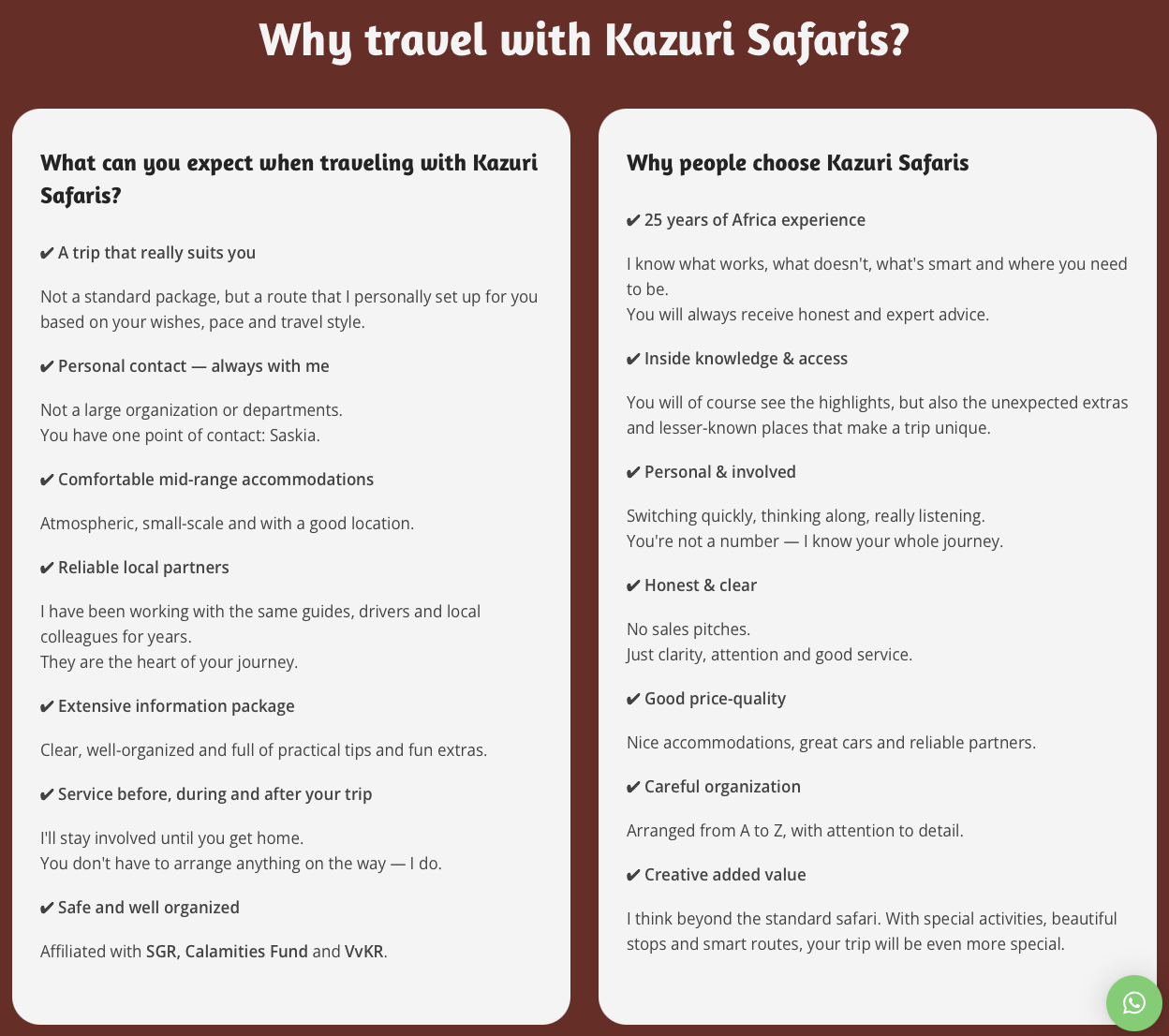
Source: Kazuri Safaris, 2026
Use simple English, strong photos and short videos. Show real experiences, not only beautiful landscapes. You need to make your website mobile friendly. Smartphones are becoming more important in Dutch online shopping. In 2025, 41% of all Dutch online purchases were made by smartphone, up 5% from 2024.
You should use social media to encourage people to visit your website. Facebook, Instagram, YouTube and TikTok are the most important platforms for travellers. LinkedIn is preferred for business contacts. Younger Dutch consumers typically use Instagram and TikTok for inspiration. Older travellers usually use Facebook. YouTube is useful for longer videos, such as guides and stories. Do not try to manage every platform at once. Choose one or two platforms. Manage them well before expanding.
Make sure that it is easy to make bookings and leave reviews. Dutch consumers are used to buying from foreign websites. Online purchases from other countries reached 44.8 million in 2025. This is up 9% compared to 2024. It shows that Dutch buyers are comfortable purchasing internationally if the offer feels reliable. Make sure guests can leave customer reviews through Google and Tripadvisor.
Dutch travellers are using AI (artificial intelligence) more and more often to plan their trips. They often use ChatGPT, Google Gemini and specific travel platforms, like Layla and Mindtrip. Overall, 52% used AI as a research source during the year 2025. In the under 35 age group, this figure rises to 75%.
Tips:
- Make your website the centre of your online presence. Keep it updated, mobile friendly and easy to navigate. Have clear product pages for each trip you offer.
- Use reviews to build trust. Ask satisfied guests to review you on Google, Tripadvisor and OTAs. Use short quotes on your website and social media.
- Use social media with purpose. Post real stories, guide introductions, short videos, guest photos, images of food and wildlife. Link every platform back to your website.
- Make it easy for Dutch tour operators to assess who you are and what you do. Add a trade section with company profile, product sheets, rates, insurance, sustainability actions, contact person and response times.
- Use the CBI study How to be a successful tourism company online to help you build or improve your website. Use social media effectively.
Create suitable packages for the Dutch market
When preparing products for the Dutch market, you should think about their behaviour and motivations. Dutch travellers are experienced, well informed and careful about their choices. They compare prices, check reviews, research early and expect good organisation. They also want freedom to explore independently.
Dutch travellers often want several experiences in one trip. For instance, they may want to combine adventure with nature or culture with sun and beach. As such, you should think about creating multi-activity itineraries rather than single-theme trips. For example:
- For adventure and nature trips, combine several activities like walking, cycling, wildlife, birdwatching, food, and local culture. Keep the pace comfortable and safe for soft adventure.
- For sun and beach, add short local experiences. For example, add visits to food markets, artisanal producers (e.g. fishing communities), reef conservation activities or boat trips. This means the holiday offers more than resort relaxation.
- For culture and city breaks, use strong storytelling, guided walks, food experiences, heritage sites, creative neighbourhoods and local encounters that feel real.
The Dutch market is keen on round trips. They help travellers make the most of long-haul flights. Local operators that provide longer trips should consider offering a 1–2 week itinerary. It should combine cities, nature, wildlife, beaches, local food, villages, heritage and soft adventure. Alternatively, 2–3 day multi-activity trips may appeal to Dutch travellers looking to add to their own self-guided trip.
2. Through which channels can you get tourism products on the Dutch market?
The Dutch market typically either buys trips directly from local tour operators or indirectly via specialist European tour operators and OTAs. The Dutch travel trade is large and mature. It is supported by travel trade associations. They provide a lot of information to support local tour operators looking to make business connections.
How is the end market segmented?
The Dutch are enthusiastic travellers. They made 20.1 million outbound tourism trips in 2024. The average trip was 9.4 days long, and 55.5% of all trips were to destinations beyond the Netherlands. Türkiye, Morocco, Thailand, Egypt, South Africa and Mexico are the most popular destinations for Dutch outbound tourists.
Dutch travellers are price conscious and well organised. They often research trips online well in advance. They use reviews, recommendations and past experience to guide their choices. They are motivated by relaxation, nature, culture and discovery, with good opportunities for trips that combine landscapes, wildlife, local culture, walking, birdwatching and soft adventure.
For more information about the Dutch travel market, download the accompanying CBI study The Dutch market potential for tourism.
Through which channels does a product end up on the end market?
Supplying tourism products to the Dutch market is a mix of direct and indirect sales.
- Direct sales: sales made directly by local tourism businesses (accommodation providers, tour operators, local guides, etc.) to Dutch travellers and Dutch tour operators.
- Indirect sales: sales made indirectly to Dutch travellers via tour operators or OTAs (online tour operators).
The chart below gives a broad indication of the routes of tourism products to market.
Figure 2: Sales channels to reach the Dutch market
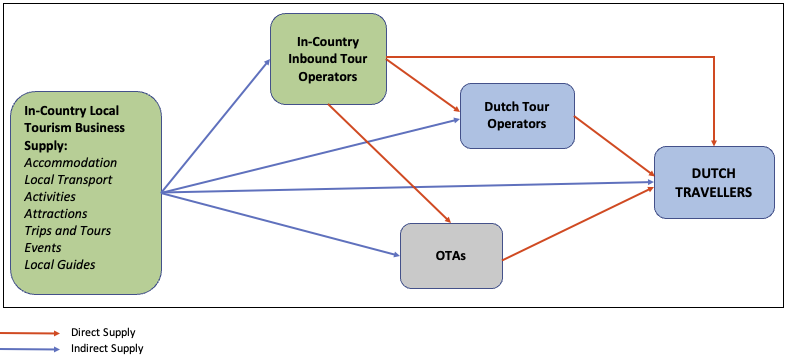
Source: Acorn Tourism Consulting, 2026
Dutch tour operators
The Dutch travel trade market is large, mature and growing. There were more than 4,800 travel agencies and tour operators in 2026. ANVR reported that 2024 bookings were almost 4% higher than in 2023.
The market is also changing fast. Dutch travellers compare prices and book many simple trips online. Meanwhile, online platforms and digital booking are growing across Europe. However, Dutch travellers still use tour operators and travel agents for package holidays, long-haul trips, tailor-made travel and trips where they want security, advice and clear support.
Many tour operators travel to LMICs. Generally, they are members of trade associations, either the ANVR (Dutch Association of Travel Agents, Tour Operators and Entrepreneurs in Travel) or VVKR (Vereniging van Kleinschalige Reisorganisaties). ANVR is the larger association (around 2,000 members). VVKR has a smaller membership base (539 members). The profiles below give an idea of operators on the Dutch market. Note how sustainability is an important feature on each of the operators’ websites.
Table 1: Examples of Dutch tour operators
| Tour Operator | Profile |
|---|---|
| Positive Impact Tourism | Positive Impact Tourism is a Dutch organisation. It focuses on regenerative tourism, where trips should benefit travellers, local communities and nature. It works in several LMICs, including Bolivia, Colombia, Cuba, Ecuador, Guatemala and Indonesia.
The company works with local partners to create and promote ‘Positive Impact Experiences’. It requires partners to follow its mission, partnership documents and code of conduct. Its Travelife Partner status shows that sustainability and responsible supplier relationships are important to its model.
Find out how to become a partner. |
| Better Places | Better Places is a Dutch online tour operator. It sells tailor-made, responsible trips, including many long-haul holidays to LMICs in Africa, Asia and Latin America. It connects Dutch travellers directly with local travel experts who live in or know the destination well. This means trips are designed with local knowledge.
Better Places selects local partners based on quality, sustainability and respect for nature and local people. It encourages them to use local hotels, guides and services so more money stays in the destination. The company is Travelife certified. It trains its local experts to work towards Travelife standards.
Watch this video, which explains how they work with local suppliers. |
| Marlucía Travel | Marlucía Travel is a Dutch Moroccan specialist tour operator focused on tailor-made holidays and round trips to Morocco. It offers personalised trips for travellers who want more than standard tourist sights. It provides culture, nature, cities, history, beach and active experiences.
The company is run by a Dutch Moroccan team and uses strong local knowledge. It presents itself as socially involved and supportive of local development. Its model is based on close destination knowledge and local delivery rather than mass-market package tourism. |
| Kazuri Safaris | Kazuri Safaris specialises in tailor-made safaris and round trips to destinations such as Kenya, Tanzania, Uganda, Rwanda, Malawi and Zambia. It focuses on personal, well-planned trips with safari, nature, culture and some beach extensions.
The company is led by Saskia, who has a lot of experience with Africa and local contacts, guides and drivers who deliver trips on the ground. This makes Kazuri Safaris a good example for local operators that can offer reliable guiding, transport, accommodation, permits and destination knowledge for Dutch travellers. |
| Sawadee | Sawadee is a well-established Dutch tour operator specialised in adventurous small-group round trips, family trips, single-traveller trips and youth trips. Its trips focus on nature, culture, activity and local experience.
Sawadee is one of the largest experiential operators in the Netherlands. It offers more than 250 trips across around 100 countries. Local, English-speaking guides get intensive training to help them understand the Dutch market and its needs. |
| Shoestring | Shoestring focuses on adventurous and affordable holidays, especially for solo and single travellers. It offers group tours to many destinations in Africa, Asia and Latin America.
It is a strong fit for culture, nature, adventure and social travel. Local partners are crucial to its business for transport, guiding and trip operations. They also advise on places to visit and accommodation choices. Local operators that can manage reliable group logistics at accessible prices are a good fit for this tour operator. The operator is Travelife Certified. |
| Riksja Travel | Riksja Travel sells individual round trips to a wide range of countries through Africa, Asia and Latin America. It uses flexible ‘building blocks’ to create trips, such as local encounters and small-scale accommodation. This means travellers can build personalised trips.
It works with local partners in each destination. This includes guides and drivers who can deliver trips and support travellers on the ground. Its B-Corp certification and positive impact positioning make it relevant for local operators that can offer responsible, small-scale and experience-led products. |
Figure 3: Building a trip with Riksja Travel
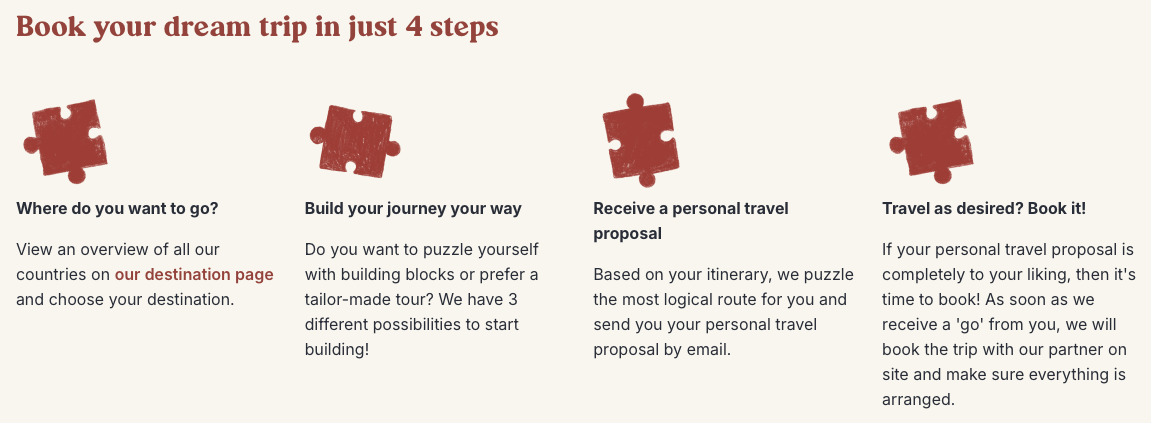
Source: Riksja Travel, 2026
You can find listings of Dutch tour operators on the ANVR and VVKR websites. An analysis of the most popular LMICs among their members is provided in the table below. Explore the listings and identify the ones worth approaching. Shortlist potential partners and personalise your approach according to your country and specialism. For example, this is a list of Dutch operators covering Indonesia that offer nature, diving, luxury, cycling, bird watching and so on.
Table 2: Priority destinations among ANVR and VVKR members
| Top LMIC destinations among ANVR members | Top LMIC destinations among VVKR members |
|---|---|
|
|
Source: ANVR, VVKR, 2026
Attending trade fairs is a good way of finding buyers on the Dutch market. Vakantiebeurs is a major tourism and leisure fair held in Utrecht (the Netherlands) every year in January. It is part of Dutch Travel Week. It is both B2B (business to business) and B2C (business to consumer).
OTAs
OTAs have a strong presence on the Dutch market. Dutch travellers are very comfortable using OTAs to book travel online, especially for flights and accommodation. Booking.com is especially influential because it is Dutch-founded and widely used. Airbnb, Expedia and Tripadvisor also play a role in short-term rentals and hotel accommodation. Dutch travellers often book directly with airlines if they know what they want. However, they still use OTAs and comparison tools, like Skyscanner, to check prices, routes and combinations.
Booking behaviour is more mixed for experiences, trips and activities. Many Dutch independent travellers still book simple activities while travelling, using local guide platforms. These include With Locals (a Dutch business with global reach), Google Things to Do, Tripadvisor, GetYourGuide, Viator and destination websites.
Which is the most interesting channel for you?
All sales channels are suitable to explore for opportunities, depending upon your business and what you offer. Dutch tour operators all have different criteria they use to define their work with suppliers. You should research doing business with them. Start with the CBI study 10 tips for organising your tourism services export to Europe. To understand OTAs and how to work with them, the CBI study Working with OTAs has lots of helpful advice.
For either channel, make your product ready for sale. For your website and OTA listings, create clear English product pages, show fixed prices and inclusions, add inspiring images and customer reviews. For Dutch tour operators, prepare a trade-ready fact sheet with net rates, commission policy, group sizes, guide standards, sustainability actions, insurance, emergency procedures and example itineraries that can be adapted for Dutch clients.
3. What competition do you face on the Dutch tourism market?
Which countries are you competing with?
Dutch outbound travellers visit a wide range of destinations beyond Europe. The most popular destinations are profiled below. They are Türkiye, Morocco, Indonesia, Thailand, South Africa and Suriname. The latter is especially notable for its strong historical ties. Egypt is also popular among Dutch travellers.
Türkiye
The Dutch market is important for Türkiye. In particular, sun and beach holidays, family travel, all-inclusive resorts, city breaks and visiting family and friends (VFR) travel are linked to the Turkish-Dutch community. In 2025, Dutch arrivals to Türkiye were reported at almost 1.3 million. This is a fall of 2% compared to 2024. However, the Netherlands is still one of the leading European source markets after Germany, the UK and Poland.
For Dutch travellers, Türkiye offers a strong combination of short flight times, direct air access, warm weather, beaches, culture, food, shopping and good value compared with many Western European destinations. They can enjoy a variety of activities and experiences in Türkiye and often combine experiences. For example, they can combine Antalya and the coast with cultural excursions, explore Istanbul or combine Cappadocia with nature and food experiences.
Figure 4: Türkiye is a leading destination for Dutch travellers
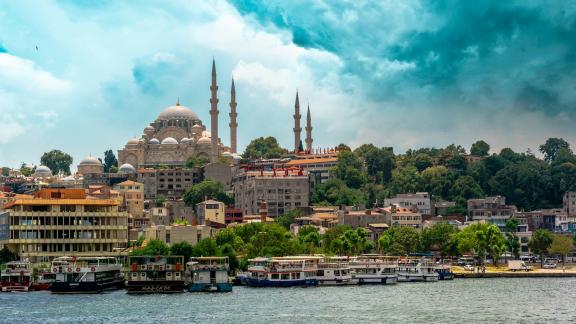
Source: Ibrahim Uzun at Unsplash, 2021
Türkiye also has strong sustainability and quality assets. These include 577 Blue Flag beaches and 19 UNESCO World Heritage Sites. There is also a large formal accommodation base. This can reassure Dutch tour operators and travellers looking for reliable, good-value and well-organised trips.
Morocco
Morocco is one of the world’s leading tourism destinations. It attracted a record 19.8 million international tourist arrivals in 2025. Exact figures are unavailable, but the share of arrivals from the Netherlands is estimated to be around 2–4%. This means that between 396,000 and 792,000 visitors to the North African country were Dutch. It is likely that the Dutch-Moroccan diaspora accounts for a large proportion of visitors.
Morocco is targeting tourism growth. It is looking to attract 26 million tourists by 2030 when the country will co-host the FIFA World Cup with Spain and Portugal. In the first quarter of 2026, international arrivals to Morocco grew by 7%, significantly higher than the global average of 2%.
Morocco offers convenient, short-haul access to Dutch travellers. It also provides warm weather, a rich culture, beaches, desert landscapes and good value. Typical tourism products include experiences that can be combined. These include city trips to Marrakech and Fes, trekking in the Atlas Mountains, trips to the Sahara, beach and coastal activities, wellness and culture. Community-based tourism experiences are also popular in Morocco, such as homestays with Bedouin communities. This particularly appeals to Dutch travellers seeking authentic and immersive experiences.
Indonesia
Indonesia is a top destination for Dutch outbound travellers. This is because of historic ties, a strong awareness of the country, and high demand for Bali and island-hopping trips. There were 314,211 visitors from the Netherlands to Indonesia in 2024. This was up from 250,201 in 2023 and above the 2019 level of 215,287. Bali is the main entry point to Indonesia. However, Dutch travellers are also likely to combine Bali with Java, Lombok, Komodo, Sumatra, Sulawesi and Kalimantan.
Indonesia will remain popular in the Dutch market going forward, especially with trips that offer clear sustainability standards, good guides, transparent pricing and authentic local experiences. WTTC estimated that international visitor spending in Indonesia reached IDR 322.4 trillion ($19.5 billion (USD)) in 2024. It is forecast to rise to IDR 589.6 trillion ($35.7 billion) in 2036. This clearly shows the growing value of inbound tourism to the national economy.
Thailand
Thailand is another major tourism destination. The Netherlands is an important source market from Europe. There were 261,467 Dutch visitors to Thailand in 2024. This is an increase of 13.9% over 2023. Tourism is an important export for Thailand. The sector generated more than THB 1.8 trillion (US$54.7 billion). During 2024, Thailand expanded flight routes and hosted high profile events and festivals to attract 26% more visitors.
For the Dutch market, Thailand’s strongest advantage is that it feels easy but still adventurous. It offers familiar tourism infrastructure, English-speaking services, domestic flights, rail links, wellness products and a wide range of accommodation. It also has temples, street food, night markets, national parks, islands, diving, soft adventure and rural experiences. This makes it suitable for Dutch travellers who want independence and flexibility, but still expect reliability, safety, clear prices and good logistics.
New initiatives for 2025 under the ‘Amazing Thailand Grand Tourism and Sports Year 2025’ focus on generating more growth. There are several initiatives, including ones that showcase unique Thai cultural experiences, enhance travel convenience and promote Thailand’s appeal through collaboration with global influencers. This high-profile marketing of experiences that appeal to the Dutch market is likely to continue to attract a solid visitor base.
South Africa
South Africa is a long-haul destination that offers a wide variety of experiences in one trip. It offers world-class safaris, a long coastline, renowned wineries, cities, mountains, and self-drive touring. Europe is a leading source market region for international tourist arrivals. There were 132,422 arrivals from the Netherlands in 2024, up slightly from 131,371 in 2023. Although a smaller market than the UK or Germany, Dutch travellers accounted for 11% of European travellers. The Netherlands is the 4th-largest market overall.
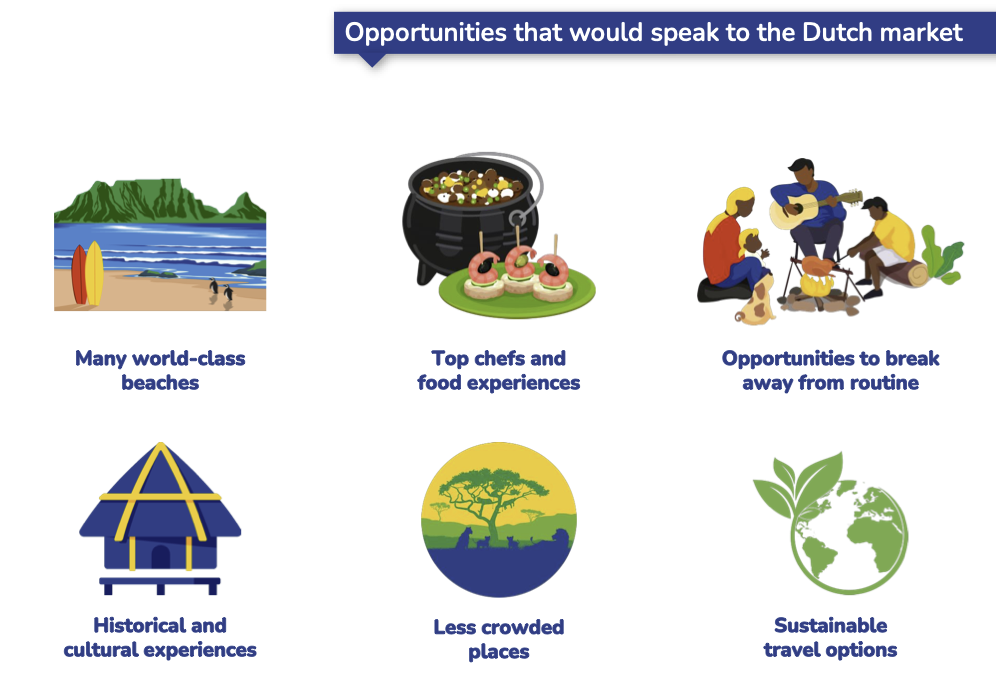
South Africa recognises the importance of the Dutch market. It has developed a detailed profile of the Dutch market to help tourism businesses attract it. Destinations that are less crowded, sustainable travel options, wellness retreats and authentic experiences are all important factors that Dutch travellers seek. They also look for good value for money.
Figure 5: Tips for local operators to attract the Dutch market
Source: South African Tourism, 2023
Suriname
Suriname is a remote South American country that is ‘off the beaten track’. It has relatively few international visitors, but the Netherlands is the country’s largest source market for inbound tourists. Around 100,000–150,000 Dutch people travel there every year. They largely do so to visit friends and family as a result of heritage ties. The sector has been recovering in recent years.
The World Travel and Tourism Council (WTTC) estimated that Suriname generated SRD 1,416.6 million in visitor exports in 2023 ($38.4 million (USD)). It expects international tourist arrivals will reach 273,000 by 2034, generating SRD 3,054.5 million ($82.7 million) in expenditure. Suriname’s tourism strengths are in its rainforest, river, cultural heritage and VFR travel. Typical tourism products combine Paramaribo, plantation history, indigenous culture and inland nature experiences.
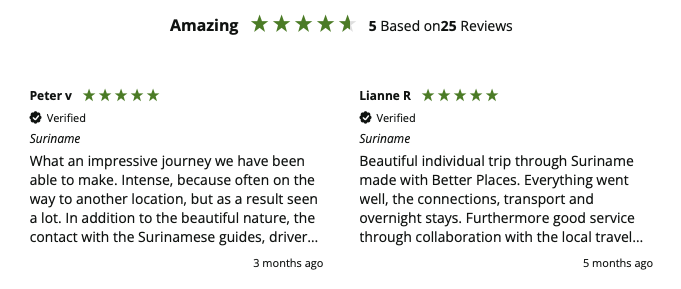
The Dutch-speaking environment and strong diaspora links give it a clear advantage in the Dutch outbound market. Dutch tour operators report that it is becoming more popular among their customers. Better Places offers trips to Suriname. It is clear from visitor testimonials that it has a lot to offer. Having testimonials on your website is a great way to inspire confidence and interest.
Figure 6: 5 Star Reviews for Suriname
Source: Better Places, 2026
Tip:
- Research tourism products on the market from competing nations to see what you can adapt for your business. Carefully assess packages and trips to identify what is included and what is not. This helps you see what travellers to these countries like to do.
Which companies are you competing with?
There are many local tour operators that target Dutch travellers as well as other European markets. This is largely done by offering Dutch language versions of their websites and guides who can speak Dutch. Although Dutch people speak English to a very high standard, they like the option of a Dutch-speaking guide. It is an indication that they are valued as clients and their needs are understood.
Lya Travel (Türkiye)
Lya Travel has a clear and simple Dutch market offer. It provides excursions in Istanbul and Türkiye that are accompanied by an experienced Dutch-speaking guide. Tours are well presented as a way to go deeper into Turkish history and culture, not just look at monuments from the outside. This is a good fit for Dutch travellers who like culture, explanation and personal contact when travelling.
The website is well designed. It clearly describes the tours and what visitors will enjoy: Dutch-speaking guidance, cultural depth and recognisable Istanbul highlights, such as the Blue Mosque, Hagia Sophia, Basilica Cistern and Grand Bazaar. It also uses storytelling. This helps turn standard sightseeing into a more emotional experience. The operator could display stronger B2B (business to business) credentials, trade partnerships, sustainability actions or detailed proof of market reach.
MAB Deserttours (Morocco)
MAB Deserttours is a good example of a local tour operator that appeals to a broad European market. It has English, French and Dutch language options on its website. It focuses on Sahara desert tours from Marrakech, Ouarzazate and Agadir, as well as southern Morocco tours, transfers and day activities. This is a good fit for the Dutch market because Morocco is often sold as a short- to medium-haul destination for culture, desert, nature and soft adventure.
The Dutch market message is very visible. Dutch tour guides are offered as a USP. There is a featured testimonial that claims it was ‘the only one with Dutch-speaking guides’. It also adapts its products well to European expectations. For example, meals tailored to European tastes, free cancellation, family suitability and luxury package options. However, the website could show a clearer company background, Moroccan licence details, guide profiles, sustainability actions, local ownership information and more detailed recent reviews.
Authentic Indonesia (Indonesia)
Authentic Indonesia is a Bali-based travel agency. It clearly understands the Dutch market. Its website has a dedicated page for Dutch tourists. It says it creates personalised holidays for travellers from the Netherlands. This is a useful position. Dutch travellers often want freedom, local insight, nature, culture and comfort without feeling pushed into a fixed mass-market package. This makes Authentic Indonesia’s offer relevant for Dutch travellers looking for tailor-made trips across Bali and wider Indonesia, rather than standard beach holidays.
The operator has a section on its website dedicated to its sustainable policy. It details its commitments to being responsible while providing authentic trips to customers. The operator also offers community-based tourism. These activities are attractive to the Dutch market.
Co van Kessel Bangkok Tours (Thailand)
Co van Kessel Bangkok Tours is a Bangkok-based bicycle and boat tour operator that really appeals to the Dutch market. It presents its website in both English and Dutch. Its core product is bicycle tours through local neighbourhoods. It fits naturally with Dutch travel culture.
The company positions itself around seeing the ‘real Bangkok’ through Chinatown, markets, backstreets, Thonburi communities and boat routes, rather than only visiting the most obvious tourist sights. It also offers cycle trips in Chiang Mai. It gives clear tour details in Dutch, including price, departure time, duration and distance. This helps Dutch travellers compare and book confidently.
AWOL Tours (South Africa)
AWOL Tours is a Cape Town-based operator. It specialises in cycling and hiking tours, including Table Mountain hikes, city cycle tours, Cape Point, the Winelands and township bicycle tours. Cycling is popular among the Dutch, and Cape Town offers strong nature, culture and community experiences. The company also offers Dutch-speaking guides for some tours. Its products are practical and easy to understand. They have clear information on duration, prices, meeting points and what is included.
Jenny Tours (Suriname)
With such a strong inbound market, Jenny Tours is aimed firmly at the Dutch market. The website is in Dutch. However, there are other languages too, including English, French, German, Greek, Italian and Portuguese. Its office is in the centre of Paramaribo. It offers 24-hour WhatsApp support. This makes communication easy for Dutch travellers.
The company offers a wide range of Surinamese experiences. This includes Paramaribo, plantations, river trips, jungle lodges, wildlife, Indigenous and Maroon culture experiences, and multi-day tours. This fits Dutch travellers well. Suriname combines language familiarity, historical links, and strong nature and culture products.
Tips:
- Browse these websites. Assess what they do well and what they could do better. See how they compare with your website. Where relevant, consider changing yours where you see potential improvements.
- Research sustainable tourism products in the Netherlands to assess what is common on the Dutch market and that you might be able to adapt for your business.
Which products are you competing with?
Dutch travellers like to do a wide variety of activities while on long-haul trips. As a result, you can consider many niche markets as competition. Adventure tourism, sun and beach, culture and nature tourism are all highly favoured by the Dutch market. So, you need to make your product stand out by offering good value, flexible and interesting experiences.
The best way to understand the competition is to build your knowledge of market niches and target segments. Market information published by CBI is a good source to explore markets and target groups. Look at this infographic to help you decide which European tourism market segments and niches you should target.
4. What are the prices of tourism products on the Dutch market?
There are few standard prices for tourism products aimed at Dutch travellers. However, they are known to look for good value tourism products, particularly when travelling to long-haul destinations. You should work hard to make sure your products are priced appropriately for this market. If they are more expensive than others’, make sure you add value and clearly state what you offer. Look at the table below for a guide to market prices in 2026.
Table 3: Prices of tourism products targeted at Dutch travellers
Source: Acorn Tourism Consulting, 2026
Consider the following as you set your prices:
- Know your true costs before setting a price. List all fixed and variable costs. This includes guides, transport, meals, entrance fees, permits, commissions, taxes and admin time. Next, add a realistic profit margin.
- Price for value, not only for cost. Clearly show what is included, such as local guiding, small groups, flexibility, sustainability benefits and authentic experiences. This means Dutch travellers can understand why the trip is worth the price.
- Build in margins for sales partners. Create a direct price and a net trade price that leaves room for agent, OTA or tour operator commission without reducing your profit.
Tip:
- Research online pricing guides to help you, such as How to price tours and attractions competitively, and Visit Scotland’s Pricing Strategies.
Acorn Tourism Consulting Limited carried out this study on behalf of CBI.
Please review our market information disclaimer.
Disclaimer: The statistics quoted in this study are drawn from a range of sources. Due to variations in data collection and presentation methods, figures may not always be directly comparable.
Search
Enter search terms to find market research
Do you have questions about this research?
Dutch travellers are experienced, well informed and independent. They still book through tour operators for security, comfort and access to well organised trips, but they want free time, authentic experiences, nature, culture and opportunities to discover something new.

Jorieke Graven, Impact Coordinator at Sawadee
Pricing is very important, especially today when inflation is growing. But be always clear about prices, terms of communication, and product quality to avoid misunderstandings. When someone pays, they must know exactly what they are paying for and what they will get, so customer care is very, very important!
Jasna Šestak, Tour Guide at With Locals