

The European market potential for cultural tourism
Cultural tourism is one of the largest tourism segments. It is thought that 40% of international tourists travel to experience culture. Europe is the largest market for cultural tourism. Traditional sightseeing is moving towards more authentic and immersive cultural experiences, driving market growth. Long-term sustainability is a very important part of cultural tourism. Overtourism and climate change have a particularly large effect on cultural tourism.
Contents of this page
1. Product description: cultural tourism
Cultural tourism is travelling to experience and learn about the culture of a country or region. It involves the many features of a destination’s history and heritage, culture, lifestyle, art, architecture and religion that have shaped that society’s way of life. Cultural tourism is wide-ranging and generally either tangible (built or physical, like churches, museums and monuments) or intangible, which means the non-physical aspects of culture, like festivals, cultural events and music. Table 1 gives more information about tangible and intangible cultural tourism products.
Table 1: Definition of tangible and intangible cultural tourism products
| Tangible cultural tourism products | Intangible cultural tourism products |
|---|---|
|
|
Source: Acorn Tourism Consulting, 2025
Tangible cultural tourism is the largest and best-established segment in terms of the number of physical sites, visitor numbers and economic impact. However, intangible cultural tourism is becoming increasingly popular as today’s tourists want more immersive experiences that connect them to local places and people. Intangible cultural tourism can also benefit local communities directly if it is managed sustainably and responsibly.
Examples of cultural tourism experiences
The market for cultural tourism experiences is very crowded. Many European tour operators take guests on cultural holidays. These are a mix of tangible and intangible experiences that involve many of the sub-niches mentioned in Table 1. However, because the sector is so large, the chance of creating unique cultural tourism products is high. Look at the examples in Table 2 for inspiration as you develop cultural tourism tours.
Table 2: Examples of cultural tourism experiences on the European market
| Trip | Description |
|---|---|
| Classic Ethiopia Historical Tour, Ethiopia | A 12-day tour. It includes a visit to Lalibela’s rock-hewn churches, a UNESCO World Heritage Site and the 17th-century castles at Gondar. Other cultural activities include a city tour of Addis Ababa and visits to local markets and villages. |
| Essential Jordan – Nabatean, Roman, Christian and Islamic sites, Jordan | This is a 9-day tour that mixes culture and religion, visiting some of Jordan's most famous sites. The itinerary includes the remains of the Temple of Hercules and the UNESCO World Heritage Sites at Qasr Amra and Petra. Crusader castles and religious sites at Mount Nebo are also included. |
| Chimu Floating Islands, Peru | This 5-hour trip to the Chimu Floating Islands is promoted as a cultural immersion experience led by the residents. It involves storytelling, meeting local people, understanding the environment, tasting local food and discovering local handicrafts. |
| Culture and Coffee, Colombia | A 15-day trip to discover Colombia’s diversity, including a city tour of Bogotá, a trip to the coffee region for a coffee tour and a tour of how Medellín has been transformed from a city of conflict to a cultural hotspot. |
Cultural Tour in India with the Six Most Famous World Heritage Sites, India | A 14-day cultural tour to visit the well-known highlights of India, including the Taj Mahal, Jantar Mantar, Fatehpur Sikri, Red Fort in Delhi, Qutub Minar and Agra Fort. A qualified English-speaking cultural tour guide accompanies the tour. |
| A Journey through Vietnam – History, Art and Culture, Vietnam | A 13-day tour travelling the length of Vietnam’s east coast from Hanoi to Ho Chi Minh City, learning about the country’s culture and history, led by an art history and architecture expert.
|
| Homestay in Kampong Thom, Siem Reap, Cambodia | A 2-day, 1-night stay with a local family provides a cross-cultural experience. Guests spend time in the village, trying the local cuisine and experiencing local life from the perspective of Cambodian villagers. |
Real Food Adventure, Thailand | An 8-day trip to sample Thai cuisine and tour the country's must-see sites. It includes exploring markets, learning about palm sugar, cruising through the Tha Kha Floating Market and cooking and eating with local people. |
| Naadam Festival Cultural Adventure, Mongolia | A 9-day trip to enjoy Mongolian culture and the famous Naadam Festival, a sporting event with horse racing, wrestling and archery competitions. |
| Off the Beaten Track in Marrakech, Morocco | A two-and-a-half-hour walking tour of the vibrant city of Marrakech, off the beaten track and away from the crowds, to see the real city. Sights include the Al Nour cooperative, the Medersa Ben Youssuf and lesser-known alleyways with street art, crafts and other hidden gems. |
| Vietnam DMZ Tour from Hue with the Best DMZ Guide, Vietnam | A full-day tour of the historic DMZ area in Vietnam led by an English-speaking guide with expert knowledge of the Vietnam war and the resilience of local people.
|
Source: Acorn Tourism Consulting, 2025
Understand the benefits of cultural tourism
Understanding the benefits of cultural tourism is the first step towards creating a cultural tourism product. Creating local pride by showing traditions and cultures to an interested audience has multiple benefits, as you can see in Table 3.
Table 3: Economic, social and environmental benefits of cultural tourism
| Area | Benefits of cultural tourism |
|---|---|
| Economic |
|
| Social |
|
| Environmental |
|
Source: Acorn Tourism Consulting, 2025
It is important to be aware that cultural tourism can have negative effects if it is not done the right way. Dangers can include overtourism, damaging protected buildings or promoting unacceptable western behaviours that local communities then adopt. Read more about how to make your business sustainable in the CBI study 'How to be a sustainable tourism business'.
End-market segmentation and consumer behaviour
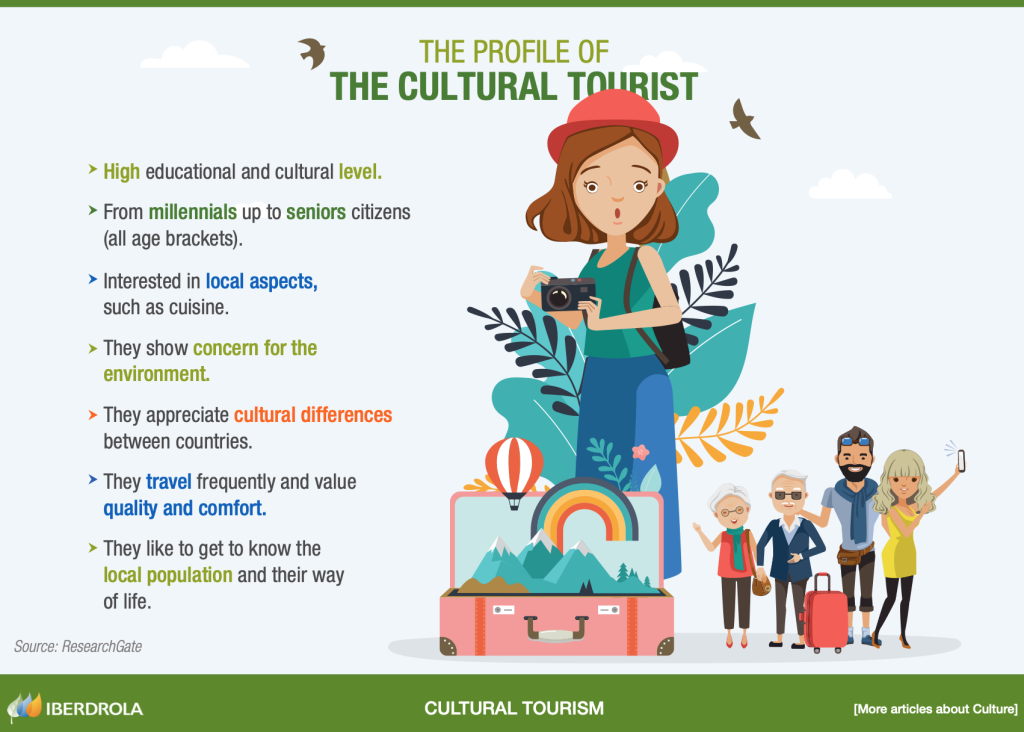
Cultural tourists span all age groups. Most are well-educated and care about the planet and its people, appreciating the wide range of cultural differences. They tend to be frequent travellers and value quality and comfort, but they like to get to know local populations and how they live.
Figure 1: Profile of the cultural tourist
Source: Iberdrola, 2025
Cultural tourists can be broadly split into two major groups:
- Motivated cultural tourists travel specifically to experience and learn about a destination’s culture.
- Incidental cultural tourists are the largest group by far. They travel for other reasons, such as adventure, sun, beach and nature. But they also enjoy taking part in cultural activities when these fit in with their itineraries.
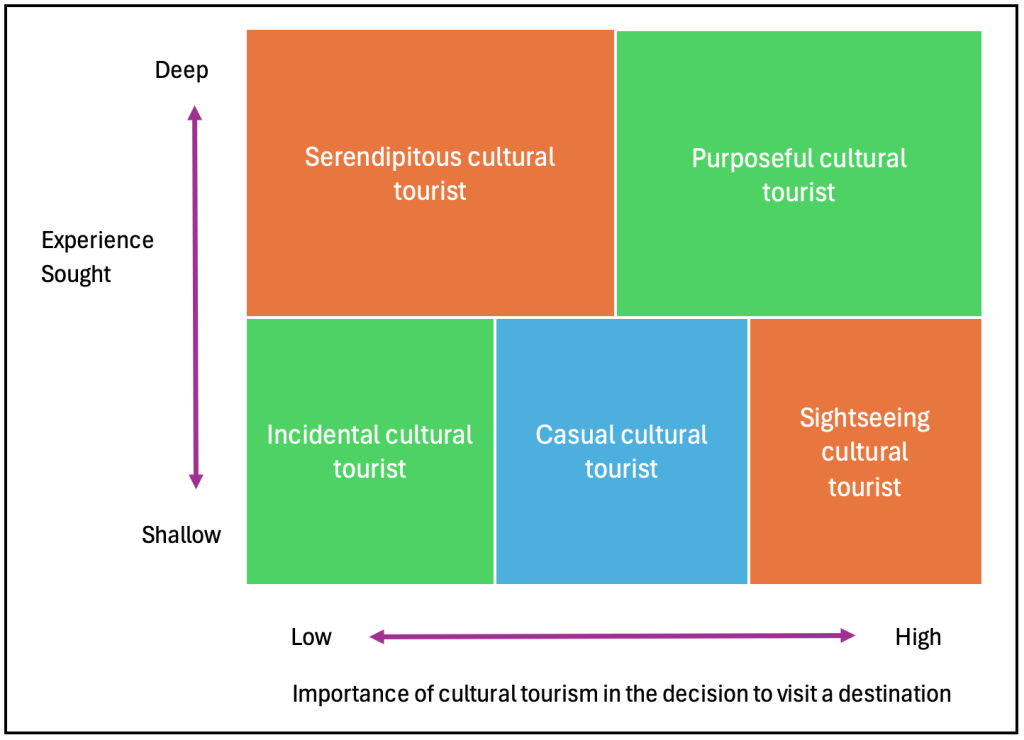
They can also be further split by motivation and behaviour. This framework identifies five types of cultural tourists, split by motivation and how deeply they connect with culture.
Figure 2: Types of cultural tourists
Source: Cultural Tourism: The Partnership between Tourism and Cultural Heritage Management, 2002
The table below further outlines the motivations and characteristics of these types of cultural tourists.
Table 4: Motivations and characteristics of cultural tourists
| Cultural tourist type | Motivations | Characteristics |
|---|---|---|
| Casual cultural tourist | Culture plays a small part in choosing a destination, and engagement is not very deep. For instance, they visit one or two sites that are conveniently located. They usually engage in cultural experiences as a break from leisure or other activities. Example holiday: a trip to Thailand with visits to temples or villages in between spa treatments. | This is the largest group of cultural tourists. They are also the easiest to attract because they value convenience, simplicity and entertainment in cultural activities. |
| Sightseeing cultural tourist | Culture is the main reason for choosing the destination, but their engagement with it is less deep. They enjoy visiting cultural sites but do not look for immersion or to learn more than what is on the surface. They like the ‘must-sees’ but usually for short visits or quick tours. Example holiday: a trip to Paris with a visit to the Louvre because it is iconic, rather than finding out more about French art or history. | This is the second-largest group of cultural tourists. They are more common in urban destinations, especially cultural cities with iconic attractions. |
| Incidental cultural tourist | Culture plays no role in travel decisions, and any cultural interaction is accidental, such as passing a local market or hearing live music. They are not particularly interested in history, art or tradition. Example holiday: a business trip to Tokyo, walking past a shrine but not stopping. | The next largest group is cultural tourists, common among business and mass-market tourists (e.g. tourists who ‘fly and flop’ to traditional beach destinations). |
| Serendipitous cultural tourist | They did not choose to take cultural trips but end up having deep cultural experiences while travelling. They are curious and open-minded. They may become very engaged in a culture during events like festivals and other hands-on cultural experiences. Example holiday: Travelling to Mexico and getting involved in a Day of the Dead celebration, being immersed in the symbolism and customs. | This smaller group is growing because of the increased demand for immersive and experiential travel. Their open-mindedness and desire for a different experience can lead to an unexpectedly satisfying cultural experience. |
| Purposeful cultural tourist | Culture is their main reason for travelling. They want deep and meaningful cultural experiences. They plan trips around heritage and historic sites or cities to learn about local traditions. They take guided tours, attend lectures and do lots of research before they travel. Example holiday: Travelling to Greece to study classical architecture, and attending academic lectures at ancient sites. | The smallest of the groups, these tourists are often academics and heritage enthusiasts. They spend more per visit and tend to stay longer. |
Tips:
- Use the CBI infographic to identify which tourism niches are most relevant for your business. This will help you understand your business more clearly.
- Find out more about cultural tourism’s different niches. There are many CBI studies that can help. These include agritourism, community-based tourism, food tourism, urban experiences and volunteer and educational tourism.
- Identify how cultural heritage and traditions are promoted as tourism products in your destination. Work out the best way to make your product stand out and reach the right markets.
Accessible tourism on the European market
Accessible tourism is the ongoing effort to ensure that people can access tourist destinations, products and services, despite any physical limitations, disabilities or age. This applies to publicly and privately owned tourist locations. The improvements help those with permanent physical disabilities, as well as parents with small children, elderly travellers, people with temporary injuries as well as their travel companions. Tourists with disabilities may travel individually, in groups, with their family or with carers.
Accessibility and cultural tourism
Making cultural tourism experiences accessible to everyone means you need to think about a lot of different things. Consider the following when planning accessibility for your cultural experience:
- Provide physical access by making sure there are ramps, lifts, accessible toilets/bathrooms and suitable seating.
- Offer sensory and communication aids, like audio guides, subtitles, Braille interpretation and other clear signage.
- Train your staff in accessibility awareness so that they can help people with disabilities and fully understand their needs. They need to be proactive and good listeners.
- Involve people with disabilities to help you design and test your experiences to ensure that they work for them.
If you cannot provide some or all of these things, you should say so. Do not promise what you cannot deliver. People with disabilities must be able to make decisions based on facts.
Tip:
- Read the CBI studies 'The European market potential for accessible tourism' and 'Entering the European market for accessible tourism products' for practical and useful advice to make your tours accessible.
2. What makes Europe an interesting market for cultural tourism?
Cultural tourism is one of the largest niche tourism markets. UN Tourism believes that around 40% of all international tourists travel to experience culture in some form. Europe is the leading market for cultural tourism. It has a 39.3% share of the global market. Estimates of the market value are very different, but experts generally agree that cultural tourism is growing. Some say that it will grow by 8.1% per year until 2035, but others say it will grow 15% per year until 2033.
Europe has a very diverse and rich cultural heritage, and Europeans’ interest in culture goes beyond other European countries. CBI research into the top European outbound tourism markets in 2025 (Germany, the UK, France, Italy, Spain, the Netherlands) found that cultural tourism activities were the most popular activities for European respondents when on holiday outside of Europe in 2024.
Source: CBI, Travel Behaviour and Motivation of Top European Source Markets 2024–2025
Looking ahead to 2025, the top markets also often take part in cultural activities when on holiday, including visiting cities/towns (42.1%), enjoying local food and drink (32.4%) and cultural tourism (27.2%). These are very similar to trends in the market. This highlights growing demand for authentic and unique travel experiences that connect tourists more closely with people, places and the planet.
This is good news for local tourism businesses that want to attract European markets to cultural tourism products.
Tip:
- Be prepared for doing business in the European market. Read the CBI studies 'Tips to do business' and 'Tips to organise your export' to help plan your strategies. Europeans are very professional and will expect suppliers to be efficient and transparent.
3. Which European countries offer the most opportunities for cultural tourism?
Germany, the UK, France, Italy, the Netherlands and Spain are the largest outbound overnight tourism markets from Europe and offer the most opportunities for cultural tourism in developing country destinations. Cultural tourism is predicted to grow across every market over the next few years, driven by the increased demand for experiential and authentic tourism, which are directly linked to cultural tourism. Across the continent, growth is expected to reach a CAGR (compound annual growth rate) of 13.5% until 2031.
Source: UN Tourism, 2024 (note: UK figures include overnight and day visitors)
Germany
Germany has the largest cultural tourism market in Europe. It was worth around $424.96 million (USD) in 2024 and is predicted to grow by a CAGR of 13.7% between 2024 and 2031. Cultural tourism in Germany is slightly different from other source markets because cultural exchange programmes drive the market. These programmes foster international understanding, professional development and intercultural dialogue.
Germany has more of these programmes than other European countries. The programmes receive money from the government and attract people who work in academia and education. Examples include the Cross-Culture Programme, run by the Institute for Foreign Relations, and DAAD, the German Academic Exchange Service.
Germany is the largest outbound travel market, but German tourists also like outdoor activities, especially sun and beach, followed by culture. Like all European markets, city trips were the top cultural activity in 2024 (38.8%) and almost one-quarter appreciated cultural activities (24.3%) according to CBI research. This pattern was set to continue into 2025.
Germans like to travel overseas: 78% prefer to travel internationally, compared with 22% who prefer domestic travel. They also like to visit developing countries, especially Egypt, Mexico, Tunisia and South Africa. In 2025, Germans had a high intention to travel to Africa (7.9%), Türkiye (6.6%), and South/Southeast Asia (4%). Interest in South/Southeast Asia increased by 1.3% between 2024 and 2025. This creates opportunities for providers in these destinations.
The tour operator market is well served by German tour operators that offer culture as a theme, including Rewe Reisen, TravelScout24 and Travelmyne.
United Kingdom (UK)
The UK is the second-largest European cultural tourism market. It was worth around $360.57 million (USD) and is set to grow faster than Germany’s, at a CAGR of 14.3% until 2031.
Culture is a key reason to visit developing countries, and British people are known to visit places with rich history and culture. CBI research in 2024 found that the UK was the top market for attending cultural events and festivals (14.6%), compared with the other top source markets.
Visiting cities and food and drink experiences were the top activities on trips abroad for UK nationals in 2024, making up 40.7% and 34.4% of respondents, respectively. In 2025, interest in food and drink experiences increased among British nationals by 9.3%, reaching 43.7%. Providers of food and drink experiences can use this to attract this market of enthusiastic travellers.
British people travel to a wide range of countries and have the highest preference for visiting developing destinations. Türkiye is a top destination, along with India and many African countries, like Kenya and Tanzania. In 2025, Britons were set to continue to travel to these traditionally popular destinations. Still, there is a new trend: increased travel to South America and Central America, which grew by 2.1% and 1.6%, respectively.
The tour operator market for cultural holidays and experiences is very large in the UK. Most tour operators offer culture as a travel theme, like Wild Frontiers, Kirker Travel and Explore. There are also specialist providers, such as Martin Randall Travel, ACE Cultural Tours and Cultural Breaks.
France
France is the third-largest European outbound travel market. In 2024, the cultural tourism market was worth around $197.46 million (USD). It is forecast to rise by a CAGR of 12.7% until 2031.
Cultural experiences and sites of religious importance are key to French outbound tourists. CBI research found that the top three activities undertaken by French respondents were culture-related. Visiting cities/towns was popular for 55.6%, along with cultural tourism (29.4%) and local food and drink experiences (20.2%). Interest in food and drink experiences is set to rise in 2025 by 5.9%, to 26.1%.
There are strong cultural and language ties between France and North African countries, such as Morocco and Tunisia. This makes them popular destinations for French tourists who want cultural experiences. In 2025, French travellers made more trips to South/Southeast Asia. The intent to travel to this region was up by 4.8%, to 9.2%, compared with 2024.
Many tour operators serve the cultural travel market in France. Examples include Arts et Vie, Intermedes and Clio Voyages Culturel.
Italy
The Italian cultural tourism market was worth around $184.58 million (USD) in 2024, and is expected to rise by a CAGR of 12.9% until 2031. Like the French, Italians are keen on cultural experiences. Italians stand out in their appreciation of cultural trips and visiting cities for art. This trend is evident in increased spending on cultural trips and a preference for visiting cities known for their cultural heritage.
CBI research confirmed that they were the top market for visiting cities/towns (59.8%). They are also a key market for immersive cultural experiences, like interactions with local communities. In 2025, intent to visit cities/towns was the top preference, but interest in food and drink experiences was expected to rise by 10.2%.
Popular developing country destinations for Italians include Egypt, Morocco and Tunisia. They all have rich cultural heritage and are relatively close to Italy. Interest in African destinations and North Asia was set to increase among Italian travellers in 2025, according to CBI research.
The tour operator market supports cultural holidays. Examples of tour operators offering cultural holidays to the market include Archetravel and Eden Viaggi.
Netherlands
Although the Netherlands is small, the Dutch are some of the most enthusiastic travellers to developing countries. Culture is important while travelling and visiting cities/towns, and local food and drink experiences are the two most popular activities for Dutch travellers (44.8% and 39.9%, respectively) according to CBI research.
Türkiye, Egypt, Morocco and Indonesia were the top developing destinations for Dutch travellers in 2022. They are also increasingly visiting places like Mexico. For 2025, Dutch people planned to travel more to Africa and Türkiye.
Many Dutch tour operators specialise in cultural holidays, and cultural immersion is a particular strength. Tour operators include Djoser, Sawadee Reizen and Better Places, which have a focus on sustainable travel experiences.
Spain
Outbound cultural tourism from Spain to developing countries has been growing because of the Spanish people’s growing interest in immersive experiences. Research showed that 44% of Spanish travellers appreciate cultural holidays, compared to the global average of 33%. They are very interested in exploring new places, learning about different cultures and experiencing local customs. In 2024, the cultural tourism market was worth around $175.99 million (USD). It was expected to grow by a CAGR of 12.6% until 2031.
CBI research confirms that Spanish travellers are especially motivated by culture when they travel, including visiting cities/towns (49.8%), cultural tourism (41.2%), tangible culture (27.7%) and other forms of culture, like visits to local communities. They also like to take part in religious activities. Many Spanish people are Catholic and take part in religious festivals and ceremonies.
Spanish-speaking countries like Mexico, Colombia, Costa Rica and Peru are popular destinations for Spanish tourists, with their very rich cultural heritage. There was also likely increasing interest in North Asia and Africa in 2025. Examples of Spanish tour operators that offer cultural trips include Politours, Catai and Viajes el Corte Inglés, one of Spain’s largest travel agents. Creating immersive experiences for Spanish consumers offers particular opportunities to local operators, particularly if they can offer them in Spanish.
Tips:
- Learn more about these markets and their travel habits. The CBI study 'What is the demand for outbound tourism on the European market?' provides detailed information about each source market. Make sure you read it well to develop your knowledge.
- Food tourism is a growing niche that is associated with cultural tourism. Find out more about this important niche in the CBI study 'What are the opportunities on the European food tourism market?'.
4. Which trends offer opportunities or pose threats in the European cultural tourism market?
The biggest trend in the cultural tourism market at the moment is the demand for authentic cultural tourism experiences in which participants enjoy real learning and immersive experiences. These experiences have the added benefit of being truly sustainable, providing long-term benefits to local communities and the environment. Challenges in the market are overtourism and climate change. However, there are several strategies to help communities protect against these damaging factors.
Cultural tourism shifts from sightseeing to tailored immersive experiences
The cultural tourism landscape is growing and changing. Cultural tourism used to be a largely passive experience of sightseeing and watching. Today, authentic, immersive experiences that create more personally satisfying learning experiences are at its heart. Travellers want hands-on activities that connect with the culture and traditions of local people and places. Cookery classes, local festivals, artisan workshops and historical reenactments are all examples of immersive cultural tourism.
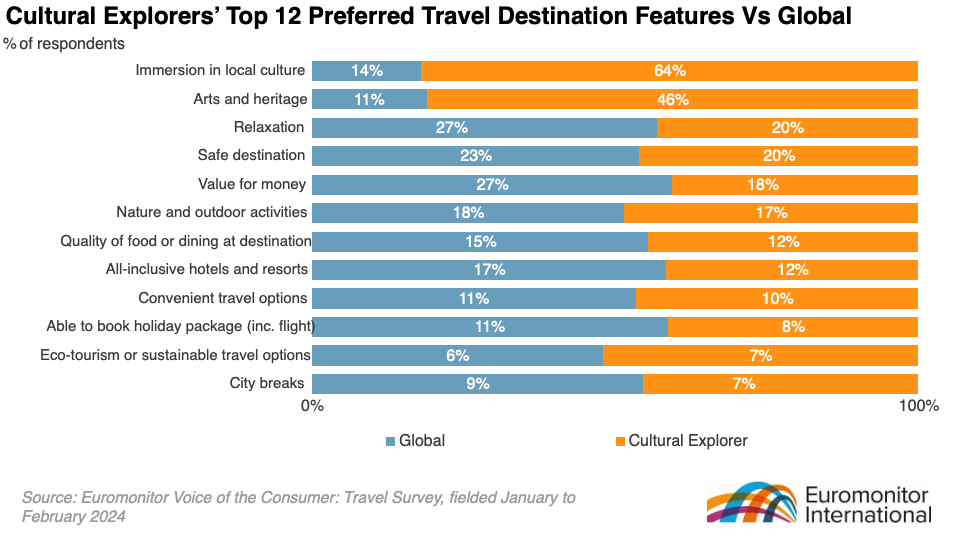
The ‘cultural explorer’ segment, identified by Euromonitor, helps to shape global tourism priorities, driving change through demand for authentic, sustainable, and personally enriching experiences. Cultural explorers are highly motivated by cultural experiences and place a strong emphasis on authenticity, sustainability and personal enrichment. The chart below clearly shows the importance of immersion in local culture for this group of travellers.
Figure 5: Cultural explorers demand immersive and authentic experiences
Source: Euromonitor, 2024
The younger generations, Gen Y and Gen Z (aged 30-45 and 13-29 respectively in 2025), are known for their love of authentic and immersive experiences when they travel. They are also driving this important change in the cultural tourism segment. You can find out more about these target groups in the CBI studies 'Opportunities on the European Gen Y tourism market' and 'Opportunities on the European Gen Z tourism market'.
Museums and art galleries offer new types of exhibitions to attract a new audience of travellers who want to learn more about different cultures. Pop-up exhibitions and virtual experiences that use new technologies are increasingly being used to engage with cultural tourists. Some interesting examples include:
- Immersive Lalibela – Wonder of an African Kingdom in Ethiopia. This was a travelling exhibition bringing the ancient rock-hewn churches of Lalibela to life through immersive digital projections and interactive installations.
- Art in Island, Philippines. An interactive 3D art museum in Quezon City, where visitors could become part of the artwork through optical illusions.
- FORTUNE REALMS: Pop-Up Museum of Chinese Culture & Arts (Macau Station) ran at the Grand Lisboa Palace Resort between December 2024 and February 2025. It was an immersive exhibition that celebrated the founding of the People’s Republic of China and the return of Macau to China.
Digital tools, such as AR (augmented reality) guided tours and virtual experiences, will change how destinations engage with cultural tourists. Technology investments will help tourism businesses make better connections and grow in this sector.
Destinations and local tour operators have a lot of opportunities to attract culturally curious travellers. Through information-rich experiences that they actively engage with, cultural tourists can contribute to keeping heritage alive so that it benefits visitors and host communities.
Sustainability is key to creating authentic, immersive cultural tourism experiences
Authentic and immersive cultural experiences need to be sustainably managed. Sustainability is more than just a trend. It is a crucial business practice that has many benefits to visitors and host communities. European travellers are more and more aware of the negative impacts of travel and want to know that the cultural experiences they take part in help local communities and do not harm local environments. Cultural tourism that is not managed sustainably risks being shallow and harmful to people, places and the planet.
These are the key factors that make sustainability so important for successful cultural tourism:
- In cultural tourism, authentic immersion depends on genuine, truthful cultural expression. This empowers local communities to present their culture in their own way, avoiding showing something that is not true. It helps to protect and preserve traditional knowledge, rituals, crafts and heritage that might be lost otherwise.
- Well-managed community-based tourism (CBT) means that economic benefits stay within the community. This helps reduce poverty and create long-term financial security. It also helps local communities develop new skills and foster cultural pride.
- Cultural tourism works best when both visitors and hosts benefit, and it is not one-sided. Sustainable tourism should focus on learning, cultural sensitivity and storytelling to help visitors appreciate local cultures rather than watch a spectacle. Making this type of connection is key to sustainability.
- Finally, sustainability means that tourism can keep going in the long term. It promotes non-exploitative tourism and resilience in difficult times.
Look at these real-life examples of local organisations that have successfully made long-term sustainability part of their businesses:
- The Great Himalaya Trail Project, Nepal, trains local people to manage homestays and work as certified trekking guides, which brings money to remote villages. Local villagers along a 1,000-kilometre trail are encouraged to start their own indigenous ecotourism products that attract hikers and trekkers to enjoy the rich culture of this mountain region.
- Pachamama Alliance, Ecuador, offers immersive visits with indigenous families in Ecuador. Guests take part in daily life and help with conservation efforts in the forest.
- KARA-TUNGA Tours, Uganda, is a registered social enterprise. The local community conducts tours to local museums, historical sites and farms. Local guides tell tourists about the local customs and cultures, as well as restoring the community’s pride in its culture.
Read the CBI study 'Best practice for successful sustainable tour operators' to see how other businesses have made sustainability part of their everyday operations.
Overtourism and climate change remain challenges in the cultural tourism segment
Cultural tourism is particularly vulnerable to the negative and harmful consequences of overtourism and climate change. Overtourism is a key challenge for some of the world’s best-known cultural attractions, including cities (e.g. Venice and Dubrovnik) and built heritage (e.g. Machu Picchu).
Climate change is another challenge for many tourism destinations, especially in developing destinations where flooding and wildfires have extreme impacts. These factors mean that cultural assets are at risk. This means that well-known tourist sightseeing hotspots will be affected, but also lesser-known places and even communities.
Several initiatives are being put in place to protect against these issues. Sustainable cultural tourism experiences are one important strategy. The table below shows some actions being taken to help tackle these important issues.
Table 5: Strategies and actions to address overtourism and climate change
| Strategy | Action |
|---|---|
|
|
|
|
|
|
|
|
|
|
|
|
|
|
Source: Acorn Tourism Consulting, 2025
Tips:
- Learn from your competitors. Identify other cultural tourism experiences in your local area. Look at what they do and see how this compares with what you offer. See if you can identify any gaps in the market that you can move into.
- If you are in an off-the-beaten-track destination, work with your local tourist board and destination marketing organisation (DMO) to find out how to promote your cultural experience out of season and to new audiences.
- Carefully assess your own business to learn how sustainable it is. You must embed sustainability into your business to attract European travellers. These CBI studies will help you take this step: 'How to be a sustainable tourism business', '10 tips to go green in the tourism sector' and '9 tips on how to become more socially responsible in the tourism sector'.
- Focus on providing authenticity to your guests and avoid overtourism. Do not encourage more tourists to come to you to boost revenue. This will affect your authenticity and put visitors off. Remember, if word gets out that your experience was too busy or not authentic, you will not attract the European market interested in learning about local culture.
- Make sure that you have a risk management plan in place. Read the CBI study 'How to manage risks in tourism' for more information.
Disclaimer: statistics provided in this study are taken from a range of sources. Due to differences in data collection and presentation methods, figures may not always be directly comparable.
Acorn Tourism Consulting Limited carried out this study on behalf of CBI.
Please review our market information disclaimer.
Search
Enter search terms to find market research
Do you have questions about this research?
Community-based tourism, and therefore intangible heritage, is a trend that has been growing over the last years. The tangible must-sees are still there and play a very important role in the profile of a destination. But what makes an experience worthwhile is the relationship with the locals: how welcoming they are. That is what will leave an imprint in visitors’ memories and will encourage them to recommend the destination.

Carlos Burgos Tartera, Master in Cultural Tourism/PhD student in Cultural Heritage