
Entering the German coffee market
Germany has a huge lower-end market, mainly for non-certified commercial coffee. Brazil and Vietnam are the most important suppliers in this segment. Honduras is a main supplier of the certified coffee market. The high-end and speciality segments are also growing. All coffee that enters Germany has to meet certain demands. Most of these come from European Union legislation.
Contents of this page
1. What requirements and certifications must coffee meet to be allowed on the German market?
There are a lot of requirements for exporting to Germany. Most are set by the European Union (EU). Some are set by the German government or private companies. These requirements can be split into:
- Mandatory requirements;
- Further requirements to be as successful as possible in the market;
- Requirements for niche markets.
These are described in more detail below. Most requirements are the same in all European markets. For more information, read our report on requirements for the European coffee market.
What are mandatory requirements?
Requirements on food safety and hygiene
You must follow the European Union’s legal requirements for coffee. These rules mainly deal with food safety. Traceability and hygiene are the most important themes. You should pay extra attention to specific sources of contamination from pesticides and mycotoxins/mould, particularly Ochratoxin-A (OTA).
Tips:
- Search the EU Pesticides Database to see each pesticide's maximum residue levels (MRLs). You can search for ‘coffee’ or look for your pesticide’s active ingredient. This will show the MRLs of the active ingredients accepted in the EU.
- Always check with your buyers if they have different MRLs or rules on pesticide use.
- Use your browser or AI translation to translate information on German websites.
Labelling requirements
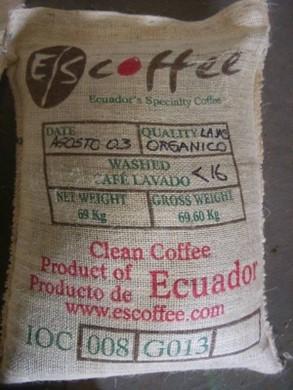
The labels of green coffee exported to Germany should be in English. They should include the following information so that individual batches can be traced:
- Product name;
- International Coffee Organization (ICO) identification code;
- Country of origin;
- Grade;
- Net weight in kilograms;
- For certified coffee: name and code of the inspection body and certification number.
Figure 1: Example of green coffee labelling
Source: Escoffee
Payment and delivery terms
Payment is usually needed when coffee is accepted, or within 30 or 45 days. It depends on the terms in your contract. Cash Against Documents is the most common agreement when exporting coffee to Europe. You provide documents that prove shipment, such as a bill of lading or invoice, and you get paid in return.
It is important to look at these terms carefully. Generally, payment will be earlier if you sell your coffee to a trading company than when you sell it to a roaster directly. You can read more about this in our tips on organising your coffee exports.
Packaging requirements
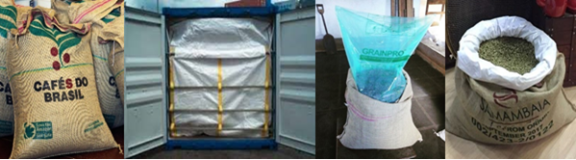
Green coffee beans are usually shipped in woven bags made from jute or hessian natural fibre. Jute bags are strong. Some suppliers use other materials inside jute bags, like GrainPro and Videplast. These materials also help maintain bean quality, stop post-harvest losses, create less solid waste, cut farmers’ net carbon footprints and enable chemical-free storage. These materials are usually used in the higher segments of the market.
Other packaging for transporting coffee includes:
- 1 tonne polypropylene super sacks;
- 21.6 tonne polyethylene liners;
- Vacuum packing.
These increase efficiency and maintain and preserve quality.
Figure 2: Examples of coffee packing from left to right: jute bag, container-sized flexi bag, GrainPro and Videplast liner
Sources: Raad, Bulk Logistic Solutions and GrainPro
Tips:
- Read the CBI study on buyer requirements for coffee in Europe for all buyer requirements.
- Read EUR-Lex for more information on limits for different contaminants. To learn more about preventing and reducing Ochratoxin A contamination, read Codex Alimentarius CXC 69-2009. Use the search tool to find the codes that contain information about Ochratoxin A and select your preferred language.
- For information on safe storage and transport of coffee, visit the website of the Transport Information Service.
- Learn more about delivery and payment terms by reading our study on organising coffee exports to Europe.
Sustainability requirements are becoming stricter
The main sustainability requirements are the result of the European Green Deal. These include the European Deforestation Regulation (EUDR) and the European Corporate Sustainability Due Diligence Directive (CSDDD).
The European Green Deal (EGD) is the European Union’s response to the global climate emergency. The EGD is a package of policies that sets out Europe’s plan to reach net zero and become a resource-efficient economy by 2050. The Forced Labour Regulation will also affect coffee suppliers that export to the EU.
The European Deforestation Regulation prohibits coffee that led to deforestation
One of the laws that comes from the Green Deal is the EU Deforestation Regulation (EUDR). This has the most influence on the European coffee industry.
In December 2024, the European Union delayed the date of implementation by a year, to 30 December 2025. Micro and small enterprises have six more months. This law makes traceability and technology very important for exports to the EU market. This will mean things need to change in the coffee industry. The EU has a sheet that answers common questions about this topic.
The CSDDD will increase requirements for traceability and human rights
Under new CSDDD regulations, European corporations must make their sustainability performance better throughout their supply chains. They must also stop negative impacts on human rights and the environment. The law forces European companies to be responsible for their entire supply chain. The directive means buyers will ask for proof that you act in a sustainable way.
A lot about the CSDDD is unclear. The European Commission has suggested making the CSDDD simpler. This would make it much weaker. The directive would apply to 80% fewer companies. It would limit the obligations to their direct suppliers. It would also remove obligations for climate transition plans and reduce penalties. This has not been accepted yet, so the final text may still change. It is unclear when the CSDDD will come into force.
Germany's Supply Chain Act: Rules for Fair Business
Sustainability due diligence is not new to Germany. The Supply Chain Act (Lieferkettengesetz), or the Act on Corporate Due Diligence Obligations in Supply Chains, has been in force since 2021. This law means large importers have to safeguard human rights by taking reasonable measures. If a business is active in Germany and has more than 1,000 employees (as of 2024), it has to check that human rights and environmental standards are met throughout its supply chain. This means companies have to:
- Find out where their raw materials and goods come from;
- Spot any risks to human rights or the environment;
- Take steps to fix or prevent harm;
- Set up a complaint system for affected workers;
- Create a public report on what they have done every year.
There are important differences between the CSDDD and the Supply Chain Act. The Supply Chain Act is less far reaching than the CSDDD. Under the Supply Chain Act, importers do not have to look past their direct suppliers. Second, the Supply Chain Act does not address environmental issues. It also only applies to very large companies. These large companies may ask for more information on human rights.
The Forced Labour Regulation bans coffee produced with forced labour from the European market
The goal of the EU’s Forced Labour Regulation is to stop the production or export of any product made using forced labour. Based on risk assessments, companies based in the EU will have to ensure that no forced labour is used in their supply chain. In April 2024, the EU Parliament gave its final approval on the legislation. Companies should be ready to comply with the regulation’s requirements from mid-2027. European companies that do not comply will be fined.
What the Forced Labour Regulation fully means for exporting companies is unclear. However, it will mean that European buyers will ask for more information from their suppliers.
Tips:
- Become more traceable. European sustainability requirements will become stricter. You can only prove your sustainable behaviour if you know where your coffee comes from. Certification may be an interesting way to improve this.
- If you are unsure about any requirements, talk to your buyer.
- Read more about the European Green Deal for a better overview of the legislation.
- Read about what you can do to become more sustainable in our tips to go green and tips to become socially responsible.
What additional requirements and certifications do buyers often have?
Some German buyers may have extra safety processing or quality requirements.
Additional food safety requirements
Buyers in Germany will likely ask for extra food safety guarantees. In terms of production and handling processes, you should think of:
- Implementing good agricultural practices (GAP): The main standard for good agricultural practices is GLOBALG.A.P. This is a voluntary standard for certification of agricultural production processes that provide safe and traceable products. Certification organisations, such as Rainforest Alliance, often incorporate GAP in their standards.
- Implementing a quality management system (QMS): Buyers increasingly need a system based on Hazard Analysis and Critical Control Points (HACCP) as a minimum standard for green coffee production, storage and handling. Implementing regular checks of residue levels in your coffee could be part of this system. Pay particular attention to Ochratoxin-A (OTA), polyaromatic hydrocarbons (PAHs) and glyphosate contamination.
Quality requirements
Green and roasted coffee generally undergo physical evaluation to determine their quality. Roasted coffee also undergoes a sensory evaluation.
The quality assessment is usually based on the following criteria:
- Altitude and region;
- Botanical variety;
- Processing method (wet/washed, dry/natural, honey, pulped naturals);
- Screen size;
- Number of defects or imperfections;
- Bean density;
- Cup quality.
A moisture check and water activity analysis are also part of the assessment. Sample roasting is sometimes done to assess the quality and uniformity of green coffee.
The process of quality assessment is the same for all types of green beans. The exact criteria, however, are different. Both high-end and low-end coffee beans are checked for bean density (mass divided by volume). High-end coffees need higher bean density.
Tips:
- Know the coffee you sell. This includes information on the growing process, processing and flavour. You should also understand the quality you are selling. This can help you sell some of your coffee for a higher price.
- Learn about the green coffee quality assessment. The Specialty Coffee Association is the main standard, but you can also read about other ways to assess coffee quality.
What are the requirements for niche markets?
Exporting organic, speciality and roasted coffee comes with more requirements.
Requirements for organic coffee
Exporting organic coffee comes with more requirements. To market your coffee as organic in the European market, it has to comply with the EU regulations for organic production and labelling. Regulation (EC) 2018/848 sets organic production and labelling rules.
Organic coffee is checked at the EU border. To import organic coffee into the European Union, the delivery needs to include an electronic certificate of inspection (e-COI). The certificate should be set up in the Trade Control and Expert System (TRACES). It has to be signed by a control authority before the shipment leaves the country.
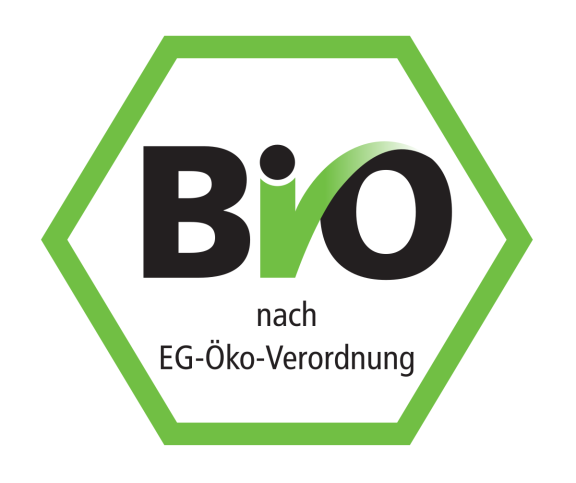
When packaging, German roasters can either add the EU organic label or the Bio-Siegel label. The Bio-Siegel label has the same requirements as the EU organic label, but it is only used in Germany. The Bio-Siegel is well-known in German supermarkets.
Figure 3: the German Bio-Siegel label
Source: Ökolandbau
Tips:
- Learn more about exporting certified coffee by reading our studies on organic coffee, certified coffee and multi-certified coffee.
- Find importers that specialise in organic products on the Organic-bio website. These importers can become buyers.
- Use this cost calculator to work out how much it would cost for your organisation to become Fairtrade-certified. Ask for quotes from different certifiers before you decide which one you want to work with. Ask for timelines and how many days would be charged. Always discuss certification with your buyers before deciding.
- Try to combine audits if you have more than one certification. This saves time and money. You should look into the possibilities for group certification with other regional producers and exporters.
Requirements for speciality coffee
Speciality coffee is graded according to its cupping profile. Fragrance, flavour, aftertaste, balance, acidity, sweetness, uniformity and cleanliness are important in the grading process. If you sell speciality coffee, buyers need to know your coffee’s cupping score. Adding this information to the documentation of the coffee you export can add value. It is very important to be aware of the quality of your coffee. You can do this through local cupping experts or by becoming a cupping expert yourself.
Transparency is also very important. Many buyers are interested in stories about the product’s origin, like details about your coffee farm, the coffee growers, how and where you grow your coffee, and your processing facilities. This means you should know all about your coffee, from soil management to cup, from variety to processing, from external suppliers to farmers. You must be willing to share this information honestly.
Direct trade can result in more frequent coffee farm visits, product assessments by your buyers and long-term business relationships.
Requirements for roasted coffee
Sensory assessment: coffee cupping
Coffee can be assessed and scored using a method called ‘cupping’. Buyers will use different standards to do sensory assessments. However, the SCA recommends protocols and best practices for cupping coffee. The SCA’s Coffee Taster's Flavour Wheel is a widely-used cupping tool.
Hygiene requirements for roasting
Food imported into the EU is subject to official food checks. These checks include regular inspections that can be carried out at the border or once the food is in the EU. They are meant to check whether products meet legal requirements.
All roasters have to use a procedure based on HACCP principles. The HACCP (Hazard Analysis and Critical Control Points) principles for roasted coffee focus on good quality and keeping the coffee safe. HACCP plans are a very important part of the quality management systems that companies use to become successful suppliers to the European market.
HACCP steps include checking for issues like contamination, setting up points to check these issues and ensuring coffee meets safety standards. Monitoring and keeping records is also important to ensure coffee is safe for consumption.
Trade tariffs
The standard duty for roasted coffee imports is 7.5%. The duty for decaffeinated roasted coffee is 9%. These duties depend on the exporting country and whether your country has a contract with the European Union. Note that the importer is responsible for paying the trade tariff, not you as an exporter.
The German coffee tax
Germany taxes roasted and instant coffee. Roasters pay €2.19 per kilogram of roasted coffee and €4.78 per kilogram of instant coffee. In 2021, the tax brought in €1 billion.
The tax applies once the coffee is roasted. This means it applies to roasters inside Germany and importers that bring in roasted coffee from abroad. For example, retailers must pay it if their store-brand coffee is roasted outside Germany and shipped in.
The tax does not apply to green coffee that only passes through Germany. It also does not apply to coffee products that are made in Germany but are sold in other countries.
Tips:
- Check if any roasted coffee trade duties apply to your country via the Access2Markets website.
- Read our study on exporting roasted coffee to Europe to learn more about this market.
2. Through which channels can you get coffee on the German market?
The German market can be split into several market segments; from the lower end to the upper end. Most coffee is imported through large multinational trading companies. Multinationals are mostly importers and exporters. Most coffee in Germany is sold through supermarkets. Cafés, however, are still responsible for a large market share. Most coffee flows to the consumer through multiple value chain actors.
How is the end market segmented?
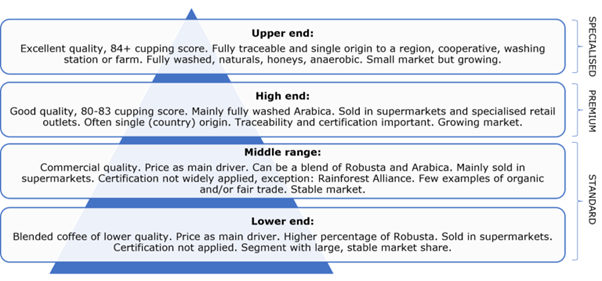
The German end market for coffee can be split into four segments: the lower end, middle end, high end and upper end.
It is important to know that exports to Germany do not always end up on the German market. Germany is a large re-exporter of green coffee. Around 30% of its green coffee is re-exported. A large share of its roasted coffee is also exported to other countries. Germany is a large importer of coffee roasted in other countries (mainly European).
Figure 4: Coffee end-market segmentation by quality
Source: Profound
The lower end is the largest in Germany. German consumers are very sensitive to price. The lower-end market is growing due to high global coffee prices and the economy. You can read more about this in the trends section of our study on the German market potential for coffee. Germany is home to many discount supermarkets, such as ALDI and Lidl. Both supermarkets have their own private-label roasters to supply their stores.
Compared to other European countries, Germany has quite a small middle-range segment. Certification is very important in this segment, as German demand for certified coffee is high.
The high end and upper end are growing. The German speciality coffee sector is booming. The market for whole bean coffee is also growing. It has the most automated coffee machines in Europe. Many German coffee consumers are willing to buy high-quality coffee to drink at home. The COVID-19 pandemic accelerated this trend.
Rehm & Co and Café Imports are traders in the high and upper segment. Both companies focus on speciality coffee. Examples of roasters in this segment are Bonanza Coffee Roasters, The Barn and Machhörndl Kaffee.
Tips:
- Know the quality of the coffee you sell. The higher the quality, the higher your price should be. Very high-quality beans, if processed well, can also offer opportunities for direct trade.
- Explore ways to improve the quality of the coffee you produce. Certification, good agricultural practices and post-harvest processing can improve the quality of your product.
Through which channels does coffee end up on the end market?
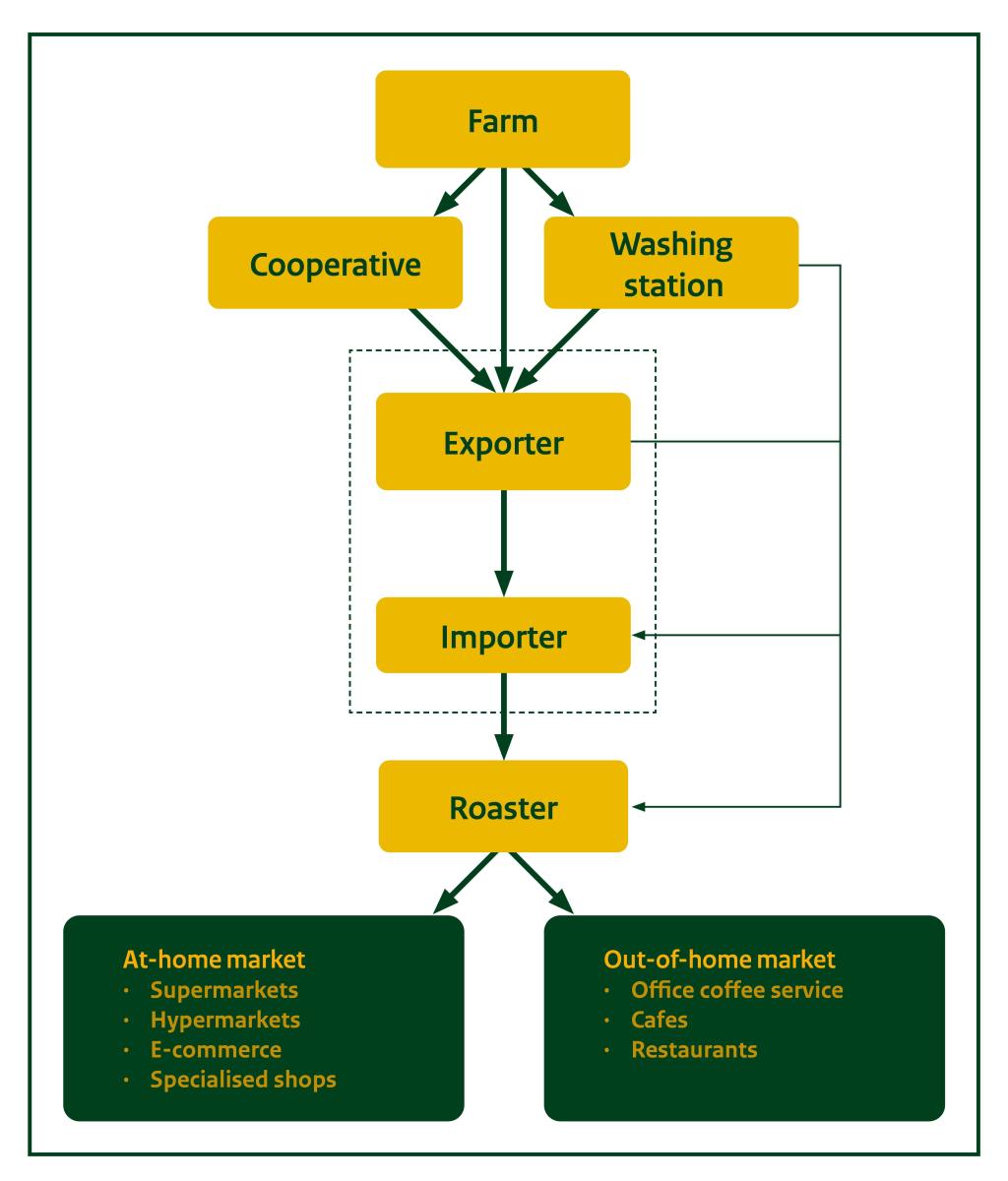
The German supply chain is made up of many actors. They are listed in Figure 4. Most coffee flows through all actors in the chain. However, ways of entering the German market directly are coming up.
Figure 5: The German coffee supply chain
Source: based on Counter Culture Coffee
Importers have key roles in the supply chain
Importers play a key role in the global coffee trade. They act as supply chain managers and have a wide range of coffee portfolios from different origins. They often pre-finance shipments, check quality, manage price risks and connect producers to buyers.
One company often handles both export and import. For example, Neumann Kaffee Gruppe (NKG) has many warehouses in producing countries. Farmers and cooperatives can transport their coffee to a local NKG warehouse. From there, NKG ships the coffee to warehouses in Europe. As a supplier, you do not usually know the final destination of your coffee.
Some of the leading German importers are:
- Neumann Kaffee Gruppe (NKG);
- Hamburg Coffee Company (HACOFCO);
- List + Beisler;
- Rehm & Co.
All these companies are based in Hamburg, Europe’s largest coffee port.
Tip:
- If you are a farmer or cooperative, learn which global importers work in your region. This can help you reach more buyers and access new markets.
Marketplaces facilitate trade
Marketplaces are platforms that connect actors in the chain. They mainly connect farmers to roasters directly. Using marketplaces allows farmers or cooperatives to cut out parts of the chain. This may allow you to get better prices. Only a very small amount of coffee reaches German roasters through a marketplace. Examples of these marketplaces are:
We did not find any German marketplaces that connect farmers to roasters, but the companies mentioned work globally.
The German coffee market is dominated by retailers and large roasters
Germany’s grocery market is Europe’s largest. It is tightly controlled by a few key players. Retailers, not multinational brand names, control the cost of coffee. In 2021, four retailers made up 70% of food sales. Traditional giants EDEKA and REWE face competition from discounters ALDI and Lidl. These discounters grew fast by cutting costs, offering a small selection of private-label goods, and keeping prices low. Coffee is a big promotional tool, often sold below cost. By 2022, discounters held 35% of the market. However, growth has stopped. In 2023, major stores slashed coffee prices permanently. Traditional retailers fought back with their own private labels and big discounts. Now, discounters are improving modern stores, city locations, organic and branded goods to stay competitive.
Germany is Europe’s second-largest roasting market. Most coffee is roasted by several very large companies. Important roasters are:
- JDE-Peet’s: JDE Peet’s is the world’s second-largest coffee roaster, and the largest roaster in Germany. The company works with several sub-brands, like Senseo, Tassimo and KaffeeHAG.
- Tchibo: A major German coffee brand. Tchibo is famous for its retail presence. It has numerous stores across the country.
- Nestlé: The world’s largest coffee roaster, Nestlé is recognised in Germany for its Nescafé and Nespresso products.
- Melitta: one of the ten largest roasters worldwide.
- Dallmayr: Well-known German coffee brand with a strong image and position in the market.
Source: BASIC (2024, based on data from 2021)
Germany is home to many small roasters
Large roasters make up most of the market. However, there are about 2,500 roasters based in Germany. Most are small or very small roasters. Small-scale roasters include Backyard Coffee and Bergbrand. Some of these roasters are only active at the urban or regional level. For examples, see this overview of roasters in Bremen. Most small coffee roasters focus on speciality coffee. To find more roasters in Germany, search the German Coffee Association database.
What is the most interesting channel for you?
The best sales channel for your coffee depends on many factors. Most of all, it depends on your unique selling points. This means you need to know your product.
- Step 1. Know your coffee: to sell your coffee to German buyers, you should understand its specific characteristics and what sets it apart. Think about the origin of your coffee and its unique flavour notes. Consider factors like your coffee beans’ genetic profile, agroecological context, post-harvest practices, quality and impact on communities and nature. Storytelling and traceability are also important. A good story can help connect consumers to the origin of your coffee and make their experience richer.
- Step 2. Know your buyers: the second step is to learn what your buyers want. To successfully sell your coffee to European buyers, it is important to understand their preferences and consumption patterns. Explore specific requirements with your buyers, like cup quality and sustainability. Look for buyers who are willing to build long-term relationships. You can either approach them directly or through an importer. You can raise your chances of success by analysing market information and identifying key buyers.
If you export mainstream green coffee, you should consider entering the German market through large importing companies. These companies usually have agents or representative offices in producing countries. This can be your first point of contact.
If you have coffee with cupping scores of 80 or above, think about working with specialised traders. Many specialised importers prefer to work with producers or cooperatives directly.
Supplying to small roasters is interesting if you have:
- High-quality coffee;
- Micro lots;
- Sustainability certification;
- An interest in engaging in long-term partnerships.
As the coffee market keeps changing, it is a good idea to explore multiple market channels.
Tips:
- Visit the World of Coffee. It is a great place to meet buyers directly.
- Try online marketplaces, such as Algrano, Beyco and Raw Material. These platforms let you sell to German roasters directly.
- If you have high-quality coffee and work through an importer, look into direct trade possibilities and connect with specialised roasters.
- Offer your coffee to specialised coffee importers and small coffee roasters directly. This is only possible if you are a farmer and have the financial means and technical know-how to organise exports.
3. What competition do you face on the German coffee market?
As a coffee supplier, you are working in a global and competitive landscape. For producers and exporters, it is important to understand the market segment you operate in and the scale at which you work. By identifying these factors, you can find out which countries you are competing with. Understanding the quality, volume and position of your products allows you to better assess your competition and develop strategies to stand out in the global market. This knowledge is very important to compete.
Which countries are you competing with?
Competition in the German coffee market is fierce. Your main competitors depend on the product you supply. Vietnam, Uganda and Indonesia are Germany’s main Robusta suppliers. Brazil, Honduras and Colombia focus more on Arabica. Germany sources a lot of both varieties.
In this section, we focus on the six main competing countries. These are Brazil, Vietnam, Honduras, Uganda, Colombia and Peru.
Brazil is Germany’s largest green coffee supplier
Brazil is the world’s largest coffee producer and exporter. It produces both Arabica (around 70%) and Robusta (around 30%), although almost 80% of exports are Arabica. Brazil is also Germany’s largest supplier. Brazilian exports to Germany reached 487,000 tonnes in 2024. It has shown an average yearly increase of 4.9% since 2020.
Brazil’s coffee-producing areas are relatively flat. This means mechanical pickers are popular. The use of mechanical pickers has reduced labour costs in Brazil’s coffee production. It has also led to average lower quality, as machines do not distinguish between ripe and unripe cherries.
Brazil mainly produces natural and pulped natural coffees. Low-grade Brazilian Arabica is mostly used in blends. This is in high demand with German roasters, who focus mainly on price.
Despite lower coffee prices, Brazilian coffee farmers are quite successful. Factors that help with their success are:
- Their scale;
- Mechanised cherry picking;
- Efficient infrastructure;
- The good climate (although climate change is affecting several key producing regions).
Brazil is the only large producing country where the average farmer can earn a living income from coffee farming.
Brazil is mainly known for exporting large volumes of standard quality coffee. However, the country also has a reputation for being a producer of speciality coffees. The sector receives a lot of institutional support through the Brazil Specialty Coffee Association (BSCA). The association aims to improve quality and value in the production and marketing of Brazilian coffee.
Burgeon and Bourbon Specialty Coffees are Brazilian exporters of speciality coffee.
The 2024/2025 outlook for Brazil is positive. A 5.4% production increase is expected.
Table 1: Competitive country profile of Brazil
| Strengths | Weaknesses | Image on the coffee market |
|---|---|---|
Largest coffee producer and exporter in the world, meaning economies of scale.
Varied climate and geography suitable for various types of coffee.
Established infrastructure and expertise in coffee cultivation and processing.
High level of automation.
Large domestic market. | Environmental concerns related to deforestation and sustainability practices.
Climate change will impact key producing regions.
Inconsistent quality control across large production areas. | Known for its supply of coffee beans.
Often associated with volume and affordability.
Known for speciality coffees.
Positions itself as a reliable source of commodity coffee. |
Source: various
Vietnam is Germany’s main green Robusta supplier
Vietnam is the world’s second-largest coffee producer and the biggest Robusta producer. Over 96% of Vietnamese coffee production was Robusta coffee in 2023/2024. Vietnam’s coffee production strongly focuses on creating large volumes of standard-quality coffees.
Vietnam’s total coffee exports to Germany reached around 182,000 tonnes in 2023. Vietnamese exports to Germany decreased by 6.5% per year on average between 2020 and 2024. Dry weather reduced the 2023/2024 harvest, which was the main cause for this decrease.
Large Vietnamese coffee exporter groups include Simexco Daklak, Intimex Group, Tin Nghia Corporation and MASCOPEX.
Vietnamese coffee production is expected to remain stable in the short term. High coffee prices encourage farmers to invest in production, which cancels out the negative influences of bad weather conditions.
Table 2: Competitive country profile of Vietnam
| Strengths | Weaknesses | Image on the coffee market |
|---|---|---|
The world's largest producer of Robusta coffee.
Low labour and production costs, making it highly competitive.
Favourable climate for Robusta cultivation. | Limited presence in the higher-value Arabica coffee market.
Challenges related to environmental sustainability and pesticide use.
Perception of lower quality compared to other coffee origins. | Associated with Robusta coffee and instant coffee production.
Seen as a budget-friendly source for coffee beans. |
Main source: Standard Insights
Honduras is a main supplier of organic coffee
Honduras supplies a large share of organic coffee to Germany. In 2024, Germany imported 64,000 tonnes from Honduras. Between 2020 and 2024, green coffee imports from Honduras registered an 11.4% yearly decline. Leaf rust and domestic labour shortages led to a 24% coffee production decrease in 2023/2024.
The Honduran Coffee Institute (IHCAFE) promotes the production of value-added coffees. It has done so through certification and actively improving quality. The country has grouped coffee production and quality specifications into six regions, based on different microclimates and soil composition.
Honduras has a growing reputation as a high-quality coffee supplier. Germany is a large importer of speciality coffee. One example of a German speciality coffee trader that imports speciality coffee from Honduras is Rehm & Co.
A relatively large share of Honduras's coffee is organic. According to FiBL & IFOAM’s The World of Organic Agriculture 2022, about 24,000 hectares were dedicated to organic coffee farming in Honduras. This is around 5.7% of the total planted coffee area in the country. With 24,000 tonnes, Honduras was Germany’s largest organic coffee supplier in 2023. Honduras is followed by Peru, with 17,000 tonnes.
Certified coffee production in Honduras grew from 42% in 2018/2019 to 58% in 2022/2023. This includes Fairtrade, Rainforest Alliance, 4C and organic certification.
Examples of successful exporters in Honduras are CAFICO (organic coffee) and ARUCO (speciality coffee).
Table 3: Competitive country profile of Honduras
| Strengths | Weaknesses | Image on the coffee market |
|---|---|---|
Main producer of organic coffee. | High volatility due to bad weather conditions, for example causing leaf rust. | Producer of organic and high-quality coffee. |
Main source: Standard Insights
Uganda’s coffee exports to Germany have grown rapidly
Another major coffee supplier to Germany is Uganda. In 2024, Germany imported 51,000 tonnes from Uganda. Between 2020 and 2024, green coffee imports from Uganda saw a 5.7 % yearly increase.
Smallholder farmers mainly grow coffee in Uganda. They are organised as part of NUCAFE, the national umbrella coffee farmers’ organisation. NUCAFE represents more than 213 farmer cooperatives and associations as NUCAFE members. Around 80% of total Ugandan production is Robusta. Uganda has some of the largest organic coffee production areas in the world, with 35,000 hectares in 2023.
The Uganda Coffee Development Authority (UCDA) helps to promote and guide the development of the Ugandan coffee industry. They do so through quality assurance, research and improved marketing techniques. UCDA works towards achieving the Presidential Directive of 20 million 60 kilogram bags of coffee by 2030. UCDA has also encouraged the production and marketing of high-quality Arabica coffees. Private companies have also invested in Uganda, focusing on sustainable production approaches.
Uganda is the only African country where green coffee is available throughout the year. This gives it a strong competitive advantage. However, disruptions in weather patterns due to climate change have led to supply chain difficulties. Examples of Ugandan exporters are ACPCU and Great Lakes Coffee.
Uganda's production in 2024/2025 is expected to remain the same as in 2023/2024.
Table 4: Competitive country profile of Uganda
| Strengths | Weaknesses | Image on the coffee market |
|---|---|---|
Unique speciality coffee, like Bugisu and Mount Elgon.
Increasing emphasis on sustainable and organic production.
Development of ‘speciality’ high-altitude Robusta. | Low average coffee yields.
Low investments, including insurance, agricultural inputs and training. | Gaining recognition for its speciality coffee varieties (including high-end Robustas).
Positions itself as a source of unique and distinctive flavours. |
Source: Ethos Agriculture
Colombia is a strong brand of high-quality coffee
In 2024, Germany imported 50,000 tonnes of green coffee from Colombia. Imports went down from 57,000 tonnes in 2020 to 40,000 tonnes in 2023, before rising again in 2024.
Colombia is the world’s largest producer of washed Arabica. It has a strong national coffee industry and is highly developed. The Colombian Coffee Growers Federation strategically promotes and markets Colombian coffee. The country has an established image for high-quality coffees. Colombian coffee is known for its chocolate, nuts, herbs, fruit and citrus flavours. Its main processing technique is ‘washed processing’. The country’s most well-known coffee varieties include Typica, Bourbon, Caturra and Castillo.
Café de Colombia is a protected trademark. It is registered in eAmbrosia, the register for protected trademarks in Europe. Registration in eAmbrosia is unique among coffee-producing countries. It protects the rights of more than 550,000 smallholder families in the country.
The Colombian coffee industry is developing quickly. Coffee companies are increasing capacity and product quality. Colombian producers can follow coffee quality and tasting programmes to get certified. The Coffee Quality Institute (CQI) has a strong presence in Colombia. They provide courses in partnership with the National Institute of Professional Training SENA. The country’s coffee has ongoing success in competitions, like the World Barista Championships.
Table 5: Competitive country profile of Colombia
| Strengths | Weaknesses | Image on the coffee market |
|---|---|---|
Very strong branding.
Strong focus on high-quality coffees.
Has many different landscapes at high altitude, leading to a great variety of high-quality coffees. | Limited economies of scale, mostly due to small farms.
The harbour is labour-intensive, leading to higher costs. | Has cultivated a very strong brand, well-known for its high-quality coffees and its unique flavours. |
Source: various
Peru takes the top position in the production of sustainable coffee
In 2024, Germany imported 47,000 tonnes of green coffee from Peru. German imports varied in 2020 and 2024; from 55,000 tonnes in 2022 to 33,000 tonnes in 2023.
According to UNDP, coffee is one of Peru’s main agricultural products. It accounts for around 25% of its agricultural income. Up to 40% of Peru’s farmland is used for coffee production. In the highlands, this is up to 70%. Peruvian exporters are especially important in the speciality market segment. Peru is the global leader in speciality coffee production. One example of a Peruvian speciality exporter is Rainforest Trading.
Besides speciality coffee, Peru is also a major supplier of organic coffee. It is the second-largest exporter of organic coffee. It has 90,000 hectares dedicated to growing organic coffee.
The flavour profile of Peruvian coffees is usually nutty, chocolatey and mildly citrusy. The country’s varieties include Catimor, Pache, Bourbon, Typica and Pacamara. Their main processing method is wet processing.
Peruvian coffee is known for its quality and sustainable production. It is one of the leading countries trading Fairtrade-certified coffee. 75% of its coffee industry is owned by smallholders. Peru introduced a national coffee brand, Cafés del Perú, to the international market in 2018.
Table 6: Competitive country profile of Peru
| Strengths | Weaknesses | Image on the coffee market |
|---|---|---|
Strong focus on organic and high-quality coffees. These coffees usually have high margins.
Has many different landscapes at high altitude, leading to a great variety of high-quality coffees. | Limited infrastructure.
Changing weather conditions resulting in inconsistent quality. | Becoming well-known as a source of ethically produced and high-quality coffee. |
Source: various
Tips:
- Identify your potential competitors. To be successful as an exporter, it is important to learn from them.
- Understand and promote your unique selling points. Give detailed information about your coffee-growing region or origin, varieties, qualities, post-harvesting techniques and certification. You can also share the history of your organisation, your coffee-growing farm and the passion and dedication of the people who work there. These all make your company unique.
- Promote your company on your website and at trade fairs. Quality competitions also offer good opportunities to share your story, for example through auctions organised by the Cup of Excellence.
- Are you interested in exporting high-quality coffee? Learn more about grading and best practices via the website of the Specialty Coffee Association (SCA). You can also consider getting a Q Arabica or Q Robusta Grader certificate to cup and score your coffee according to international standards.
- Work with other coffee producers and exporters in your region if your company size or product volume is too small. As a group, you can promote good-quality coffee from your region and be more attractive and competitive.
- Develop long-term partnerships with your buyers. This means always complying with their requirements and keeping your promises. Read our tips on doing business with European coffee buyers for more information.
Molgo Research carried out this study in partnership with Ethos Agriculture on behalf of CBI.
Please review our market information disclaimer.
Search
Enter search terms to find market research
Do you have questions about this research?
If you have coffee of great quality, try to sell your coffee to roasters directly for a better margin. You can meet German roasters at large coffee trade fairs, such as World of Coffee.

Gerd Mueller-Pfeiffer, CEO of International Coffee Consulting, former CEO of Nestlé Germany
Roasters are increasingly looking to help producers profit first by buying their coffee directly, becoming part of the solution to alleviate poverty while supporting customers in getting value for money. Connecting with roasters who are looking for the beans a specific producer has – a task that the TYPICA platform greatly facilitates – is key for producers in getting higher prices.

Ayane Yamada, Founder, TYPICA