
The European market potential for Arabica coffee
Europe is the largest coffee market, as well as the largest market for Arabica coffee. Germany and Italy are the main Arabica-importing countries. Germany has a large certified and specialty coffee market. In Italy, much Arabica is used in blends with Robusta. Climate change, increasing prices and a growing demand for specialty coffee are factors that change the Arabica market.
Contents of this page
1. Product description: Arabica coffee
Arabica coffee comprises about 57.5% of global coffee production. The other 42.5% is almost entirely Robusta coffee. Other varieties exist, such as Liberica and Excelsa, but these have a minimal market share. Arabica coffee has many different varieties. Common ones include Typica, Bourbon, Caturra, and Catuai. For more information on the different varieties, refer to the World Coffee Research catalogue.
Definition of Arabica coffee
For our qualitative analysis, we base our definition of Arabica on the biological classification. In other words, when we make qualitative statements about Arabica coffee – for example that it is often considered to have a better taste than Robusta – we are referring specifically to the Arabica variety. Arabica coffee beans are the seeds of the Coffea Arabica plant.
For growers, traders, importers and roasters, the differences between Arabica and Robusta are significant and will be discussed later in this report. In contrast, our quantitative analysis is based on trade statistics rather than biological classification, as explained in the next section.
Calculation of Arabica coffee imports
Publicly available trade statistics do not differentiate between Robusta and Arabica. So for analysing trade statistics we consider coffee Arabica when it comes from a country that the European Coffee Federation considers an Arabica-growing country, which again is based on the International Coffee Organisation. See the yellow box below for a list of these countries
HS codes that may apply to Arabica are:
- 090111 (non-decaffeinated green coffee);
- 090112 (decaffeinated green coffee);
- 090121 (non-decaffeinated roasted coffee);
- 090122 (decaffeinated roasted coffee);
- 090190 (coffee husks and skins);
- 210111 (soluble coffee);
- 210112 (coffee extracts, essences and concentrates).
Coffee that comes directly from producing countries is almost always green coffee, so we focus our study on green coffee. This includes the HS-codes 090111 and 090112.
We base the calculation of green Arabica imports on HS code 090111 (green coffee, not decaffeinated) and HS code 090112 (green coffee, decaffeinated), sourced from the following countries:
- Colombia
- Bolivia
- Brazil
- Kenya
- Burundi
- Ethiopia
- Tanzania
- Costa Rica
- Paraguay
- Cuba
- Dominican Republic
- Ecuador, El Salvador
- Guatemala
- Haiti
- Honduras
- India
- Jamaica
- Malawi
- Mexico
- Nicaragua
- Panama
- Papua New Guinea
- Peru
- Rwanda
- Timor-Leste
- Venezuela
- Zambia
- Zimbabwe
It is important to note that this calculation is a simplification. First, because many countries grow both Arabica and Robusta coffee. For example, Brazilian Robusta production is expected to exceed 1.5 million tonnes in 2025-2026. Despite this enormous production, all coffee from Brazil is considered Arabica for calculating trade statistics, because the country produces more Arabica than Robusta. This classification is supported by the fact that roughly 80% of Brazilian coffee exports are Arabica.
Second, not all coffee imported from a producing country is grown in that country. For example, some coffee grown in Central American countries is first exported to Honduras before being re-exported to Europe. Because Honduras mainly grows Arabica, all re-exported coffee from Honduras is considered Arabica, although part of it is Robusta.
Any green coffee imported from any other producing country not listed in box 1 is considered Robusta coffee in this study.
How Arabica coffee differs from Robusta coffee
Arabica and Robusta coffee differ in several ways:
- Caffeine: Arabica contains about half the caffeine of Robusta.
- Flavour: Arabica typically tastes smoother and fruitier, Robusta tastes more bitter and earthy.
- Growing conditions: Arabica needs higher altitudes (1,200–2,000m). Robusta thrives at lower elevations (600–1,200 m).
- Disease resistance: Robusta plants resist pests and diseases better than Arabica.
- Price: Arabica is typically more expensive due to growing and harvesting challenges, as well as marketing and consumer preferences.
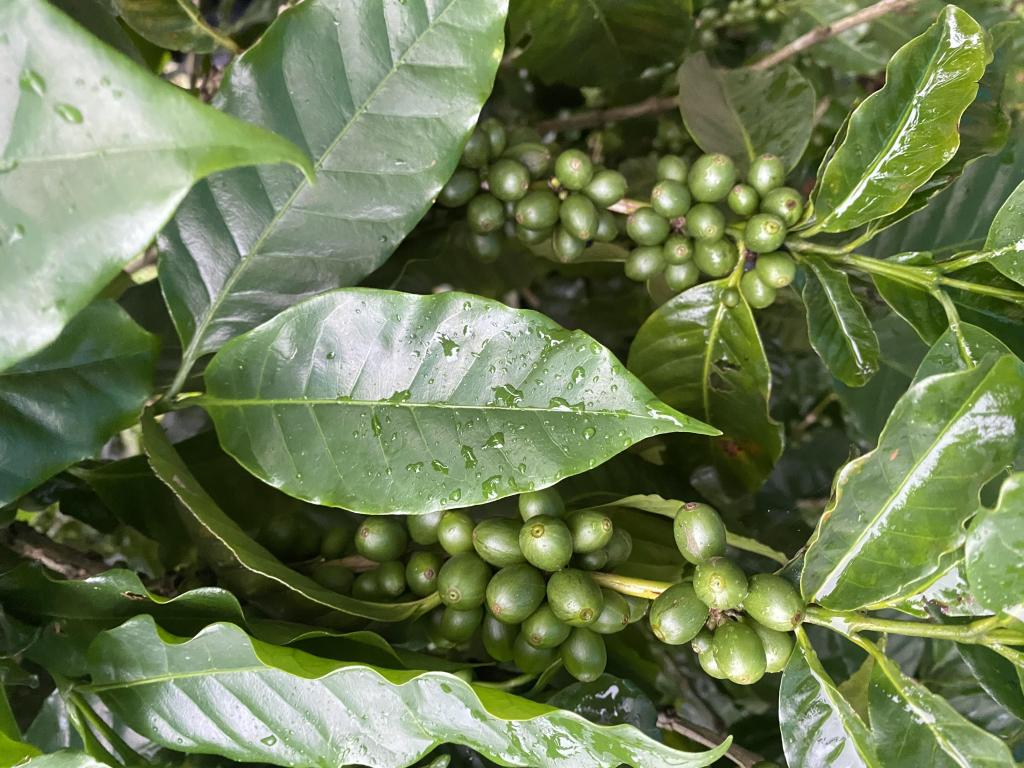
Figure 1: Unripe Arabica berries of the Geisha variety in Costa Rica
Source: Photo by Tjalling de Boer, 2024
Tips:
- Activate your browser's 'Translation' function to make this study available in your native language.
- Inform yourself of the different characteristics of Arabica varieties before you decide which trees to plant. Arabica trees are generally most productive when they are between 7–20 years old, so your decision on which trees you plant will have long-term consequences. Varieties differ widely in yield, revenue, disease resilience and taste.
2. What makes Europe an interesting market for Arabica coffee?
Europe is the world's largest coffee consumption market. It is also home to a very large roasting industry. Europe is also a major importer of Arabica. Arabica imports make up for about 65% of the green coffee imports. This percentage is based on our definition, as mentioned in the first section of this study.
Europe: World's largest coffee consumption market
Europe is the world's largest coffee consumption market, with about 3.2 million tonnes of green coffee accounting for 30.6% of global coffee consumption in 2024. Asia-Pacific is the 2nd-largest, with a share of 27.1%, followed by South America (16.0%), North America (15.9%) and Africa (6.9%).
The amount of coffee Europeans drink is not expected to grow much. Almost all Europeans can afford coffee, and economic growth will hardly lead to more consumption. Also, the European population is growing slowly. Between 2005 and 2024 it grew by an average of 0.2% per year, compared to Africa, which was close to 2.5%. Despite the predicted low volume growth, the value of imports is expected to rise due to the increasing demand for high-quality coffee.
Source: International Coffee Organisation market report, March 2026
Europe: Major Arabica coffee importer
Europe is a very large importer of Arabica coffee. In 2025, it imported 2.0 million tonnes of green Arabica coffee. The imports are relatively stable on the long term, but vary slightly from year to year. For example, imports were higher in 2024, at 2.3 million tonnes. This decline is no indication of a structural downward trend. A decline in imports from Brazil explains 84% of the import reduction. Brazil, the world's largest Arabica producer, suffered a 18.4% decline in Arabica production in the 2024-2025 season. This was mainly caused by poor flowering and frost.
Source: Eurostat and ITC Trademap, 2026
Short-term projection
The European coffee market is saturated. In volume, European Arabica imports are expected to remain stable in the 2025-2026 season. However, in value the market is expected to grow. The main reason for this is premiumisation, which is the increasing value of coffee products. You can read more about this in our study on coffee market trends. Note that premiumisation does not always lead to a demand for higher-quality coffee. Most of the premiumisation is realised in the ready-to-drink (RTD) market. The coffee in the RTD market is often of lower quality because taste becomes less important when other ingredients are added.
Long-term projection
Looking at the long-term outlook at the global level, demand for coffee is expected to exceed supply. One important reason for this increase in demand is the growth in Asia, where more people are drinking coffee than ever before.
Another important factor is climate change, which affects coffee production more and more. This applies particularly to Arabica, which is more vulnerable to rising temperatures and unpredictable weather conditions. Climate change brings higher temperatures, unpredictable weather, and more pests and diseases. These problems make it more difficult to produce enough coffee to meet demand and affect bean quality. As a result, coffee is likely to become more expensive, supplies may decrease, and quality or taste profiles could be affected.
Besides climate change, other major problems could affect supply. Most coffee farmers are now between 55 and 60 years old. Not enough younger people are willing to take over their farms. This means that as older farmers retire, there may not be enough new farmers to take over coffee production. If this trend continues, it could further reduce coffee production and worsen existing supply issues.
Tips:
- Read our study on the demand for coffee on the European market to learn more about European coffee consumption.
- Read the International Coffee Organisation market reports (ICO) to stay updated on the developments of Arabica production and exports. The ICO publishes a market report every month.
- Participate in coffee events to connect with potential buyers. For example, World of Coffee can help build a network in the Arabica market. There are also different coffee events in producing countries, including the AFCA Conference in Africa and Sintercafe in Costa Rica.
3. Which European countries offer the most opportunities for Arabica coffee?
Germany and Italy are by far the largest Arabica-importing countries in Europe. In 2025, Germany imported 611,000 tonnes of green Arabica directly from producing countries. Italy followed with 325,000 tonnes, then Belgium (181,000), Switzerland (175,000), the Netherlands (123,000) and Spain (121,000).
Source: Eurostat, 2026
Germany: Europe's largest coffee hub with a strong certified market
Germany is Europe's largest coffee-importing market. In 2025, it imported 938,000 tonnes of green coffee directly from producing countries. German imports have remained stable over the past five years, except for 2023, when they dropped to 869,000 tonnes due to global shortages.
Between 2021-2025, Arabica imports were 70% of the total coffee imports. Imports fluctuated between 591,000 tonnes in 2023 and 760,000 tonnes in 2024. In 2025, Germany imported 611,000 tonnes of green Arabica, with Brazil (356,000 tonnes), Honduras (62,000), Colombia (61,000) and Peru (40,000) as its largest suppliers. Note that a large share of imports from Brazil is actually Robusta.
Most green coffee beans enter Germany via the port of Hamburg, where Neumann Kaffee Gruppe, the world's largest coffee trader, is headquartered. The ports of Bremen and Bremerhaven are also major ports. As the largest coffee market in Europe, Germany is an ideal destination for exporters of various qualities and origins.
The German coffee market is known for fierce price competition among discounters. Examples are Aldi, Lidl, and Rewe. Aldi Nord has its own roasting facility. The owner of discounter Lidl also has its own coffee roastery in Germany. Aldi Süd has relaunched its roasting facility, New Coffee, after closure due to poor business results in 2022.
Germany: Large market for Fairtrade and organic coffee
Germany is one of the world's largest markets for Fairtrade coffee. According to Fairtrade Germany, 5.3% of all consumption was Fairtrade-certified in 2024. Almost all Fairtrade coffee is Arabica coffee.
Based on Traces data, Germany is Europe's largest market for organic-certified coffee. This creates interesting opportunities for organically certified coffee exporters. However, Germany is also the most competitive organic coffee destination market in Europe, having imported 49,000 tonnes of organic green coffee in 2024. This is a 15% decrease in imports, despite an increase in green coffee imports in 2024. This is most likely due to higher coffee prices, which drove consumers towards cheaper, non-organic alternatives.
German traders of organic coffee include Bernhard Rothfos, InterAmerican Coffees, List + Beisler and Rehm & Co.
Germany also has a large market for double-certified coffee. 75% of all Fairtrade-certified coffee was also organic-certified. This percentage has been stable since 2011, fluctuating between 68% and 78%. Since 5% of all German coffee was Fairtrade-certified, approximately 4% of all coffee sales in Germany were Fairtrade-organic certified. The largest German retailers sell Fairtrade-organic coffee as part of their offering. Aldi sells Fairtrade-organic coffee under its Simply Nature brand. Lidl sells Fairtrade-organic coffee under its Café del Mundo brand. REWE also sells Fairtrade-organic coffee.
Italy: Famous for its Robusta-based espressos plus imports significant volumes of Arabica
Italy is Europe's 2nd-largest coffee importer. In 2025, it imported 588,000 tonnes of green coffee from producing countries directly. Italy's main Arabica suppliers are Brazil (205,000 tonnes), India (52,000 tonnes), Honduras (13,000 tonnes), Tanzania (13,000 tonnes) and Colombia (11,000 tonnes). Note that a large share of the imports from Brazil and India are actually Robusta.
In recent years, Arabica imports have accounted for about 55% of Italian imports, far below the European average. This can be explained by Italy's espresso-based coffee culture, which often uses Robusta. Italian importers include Garbin Coffee Trade and Alkaff.
The top-5 Italian coffee roasters account for over half of the total market. According to Beverfood, the largest companies are Lavazza, Illy, Nestlé Italia and Caffe Borbone. Segafredo Zanetti, part of Massimo Zanetti, is another very large Italian roaster, with a highly international focus.
Other large coffee roasters based in Italy:
It is unknown what the share of Arabica is for the companies mentioned above. All these companies buy large quantities of Arabica and Robusta coffee. In Italy, the role of Fairtrade and organic certification is very minor.
Belgium: Offering a growing market for certified coffees
In 2025, Belgium imported 242,000 tonnes of green coffee directly from producing countries, of which 181,000 tonnes are Arabica. Their total coffee imports from producing countries have declined from 320,000 tonnes in 2021. Since 2021, some traders have chosen other ports than Antwerp to get their coffee to the European market. A large share of the coffee meant for other European countries now flows via the Netherlands. Despite this reduction, Belgium remains one of the main coffee trading hubs in Europe. Belgium re-exports about two-thirds of its green coffee imports to other European countries. It is unclear what share of these re-exports is Arabica.
Belgium's main Arabica suppliers are Brazil (86,000 tonnes), Honduras (21,000), Peru (16,000), Nicaragua (13,000) and Colombia (12,000). Note that a large share of the imports from Brazil are actually Robusta. Efico and Supremo are Belgian trading companies that import green coffee. However, multinational companies like Neumann Kaffee Gruppe (NKG), Ecom and Volcafe dominate the Belgian trade market.
Organic imports are growing
Belgium imported 26,000 tonnes of organic green coffee in 2024, making it the EU's 2nd-largest organic coffee importer. In 2024, organic imports were on the same level as in 2019. In 2019-2024, imports fluctuated year by year, reaching a low of 21,000 tonnes in 2020 and a high of 29,000 tonnes in 2023. Most organic coffee is Arabica.
Belgium's retail scene is diverse. Major chains and small stores sell organic coffee. Demand has pushed large retailers, like Delhaize, Colruyt and Carrefour, to expand their organic lines. They often offer organic coffee brands at competitive prices.
Fairtrade coffee offers a stable market. Belgian Fairtrade green coffee sales amounted to 2,686 tonnes in 2024, up 0.7% from 2023. In terms of market share, 4.4% of all coffee sales were Fairtrade-certified in 2024 – same as 2023. Almost all Fairtrade coffee is Arabica coffee.
Sucafina is a global coffee trader, also based in Belgium. The company sources coffee certified according to different certification programmes, including Fairtrade.
Switzerland: Imports include a large share of Arabica coffee
In 2025, Switzerland imported 205,000 tonnes of green coffee directly from producing countries. Almost all coffee, 175,000 tonnes (86%), comes from Arabica-producing countries. Switzerland's main Arabica suppliers are Brazil (57,000 tonnes), Colombia (40,000), Costa Rica (15,000) and India (13,000). Note that a large share of the imports from Brazil and India are actually Robusta. Nestlé, the world's 2nd-largest coffee company, has very large roasting facilities in Switzerland.
Fairtrade retail coffee sales amounted to €108 million in 2024, representing 2% growth compared to 2023. Fairtrade coffee volumes rose sharply to 9,630 tons (+26%), indicating strong consumer demand. Dedicated coffee roasters were a main reason for this: the 65 Fairtrade coffee roasters increased sales by 22%, with several Swiss roasters and brands expanding their Fairtrade ranges. Nespresso further strengthened Switzerland's role by roasting all of its Fairtrade coffee worldwide in Switzerland, making it the country's largest Fairtrade coffee roaster. Almost all Fairtrade coffee is Arabica.
Swiss imports of organic green coffee are limited. According to BioSuisse, these amounted to 1,466 tonnes in 2022, 1,639 tonnes in 2023 and 1,148 tonnes in 2024. These numbers only represent imports by BioSuisse certified companies, which is about 60% of total organic green coffee imports. About 1% of all green coffee imports is organic-certified. To compare, in Germany this is above 4%. The decline in green coffee imports in 2024 is similar to that of most other European countries. A main reason specific for the Swiss market, is that Migros, Switzerland's largest retailer, stopped purchasing many BioSuisse products. Most organic coffee is Arabica.
Increasing demand for specialty coffee is a major reason for growth
Domestic demand for conventional coffees in Switzerland has stagnated, while that for high-quality coffees is growing. Swiss consumers also have a high demand for decaffeinated coffee and espressos, including Arabica coffees. If you aim to broaden your network in the Swiss specialty coffee sector, there are many opportunities:
- The Specialty Coffee Association Switzerland (SCAS) organises specific coffee events, seminars and courses.
- The Swiss Coffee Festival is one such event, especially aimed at Swiss-German speakers.
- The Swiss Coffee Connection is the main event for the French-speaking Swiss. There are also several private coffee academies authorised by SCAS to promote knowledge about specialty coffees, like Académie du Café.
The Swiss Coffee Trade Association (SCTA) is an important organisation in Switzerland and globally. Its membership includes several large multinational companies that manage a significant portion of the global coffee trade. This includes both commercial and specialty coffees. Swiss traders handle over 50% of global coffee transactions. This does not mean the coffee physically passes through Switzerland. Instead, the trading activities are conducted through Swiss offices, often for tax advantages. Large traders headquartered in Switzerland include Ecom and Sucafina.
The Netherlands: Offers a competitive market for sustainable initiatives
In 2025, the Netherlands imported 199,000 tonnes of green coffee from producing countries directly, more than triple the 58,000 tonnes of 2020. A shift in trade partners mainly explains the growth of imports from producing countries. Out of these 199,000 tonnes, 123,000 come from Arabica-producing countries. Brazil (72,000 tonnes) and Colombia (17,000 tonnes) are its main Arabica suppliers. Note that a large share of the imports from Brazil are actually Robusta.
Whereas previously large volumes were imported from Belgium and Germany, Dutch traders have moved more and more towards sourcing directly from producing countries. Some Dutch coffee trading companies active in the Arabica coffee market are Daarnhouwer and Bijdendijk. Dutch specialty coffee importers include Trabocca, This Side Up and The Coffee Quest.
The Netherlands is an interesting country for companies focused on sustainability because consumers are highly aware of sustainability and willing to pay for it. However, there is strong competition from many different sustainability-focused coffee suppliers. For example, besides certification, the Netherlands founded two companies (Moyee and Guzo) that roast at origin. They do so to keep a larger share of the chain, and as a result added value, in the producing country.
Fairtrade green coffee sales amounted to 5,664 tonnes in 2024, up 4% from 2023. This is equal to about 5% of the Dutch market. The share of Fairtrade certified coffee, comprising almost fully of Arabica, has remained stable for many years. One Dutch roaster working with Fairtrade Arabica is Peeze.
Organic coffee imports varied between 3,445 and 3,883 tonnes in 2018-2022. 2023 and 2024 showed lower import levels of 2,569 and 2,751 tonnes, respectively. Simon Lévelt is an all-organic Dutch specialty coffee roaster. Its coffee is available in specialised shops and supermarkets.
The Dutch drink a lot of coffee – about 4 cups of coffee per day on average. With only 18 million inhabitants, they are the 6th-largest coffee-consuming country in Europe. You can find more information in our study Exporting coffee to the Netherlands.
Spain: Imports mainly Robusta
Spain is Europe's 3rd-largest coffee-importing market. Spanish imports have remained stable in the past 5 years: in 2025, Spain imported 274,000 tonnes of green coffee directly from producing countries, in 2020 this was 266,000 tonnes.
Spain has one of the highest shares of Robusta of all European markets. This can largely be explained by Spanish coffee culture and the popularity of Robusta-based espresso. However, imports of Arabica have grown, from 97,000 tonnes in 2021 to 121,000 tonnes in 2025. In 2025, Spain sourced most Arabica from Brazil (86,000 tonnes) and Colombia (18,000 tonnes). Note that a large share of the imports from Brazil are actually Robusta.
Some of the leading Spanish importers:
- Icona Café (Madrid);
- Coprocafé Ibérica (part of Neumann Kafé Gruppe, in Madrid);
- Volcafe Iberia (Madrid);
- Louis Dreyfus Company España (Madrid);
- Guzmán Coffee & Nuts (part of Guzman Minerals), in Valencia);
- Tostadores Reunidos (Madrid).
In 2024, at 3,764 tonnes, Spain was the 6th-largest organic coffee importer, with volumes far above the Netherlands (7th-largest), which imported 2,751 tonnes. Most of these organic imports are Arabica. Organic imports have grown over the past few years – by 123% since 2018. Spain only has a limited market for Fairtrade coffee.
Tips:
- Find more opportunities and information in our studies on specific European markets, like Exporting coffee to Germany, Exporting coffee to Italy, Exporting coffee to Belgium, Exporting coffee to Switzerland, Exporting coffee to the Netherlands and Exporting coffee to Spain.
- Find more information on European markets by looking on the website of their coffee associations, for example the Spanish Coffee Association website (AECafé) and the Dutch Koffie en Thee. You can find sector news and national events on these websites.
- Before certifying, find out if buyers are willing to purchase your certified coffee. Although certified coffee usually comes with a premium, not all certified coffee is sold as such. You can read more about this in our study on exporting certified coffee.
4. Which trends offer opportunities or pose threats in the European Arabica coffee market?
The European market for Arabica coffee is changing due to several trends. Most of these trends are described in our study on trends in the coffee market. Since the Arabica market is large and diverse, most of these trends in the coffee market apply to the Arabica market as well. However, some trends have a specifically large effect on the Arabica market – these are climate change, changing prices, market uncertainty and the growing European speciality coffee market.
Climate change especially affects Arabica production
Climate change threatens coffee productionglobally, lowering availability and quality. Coffee plants require specific temperature and rainfall conditions. These are more and more disrupted due to climate change. Rising temperatures increase vulnerability to pests and diseases, which impacts productivity as well as the flavour profile of coffee beans, potentially resulting in less desirable tastes.
Many Arabica growers are impacted. Already, 8% of the land currently used for Arabica production is now unsuitable due to climate change. Climate change will likely reduce half the land available to grow Arabica coffee. Other, more positive publications, report 20% reduction. The pace at which land becomes unsuitable for growing Arabica varies widely by country and region. Nonetheless, millions of coffee farmers and labourers will face declining production and may be forced to abandon or adapt their livelihoods.
Although climate change will affect many farmers negatively, it may also lead to higher prices. If your area is affected by climate change, you will likely suffer lower yields. If availability is lower, it is likely that prices will rise. It is unclear whether and to what extent producers and exporters will profit from these higher prices, as not all producers profit from higher prices.
For exporters, it is important to have access to multiple buyers to profit from higher prices. Better market access, however, does not guarantee better prices. Producers should consider other steps to prepare for climate change, such as income diversification, improving water management, implementing integrated pest management, shifting towards regenerative agriculture, agroforestry, and working with climate-resistant varieties. One example of income diversification is to start producing honey. Beehives generate extra income and improve the health of your coffee farm. In this article by AA you can read more about how producers in Uganda keep bees to foster coffee production and diversify income.
Changing prices and uncertainty change market dynamics
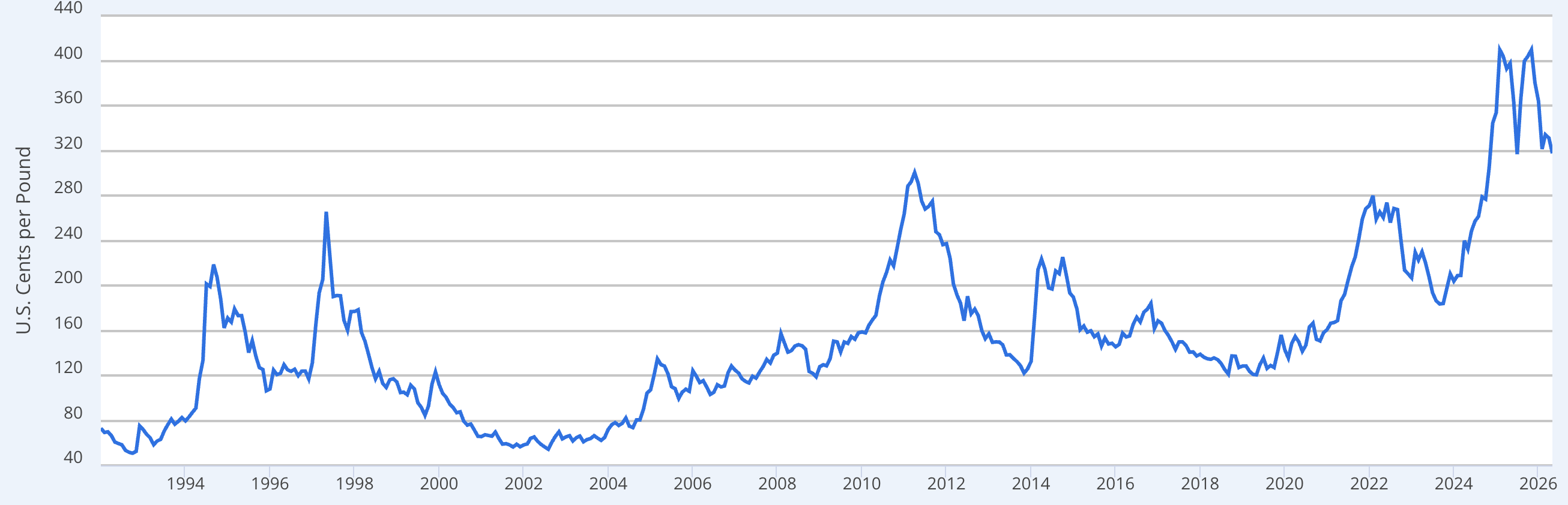
Arabica prices have risen strongly in recent years. This is caused by higher production and transport costs, plus strong global demand. Climate change plays a major role. It reduces yields and increases production risks and costs (see previous section). Prices will continue to fluctuate (often called volatility). Still, prices are expected to remain relatively high in the coming years.
Figure 5: Price development of Other Mild Arabica, since 1992
Source: FRED, 2026
Another major disruptive factor is the trade tariffs imposed by the United States. These tariffs change quickly, vary by country, and are hard to predict. As a result, trade flows that were stable for many years are now being disrupted.
How this changes trade of Arabica coffee
The developments described above affect the Arabica green coffee trade in several ways. First, they have shifted some power toward sellers, particularly in the high-end specialty segment where quality Arabica is more and more scarce. This allows suppliers, in some cases, to negotiate higher prices and more favourable terms. Exporters may also make more strategic choices, focusing on long-term partnerships or seeking the most competitive price available. In some cases, sellers have been reported to default on existing contracts in order to sell their coffee at a higher price elsewhere, though this remains a sensitive issue in the trade.
Although some negotiation power has shifted to suppliers, not all producers profit, for several reasons. First, production costs have also increased. Second, market access differs between regions. Third, although many European traders and roasters struggle, other companies have seized opportunities to turn these market shifts to their advantage. Large roasters like JDE Peet's and Lavazza reported strong profits.
Price volatility also encourages risk-averse behaviour. One result is paying closer attention to inventory levels, as it is unclear what coffee will be worth in a few months. Some importers choose to buy more coffee when it is physically available, rather than through futures contracts. Often, this coffee is purchased alongside a contract with a roaster. This allows the importer to largely offset price risk by aligning purchases with confirmed sales.
Finally, these developments put pressure on trading relationships. Some long-standing partnerships are ending due to strategic realignments or purely transactional decisions. At the same time, others are deepening, as buyers and sellers seek greater stability through closer collaboration and longer-term commitments.
To capitalise on higher prices, it is important to remain flexible. This requires access to funding or high liquidity to sell at the right moment, which is often problematic. It also requires market access to shorten the value chain. For example, Sorgeba Union is a group of Ethiopian producers that offers its coffee directly to importers through the online marketplace Beyco.
Some specialty coffee importers, like This Side Up, avoid market speculation and price swings by using long-term contracts. They work with farmers directly and agree on stable prices for several years. This gives farmers more security and helps them plan ahead. By building trust and maintaining open communication and transparency, both sides benefit. Farmers can invest in their farm and care for their land, knowing they will get a fair price. This approach helps create more stable, sustainable and equitable supply chains.
The European premium and specialty segments continues to grow
The European premium and specialty coffee markets have grown for years and continue to do so. These sectors are dominated by Arabica beans. Consumers want high-quality, unique coffee experiences. Some consumers are willing to pay more for coffees with inspiring origin stories. Globally, younger generations are driving this trend due to their interest in sustainability and ethical sourcing.
Demand for premium and specialty coffee is rising across various channels, including e-commerce and supermarkets. An example is the Dutch Little Roastery, offering their coffee directly to their consumers via their website. The British Origin coffee sells compostable specialty coffee capsules in their webshop. Most European supermarkets sell premium or specialty coffee. For example, the Dutch supermarket chain Albert Heijn sells single-region specialty-organic coffee roasted by Simon Lévelt.
In the premium segment, single-origin coffee is important. Growers from Ethiopia, for example, rely on the uniqueness of their origins, which is considered the birthplace of coffee. Peruvian producers also promote their origins through their national coffee brand Cafés del Peru. In the high-end specialty market, the region is even more important, and much of this coffee is sold as single estate coffee (traceable to a single farm). An example is Los Lajones Geisha. The German roaster The Barn emphasises that the coffee is produced by Graciano Cruz, connecting consumer to producer.
Tips:
- Read our studies on trends on the European coffee market and exporting specialty coffee to the European market to better inform yourself on these topics.
- Consider adopting agroforestry practices, for instance by growing your Arabica under shade trees. While this may reduce yields in the short term, it extends the lifespan of your trees, improves cup quality, and increases resilience to climate change.
- Consider major steps to prepare for the impact of climate change, such as diversifying your crops, improving water management and implementing integrated pest management. An example of diversification is to start producing honey. Beehives not only generate extra income, they also foster the health of your coffee farm.
- Inform yourself on how to prepare for climate change and what steps to prioritise. For instance, you can start by reading the Fairtrade Climate Academy Guide for coffee producers.
- Work on the quality of your product. There is increasing demand for higher-quality Arabica.
Molgo Research carried out this study in partnership with Ethos Agriculture on behalf of CBI.
Please review our market information disclaimer.
Search
Enter search terms to find market research
Do you have questions about this research?
Large coffee buyers think in 5 dimensions when deciding which coffee to buy: (1) availability in the long term, (2) quality consistency, (3) pricing, (4) climate risk, and (5) compliance with regularity and traceability.

Gerd Mueller-Pfeiffer, CEO of International Coffee Consulting, former CEO of Nestlé Germany