
How tourism businesses can benefit from slow tourism
More European travellers are choosing to slow down when they travel to properly connect with the places they go. They want to spend more time in one location, connect with the local people and understand the destinations they visit. This is a real opportunity for tourism businesses in low and middle-income countries. Your location, community and way of life are what these travellers are looking for. This study explains what slow tourism is, who it attracts and how you can use it to strengthen your tourism offer.
Contents of this page
- What is slow tourism?
- What do slow tourism travellers want?
- What do slow tourism travellers look for?
- Slow tourism case studies
- How to include slow tourism in your tourism products
- Opportunities, risks and limitations for tourism businesses
- How slow tourism adds value to your existing products
- What this means for tourism businesses
- The future of slow tourism
1. What is slow tourism?
Slow tourism is a way of travelling that focuses on taking time and experiencing a place more deeply. It is not a specific product, but an approach that you can apply across different types of tourism, including nature, food and community-based tourism. The focus is on depth rather than speed, and on helping your visitors feel genuinely connected to where they are.
The idea comes from the Slow Food movement in Italy, which promoted local culture, traditional food and a slower pace of life. Over time, this way of thinking spread beyond food and rural areas. Today, slow tourism can be applied in many types of destinations.
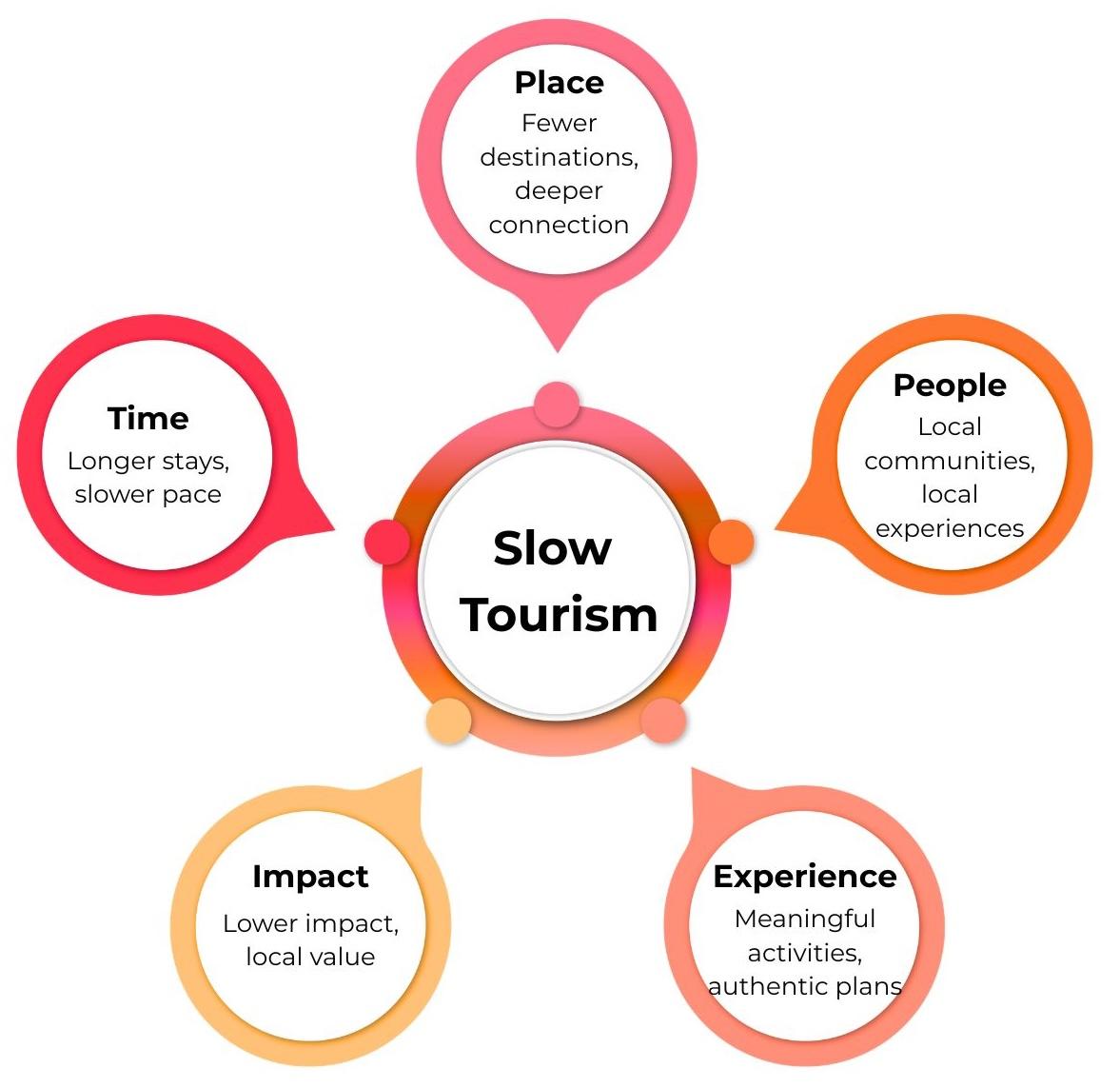
The diagram below highlights five important elements of slow tourism: time, place, people, experience and impact. Together, these elements can help you design experiences that feel more personal and create more value for the people in your destination. Explore the case studies below to see how this works in practice.
Figure 1: Slow tourism model
Source: Acorn Tourism Consulting, 2026
The meaning of ‘slow’ has evolved. It is not only about speed but also the quality of the experience. Your visitors want more time to connect with places, people and culture, and to engage more fully with the destination.
For example, a slow tourism experience in Colombia could offer several days in a coffee region village. There can be guided walks with local farmers, birdwatching, traditional cooking and time to explore the area at a relaxed pace. Instead of visiting many destinations quickly, the experience focuses on understanding a single place more deeply.
Slow tourism research from Portugal shows that the most common activities include the following:
- Guided walks
- Cycling
- Horse riding
- Wine and food tastings
- Cooking workshops
- Farm visits
- Stargazing
- Stays in rural accommodation with no phones or TV distractions
Some of these are relatively easy to organise at low cost and may require only a small change to what you already do.
At the same time, more tourism businesses are now using slow tourism ideas, without calling it as such. According to Euromonitor International, major operators are already changing what they offer to attract travellers who want to slow down. Slow tourism is no longer just for a small group. It is becoming part of how the wider tourism market works.
Take a look at these examples of slow tourism products on the market today:
- Sloways, slow holidays in Albania: a walking-based slow travel experience in Albania, designed around moving at your own pace, staying in local accommodation and connecting with rural landscapes and communities along the route.
- Much Better Adventures, Hike and kayak in Indonesia: a small group adventure in remote Indonesia combining hiking and kayaking, built around one destination, local guides and slower travel through less-visited island landscapes.
- Inntravel, cycling holidays in Croatia: a self-guided cycling holiday in Croatia built around rural landscapes, local accommodation and moving at your own pace through less-visited areas.
2. What do slow tourism travellers want?
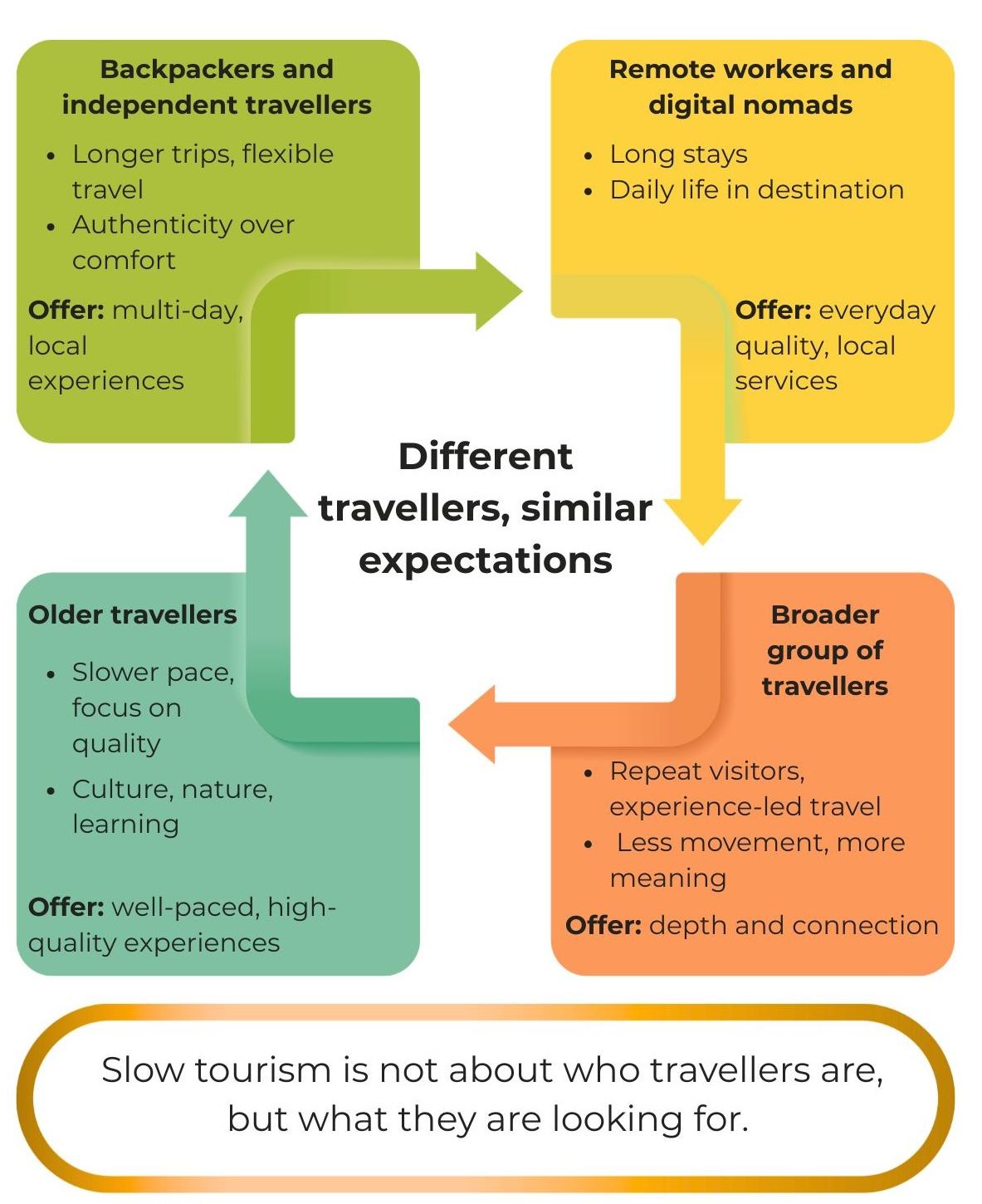
Slow tourism is not limited to one type of traveller. Different people travel slowly for different reasons, and that is part of what makes it a useful approach for a wide range of businesses. You can see how different groups of travellers interested in slow tourism share similar expectations in the chart below.
Figure 2: Market profile
Source: Acorn Tourism Consulting, 2026
Backpackers and independent travellers are a natural fit for slow tourism. They often travel for longer periods of time, move at their own pace and are curious about local life. Low prices are important for them, but many are willing to spend more on experiences that feel real rather than highly packaged. Flexibility and local experiences often matter more than comfort. A well-designed multi-day experience with a local guide, a home-cooked meal or access to places outside the standard tourist route can be more appealing than discounted tours.
Remote workers and digital nomads are a growing and often overlooked segment. They stay for weeks or months, not days. The destination becomes part of their routine. They need a good local café as much as a good view. A digital nomad staying three weeks will spend significantly more on food, transport and local services than a tourist staying three days, even if they spend less per day. For businesses, this means everyday quality matters as much as the experience itself.
Older travellers, including retirees, have time, and they use it differently. They are less interested in covering ground and more interested in understanding a place. Culture, nature and learning tend to matter more than attractions. They are often willing to pay more for quality, and they tend to be loyal. A traveller who has a genuinely good experience is likely to return and likely to recommend.
Find out more about these markets and download the following CBI studies:
- What are the opportunities in the European FIT tourism market?
- What are the opportunities on the European baby boomer tourism market?
Beyond these groups, slow tourism is attracting a broader range of travellers. These include people tired of rushed trips, repeat visitors who want to go deeper and travellers with a growing awareness of the impact of their choices. The common thread is not who they are, but what they are looking for: less movement, more meaning.
3. What do slow tourism travellers look for?
Slow tourism is shaped by how people travel and what they expect from their trips. One of the clearest changes is the growing interest in spending more time in a single destination. Travellers want time to slow down, return to places they enjoy and experience destinations at a more natural pace. Many are moving away from rushed itineraries built around visiting as many places as possible.
For tourism businesses, this creates opportunities to put together experiences that go beyond short activities or one-day tours. Multi-day experiences, flexible itineraries and experiences built around one area are becoming more attractive to many European travellers.
There is also growing interest in experiences connected to local life. Instead of only visiting attractions, more and more travellers want to meet people, hear local stories, try local food and understand how people live. This creates opportunities for businesses to involve local people more directly in the experience they offer.
At the same time, many travellers are trying to avoid crowded destinations and are looking for smaller towns, rural areas and less-known places. Flexibility also matters more than before. Some travellers now prefer to leave space in their itinerary to decide what to do during the trip, instead of planning every hour in advance.
This shift is also changing how tourism products are promoted. Travellers are often looking for experiences that feel personal, local and less commercial. Small details, such as a meal with a local family, a guided walk with a community member or staying longer in one place, can sometimes be more valuable than adding more activities to an itinerary.
Tips:
- Plan your itinerary around 2 or 3 places instead of 6 or 7. Visitors who stay longer in one place spend more, connect more deeply and are more likely to return.
- Build at least 1 experience around everyday local life. This could be a meal with a local family, a morning on a farm or an evening listening to local music. These moments are often what visitors remember most.
- Leave 1 or 2 free half-days in the itinerary. Tell your visitors they can explore at their own pace. Many will see it as a feature, not a gap.
- Keep your groups small. A group of 6 to 8 people allows for real conversation with local guides and hosts. Larger groups make this harder.
- Ask yourself: what would make someone want to spend 5 nights here instead of 2? Start there when you design your product.
4. Slow tourism case studies
The following case studies show best practices for applying slow tourism in tours, particularly in low and middle-income countries. These examples include tour operators and destination-based initiatives, and focus on longer stays, fewer locations and stronger connections with local communities. They highlight different approaches to designing experiences and provide practical ideas that tourism businesses can adapt.
Case study #1: Better Places, Netherlands
Tour: Low season trip in Costa Rica
Company: Better Places is a Dutch tour operator that works with local travel experts to design personalised trips in low and middle-income countries.
This itinerary encourages travel outside peak periods, helping to reduce pressure on popular sites and support local economies more evenly throughout the year.
Why this experience works
- Time: Travellers stay longer in fewer locations instead of moving quickly between destinations.
- Place: The trip includes smaller destinations and experiences outside the busiest tourism areas.
- People: Travellers interact with local guides, accommodation providers and community businesses.
- Experience: The focus is on flexible and personal experiences rather than rushing between attractions.
- Impact: Travelling during the low season helps spread income more evenly throughout the year.
This tour invites visitors to experience Costa Rica during the green season, when nature is at its best and destinations are less crowded. With fewer visitors around, travellers have more time to enjoy local experiences, connect with nature and explore the country more deeply. The itinerary responds to growing demand for less crowded and more experience-led travel, encouraging visitors to discover a different side of Costa Rica.
What you can learn from this example
The low season is an opportunity to offer something better. With fewer visitors, your destination feels more personal, local life continues at its own pace, and travellers get closer to the real experience. Think about what your destination looks and feels like outside peak season. If that version is genuinely interesting, start promoting it. You may find the travellers who come are exactly the kind of slow tourism visitors you want to attract.
Main takeaway
The Costa Rica itinerary by Better Places shows that travelling in the green season can be a positive part of the experience. With fewer visitors, small adjustments to pace, timing and local involvement can create more personal experiences and help spread the benefits of tourism throughout the year.
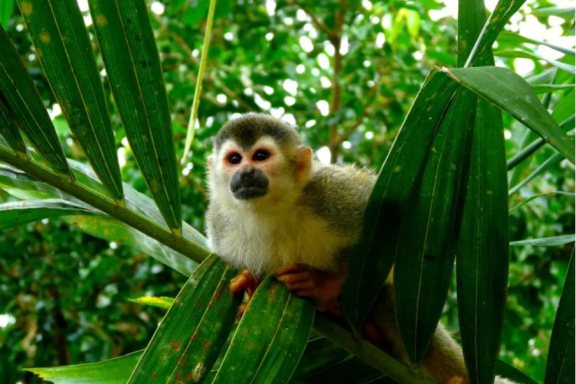
Figure 3: Slow tourism in Costa Rica
Source: Better Places, 2026
Case study #2: Intrepid Travel, Australia
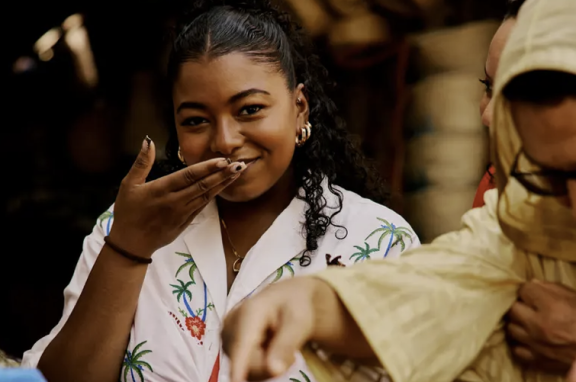
The tour: Applying slow tourism principles in a structured itinerary – Premium Morocco in Depth
The company: Intrepid Travel designs small-group tours that focus on local experiences, cultural immersion and responsible travel. Their premium range offers more in-depth itineraries with longer stays and greater comfort.
This itinerary includes time in major destinations like Marrakech and Fes, combined with visits to smaller towns and natural areas. The trip is designed to balance structured travel with time in each location and uses local guides and services throughout.
Why this experience works
- Time: Travellers spend more time in selected destinations instead of trying to cover the whole country quickly.
- Place: The trip combines major cultural destinations with smaller towns and natural areas.
- People: Local guides and local businesses are used throughout the itinerary.
- Experience: Travellers take part in cultural experiences connected to everyday life, food and local traditions.
- Impact: Small groups and local suppliers help spread the benefits of tourism more directly. The itinerary avoids the fast pace often linked to traditional group tours. Travellers have more time to explore, talk to local people and experience Morocco beyond the main tourist attractions. This example also shows that slow tourism works for independent travellers and organised group tours too, simply by slowing the pace, reducing group sizes and giving travellers more time in each place.
What you can learn from this example
If you run group tours, you do not need to move away from the slow tourism formula. Look at your current itinerary and ask yourself: how many destinations can we remove? Where can we add an extra half day? Which stops could be replaced with a more local, less-visited experience? These are small decisions, but they completely change how the trip feels. A group tour that visits 4 places well is a stronger slow tourism product than one that rushes through 8.
Main takeaway
Slow tourism works well in organised group tours when the focus is on quality, local connection and a slower pace rather than covering as many destinations as possible.
Figure 4: Slow tourism in Morocco
Source: Intrepid Travel, 2026
Case study #3: Much Better Adventures, UK
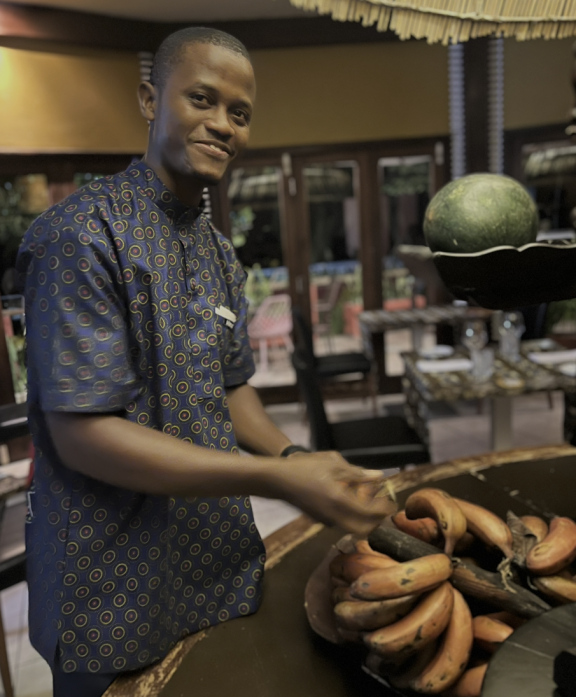
The tour: Journey to the Equator in São Tomé and Príncipe
The company: Much Better Adventures is a UK-based operator that specialises in small-group adventure travel in low and middle-income countries, including the Middle East, Africa and Asia. The company designs activity-based trips focused on nature, small groups and local experiences. Trips are built around one destination and use local guides, accommodation and services throughout.
This itinerary explores São Tomé and Príncipe over several days. It combines rainforests, cocoa plantations, beaches and small communities. Instead of moving between multiple countries or destinations, travellers spend their time discovering the unique character of these two small islands.
Why this experience works
- Time: Travellers spend several days exploring the islands rather than rushing through multiple destinations.
- Place: The itinerary is built around the islands’ unique combination of rainforests, plantations, beaches and small communities.
- People: Local guides, accommodation providers and community businesses play a central role throughout the journey.
- Experience: Activities combine nature, culture, food and local stories, helping visitors connect with the destination more deeply.
- Impact: Tourism spending supports local businesses and helps create economic opportunities in a lesser-known destination.
The itinerary encourages travellers to slow down and discover the islands through their landscapes, culture and everyday life. There is no rush to cover ground. The experience is built around being present in one place and learning about it fully.
This example shows that slow tourism works well in lesser-known destinations. Many European travellers are looking for places that feel genuine, unhurried and different from the destinations they have visited before. For many of them, discovering a place that most people have never heard of is part of what makes the trip special.
What you can learn from this example
You do not need famous attractions to create a successful tourism product. Your local culture, landscapes, food and way of life can be the experience. Travellers interested in slow tourism often look for destinations that feel different, personal and less crowded. Instead of trying to compete with well-known destinations, focus on what makes your place worth discovering.
Main takeaway
Some of the best slow tourism experiences are in places most travellers have never heard of. Nature, local culture and real connections with people are often more valuable than famous attractions.
Figure 5: Slow tourism in São Tomé
Source: Acorn Tourism Consulting, 2025
Case study #4: Trans Bhutan Trail, Bhutan
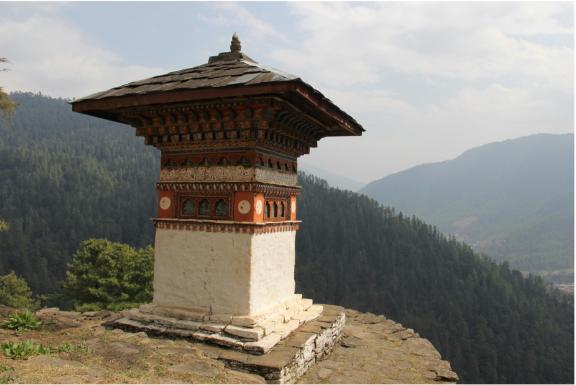
The tour: Long distance walking and cultural immersion in Bhutan
The company: The Trans Bhutan Trail is a national tourism initiative that restored a historic 400 km walking route across Bhutan. The trail connects rural communities, monasteries, forests and cultural sites across the country. Visitors travel the route on foot, using local guides, accommodation and services along the way.
Why this experience works
- Time: Travellers spend several days or weeks moving slowly across the country.
- Place: The trail connects villages, natural areas and cultural sites across Bhutan.
- People: Local guides, communities and small businesses are involved throughout the experience.
- Experience: Walking allows travellers to experience landscapes and local life at a slower pace.
- Impact: Tourism income is spread across multiple rural communities along the trail rather than concentrated in a few popular destinations.
As travellers move through different communities over several days, they interact with local people, learn about Bhutanese culture and experience everyday life in rural areas. The benefits of tourism are spread widely instead of staying in one or two major destinations. This is one of the clearest examples of how slow tourism can directly support rural communities and small businesses across a whole region.
What you can learn from this example
Think about whether your destination has a natural route. Think of a trail, river, cultural path or series of villages that connects different communities. If it does, the route is a tourism product. Instead of bringing visitors to one place and keeping them there, a route-based experience moves them slowly through several communities, leaving economic benefits along the way rather than concentrating them in one spot. This requires working with other local businesses and communities, but the result is a stronger, more distributed model that benefits far more people.
Main takeaway
Walking routes and multi-day trails encourage travellers to spend more time in your destination, interact with local communities and create more economic value across different parts of your region, and not just in the most visited spots.
Figure 6: Slow tourism in Bhutan
Source: Truly Bhutan, 2022
Case study #5: Inside Travel Group, UK
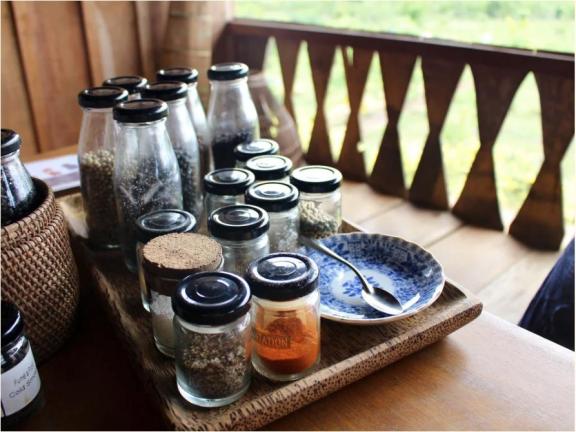
The tour: Food-based slow tourism in Cambodia
The company: Inside Travel Group is a UK tour operator that specialises in travel experiences across Asia. Through its Cambodia tours, visitors can spend time on local pepper farms in Kampot. Guided tours, tastings and farm visits help travellers learn about pepper growing, harvesting and processing. Many of these experiences are run by local farmers and families, giving visitors the chance to learn about rural life while exploring the countryside.
Why this experience works
- Time: Visitors spend time learning about the full production process.
- Place: The experience is strongly connected to Kampot’s landscape, agriculture and food culture.
- People: Travellers interact directly with farmers and local producers.
- Experience: Activities include guided visits, tastings and learning about traditional farming methods.
- Impact: Income goes directly to local farms, guides and small tourism businesses.
This experience turns local agriculture into a tourism product without losing its connection to everyday life. Visitors are introduced to real farming processes and local knowledge rather than staged activities created just for tourists. This makes the experience feel personal and genuine, exactly what slow tourism travellers are looking for.
This example also shows something encouraging: you do not need a complex itinerary or luxury facilities to attract European travellers. Simple experiences built around food, local knowledge and direct interaction can create strong value.
What you can learn from this example
The production process behind your local product is the experience. You do not need to build a visitor centre or create a special programme. The farm, workshop, kitchen and drying process, for example, are already interesting to European travellers who have never seen them. Think about what you produce or work with every day that visitors could witness, learn about or take part in. Then open the door and let them in. That is the experience. You do not need to create something new.
Main takeaway
Food and farm-based tourism helps visitors spend more time understanding local culture and everyday life while creating direct income for local communities and small businesses.
Figure 7: Slow tourism in Cambodia
Source: Inside Asia Tours, 2026
Case study #6: Vapues Travel, Panama/Nicaragua
The tour: Slow travel through community connection in Nicaragua and Panama
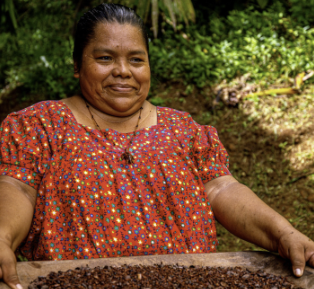
The company: Vapues Travel is a locally based tour operator specialising in tailormade travel in Nicaragua and Panama. The company has developed an approach they call ‘Location Bound Slow Travel’. They encourage travellers to stay in one or several hubs instead of moving quickly between multiple destinations. Visitors spend time in each hub, learning about local culture, daily life and the work of local providers, such as coffee producers, artisans, rural cooperatives and indigenous communities.
In Panama, this includes experiences with the Naso community, developed in partnership with the Panamanian Foundation for Sustainable Tourism. In Nicaragua, itineraries are built around destinations such as Isla Ometepe, Granada, León and rural communities in the north.
Why this experience works
- Time: Travellers stay longer in single destinations or regions.
- Place: The itineraries focus on smaller destinations, rural areas and local communities.
- People: Visitors interact directly with local guides, farmers, artisans and indigenous communities.
- Experience: Experiences are built around everyday life, culture and local realities instead of only tourist highlights.
- Impact: The approach supports local businesses, cooperatives and community initiatives.
Instead of trying to visit as many places as possible, visitors spend time learning about local culture, daily life and community realities. The itineraries create stronger local connections by working closely with community groups, local providers and small businesses. This makes the experience feel more personal and less like a standard tourist product.
What makes Vapues particularly relevant for your business is that this is not a large international operator. It is a locally based company in a low and middle-income country that built its entire model around slow tourism principles.
What you can learn from this example
Vapues is not a large international operator. It is a locally based company built in a low and middle-income country that made slow tourism the foundation of its entire business model. That matters because it shows that this approach is not reserved for big operators with large marketing budgets. Being close to your community, culture and destination is a real advantage in slow tourism. It is something large international operators find difficult to replicate and something many European travellers are actively looking for.
Main takeaway
Tourism experiences built around longer stays, local relationships and community connection create deeper experiences for travellers and more benefits for your destination and the people who live there.
Figure 8: Slow tourism in Nicaragua and Panama
Source: Vapues Travel, 2026
5. How to include slow tourism in your tourism products
Before making changes, take a moment to assess what you already offer. Many businesses already have elements of slow tourism even if they do not define them. The quick self-check below can help you identify where your current experiences align with this approach and where there may be opportunities to adjust. Do a quick self-check: is your product aligned with slow tourism?
- Do your itineraries require visitors to move frequently between locations?
- Do visitors have time to stay in one place and explore it more than once?
- Do your experiences include direct interaction with local people?
- Are you using local guides, food or services as part of the experience?
- Do visitors understand the story behind what they experience?
If most of your answers are ‘no’, there may be opportunities to adjust your product. If some are already ‘yes’, you may be closer to slow tourism than you think.
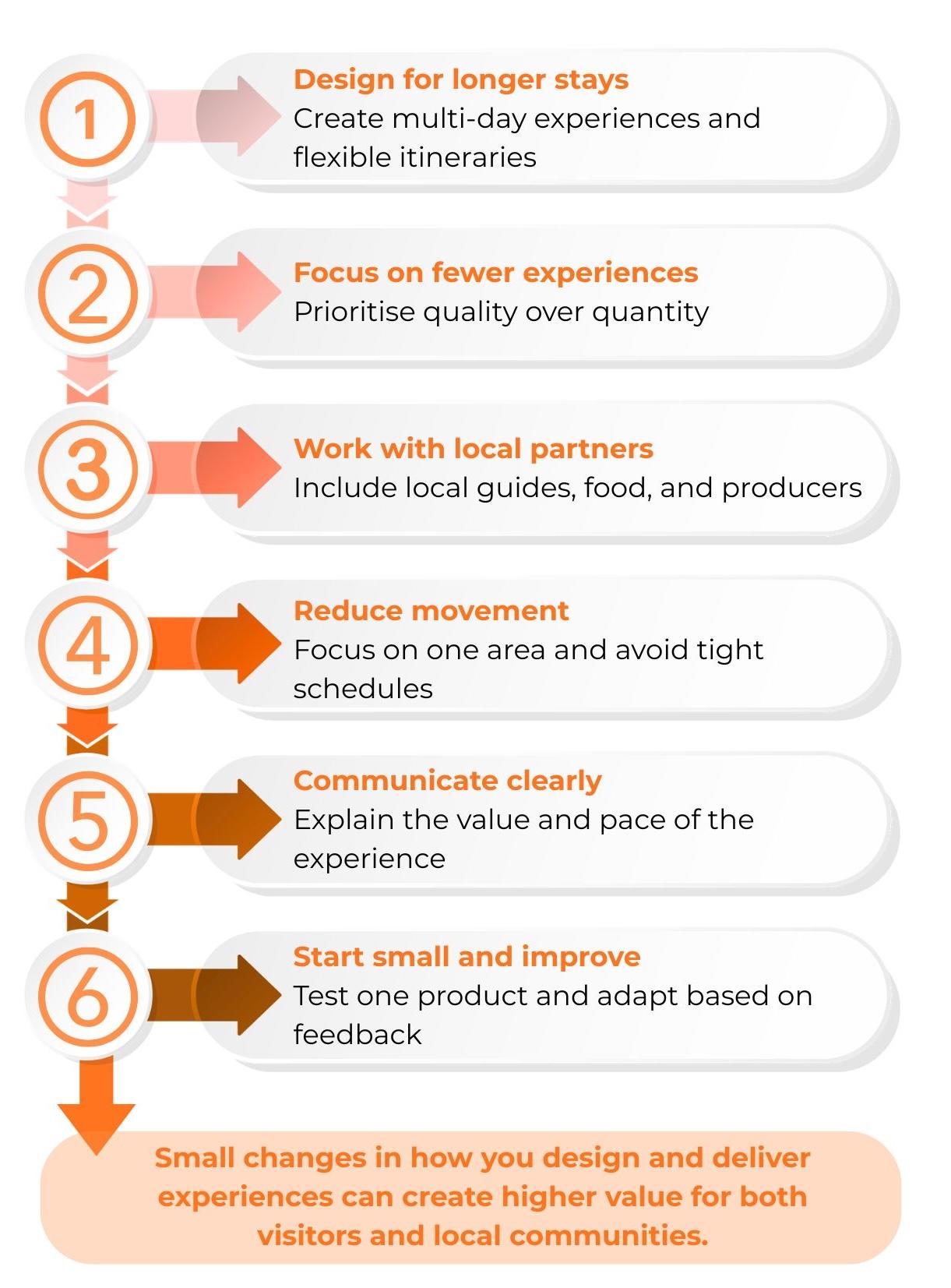
In most cases, moving towards slow tourism starts with small, practical decisions. Spending more time in one place, working with local guides or including locally based activities can already shift the experience significantly. The steps below give you a starting point. Focus on what is most relevant to your business and destination.
Figure 9: Applying slow tourism to your business
Source: Acorn Tourism Consulting, 2026
Tips:
- Design tours around what makes your place worth staying in. Start with what you already have. Your landscape, food and local knowledge are the foundation of a slow tourism experience.
- Talk to your local partners before you redesign anything. Guides, farmers, cooks and community leaders often have the best ideas. Involving them early makes the experience stronger and more sustainable.
- Test your experience with one small group before you scale. Slow tourism works best when it feels personal. A small, well-delivered product will do more for your reputation than a large, unfinished one.
6. Opportunities, risks and limitations for tourism businesses
Slow tourism can work well for small businesses in low and middle-income countries, but it is not the right fit for everyone. Before investing in this approach, it is worth understanding what you can gain and what to watch out for.
What are the main opportunities?
Slow tourism creates value by focusing on quality over volume. Visitors who stay longer tend to spend more on local services and experiences, which benefits both your business and the wider local economy. It also helps you define your offer more clearly, based on your place, community and way of working.
Slow tourism can also help you attract visitors outside peak seasons, reduce pressure during busy periods and build stronger relationships with local partners. In many cases, it builds on what you already have rather than requiring significant new investment. According to Euromonitor International, more and more travellers are spending more per trip, even if that means travelling less often. Visitors who travel slowly and stay longer are exactly the kind of travellers that drive this growth.
What are the risks and limitations?
The biggest risk is using ‘slow tourism’ as a label without making real changes to how your experiences are designed and delivered. If what you offer does not match what you promise, you will lose European buyers and travellers’ trust quickly. The name is not enough; the experience has to feel genuinely different.
Slow tourism is also not a solution for every business. Seasonality, limited local infrastructure and the small-scale nature of this approach can make growth challenging in some destinations. Be realistic about what is possible in your context before you invest.
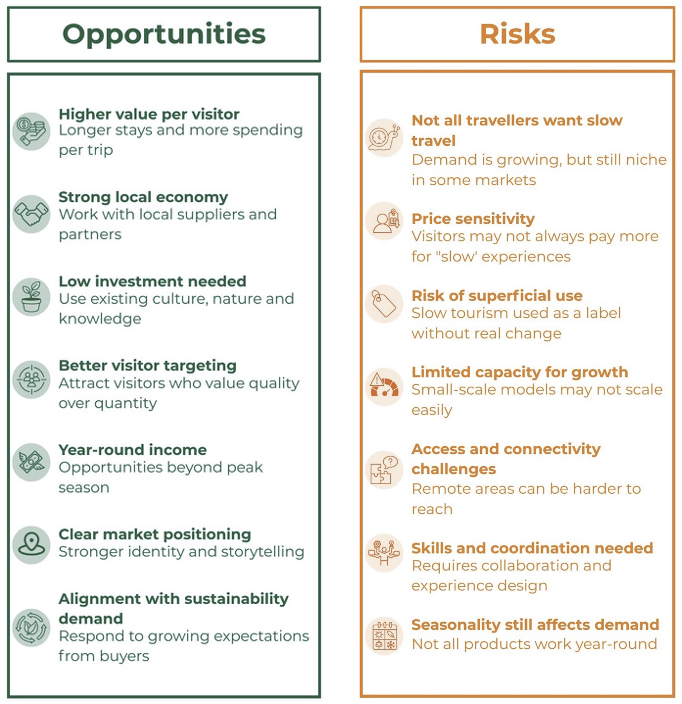
Look at the chart below to understand the major opportunities and risks of slow tourism for your business.
Figure 10: Opportunities and risks of slow tourism
Source: Acorn Tourism Consulting, 2026
7. How slow tourism adds value to your existing products
The experiences you already offer may be closer to slow tourism than you think. Food, community connections and responsible travel all share the same core principles. Here is how slow tourism can build on what you already do.
Food is one of the most natural entry points into slow tourism. A meal prepared by a local family, a visit to a farm and a market where producers sell directly to visitors: these are already slow experiences. They ask the visitor to stop, pay attention and connect with something real.
If you offer a food experience already, try adding the story behind it. Where does the food come from? Who grew it? How is it prepared? These details turn a meal into a slow tourism experience.
- For more information, read the CBI study What opportunities are there on the European food tourism market?
Community-based tourism and slow tourism share the same core idea: the people are as important as a place’s landscapes or attractions. When visitors spend more time in one place, they naturally spend more time with the people who live there. It creates value on both sides. More direct income for your community and a genuinely unique experience for your visitor.
If you already work with local guides or community groups, think about how you can give visitors more real time with them, not just a short visit but an actual conversation.
- For more information, see the CBI study What are the opportunities for community-based tourism from Europe?
Regenerative tourism asks what tourism can give back, not just what it takes. A traveller who stays longer, moves less and engages more deeply leaves a very different impact than one passing through quickly. The overlap between the two approaches is clear.
If you are already working towards more responsible practices, slower and more thoughtful experiences are a natural next step. Show your visitors the positive impact their visit has on your community, your environment and your local economy.
- For more information, refer to the CBI study Building regeneration into your tourism business.
These are not the only types of tourism that can benefit from a slower approach. Ecotourism, agritourism, adventure tourism and wellness tourism all share elements of slow tourism.
- Look at CBI tourism studies that match your niche. They can help you find new ideas and improve your tourism products.
Expert insight
Slow tourism does not follow one fixed model. Each destination has its own culture, landscapes, communities and way of life. This means tourism businesses should build experiences around the local character of their destination, instead of copying products from other places.

Marianna Preston, Project and Doctoral Researcher at the University of Eastern Finland, co-author of Slow Tourism and Its Good Practices (2024)
8. What this means for tourism businesses
Slow tourism does not require a bigger team, larger budget or new business model. In most cases, it means doing what you already do but with more care.
The shift is mainly in how you think about value. Instead of asking ‘how many visitors can I serve?’, the question becomes ‘how much value can each visitor experience?’ This change in focus influences how you price your offer, how you communicate it, and who you aim to attract.
For small and medium-sized businesses, this can be a real advantage. You are already close to your place, community and culture. That closeness is exactly what many slow travellers are looking for, and it is something that large operators often find difficult to offer.
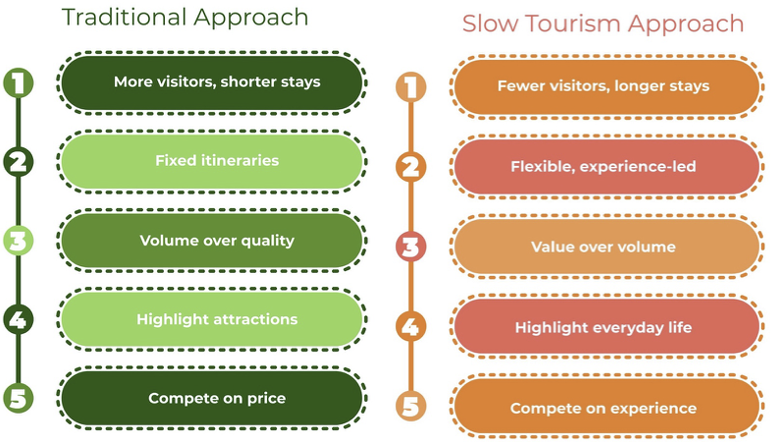
The diagram below compares a traditional tourism approach with a slow tourism approach across the areas that matter most for your business. It shows a shift from volume to value, from fixed itineraries to flexible experiences, and from competing on price to competing on the quality of what you offer.
Figure 11: Traditional vs Slow Tourism
Source: Acorn Tourism Consulting, 2026
9. The future of slow tourism
The tourism market is changing in ways that work in your favour. Travellers are spending more per trip, travelling with more purpose and looking further for destinations that feel genuine and uncrowded. Low and middle-income countries that offer strong local culture, nature and community connections are more and more well placed to meet this demand.
In the short term, over the next 1 to 3 years, slow travel will move from a niche into the mainstream. Major operators are already changing what they offer to meet this demand. This is a good time to position yourself clearly. European buyers and travellers are actively looking for what you have to offer, and the competition from large operators in your specific destination is still limited.
In the longer term, beyond 3 years, the shift is likely to go deeper. As pressure on popular destinations grows, travellers will look further for places that feel real and unhurried. Research from the University of Eastern Finland confirms that slow tourism looks very different across regions and destinations. There is no single model to follow. Your destination’s unique character is not a limitation. It is your strongest selling point.
The businesses that will benefit most are those that focus on how the experience is designed and delivered instead of simply using ‘slow tourism’ as a label. That starts with small, intentional decisions: who you work with, how much time you give your visitors and how closely your product is connected to the real life of your destination.
Acorn Tourism Consulting Limited carried out this study on behalf of CBI.
Please review our market information disclaimer.
Disclaimer: The statistics quoted throughout this study are drawn from a range of sources. Due to variations in data collection and presentation methods, figures may not always be directly comparable.
Search
Enter search terms to find market research
Do you have questions about this research?
Nowadays, commitment to sustainability is not a choice, but an obligation. The role of tourism businesses is important for cultural understanding, inclusion and protecting the environment. A tour is much more than a product. It is a learning experience where travellers connect with local people, discover different realities and understand different perspectives on life and development.

Jan Strik, Founder at Vapues Travel
A slow travel experience is shaped by the feeling of being present, rather than by the number of nights spent in one place alone. It involves having enough time to connect with local people, gain a deeper understanding of the destination, and take part in small-scale, locally rooted experiences beyond the main tourist attractions.

Elise Gelderloos, Product Manager and Data Analyst