
Entering the European market for luxury tourism
Luxury travellers need high levels of customer service, personalisation and flexibility. Sustainability in the luxury tourism segment is in high demand. Luxury travellers expect tourism providers to have environmental, social and economic measures to protect local places and support local communities. To sell luxury tourism products to the European market, local tour operators need to build strong relationships with Destination Management Companies (DMCs).
Contents of this page
- What requirements and certifications must luxury tourism meet to be allowed on the European market?
- Through which channels can you get luxury tourism on the European market?
- What competition do you face on the European luxury tourism market?
- What are the prices of luxury tourism products on the European market?
1. What requirements and certifications must luxury tourism meet to be allowed on the European market?
European tour operators that sell luxury tourism products to European tourists have to follow strict regulations to ensure the safety of their travellers and to protect them financially. You should be familiar with the relevant laws.
What are the mandatory and additional requirements that buyers have?
The requirements that European tour operators have for wildlife tourism products in low- and middle-income countries cover the following:
- The European Package Travel Directive.
- General Data Protection Regulation (GDPR).
- Liability Insurance and Insolvency Protection.
As a first step, you should read the CBI’s study on What requirements must tourism services comply with to be allowed on the European market and familiarise yourself with the comprehensive details of legal, non-legal, and common requirements.
What are the requirements for niche markets?
Luxury travel products need to meet high-value travellers’ expectations. You need to offer unique experiences, trustworthy quality, personal service and comfort, and communicate clearly. Sustainable practices are also becoming more important, especially when they are visible, credible and linked to the quality of the visitor experience. To attract luxury tourists, businesses also need to provide high-quality images, detailed information and enough resources to deliver what this market expects.
Create and deliver high-quality, tailored experiences
Luxury travellers want experiences that feel special, personal and different from standard tourism products. They want to do something memorable, enjoy a high level of service and feel that the experience has been designed around their own interests, needs and travel style. To do this well, you should collect information before they arrive. This includes dietary requirements, likes and dislikes, special interests, preferred pace, mobility needs, language requirements and any special occasions, such as birthdays. This will help you plan and tailor the experience properly.
Flexibility is very important in this market. Luxury travellers may want to change timings, add extra stops, spend longer in one place or adapt an itinerary at short notice. Responding positively to these requests will help you stand out.
Offer unique and exclusive experiences
Luxury does not always mean formal or expensive. It can also mean private access, expert guides, local knowledge, comfort, privacy, smooth organisation and thoughtful details. Offering experiences that others cannot easily copy will make your business stand out. This might include after-hours entry to a cultural site, a private meal in a beautiful setting, a behind-the-scenes visit with an artisan or a nature experience with a specialist guide. Build strong relationships with other local suppliers, attractions, communities and guides so you can create special access and offer exclusive experiences.
For example, Time + Tide in Africa offers overnight riverbed camping experiences. Guests spend the night under the stars in simple netting, fully immersing themselves in their surroundings. No other operators in the area offer this experience due to the expense, effort and permissions required, so Time + Tide stands out.
Figure 1: Sleepout under the stars

Source: Time + Tide Africa, 2026
Train your staff to deliver exceptional service
Luxury travellers expect high levels of service, flexibility and attention to detail. Your staff should be trained to communicate well, respond quickly and act confidently if customers make requests or plan changes. A ‘can-do’ attitude is very important. Small actions can make an experience feel personal and high-quality, such as remembering a guest’s name, solving problems quickly, offering thoughtful extras and adapting an itinerary at short notice.
Invest in customer service and hospitality training where possible. Staff should understand how to work with demanding clients, manage expectations, handle pressure and do extra without being asked. Luxury tourists can be difficult. Your staff should know how to manage their expectations. They are likely to be different from those of regular tourists. You should also ask customers for feedback and use it to improve your service. Consider the Travel Institute’s training to become a Certified Luxury Travel Specialist.
Knowledgeable guides are very important in the luxury market. Luxury travellers often want more than general information. They value guides who can share specialist knowledge linked to their interests, such as wildlife, history, food, photography, conservation and local culture. A good guide should be able to adapt the experience to the customer, answer detailed questions and bring the place to life in a way that feels personal, expert and memorable.
Have sufficient funds to service the luxury market
Providing luxury tourism is expensive and requires investment. Setting up accommodation and providing top-class services and experiences in the luxury segment costs more than in other segments. Your services must be excellent, and your staff must be well-trained. Positive cash flow, good financial planning and management are necessary.
Think about how you will fund your luxury tourism business:
- Write a business plan and discuss funding options with a bank or other private investor. Having a business plan is a useful tool for all businesses. Consult this guide: Tour Operator Business Plan Template.
- Analyse your current cash flow so you can track money coming in and going out. Cash flow management gives you a clear picture of costs versus revenue. It helps ensure you have enough funds to pay bills and make a profit. Have a look at this guide, The importance of cashflow for tourism businesses, to help you.
If you cannot adequately fund your business to serve the luxury market, you should consider focusing on less demanding niches.
Provide clear and inspiring information
Luxury travellers look for detailed, high-quality information before they book. They want to understand what is included, how the experience will be delivered and what makes it special. You should provide clear descriptions of your experiences and activities on your website, supported by well-written itineraries, practical details, attractive images and videos.
Your website should be well-designed, easy to use and visually inspiring. In your marketing materials, emphasise the quality of your service. Use language that highlights personalisation, privacy, exclusivity, comfort and flexibility, such as ‘private guided experience’, ‘designed around your interests’ and ‘luxurious facilities’.
Best Practices for Luxury Tourism Service Providers
Whether you offer tours or accommodation, it is important that you know you can offer good-quality services before you target luxury tourists. Consider the best practices outlined in the infographics below to assess what you can do and what needs improving.
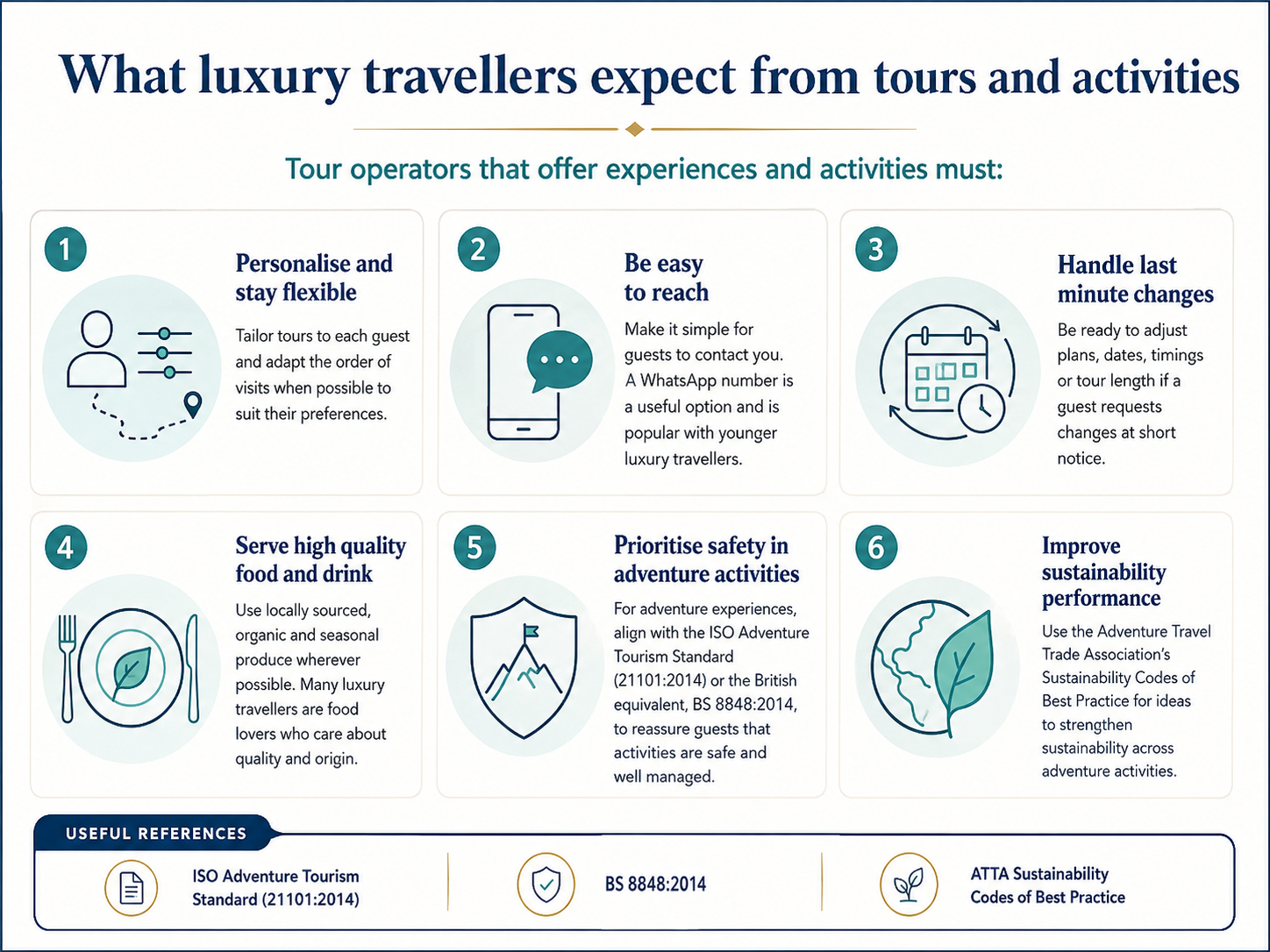
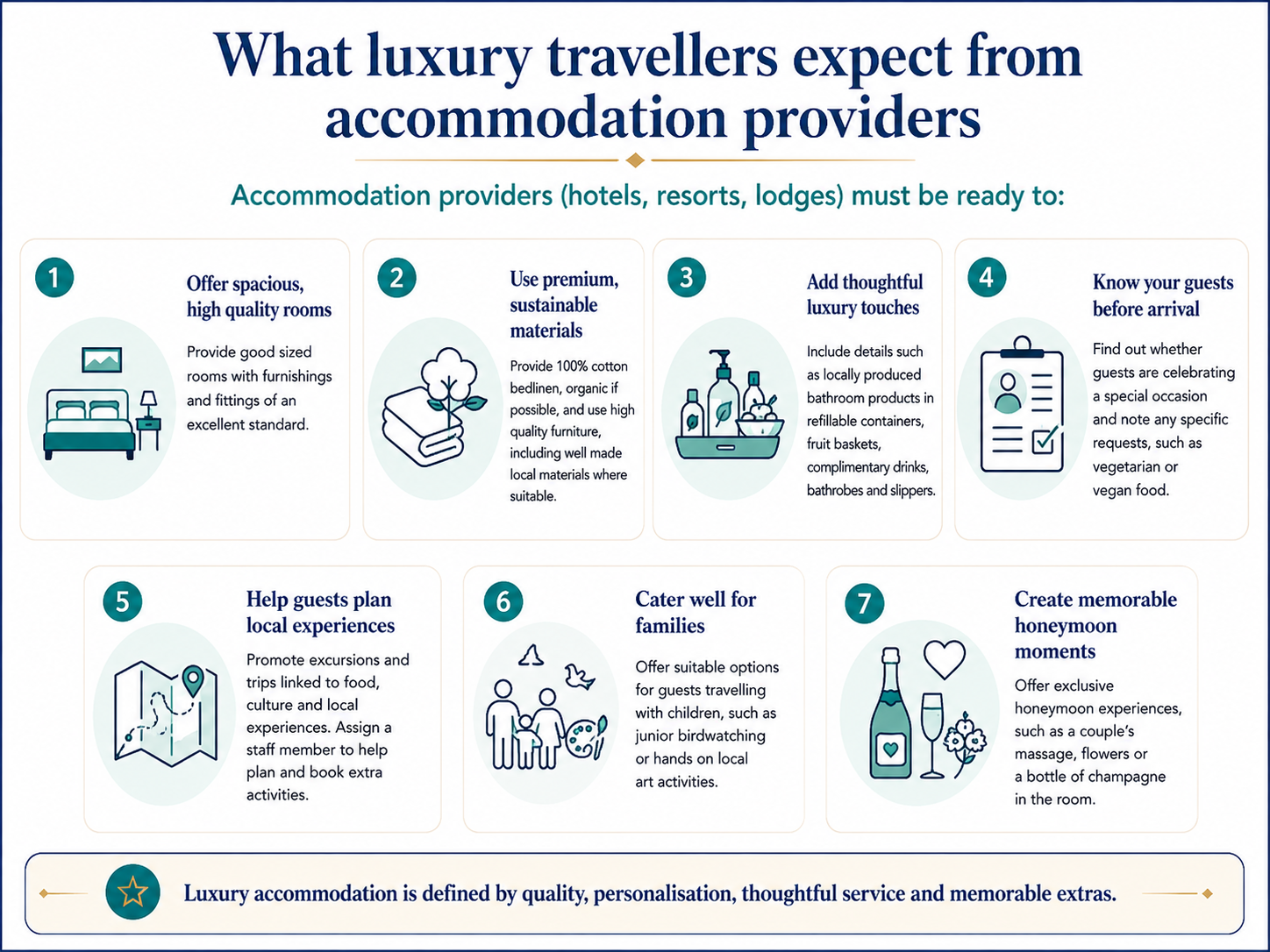
Source: Acorn Tourism Consulting, 2026
For examples of luxury tourism providers in developing countries, see the CBI study What are the Opportunities for Luxury Tourism from Europe.
Tips:
- Prepare detailed pre-arrival information: Send guests clear information before the trip, including timings, journey time, weather, accessibility, clothing, dietary options and who to contact. Luxury travellers value feeling prepared and cared for before they arrive.
- Ensure comfort throughout the experience: Think about the whole journey, including vehicle quality, refreshments, shaded rest stops, clean toilets, waiting times and transfers. Small, practical details can make a big difference to how luxurious the experience feels.
- Have a clear backup plan: Luxury travellers expect smooth delivery, even if things go wrong. Prepare alternatives for bad weather, delays, closures, illness, safety concerns and changes in customers’ plans.
- Personalise the stay before guests arrive: Ask about dietary needs, room preferences, arrival times, special occasions and preferred activities in advance. Use this information to make the guest feel recognised and valued.
- Assess whether your website accurately reflects what you offer luxury travellers. If it does not, you should update it or build a new one. There are several good website builders on the market today that are affordable and easy to use.
- Read the CBI study How to be a successful tourism company online and watch the video Tutorial on how to be a successful tourism company online.
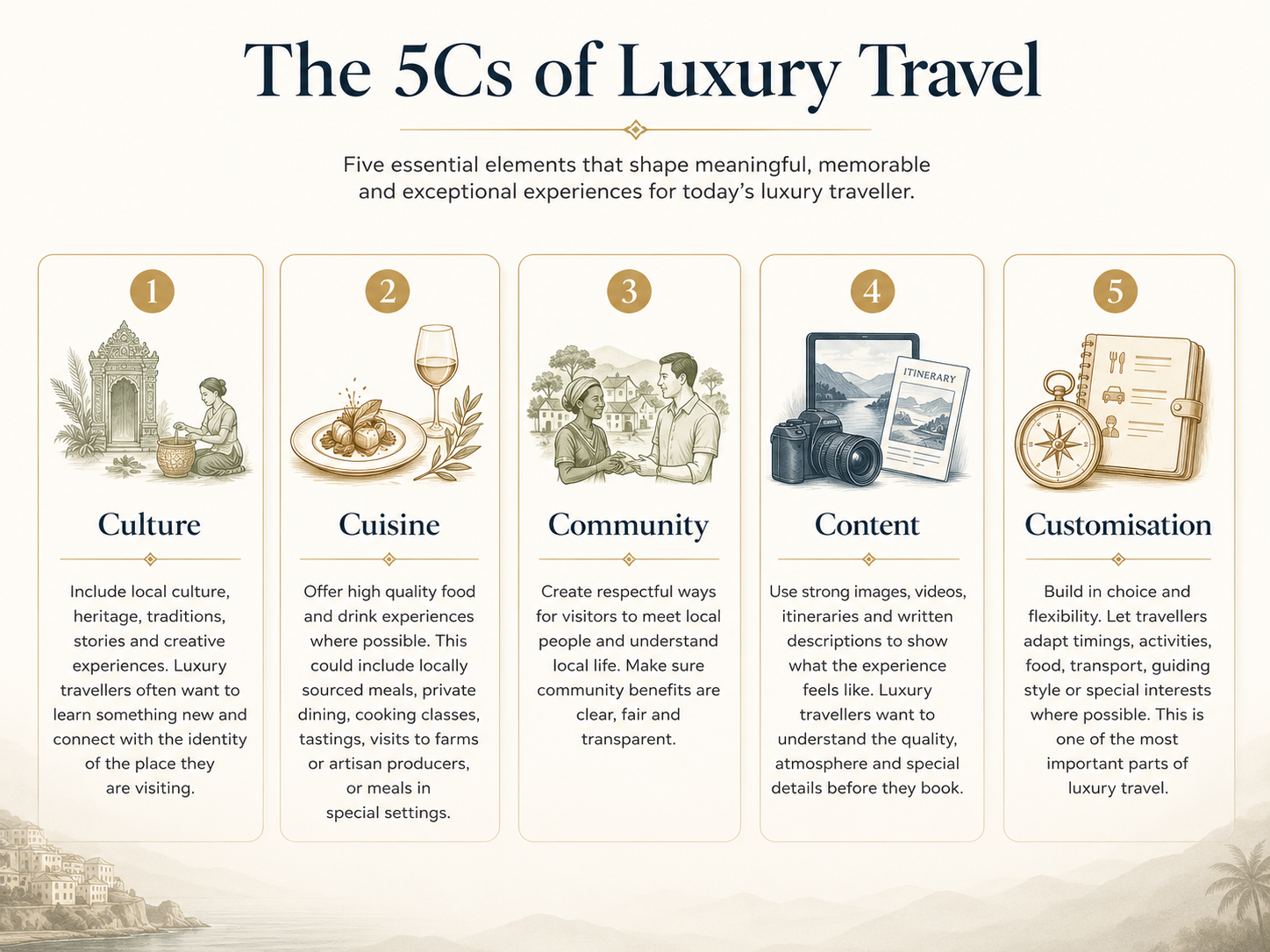
Adapt the 5Cs of luxury travel for your product
The 5Cs of luxury travel are a set of principles that can help luxury tourism providers make products for high-value travellers. The 5Cs are Culture, Cuisine, Community, Content and Customisation. Together, they show that luxury travel is not only about expensive accommodation or private transport. It is also about meaningful experiences, personal service, strong storytelling and access to places, people and activities that feel special.
For local tour operators and tourism businesses, the 5Cs can serve as a simple checklist for reviewing or developing products. Think about whether your product includes local culture, high-quality food, benefits for communities, strong images and stories, and enough flexibility to meet individual traveller needs. The strongest luxury products often combine several elements into a single experience.
Figure 2: The 5Cs of Luxury Travel
Source: Acorn Tourism Consulting, 2026
Embed sustainability into your luxury tourism business
Sustainability is now an important part of luxury tourism. Many luxury travellers want high-quality experiences that also protect the environment, support local communities and respect local culture. This means luxury tourism businesses should produce less waste, use water and energy carefully, avoid single-use plastics, source food and products locally, employ local people, and support conservation or community projects where possible.
Sustainability is also important to build trust with European buyers. Tour operators want to work with suppliers that can show clear, practical and measurable sustainability actions. This means explaining what you do, why it matters and what impact it has. For luxury travellers, sustainability should feel authentic and well-managed, not like a marketing message.
There are several useful organisations and networks that can help luxury tourism businesses understand good practice. The Long Run works with nature-based tourism businesses committed to conservation, community, culture and commerce. The Conscious Travel Foundation is a global community of travel businesses working to make tourism more positive and responsible. Their members include high-end operators, lodges and DMCs that combine luxury travel with sustainability and positive impact.
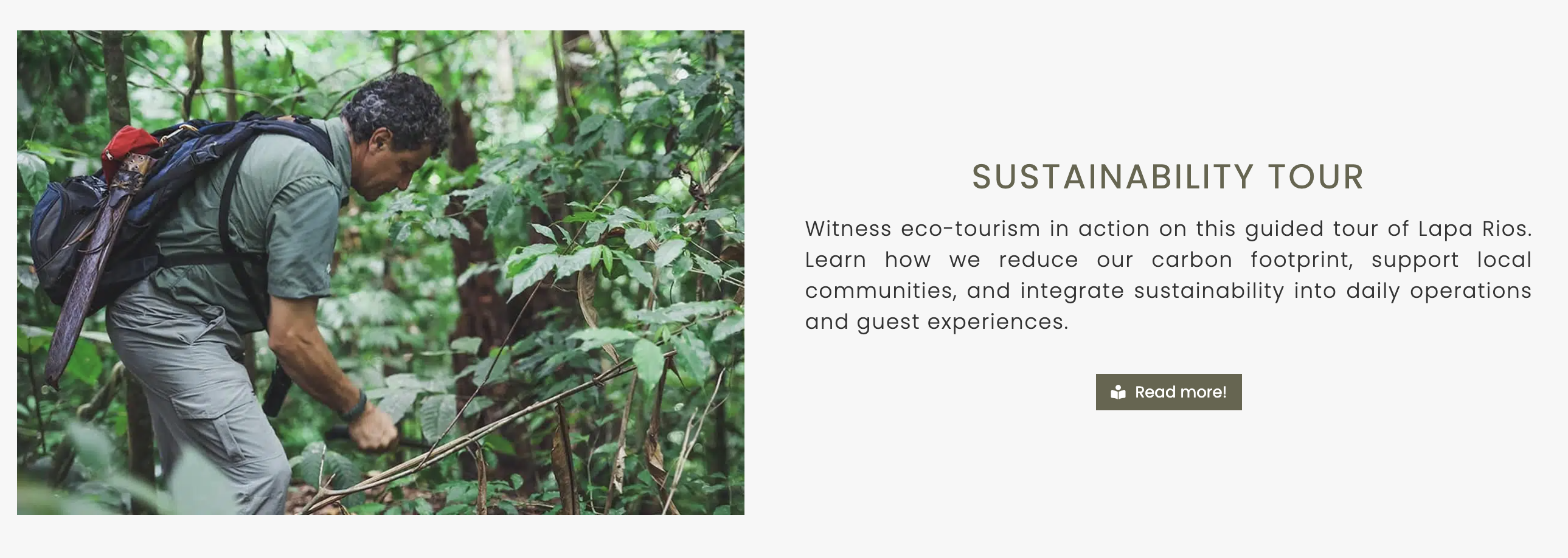
One good example is Lapa Rios Lodge in Costa Rica. It combines high-quality rainforest accommodation with conservation, local employment and environmental education. It shows how luxury can be based on nature, location, community and strong sustainability values, as well as comfort and service. They even offer experiences for their guests that highlight their work and help educate and raise awareness.
Figure 3: Lapa Rios Lodge, Sustainability Tour
Source: Lapa Rios Lodge, 2026
To succeed in the luxury tourism market, you need to insert sustainability into your business and communicate your actions clearly. It will also help if you can get certified through a recognised scheme, such as Travelife for Tour Operators or TourCert. If you cannot get certified just yet, start with practical actions and document your progress on your website. Luxury European tour operators are unlikely to work with suppliers that cannot show they understand the importance of sustainability in tourism.
Tip:
- Study the CBI guide How to be a sustainable tourism business to learn about the importance of sustainability in tourism.
2. Through which channels can you get luxury tourism on the European market?
Most luxury tourism products are sold to European luxury travellers by specialist European luxury travel providers. This is because they are experts in the market and know exactly what their customers need. European luxury companies usually use Destination Management Companies (DMCs) to provide local products such as experiences and excursions. Having a good relationship with your local DMC will help you sell luxury products to the European luxury traveller.
How is the end-market segmented?
The luxury traveller market is broadly segmented into leisure and business. Luxury travel is sometimes practised in combination with business, also known as ‘bluxury’. Luxury travellers have many varied characteristics, motivations and behaviours which are interesting to study.
At the top level, there are six main types of luxury tourists:
- Always luxury: this group are wealthy millionaires and billionaires. Money is no object. Luxury is part of their everyday lives.
- Special Occasion: this group is reasonably wealthy, and luxury is a treat. They are willing to compromise on comfort to have an amazing travel experience.
- Bluxury: this group travels mainly for business and will include leisure travel in the same trip, with or without their family.
- Cash-rich, time-poor: this group travels when they can. Their plans can change, so they value flexibility.
- Strictly Opulent: this group looks for the best and most glamorous travel experiences. They often use influencers to find the best luxury experience.
- Independent and Affluent: this group uses luxury travel as a way to pamper themselves. They can be spontaneous, travel alone or with family and friends. They like to make their own decisions.
To learn about the Luxury Traveller Tribes and their distinct characteristics, motivations and behaviours, look at the detailed product description of our study, the European Market Potential for Luxury Tourism.
Beyond the luxury segment, it is worth considering that FITs (fully independent travellers) may be attracted by a luxury experience whilst on a non-luxury trip. These could be wellness experiences, privately guided cultural tours, luxury wine and food tasting, a few nights camping in a luxury tent, and so on. How you present your experience to them will determine whether they consider it a luxury.
Tip:
- Find out more about the FIT market. Read the CBI study Market Potential study for Fully Independent Travellers.
Through which channels do does a luxury product end up on the end market?
Luxury travel is mostly sold through luxury travel specialists, European tour operators, and online travel agents (OTAs) in Europe.
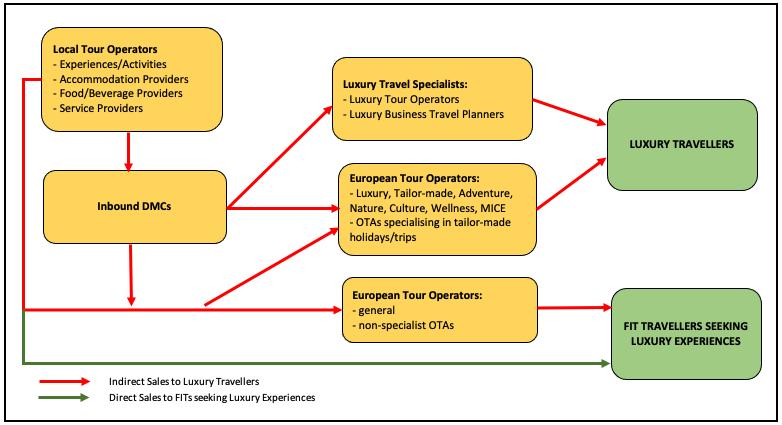
The chart below shows that the route for the sale of luxury tourism products to luxury travellers is mostly indirect. The only indirect route is to FITs who may buy luxury tourism products as part of a broader trip. Each channel is explained more below.
Figure 4: Sales Channels and Route to Market for Luxury Tourism Products
Source: Acorn Tourism Consulting, 2023
The different channels are further explained as follows:
- Inbound DMCs: a Destination Management Company is a local travel business that connects local tour operators with inbound European tour operators. It works on a business-to-business (B2B) basis. The advantage for European tour operators is that they deal only with the DMC, which may sell them tourism services from several local tour operators for one itinerary. Local tour operators with strong connections to their local DMCs can attract the luxury European tour operator market through this channel.
- Luxury Travel Specialists (luxury tour operators and luxury business travel planners): tend to be small to medium-sized companies. They have a competitive advantage against the larger European tour operators and online travel agents (OTAs) because they know how to create tailor-made products from a wide range of suppliers. They are often staffed by ex-tour operator employees who have set themselves up as expert travel planners. They understand the market and their clients very well.
- European Tour Operators: this large group of tour operators sells luxury in addition to other tourism niches like adventure, nature, culture and wellness.
- OTAs: OTAs (online travel agents) that specialise in creating tailor-made holidays, trips, and experiences serve the luxury market.
- FIT Travellers (direct sales): FITs buy their luxury experiences directly from a range of European tour operators and OTAs. They may also buy directly from local tour operators upon arrival at their destination.
Examples of European businesses in the distribution network are included in the table below.
Table 1: Luxury Travel Specialists, Tour Operators and OTAs in the European Marketplace
| Sales Channel | Examples |
|---|---|
| Luxury Travel Specialists | |
Luxury Tour Operators | Germany: Designreisen; One Luxury; Luxusreisen France: Voyage de Luxe; My Luxury Travel; LUXeTHIKA UK: Black Tomato; Virtuoso; EFR Travel Switzerland: Amadi Journeys Italy: Travel Design; Charmeadventure Netherlands/Belgium: Silk Travel; Pegase; Silverjet Spain: Luxo Tour; Viajes TGM |
| Luxury Business Travel Planners | Germany: One Luxury; Emporium Travel France: CTA Business Travel Switzerland: Globetrotter Business Travel Italy: Luxury Business Travel Netherlands: Vanhelden Travel Spain: Travelface |
| European Tour Operators | |
European Tour Operators (that offer luxury and/or tailor-made holidays) | Germany: Unforgettable Journeys; World Insight France: Intermedes; Secrets de Voyages UK: Discover the World; South America Odyssey Switzerland: Abendsonne Afrika; Davertour Italy: Original Tour; Viaggi Responsabili Netherlands/Belgium: Sawadee; Experience Travel; Kazuri Safaris; Better Places Spain: INUK Travel |
| OTAs | |
OTAs (that specialise in tailor-made trips) | KimKim; Evaneos; We Design Trips; SafariBookings; With Locals; Responsible Travel |
| FITs travellers seeking Luxury Experiences | |
| European Tour Operators | Like European Tour Operators above |
| OTAs | Similar to OTAs above, and includes others like Viator and GetYourGuide |
| Direct Sales | Your own website, or directly by phone |
Source: Acorn Tourism Consulting, 2026
Luxury travellers are more likely to use specialist luxury tour operators to make all their travel arrangements. They choose luxury specialists who can curate itineraries exactly according to their needs and wishes.
What is the most interesting channel for you?
It is not easy to enter the luxury market. Inbound Destination Management Companies (DMCs) are the most interesting channel for you. Due to high service-level requirements, luxury travel specialists almost always use inbound DMCs to provide luxury products to their clients. Inbound DMCs know the demands of their European tour operator clients very well. You will need to establish a relationship with them if you want to supply luxury products to the European market.
If you are targeting FITs who want to buy luxury tourism products, European Tour Operators and OTAs are interesting channels for you. For more information about attracting the FIT market, consult the CBI study, What are the opportunities in the European FIT market. You should also read the CBI study How to work effectively with OTAs.
Tips:
- You can find more DMCs in your region by searching the Internet. You can also find DMCs at travel trade shows. Many travel trade organisations publish member listings on their websites.
- Check out the list of exhibiting DMCs at the International Luxury Travel Market show (ILTM). Be sure to select your region in the filter (e.g. Africa). The ILTM is hosted in several locations around the world every year. The flagship event is held in Cannes, France, each December.
- Explore exhibitors and buyers at the PURE Life Experiences, a trade show for specialist luxury travel industry professionals held every year in Marrakech, Morocco. Use the filter function to help you find ones in your region.
- Continue to build your knowledge about local DMCs. Have a look at the DMC members published on the Conscious Travel Foundation website.
3. What competition do you face on the European luxury tourism market?
The luxury tourism segment is very competitive. Luxury travellers like to visit destinations all over the world, and developing destinations are interesting and appealing. There are good opportunities for local tour operators in developing countries to supply the European market.
Which countries are you competing with?
Many upcoming destinations have a strong luxury tourism product. Sri Lanka, Botswana, Costa Rica and Peru have well-established luxury markets.
Sri Lanka
Sri Lanka’s luxury appeal lies in how much it can offer in a relatively small area. High-end itineraries can combine private villas or boutique hotels on the south coast, heritage stays in Galle, leopard safaris in Yala National Park, time in the Cultural Triangle and visits to tea country bungalows in the hill country. This makes Sri Lanka especially competitive for tailor-made touring, for travellers that want variety without long domestic travel times.
There are also signs that Sri Lanka’s accommodation offer is becoming more diverse and premium. With growth in high-end hotels, as well as bungalows, boutique properties, guest houses and homestays. This range supports luxury products that combine comfort, privacy, culture, wellness, food and nature, while still offering good value compared with some other long-haul luxury destinations.
Sri Lanka is rebuilding its position as a high-value destination after several difficult years for tourism. In 2025, the country recorded its highest-ever annual arrivals. There were 2.36 million international visitors, and tourism generated 3.2 billion US dollars in revenues. The government is now targeting 3 million visitors in 2026 and around 500 million US dollars in tourism investment, showing that the country is actively trying to grow the value and scale of its tourism sector.
Botswana
Botswana is one of the clearest examples of a luxury tourism destination built around a high-value, low-volume model. Its approach has been to attract fewer visitors who spend more rather than focusing on mass tourism. This has helped protect fragile wilderness areas while building Botswana’s reputation for exclusive, conservation-focused safari experiences. The model is also commercially important. It is forecast that international tourist arrivals to Botswana could reach 3.17 million by 2034, generating 2 billion US dollars in international visitor expenditure.
The Okavango Delta is central to Botswana’s luxury offer. It is known for private concessions, small high-end camps, fly-in access and water-based safari experiences by mokoro (canoe), boat and helicopter. Chobe National Park, Moremi Game Reserve, the Linyanti and Selinda reserves, the Makgadikgadi Pans and the Kalahari add even more, giving Botswana a strong circuit of exclusive wildlife destinations.
Botswana’s accommodation offer also supports this luxury position. The luxury lodge market is continuing to change, with new and refurbished camps in the Okavango and other wilderness areas focusing on privacy, nature immersion, wellness and low-impact design.
For luxury travellers, Botswana’s main appeal is comfort, space, privacy and expert guiding. Private game drives, walking safaris, fly-in itineraries, small camps and conservation-linked experiences help make the country as one of Africa’s strongest destinations for high-end, nature-based tourism.
Costa Rica
Costa Rica’s luxury offer is built around sustainable nature tourism. It is one of Latin America’s best ecotourism destinations. Around 30% of its territory is protected as natural land, including national parks and reserves. This gives it a strong competitive position with luxury travellers who want biodiversity, wildlife, comfort and credible environmental credentials.
There are also signs of continued growth in higher-value tourism. Costa Rica’s tourism market was valued at 366.3 million US dollars in 2025 and is predicted to reach 562.03 million US dollars by 2031. The reason behind this growth is demand for sustainability, wellness and higher-value travel. Tourism investment is also strong: Costa Rica recorded 385.6 million US dollars in direct tourism-related foreign investment in 2025, the second-highest figure in eight years.
The Gulf of Papagayo and Guanacaste are becoming particularly important for luxury tourism. New and recent high-end resort developments, including brands such as the Ritz-Carlton Reserve and Waldorf Astoria, are helping to position Costa Rica as an ecolodge and adventure destination, and as a sophisticated luxury beach, wellness and nature destination.
Luxury travellers can combine rainforest walks, volcano landscapes, cloud forests, national parks, private wildlife-guiding, surfing, yoga, spa treatments and high-quality gastronomy. Costa Rica’s advantage is that it can offer comfort and premium service while still feeling closely connected to nature, sustainability and outdoor adventure.
Peru
Peru’s luxury offer is led by culture, heritage and food. It is best known for Machu Picchu, Cusco and the Sacred Valley. However, its high-end tourism product now extends into gastronomy, wellness, luxury rail journeys, Amazon lodges, trekking and community-based tourism. This makes Peru attractive to travellers who want comfort, expert guiding and meaningful cultural experiences.
Peru is becoming popular again as an international destination. The country recorded 3.4 million international tourists in 2025 and is targeting 4 million visitors in 2026. This recovery is important for the luxury market because it supports continued investment in higher-value products, specialist guidance, boutique hotels and premium visitor experiences.
Peru has a particularly strong advantage in food and culture. It was awarded the title of World’s Leading Culinary Destination 2025 at the World Travel Awards, further strengthening its reputation for gastronomy. This helps Peru stand out from other luxury destinations because travellers can combine iconic heritage sites with high-quality restaurants, local food experiences and specialist culinary itineraries.
Luxury travellers can stay in restored historic properties, boutique hotels, private villas, luxury lodges and high-end rainforest accommodation. Peru also has a distinctive luxury rail offer, including the Belmond Andean Explorer, which links the Andes with Lake Titicaca. Together, these experiences position Peru as a luxury destination for travellers seeking culture, cuisine, adventure and a strong sense of place.
Main takeaways
- Research how competing luxury destinations position themselves, including their accommodation, experiences, guiding, sustainability messages and sample itineraries.
- Identify what makes your destination different, such as wildlife, landscapes, culture, food, wellness, adventure, conservation, community experiences or a combination of these strengths.
- Focus on delivering high quality. Luxury travellers expect private experiences, expert guiding, comfort, flexibility, smooth organisation and thoughtful details.
- Show how your product has a positive impact. Sustainability, conservation, local sourcing and community benefits are more and more important in the luxury market.
Which companies are you competing with?
Companies in the luxury market are a mix of tour operators and accommodation providers. Luxury lodges, resorts and retreats are very attractive to the luxury market. They often include a range of excursions for their visitors. Community-owned establishments are also becoming more common in the marketplace.
Sri Lanka
Sri Lanka Tailor Made is a boutique DMC and luxury tour operator that offers bespoke travel across Sri Lanka. Its product range includes culture and heritage, Ayurveda and wellness, wildlife and adventure, romantic travel, luxury escapes and tailor-made weddings. This wide offer helps it appeal to different luxury traveller segments, including honeymooners, families and travellers looking for personalised, high-quality touring.
Ayu in the Wild is a women-led boutique DMC specialised in luxury experiential and sustainable travel in Sri Lanka. It focuses on immersive local experiences and supports community initiatives. This makes it a good example of how luxury suppliers can combine high-quality service with sustainability, community benefits and authentic destination experiences.
Ayu in the Wild is a member of The Conscious Travel Foundation and The Long Run, enabling them to be part of a community of similar luxury, eco-conscious organisations.
Botswana
The African Wild is a Botswana-based safari company that offers tailor-made tours across the Okavango Delta, Kalahari Desert, Makgadikgadi Pans, Tsodilo Hills and Chobe. It combines local ownership, customised itineraries and ethical safari values. The company describes itself as being focused on positive-impact tourism and ensuring that tourism works for communities.
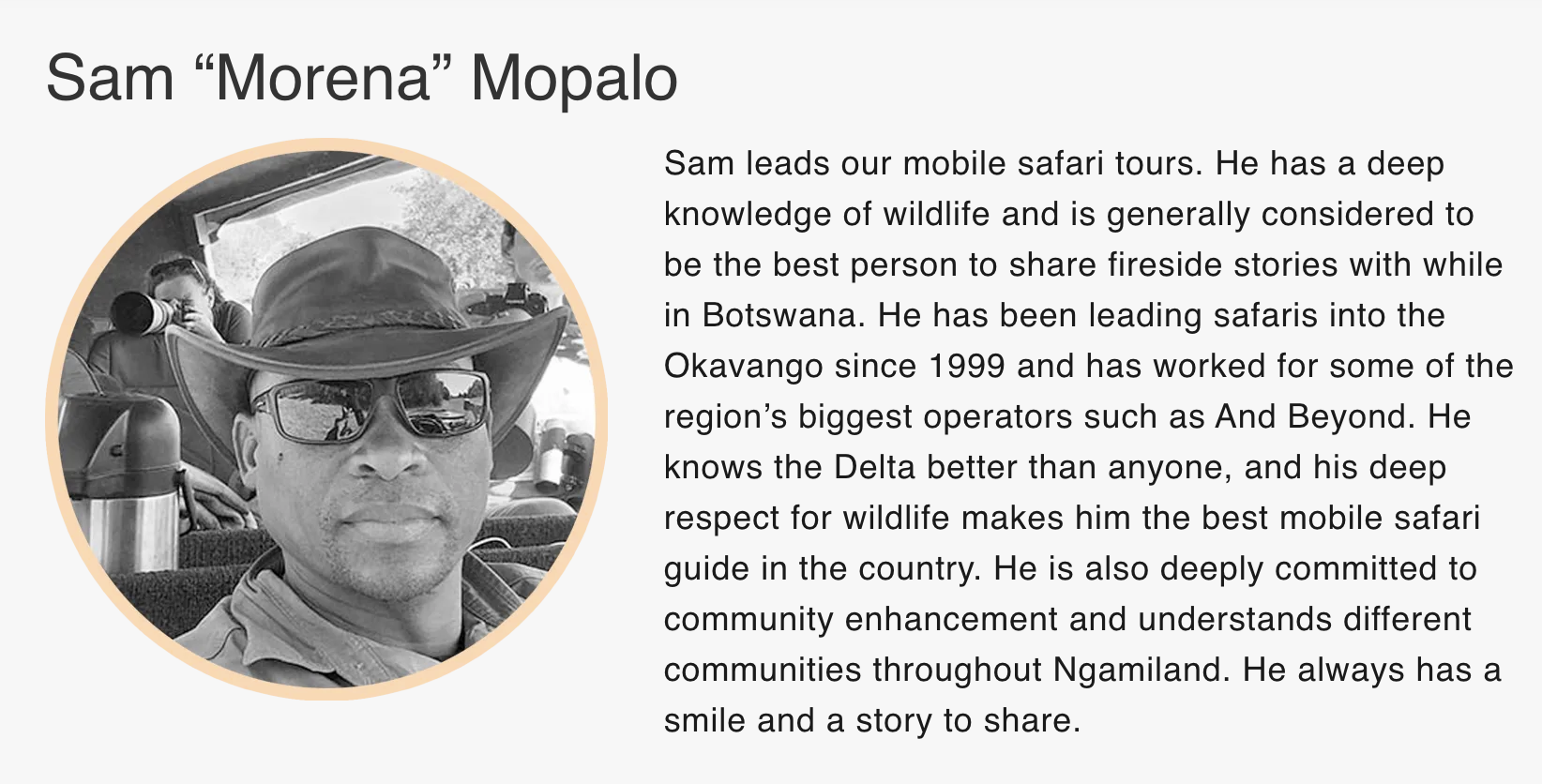
It also promotes its team as certified Botswana safari specialists, showing the importance of guide knowledge, local expertise and professional standards in the luxury safari market. Introducing your team, as in the profile below, is a good way to inspire customers before they travel with you.
Figure 5: Guide profile on the website of The African Wild
Source: The African Wild, 2026
Brave Africa Safaris is a locally owned boutique safari operator focused on Botswana’s Okavango Delta region. It offers a high-end safari experience, where guests stay in specially erected ‘mobile’ camps in different locations each night. This offers guests a close-to-nature wilderness experience with a high level of personal attention. The company is a good example because it shows that luxury does not always have to mean formal accommodation or highly designed lodges.
Simplicity can still feel luxurious when delivered in an exceptional setting, with expert guiding, privacy, comfort, good food and seamless organisation. Brave Africa Safaris shows how smaller operators can compete in the luxury market by focusing on the quality of the overall experience rather than accommodation alone.
Costa Rica
Swiss Traveller is a local tour operator and DMC offering a range of different experiences from one-day to multi-day tours. Experiences are targeted at a range of niche markets, including adventure, nature and ecotourism, celebration trips and more. They are members of LATA and Virtuoso, and have the highest level of sustainability certification with the country’s national tourism certification programme, CST.
Swiss Traveller’s guides are all certified by the Costa Rican Institute, which guarantees high-quality service. They also speak a range of languages, including Spanish, English, French, Italian, and German. This is a unique selling point (USP) that allows them to cater to several different European markets.
Jade Tours is a tour operator with four professional, licensed guides. Tours are curated to provide exclusive experiences focused on nature and conservation. They have a large product offering across seven locations and work with clients to mix and match experiences to build a full-day or multi-day itinerary.
As a responsible operator, all their guides are certified naturalists by the Costa Rican Tourism Board, helping reassure their clients about the level of knowledge and service. They provide high-level optical equipment as part of their tours, ensuring their guests have the best possible experience. Adding extras like this can effectively attract the luxury market and help operators stand out.
Peru
Enigma Peru is a boutique operator based in Peru, specialised in highly personalised journeys. It creates private, carefully planned trips that focus on Peru’s culture, heritage, landscapes and local traditions. Its strength lies in detailed planning, seamless delivery and authentic experiences rather than scale. Its offer reflects what many luxury travellers want from Peru: expert guiding, cultural depth, comfort and access to places and experiences that feel personal.
Delfin Amazon Cruises is a locally owned luxury cruise operator in the Peruvian Amazon. Its cruises combine high-end service with wildlife, rainforest interpretation and community engagement. Operating in one of Peru’s most important natural environments, Delfin offers travellers access to Amazon landscapes, biodiversity and local communities in comfort.
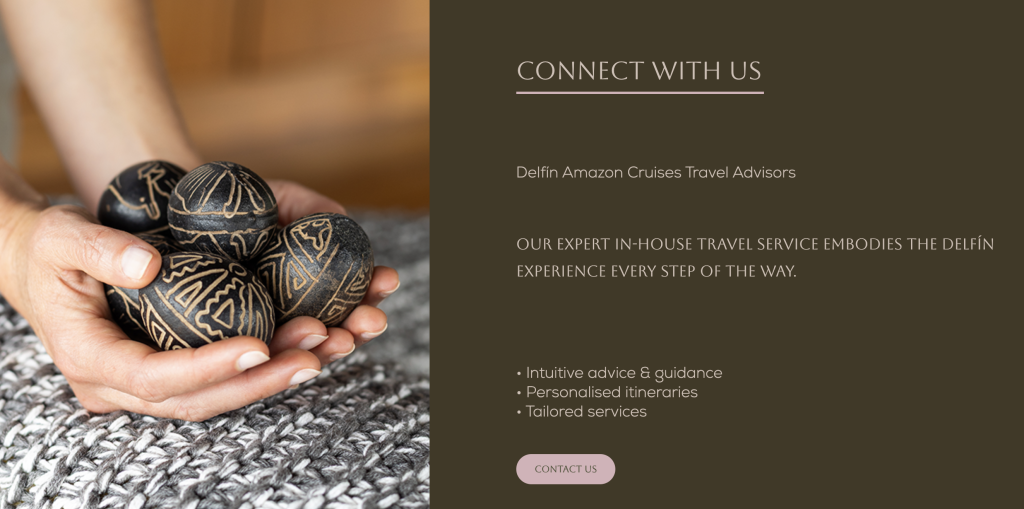
Delfin Amazon Cruises has a strong website with high-quality images and clear descriptions of its personalised offerings, giving it a strong marketing advantage over other operators. It has also been featured in many prestigious magazines focused on the luxury market.
Figure 6: 'Connect with us' page on Delphin's website
Source: Delphin, 2026
Main takeaways
- Luxury tourism businesses compete on service quality, specialist knowledge, personalisation and attention to detail, not only on price or facilities.
- Smaller local operators can compete with larger luxury brands if they offer expert guiding, authentic experiences, flexible itineraries and seamless organisation.
- Sustainability has become more important in the luxury market. Clearly show how your business supports conservation, local communities, local suppliers and responsible travel.
- Specialist guides can help you stand out. Guides with knowledge of wildlife, food, culture, history, photography, conservation and local traditions can make experiences feel more exclusive and memorable.
- Build partnerships with trusted local suppliers, including accommodation providers, restaurants, transport companies, guides, artisans and community groups, so the whole visitor experience feels high quality.
- Use memberships, certification or recognised networks where possible. Being part of organisations such as The Long Run, The Conscious Travel Foundation, LATA, Virtuoso, Africa’s Eden and national sustainability schemes can help build trust with European buyers.
- Make your website clear, professional and inspiring. Use strong images, sample itineraries, sustainability information and clear details about what makes your product special.
- Remember that luxury can be simple if it is delivered well. Privacy, expert guiding, comfort, good food, thoughtful details and a strong sense of place can all make an experience feel luxurious.
Which products are you competing with?
The tourism products you compete with in the luxury tourism market are defined by the level of service and high standards you offer, combined with the experience's attractiveness. As we have seen, luxury tourism products crossover with other tourism niches (such as adventure, nature, culture, and so on). So your products will compete on the quality and service you offer within the niche.
Tips:
- When developing products for the luxury market, use the 5Cs principles to help shape your experiences and to create a unique selling point (USP). Having a strong USP will set you apart in a very competitive marketplace.
- Use the Internet to research the luxury tourism offer in your destination. Explore what local tour operators offer and what European tour operators offer. Build a long list so you can start developing your own portfolio of ideas.
- Find out how to create a strong USP. Read the CBI study How to determine your Unique Value Proposition.
4. What are the prices of luxury tourism products on the European market?
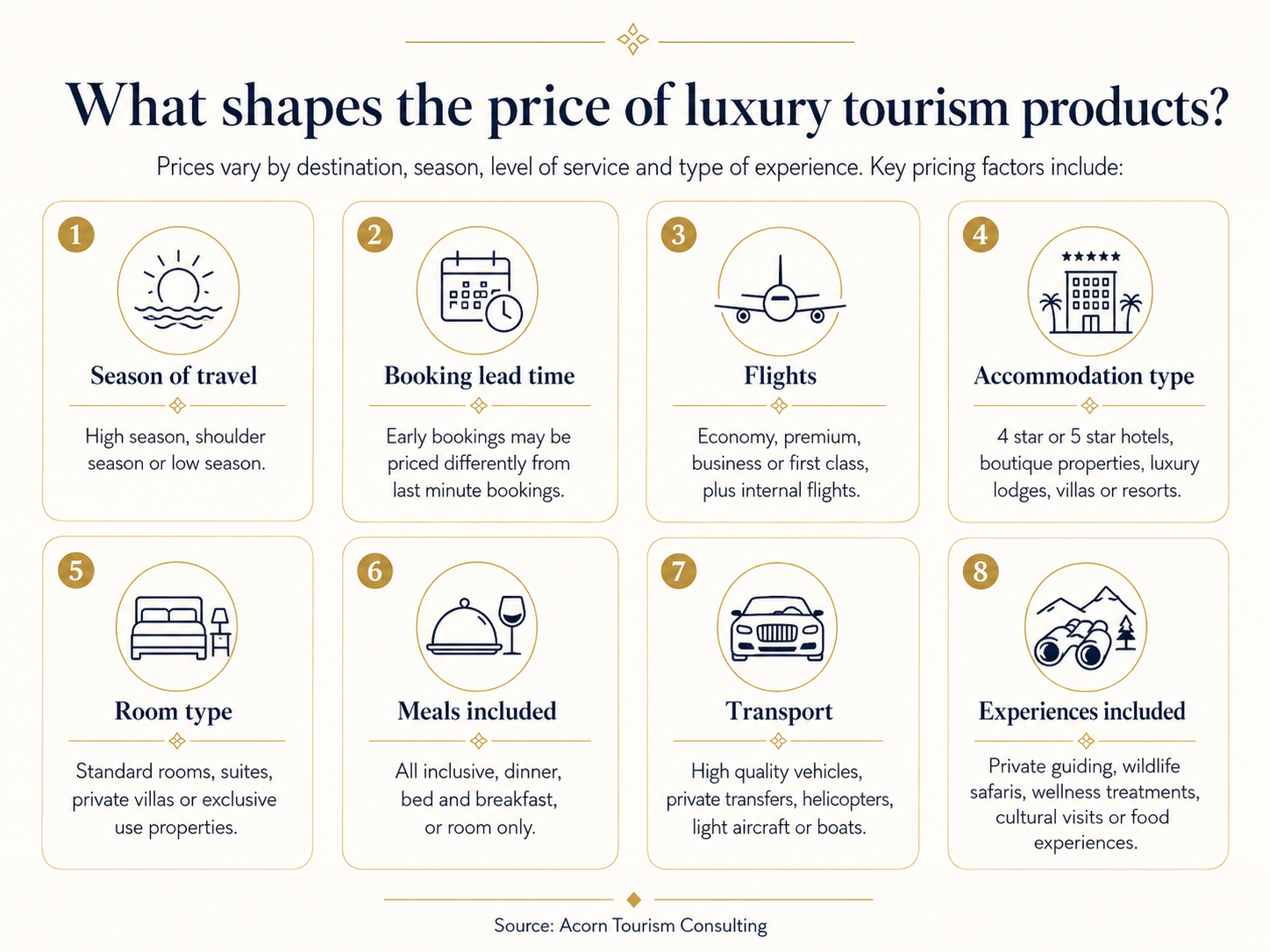
There are no standard prices for luxury tourism products as they are often tailor-made. The prices of luxury tourism products are composed of several elements. These vary by destination, season, level of service and type of experience. The infographic below indicates the many elements that make up the price of a luxury tourism product.
Figure 7: What shapes the price of luxury tourism products?
Source: Acorn Tourism Consulting, 2026
Setting prices correctly requires both market knowledge and good financial planning. You need to understand what each part of your experience costs, including staff and guides, transport, food, equipment, accommodation, and commission. Luxury travellers are willing to pay more for excellent service, privacy, flexibility, personalisation, sustainability and high-quality experiences. However, expectations are also higher, so your product needs to deliver what you promise.
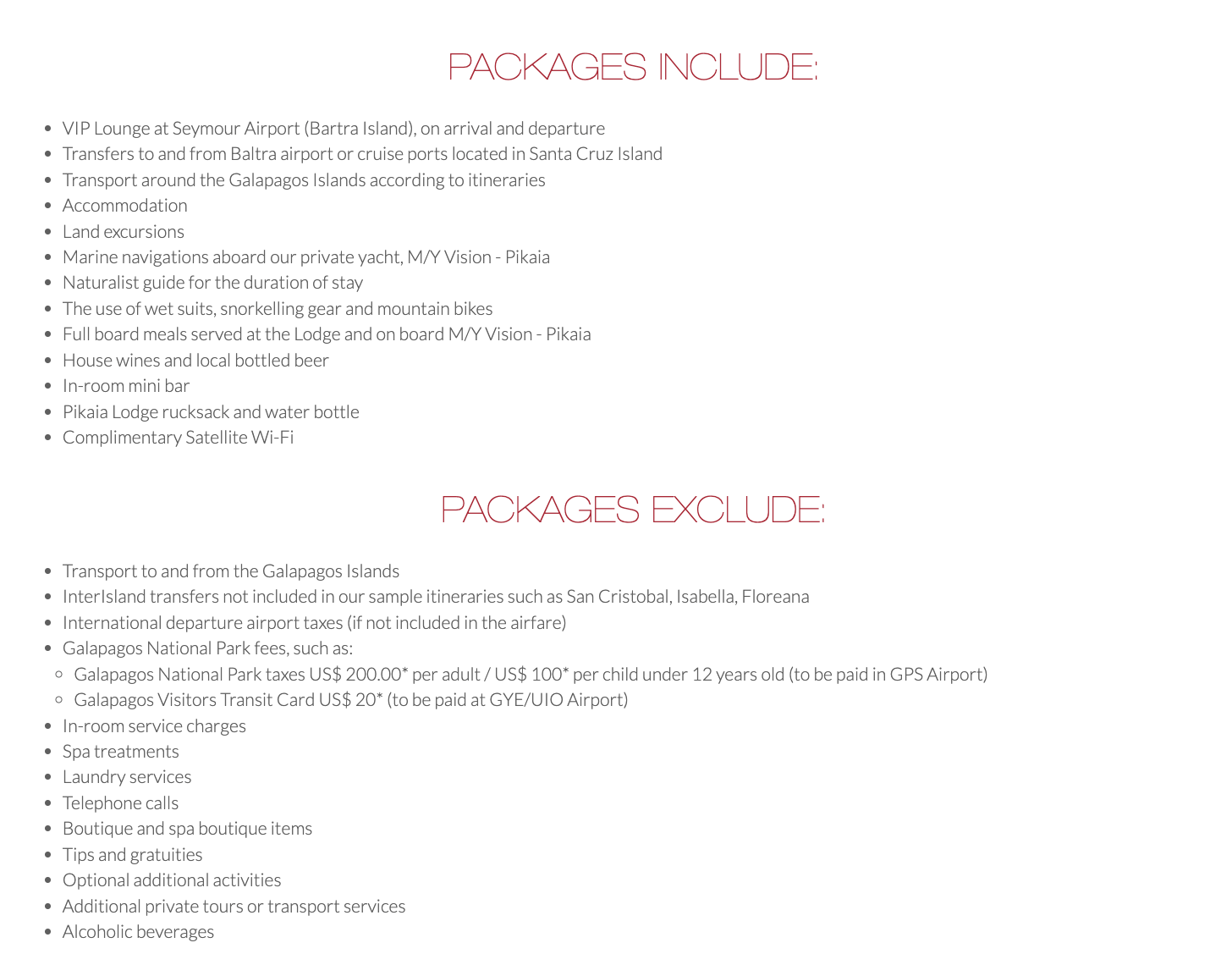
Be clear about what your price includes and what it does not include. This is especially important for tailor-made luxury trips, where customers may compare different offers. State clearly whether transport, meals, guiding, park fees, drinks, tips, taxes, activities and upgrades are included. For example, Pikaia Lodge in the Galapagos Islands clearly explains what is included and excluded in its package rates.
Figure 8: Inclusions and exclusions from luxury package prices
Source: Pikaia Lodge, 2026
The table below indicates the prices of luxury trips and overnight stays in luxury hotels. You can see they vary by destination and by experience type.
Table 2: Example prices on the Luxury Tourism Market, 2026
| Luxury Experience | Country | Duration | Guide price per person (in €) |
|---|---|---|---|
| Day, part-day Experiences | |||
| Private Rio Celeste Waterfall guided hike | Costa Rica | 2.5 hours | 68 |
| Private coffee farm tour from Medellín | Colombia | Half day | 80 |
| Manuel Antonio National Park private tour with a naturalist guide | Costa Rica | 3 hours | 82 |
| Private Yala National Park safari | Sri Lanka | Half day | 127 |
| Cocora Valley and Salento private coffee tour | Colombia | 1 day | 138 |
| Hot air balloon ride in Jaipur | India | 1 hour | 140 |
| Rio Celeste private tour with transport and lunch | Costa Rica | 1 day | 168 |
| Luxury Okavango Delta safari | Botswana | 1 day | 645 |
| Short Trips, 2–6 Days | |||
| Yala wildlife holiday with private safari experiences | Sri Lanka | 2 days | 700 |
| Private Serengeti and Ngorongoro safari | Tanzania | 3 days | 1,290 |
| 3-day Okavango Delta fly-in safari | Botswana | 3 days | 1,440 |
| Luxury Serengeti and Ngorongoro safari | Tanzania | 3 days | 1,530 |
| Luxury Sacred Valley and Machu Picchu tour | Peru | 2 days | 1,640 |
| Holidays, 7+ Days | |||
| Private Coffee Triangle tour | Colombia | 8 days | 1,200 |
| Luxury Peru private tour | Peru | 10 days | 6,900 |
Source: Acorn Tourism Consulting, 2026
Tips:
- Research the prices of your competition to learn whether your tourism products are within the range of the luxury tourism market. Be sure to compare ‘like for like’ (or as identical as you can) so you can assess whether your product will be attractive to the luxury consumer.
- Ensure you budget for providing highly trained staff and guides to meet all the requests from your luxury clients. This may include investing in specialist training or outsourcing specialist guides.
- Consult the CBI study 10 tips on how to do business with European tourism buyers, especially Tip 8 (Set a fair price for your product). Review VisitScotland’s Pricing Strategies guide for more advice on setting prices.
Acorn Tourism Consulting Limited carried out this study on behalf of CBI.
Please review our market information disclaimer.
Disclaimer: The statistics quoted throughout this study are drawn from a range of sources. Due to variations in data collection and presentation methods, figures may not always be directly comparable.
Search
Enter search terms to find market research
Do you have questions about this research?
Luxury travellers want their trips to feel seamless and personal. Honeymooners often want to go all out, while busy clients want everything planned for them. Good local agents, safe drivers and knowledgeable guides are essential. Clients also increasingly like to know that trips support community and conservation projects.

Cassie Tucker, Africa Specialist, The Ultimate Travel Company