
Entering the European market for oranges
Fresh oranges are a large and competitive product in the European citrus market. Spain supplies most oranges during the European season. Imports from outside Europe become more important when Spanish supply falls. The main overseas suppliers are South Africa and Egypt, followed by Zimbabwe, Morocco, Argentina, Uruguay, Türkiye and Peru. For exporters from low- and middle-income countries, the best sales window is usually June–October.
Contents of this page
1. What requirements and certifications must fresh oranges meet to be allowed on the European market?
Fresh oranges must meet the basic European rules for fresh fruit and vegetables, which cover food safety, plant health, quality, packaging and labelling. Check CBI's buyer requirements for fresh fruit and vegetables for the full overview. You can also use My Trade Assistant to check the import rules for oranges under code 080510.
What are mandatory requirements?
To sell oranges in the European Union, exporters must prove that their fruit is safe, healthy and suitable for the market. The most important legal topics are pesticide residues, contaminants and plant health controls. These rules apply to all suppliers, but European buyers often add stricter private requirements. So good control over spraying, harvesting, packing and documentation is essential.
Avoid pesticide residues and contaminants
Pesticide residues are one of the main risks for orange exporters. The EU sets maximum residue levels (MRLs) under Regulation (EC) No 396/2005. If oranges contain residues above these limits, they can be rejected or removed from the market. Buyers in Germany, the Netherlands, Austria and the United Kingdom often use stricter private limits than EU law.
Products that fail to meet European food legislation are reported through the Rapid Alert System for Food and Feed (RASFF). In 2025, RASFF registered 27 notifications for oranges, most linked to pesticide residues in oranges from Egypt. This shows why residue testing and good farm-level controls are important. Exporters should also control contaminants like lead and cadmium, as these are part of EU food safety checks.
Tips:
- Check the EU Pesticide Database for pesticide limits on oranges, using product code 0110020;
- Use Integrated Pest Management (IPM) to reduce pesticide risks;
- Test residues before shipment, especially if you supply strict retail buyers;
- Make sure that levels of lead in fresh oranges remain below 0.10 mg/kg and cadmium below 0.020 mg/kg, in accordance with Regulation (EU) 2023/915 on maximum levels for certain contaminants in food.
Phytosanitary regulation
Oranges must pass EU plant health checks before they can enter the market (Regulation (EU) 2016/2031 and Regulation (EU) 2019/2072). The main risk is the introduction of harmful organisms, especially fruit flies. Exporters must show that their production area, control system or post-harvest treatment meet EU plant health rules. Work with your National Plant Protection Organisation (NPPO) before you start exporting, because it must issue the right documents and confirm that EU conditions are met.
Tip:
- Ask your NPPO which EU plant health measures apply to oranges from your country. Do this before agreeing on a shipment with a European buyer.
Product quality requirements
Fresh oranges must follow the UNECE standard for citrus fruit (2025 edition). They must be intact, clean, sound, free from serious defects, free from pests and suitable for transport. In Europe, buyers usually require at least Class I oranges. This means the fruit must be of good quality, with only small defects in shape, colour or skin allowed if they do not affect the flesh or shelf life.
The standard also defines maturity and size. For oranges, maturity is based on juice content, colour and sugar/acid ratio. The minimum juice content depends on the variety and ranges from 30% to 45%. The minimum diameter is 53 mm.
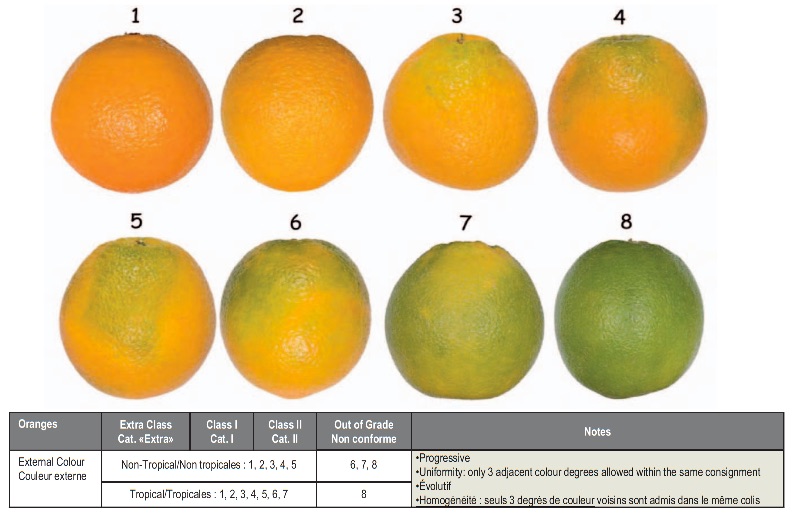
Besides the UNECE standard, there is also an OECD book Citrus Fruits (OECD Publishing, Paris, 2010), an explanatory, illustrated guide that helps inspectors and traders interpret and apply the standards in force for citrus fruit in international trade. Figure 1 shows one illustration from this guide.
Figure 1: Grading oranges according to external colour
Source: OECD, Citrus Fruits, International Standards for Fruit and Vegetables, OECD Publishing, Paris, 2010
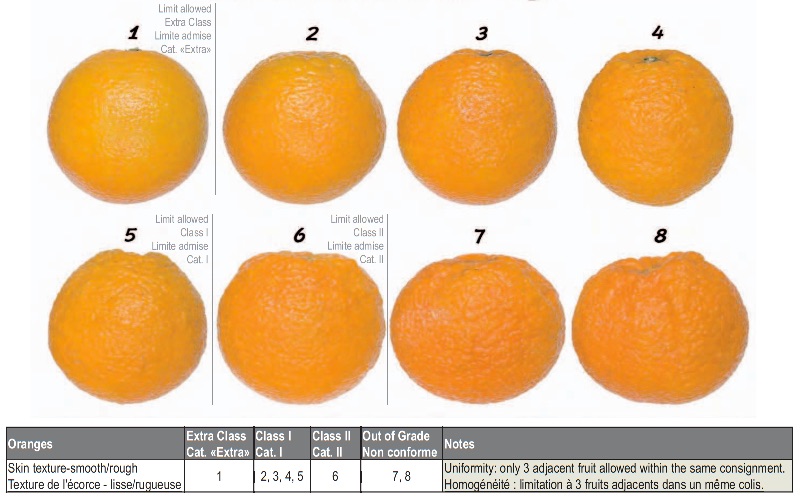
Another illustration in the OECD guide shows how oranges are graded according to skin texture.
Figure 2: Example of grading oranges according to skin texture
Source: OECD, Citrus Fruits, International Standards for Fruit and Vegetables, OECD Publishing, Paris, 2010
Tip:
- See the OECD International Standard for citrus fruit for more images of oranges (pages 80-106) in different quality classes, including differences in colour, skin texture, shape and external defects.
Packaging and labelling requirements
Orange packaging must protect the fruit and keep lots uniform. Buyers expect each package to contain oranges of the same origin, variety or commercial type, quality category and size. The visible part of the package must represent the full content.
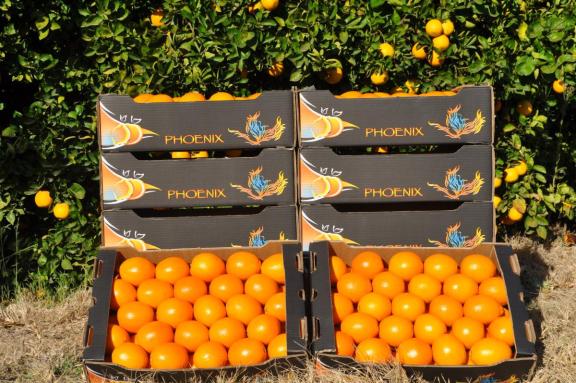
Oranges are usually packed in 15 kg cartons. Closed telescopic cartons offer stronger protection during export transport. Open-top cartons give better product visibility and are often easier for display and inspection. The preferred box depends on the buyer, the market channel and pallet efficiency.
Table 1: Closed (TSCP) versus open-top carton packaging for oranges
| 15 kg TSCP | 15 kg open-top | |
|---|---|---|
| Meaning | 15 kg telescopic carton pack | 15 kg open-top carton |
| Box style | Two-piece carton with a lid/top over the base | Tray-style carton with an open top |
| Protection | More enclosed and protective | Less enclosed, more exposed |
| Strength | Usually sturdier for stacking and transport | Usually lighter, more display-oriented |
| Product visibility | Lower | Higher, easier visual inspection |
| Typical use | Export packing where stronger protection is preferred | Export/display packing where easier handling and presentation are preferred |
| Palletisation | Often allows a denser stacking pattern, for example: 80 cartons/pallet | Often fewer cartons/pallet, for example: 65 cartons/pallet |
| Sample dimensions | Around 27 × 40 × 30 cm | Around 16.5 × 40 × 60 cm |
Source: Globally Cool, 2026
Orange box labels must show the product, origin, class, size and packer or dispatcher details. Buyers also expect the variety or variety group, such as Navels or Valencias. If post-harvest treatment was used, this must be mentioned clearly. Retail buyers may also ask for extra traceability codes or private-label information.
Tips:
- Agree on label content with your buyer before packing. Retail, wholesale and organic buyers may ask for different information.
- Find a complete list of legal requirements for labelling in our study on buyer requirements for fresh fruit and vegetables.
What additional requirements and certifications do buyers often have?
Meeting EU law is only the first step. Most orange buyers also want proof that production, packing and social practices are well controlled. Certification helps buyers reduce risk, especially in supermarket supply programmes.
Certification
GLOBALG.A.P. Integrated Farm Assurance (IFA) is the most common farm-level certification for fresh oranges. It shows buyers that production follows recognised food safety and farm management practices. For packhouses, buyers may also ask for GLOBALG.A.P. Produce Handling Assurance (PHA) or another recognised food safety system.
Some retailers add their own rules: Albert Heijn (Netherlands) and Delhaize (Belgium) use the AH-DLL GROW add-on. This adds stricter controls on hygiene, residues and contamination risks. Suppliers that target these retailers must prepare for extra checks at farm level.
Sustainability compliance
Sustainability requirements are becoming more important in the orange trade. Buyers ask about labour conditions, water use, pesticide management and environmental impact more and more often. Water is especially important for oranges from dry production areas, as irrigation can be a sensitive topic for European buyers.
Common tools are GLOBALG.A.P. Risk Assessment on Social Practice (GRASP) and Sedex/SMETA. These help buyers check social risks in the supply chain. SIFAV is also relevant, because many European fruit companies use its basket of accepted social and environmental standards.
Organic certification
Organic oranges can offer added value, but the market is specialised. European producers supply a large part of organic demand, while South Africa is the main non-European supplier. Exporters must follow Regulation (EU) 2018/848 and work with an EU-recognised control body.
Organic buyers expect full traceability from orchard to shipment. They also pay close attention to residue risks, transport impact and water use. Before investing in organic certification, check whether you have access to an importer that can sell organic oranges at a premium.
Tips:
- Ask buyers which sustainability standards they accept before you invest in certification schemes and associated audits. For oranges from dry areas, prepare clear information about water management and irrigation efficiency.
- See the SIFAV basket of standards developed by the Sustainability Initiative for Fruit and Vegetables (SIFAV) for an overview of common and accepted sustainability standards.
- See CBI's study on buyer requirements for fresh fruit and vegetables and tips for doing business with European buyers for other additional requirements like payment and delivery terms.
- Do not certify only to 'be more attractive'. First check whether organic buyers need your origin, variety and supply window.
2. Through which channels can you get fresh oranges on the European market?
Oranges reach Europe through supermarket programmes, importers, service providers, wholesalers and processors. Supermarkets are the largest outlet, but are difficult to supply directly. For most exporters from low- and middle-income countries, importers and service providers are the best entry point. They can place oranges in the right channel, depending on timing, quality, size, variety and certification.
How is the end market segmented?
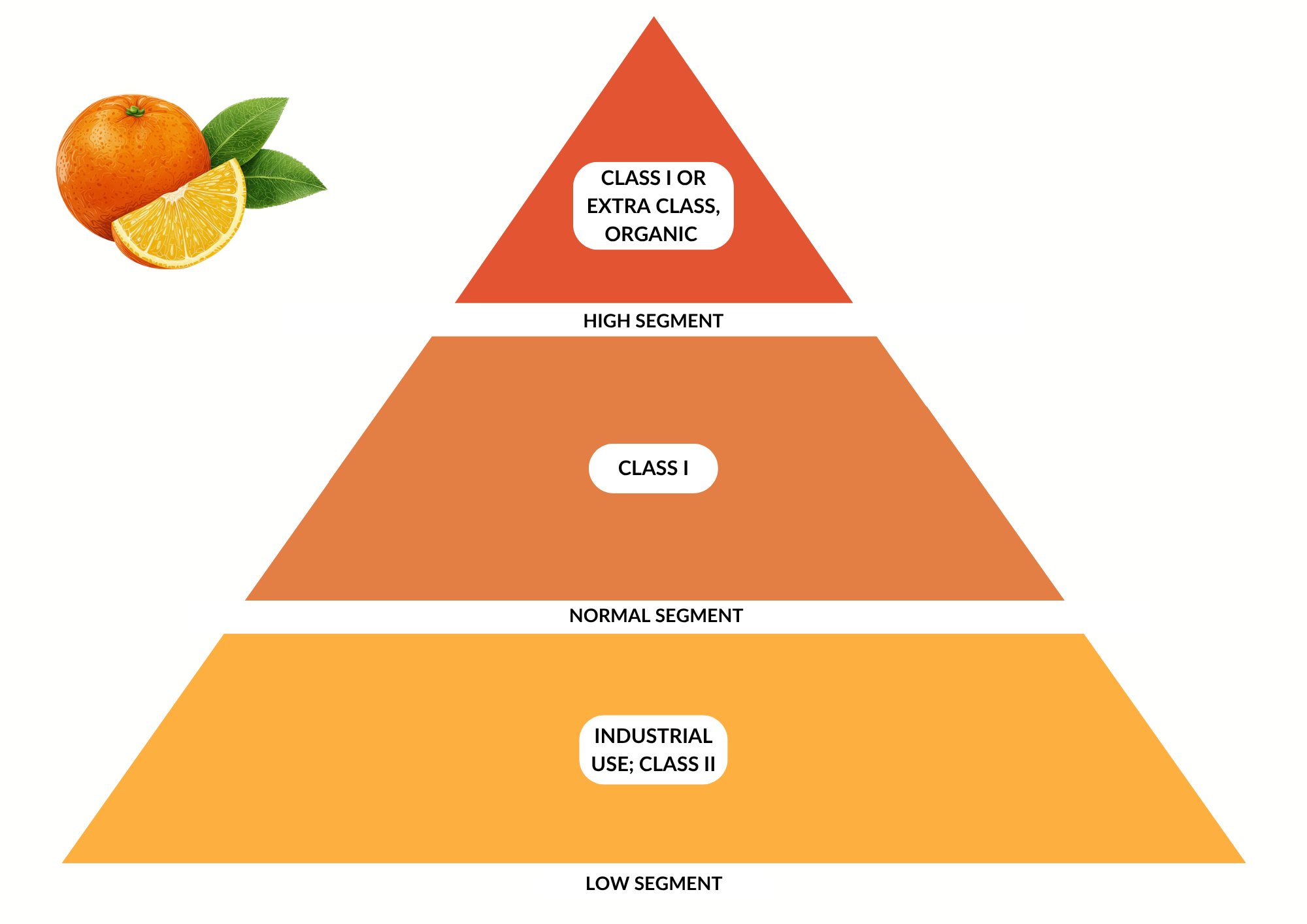
The market for fresh oranges can be divided into 3 segments: high, mainstream and low.
Figure 3: Market segments for fresh oranges in Europe
Source: Globally Cool, April 2026
High segment
The high segment includes premium, organic and branded oranges. These products focus on taste, appearance and origin. They are often sold in smaller packs, premium retail formats or through direct-to-consumer channels.
Players in this segment include SanLucar, Bollo Natural Fruit, The Natural Hand/Iberian Premium Fruits, Eosta (organic fruit specialist), Fairtrasa (organic fruit specialist) and CrowdFarming. Premium oranges are often marketed by variety, region or sustainability concept. Prices are higher, but consumers pay more for quality, branding and storytelling.
Normal segment
The normal segment is the mainstream retail market for fresh oranges. It includes standard Class I fruit mostly sold in net bags, but also loose. Most of the packaging is private label. This is the largest segment in Europe and is dominated by major supermarket supply programmes, with players like the cooperative Anecoop, GoFruit and the distributor Greenyard Fresh. Product requirements focus on consistency, appearance and competitive pricing.
Low segment
The low segment consists of lower-grade oranges and bulk volumes sold through wholesale markets, lower-priced retail and processing channels. This segment includes Class II fruit and oranges that do not meet strict retail specifications. Prices are lower and competition is mainly based on cost. Processors such as Zuvamesa, AMC NATURAL drinks, Refresco and Eckes-Granini take most of the lower-grade oranges. Processors are relevant because they provide an outlet for lower-grade fruit and help stabilise the value chain.
Also, ethnic supermarkets can sell lower-grade oranges that are often traded through spot markets like Fresh Food Amsterdam.
Tip:
- Target the right buyer type for your business. Retail programmes offer volume and continuity, while wholesalers and importers are often more suitable for smaller suppliers or off-season trade.
Through which channels do fresh oranges land on the end market?
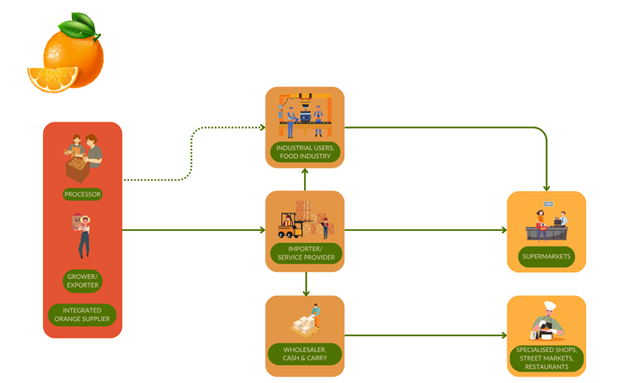
Figure 4 shows how oranges move from exporters to European buyers and consumers. For non-European suppliers, the most relevant commercial links are importers and service providers, because they can connect overseas supply to retail, wholesale and foodservice demand.
Figure 4: Market channels for fresh oranges to Europe
Source: Globally Cool, April 2026
Fresh oranges reach the European market through several trade channels. Supermarkets are the main outlet. Importers, service providers and wholesalers also play an important role. Wholesalers often supply specialised shops and street markets, as well as foodservice buyers such as restaurants, hotels and catering companies.
Importers
Importers are the most practical route for oranges from outside Europe. They know when European supply is short and which origins can fill the gap. This is important for oranges, because demand changes strongly between the Spanish season and the overseas supply window.
Importers check arrival quality, manage documents, organise storage and repacking, and sell the fruit to retail, wholesale, foodservice or processing buyers. Some importers focus strongly on citrus, while others add oranges to a wider fruit portfolio.
There are different types of importers:
- General fruit importers with a strong intra-EU supply and an off-season supply from outside Europe. Examples include Zoutewelle (Netherlands) and Staay Food Group (Netherlands)
- General fruit importers that source mainly from outside Europe. One of these is Jaguar The Fresh Company (Netherlands). It is a citrus specialised importer, traditionally known for South African citrus and grapes. Jaguar does not own farms in South Africa, but operates through partnership structures, buying from growers rather than being vertically integrated. Another example is Kraaijeveld (Netherlands), a service provider with its own ex-EU import lines for a selected range of fruit, including oranges. There is also EXSA Europe, a South African-owned distributor in the Netherlands, specialised in grapes and also trading large volumes of oranges from a wide range of origin countries, including South Africa, Zimbabwe, Egypt and Peru.
- Fruit importers that work with fruit from a certain origin country, like Origin Fruit Group (Netherlands), which supplies citrus from South African growers and runs a year-round supply from South Africa, Egypt and Spain for the juice industry.
- Fruit importers that predominantly source from within Europe, mostly located in countries without a strong trading history. Companies include Ewerman (Sweden) and S-Frutta (Austria).
- Organic and sustainability-focused importers, like Eosta (Netherlands), which works with organic citrus from several origins.
Service providers
Service providers supply large retail and foodservice customers through planned programmes. They often manage sourcing, packing, repacking, category support, quality control and logistics. This channel requires stable volumes, reliable documentation and strong communication.
Examples:
- AMFRESH (AMT Fresh): supplies Tesco and some other supermarkets through long-term retail programmes;
- Primafruit: has a long-term exclusive supply relationship with Waitrose & Partners;
- METRO: one of Europe's largest foodservice companies, with a dedicated fruit and vegetables purchasing department, the Valencia Trading Office. It handles fruit and vegetable procurement and considers oranges one of its most important categories by volume.
Wholesalers (spot market)
Wholesalers buy and sell more flexibly than supermarket programmes. They are useful for smaller volumes, mixed lots, different sizes or fruit that does not fit strict retail specifications. The main risk is price volatility, as wholesale prices react quickly to supply changes. Important wholesale markets are Rungis (France) and Mercamadrid (Spain).
Tips:
- Choose the buyer type that fits your business best. Retail programmes offer continuity and volume, while importers and wholesalers are often more suitable for off-season trade or smaller suppliers.
- Plan your offer around the European off-season, when demand for overseas oranges is strongest.
- For organic oranges, work only with buyers that understand organic certification and traceability.
What is the most interesting channel for you?
For exporters of fresh oranges from low- and middle-income countries, the most interesting channel is usually through specialised importers or service providers. These buyers know how to manage seasonal supply from outside Europe. They can also handle logistics, quality control, repacking and distribution to supermarkets, wholesalers and foodservice buyers.
Your best opportunities are outside the main European orange season, as Spain and Italy dominate in-season supply. From around June to October, European supply becomes more limited and buyers look more to overseas suppliers. This is when suppliers from countries like South Africa, Egypt, Zimbabwe and Argentina can become more relevant.
Large retail programmes can offer stable demand but are difficult to enter directly. Supermarkets need reliable volumes, strict quality, food safety certification and full traceability. For most exporters, it is better to work through an importer or service provider that already supplies retail clients. These companies can match your oranges with the right customer segment.
The wholesale channel can also be interesting, especially for smaller volumes or more flexible trade. Wholesalers can buy fruit that doesn't fit fixed retail programmes. However, prices in this channel can change quickly. This makes it more suitable for experienced exporters that can manage market risk.
Organic oranges require a more specialised route. Exporters should target organic importers or importers with a strong organic citrus programme. These buyers need certified supply, clear documentation and reliable traceability. The Netherlands is an important entry point for organic oranges from outside Europe.
Tips:
- Focus on importers or service providers that already trade citrus from outside Europe.
- Do not approach supermarkets directly unless you can supply large, stable and certified volumes.
- Use wholesalers for smaller volumes, spot trade or fruit that doesn't match retail programmes.
- Attend Fruit Logistica in Berlin and Fruit Attraction in Madrid to meet citrus importers, service providers and logistics companies. Prepare a short product sheet with your orange varieties, season, volumes, certifications, packaging options and shipment windows.
- Read our tips for finding buyers on the European fresh fruit and vegetables market.
3. What competition do you face on the European fresh oranges market?
Spain sets the standard in the European orange market. It has short transport distances, strong packing capacity and long relationships with retailers. Non-European suppliers have the best chance when Spanish supply falls. South Africa and Egypt are the strongest off-season competitors, while Zimbabwe and Argentina can supply selected windows or buyer programmes.
Which countries are you competing with?
Spain's supply of oranges to the European market is more than double the volume of the 2nd-largest supplier, South Africa. Egypt is the 3rd-largest and fastest-growing supplier to Europe. Other countries export large volumes to Europe as well, though these volumes are small in comparison.
Source: Eurostat, Norstat, SwissImpEx, UNComtrade, UK Trade, April 2026
Each supplying country has a different export window to Europe, as Figure 6 clearly shows. The supplies from Spain are aggregated with supplies from the other main European orange-producing countries (Greece, Italy and Portugal).
Source: Eurostat, UK Trade, April 2026
Egypt mainly extends the Spanish season and competes most strongly in the transition period after Spanish volumes start to decline. South Africa peaks later, when volumes from Spain and Egypt are already much lower, which strengthens its role as the main counter-seasonal supplier.
Spain: Europe's leading orange supplier
Spain remains the main orange producer in Europe. For the 2025-2026 season, total EU orange production was projected at just over 5.6 million tonnes, with Spain accounting for about 50% of that volume or around 2.8 million tonnes. However, that season is weaker than 2024-2025, with lower yields linked to extreme weather, pest pressure and a broader shift in production conditions in southern Europe.
Spain sells large volumes directly to the biggest consumer markets, especially Germany (337,900 tonnes) and France (275,500). It also has strong positions in the UK (61,900 tonnes), Italy (63,100), Portugal (63,000), Poland (54,300) and Norway (51,700).
Spain's strength is not only volume but also varietal spread and market timing. The country combines early and mid-season Navels with later lines, while white oranges support late-season supply and the juice segment. This helps Spain supply the fresh market from autumn into late spring. It also gives producers a second outlet for lower-grade fruit through processing, which improves pack-out economics and reduces total market risk.
From a trade perspective, Spain benefits from short lead times, established packing capacity and close links to northern European retailers. But its competitive position is becoming less secure. Lower water availability, rising production costs and more frequent weather shocks are increasing supply risk, especially in years when imports from Egypt and South Africa are strong.
South Africa: Major counter-seasonal orange supplier
South Africa is among the world's main orange exporters. In the harvest of 2025-2026, orange production is forecast at 1.85 million tonnes and exports at 1.45 million tonnes. South African oranges reach the market mainly from June to October, when European supply is low. The Netherlands, Europe's main fresh produce hub, is by far its largest destination (261,500 tonnes), followed by Portugal (68,650), the UK (68,300) and Italy (47,200). France has also become more important recently (24,300 tonnes in 2025).
South Africa is also by far the leading non-European supplier of organic oranges to Europe. Its exports reached 6,554 tonnes in 2024, equal to about 93% of total non-European organic orange imports to the EU. Most of this volume entered through the Netherlands.
The planted orange area is expected to rise by 2% to 46,000 hectares in 2026, showing that growers still see good medium-term prospects in oranges. The production base is becoming more market-driven. FAS Pretoria reports that nursery orders remain strong in 2024-2025 and 2025-2026, with demand especially for Valencia varieties like Bennie, Jassie, Turkey and Midknight. Growers are also replacing some early Navels with late Navels to better match export demand. This is an important signal: South Africa is not only expanding area but also adjusting its varietal mix toward stronger export windows and more commercially attractive fruit.
Regional climate explains part of this pattern. The cooler Western Cape and Eastern Cape are better suited to Navels, while the warmer provinces of Limpopo, Mpumalanga and KwaZulu-Natal are more suitable for Valencia oranges. This spread supports a long export season and different market segments.
The juice market is also influencing fresh orange decisions. Higher global juice prices, linked in part to Brazil's weaker orange crop since 2024, improved processor returns in South Africa and made juicing a lower-risk option because it avoids packing and shipping costs. Even though juice prices eased in 2024-2025, they stayed above pre-2023-2024 levels. In practice, this means the juice market can absorb part of the crop and support grower income while still leaving enough fruit for fresh exports in strong production years. Investments such as hail nets show that growers are also trying to lift both yield and exportable quality.
Egypt: Fast-growing and price-competitive supplier in the early off-season
Egypt is now one of the strongest orange exporters in the world. In 2025-2026, orange production is forecast at 4.0 million tonnes and fresh exports at 1.9 million tonnes. Even after the very high levels reached in earlier seasons, Egypt remains a scale player with a strong cost position and a broad market base. Egypt's large desert planting programmes, strong cold storage capacity and lower production costs have strengthened its position in the early orange window.
Egypt's main destination is the Netherlands (182,400 tonnes), followed by the UK (71,100); it also has relatively strong positions in Slovenia (32,350), Italy (27,300), Spain (24,500), France (11,700), Ireland (10,200), Finland (9,200) and Lithuania (9,740). This shows that Egypt is not only competing on volume and price but is also building a wider market footprint. A small volume of the oranges is organic-certified, at 1,200–1,700 tonnes/year for 2021-2023 before dropping to 320 tonnes in 2024.
Egypt's export model is built on large commercial farms in the Nile Delta and, more and more often, on irrigated reclaimed desert land. The main export varieties are Washington Navel for the earlier part of the season and Valencia for later shipments. This varietal structure gives Egypt a long export window and allows it to serve both the fresh market and processing. As in South Africa, the processing market matters because it creates an outlet for fruit outside premium fresh specifications and can support orchard economics when export margins tighten.
A major structural change is the stronger role of compliance systems. USDA notes that export growth in MY 2025-2026 is supported not only by higher output and new markets but also by the implementation of farm traceability. That matters for Europe, where market access depends more and more often on control, documentation and supplier transparency.
Zimbabwe and Argentina: Smaller suppliers with export potential
Zimbabwe and Argentina are small suppliers from the Southern Hemisphere with export potential to Europe. Although Zimbabwe's exports to Europe are larger than Argentina's export volume of oranges to Europe, Argentina is the larger producer of the two countries.
Argentina has a technically developed citrus base. For 2025-2026, orange production is forecast at 680,000 tonnes and fresh exports at 45,000 tonnes. Production is supported by mild weather and better crop conditions. Argentina's varietal spread is also quite broad: in the northwest, major orange varieties include Hamlin, Pineapple, Robertson and Navel, while the northeast has Navel, Salustiana and improved Valencia types like Midknight and Delta Seedless.
This mix gives Argentina flexibility between fresh sales and processing. That is important because the country has a stronger processing tradition than some other exporters. In years when fresh export margins are weaker, the juice outlet can still support returns. This reduces commercial risk, even if fresh exports to Europe stay limited.
Another strength of Argentina is its flexibility in market routing. In 2025, Spain (12,000 tonnes) and the Netherlands (7,800) were its main destinations, followed by the UK (5,260) and Italy (2,900). This suggests that Argentina can use both the Spanish market and the Dutch trade hub as entry routes into Europe.
Compared to Argentina's production, Zimbabwe is much smaller, but its citrus sector is clearly growing. Export volumes rose from about 62,000-63,000 tonnes in 2024 to 68,000-69,000 tonnes in 2025, according to recent trade reporting, while export earnings also increased. The sector is still small in global terms, but is moving upward through orchard investment and rising output. Current production includes both Valencia and Navel oranges.
Zimbabwe's exports are highly concentrated, with the Netherlands taking by far the largest share of Zimbabwean volumes each year (35,720 tonnes in 2025). Other destinations are much smaller, like Spain (2,950 tonnes), Portugal (1,640) and Lithuania (1,050). France also appeared as a destination in 2025 (540 tonnes).
For both countries, the main point is not scale but positioning. Argentina offers technical citrus know-how and varietal depth, while Zimbabwe offers growth from a low base. They cannot shape the European market in the way Spain, South Africa or Egypt do, but both can serve selected windows, niche programmes or regional channels when quality, timing and compliance are right.
Tips:
- Check Intercitrus and MAPA for Spain. They give useful updates on crop forecasts, market developments and the progress of the Spanish citrus season. Use them to track supply pressure in Europe.
- Use the Citrus Growers' Association of Southern Africa (CGA) for South Africa. Its downloadable statistics booklet is especially useful for export volumes, production regions, cultivar mix and planting trends.
- Follow Horticultural Export Improvement Association (HEIA) and Agricultural Export Council (AEC) in Egypt for practical export information. This offers useful support on production, post-harvest handling, training and export readiness in horticulture.
- Follow Federcitrus to track Argentinian citrus production, exports and the role of processing in the sector.
- For Zimbabwe, check the Horticultural Development Council and its Citrus Growers Association (CGAZ). These sources are useful for background on planted area, orchard expansion and sector development.
Which companies are you competing with?
Your main competitors outside the Spanish season are suppliers from South Africa and Egypt. Below are some companies that supply fresh oranges to the European market.
Bollo International Fruits – Spain
Bollo International Fruits is a leading Spanish citrus company focusing on premium oranges and strong branding in the European retail market. The company is known for high-quality fruit, consistent supply and strong marketing.
Bollo works with selected growers and uses strict quality control. It focuses on taste, appearance and reliability. This makes it a strong partner for supermarkets in Northern Europe. The company's strength is its control over the value chain and its brand position. For exporters, this means competition is not only on price but also on quality, consistency and branding.
Impala Citrus – South Africa
Impala Citrus is a South African grower-exporter of citrus. On its website, the company presents itself as a family-owned business founded in 2001, with a head office in Cape Town and an operational base in Groblersdal. The company is active in export markets and offers citrus as part of a wider fruit portfolio.
The company operates in a highly regulated export environment. EU phytosanitary requirements are strict, with controls at orchard, packhouse and port level. Compliance costs are high, especially for pests such as False Codling Moth and Citrus Black Spot. Impala Citrus, like other South African exporters, focuses more and more on late varieties like late Navel and Valencia oranges. These later windows face less direct competition and offer better margins.
Figure 7: Oranges in an open-top carton by Impala, South Africa
Source: Impala Citrus, 2025
Enmaa for Agricultural Development – Egypt
Enmaa is a large Egyptian citrus producer and exporter operating large-scale farms, including desert production areas with irrigation systems. The company focuses on volume production and export efficiency, benefitting from lower production costs and strong cold storage capacity. This allows longer storage and flexible shipment timing.
Enmaa mainly exports Washington Navel and Valencia oranges. These varieties support both early and late export windows. The company supplies a wide range of markets, including Europe. Its competitive strength is scale and cost efficiency. For competitors, this means strong price pressure, especially in the early part of the season.
Tip:
- Study your international competitors and define your market position clearly. Show buyers why your oranges are a better fit for their programme. This can be your supply window, short transit time, varietal mix, eating quality, compliance record, packing reliability or sustainability performance. Make sure your unique selling points match the needs of the buyer and the market segment you target.
Which products are you competing with?
Fresh oranges mainly compete with other fresh fruits that offer similar convenience, taste and price. These include mandarins, easy peelers and apples, which are popular for everyday consumption. Mandarins are a strong competitor because they are easier to peel and are often preferred by families and children.
Some consumers also choose fruit based on tolerance and personal sensitivities. Apples, peaches, mangoes, pineapples and kiwis can cause reactions in some people with fruit sensitivities. Citrus fruit can also cause reactions in rare cases, but oranges may still be a practical option for consumers who avoid other fruits. Do not make medical claims, but you can present oranges as a familiar and widely accepted fruit for daily consumption.
Oranges also compete with processed fruit products like fresh-cut fruit, fruit juices and smoothies, which offer convenience and ready-to-consume options. In addition, bananas compete on price and availability, while berries compete in the premium segment due to their perceived health benefits.
Consumption trends also play a role. Demand for convenience and snackable fruit can reduce demand for whole oranges, especially when preparation is seen as less easy.
Tips:
- Focus on convenience to stay competitive. Consider offering easy-peel varieties, smaller pack sizes or ready-to-eat formats. This helps you compete better with mandarins, fresh-cut fruit and snack products.
- Promote the health and value of oranges. Highlight vitamin C content, natural juice and freshness to compete with juices, smoothies and premium fruits like berries. Clear communication can support demand in both retail and foodservice.
- Promote oranges as a familiar and widely accepted fruit. Avoid medical claims, but show how oranges fit into everyday diets, lunchboxes, foodservice and juicing.
4. What are the prices of fresh oranges on the European market?
Orange prices follow the European citrus season. Spanish supply keeps prices under pressure during much of the season. When Spanish volumes fall from June onwards, Europe depends more on South Africa, Egypt and other overseas suppliers. This usually supports higher import prices, especially in markets with more spot trade.
Import prices and fluctuations are linked to the Spanish season
Prices for orange imports from low- and middle-income countries are strongly linked to the Spanish harvest season. From January to May, Spain still supplies many late-season oranges, such as Navel and Valencia types, which helps keep import prices relatively low. From June onwards, Spanish supply becomes smaller and Europe then depends more on overseas suppliers, with prices usually rising.
Source: Eurostat and UK Trade, April 2026
This pattern was especially strong in 2023. Spain had a poor orange season due to drought, irrigation limits and high temperatures. This reduced local supply and increased demand for imported oranges. As a result, prices peaked strongly in September 2023, reaching €1.53/kg in Italy, €1.42/kg in the Netherlands and €1.38/kg in Portugal.
In 2025 the same pattern returned, but the peak lasted longer. Prices stayed high from July to October, especially in Italy, Portugal, Spain and the Netherlands. This pattern suggests that the market remained tight for a longer period during the European off-season. So for exporters from low- and middle-income countries, July–October is the most attractive sales window. The other two countries – the UK and France – import more steadily during the year, which helps explain why their prices move less sharply than those of Italy, Portugal, Spain and the Netherlands.
Retail and wholesale prices do not always follow import prices
Import prices and retail prices are linked, but not 1-to-1. The import price is the price when oranges enter the country. Retail prices include many extra costs: transport, storage, sorting, losses, packaging, quality control, retailer margin and VAT. Supermarkets may also smooth prices through contracts, so retail prices often react later and less sharply than import prices.
For oranges, rising import prices from low- and middle-income countries in the European off-season may lead to higher retail prices too, but the increase is often smaller or delayed. The link is strongest in markets with more spot trade, such as wholesale-driven channels. It is weaker in markets with strong retail programmes, like the UK and the Netherlands.
In Spain, Portugal and Italy, retail prices are also influenced by local harvest volumes and domestic producer prices. The European Commission monitors fruit and vegetable prices along the supply chain, including citrus prices.
Price breakdown reflects activities and costs in the value chain
Each step in the orange value chain adds activities, costs and margins to the final retail price. After arrival in Europe, the price includes importer handling, sorting, packaging, distribution, retail margins and VAT.
Figure 9 shows an indicative price breakdown for imported oranges based on a retail price of €1.65/kg. In this example, the CIF price is around €0.75/kg. The remaining value is added through importer handling, processing and packaging, retail distribution and margin, and VAT.
Source: Globally Cool, May 2026
This breakdown is only indicative. Actual shares differ by season, quality, packaging, transport costs, contracts, and the European market and outlet where the oranges are sold.
Tips:
- Monitor prices in the European market with the European Commission's fruit and vegetable price monitor. You can select the stages 'Farmgate price', 'Ex-packaging station price', 'Retail buying price' and 'Retail selling price'.
- Check current prices in the different European markets. For a few countries there are good sources available: for the French market, FranceAgriMer gives a variety of prices, and for the Spanish market Mercalicante offers details on variety level (select the category (Frutas), product (Naranja) and variety).
Globally Cool carried out this study on behalf of CBI.
Please review our market information disclaimer.
Search
Enter search terms to find market research
Do you have questions about this research?
We work only with organic produce, but we also look for sustainability impact beyond the certification. A good example is our rain-fed Valencia oranges from Peru: they are grown mainly on rainfall, without large-scale irrigation, which helps lower the water impact compared to irrigated systems.

Peke van Beek, product manager at Eosta