
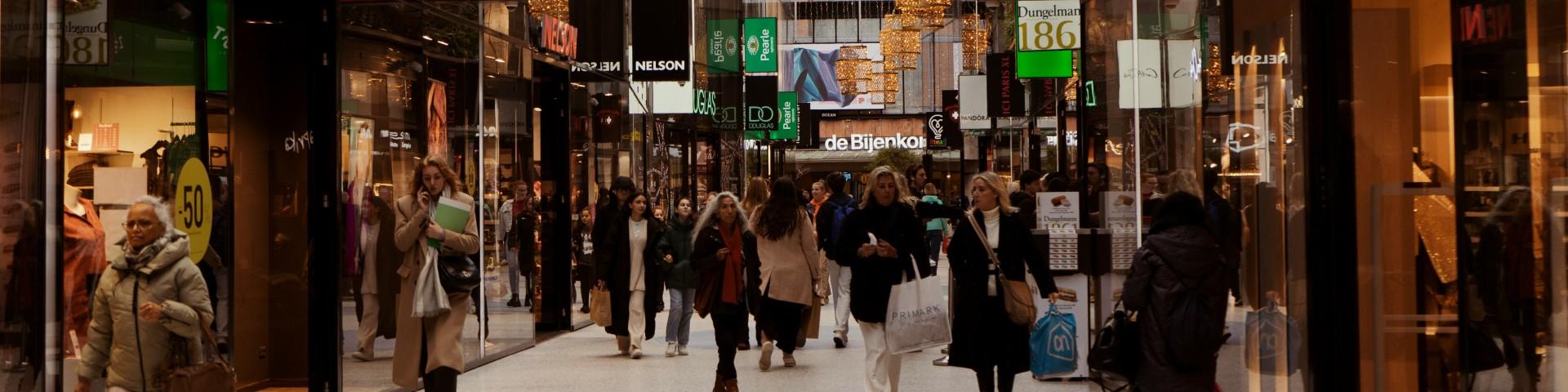
Entering the Dutch market for apparel
The Netherlands is a relatively small country in Western Europe, bordering Germany and Belgium. It is home to the largest seaport in Europe (Rotterdam) and plays a big role in European trade. The positives of doing business in the Netherlands include the its EU membership, high living standards, the culture of direct communication and English as a commonly spoken second language.
Contents of this page
Figure 1: The Netherlands has a relatively tall, multicultural and affluent population that loves cycling
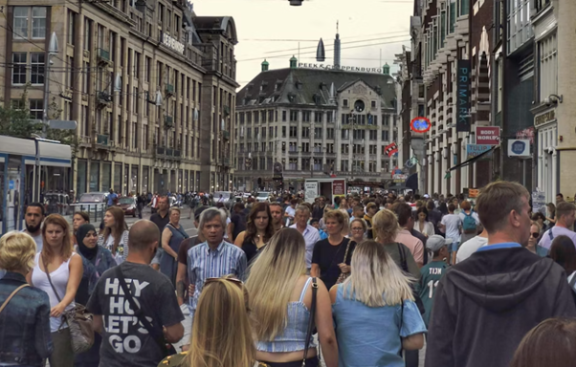
Source: Sebastian Enrique on Unsplash
High requirements
The Netherlands is a relatively fragmented market. It has many small and medium-sized brands and retailers. Order volumes are typically low, and buyers are typically very price-conscious. Requirements for quality, service and sustainability are strict. The Netherlands also has the tallest citizens in the world (men averaging 1.84 m and women 1.70 m). This means you often need to adjust size ranges compared to other EU markets. The climate is temperate, driving demand for layered clothing, outerwear and knitwear all year round.
Testing ground
The Netherlands is a good market to test sustainable and circular apparel concepts thanks to its small population with sustainability-minded consumers and high level of digitalisation. Think of new materials, lease and resale models, and traceability solutions. This can be seen by the fact that the Netherlands is home to several brands, retailers, service companies, industry initiatives, universities and NGOs that are considered pioneers in circular apparel.
1. What requirements and certifications must apparel meet to be allowed on the Dutch market?
You need to meet several requirements when exporting apparel to the Netherlands. These include legal requirements based on European Union (EU) laws and regulations, as well as national laws and regulations.
What are mandatory requirements?
There are many legal requirements for exporting apparel to Europe, including EU regulations concerning product safety, the use of chemicals (REACH), quality and labelling. Children’s wear has special EU consumer safety requirements (see below). Check the EU Access2Markets online helpdesk for an overview.
Follow these steps to ensure that your product complies with the relevant legal requirements:
- Make sure your product complies with the EU’s General Product Safety Regulation (GPSR: 2023/988) ensuring consumer safety. If your buyer supplied the product design, it is their responsibility to guarantee it is legally safe for consumers to use;
- Make sure you meet the EU’s REACH Regulation. This restricts the use of chemicals in apparel and trims, including certain Azo-dyes; flame retardants; waterproofing and stain-repelling chemicals and nickel. To prevent non-compliance, test input materials before production;
- Pay attention the safety standard that applies to apparel for children: EN 14682. This contains requirements to ensure that cords and drawstrings are placed safely on apparel for children up to 14 years.
- Specify the material composition of every apparel item of that you export to the EU, in line with Regulation (EU) 1007/2011. Check the EU Access2Markets online helpdesk on how to do this.
- Do not violate any Intellectual Property (IP) rights and do not copy or share designs with other buyers. If your buyer provides the design, they will be liable if the item is found to violate a property right.
National regulations
In addition to EU laws and regulations, the Netherlands has introduced the following national laws to enforce more sustainable and social practices in its international apparel supply chains.
Extended Producer Responsibility
Moving ahead with the EU’s Waste Framework Directive, the Netherlands introduced the Extended Producer Responsibility Decree in 2023. The Dutch ERP Decree states that producers and importers are financially responsible for collecting and recycling textile waste. By 2030, 75% of textile products must be recycled, and companies will be expected to report on traceability requirements.
Policy ambition: Fully circular by 2050
The Netherlands has large ambitions in terms of circular textile. These are laid down in the Policy Programme for Circular Textile 2025-2030, the follow-up programme to ‘Circular textiles policy programme 2020–2025’. The programme contains several measures to: reduce input materials; substitute harmful materials with more environmentally friendly ones; extend the lifespan of apparel items, and to increase post-consumer collection and processing.
Tips:
- Read the CBI study on buyer requirements for apparel products for an extensive overview of the legal, non-mandatory and niche requirements that you will face as an exporter of apparel to Europe, including the Netherlands.
- Check the EU Access2Markets online help desk for an overview of all legal requirements that apply to your product in the EU.
What additional requirements and certifications do buyers often have?
Buyers may confront you with additional, company-specific terms and conditions. These requirements are usually written in a buyer’s manual. By signing a contract with your buyer, you confirm that you will meet all the requirements listed in the manual. You will be held accountable in case of a problem after the delivery of an order.
If a buyer does not have a manual, make sure all terms and conditions are clear and agreed upon beforehand to avoid unpleasant surprises. The following topics may be included in a buyer’s manual.
Payment terms
For first-time orders, European buyers may give you a down payment via bank transfer (for instance 30%). They will pay the rest (70%) before shipment, again via bank transfer. Buyers may also give a bank guarantee. Another payment method is the L/C (Letter of Credit). With an L/C, the buyer’s bank must pay the supplier when both parties meet the conditions they have agreed upon. This is the safest payment method for a manufacturer. An L/C can also be used to get funds to purchase materials.
For follow-up orders, most European buyers will ask for a TT (Telegraphic Transfer/Open Account) after 30, 60, 90 or sometimes even 120 days. This means that the payment will be made within the number of days you have agreed on with the buyer after you have handed over the shipment. You as the manufacturer take full financial risk.
Delivery terms
Free on Board (FOB) is the standard Incoterm used by buyers and sellers to agree on delivery of goods. Some buyers may ask you to agree on Delivery Duty Paid (DDP), due to rising shipping costs. This is the riskiest Incoterm for you as a manufacturer.
Nominated suppliers
Some buyers may require you to purchase materials from a recommended supplier. This means that you are responsible for the ordering, delivery and payment of the materials. This may negatively impact your flexibility, cost, speed and liquidity. Discuss locally available solutions with your buyer to replace recommended suppliers.
Acceptance quality limit
Your buyer may set an acceptance quality limit (AQL). This refers to the worst quality level that is still acceptable. For instance, AQL 2.5 means that your buyer will reject a batch if more than 2.5% of the items are defective.
Packaging requirements
Typically, your buyer will give you instructions on how to package the order. If you agree on delivering Free on Board (FOB), your buyer will clear customs in the country of import. It is their responsibility to ensure the instructions on the packaging meet EU import procedures. Reduce unnecessary packaging materials, use reusable packaging and choose packaging containing recycled materials or biodegradable plastics
Restricted substances
Ask your buyer if they use a Restricted Substances List (RSL). These lists are often inspired by the guideline on safe chemicals use from the Zero Discharge of Hazardous Chemicals (ZDHC) foundation or AFIRM.
Transparency
Share information about your own operations with buyers, and help them to gain as much insight as possible into your entire supply chain and the materials used. The new Ecodesign for Sustainable Products Regulation (ESPR, 2024) will introduce a Digital Products Passport: a digital identity card for garments and materials. Information on this card can include:
- The product’s technical performance;
- Materials and their origins;
- Repair activities;
- Recycling capabilities;
- Lifecycle environmental impacts.
Worker happiness
Your buyer may require that you pay attention to diversity and inclusion in your workforce. All individuals in your company should have equal opportunities, regardless of gender, race, religion or other characteristics. Watch the CBI webinar on worker happiness for background information and tips.
Animal welfare
If you use wool, animal welfare is an important concern. Buyers may require that you only use RWS-certified wool. If you use merino, many Dutch buyers will require that you only use non-mulesing wool. Real down is used in items such as jackets, but most Dutch buyers will allow only Responsible Down Standard (RDS) certified down.
Other materials of animal origin are largely avoided or banned by mainstream Dutch apparel brands and retailers. These include Angora (rabbit hair), real fur and exotic leathers. Angora is very rare in Dutch retail due to animal cruelty scandals in the 2010s. Real fur is mostly absent from the market, and domestic fur farming was banned in 2021. The use of exotic leathers is mostly limited to luxury brands.
Regenerative agriculture
Regenerative agriculture is a concept focused on phasing out harmful fertilisers and pesticides and ‘regenerating’ nature. Dutch denim brand G-STAR and workwear brand Schijvens, for instance, have set goals in this area. Control Union has introduced the first certification for regenerative agriculture: regenagri.
Carbon footprint
Many Dutch brands and retailers have committed to climate neutrality and CO2 reduction, including WE Fashion and HEMA. Calculating the CO2-footprint of an apparel item is a complicated process. It starts with carefully measuring your emissions before reducing them. Several organisations have set benchmarks for certain materials and/or products. Check the CBI study Tips to go green for more information.
Recycling
The EU is introducing new legal measures to increase circularity, including new directives on durability and ecodesign of textile products and a ‘right to repair’. The EU is also working on an EU-wide EPR for apparel (extended producer responsibility), making companies responsible for the way their products are disposed of, recycled or repaired.
The Netherlands can be considered one of Europe's leaders in circular textiles. It introduced its own EPR in 2023, ahead of EU legislation. Industry initiatives help companies design for recycling, collecting, sorting and recycling, including the Dutch Circular Textile Valley (DCTV) and the national Circular Textiles Programme. Several Dutch companies are frontrunners in circular business models, including MUD Jeans, Wolkat and Loop.a life.
Certification
Most Dutch buyers require suppliers to get certified for sustainable and/or fair production or the use of sustainable materials. OEKO-TEX® STANDARD 100, GOTS and BSCI are some of the most popular standards in the Netherlands. BSCI is practically mandatory. The Responsible Wool Standard (RWS) and Recycled Claim Standard (RCS) are widely recognised material standards.
Fair Wear Foundation (FWF) has traditionally been popular amongst Dutch workwear brands. It is also being adopted by fashion brands and retailers more and more often. More and more Dutch apparel companies are B-Corp certified. This is a company-level standard, but the indirect effects on suppliers include stricter requirements regarding certification and transparency.
For an elaborate overview of popular standards, check the CBI study on Buyer requirements.
Table 1: Popular standards in the Netherlands
| Name of standard | Logo | Type of compliance | Further information on getting certification |
|---|---|---|---|
| OEKO-TEX® STANDARD 100 | 
| Material safety | Check the OEKO-TEX® STANDARD 100 webpage for practical guidance. |
| Amfori BSCI | 
| Social | On invitation by buyers. Amfori provides a list of organisations that can perform an audit. |
| GOTS | 
| Social, environmental (organic production) | GOTS provides a list of organisations that can perform an audit. |
| Fair Wear Foundation | 
| Social, environmental | This FWF webpage offers brands information on the enrolment process. |
| B-Corp | 
| Social, environmental | This B-Corp webpage offers companies information on the enrolment process. |
| Responsible Wool Standard | 
| Animal welfare, Environmental | Check how to get certified. |
| Recycled Claim Standard | 
| Environmental (material recycling) | Check how to get certified. |
| Global Recycled Standard | 
| Environmental, social (material recycling) | Check how to get certified. |
| Better Cotton Initiative | 
| Environmental, social | Check how manufacturers can source better cotton. |
Source: FT Journalistiek
Product design and development
The apparel market in the Netherlands is practical, understated and driven by functionality rather than bold, trendy designs. Most Dutch people have a strong preference for garments that are comfortable and versatile, with clean designs, like the Scandinavians. Dutch end consumers typically prefer simple silhouettes, neutral colours, comfortable fabrics that are easy to wash and dry, and garments that can be layered. Compared to Southern Europe, Dutch fashion is generally more casual and less extravagant.
Popular colours include black, navy blue, grey, beige, green and earthy tones. Subtle, small-scale prints such as checks or stripes are appreciated. Bold prints do occur, but mostly in niche or seasonal collections. During working hours, ‘smart casual’ is the norm in most sectors. This means chinos, jeans, shirts, blouses, and clean sneakers or laced shoes. The same kind of dress code is used when Dutch people go out for drinks or dinner during the weekend. Suits and dresses are mostly limited to finance, legal and corporate senior roles. Students dress very casually.
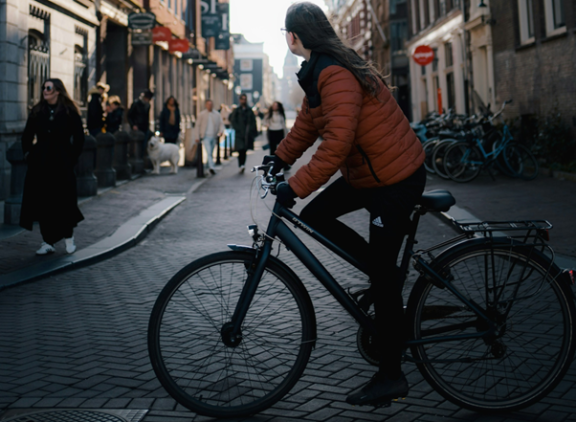
Dutch cycling culture deserves special attention. Due to the Netherlands’ mostly flat landscape, mild climate and over 35,000 km of bicycle paths, the Dutch are avid cyclists. More than a quarter of their domestic journeys are by bike, including daily commutes and sport and leisure rides. This translates into a love for comfortable and sturdy clothing. Almost 1.5 million people in the Netherlands ride bicycles for sport. They usually do so wearing special cycling sportswear. For example, look at Dutch sport/cycling brands, like Rogelli and AGU.
Figure 2: Being keen cyclists, the Dutch prefer comfortable, informal and outdoor styles
Source: Roshan Chakkeeri on Unsplash
Communication
Smooth communication is crucial. Always reply to emails within 24 hours, even if it is just to confirm that you have received the email and will send a longer reply later. If you have a problem with a production order, immediately let the buyer know and offer a solution. Create a critical path of every order and share it with your buyer. A critical path is a list of every step in the production and delivery process and the time each step takes. This will help you manage expectations and monitor progress.
Flexibility
Be prepared to first accept complicated orders. Buyers will want to test your factory before giving you large, easy orders. Make sure at the start that a buyer will not continue to place only difficult orders with you and easy orders elsewhere. Expect a European buyer to require in their first order:
- High material quality and impeccable workmanship;
- Order quantities below your normal minimum order quantity (MOQ);
- A price level that is lower than you would normally accept for small-quantity orders.
To increase flexibility, factories can install a sample room (to produce small orders), a modular production set-up (an ‘island’ instead of a production line) or a U-shaped set-up, so employees can control several machines at the same time.
What are the requirements for niche markets?
The Dutch apparel market offers several interesting niches. Be aware that niche buyers usually offer smaller orders and require a relatively high service level. This means you need to adjust your manufacturing and sourcing setup if you want to be profitable.
Denim
The Netherlands is an important market for denim. This is a product category actively pushed by Dutch public and private organisations to design for circularity. The Dutch government launched the Denim Deal in 2020: a public-private initiative bringing together brands, manufacturers, recyclers and government bodies to make recycled cotton fibre the new industry standard. An important part of the supply chain is Wolkat, a Dutch textile recycler that sorts, spins and weaves, all in one place, supplying post-consumer recycled cotton feedstock.
Following its success, the initiative evolved into the Denim Deal 2.0 in 2024, expanding its ambitions internationally to drive the use of post-consumer recycled content throughout the global denim industry. As a result of these efforts and others, the proportion of jeans on the Dutch market containing at least 20% post-consumer recycled content rose from 8% in 2020 to 41% in 2022.
Knitwear
Dutch brands are focused on using sustainable fibres in their knitwear more and more often. Cotton and man-made fibres dominate imports, so expect growing demand for organic cotton and recycled man-made fibres. For instance, look at Amsterdam-based textile innovation studio BYBORRE, which develops engineered knitted textiles on demand, with full supply chain transparency. The studio has worked with global brands including Nike, Adidas, Gore-Tex and Rapha.
Underwear
The Netherlands has a strong domestic underwear and lingerie industry. Budget and mainstream retailers, including Action, Zeeman and HEMA, offer basic underwear for men, women and children. In the women's segment, Dutch brands include mainstream retailer Hunkemöller (one of Europe's largest lingerie chains), mid-market brands, such as LingaDore and Sapph, and premium brands, such as Marlies Dekkers (famous for its bold designs).
Note that Dutch underwear brands maintain strict chemical management standards even at the mainstream end of the market. Certifications, such as OEKO-TEX STANDARD 100, are more and more expected across all market segments, given the direct skin contact nature of the category.
Outerwear
Outerwear is an important apparel category in the Netherlands, thanks to its climate with cool temperatures, frequent rain and wind and its cycling culture. This leads to higher demand for functional, weatherproof outerwear that performs on bicycles and in everyday life. Packable, water-resistant, practical designs are highly appreciated.
Dutch outerwear brands are using recycled synthetic fibres more and more often. Dutch rainwear brand Maium, for instance, uses at least 85% GRS-certified recycled PET in all of its products. Meanwhile, outdoor brands like O'Neill and Protest have made recycled synthetics a standard part of their outerwear collections. If you want to supply this market, you need to be able to work with recycled synthetic fibres and hold GRS certification.
If possible, use PFAS-free water-repellent treatments, as traditional Durable Water Repellent (DWR) finishes that contain PFAS are more and more restricted in the Dutch market.
Tips:
- Focus on the product category that best meets your manufacturing capabilities.
- Investigate which sustainable fabric options you could offer, including organic cotton, ECOVERO™ viscose and rPET. Try to offer your buyers verifiable data about the environmental impact of these materials.
- Read CBI’s tips on how to organise your export for practical guidance and background information on the best ways to get your product onto the Dutch market.
2. Through which channels can you get apparel on the Dutch market?
Before you approach Dutch apparel buyers, you need to determine what market segment fits your company best and through which sales channel(s) you want to sell your product.
How is the end-market segmented?
Dutch apparel buyers can best be classified by price/quality level.
Table 3: Apparel consumer segments
| Consumer type | Price level | Fashionability | Material use | Functionality | Order Quantities |
|---|---|---|---|---|---|
| Luxury consumers | Very high retail prices | High comfort, fashionable designs and shapes | Natural, luxury materials | Very high requirements regarding durability | Low order quantities |
Mainstream fashionable consumers | Medium retail prices | Combination of practical multi-purpose items, and fashion | Good quality, often made from sustainable materials | High requirements regarding comfort | Medium/high order quantities |
Price-conscious consumers | (Extremely) low retail prices | Basic styles with a focus on comfort | Medium-low quality materials | Low functionality | High order quantities |
Source: FT Journalistiek
Luxury consumers
High-fashion consumers shop at luxury brands and retailers and high-fashion brands. These consumers expect elegant and unique designs, focused on style and quality. Brands in this segment offer top-quality (natural) materials and manufacturing, the latest technical innovations and highly comfortable designs. Order quantities are small and quality requirements are high, just as retail prices.
Mainstream fashionable consumers
Brands and retail companies in the middle market sell fast-changing collections created around a brand image and offer a good-quality product for a mid-level price. Products must have the technical look of a high-end product, but be comfortable and suitable for different occasions. Sustainable materials are appreciated. Social compliancy is a must.
Price-conscious consumers
The budget market caters to price-conscious consumers. Design, quality and sustainability are less important, but the apparel item needs to give the impression that it is fit for its purpose and in line with the latest fashion trends. Prices are low and competition is heavy in this market segment, both with regard to retail and to manufacturing. Order quantities are high, because products sell fast.
Tips:
- Check online shopping platforms like Zalando, ABOUT YOU and Wehkamp for inspiration on styles and designs from Dutch fashion brands.
- Work with Dutch-based distributors, wholesalers and retailers to gain market access. Do not forget to choose an entry strategy, whether you are planning to export directly to retailers, participate in trade fairs or establish a local presence in the Netherlands.
Through which channels does a product end up on the end market?
There are many different ways to sell apparel to Dutch buyers, depending on their place in the apparel value chain. Each type of buyer has unique requirements, so always be aware of what type of buyer you are dealing with and investigate if you can meet their demands.
Table 4: Apparel sales channels in Europe
| Sales channel | Who’s your buyer? | Requirements | Examples |
|---|---|---|---|
| 1 | European end-consumer | You can target Dutch end-consumers directly with your own online shop (with promotion via social media), or indirectly via existing platforms. You will need to invest in an online shop, stock, order management and customer service. Your biggest challenges will be return policies and a lack of brand awareness.
Note that online B2C-platforms may require a percentage of each sale and/or a monthly fee.
You need a legal representative in Europe to ensure compliance with the EU’s General Product Safety Regulation (GPSR: 2023/988). | |
| 2 | Online multi-brand platform | Online multi-brand platforms sell existing brands and often develop their own private collections, mostly value brands. They can detect market interest very quickly and will immediately react to sales data.
Usually, such companies will place a small test order first. If the item is selling well, they will place the actual production order. Fast delivery is a must. | |
| 3 | Retailer | Apparel is sold by big retail chains in shops and online and by smaller boutique shops that can be found in almost every European city. Retailers sell existing brands and may order collections specially developed and manufactured for them. |
|
| 4 | Brand | Apparel brands develop a collection 6 to 9 months in advance. You will need a sample room, as brands require salesman samples (SMS) of each collection style. Every salesman sample needs to be actual: it must look exactly like the product will in the shop. It may take many months before orders are placed. |
|
| 5 | Intermediary | Agents, traders, importers and private label companies sell your product on to buyers up the value chain. They are extremely price focused and require flexibility in quantities and qualities.
Some are located near or in the production countries and primarily do sourcing and logistics, others work from Europe and also do market research, design and stock keeping. Their service level determines the commission rate they charge. |
Source: FT Journalistiek
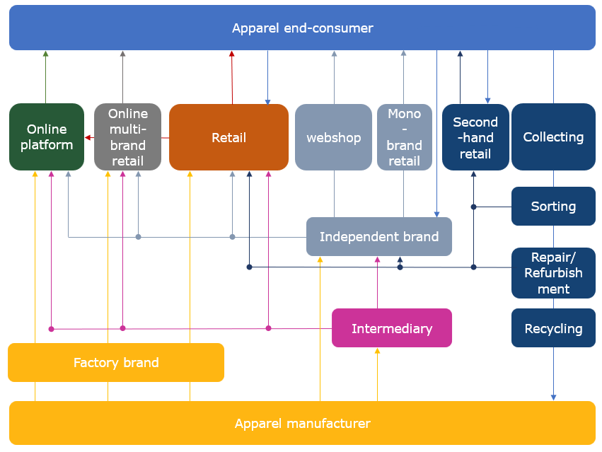
Figure 3 below shows the many ways you can get your product onto the Dutch market, either via an intermediary, your own brand or via brands, retailers or online (multi-brand) platforms. Notice how ideal consumers return their apparel items to the seller after use, to be reused, repaired, refurbished or recycled.
Figure 3: Apparel market value chain
Source: FT Journalistiek
Tips:
- Read the CBI study ‘11 tips for doing business with European apparel buyers’ to learn how to approach and engage with buyers. This report also describes how you can get practical help with understanding European business culture, analysing your Unique Selling Points (USPs) and doing business with European buyers.
- Find potential Dutch buyers on the exhibitor list of apparel trade fairs and events, such as the Modefabriek (Amsterdam), Amsterdam Textile Show (Amsterdam), ISPO (sportswear, Amsterdam), Kingpins (denim, Amsterdam), Première Vision (Paris, France), Texworld (Paris, France), Interfilière (underwear, Paris, France), ILM (leather, Offenbach, Germany) and Lineapelle (leather, Milan, Italy).
- Fast and flexible delivery is a must across all sales channels. Read the CBI study ‘7 tips on how to increase efficiency in an apparel factory’ to learn how you can lower inputs, increase your output, generate less waste, increase quality and become more competitive overall.
What is the most interesting channel for you?
As you move higher up the value chain, your margin will increase, but so will the service level that your buyer will require from you. When you have little experience with exporting to Europe, intermediaries and brands are likely the best starting point for you. Such companies have the largest market share, they service every price/quality segment of the market and they are used to working with suppliers in different production countries worldwide.
Tips:
- You can find intermediaries specialised in apparel by using an online search engine. Use keywords such as ‘full service’, ‘garment’ or ‘apparel’ plus ‘solution’. Traders’ websites usually show the brands they are working with.
- Be on top of new technical developments in the market. Check online sources like Innovation in Textiles, Textile World and Fibre2Fashion. Be an advisor as well as a producer to gain an advantage over your competitors.
3. What competition do you face on the Dutch apparel market?
Apparel is manufactured all over the world, so you will likely face a lot of competition. The most important ways to create a competitive advantage over manufacturers in other countries are: technical knowledge, service level, flexibility to accept lower MOQs, efficiency and beneficial trade agreements.
Which countries are you competing with?
The Netherlands’ biggest trading partners are China, Bangladesh, Türkiye and Vietnam. The Netherlands gets more of its imports from low- and middle-income countries than any other EU country: 60.3% by value and as much as 84.6% by volume.
Table 5: Apparel-producing countries, their strengths and weaknesses
| Country | Strengths | Weaknesses | Image in Europe | Future developments |
|---|---|---|---|---|
| China | Scale, technical innovation, high efficiency, excellent customer service, and local availability of raw materials. | A range of quality standards, rising labour and production costs, no General Scheme of Preferences (GSP). | Still dominant in apparel manufacturing, but facing increasing regulatory scrutiny and trade barriers. | Shifting to higher value-added apparel products, automation and selective sourcing for specific product categories. |
| Bangladesh | Large-scale apparel production expertise, low production and labour costs, GSP access. | Lower technical skill levels than China, longer lead times due to import of fabrics, risk of political instability. | Global hub for cost-competitive volume apparel production but challenges regarding CSR and compliance. | Massive investments in sustainable and compliance-driven manufacturing; diversification into technical textiles. |
| Türkiye | Proximity to Europe, very short lead times, high-quality small-batch apparel, European business culture, payments in Euros. | Increasing labour and production costs due to inflation. | Preferred nearshore supplier for fast fashion and high-quality compliant apparel, especially for smaller runs. | Growing focus on sustainable production, product innovation and expanding exports to the US market. |
| Vietnam | Experienced apparel manufacturing base with strong capacity in cut-and-sew, sportswear, denim, and outerwear. Benefits from a free trade agreement the with EU (EVFTA). | Increasing labour costs and strong dependency on China for import of fabrics. | Reliable and relatively compliant sourcing destination for sportswear and volume orders. | Expected to benefit from EU due diligence legislation and diversification away from China. |
Source: FT Journalistiek
Tips:
- Study the countries you are competing with, compare their strengths and weaknesses to yours, and advertise the competitive advantages of doing business with you. Besides GSP, consider factors such as distance to Europe, ease of doing business, transparency, political stability and general CSR compliance.
- Check if and how other countries benefit from the Generalised Scheme of Preferences on the EU’s website on international trade.
- Most online search engines will let you create news alerts on specific topics, so you can automatically follow the latest developments in the apparel industry in a specific country.
Which companies are you competing with?
Many Dutch fashion brands and retailers have long-standing business relations with apparel factories around the world. They are, however, always looking for factories that can offer special designs, styles or very good prices. Always make sure your company fits a potential buyer’s requirements before reaching out to them.
Denim Expert in Bangladesh is a well-established manufacturer of denim products that has successfully exported to the Netherlands for many years. This company uses regenerative cotton and recycled fibres, and invests in water-saving production techniques and renewable energy. It also works with the Bangladesh Partnership for Cleaner Textile (PaCT) and ZDHC. It promotes transparency throughout its supply chain.
MAS Holdings in Sri Lanka started as a small manufacturer. It has developed into a group of international manufacturers with different production units in different countries. MAS Holdings has invested in digitisation and automation to go beyond compliance. Its structure has enabled it to successfully export worldwide, including the Netherlands.
Interloop in Pakistan is a leading manufacturer of socks, hosiery and knitwear. It supplies many international fashion and sports brands, including Dutch companies. Interloop has a strong focus on innovation, sustainability and service. Its website presents its mission and capabilities first, then its product range. The company participated in the Socklab Digital Product Passport (DPP) pilot, showing how shared supply chain data can improve transparency and traceability.
Tips:
- Check the free online database Open Supply Hub. This website enables you to look up the suppliers of hundreds of European fashion brands.
- Identify organisations that manufacture similar products for the same target market and try to seek cooperation.
- Diversify your fabric sourcing portfolio to offer buyers more choice in fabrics.
Which products are you competing with?
Trousers and shorts, knitwear, T-shirts, underwear/nightwear, outerwear, and shirts and blouses are the most common product categories that developing economies export to the Netherlands. Together, these 6 categories make up 75.9% of all apparel exports from developing economies to the Netherlands.
Trousers and shorts
Dutch consumers value a combination of style, comfort and durability when shopping for trousers. Dutch consumers cycle a lot and prefer practical garments with good mobility. Stretch fabrics and reinforced seams are often expected. Sustainability requirements are high (low-impact dyeing, use of recycled cotton, chemical compliance).
Knitwear
Knitwear is widely worn in the Netherlands. Pilling resistance, shape retention and soft hand-feel are major requirements in the knitwear category. Buyers demand sustainable fibres (organic cotton, recycled wool or blends with traceability) more and more often. The emphasis here is on timeless styles rather than trendy collections.
T-shirts
T-shirts must meet strict chemical safety standards (such as OEKO-TEX) and offer consistent sizing and colourfastness. Sustainable production (organic cotton, recycled yarns) is often a baseline requirement. This applies to all market segments.
Underwear/nightwear
This category has a strong focus on skin safety, comfort and certified materials. Certifications and restricted substance compliance are essential.
Outerwear
This category has high technical requirements regarding weather protection (windproof, waterproof, breathability). Performance is important, but Dutch brands also expect minimalist styling and urban functionality. Recycled materials and PFAS-free water repellents are required more and more often.
Shirts and blouses
Fit precision, easy-care fabrics, subtle designs and versatility for smart-casual wear are major requirements in this category.
Tips:
- Research the growing second-hand market to understand consumer requirements for second-hand apparel. For example, check the Circular Design Guide by the Ellen MacArthur Foundation for inspiration on designing items that are easy to recycle and reuse.
- Check the CBI study on recycled fashion for more background information on recycled materials and circular business models.
4. What are the prices of apparel on the Dutch market?
The factory price of your product is influenced by many factors, such as the cost of materials, the efficiency of your employees and your overhead and profit margin. For a step-by-step guide on how to calculate the FOB-price of an apparel item, check the CBI study on cost price calculation.
The average cost breakdown of your FOB price (Free On Board) should look something like this:
Source: FT Journalistiek
Retail pricing
The retail price of an apparel item is on average 4-8 times the FOB price (this is called the ‘retail markup’). It follows that the FOB-price is on average 12.5-25% of the retail price of the product. Exceptions do occur. In the budget market, large European retail chains might only double the FOB price mark up. Retailers mark up the FOB-price by 4-8 times because they need to account for (among other things) import duties, transport, rent, marketing, overhead, stock keeping, markdowns, and VAT (15-27% in EU-countries).
These percentages may vary per factory, per order and in time. Some factories accept lower profit margins during the off-season, or when order volumes are high. In addition, the percentages for labour versus fabrics may differ, depending on the efficiency and wage level of the workforce and the price of the materials. Higher costs due to inflation, increasing taxes, sustainability requirements, lower quantities or near-shoring can also lead buyers to adopt bigger margins.
Source: Eurostat, 2025
The Netherlands has average EU apparel retail prices
According to Eurostat’s 2025 comparison of retail prices for apparel in Europe, Denmark’s retail prices are around 32% higher than the EU average. Bulgaria has the lowest prices. Note, however, that retail prices are only indirectly linked to FOB prices, as shown above.
Inflation in the Netherlands was 2.8% in April 2026, but this was mostly driven by rising fuel and energy costs, not apparel consumer prices.
Tips:
- Check the CBI study on cost-price calculation for a step-by-step guide on how to calculate your FOB price and how to develop a pricing strategy.
- Read the CBI study ‘11 tips for doing business with European apparel buyers’ to learn how to approach and engage with buyers.
FT Journalistiek carried out this study in partnership with Giovanni Beatrice on behalf of CBI.
Please review our market information disclaimer.
Search
Enter search terms to find market research
Do you have questions about this research?
Breaking into the European market can be difficult. Your product has to be either really special, or your price has to be really low. Never forget however that apparel is a peoples business. Be unique, be open and communicate on a personal level. Try to build a network. That is how you get a place at the table.

Edwin van den Broek, Fashion sourcing expert