
Entering the European market for dried mango
Quality is important for smooth entry into the European market. Using modern drying technologies can greatly improve quality and consistency. Food safety certification helps to build trust with European buyers. Sustainable and responsible production provides extra advantages for emerging suppliers. South Africa, Burkina Faso and Ghana are the main competitors for dried mango.
Contents of this page
1. What requirements and certifications must dried mango comply with to be allowed on the European market?
All food products sold in Europe must be tested for safety, including dried mangoes. Along with providing proof of compliance with European food safety regulations, there is increasing demand for sustainably processed mango. This chapter describes the most important dried mango market requirements. For a general overview, read the CBI study about buyer requirements for processed fruit and vegetables.
What are mandatory requirements?
To export dried mangoes to Europe, you need to follow strict regulations on pathogens, pesticides and additives. Excessive or undeclared sulphite content is the most important reason for border rejections. Monitor and lab-test every lot before you export it. New EU Due Diligence and Corporative sustainability reporting directives mean that every supplier is responsible for ensuring social-environmental standards.
Make your own checklist to assess contamination risks along the supply chain
The most important contaminants to check for are:
- Microbiological contaminants: The European regulation on microbiological criteria for foodstuffs sets the limits for pathogenic micro-organisms, toxins and metabolites.
- Pesticide residues: The EU maintains a list of approved pesticides and sets the maximum residue levels (MRLs). Buyers often request MRL test results, but some retail chains have MRL limits that are stricter than the official ones.
- Heavy metals: The maximum level of cadmium for tropical fruit including fresh mango is 0.02 mg/kg of wet weight.
- Packaging contaminants: Plastic materials need to be in line with the European Regulation on Plastic Food Contact Materials. Special attention should be paid to the levels of Bisphenol A and Phthalates.
- Foreign bodies: Prevent contamination by carrying out strict eye-hand control. Use metal detectors as a final method of control before packaging, fumigation or temperature treatment.
Use only approved additives and processing aids
Dried mangoes have to comply with the EU additives regulation (EC) No 1333/2008). Sulphites are common additives used to prevent discolouration and increase shelf life. If sulphites are used, they need to be labelled as allergens. Using unauthorised additives or excessive levels can lead to rejection or product recalls. Over the last three years, the Rapid Alert System for Food and Feed has reported three market withdrawals of dried mangoes because of unlabelled and excessive sulphite content.
Other ingredients also need to be mentioned on the ingredients list if used. These include free flow agents (for example, rice flour) and sugar or concentrated juice if the dried mangoes are sweetened.
Check the levels of mineral oil hydrocarbons
Mineral Oil Saturated Hydrocarbons (MOSH) and Mineral Oil Aromatic Hydrocarbons (MOAH) are contaminants that can harm human health. Although official limits have not been set yet, they are expected soon. The proposed maximum MOAH level for dried mangoes is 2 mg/kg. Germany has set a benchmark level of 4 mg/kg. It is checked regularly.
Follow labelling rules
The bulk label should be coded by lot. The labelling should show the following:
- Product name;
- Mango cultivar;
- Country of origin;
- Address of the processor;
- Moisture level;
- Cut style;
- Lot code;
- Net weight;
- Shelf life.
Allergen warnings also need to be visible on bulk packaging. Further details can be provided in the accompanying bulk packaging documents.
For retail packaging, product labelling needs to comply with the European Union Regulation on the provision of food information to consumers. This regulation defines nutrition labelling, origin labelling, allergen labelling and the minimum font size for necessary information.
Comply with the legislative requirements on sustainability
Some of the most relevant European laws and legislation related to environmental and social sustainability have been made part of the European Green Deal (EGD). The EGD includes legislative changes. There is a timetable that explains when they will come into force. The most relevant specific legislations for dried mango are:
- Organic food regulation (after October 2025);
- Sustainability labelling of food products (under discussion);
- Corporate Sustainability Due Diligence Directive (in force);
- Packaging and packaging waste (January 2030);
- Corporative sustainability reporting (2027 for the fiscal year 2026 for listed SMEs and voluntary for non-listed SMEs);
- The EU Forced Labour Regulation (in force from December 2024);
- Empowering consumers for the green transition Directive (in force but to be applied from September 2026).
Tips:
- Follow the Codex Alimentarius Code of Hygienic Practice for Dried Fruits. For dried mangoes, it is particularly important to control the occurrence of insects and other parasites.
- Read more about MRLs on the European Commission website on Maximum Residue Levels. To be prepared for changes in the MRLs, read the ongoing reviews of MRLs in the European Union.
- Consult the foodstuffs labelling and packaging advice from the European Union’s Access2Markets portal.
What additional requirements do buyers often have?
As well as the mandatory requirements, food safety, quality and sustainability standards have become equally important.
Quality requirements
In January 2025, the EU officially implemented the marketing standards regulation for dried fruit and nuts. Labelling now needs to state the single country of origin. This was an important update compared to the previous legislation. Here it was enough to record the origin as ‘EU’ or ‘Non-EU’. The basic standard for dried mango is the United Nations Economic Commission for Europe (UNECE) standard.
The basic quality requirements for dried mangoes are:
- Defect tolerances: Dried mangoes must be free of insects, mould, damage and blemishes. Based on defect tolerance, dried mangoes can be classified into three classes: ‘Extra’, ‘Class 1’ or ‘Class 2’;
- Moisture content: This should not exceed 15% for untreated dried mangoes. A moisture content of up to 35% is allowed for dried mangoes that are treated with preservatives or pasteurised;
- Cut style and size: Mango slices are usually sorted by size, often into three categories: 2–4 cm, 3–6 cm and 6–9 cm. Sweetened dry mango (common in Thailand and the Philippines) can be cut in half or arranged into the form of a flower in its retail packaging;
- Chemical parameters: The most important parameters are water activity, which should be below 0.65 (aw);
- Organoleptic characteristics: Colour, taste, aroma and texture.
Get food safety certified
Food safety certification is not mandatory under European legislation. However, it has become a must for almost all European food importers. Most established European importers will refuse to work with you if you cannot show some type of safety certification.
Most European buyers will ask for certification recognised by the Global Food Safety Initiative (GFSI). For dried mango, the most popular certification programmes recognised by GFSI are:
- International Featured Standards (IFS);
- British Retail Consortium Global Standards (BRCGS);
- Food Safety System Certification (FSSC 22000).
Invest in sustainability
There is growing demand for sustainably sourced food in Europe. To help consumers make more ecological choices, labelling systems are being introduced. These are labels such as Eco Score, Eco Impact, Planet Score and Enviro Score. Along with requirements related to environmental impact, there is growing demand for more transparent and fair supply chains.
One way to show that you take care of farmers and workers is to get certified with standards like Fairtrade, Fair for Life and Rainforest Alliance. Most European buyers also appreciate proof of a social audit, such as SMETA (by SEDEX) or BSCI (by amfori).
Respect delivery terms
Initial transactions often use a Letter of Credit. This guarantees security on both sides. Many European buyers will open account terms once trust is established. For example, they may opt for 30 days after the Bill of Lading date or 30 days after arrival. Full payment within 30 days is standard in the Western European food trade. Importers may also compromise; for example, a small discount for advanced payment or a mixed term (10% advance, 90% after 30 days).
Packaging requirements
Dried mango is packaged in such a way that it protects the produce properly. A common type of export packaging is plastic bags or plastic liners placed in carton boxes of different sizes. Packed products should be transported on Euro pallets (80x120 cm) and further transported in containers. 22 foot containers may contain 1,600 cartons of 12.5 kg or 2,000 cartons of 10 kg. For the retail market, dried mango is generally packaged in resealable pouches or simple transparent plastic containers.
Understand retail chains requests
Leading European retail chains generally have stricter requirements than the legal ones. Discuss these requirements with buyers. For example, Lidl requires IFS certification, while most UK retailers need an AA BRCGC grade. Many retailers have stricter MRLs too. A ‘zero tolerance’ claim is expected for some pesticides. This means there should be no detectable residue of certain chemicals.
European retailers demand carbon footprints for products more and more. For example, the Dutch retail giant Ahold Delhaize declared that, by 2025, it planned to ask all suppliers to report their Scope 3 GHG emissions. This means that dried mango exporters may be asked to provide data on emissions from farming, processing and shipping. Most retail chains in Europe use nutrition labelling schemes, such as Nutri-Score, Keyhole and Traffic Light.
Tips:
- Read more about transport and storage requirements for dried fruit on the Cargo Handbook website.
- Follow news on sustainable trade from the Sustainable Trade Initiative (IDH) for new ideas on sustainable good practices.
- Read the CBI’s Tips to Go Green and Tips to Become a Socially Responsible Supplier to learn more about sustainability requests.
What are the requirements for niche markets?
To avoid competition with leading suppliers in the main retail chains segments, you can find opportunities in organic, ethnic or premium niches.
Consider organic certification
To market mango as organic in Europe, it needs to be grown using organic production methods. Growing and processing facilities need to be audited by an accredited certifier before the European Union’s organic logo can be put on the packaging. The same is true of the logo of any standard holder, like L’agriculture biologique (AB) in France, Bio Suisse in Switzerland and Naturland in Germany.
If you want to produce and export organic dried mangoes to Europe, you need to be aware of important new rules that may affect your business. The new EU organic regulation came into force in October 2025. This regulation has more than 20 secondary laws that regulate the production, control and trade of organic products in more detail. Some of the most important laws you need to be aware of are the organic production rules, the list of authorised substances for plant protection and the rules on documentation requirements for imports.
Consider dietary food certification
Islamic (halal) and Jewish dietary laws (kosher) set specific dietary restrictions. If you want to focus on Jewish or Islamic niche markets, you should consider implementing halal or kosher certification schemes.
Halal was a key topic for ANUGA 2025. Over the last five years, halal claims have increased by 8% every year. A report from August 2023 predicted that the European Muslim community would predicted grow from the current 4.9% of population to more than 7% by 2050.
Tips:
- Read the training materials on the new organic regulation by the Alliance for Product Quality in Africa project, so you know the new rules better.
- Consult the Sustainability Map database for information on a wide range of sustainability labels and standards.
2. Through what channels can you get dried mango on the European market?
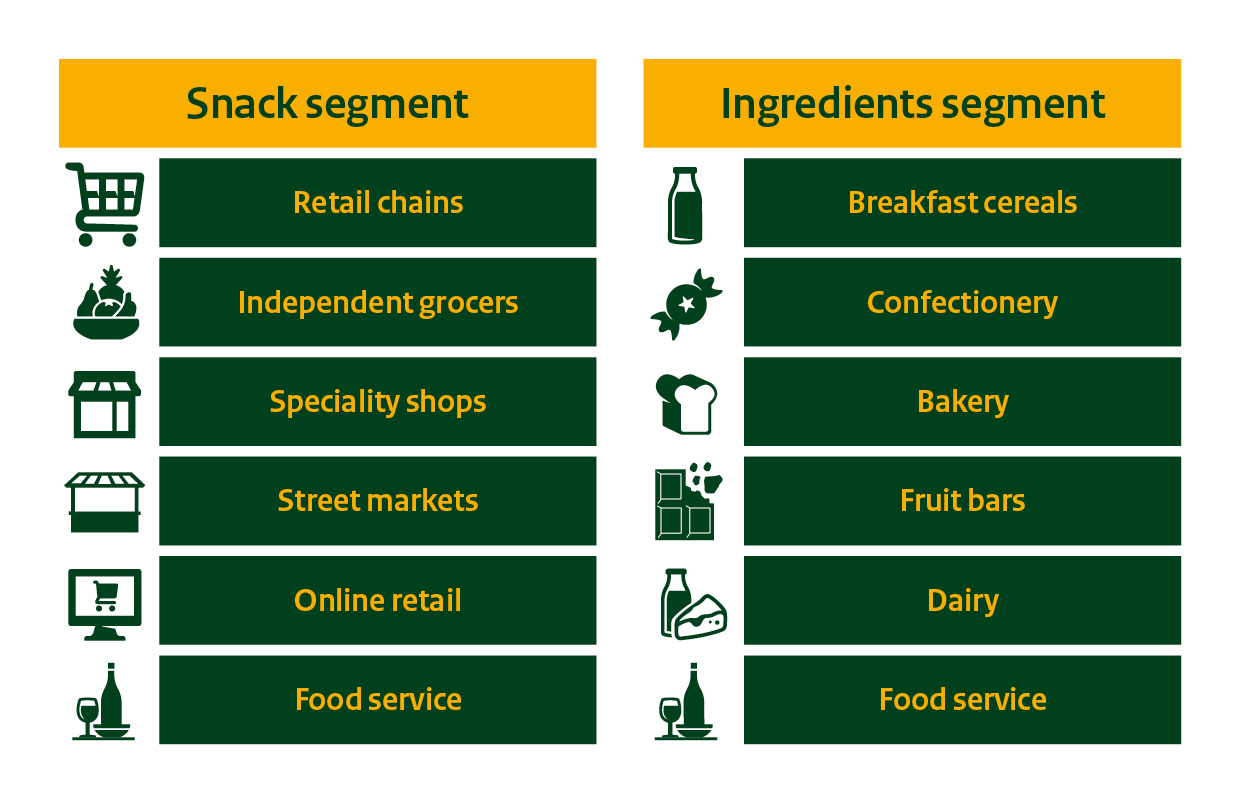
In Europe, dried mangoes are used as a snack and ingredients in the food processing industry. About 80–90% of the total imported dried mango in Europe is re-packaged and sold as a snack through retail. The remaining 10–20% is used in the food processing industry and the food service segment.
How is the end-market segmented?
Figure 1: End-market segments for dried mango in Europe
Source: Autentika Global
Snack segment
Almost 80% of imported dried mango in Europe is consumed as a snack. This is driven by consumer demand for healthier but tasty snacking options. According to Grand View Research, Europe is expected to see an annual growth rate of 6.2% in the healthy snacking market between 2024 and 2030. This growth is driven by the high prevalence of obesity and lifestyle diseases. It motivates individuals to adopt healthier eating habits. There is a strong demand for snacks with lower calories, reduced sugar, healthier ingredients and functional benefits.
The snack segment is mainly served by packing companies that repack and brand imported bulk dried mangoes. Many of these companies pack dried mango under private labels for the European retail chains. The market is concentrated and a relatively small number of companies in each European country supplies the snack segment. For examples of leading dried mango brands in Europe, see the market analysis part of this study.
‘No sugar added’ and ‘free from preservatives’ are the main trends in the snacking segment. Dried mango is seen as an attractive exotic flavour. It also has a good sugar/acid ratio (not too sweet) and provides minerals, vitamins, phytonutrients and fibre. Consumers wanting to satisfy their need for something sweet, see sugar infused tropical fruit as less ‘unhealthy’ compared to chocolate and other sweet snacks.
Ingredient segment (food processing segment)
The food processing segment is smaller. This is explained by the relatively high prices of dried mangoes compared to most other dried fruit. The biggest demand for dried mango in this segment comes from:
- Breakfast cereal industry: Large user of sugar infused and candied mango. Dried mango can be shredded or diced and added to cereal mixes in shredded, diced or sliced form.
- Confectionery industry: Mainly uses dried mango pieces to produce sweet snacks. New products more often use dried mango coated or half dipped into chocolate. Freeze-dried mango pieces are also used as crispy bits in some confectionery products.
- Bakery industry: Uses pieces of dried mango in muffins, pies, cookies and cakes. The industry is still an important user of candied mango cubes. Many European specialties that use dried fruit can be made in versions with dried mango, such as a tropical version of Italy’s Christmas specialty Panettone.
- Fruit bars: More often offered in many varieties. Organic fruit bars are on the increase (especially in Germany). In some fruit bars, naturally dried mango is used as the main fruit ingredient, while other bars consist mainly of dehydrated fruit puree.
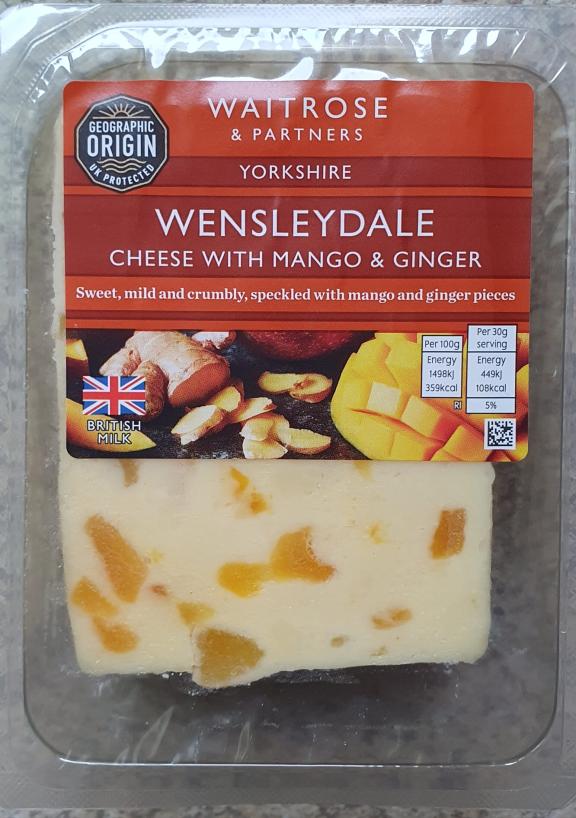
- Dairy industry: Uses dried mango as an ingredient in fruit preparations for ice creams, smoothies and fruit yoghurts. It is used to flavour cheeses, such as Stilton with mango and Wensleydale with Mango.
Figure 2: Wensleydale cheese with dried mango
Source: nigelpentland for Open Food Facts, licensed under CC BY-SA 3.0
Tips:
- Consult industry trade publications such as SF&WB, Confectionery News and Bakery & Snacks.
- Search the list of exhibitors of the specialised trade fair Fi Europe to find potential buyers for your dried mango within the food ingredient segment.
- Visit or exhibit at ISM Cologne, a leading European trade fair for sweets and snacks, to explore opportunities in the dried fruit snack segment.
Through what channels does dried mango end up on the end-market?
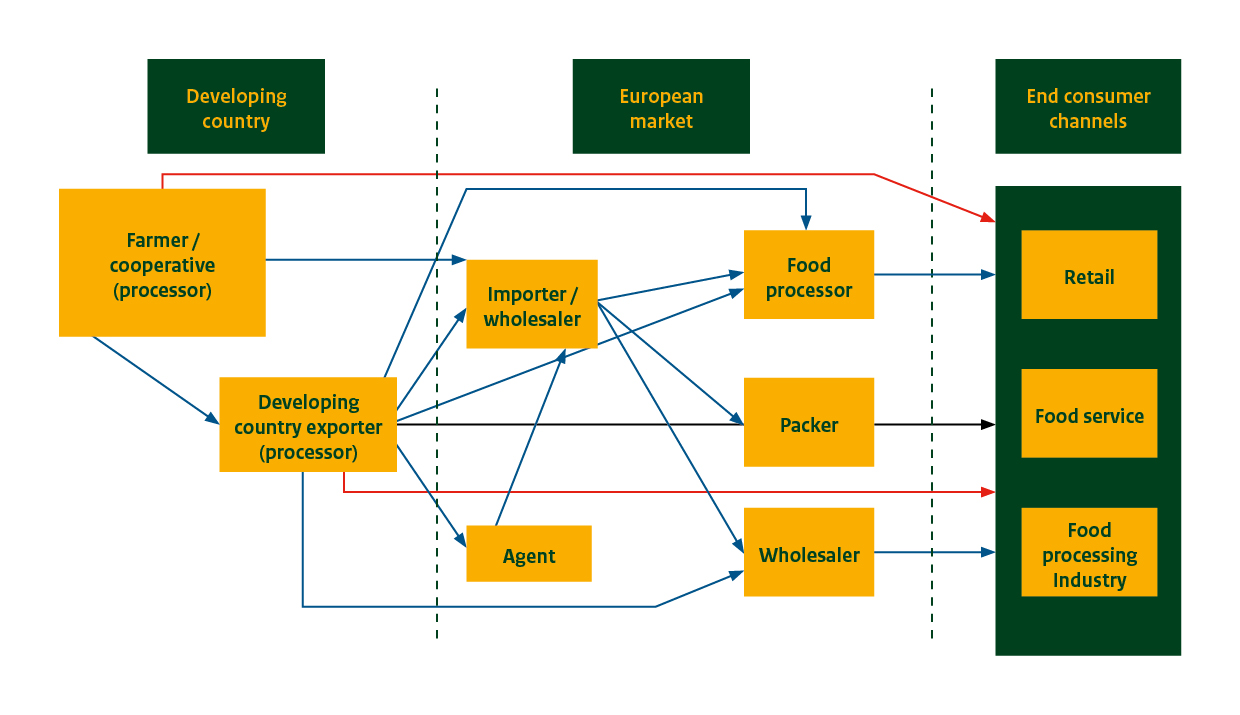
The most important channel for dried mango in Europe is specialised dried fruit importers. There are also several alternative channels, such as agents, food processors or food service companies.
Figure 3: European market channels for dried mango
Source: Autentika Global
Importer/wholesaler
In most cases, importers act as wholesalers. They very often sell dried mango to packing companies who pack it into consumer packages. Some importers are also equipped with processing and packing equipment. This means they can supply retail and food service channels directly. However, many dried fruit brands import dried mango directly. Importers usually have a good knowledge of the European market and they monitor the situation in dried mango producing countries closely. Because of this, they are your preferred contact. They can give you timely information about market developments and provide practical advice for your exports.
The position of importers and food manufacturers is under pressure by retail. The higher requirements from the retail industry determine the supply chain dynamics from the top down. This pressure causes lower prices, but also added value aspects such as ‘sustainable’, ‘natural’, ‘organic’ or ‘fairtrade’ certified products.
Notable German dried tropical fruit importers/wholesalers include Heinrich Brüning and Zieler & Co. J.O. Sims is a UK-based importer and distributor of dried mango. Danish Berrifine is a family-owned trader, processor and importer of dried mango. Italy’s Blife specialises in the trade and wholesale of dried mango from Burkina Faso. The Dutch Berrico Food Company is also a player in the dried mango market.
Packer
For new suppliers it is difficult to establish long-term relationships with well-known dried fruit packers. This is because they usually already work with selected suppliers. Dried mango is still seen as a non-essential purchase by many European consumers. So being price competitive will help establish new relationships.
Agent/broker
Agents act as independent companies that negotiate on behalf of their clients. They also act as intermediaries between buyers and sellers. Typically, they charge commissions of 2–4% of the sales price for their intermediary services. For most developing country suppliers, it is very difficult to take part in the demanding private label tender procedures. For these services, some agents, in cooperation with their dried mango suppliers, participate in procurement procedures put out by the retail chains.
Examples of dried mango agents in European markets include Kenkko (the United Kingdom), Belfrudis (Belgium), MW Nuts (Germany), Cardassilaris Family (Greece) and QFN Trading & Agency (the Netherlands).
Retail
Retailers rarely buy directly from developing country exporters. A new development is the polarisation of the retail sector into discounters and high-level segments. Until recently, naturally dried mango was mainly offered by high-end retail segments. However, dried mango is now also offered by several large European discounters (for example, ‘Simply Nature’ dried mango by ALDI or ‘Alesto’ dried mango and dried pineapple by Lidl).
Food service
The food service channel (hotels, restaurants and catering) is usually supplied by specialised importers (wholesalers). The food service segment often requires specific packaging of 1–5 kg of dried mango, which is different from bulk or retail packaging packs. Dried mango is not usually sold through the food service channel.
Tip:
- Search the members list of the European Trade Federation for Dried Fruit and Edible Nuts (FRUCOM), to find buyers from different channels and segments.
- Monitor snack market developments by visiting the news section of the European Snack Association.
What is the most interesting channel for you?
Specialised importers are the best contact for exporting dried mango to the European market. This is especially relevant for new suppliers. Supplying established brands or the retail segment directly is very demanding and requires a lot of quality-related and logistical investments. However, for the well-equipped and price competitive producers, packing for private labels can be an option. Also, in order to have full control of the process, it is easier to pack dried mango for the snack segment within Europe.
3. What competition do you face on the European dried mango market?
The European dried mango market is concentrated. The main suppliers are West African countries. Competing substitutes include fresh mango and other types of dried fruit.
Which countries are you competing with?
Trade in fresh mangoes is more regional in scope, while dried mango trade is more globally oriented. The main competing countries for the exportation of dried mango to Europe are Burkina Faso, South Africa, Ghana and Côte d'Ivoire. Burkina Faso and Ghana have become major hubs for processed dried mango, according to a 2022 ITC report. Other leading competitors include the Philippines, Thailand, Mexico and Peru. Emerging suppliers include Ecuador, Mali, Mozambique (represented by the company Afrifruta), Senegal, Kenya, India and Pakistan.
Source: Autentika Global, based on industry estimates
Burkina Faso: a supplier of organic dried mangoes
Burkina Faso’s national dried mango production changes a lot. It depends on climate conditions and how much fresh mangoes are harvested. There are no exact data on national production and export. However, during the third edition of the Mango Show (July 2024), it was estimated that Burkina Faso produced over 3,500 tonnes of dried mango in 2023. Recent industry sources state that production is increasing and that processed volumes will soon exceed 5,000 tonnes. Nearly all dried mango production is exported, with minimal local consumption.
Mango growers are grouped within the Association Interprofessionnelle de la Mangue du Burkina (APROMA-B). It assembles organisations active in three links of the value chain: UNPM-B (production), PTRAMA-B (processing) and APEMA-B (marketing). The government authorised APROMA-B to import biopesticides to fight against fruit flies. In 2024, APROMA-B estimated that there were more than 120 drying units producers.
Most dried mangoes in Burkina Faso come from smallholder mango orchards. Mangoes are harvested from April to June. The most popular varieties, like Brooks (very sweet, low acid) and Amélie, are chosen for their high natural sugar and suitable drying characteristics. Most of the industry is located in the Hauts-Bassins region, which handles 70% of processing at the national level. Next to local processors, there are also foreign investments. Gebana Afrique was launched in 2006; Tradin Organic helped with the installation of dryers in 2016, while HPW received support from Netherlands Development Finance Company (FMO) for Burkina Faso mango sourcing in 2023.
Many processors use simple tunnel dryers. These often use gas or hybrid fuel. Processors usually organise farmer clusters or cooperatives for supply. Mangoes are hand-peeled and sliced and dried until they have a 15% moisture content. Sulphites are rarely used, since much of the output is organic. The downside of this is that Burkina Faso’s dried mangoes are often darker and less uniform than sulphured products. However, quality is constantly improving. Processors prevent browning with improved process control and they use mangoes with rich, yellow flesh.
Burkina Faso positions itself as a sustainable, community-oriented supplier. Exporters highlight their social impact (dried mango production is a large source of female employment) and natural quality. European buyers recognise Burkina Faso as a reliable source of organic dried mangoes with a good origin story. Most dried mango from Burkina Faso is organic, and 13 processors were also Fairtrade certified in 2025. Buyers have noticed that Burkina Faso’s suppliers’ consistency and uniformity are improving. Germany, the Netherlands and France are the three main target markets for this country’s dried mangoes.
Ghana: a growing supplier of dried mangoes
Ghana is one of the three largest suppliers of dried mangoes to Europe and a leading supplier of naturally dried pineapples. Export of dried mangoes from Ghana to Europe is estimated to be over 2,000 tonnes. The leading variety used for drying is Keitt. Production is very concentrated. Just three large-scale producers make up more than 90% of national dried mango exports. The rest of production is made up by small to medium processors.
The mango harvesting season peaks between May and July. Ghana’s main challenge is the availability of fresh mangoes that have a quality that is suitable for drying. To extend processing year-round, larger companies import and source mango from the Côte d'Ivoire and Burkina Faso in the off-season. The sector is supported by international development projects, including the CBI’s dried fruit project.
Supply is organised into out-grower schemes: some exporters make contracts with grower cooperatives. Other processors buy fruit directly or through aggregators. Over 95% of exported dried mangoes are conventional (often sulphite treated). The organic output is still in its early stages. Ghana only exported a few containers in 2024. Ghana has built a reputation for consistent quality. With the help of HPW, it can meet the requirements of private labels and companies that invest in certifications.
South Africa: the pioneer of African dried mango production
South Africa dried more than 10,000 tonnes of fresh mangoes in 2024. This is a 4,000-tonne decrease compared to 2023. Due to increasing production costs, South African processors are investing in Burkina Faso and other mango-producing countries. South Africa is a long-established dried mango exporter to Europe. It has a good reputation for bright-yellow and high-quality slices.
South Africa has been the largest dried mango producer in Africa for many years. South Africa’s mango growers are represented by South Africa’s Mango Growers’ Association (Samoa). Samoa maintains a list of mango processors in the country. South African dried mangoes are largely conventionally produced, with sulphites to preserve colour. Besides the export of dried mango slices, South African producers are innovative and produce a range of sweet snacks from dried mangoes, such as mango cubes, rolls and snacks mixed with other dried fruits.
South Africa’s mango producing regions are mainly situated in the Northeastern part of the country. Limpopo is the leading producing region, followed by Mpumalanga. There are several mango cultivars grown in South Africa but Kent, Keitt and Tommy Atkins are mainly used for drying.
The Philippines: an emerging supplier
The Philippines produced 786,000 tonnes of fresh mango in 2023, according to the Philippines Statistics Authority. It supplies about 10% of the world’s demand. The Philippines is home to 7 million mango trees. Most dried-mango processors are based in Cebu. Dried mangoes are the most valuable mango export of the Philippines. It is estimated that, in 2024, the Philippines exported over 9,000 tonnes of dried mangoes. This estimate also includes sweetened dried mangoes. Exports of natural dried mangoes from the Philippines to Europe in 2024 were approximately 300 tonnes.
Around 85% of the local total dried mango production is exported to key markets, such as the United States, China, Japan, South Korea and other Asia Pacific countries. Exports to the United States reached more than 3,000 tonnes in 2020. The United States and Europe have switched positions as the most important dried mango export destination for Philippine-grown mangoes. The Philippines produces large quantities of sweetened dried mangoes which are mostly exported to other Asian countries.
The mango variety Carabao (also called Manila mango) is the most important for the industry. It is sweet, aromatic and has a distinctive dried mango flavour. Harvest seasons vary by island but March to June is generally the peak season in Cebu and Mindanao.
Which companies are you competing with?
Some of the large, dried fruit processors in Africa are the result of investments by European companies or organisations. This is unlike the situation in Asia and South America. Here, dried fruit industries are mainly set up by local investors. A quick overview of some leading companies per supplying country is given below.
Timini
Timini is the largest producer of dried mangoes in Burkina Faso. Timini is a joint venture company created in 2014 by local company Fruiteq, and South African firms MPAK Pty and Westfalia. They have the capacity to produce 2,000 tonnes of dried mangoes per year. It is BRCGS, organic and Fairtrade certified.
Other notable locally-established dried mango processors and exporters include Fantic, Ranch Koba, Association Wouol, AgroBurkina, Sanle Sechage, Mango-So, Burkinature and Fruiteq.
HPW
The largest share of production and export of dried mangoes in Ghana comes from the Swiss company HPW. Its local subsidiary is the BRC-certified HPW Fresh & Dry Ghana plant. This is the largest mango and pineapple processor in Ghana, and a major supplier of dried mangoes to Europe. HPW processes 25,000 tonnes of fresh fruit every year, exporting 2,500 tonnes of dried fruit (mostly mangoes and pineapples). It employs 1,500 people. The HPW company joined SIFAV and created a Special Initiative on Pineapple Production in Ghana.
Other important suppliers include Bomarts Farms, Agropal West Africa, Pure & Just, Integrated Tamale Company and Groital.
Westfalia Fruit
Westfalia Fruit is the largest producer of dried mangoes in South Africa. Westfalia has a network of subsidiaries around the world including in the UK, the Netherlands, Austria, Portugal and France. To increase and secure production, Westfalia has invested in processing facilities in Timini, in Burkina Faso. Westfalia’s dried mango processing facilities are BRCGS certified. They produce conventional dried mango, mostly packed and exported in bulk packaging.
Other South African dried mango producers include Cape Dried Fruit Packers, Taste Africa Foods, Cecilia’s Farm, Bavaria Fruit Estate, BAOBAB Value Adding (part of Blydevallei) and Cape Mango.
Profood International
Profood International is Asia’s largest dried mango producer. Since its establishment in 1978, it has grown into the country’s biggest dried fruit processor. It is famous for its ‘Philippine Brand’ dried mangoes. Profood operates a large, modern factory complex in Cebu and further facilities in Davao. It handles dried mango, as well as purees, juices and other fruit products. Profood processes an enormous volume of Carabao mangoes each season. According to reports, it processes tens of thousands of tonnes of fresh fruit.
Profood is BRCGC certified, and it meets US FDA and other international standards. It also has Kosher and Halal certifications. Profood’s focus was not historically on organic production, although it has developed an organic line and obtained organic certification.
Tips:
- Visit the website of the South African Mango Growers Association (SAMOA) to find mango processors.
- Consult WACOMP’s cost-margin analysis of dried mango production in Ghana to understand the competition.
Which products are you competing with?
The main product competitors for dried mango are other dried fruits and fresh mango. European consumers have become increasingly health-conscious and prefer a healthy diet with an increased consumption of fresh fruit and vegetables. This trend can influence the consumption of dried mango, especially if it is treated with artificial colouring, or has added sugars or preservatives.
Dried mango has a significantly higher price compared to most other dried fruit on the European market. For producers of dried mangoes, it is not easy to decrease the production prices as 10–12 kg of fresh mangoes are needed to produce 1 kg of dried mangoes, according to some estimates.
Tip
- Read the CBI’s fresh mango study to better understand competition from fresh fruit.
4. What are the prices for dried mango?
Calculating margins based on final retail prices for dried mangoes gives only a very general overview of price structure. The Cost, Insurance and Freight (CIF) price is estimated to represent approximately 25–30% of the retail price of dried mangoes. The most common end-market prices in Europe range from €20/kg to €35/kg. If dried mangoes are used as an ingredient, it is even more difficult to estimate the added value. this is due to the number of different ingredients.
FOB prices for natural dried mangoes usually range between €8 and €12 per kilo. Meanwhile, the price for most sugar-infused dried fruit from Thailand is between USD 3/kg and USD 5/kg.
Dried mangoes from the Philippines and South America (Mexico, Peru and Ecuador) usually bring higher prices, compared to African dried mangoes. Depending on origin and quality, prices for African dried mangoes differ widely. For example, South African dried mangoes are usually higher priced than those from Burkina Faso.
Table 3: Dried mango retail price breakdown
| Steps in the export process | Type of price | Price breakdown | Example (€/kg) |
|---|---|---|---|
| Production of fruit or vegetables | Raw material price (farmers’ price) | 5% | 1.6 |
| Handling, drying, packing and selling bulk product | FOB or FCA price | 27% | 8 |
| Shipment | CIF price | 28% | 8.5 |
| Import, handling, storing and bulk wholesale | Wholesale price (value added tax included) | 50% | 15 |
| Retail packing, handling and selling | Retail price (for average packaging of 250 g) | 100% (retail price as seen in stores) | 30 |
Source: Autentika Global, 2025
Autentika Global carried out this study on behalf of CBI.
Please review our market information disclaimer.
Search
Enter search terms to find market research
Do you have questions about this research?
The dried mango market is mostly a relationship-based one. Some companies may develop good relationships with organic buyers, while others may develop better relationships with conventional buyers. It may depend on how you start off your drying company and where your contacts are. If you can do organic and get certified, there might be advantages, but be aware that this process is not cheap.
Ties Minnen, Managing partner Gedroogdemango.nl (operated by Mango Impact) and Afrifruta
If you do not do your sourcing well or if you do not know who you are buying from, the mango you receive might be contaminated with pesticides, for example. Other forms of product contamination could emerge from issues related to worker hygiene. For example, all the people handling the product have to wash their hands to prevent contamination.
Ties Minnen, Managing partner Gedroogdemango.nl (operated by Mango Impact) and Afrifruta