
Entering the European market for natural ingredients for women’s health
To access the European market, you must meet strict requirements. These vary depending on your target sector, such as food supplements, herbal medicinal products, or infusions. Understanding both the specific market segment and your buyer's expectations is essential. Typically, importers and distributors are your main entry point into the market.
Contents of this page
- What requirements and certifications must natural ingredients for women’s health meet to be allowed on the European market?
- Through which channels can you get natural ingredients for women’s health on the European market?
- What competition do you face on the European market for natural ingredients for women’s health?
- What are the prices of natural ingredients for women’s health on the European market?
1. What requirements and certifications must natural ingredients for women’s health meet to be allowed on the European market?
You can only export natural ingredients to European Union (EU) members if you comply with strict EU requirements. For a complete overview of these standards, refer to our study on buyer requirements for natural ingredients for health products, or consult the specific requirements for your product in Access2Markets by the European Commission.
Buyer requirements can be divided into:
- Mandatory requirements: legal requirements you must meet to enter the market;
- Additional requirements: those you need to comply with to stay relevant in the market;
- Niche requirements: applying to specific niche markets.
What are mandatory requirements?
Natural ingredients must be safe for human consumption when entering the European market. That is why legal requirements mainly concern food safety, hygiene, and traceability. Food safety can be compromised by poor water quality, low fertiliser quality, and overall poor cultivation management. In general, you need to avoid specific sources of contamination, namely:
- Pesticides: Consult the EU pesticide database for an overview of the maximum residue levels (MRLs) for each pesticide.
- Contaminants in food and microbiological contamination of food: Regulation (EU) 2023/915 sets maximum levels for certain contaminants in food, including mycotoxins, metals, and processing contaminants. Regulation (EC) No 2073/2005 lists food safety criteria for microbiological contaminants, such as Salmonella.
- Extraction solvents for foodstuffs and food ingredients: Regulated by Directive 2009/32/EC. Annexe I contains a list of the authorised extraction solvents for use in food and the conditions of use. For example, sulphur dioxide extraction is not authorised. Remember that extraction processes can amplify even minimal pesticide residues in your product. It is, therefore, important to carefully monitor your laboratory tests to ensure you meet the MRLs.
Food supplements
If your natural ingredients are used in food supplements, you must follow EU food supplement laws, which set requirements for the composition and labelling of supplements.
In addition, if your ingredient is considered a novel food, the Novel Food Regulation is important. It mandates that the safety of ingredients not consumed within the EU before 15 May 1997 is assured. To determine if your botanical qualifies as a novel food, consult the Novel Food Catalogue based on the Union List.
Note that national positive lists for botanicals determine whether your ingredient is already allowed in food supplements. Examples of positive lists include the BELFRIT (Belgium, France, and Italy) and the Germany lists. Annexe III of Regulation 1925/2006 determines whether your product has been prohibited, restricted, or is under scrutiny for use in the European Union.
Herbal medicine
If you target the herbal medicine market, you need to understand whether your ingredient is allowed, as you cannot sell ingredients for herbal medicinal products if they are not officially accepted by the European Medicines Agency (EMA). The EMA is responsible for the scientific testing, supervision, and safety monitoring of medicines in EU member states. It has developed standards for the most commonly used and accepted ingredients for herbal medicinal products. These standards are known as EU herbal monographs.
You can only export natural ingredients for herbal medicinal products if you follow European Union (EU) laws (Directive 2004/24/EC). You must also meet the detailed quality, documentation, labelling, packaging, certification, and tracking standards in the EU's medicinal product rules.
If your ingredient is new on the European market, it should be registered as a ‘Traditional Herbal Medicinal Product’ (THMPD). Under Directive 2004/24/EC, the EU offers a simplified registration procedure for herbal substances and preparations with a long tradition of safe medicinal use in Europe.
Your ingredients must also follow Good Agriculture and Collection Practices (GACP) for raw plant materials and Good Manufacturing Practices (GMP) if you supply active substances used as starting materials for medicinal products. GACP and GMP ensure that medicinal products meet all the identity, quality, effectiveness, and safety requirements for medicinal-grade ingredients.
International standards
All traders must also comply with the Convention on International Trade in Endangered Species of Wild Fauna and Flora (CITES). CITES regulates the trade in (for example) wild-collected endangered plants and guides the species for which trade is prohibited or restricted. CITES provides an overview of plant and animal species that you cannot export/import (Appendix I) or where export/import is restricted (Appendix II).
Also applicable to botanicals, you need to determine whether the Nagoya Protocol of the Convention on Biological Diversity (CBD) applies. This protocol aims to ensure the benefits of genetic resources and traditional knowledge are fairly shared. It provides guidelines for accessing and using genetic resources and traditional knowledge in Access and Benefit Sharing (ABS) agreements.
What additional requirements and certifications do buyers often have?
Buyers demand proof of your product’s safety and that it meets quality and sustainability requirements before they buy from you. If European companies or authorities find that the safety of your product cannot be guaranteed, they will take it off the market.
Quality requirements and documentation
Many buyers have quality requirements that go beyond legislation. These include active ingredient content, moisture content, maximum residue levels, nutritional profile, and composition. Buyer specifications establish these requirements. Buyers require well-structured company and product information to show that you meet their specifications.
This means you should have the following documentation:
- Technical data sheet – TDS (example: Chaste tree (Vitex agnus-castus L.));
- Certificates of analysis – CoA (example: Red Clover (Trifolium pratense));
- Safety data sheet – SDS (example: Fenugreek seed extract (Trigonella foenum-graecum);
- GMO certificate (if requested);
- Certificate of origin.
European buyers regularly test the products they buy, usually on a per-batch basis, to ensure that they meet quality requirements and are not adulterated or contaminated. They will also test the samples that new suppliers provide. Many European buyers lose interest when a new supplier delivers a low-quality product. You have one chance to convince these buyers of your company and product. You need to supply this quality consistently to keep the client.
Food safety management
In addition to the required HACCP standard, European food industries increasingly want suppliers to follow more complete food safety standards or food safety management systems. ISO 9001:2015 is an industry (management) standard that sets out the expectations for a quality management system.
Examples of food safety management systems include: ISO 22000, FSSC22000, IFS, and BRCGS.
Sustainable practices
European buyers face increasing pressure from EU legislation to ensure their supply chains are transparent and traceable. Therefore, when selecting product suppliers, they demand a transparent supply chain. Buyers want guarantees that the product they buy matches the specifications and can be traced back to the source.
Buyers expect their suppliers to provide them with all the necessary information. For exporters, this means it is important to have information on production and labour practices, as well as environmental issues. Implementing an environmental management system, such as ISO 14001, will help you improve environmental performance through more efficient resource use and waste reduction.
Labelling requirements
To export your ingredients to the European market, you must comply with the following labelling requirements:
- Name, address, and phone number;
- Product name and identification, including Chemical Abstracts Service (CAS) number, if applicable;
- Batch code;
- Place of origin;
- Date of manufacture;
- Best before date;
- Net weight;
- Recommended storage conditions;
- Hazard symbol (if applicable).
If you supply organic-certified ingredients, your label needs to include the inspection body's name/code and certification number. Label your products in English unless your buyer wants you to use a different language.
Packaging requirements
Packaging must be safe for consumer health and for the environment. Specific packaging requirements may differ per buyer and product. Your packaging will need to maintain product quality and prevent contamination. There are some general requirements you will have to take into account. These include:
- Always ask your buyer for their specific packaging requirements.
- Reuse or recycle packaging materials to help meet the demands of the European Green Deal. For example, use bags or containers of recyclable material, such as kraft paper for powders and metal for extracts.
- If you produce powdered ingredients, package them in waterproof material. For example, use paper bags lined with plastic. Preferably, use an eco-friendly lining (such as biodegradable or recyclable lining).
- In the case of extracts, use containers of a material that does not react with extract components (such as lacquered or lined steel, stainless steel, or aluminium).
- Clean and dry the containers before filling them with ingredients to prevent contamination.
- Store bags or containers in a dry, cool place to prevent quality deterioration.
- If you offer organic-certified ingredients, physically separate them from products that are not certified.
What are the requirements for niche markets?
Verifying and certifying sustainable production represents a niche market in the health industry. However, it can add value to your product. Standards and requirements for social and environmental sustainability include:
- Organic production: Organic certification acts as a quality control system and can help improve your quality image and traceability performance. Regulation (EC) 2018/848 sets down rules on organic production and labelling in Europe. Refer to this list of recognised control bodies and control authorities issued by the EU to ensure that you always work with an officially recognised accredited certifier.
- Verification and certification of sustainable production: These include standards for environmental sustainability, such as the UNCTAD BioTrade Initiative and FairWild. Examples of social sustainability include Fairtrade International, Fair for Life, and Union for Ethical BioTrade (UEBT).
- Implementation based on ISO 26000 guidance on social responsibility.
- Implementation of an environmental management system based on ISO 14001.
Figure 1: Examples of certification standards for sustainable production
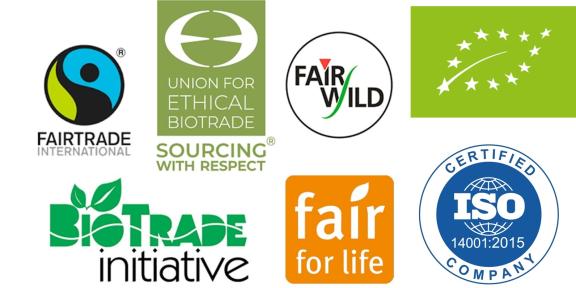
Source: FairTrade International, UEBT, FairWild, European Commission, BioTrade Initiative, Fair for Life, ISO, 2025
Tips:
- Before you certify your products, find out if a market exists for them. Can you earn back your investment? Talk with (potential) buyers about whether they are interested in certified ingredients. Buyers in different market segments (example: food supplements vs. herbal medicine) will most likely have different certification expectations.
- Standardise and minimise significant variations in your product quality. Develop Standard Operating Procedures (SOPs) and train farm and processing staff. Always match such activities to the requirements of your buyer. Use incentives to ensure that they follow your specifications on harvesting and post-harvest processes. It is important to monitor these practices to maintain product quality throughout the entire harvest and post-harvest stages.
- Consider working together with a local or national university to test your product’s properties. They can help determine the composition, safety and efficacy of your ingredient, to be included in your product documentation.
2. Through which channels can you get natural ingredients for women’s health on the European market?
Importers and distributors are likely your primary entry point into Europe. They handle a wide range of ingredients and ensure compliance with European standards, often serving as intermediaries between processors and end-product manufacturers.
How is the end market segmented?
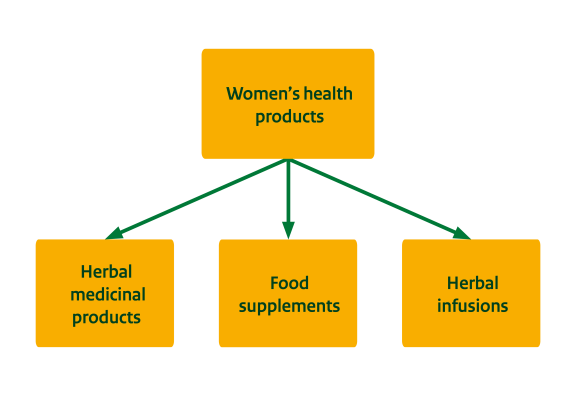
The end market can be segmented into the following segments: 1) herbal medicine, 2) food supplements, and 3) herbal infusions. Knowing which segment your target is in is crucial, as there are big differences in related legislation, quality parameters, and certification requirements.
Figure 2: Market segmentation for women’s health products
- Herbal medicinal products: Many herbal medicine manufacturers feature products for women’s health in their portfolios. Key products like red clover and raspberry leaf have a long history of use and consumer trust. Herbal medicines are highly established and have proven effectiveness and consumer trust. Consequently, innovation and new product/ingredient development in Europe are quite limited within this segment. This segment is due to legislative hurdles and established supplier-buyer relationships. Examples of herbal medicine product manufacturers in Europe include Salus Haus (Germany), Schwabe (Germany), A.Vogel (Netherlands), Aboca (Italy), Natures Aid (UK), and Tilman (Belgium).
- Food supplements: Food supplements represent a faster-growing market than herbal medicines, and new Research & Development (R&D) and product development are key. Europe has a large and growing number of women’s health supplements available on the European market. Supplements often contain lower concentrations of the same active ingredients used in herbal medicinal products and aim for milder conditions. Although food supplements are often based on traditional recipes, more and more companies are showing innovation by adding new ingredients. As such, stronger competition between suppliers within the supplement market makes it easier for new players to enter. Examples include nu3 (Germany), Terravita (France), Salugea (Italy) and Nature’s Best (UK).
- Herbal infusions: Consumers also show interest in herbal infusions to address issues related to women’s health. The popularity of herbal infusions is steadily growing across Europe, driven by the demand for a healthy lifestyle. Herbal infusions typically have low concentrations of botanicals. It is important to note that the claims for botanical ingredients used in tea and herbal infusions have yet to be evaluated by the European Food Safety Authority (EFSA).
Figure 3: Women’s health products (from left to right): herbal medicine, food supplement, and herbal infusion
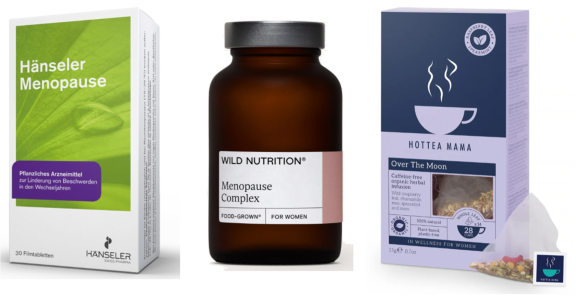
Sources: Hänseler Swiss Pharma, Wild Nutrition & HotTea Mama, 2025
Tips:
- Inform buyers how your ingredients can help consumers improve their health and well-being by focusing on their nutritional or health aspects. Do not make medical claims. More information on EU regulations regarding claims can be found on the European Commission website.
- Look at local practice for potential, innovative botanicals to support women’s health. What do people use to ‘stay healthy’? Build up files on traditional use and support this with clinical tests. You can use such information to approach European traders, ingredient processors, and food supplement manufacturers.
- Read CBI’s study on trends in the European market. It offers useful information about the European health products market and how to increase your chances of market access.
Through which channels does a product end up on the end market?
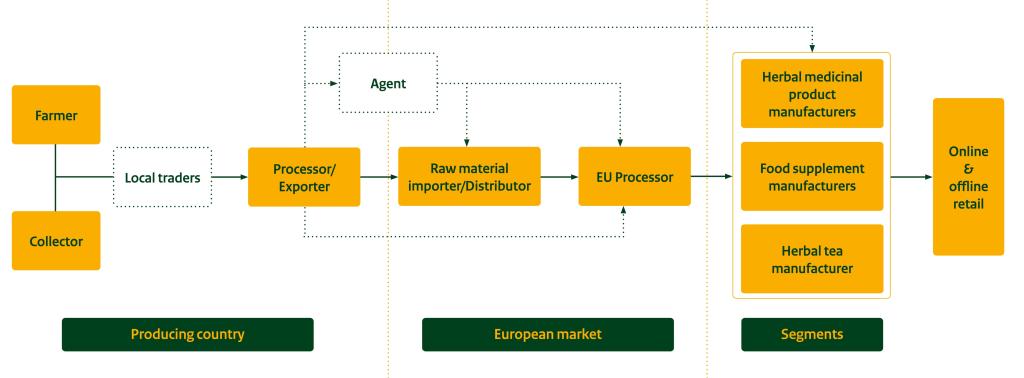
The figure below shows a simplified value chain for natural ingredients from production to the European end market. Botanicals can be cultivated or collected from the wild. Typically, exporters assume processing activities, sourcing raw materials either through local traders or directly from farmers and/or collectors.
Figure 4: Market channels for natural ingredients for health products
Source: ProFound, 2024
Importer/distributor
European importers and distributors are typically your most important entry point into the market. They can trade in up to 500 species, together with other ingredients. Some supply a wide variety of conventional, organic, and/or fair-trade ingredient lines. Their clients include ingredient processors and cosmetic, supplement, food, and herbal medicine product manufacturers.
Importers typically focus on establishing and maintaining strong relationships with suppliers to ensure a consistent and reliable supply of raw materials. They implement quality control measures to ensure ingredients meet the required standards and comply with relevant regulations, often conducting laboratory testing. Importers handle all necessary documentation, including specifications, certifications, and compliance records, ensuring accuracy and up-to-date documentation for each imported ingredient.
Specialisation is becoming less common among importers and distributors, but some European players specialise in:
- Focusing on only one sector, for example, ingredients for food supplements or herbal medicine products;
- Limiting their product offering, for example, only producing extracts or active principles, or offering ingredients from a particular region;
- Focusing on certified ingredients, for example, organic, FairWild, and/or fair-trade labels.
Examples of European companies that source ingredients from emerging economies are:
- Importers such as Carlo Sessa (Italy);
- Importers and processors such as the Martin Bauer Group (Germany);
- Specialised organic importers such as Organic Herb Trading (UK);
- Distributors such as IMCD (the Netherlands).
Agent
An export agent is a firm or an individual that undertakes most of the exporting activities on behalf of an exporter for a commission. In contrast to importers/distributors, agents do not buy products themselves but contact potential customers on your behalf to sell your products. Agents can be found in producing countries as well as in Europe. As an exporter from a producing country, you can work with agents who represent and act on your behalf in the European market. You can look for commercial agents on the website of Internationally United Commercial Agents and Brokers (IUCAB).
EU processor and manufacturer
Processors based in Europe often buy raw materials from importers and distributors. After processing, they sell ingredients to the end-product manufacturers, sometimes via ingredient distributors.
Processors and end-product manufacturers also increasingly source key ingredients directly. They do this to guarantee quality, price, and a sustainable supply over time for ingredients with high supply risks. These can be ingredients used in high-volume end-products, with a high-risk supply situation, or with a crucial active component.
You can consider supplying processors or end-product manufacturers directly if you have sufficient staff to guarantee a consistent service level. You must have well-developed company and product documentation, and ensure a consistent quality and volume. Moreover, you need adequate logistics so you can deliver small quantities at short notice if needed.
If you are a small supplier, it may be easier for you to trade through smaller processors. They often require lower quantities and are still important to the industry. Remember that the quantities required for many less-traded medicinal and aromatic plant (MAP) species are limited.
Examples of processors and manufacturers on the European market that directly import raw material from the origin are Herbal Apothecary (UK) and PhytoFrance (France).
Tips:
- Ask potential buyers how they assess suppliers and what their application process is like. Then you can consider whether you would be able to become a long-term trusted supplier for them in the European market.
- Be prepared to send high-quality samples to prospective buyers, who will test them to assess whether you are a credible exporter. Doing so will give you an advantage when you are seeking to enter the European market.
What is the most interesting channel for you?
As an exporter of botanical ingredients, importers and distributors are likely your most interesting channel.
It is important to note that European importers and distributors are becoming more powerful. They can demand additional services from their suppliers (such as audits and certifications) at lower prices. Large buyers also want to limit the number of suppliers they source from by focusing on reliable (large) quantities and (documented) qualities.
Large buyers generally work with suppliers who have passed a buyer’s pre-assessment process. Becoming a buyer’s preferred supplier can stabilise the market, boost your sales, and improve your reputation. However, you will also need to meet the demands of larger volumes and very high expectations for service delivery.
These companies can offer good opportunities if you can show you are a viable partner and offer a high-quality product that meets volume and delivery requirements. For exporters of smaller volumes without a marketing and sales team, working with smaller importers or agents who can represent you in the market could be more interesting.
You can trade your botanicals through general or specialised buyers. Both types of buyers can be interesting for you, depending on the size of your company, the type of products you supply, and the certification and documentation requirements.
Tips:
- Find buyers that match your business philosophy and export capacities regarding quality, volume, and certifications. See our study on finding buyers in Europe.
- Visit or participate in trade fairs to test if the market is open to your product, get market information and find potential buyers. The most relevant trade fairs in Europe are Vitafoods, Nutraceuticals Europe, Food Ingredients Europe and Biofach (for organic products only).
3. What competition do you face on the European market for natural ingredients for women’s health?
China and India are leading suppliers of MAPs and botanical extracts to the European market. Both have large processing industries, enabling them to offer value-added ingredients. Egypt is also a strong competitor, particularly for MAPs. Product competition mainly comes from vitamins and minerals, and other established species and synthetic alternatives.
Which countries are you competing with?
A wide range of botanicals is used in women’s health products, which means competition can come from many countries, such as China, India, and the United States (US). You may also face competition from countries with strong medicinal plant production, such as Egypt.
China
China has a strong tradition in medicinal plants thanks to Traditional Chinese Medicine (TCM). Beyond botanical products, TCM practitioners use various psychological and/or physical approaches (such as acupuncture and tai chi). TCM has been used for many years in treating various gynaecological conditions, such as menstrual disorders, fertility issues, and menopause symptoms. Examples of herbs commonly used to treat women’s health issues in Chinese medicine include peony (Paeonia lactiflora), dong quai (Angelica sinensis), and goldthread (Coptis chinensis).
China is a major player in the production and export of these herbs and non-native species, enhancing its competitive edge across a range of botanicals. The country's ability to offer high volumes at low prices, particularly for mechanised products, ensures a stable supply that meets quality, delivery, and safety standards. With government support and investments in agricultural technology, China remains a strong competitor.
However, Chinese producers also face challenges, including quality control concerns and reported issues of non-compliance. In the past, some Chinese herbal products have been found to be contaminated with undeclared plant or animal material, heavy metals (such as arsenic, lead, and cadmium), drugs, and pesticides. In addition, a large number of medicinal plants in China are threatened by human activities and climate change, which greatly affect the conservation of species diversity, genetic resources and sustainable development of the medicinal plant industry and its exports to global markets.
In 2024, China was the leading supplier of botanical saps and extracts to Europe, with imports reaching €264 million, representing nearly 22% of Europe’s total import value. Over 2020–2024, this category saw an average annual growth rate of 12%. Europe’s imports of MAPs from China amounted to €49 million, 2.8% of total European MAP imports, up from €43 million in 2020.
India
India is one of the largest suppliers of botanicals used in the nutraceutical industry. It has a rich herbal medicine heritage (Ayurveda), abundant ingredient availability, a robust processing industry, strong manufacturing expertise, and high-quality clinical research. India also has strong governmental support for the production and export of botanicals, coupled with low production costs. This facilitates exports to Europe. India produces various botanicals used in women’s health products, including fenugreek (Trigonella foenum-graecum), shatavari (Asparagus racemosus), ashwagandha (Withania somnifera), and ginger (Zingiber officinale), among several others.
But India also faces challenges, such as concerns over quality, consistency, and adulteration. The EU’s Rapid Alert System for Food and Feed (RASFF) has reported multiple instances of the presence of pesticide residues and ethylene oxide in botanicals used in health products. This system tracks food safety risks flagged by national authorities across the European Union.
In 2024, India was Europe’s largest supplier of MAPs, amounting to €202 million, representing 14% of Europe’s total MAP import value. From 2020 to 2024, import value from India increased at an average annual growth rate of almost 21%. Regarding botanical extracts and saps, Europe imported €97 million worth from India in 2024, making India the second-largest supplier, behind China. Over the period from 2020 to 2024, the value of these imports registered an average annual growth rate of almost 15%.
Egypt
With a long history of cultivation, Egypt is an important supplier of various botanicals. This also includes botanicals used in women’s health products such as fenugreek (Trigonella foenum-graecum), fennel (Foeniculum vulgare), nettle (Urtica dioica) and sage (Salvia officinalis). In 2024, European MAP imports from Egypt amounted to a value of €41 million, 2.8% of the total European import value. Imports registered an average annual growth of 4.1% between 2020 and 2024.
The MAP sector in Egypt relies on small-scale farmers, yet competing with Egypt as an established player would require new exporters to achieve substantial mechanisation, standardisation, and economies of scale. Egypt’s agricultural sector is supported by government investments and land reforms. However, Egyptian producers face sustainability challenges, including recurring pesticide issues and reliance on polluted Nile water due to limited access to treated alternatives.
United States (USA)
The USA is an end market for ingredient exporters from developing countries and a competitor. It plays a significant role as a supplier of MAPs and botanical extracts to Europe. Some well-established botanicals used in women’s health are native, including black cohosh (Actaea racemosa) and raspberry leaf (Rubus idaeus). Red clover (Trifolium pratense) is also widely cultivated.
In 2024, the US was Europe’s fifth-largest MAP supplier by value, after India, Canada, Germany, and Poland. Total imports from the US amounted to €62 million, representing 4.3% of Europe’s MAP imports. US supplies to Europe registered an average annual decline of 5.8% between 2020 and 2024. This is mainly due to a significant drop in imports from the Netherlands.
The US is also an important supplier of botanical extracts, with exports to Europe reaching €64 million, accounting for 5.3% of Europe’s total import value in 2024. The country has a sophisticated processing industry that produces further processed/standardised extracts and patented ingredients.
Several US companies are vertically integrated with production elsewhere, and as such, they directly compete with exporters from those countries. US companies can deliver excellent customer service and high-quality ingredients, but these also come at a higher cost for buyers.
Tips:
- Find out if your country has programmes to help exporters improve the harvest, cultivation, processing, and exporting of MAPs or botanical extracts. You can contact your local chamber of commerce or government trade ministry.
- Help EU buyers build their story by documenting and visualising your product and company’s unique value proposition. You can base this on your country’s image, your sustainable wild collection, how you support communities, or the traditional uses of your product. This will also add to your own marketing effort. Final manufacturers can use this information to market the end product in Europe.
Which companies are you competing with?
Many established companies export MAPs and extracts to the European market. For new suppliers aiming to access the European market, observing and learning from successful companies is important.
China
Green Spring Shop offers diverse products, such as standard herbal extracts, fruit powders, and antioxidants derived from natural ingredients. The company has a large factory equipped with advanced extraction technology, certified with ISO 9001. Green Spring Shop also publishes knowledge articles and industry news on its website. The company ensures full transparency by providing comprehensive documentation. This includes the provision of Technical Data Sheets (TDS), Safety Data Sheets (SDS), Certificates of Analysis (COA), and composition sheets developed by its in-house testing facilities.
ACE Biotechnology is a botanical extract supplier and manufacturer of over 300 types of natural ingredients from herbs, spices, fruits and mushrooms. Their portfolio includes fenugreek (Trigonella foenum-graecum) and ginseng (Panax ginseng) extracts, often used in women’s health products. The company is involved in activities from cultivation, harvesting, processing, and the manufacturing of standardised extracts. Their facilities operate under ISO9001, HACCP, FSSC, Kosher, Halal, and Organic certification.
India
Cultivator’s was founded in 1988 and is a major supplier of herbs, botanicals, spices, nutraceuticals, supplements, and oils. The company is certified as organic, Fair for Life, and Fairwild, and its processing facility holds quality and food safety management certificates such as BRCGS, ISO22000, and ISO9001. Cultivator’s has an in-house testing laboratory that is compliant with international standards. It has European distribution warehouses in Bulgaria and Spain, facilitating logistics. Cultivator's supplies many botanicals used in women’s health products, such as fenugreek (Trigonella foenum-graecum) and shatavari (Asparagus racemosus).
Arjuna Natural is a leading manufacturer of standardised botanical extracts with over 30 years of experience. Arjuna Natural produces speciality, branded ingredients and standardised ingredients. It implements stringent quality control for raw materials, has a complete CSR policy, and its manufacturing practices comply with advanced international standards. It also has an in-house team of experienced scientists that has developed over 100 patents, and a global sales and distribution network. An example of Arjuna Natural’s standardised ingredient for women’s health is fenugreek (Trigonella foenum-graecum), while Shoden (including ashwagandha (Withania somnifera)) and Ellagi Rush (with pomegranate (Punica granatum) are examples of its branded ingredients marketed for women’s health support.
Egypt
United for Import & Export exports several botanicals to the European market, including those for women’s health, such as sage (Salvia officinalis) and fennel (Foeniculum vulgare). The company has a strict quality management system in place, which complies with the ISO 22000 food safety management standard. This helps ensure the export of high-quality products. Additionally, the company holds organic, Fairtrade, and Rainforest Alliance certifications and regularly conducts chemical analyses to maintain product integrity.
Herbs Oasis offers a broad range of herbs, spices and seeds, including those used in women’s health products such as fenugreek (Trigonella foenum-graecum) and fennel (Foeniculum vulgare). The company handles both small and large quantities of raw materials and is GLOBALG.A.P.-certified, assuring good agricultural practice. It also holds organic certifications for both the EU and US markets. The company is also BRCGS- and FSSC22000-certified for food safety management and ISO 9001:2015 for quality management.
United States (USA)
Bio-Botanica Inc. combines traditional botanical extraction methods with modern scientific advancements and is also involved in contract development and manufacturing. Its facilities are GMP-certified and FSSC 22000. It also holds organic certification. Its product portfolio includes a wide range of products, both imported into the US and cultivated within the USA, such as black cohosh (Actaea racemosa) and raspberry leaf (Rubus idaeus).
Artemis International provides science-supported nutraceutical ingredients for use in functional foods, beverages, and food supplements. Their portfolio includes herbs and botanicals such as black cohosh (Actaea racemosa). The company maintains ingredient traceability from field to factory while verifying its ingredients' identity, purity, and potency.
Tips:
- Build long-term and sustainable trade relationships with your buyers. Trust is necessary from both sides: the supplier and the buyer. Respond promptly and always follow up. A good website with information on your company, products and certifications can support this. For instance, have a look at the website of Arjuna Natural (India) to learn from the type of information they display per product.
- For more tips on building trade relationships and finding buyers, see the CBI studies Tips to do business and Tips to find buyers in the natural ingredients for health products sector.
Which products are you competing with?
Many botanicals are used to address various women’s health issues. However, there is competition even for the same health issue, as multiple botanicals offer similar benefits. For example, several botanicals are commonly recommended to manage menopausal symptoms, such as black cohosh (Actaea racemosa), red clover (Trifolium pratense), dong quai (Angelica sinensis), and others, and thus compete against each other. The competitive edge of one species over the other is related to availability/accessibility, perception of efficacy, positive recommendations/testimonies and other customary elements.
Other product categories that you compete with as an exporter of ingredients for women’s health are:
Vitamins and minerals
The main ingredients in women’s health supplements are vitamins and minerals, with vitamins B, D and C and zinc used most often. Lunary (Germany) is a brand that exclusively focuses on women’s health, offering supplements containing vitamins, minerals and probiotic bacterial cultures.
In many European markets, vitamins and minerals represent approximately half of all food supplements sold and are often synthetic. They offer advantages in comparison to botanicals, like lower production costs and greater product stability and shelf life. This stability also allows vitamins and minerals to have longer shelf lives, to be added to foods in higher dosages, and to be formulated into smaller tablets.
Synthetic vitamins and minerals also have a competitive edge over botanicals because they can carry authorised health claims, which is impossible for many botanical ingredients. Food supplement brands that include vitamins or minerals can feature health claims on their products without any disclaimers. For instance, vitamin B6, vitamin D and magnesium are often used in women’s health products and all have several approved health claims.
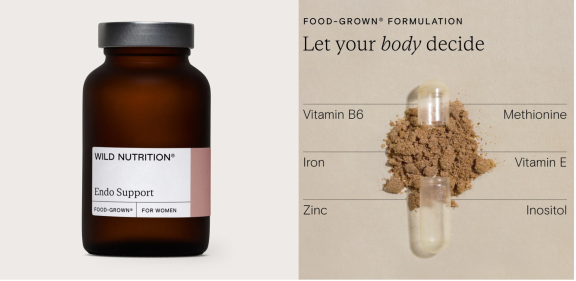
Consumer trust in vitamins and minerals is strong and forms the foundation of many supplements. Yet there is an increasing number of products that combine vitamins and minerals with botanicals. An example of such a product is Wild Nutrition’s Perimenopause Complex, which combines magnesium, vitamin B6 and iron with shatavari and saffron.
Figure 5: Food supplement example formulated to support women with endometriosis, containing added vitamins and minerals
Source: Wild Nutrition, 2025
Synthetic medicine alternatives
Herbal medicine and food supplements are commonly used in Europe for mild conditions, but most European consumers rely on non-herbal synthetic products for the treatment of more severe and chronic disorders. For example, women with perimenopausal symptoms are often offered hormone replacement therapy (HRT), which involves using medications containing hormones to replace those naturally produced by the body.
General practitioners and specialists often prefer these treatments for their patients due to their reliability and efficacy. Consequently, outside of a small niche of consumers who reject synthetic health solutions, herbal alternatives struggle to compete in this market.
Tips:
- Build a marketing story for your ingredients that shows how it is different from competing products. You can use histories regarding the ancient use of your ingredient or its nutritional content, or you can refer to studies and results of clinical trials. For an example of how this could be done, see the website of KSM-66 ashwagandha (India).
- Do market research into potential substitute products. Find out, for example, how your different ingredients compare in terms of scientific evidence, price, supply security/sustainability and ease/cost of substitution. Ensure you have these results prepared when you talk to potential buyers.
4. What are the prices of natural ingredients for women’s health on the European market?
The price of ingredients depends on various aspects, including:
- The product and its properties: A botanical with popular properties linked to health benefits could sell for a higher price when it is sufficiently substantiated in testing.
- Compliance with quality standards: Botanicals that comply with quality standards from production/collection (for example, Good Collection and Agricultural Practices for Medicinal Plants) through processing are likely to attain a higher market value when an adequate market and buyer segment is targeted.
- Level of processing: Botanicals that are processed into extracts or even branded ingredients are more expensive.
- Cost price: Raw material prices and processing costs influence the export price of a botanical ingredient.
- Exclusivity and novelty versus availability: Popular botanicals with limited availability can sell for a higher price.
- Certification: Certified botanicals could sell for a higher price if you can find buyers who are willing to pay for such products.
- Buyer relations: The relationship between you and your (potential) client, and your negotiation skills.
The general price structure of natural ingredients for health products, considering different steps in the supply chain, is:
- Raw materials: 5-15%;
- Processing: 5-15%;
- Transport costs: 2-5%;
- Import and processing in Europe: 15-30%;
- Retail margin: 30-60%.
Tips:
- Calculate your production costs by using a detailed cost breakdown. Do not forget to include additional costs such as customs, loading/unloading, marketing, samples for chemical analysis and internal transport. Add your profit margin to the cost breakdown to establish the selling price.
- When pricing your product, consider the maximum price that the market is willing to pay for your product, plus the existing demand, your cost analysis and break-even analysis. Ensure that the price reflects quality levels and delivery conditions.
ProFound – Advisers In Development carried out this study on behalf of CBI.
Please review our market information disclaimer.
Search
Enter search terms to find market research