

The European market potential for notebooks
The European market for notebooks is growing, with developing countries as important suppliers. As a countertrend to the increasingly fast, digitalised communication of modern society, consumers are using paper to write down their thoughts and plans. Incorporating sustainability values into your products is increasingly important. Adding design value and accessories allows you to tap into the trend of personalisation and makes your notebooks great gift items.
Contents of this page
1. Product description
In the home decoration and home textiles (HDHT) sector, notebooks are part of the categories “office and school” and “leisure”.
This study uses the following codes to classify trade in notebooks:
Table 1: Product codes
| Harmonised System (HS) | Prodcom | Description |
| 4820 10 30 | 17 23 13 15 | Notebooks, letter pads and memorandum pads without calendars, made of paper or paperboard |
Functionality
Apart from the purely functional notebooks used in offices and schools, the notebooks discussed here are mainly used for leisure. Consumers write down their thoughts, scrapbook and doodle or draw in them, usually as a hobby or pastime. They make great gifts, for men, women and children.
Material
Notebook covers can be made from various raw materials including textiles (such as cotton), leather, paper and paperboard. The pages are usually made of handmade or industrially produced paper, textile fibres (such as cotton), or alternative fibres such as bark, banana fibre, mulberry, lokta and argeli. They can even be made from elephant excrement. Because consumers prefer a white or off-white colour, paper is often bleached.
Size
There usually are at least 30 unlined pages in a notebook. Common sizes are A4 to A7, based on ISO 216:2007.
Design
Notebooks come in an endless variety of sizes, designs and colours, depending on the use of the notebook, whether or not it is a gift, and the preferred style.
You can add character with:
- colour and decoration
- materials
- accessories
- small extras such as pens or pencils
- sustainability values
2. What makes Europe an interesting market for notebooks?
The European market for notebooks has grown strongly in recent years. More than two-fifths of the import value is sourced from developing countries, making Europe an interesting market for you.
The coronavirus pandemic and the measures taken against it worldwide are expected to have a large impact on international trade and the European market for many products and services, including HDHT. Please note that the below analysis is based on the statistics that are currently available (2015–2019). Therefore, the expected impact of the pandemic on the European market and global supply chains have not been taken into account in this report. For the latest news in your sector, please check CBI News.
The pandemic is expected to affect demand for HDHT products. The current crisis results in very low consumer confidence globally. In addition to worrying about their health, consumers also worry about whether they will have work and income, and to what extent their livelihood will be under pressure. This scenario obviously does not stimulate sales in HDHT. Many brick and mortar retail businesses in HDHT have been forced to close under local government public health rules (being non-essential), and many will not survive the crisis for financial reasons. In addition, the distribution chain in HDHT has also been also severely affected.
European notebook imports increased from €394 million to €540 million between 2015 and 2019, at a strong average annual growth of 8.2%. More than 40% of these imports came from developing countries, whose import value grew from €180 million to €224 million. This scenario makes Europe an interesting market for you, as an exporter from a developing country.
Market growth is driven by a renewed interest in living offline, using paper notebooks instead of digital devices and apps. For more drivers of demand, see ‘which trends offer opportunities?’ below.
Tip:
- For more information on the short and long-term impact of the pandemic, see our study on how to respond to COVID-19 in the HDHT sector.
3. Which European countries offer most opportunities for notebooks?
The larger western European economies are the main importers of notebooks. However, importers in these countries generally sell their products to other countries in Europe. Your best strategy therefore is to focus on a particular segment, rather than a specific country.
In 2019, the United Kingdom remained the main European market for notebooks, accounting for 23% of imports, followed by Germany (19%), France (12%), and the Netherlands (11%). Together, these countries accounted for nearly two-thirds of the total European notebook imports. Poland (4.5%) and Italy (4.3%) are smaller markets with a share smaller than 10%, but still in the top-six leading importing countries.
However, be aware that in the European market, different countries have different roles. You can make a rough distinction between countries that are mainly importers and countries that are mainly manufacturers. Most western European importing countries do not just import products for sales within their own country, but also to re-export to other countries in Europe. This explains why countries with small HDHT markets, like Denmark and the Netherlands, often import much more than the demand in their own domestic markets.
In terms of marketing, take into account also that a specific country does not necessarily correspond to a target market. In HDHT, each European country has different market segments, ranging from low to high (see also our study on market entry for notebooks), although their sizes may vary per country. Therefore, it makes much more sense for you to identify a particular segment in your product group and connect to the importers and distributors in that segment, instead of focusing on a specific country. These distributors will then sell in that segment, not only in their own country but in other countries in Europe.
Real private consumption expenditure
An important indicator of growth in demand is real private consumption expenditure. The HDHT sector, which includes the market for notebooks, is sensitive to economic cycles. When economic circumstances and prospects are dim, consumers postpone buying non-essential items. Conversely, when economic conditions are favourable, private consumption expenditure and purchases of non-essential HDHT products surge.
In recent years, real private consumption expenditure in the leading European markets grew at annual growth of 1%–3%. Previous forecasts for the coming years suggested this positive trend would continue, but the coronavirus pandemic has made any predictions all but uncertain. The HDHT market responds to economic cycles, so demand is expected to reflect any potential economic fluctuations.
Brexit may negatively impact UK demand
The United Kingdom is the largest European import market for notebooks. British notebook imports increased from €109 million in 2015 to €125 million in 2019, at an average annual growth rate of 3.6%. The country sourced 68% of these from developing countries, which is considerably above the European average.
China is the United Kingdom’s main notebook supplier by far, with 58% of imports in 2019, followed by India and Poland with 8% each. However, while Chinese supplies increased at an average annual growth rate of 1% between 2015 and 2019, supplies from other developing countries grew by 12% per year in the same period. This illustrates that there are opportunities in this market despite China’s dominance.
The United Kingdom’s withdrawal from the European Union (Brexit) may have a major impact on consumer confidence. The uncertainties related to Brexit, the Covid-19 pandemic and the resulting economic slowdown are expected to affect HDHT product sales, including notebooks. As such, your prospects in the UK for the next few years may be modest.
Germany imports mostly from other European countries
Between 2015 and 2019, German notebook imports increased from €80 million to €103 million at an average rate of 6.5% per year. A mere 24% of these were sourced from developing countries, which is considerably lower than the European average. These imports are relatively stable at around €25 million. Although Germany’s main notebook supplier is China (21%), most of its notebook imports come from within Europe. Poland is the second-largest supplier with 19%, after nearly doubling its notebook exports to Germany between 2015 and 2019.
Germany is the largest economy in Europe, home to 19% of the European Union’s population. The German economy is widely considered the stabilising force within the European Union, historically showing a higher growth rate than other member states. In fact, according to The Economist, Germany will be the first major European economy to recover from the pandemic crisis. This expectation is based on the country’s healthy finances before the crisis and the sheer size of its large industrial sector, whose reboot will consequently benefit suppliers abroad.
In addition to having a large domestic market, Germany is also a key trade hub within Europe, which, combined with the forecast economic recovery, make Germany an interesting market for you. However, the strong performance of other European countries, like Poland, indicates that competition may be fierce.
France’s growth slowing down
With an impressive average annual growth rate of 21%, French imports of notebooks surged from €28 million in 2015 to €60 million in 2019. This is mainly due to a fairly spectacular increase in imports from Poland (264%) and the United States (212%), making these countries France’s new leading importers, ahead of Germany, the Netherlands, and China.
French notebook imports from developing countries increased from €5.8 million in 2015 to €10 million in 2019, at a strong average rate of 15% per year. However, despite the growth this accounts for a relatively low import market share of 17% in 2019.
The economic growth in France has slowed down after a gradual recovery. Global uncertainties and the effects of social unrest weighed on consumer confidence and consumption of non-essential products. This is expected to be reflected in the country’s imports of notebooks in the coming years.
The Netherlands is an important European trade hub
Dutch notebook imports increased from €41 million in 2015 to €55 million in 2019, at an average rate of 8.2% per year. Similarly, imports from developing countries increased from €27 million in 2015 to €33 million in 2019. This represents an import market share of 60%, which is among the highest in Europe. Again, China is by far the leading supplier with a 52% share. Although imports from other developing countries are relatively small, they nearly doubled between 2015 and 2019, reaching €4.5 million.
Brexit and the coronavirus pandemic, the international trade disputes between the United States and China and between the United States and Europe may have a big impact on the Netherlands. The country heavily depends on international trade, so negative developments in that area strongly affect its economic performance. This, in turn, would affect notebook consumption.
Since the Netherlands is a big re-exporter of goods, the impact on the imports of notebooks goes beyond the country itself. As such, developments in other European countries will also play a role. Given the economic slowdown in Europe as a whole, an increase in imports is not expected for the coming year. However, its large market for developing countries continues to make the Netherlands a relatively interesting market for you.
Poland is a quickly emerging import market
Another fast-growing import market for notebooks is Poland. Polish notebook imports increased from €13 million in 2015 to €24 million in 2019, at a high rate of 17% per year on average. Although imports from developing countries are relatively low, they tripled from €3 million to €9 million between 2015 and 2019. This considerably increased the import market share of developing countries, from 25% to 36%.
China (36%) and Germany (27%) are Poland’s leading notebook suppliers, accounting for nearly two-thirds of imports. As Germany is an important European trade hub, this suggests that supplying to German traders may be a good way for you to reach the Polish market.
Italy’s economy expected to recover particularly slowly
Between 2015 and 2019, Italian notebook imports slightly fluctuated around €22 million. Similarly, imports from developing countries were relatively stable at around €11 million, representing slightly more than half of Italian imports. China is Italy’s leading notebook supplier, with an import market share of 40%.
Economic growth in Italy is likely to slow down as the country is particularly affected by the current pandemic. In fact, out of the major European economies, Italy is expected to be the slowest to recover. This is expected to affect consumer confidence and the consumption of non-essential products in the coming years.
Tip:
- Do not just focus on specific European countries. Instead, identify the appropriate segment and let your buyers distribute your products across Europe within this segment.
4. What trends offer opportunities on the European market for notebooks?
Notebooks play a key role in some major consumer trends that dominate the HDHT sector: wellness and sustainability. For more information, see our study about trends in HDHT. We will outline each trend below.
Wellness: the more conscious consumer
European consumers want to embrace the here and now. They make the most of every moment and experience, record it and move on. Average attention spans have fallen to eight seconds. The internet offers the perfect platform to follow, connect, record and review, share and to create an individual identity. The notebook and everything it represents provides a small but firm countertrend to all of this. It celebrates offline existence, introspection, “slow” communication and a moment of “me-time.”
The effects of the Covid-19 pandemic on the consumer state of mind are profound and conflicting. Many are close to a burnout because of an out-of-balance work and private life and a feeling of claustrophobia. At the same time, however, consumers have re-appreciated the aspect of life slowing down under stringent public health measures and the renewed sense of feeling a true connection with their inner circle of family and friends.
Digital media have kept communication lines between people open during the pandemic. And yet, consumers have also felt how fleeting and shallow online communication can be and how difficult it is to express their true feelings through an online chat. Stationery and notebooks are part of that need for a slower, more considered lifestyle, right now or after the pandemic.
“Me time”
In their notebooks, consumers put their thoughts on paper, draw and illustrate, or scrapbook. These activities create moments of reflection and introspection, real quality time, or “me time”. Stressed-out European consumers also want to spend time offline, alone or with their nearest and dearest. The notebook can be a meaningful tool in this process.
Gifting
Giving gifts is a form of bonding, which is strongly connected to wellness, as human beings are social creatures and happiness comes through connecting. Stationary, including notebooks, used to be categorised under school and office supplies. Because of its gift potential, stationery is now often included in home decoration. Retailers of general home decoration and lifestyle segments now also offer ranges of notebooks. This means notebooks are no longer merely functional items, which emphasises the importance of their design and decorative value.
Millennials
Interestingly, millennials and the younger generation after that (Generation Z) are showing a renewed interested in paper-based communication and reflection. Known for being online 24/7, they are also under pressure by the constant flow of information and the need to keep up appearances in the digital world. Notebooks are a meaningful way for these younger consumers to create ‘me time’ moments. Notebooks also have gift value amongst this consumer group.
Personalisation
As a gift to oneself or another, the choice of notebook has become extremely individual. For this reason, notebook users care about detail.
There are various ways to add interest and variation to notebooks. In addition to offering various sizes (usually A4-A7), materials and designs, you can use different types of binding, such as stitched, case bound, spiral or wire bound methods. Another option is to create multi-use notebooks, such as those which can be used as a notebook, notepad, travel journal or scrapbook. You can also make your notebooks lockable, or add other functional or decorative accessories. Some websites even allow consumers to decorate their own notebooks.
Picture 1: Notebook with a leather cover and metal bangles

New directions in marketing
Stationery as a whole, including notebooks, is part of a strong trend in marketing aimed at a more participative consumer, and the need for that consumer to be part of an event rather than just a business transaction. Examples are gift boxes, where consumers receive a one-off or frequent gift box with an unknown surprise in it. Often this is on a subscription basis: consumers subscribe to, for example, a stationery company, to receive a monthly gift box.
Consumers are also more eager than ever to understand production processes, and to learn how to make certain items themselves. In the case of stationery, this can range from learning how to do bookbinding to courses in fine writing or calligraphy. More service-oriented forms of creating customer intimacy can lead to greater loyalty and share of wallet.
Tips:
- Covid-19 and your business. Follow the international news, for example in The Economist, especially on how consumers change their consumption, work, and travel patterns. Reflect on the possible short and long-term effects on HDHT and your business.
- See how big global companies are responding to the pandemic, both at contributing positively to society, and at shielding themselves from financial losses. Look for possible changes you can implement in your post-crisis domestic and international marketing. For example, Ikea responded to the crisis by producing personal protective equipment and assisting suppliers with loans, swift invoice payments and help with accessing government support packages.
- Design your notebooks to be attractive gifts. Design aspects can include the texture of natural fibres, accessories (such as beads), embossed surfaces, woven and printed fabrics, and colour effects (such as gradient or marbled effects).
- Do not limit your search for new distribution partners to the paperware industry, but also include home decoration importers.
- Extend your range of notebooks to include related paperware products, such as colouring or address books. You can add an extra gift, such as a pencil, or create notebooks for children.
- Ask yourself how you can support your distribution partners in adopting marketing approaches that lead to a more interactive relationship with consumers. What courses can you give, how can you stimulate personalisation and consumers co-creating with you.
Sustainability
European consumers are increasingly adopting more sustainable lifestyles. Millennials make up the largest age group globally, and soon they will be the dominant consumer group as well. They list climate change as their main concern and are used to expressing their preferences through consumption. These preferences are rapidly turning people friendly and environmentally friendly practices into more central consumer needs, including in HDHT.
For notebooks, this can include changes in the use of materials (recycling, reusing or reducing materials, as well as using local or renewable materials) or the production process (health and safety, energy consumption, waste management, fair wages). The distribution (such as reducing transport volume), use and disposal of notebooks (such as biodegradability) are also important factors to consider.
Tips:
- Use natural, recycled or leftover raw materials and natural dyes.
- Avoid chlorine-bleached paper. There are plenty of alternatives available.
- Use an environmentally friendly paper bleaching method. For more information on chlorine-free bleaching see, for example, the Environmental Paper Network.
- Clearly communicate your sustainable values. For instance, if you produce notebooks from elephant dung, link this to animal welfare to attract additional interest. Obtain social and/or environmental certifications, if necessary.
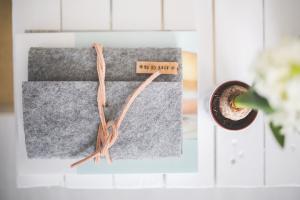
Picture 2: Notebook with a felt cover
National Handicraft Exports from India is a private label manufacturer of paperware, including notebooks and stationery that can be digitally printed. Their main selling point is their Cotton Leather material, made from recycled cotton remnants formed and pressed into paper by hand to look like leather. Cotton Leather is biodegradable, water resistant and can be custom fabricated in a variety of bright and metallic based colours. Functional and well priced, NHE’s stationery tries to offer a sustainable alternative to the volume market.
This study was carried out on behalf of CBI by Globally Cool B.V. in collaboration with GO! GoodOpportunity.
Please review our market information disclaimer.
Search
Enter search terms to find market research