

Entering the European market for notebooks
The European market for notebooks is promising, but competition is strong. Mass-producing countries dominate the low ends of the middle market, so your best chances are in the handmade niches in the mid-high and higher ends of the market. To compete in these segments, you need to add design value to your products. Entering the European market also means you need to comply with the European Union’s mandatory legal requirements, as well as any additional or niche requirements your buyers may have.
Contents of this page
1. What requirements must notebooks comply with to be allowed on the European market?
The following requirements apply to notebooks in the European market. For a more detailed overview, see our study on buyer requirements for home decorations and home textiles (HDHT).
What are the mandatory requirements?
When exporting to Europe, you have to comply with the following legal requirements:
- General Product Safety Directive
- REACH
- Timber Regulation
- Packaging and packaging waste legislation
General product safety
Europe’s General Product Safety Directive states that all products marketed in Europe must be safe to use. It provides a framework for all legislation regarding specific products and issues. If there are no specific legal requirements established for your product and its use, the General Product Safety Directive still applies. If specific requirements do apply, the Directive applies in addition to those, covering other safety aspects that may not have been described specifically.
Unsafe products are rejected at the European border or withdrawn from the market. The European Union has introduced a rapid alert system (RAPEX) to list such products.
Tips:
- Read more about the General Product Safety Directive in the EU Trade Helpdesk.
- Use your common sense to ensure that normal use of your product does not cause any danger.
- Search the RAPEX database for notebooks and other paper products for an idea of what issues may arise.
Restricted chemicals: REACH
The REACH regulation lists restricted chemicals in products that are marketed in Europe. REACH (EC 1907/2006) aims to improve the protection of human health and the environment through better and earlier identification of the properties of chemical substances. This is achieved through the four processes of REACH, namely registration, evaluation, authorisation, and restriction of chemicals. REACH also aims to enhance innovation and competitiveness of the European chemicals industry.
For notebooks, chemical residues can be the result of:
- chemicals used in paper production or recycling
- dyes used to decorate the paper
- chemicals used in coatings
Tip:
- For useful information and tips from the European Chemical Agency, see REACH Annex XVII (a list of all restricted chemicals), Information on REACH for companies established outside Europe and Questions & Answers on REACH.
Packaging
Europe has specific packaging and packaging waste legislation. EU Directive 2015/720 was adopted to harmonise measures at European level concerning the management of packaging and packaging waste, and to prevent or reduce their impact on the environment. Buyers may therefore ask you to minimise the use of packaging materials (paper, carton, plastic) or to use a different kind of material, including recycled material.
Europe also has requirements for wood packaging materials (WPM) used for transport, such as:
- packing cases
- boxes
- crates
- drums
- pallets
- box pallets
- dunnage
All wood packaging material and dunnage from non-European Union countries must be:
- either heat treated or fumigated in line with ISPM15 procedures;
- officially marked with the ISPM15 stamp consisting of 3 codes (country, producer and measure applied) and the IPPC logo;
- debarked.
These requirements do not apply to:
- wood 6 mm thick or less;
- wood packaging material made entirely from processed wood produced using glue, heat, and pressure, such as plywood, oriented strand board, and veneer;
- wood packaging material used in trade within the European Union.
The objective of this directive is to prevent organisms that are harmful to plants or plant products from being introduced into and spreading within the European Union. It also regulates imports from third countries in line with international plant health standards. Keep this in mind when you decide on the packaging of your notebooks.
Tip:
- Read more in the overview of EU rules on wood packaging material.
What additional requirements do buyers often have?
Sustainability
Social and environmental sustainability make your products stand out on the European market. Think of the impact your company has on the environment, the well-being of your workers and society as a whole. Buyers appreciate a strong story to create an emotional connection with their customers.
You should also consider sustainable raw materials like recycled paper or alternative natural fibres, and sustainable production processes. A case in point is the bleaching of paper. Due to the negative impact of chlorine on the environment, non-chlorine bleaching techniques are increasingly popular, for example, using hydrogen peroxide or oxygen.
Nowadays, an increasing number of European buyers demand the following certification schemes:
- Business Social Compliance Initiative (BSCI): European retailers developed this initiative to improve social conditions in sourcing countries. They expect their suppliers to comply with the BSCI Code of Conduct. To prove compliance, the importer can request an audit of your production process. Once a company is audited, it is included in a database for all BSCI participants.
- Ethical Trading Initiative (ETI): This initiative is an alliance of companies, trade unions and voluntary organisations. It aims to improve the working lives of people across the globe that make or grow consumer goods.
You can use standards such as ISO 14001 and SA 8000 to read up on sustainable options. However, only niche market buyers demand compliance with such standards.
A recent study by the International Trade Centre concluded that, irrespective of the product, retailers in the major European markets are putting more environmentally and socially sustainable products on their shelves. And that is simply because consumers ask for it. According to the survey, 98.5% of retailers consider sustainability as a factor in their product sourcing decisions.
Tips:
- Optimise your sustainability performance. Consider using recycled paper, chlorine free paper and natural fibre alternatives. Reading up on the issues included in initiatives such as BSCI and ETI will give you an idea of what else to focus on.
- If you can show sustainability performance, this may give you a competitive advantage. For instance, use a self-assessment tool like the BSCI Producer Self-Assessment, or a code of conduct such as the ETI base code.
Labelling
Information on the outer packaging of notebooks should correspond to the packing list sent to the importer. External packaging labels should include:
- producer name
- consignee name
- quantity
- size
- volume
- caution signs
Your buyer will specify what information they need on the product labels or on the item itself, such as logos or 'Made in…' information. This is part of the order specifications. It is common in Europe to use EAN or barcodes on the product label. Labelling should be in English, unless your buyer indicates otherwise.
Packaging
Importer specifications
You should pack notebooks according to the importer’s instructions. Importers have their own specific requirements for the use of packaging materials, filling boxes, palletisation and stowing containers. Always ask for the importer’s order specifications, which are part of the purchase order.
Damage prevention
Properly packaging notebooks should minimise the risk of damage caused by shocks. How an item is packed for export depends on how easily it can be damaged. Packaging should ensure that the items inside a cardboard box cannot damage each other. It should also prevent damage to the boxes when they are stacked inside the container. Packaging therefore usually consists of outer and inner cardboard boxes filled with protective materials like bubble wrap or paper.
Dimensions and weight
Packaging must be easy to handle in terms of dimensions and weight. Standards are often related to labour regulations at the point of destination and must be specified by the buyer.
Cost reduction
Boxes are usually palletised for air or sea transport, and you have to maximise pallet space. Packaging must provide maximum protection. However, you should also avoid using excess materials or shipping ‘air’. Waste removal is a cost for buyers. You can reduce the amount and diversity of packing materials by:
- partitioning inside the boxes, using folded cardboard
- matching inner and outer boxes by using standard sizes
- considering packing and logistical requirements when designing your products
- asking the buyer for alternatives
Material
Importers are increasingly banning wooden crating and packaging due to their unsustainability and high material and disposal costs. Economical and sustainable packaging materials are more popular. Using biodegradable packing materials can be a market opportunity. For some buyers, it can even be a requirement.
Consumer packaging
Retailers usually present notebooks without any packaging. This allows consumers to try them out and feel the material. A paper sleeve cover or wrapper around the notebook often communicates its special features.
Tips:
- Always ask for the importer’s order specifications, packaging, and labelling requirements.
- See Packaging Europe for more information on the latest packaging developments, with regular news articles about biodegradable packaging.
Payment and delivery terms
Payment terms are usually agreed upon with the buyer in the order contract. They vary from buyer to buyer and are related to the volume and value of the order, the type of distribution partner, whether or not an agent is involved, and what delivery terms apply.
Delivery terms, officially known as Incoterms, depend on the type of distribution partner and their preferences regarding physical distribution. Importers generally prefer Free On Board (FOB) or Free Carrier (FCA) arrangements.
FOB is restricted to goods transported by sea or inland waterway. It means that the seller pays for transportation of the goods to the port of shipment, plus loading costs. The buyer pays the cost of marine freight transport, insurance, unloading and transportation from the arrival port to the final destination. FCA can be used for any transportation mode. In this type of arrangement, the seller fulfils his obligation to deliver when he has handed over the goods, cleared for export, into the charge of the carrier named by the buyer at the specified place or point.
Retail multiples can ask for Cost Insurance Freight (CIF). That means that they will ask you to include the shipping and insurance charges in your quotation. Small retailers may go a step further and ask you to arrange that the goods will be delivered to their doorstep via a Delivered Duty Paid (DDP) arrangement. For importers who consolidate orders in your country, Ex Works (EXW) terms are often best.
Tips:
- For a more elaborate overview of the various terms and conditions, and how to work with these, see our study on terms and conditions, which also explains the benefits of having your own terms and conditions.
- Study the different types of Incoterms, including what your and your buyer’s rights and obligations are.
What are the requirements for niche markets?
Fair trade
The concept of fair trade supports fair pricing and improved social conditions for producers and their communities. Especially when the production of your notebooks is labour intensive, fair-trade certification can give you a competitive advantage. Common fair-trade certifications are issued by the World Fair Trade Organisation (WFTO) and Fair For Life.
Tips:
- Ask buyers what they are looking for. Especially in the fair-trade sector, you can use the story behind your product for marketing purposes.
- Check the ITC Sustainability Map database for more information on voluntary standards and their requirements, including fair production.
FSC certification
FSC (Forest Stewardship Council) certification is the most common label for sustainable wooden products, including paper. The FSC label guarantees that a product’s source material comes from responsibly managed forests. These products are especially popular in Western European markets.
Tips:
- For more information, see the three steps towards FSC certification.
- If you use recycled paper, you can apply for the FSC Recycled label.
2. Through what channels can you get notebooks on the European market?
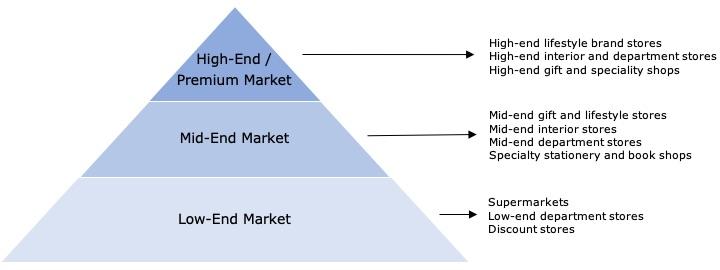
The notebook market is segmented into low, mid and high-end or premium market segments. Notebooks are put on the market through the traditional channels: importers and wholesalers that supply to retailers, as well as retailers that buy directly from suppliers.
How is the end-market segmented?
Figure 1: Notebook market segmentation in Europe
Low-end market
In this segment, price and functionality are leading factors. Notebooks for the low-end market are functional and inexpensive, making it difficult to add much design value. Because this segment is dominated by low-cost and mass-produced items, opportunities are limited for smaller manufacturers.
Mid-end market
The middle segment puts more emphasis on design, material and finish, while prices are often reasonable. It follows trends, and craftsmanship and sustainability values can add value. The mid-end market offers you good opportunities, especially in the niches where handmade and gifting are important consumer values.
High-end or premium market
Trends, materials, finishing and design play a key role in the high-end market. Here too, we find niches based on handmade and gifting, with a bit more room for luxury.
Through what channels do notebooks end up on the end-market?
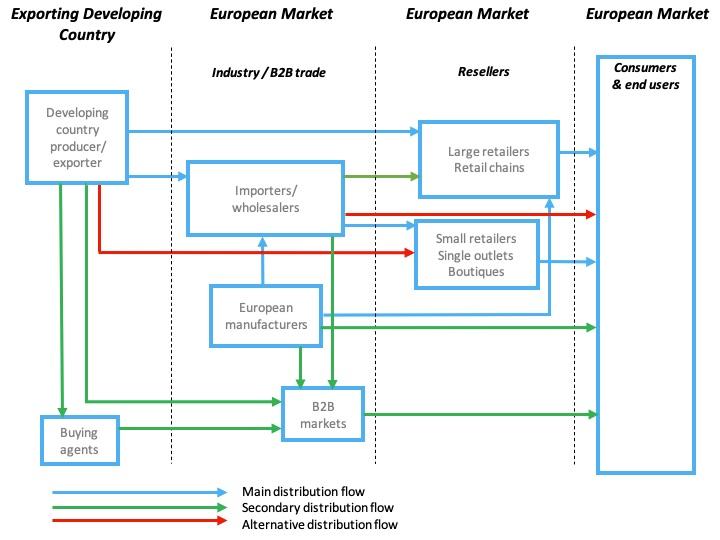
The channels through which notebooks are put on the market follow the traditional patterns: import takes place via importers/wholesalers that supply to retailers. Larger retail chains often bypass the importers/wholesalers and import themselves, while more and more smaller retailers have also started buying directly from suppliers. In some cases, buying agents play a role. Below, we highlight the main actors in the market for notebooks.
Importers/wholesalers
Importers/wholesalers sell products to retailers in their own country or region, or re-export to the broader European continent. Some European markets are therefore supplied by wholesalers/importers from other European countries (internal European trade). Supplying to buyers in the business-to-business (B2B) market can be considered as a secondary distribution flow for European importing wholesalers.
These importers/wholesalers take care of the import procedures. They take ownership of the goods when they buy from an exporter (as opposed to agents), taking on the risk of the onward sale of the products. Developing a long-term relationship can lead to a high level of cooperation on appropriate designs for the market, new trends, use of materials, type of finishing and quality requirements.
Importing retailers
Some retailers, especially the larger chains, are importing directly from their suppliers in developing countries. Many large retail chains even have their own buying offices in developing countries, such as Ikea. Others, mainly the smaller independent stores, order in Europe from wholesalers. Retailers come in many sizes: large and part of a chain, or small and independent.
Retailers come in many sizes: large and part of a chain, or small and independent. There is a tendency for consolidation in European retail, with large retail brands becoming more widespread in Europe and more ‘lifestyle-centred’ (offering home and office supplies as well as home decoration and textiles, and fashion accessories).
Buying agents
Buying agents do not import, but instead represent European buyers in the sourcing country. Sometimes agents have a more limited role, such as checking the quality of the shipments in your warehouse on behalf of a specific importer or checking the codes of conduct that exporters have agreed with the buyer. Agents can work individually or as part of purchasing companies. They mostly operate based on commission.
E-commerce
E-commerce in the HDHT sector is growing and can help you reach a broader range of customers. However, it is important to understand that for most producers this is not a completely separate channel in itself and that catering to buyers that sell online does not differ from your regular business. Retailers often combine online and offline channels but the way of supplying to them is the same. Companies that only sell online also need to take stock before they can sell.
Channeling online sales via your own website would mean:
- supplying small batches or individually packaged items, and being prepared to pre-stock and offer more just-in-time supply concepts;
- needing to be found in a crowded space of European and producer country wholesalers and retailers that are ahead of the game in understanding and responding to online consumers’ needs;
- being able to deal with aftersales on a business-to-consumer (B2C) level, including returns and replacing items.
These circumstances make it unfeasible for most exporters from developing countries to sell online to consumers in Europe.
Tips:
- To find potential buyers of your notebooks, search the list of exhibitors or attend the main (online) trade fairs in Europe: Ambiente - Frankfurt (February), Maison et Objet - Paris (January and September) and Paperworld - Frankfurt (January/February).
- See our Tips for finding buyers on the European market.
- For more information about trading directly with small retailers, see our special study about alternative distribution channels.
Figure 2: Trade channels for notebooks in Europe
What is the most interesting channel for you
Wholesale importers are the main channel between exporters in developing countries and European retailers. They are interesting if you want to develop a long-term relationship and they usually have good knowledge of the European market. They can provide you with valuable information and guidance on European market preferences and will normally provide you with design input.
However, as the market is becoming more and more competitive, large retailers are increasingly importing themselves instead of through European wholesale importers. The obvious advantages are cutting out the margins of the wholesaler and reducing delivery time to the market. In the lower-end market segments, self-importing retailers might want to drive a much harder bargain with you. However, in the higher middle segment, which offers you the most opportunities, price is less of an issue.
Smaller independent European retailers continue to purchase mainly from domestic wholesalers and importers. As in other European market sectors (such as food or clothing), independent HDHT retailers struggle to compete with retail chains. They need to differentiate on value-added service, as well as specialised offers and authenticity. They typically prefer small order quantities per item, small total order volumes and delivery to their doorstep, with a limited likelihood of repeat orders. You need to calculate if this is cost-effective for you.
The trend of direct sourcing is expected to continue in future and may create more opportunities for you. The pool of buyers may increase if more retailers become importers, possibly resulting in an improvement of your bargaining position. Importing retailers order for their own shops and can therefore place orders much more quickly than some of the importers and wholesalers, who first need to show samples to their retailers before exporters receive their orders.
Tips:
- Consider targeting retailers directly, to improve your bargaining position and increase your chances of closing deals faster.
- Relate your offer and terms to the targeted retailer (large or small). Ask your existing buyers how they operate if you are unsure. The better informed you are about this aspect, the better you will be able to set prices.
- For more information on the pros and cons of dealing directly with small retailers, read our study on alternative distribution channels.
- Offer suitable services such as fast delivery and after-sales support to build a relationship based on mutual benefits.
- When you participate in international trade fairs, especially within Europe, make sure that you have a policy for small, independent retailers coming to your booth. If you choose to sell to them, you must have appropriate terms of trading (such as low minimum order quantities, delivery to the doorstep of the retailer and pre-stocking).
3. What competition do you face on the European notebook market?
China supplies about a third of European notebook imports, consisting mainly of mass-produced, low-cost items. Eastern European countries are also emerging as strong competitors in the lower-end segments. Instead, your best opportunities are in the mid-to-high end market, where you compete with manufacturers from countries such as India.
The coronavirus pandemic and the measures taken against it worldwide are expected to have a large impact on international trade and the European market for many products and services, including HDHT. Please note that the below analysis is based on the statistics that are currently available (2015–2019). Therefore, the expected impact of the pandemic on the European market and global supply chains have not been taken into account in this report. For the latest news in your sector, please check CBI News.
China is Europe’s main supplier of notebooks with 35% of the imports, followed by Germany (13%) and Poland (10%). Together, these countries supply more than half of the European imports. Italy (6%), the United States (6%) and the Netherlands (5%) come next on the list.
However, be aware that in the European market, different countries have different roles. You can make a rough distinction between countries that are mainly importers and countries that are mainly manufacturers. Most western European importing countries do not just import products for sales within their own country, but also to re-export to other countries in Europe. This explains why countries with small HDHT markets, like Denmark and the Netherlands, often import much more than the demand in their own domestic markets.
European production mainly takes place in eastern European countries. This is mostly because of their location already in the European market and their relatively low labour costs. This sometimes makes them a good alternative to sourcing from Asia.
In general, western European countries are mainly re-exporters, countries in Asia are the manufactures and eastern European countries are the new manufacturers. Mass-produced notebooks are segmented in the lower ends of the market and produced in the most cost-effective country. You do not compete with these countries, as your focus should be on the mid- to high-end market. Western European countries could therefore be interesting trading partners for you.
Which countries are you competing with?
China dominates the market
As discussed, China is Europe’s main supplier of notebooks. The country increased its supplies from €160 million in 2015 to €190 million in 2019, at an average rate of 4.4% per year. It is primarily focused on contract manufacturing for lower-end segments, but increasingly for more luxurious product brands as well, such as Italy’s Moleskine. A new raw material that will appeal to those interested in sustainability in the European market is bamboo paper.
Its low-cost workforce, availability of raw materials and efficient shipping to Europe compared to other Asian countries make China the most competitive supplier. In the coming years however, disruptions following China’s trade war with the United States and the Covid-19 pandemic may negatively impact the country’s trade performance. This could benefit companies from other developing countries.
Chinese producers mainly supply the lower ends of the market with low-priced products, as product development and creativity are not their core strengths. To avoid having to compete with Chinese suppliers on costs, you should differentiate and stay away from mass-produced notebooks. Focus more on design, craftsmanship, sustainability, and storytelling, which allows you to enter the mid-end market, where your best opportunities are.
Poland strengthening its position as a regional supplier
Polish notebook supplies to Europe grew from €22 million in 2015 to €51 million in 2019, at an impressive annual rate of 23%. Although around 40% of these exports were destined for Germany, Poland is diversifying by considerably increasing its exports to other European countries, such as France (21%) and the United Kingdom (20%).
Poland and its neighbouring eastern European countries are new entrants in the more industrialised segments of the notebook market. The relatively low production costs, availability of technology and nearness to the end market have given them a competitive edge in the mass market for notebooks. In many respects, they are becoming a second source to China, by offering smaller runs and a more just-in-time approach.
Because of these strong competitive values, eastern European manufacturers are generally out of reach for manufacturers from developing countries. Instead, you should compete in the more handmade segments, where the focus is more on design, gifting, and personalisation.
American notebook exports had a strong 2019
Although the United States is traditionally a relatively small player in the European notebook market, it won a place among the leading suppliers in 2019 by increasing its exports by nearly 80% that year. Due to this impressive growth, exports to Europe reached €33 million.
American notebook brands generally target the higher-end, luxury markets. Many of these brands outsource their production to suppliers in low-wage countries, such as China. This approach could actually offer you opportunities, especially if the American trade war with China stimulates American brands to look for alternative sourcing countries.
India has a fast-growing home market
Between 2015 and 2019, India’s notebook supplies to Europe doubled from €8 million to €16 million, thanks to strong growth in 2018 and 2019. About two-thirds of these notebooks were destined for the United Kingdom.
India’s stationery sector is becoming more active at home, with increasing literacy rates along with rapid growth in GDP. Domestic quality expectations are expanding and bringing India closer to the level sought in European markets. In the lower- and mid-end segments, large-scale establishments are including contract manufacturing for export in their business (which has more of a domestic orientation). When it comes to the higher-end segments with luxury leather-bound and handmade paper notebook producers, exporting is a higher priority.
In the handmade segments of the market, India is a straight competitor. To compete, you should focus on design value and sustainability. Local materials and techniques can help you differentiate.
Czech Republic mainly supplies notebooks to Germany
Another emerging European notebook supplier is the Czech Republic, albeit on a much smaller scale than Poland, with a 1% import market share. Czech notebook exports to Europe increased from €2.7 million in 2015 to €5.5 million in 2019, at an average annual rate of 19%. Generally, about half of these notebooks are destined for neighbouring Germany, which offers both a sizeable domestic market and a gateway to other markets in Europe through its function as an international trade hub.
The Czech Republic’s profile as a notebook supplier is similar to that of Poland. Again, your best option is to avoid competition from these countries by focusing on the more handmade segments of the market.
Turkey steadily increases its notebook exports to Europe
The least significant of your main competitors is Turkey, with a 0.9% share of Europe’s notebook imports. The country increased its notebook supplies to Europe from €2.3 million in 2015 to €4.8 million in 2019, at an average growth of 20% per year. About a third of these notebooks were destined for Germany, and another quarter for the United Kingdom. Turkey benefits from being located near the European market, which allows for relatively short delivery times.
Turkish manufacturers of notebooks are rare but coming up. Their focus is not yet very clear; sometimes they compete on price, sometimes on design value. You need to firmly stick to your own selling points — handmade, design, origin — and do your marketing well until the Turkish new entrants have established themselves properly in the European market.
Which companies are you competing with?
Pechaan, India
Pechaan is a collective of artisans working on the basis of fair-trade principles, offering a broad range of products for the home. Their handmade notebooks are of woven and block-printed cotton, proving a meaningful, authentic gift to the mid-high market segment. Preserving traditional craftsmanship and cultural diversity are important underlying social values. Craftspeople receive a fair price and part of the profits are donated to social projects, to benefit women and orphaned children.
Atelier Dreieck, France
Atelier Dreieck is an example of a younger generation of Europeans that is increasingly interested in reviving traditional craftsmanship. Dreieck’s two owners are manual bookbinders, a process that has become thoroughly industrial for mass-market paperware. They offer bookbinding, boxes, notebooks, and paper objects to a luxury market, where factors such as authenticity, handmade, and limited editions are much appreciated. They are both an example and a competitor for you. Their latest collection has a minimalist style with a marbled cover.
Etnodizainas, Lithuania
Etnodizainas is an eastern European manufacturer, offering gifts and home accessories from wooden composites. They call their concept ethno-design, combining handmade craftsmanship and industrial technology, especially laser cutting techniques. This combination of high and low tech allows them to differentiate from their industrialised, mass-producing competitors of wooden items in eastern Europe, as well as from traditional artisans in wood from developing countries.
Their notebooks target a premium market and form a perfect example of their concept. The wooden covers have ornamental fretwork and the veneering has been done in such a way that the book is easy to bend and yet keep the fastness at the same time. Inside, industrial paper ensures optimum functionality. Etnodizainas produce the wooden composites themselves using sustainable wood.
Which products are you competing with?
Although pen and paper will most likely never disappear, competition from digital products is increasing. Nowadays, consumers (at school, at home and at work) are increasingly taking notes on their devices, such as their phone or tablet. Competition is therefore mostly to be found in the digital area.
Applications on smartphones and tablets
Most smartphones and tablets have a standard application installed for notetaking, and several notebook applications available for all types of phones and tablets. An example of a widely used application for taking notes is Evernote. Notetaking applications are often used with a stylus, which is a pen-like object included with some tablets.
Smart/digital notebooks
A smart or digital notebook allows you to write with a pen and paper, while still offering the ability to turn those notes into digital files that you can edit and manipulate digitally later on. Depending on the type and brand, special or normal paper is used. An example of a smart notebook is the Smart Writing Set Ellipse from Moleskine.
Tip:
- Follow relevant trends and developments, for example, on Paperworld Trends.
4. What are the prices for notebooks on the European market?
Prices for notebooks vary across market segments, ranging from low end to high end. After adding logistics costs, wholesaler and retail margins and VAT, European consumer prices amount to about 4–6.5 times your selling price.
Table 1 gives an overview of the prices of notebooks in the low-, mid- and high-end market segments. ‘Indicative’ is key here, since prices for notebooks vary depending on technique, size, material, design, brand and other ways of value addition.
Table 1: Indicative consumer prices of notebooks in Europe
| Low-end | Mid-end | High-end |
| Up to €10 | €10-15 | €15 and over |
Consumer prices depend on the value perception of your product in a particular segment, which is influenced by your marketing mix:
- product benefits
- promotion (brand or not, communication of product benefits)
- points of sale (reseller positioning)
- price
The following percentages give an indication of a price breakdown for notebooks in the supply chain:
- Shipping, import, handling: +25%
- Wholesale: +100%
- Retailer: +100-150%
- Retail price (VAT)*: +20%
*VAT percentages in Europe range from 18% in Malta to 27% in Sweden. On average, these percentages are around 20%.
For example, in Table 2, the FOB price is set at €10. Depending on the market segment your product is designed for, the consumer price ranges from €41 in the low-end market to €65.50 in the high-end market.
Table 2: Example of the price breakdown per market segment
| Low margin | Middle margin | High margin | ||
| FOB price | €10 | €10 | €10 | Your FOB price |
| Transport, handling charges, transport insurance, banking services (20%/15%/15%) | + €2 €12 | + €1.50 €11.50 | +€1.50 €11.50 | Landed price for the wholesale importer |
| Wholesalers’ margins (50%/75%/90%) | + €6 €18 | + €8.60 €20.10 | + €10.40 €21.90 | Selling price from the wholesale importer to the retailer |
| Retailers’ margins (90%/110%/150%) | + €16.20 €34.20 | + €22.20 €42.30 | + €32.70 €54.60 | Selling price excluding VAT from the retailer to the end consumer |
| Selling price incl. VAT (20%) | + €6.80 €41 | + €8.50 €50.80 | + €10.90 €65.50 | Selling price including VAT from the retailer to the end consumer |
Examples of notebook prices across Europe (excluding shipment):
- Elephant dung notebook/planner, QBamboo (United Kingdom): €8 (approx.)
- Fairtrade lokta paper notebook, Opschrijfboekjes.nl (Netherlands): €11.99
- Handmade cotton paper notebook, Paper Haveli (United Kingdom): €12 (approx.)
- Customisable, erasable notebook with optional accessories, Greenstory (Netherlands): €16.50–€54.50
Tips:
- Study consumer prices in your target segment to determine your price and adjust your cost accordingly. Your notebooks’ quality and price must match what is expected in your chosen target segment.
- Understand your segment. Offer a correct marketing mix to meet consumer expectations. Adapt your business model to your position in the market.
This study was carried out on behalf of CBI by Globally Cool B.V. in collaboration with GO! GoodOpportunity.
Please review our market information disclaimer.
Search
Enter search terms to find market research