

8 tips to go green in the fresh fruit and vegetables sector
Sustainability is no longer a choice in the European fresh fruit and vegetables market. Buyers want proof that major risks are under control, particularly water use, emissions, packaging and waste. The easiest ways to improve are mapping your hotspots, improving the 2–3 areas that matter most and showing progress with recognised certification and clear records.
Most improvements start at the farm level. Improving soil health and reducing synthetic fertiliser use can reduce emissions and strengthen resilience. EU sustainability and packaging rules are also getting stricter. This means meeting buyer requirements will depend on compliance and evidence more and more often, and being supported by innovation and the right partners and funding.
Contents of this page
- Focus on improving major issues in your supply chain
- Become a certified fresh producer
- Reduce your emissions by improving your soil condition and reducing the use of synthetic fertilisers
- Stay on top of new green European legislation
- Be aware of the challenges
- Make use of green innovations
- Incorporate green principles in your code of conduct
- Find funding, investors and/or partners
1. Focus on improving major issues in your supply chain
European buyers want fresh fruit and vegetables that are produced in a responsible way, with clear proof. The biggest ways to improve are in mapping your full process and supply chain, spotting the main ‘hotspots’ (energy, water, waste, inputs, labour and transport) and improving what matters most.
Identify the main sustainability hotspots in your process
Every step in the fresh fruit and vegetables supply chain affects the environment. This includes farming, post-harvest handling, packaging, cooling and transport. The biggest ‘hotspots’ depend on your product, origin, buyer market and mode of transport. Your goal is to find the steps where you can make the biggest improvements.
Tomatoes grown in heated greenhouses usually have higher emissions than outdoor tomatoes. But outdoor tomatoes can still have a high footprint if they are shipped by air. This shows why you need to look at the full chain and not only the farm.
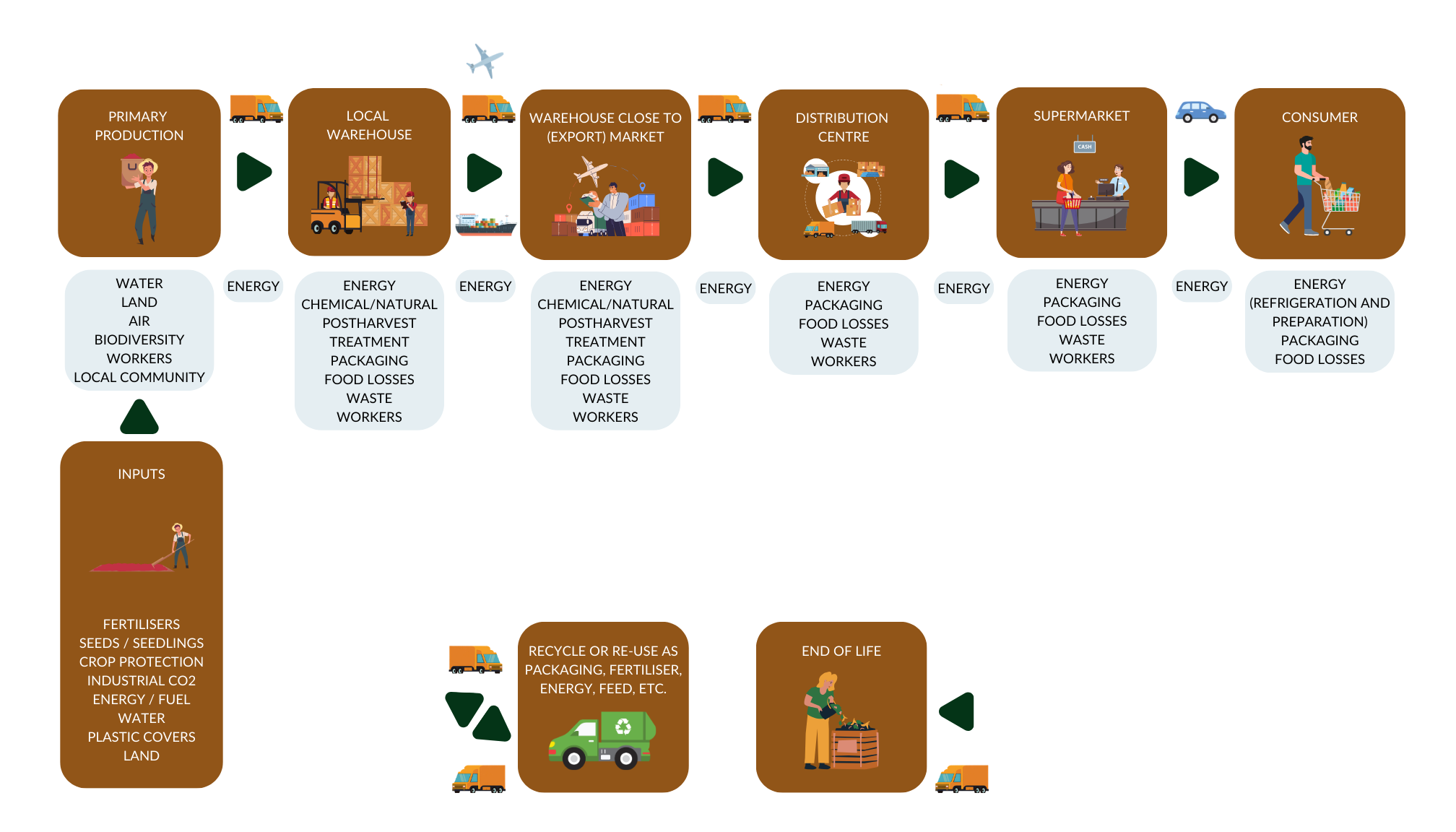
Even if you do not control the whole chain, you can influence major areas. Focus on inputs, farming practices, post-harvest handling, packaging and shipping choices. Figure 1 shows common sustainability hotspots throughout the chain. Note that this list is not exhaustive: there may be other hotspots or sustainability impacts that are not listed here. Use it to guide your own hotspot scan.
Figure 1: Sustainability impacts along the fresh fruit and vegetable supply chain (not exhaustive)
Source: Globally Cool, 2026
One good example is avocado. Water use can be a major sustainability risk, especially in dry regions where irrigation is needed. In parts of Chile, avocado expansion has been linked to water conflicts and pressure on local water availability. This can harm ecosystems and reduce water access for nearby communities.
Since buyers and consumers are more aware of water risks, some suppliers highlight that they grow ‘rain-fed’ or ‘rain-grown’ avocados. This means orchards rely mainly on rainfall, with limited or no irrigation, depending on the season and location. If you use this claim, be ready to show evidence. These can, for example, be things like water records, risk mapping and audit results.
The Tanzanian company TanzaNice uses a story about their rain-fed avocados to position itself as a more sustainable supplier. It combines this message with market certifications and other evidence on its website. Doing this means buyers can see both the claim and the proof.
The Peruvian cooperative Cooperativa Agraria Kivinaki also benefits from the growing focus on water use in agriculture. It supplies organic, ‘rain-grown’ Valencia oranges to the Dutch organic importer Eosta. These oranges are grown in Peru’s Amazonas region and use natural rainfall instead of irrigation, which Eosta markets as more water-efficient.
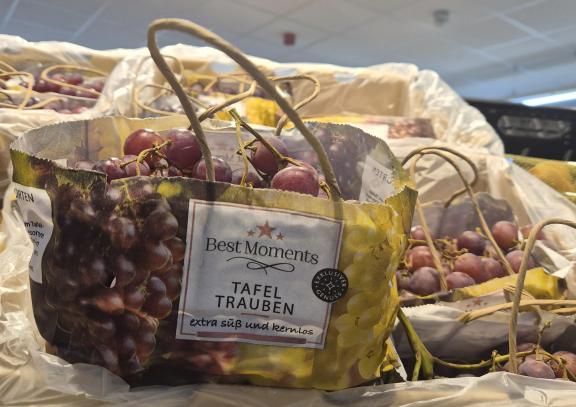
Packaging can also be an important hotspot. For physalis, the Colombian company Caribbean Exotics uses biodegradable boxes to reduce plastic use. If you change packaging, make sure that shelf life and damage rates do not decrease.
Figure 2: Grapes in paper bag in a German retail outlet
Source: Globally Cool, 2026
Tip:
Do a simple hotspot scan. Check these areas in your process and chain:
- Inputs (fertiliser, crop protection);
- Energy (irrigation, cooling, packhouse);
- Water risk (availability, quality, community impact);
- Waste and losses (on-farm, packing, transport);
- Packaging choices;
- Transport mode (air/sea/road) and cold chain.
Identify your biggest hotspots first, then focus on the 2–3 improvements that reduce the most risk, cut costs and are easiest to prove to buyers.
2. Become a certified fresh producer
Proving sustainability is now part of market access for many European buyers, especially if you supply supermarkets. Many importers will ask for recognised schemes to reduce their risks and to meet retailer programmes. Third-party audits are important because they check your practices and records in a consistent way.
If you are not certified, it will be hard to benefit from sustainability efforts, such as rain-fed production, improved packaging or other sustainable practices. Many buyers who value these efforts also require a recognised sustainability certification as a minimum condition for entry.
There are several internationally recognised certification programmes that European buyers accept regarding environmental sustainability. The following are the most relevant.
GLOBALG.A.P.
GlobalG.A.P. IFA is third-party certification and is the standard for good agricultural practices. Audits come from an independent certification body. It covers good agricultural practices, including food safety, traceability and farm management. It is now a non-negotiable requirement for imported fresh produce sold in supermarket chains in Europe. Retailers may also ask for their own add-ons or programmes. For example, Tesco Nurture is audited in combination with GLOBALG.A.P. IFA for suppliers to Tesco.
SAI Platform’s Farm Sustainability Assessment (FSA)
The SAI Platform FSA is a tool to assess and improve on-farm sustainability. The aspects assessed include soil, water, biodiversity, labour and emissions. The results of the assessment can be shown as performance levels, such as Bronze, Silver and Gold, and they can be verified by third-parties. Farms can start with a self-assessment, but buyers will only accept the results as reliable proof if they are verified by an independent third party.
FSA links well with GLOBALG.A.P. through the GGFSA add-on. With it, producers can combine an FSA verification with a GLOBALG.A.P. farm audit into a single audit process. This reduces duplication and makes it easier to share sustainability results with buyers.
Rainforest Alliance
Rainforest Alliance is a sustainability certification for farms and supply chains. It covers environmental, social and farm management topics, such as protecting forests and biodiversity, improving soil and water practices, and respecting workers’ rights. This certification focuses on avoiding deforestation. Certification is checked through third-party audits, so buyers can use it as independent proof.
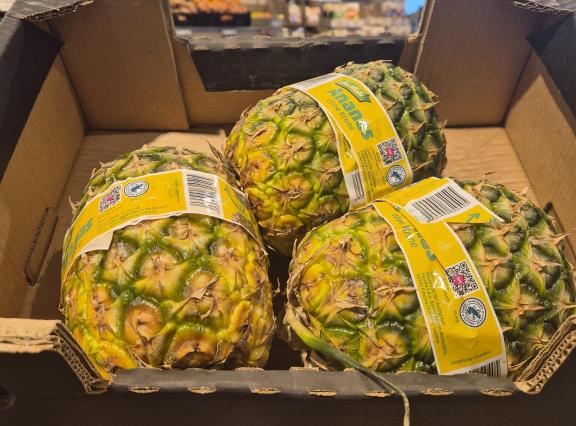
In fresh produce, Rainforest Alliance is often used in tropical fruit supply chains in which biodiversity protection and social standards are very important, like bananas and pineapples.
Figure 3: Rainforest Alliance certified crownless pineapples at a German discounter
Source: Globally Cool, 2026
Organic
Organic farming avoids synthetic fertilisers and most synthetic pesticides. It focuses on soil health and natural pest control. To sell as organic in the EU and use the EU organic logo, you need to follow EU rules and be certified by an approved control body.
Besides the EU organic standard, some European private schemes build on EU organic rules and add extra requirements. Examples include the Soil Association in the UK and Naturland in Germany. These schemes can be useful if your target buyer asks for them.
Demeter
Demeter is a biodynamic standard that goes beyond EU organic rules. Biodynamic farming treats the farm as a living system and aims to close nutrient cycles there. It focuses on soil fertility, biodiversity, composting and careful use of natural inputs, including specific biodynamic preparations used in compost and field management. Demeter certification is a separate standard on top of organic. Demeter farms are inspected every year. This inspection is done in addition to the organic inspection.
Demeter is a niche market, but it can help you stand out with specialised organic buyers. It is especially well known and in high demand in Germany.
Regenerative Organic Agriculture
Regenerative Organic Certified (ROC) is a niche scheme that goes beyond organic. It uses organic certification as the baseline and adds extra requirements in three areas: soil health and land management, animal welfare, and farmer and worker fairness. ROC has three performance levels (Bronze, Silver, Gold), which encourages step-by-step improvement. For fresh produce exporters, ROC can be a strong ‘premium proof point’. However, it only makes sense if you already sell organic and have buyers who will recognise and pay for it.
Recommendations:
- If you sell conventional produce, start with GLOBALG.A.P. Then you can upgrade with extra sustainability schemes, based on your target buyers and their requirements.
- For more information on certification of specific fresh produce, refer to the specific documents (for example about mango, tropical fruit and avocado) on the CBI’s market information page.
3. Reduce your emissions by improving your soil condition and reducing the use of synthetic fertilisers
Nitrogen is essential for crop growth. In healthy soils, plants can get nitrogen through natural soil processes, helped by soil organic matter and microbes. In soils that lack nutrients, crops often need extra fertilisation to maintain good yields. For this reason, the use of synthetic nitrogen fertilisers is quite common in agriculture.
But producing and using synthetic nitrogen fertilisers can cause greenhouse gas emissions. One particularly important one is nitrous oxide (N₂O), which is released from soils after fertiliser is applied. N₂O is far more powerful than CO₂ as a greenhouse gas; it is often described as around 300 times stronger in the long term. Heavy and repeated use of synthetic nitrogen can also weaken soil health over time. It can reduce soil organic matter if it replaces good organic inputs, and it can disturb soil biology and nutrient balance. This can create a cycle where the soil becomes less fertile and needs even more fertiliser to keep yields stable.
A direct way to cut these emissions is to use less synthetic nitrogen and replace part of it with better soil practices. Examples include using compost or manure where suitable, planting cover crops, rotating crops and working withmore precise fertiliser timing and dosing.
According to industry experts, when it comes to fresh fruits and vegetables, the biggest wins can be achieved by investing in sustainability practises in the primary production process.
Organic agriculture
Organic agriculture is a way of farming that works without synthetic inputs, such as synthetic nitrogen-based fertilisers. Instead, farmers focus on healthy soil, crop rotation, compost, manure and natural pest control. Animal welfare and biodiversity are also important parts of organic farming.
Organic production can lower the environmental impact of fresh fruit and vegetables by improving soil health and reducing chemical pollution. Organic farmers build soil organic matter with compost, manure, cover crops and crop rotation. This can increase carbon storage, improve water retention and reduce erosion, which also helps farms cope better with drought and heavy rain.
Organic farming also supports biodiversity because it uses more diverse rotations and relies more on natural pest control. Keep in mind that organic yields can be lower. So good farm management is important to benefit both the environment and your business.
Organic food has become a strong market segment in Europe. Most retailers, from discounters to premium supermarkets, sell organic fresh fruit and vegetables. There are also specialised organic chains in many countries. These products usually sell at a higher price than conventional products, but the premium changes depending on product, season and market. For example, the difference between conventional and organic Valencia oranges is only around 9%, while it is over 100% in the case of Jonagold apples.
Even so, the organic market keeps growing: EU organic retail sales reached about €49.5 billion in 2024, up around 5% from 2023. This can make organic an attractive niche. Buyers may accept higher prices and there may be less competition in some products. However, organic prices still follow normal supply and demand. If supply rises quickly for a product, prices can drop and margins can shrink.
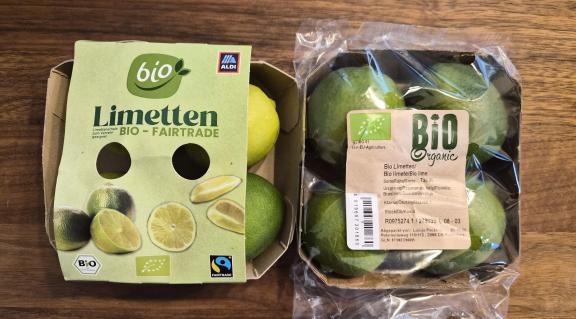
Figure 4: Organic certified limes from different retailers
Source: Globally Cool, 2026
Sustainable agricultural practices
If you do not want to go full organic, you can still reduce your use of synthetic nitrogen-based fertiliser and your emissions. To do so, farmers can carry out sustainable agricultural practices. They can be introduced in phases and mixed with conventional farming practices.
Several important sustainable agricultural practices to reduce synthetic fertiliser use are:
- Reduce in steps, not all at once: Cut nitrogen gradually over 3–5 years while you build soil fertility. Use small ‘starter’ doses only if needed.
- Use biological nitrogen fixation: Grow legumes (for example clover, vetch, lupine) in rotations or pastures. This adds plant-available nitrogen through soil bacteria.
- Use cover crops and green manures: Keep living roots in the soil for more months each year. Mix several cover crop species to improve resilience, biomass and nutrient cycling.
- Build soil carbon and soil life: Improve organic matter with crop rotations, reduced disturbance and year-round ground cover. Healthier soils supply more nutrients and need less fertiliser.
- Use organic inputs as part of a strong soil plan: Use manure and compost to improve soil structure, soil life and long-term fertility where available and safe. Apply the right amount at the right time, based on soil tests and crop needs, so nutrients feed the crop instead of being lost through run-off or leaching.
- Improve grazing management (if you have livestock): Use adaptive grazing with rest and recovery periods. Manage stubble height and stocking density to support strong roots and nutrient cycling.[A2]
Reducing synthetic fertiliser use can be good for the environment and for your profit. One pineapple study found that using less synthetic fertiliser and replacing part of it with organic fertiliser increased yields and lowered emissions. The best approach raised pineapple yield by 26.3% compared with full synthetic fertilisation. Results were even better in the second season, which suggests soil benefits can build over time.
In this study, treatments with organic fertiliser also improved nitrogen efficiency and cut nitrogen losses and nitrous oxide emissions by around 27–29% compared with full synthetic use.
Tips:
- Test new sustainable practices on a small plot first. Track yields, costs, pest pressure and soil indicators, then scale up what works.
- Use proven methods for your crop and region. Look for practices that are already successful for your crop. Adapt them to your local climate, soils and water situation.
- Use technology that helps you optimise the use of input and reduce emissions and costs. For example, you can use satellite data to make decisions about fertiliser application.
- Reduce soil disturbance like tillage. This might work differently depending on the type of crop and weed pressure, so you might want to start experimenting with the low-tillage variants.
4. Stay on top of new green European legislation
The EU is tightening rules on sustainability and responsible business. There are two important policy drivers. The first is the European Green Deal, which aims to make the EU climate-neutral. The second is the Farm to Fork Strategy, which is part of the Green Deal and aims for fair, healthy and more sustainable food systems.
These policies shape what European buyers expect from suppliers, including better control of environmental and social risks. They are followed by concrete laws that set different requirements for companies and their supply chains. We discuss three important laws here.
CSRD: Corporate Sustainability Reporting Directive
The CSRD requires companies in the EU or with sales in the EU to report on their environmental, social and governance (ESG) using EU reporting standards (ESRS). This can affect fresh fruit and vegetable suppliers because EU buyers may ask for more data and documentation on farming practices, emissions, labour conditions and traceability. For suppliers, this is likely to mean more questions about the social and environmental impact of their activities.
At first, only large companies with more than 1,000 employees and a net annual turnover of above €450 million will have to report. Smaller companies will have to start reporting in 2028 and 2029, depending on their size.
CSDDD: Corporate Sustainability Due Diligence Directive
The CSDDD (Directive (EU) 2024/1760) requires large companies to identify and address negative human rights and environmental impacts in their operations and parts of their value chains. This can increase buyer focus on risks like unsafe working conditions, child labour, and environmental damage. The first application dates have been pushed back. The first group is expected to start from 26 July 2028, and full application will apply from 26 July 2029.
For suppliers of big companies, this is likely to mean more questions about traceability, risk mapping and responsible practices.
PPWR: Packaging and Packaging Waste Regulation
The PPWR (Regulation (EU) 2025/40) is the EU’s new packaging law. It is already in force, but most rules will apply from August 2026. There are more changes coming in phases up to 2030 and beyond. It sets EU-wide requirements on recyclability, less ‘unnecessary’ packaging, recycled content for plastics and reuse targets, especially for transport and distribution packaging.
For fresh fruit and vegetables, this matters because some single-use packaging formats will be banned from 2030. This includes plastic packaging for most pre-packed fruit and vegetables under 1.5 kg. The regulation will push supply chains towards more loose sales, fibre-based recyclable solutions and more reusable systems.
What it means to exporters from low and middle-income countries
These laws will not affect all small and medium-sized enterprises (SMEs) directly at the same time. However, they will affect many exporters through their European buyers. Large buyers need better data from their suppliers to meet their own reporting and due diligence duties. This means that SMEs should not wait until a buyer asks for proof.
Start preparing now by improving traceability, keeping better records and checking your packaging. Suppliers that can show clear evidence of responsible practices will be easier to approve and may become more attractive to European buyers.
Tips:
- Create a simple sustainability file for each product. Include farm locations, suppliers, certificates, pesticide records, worker conditions, packaging details and traceability documents.
- Ask buyers which CSRD, CSDDD and PPWR data they expect in the next 2-3 years and prepare. If you do nothing, buyers may delay approval, ask for audits or choose suppliers with better documentation.
- Read more about the European Green Deal and the Farm to Fork strategy in the CBI’s study The EU Green Deal – how will it impact my business?
- For more information on buyer requirements for fresh produce, read the document Buyer Requirements for Fresh Fruit and Vegetables.
5. Be aware of the challenges
As a producer of fresh fruit and vegetables you will encounter challenges when switching to sustainable farming practices. You will need to find a new balance in your farming costs, yield and the price you receive for the sustainable products. How can you remain profitable?
Switching from conventional to regenerative agriculture can lead to yield reduction at first, depending on the crop and local conditions. However, many producers have found that after one or two years of transition, their yields return to normal or are even higher than before. On top of that, regenerative fields perform better in drought periods because the soil can absorb more water.
In organic agriculture, yields are lower than in conventional agriculture. Nevertheless, as the market prices for organic products are higher, some companies that sell organic produce have higher incomes. Regenerative and organic farming tend to have higher labour requirements, but no or hardly any costs for pesticide and fertiliser. Depending on the crop, the yield is usually lower, but profitability is higher in comparison to conventional farming practices.
In order to get these higher prices for your sustainable or organic product, you need to meet buyers’ requirements and invest in certification. This can be a challenge, especially if you are still in the phase of the initial yield reduction.
Farmers that want to change from conventional to sustainable farming practices have to gain new knowledge and skills, both for themselves and for the employees. Knowledge about soil, crop rotation and disease management is necessary for success. This is another challenge that needs time and investment.
Tips:
- Check out the overview of certifications in the CBI’s Buyer requirements study.
- Read this article about diversified crop rotations about reducing pest pressure and balancing the soil ecosystem.
6. Make use of green innovations
Agriculture is a big industry, and new technologies are constantly becoming available on the market, offering solutions for farmers. As the relation between agriculture and climate change has become clearer, many new developments that target this issue have taken place.
This gives opportunities to be more sustainable. Precision agriculture that uses technology offers opportunities for better efficiency in terms of input use for resources like water and fertilisers. On the other hand, new sustainable methods for disease control are being researched to provide more environmentally friendly alternatives to farmers.
The Alliance for a Green Revolution in Africa (AGRA) and CropIn launched a project for smallholder farmers in Ghana, Nigeria, Burkina Faso, Mali, Tanzania and Mozambique. The project aimed to provide digital solutions promoting climate change mitigation and resilience.
In the six countries where it was launched, CropIn’s platform facilitated the digitalisation of end-to-end agricultural operations. This involved geotagging agricultural plots and digitising farm and farmer data, making this easily accessible through a centralised cloud platform. The platform also provided farmers with tailored support through a Package of Practice (PoP), which included agricultural input tracking, providing guidance on optimal sowing periods and issuing timely pest and disease alerts to prevent crop loss.
Tips:
- Look at companies similar to yours that are already engaging in sustainability efforts. You can learn from their experiences. Perhaps you can help each other improve.
- The UNDP has a report about precision agriculture for smallholder farmers that describe the current alternatives to implement precision farming.
- When attending international trade shows, look for new solutions and ask the manufacturers for options for your type of crop. Very often, new developments are put on the spotlight in presentations, so pay attention to shows’ academic programmes too.
- For more information on how to use digital tools to achieve progress in precision agriculture (for example, how to use the right amount of chemicals), read the document on tips to go digital in the fresh fruit and vegetable sector.
7. Incorporate green principles in your code of conduct
Codes of conduct (COC) are a set of guidelines adopted by an organisation to address what behaviours are expected and appropriate. Every company should have a code of conduct. By incorporating green principles into your code of conduct, you can demonstrate your commitment to sustainability and promote a more environmentally responsible industry. As such, it is a good idea to rewrite the COC of your organisation and add your new green principles.
Your code of conduct should include information about:
- The values your company believes in;
- Guidelines for behaviour;
- Day-to-day business practices;
- How your employees should interact with outside parties.
Greenyard is a fresh fruit and vegetable company that supplies retailers across Europe. On its website, Greenyard publishes code of conduct for suppliers that sets out sustainability expectations, available in different languages. It covers environmental topics, but also social issues and good governance.
In the code, suppliers are expected to follow environmental laws and limit negative impacts across their supply chain. This includes responsible use of water, energy and other resources, targets to reduce greenhouse gas emissions, and better waste management through prevention, recycling and safe disposal. The code also expects suppliers to protect biodiversity and commit to zero deforestation, and to manage impacts on local communities.
Tips:
- Encourage sustainable behaviour among your employees and customers by promoting recycling, reducing waste, and conserving energy. This can be done through training, education and communication.
- Engage with your suppliers to encourage sustainable practices throughout the supply chain. This includes promoting sustainable farming practices and reducing the use of harmful chemicals.
- Monitor and report on your environmental performance regularly. It should include your greenhouse gas emissions, water usage and waste generation. This can help identify areas for improvement and demonstrate your commitment to sustainability.
- Go to the Valamis website to read their article about what to include in your code of conduct.
8. Find funding, investors and/or partners
As a farmer of fresh fruit and vegetables based in a developing country, it can be interesting to find funding, investors or partners to support your sustainability efforts. There are several approaches that may be of interest.
NGOs or non-profit organisations that work with farmers to promote sustainable agriculture often offer funding or technical assistance. Examples of organisations include the World Bank, the International Fund for Agricultural Development (IFAD), GIZ and the CBI. They provide funding and technical support to SMEs in developing countries. This usually happens as part of projects that involve funding, training and technical assistance, but are limited in terms of time. Because of this, SMEs have to research what new projects are being launched in their regions.
You can strengthen your network around organisations supporting farming, development and exports. These are often selected by international NGOs to implement projects that can include grants and other types of business support. Make sure to look for new project openings and to register in their databases so they can contact you for upcoming opportunities.
You can find support from agricultural and national development banks. Agricultural banks are specialised in giving loans to companies in the agricultural sector. The Agricultural Bank of Egypt, for example, provides special loan types and services for agricultural activities and has branches in rural areas in Egypt. Start looking in your country’s agricultural or development bank. These institutions often have special schemes for the agricultural sector.
Look for government programmes or grants that promote sustainable agriculture and offer funding or technical assistance to farmers. The Vosieda programme in west Africa, for example, offers funding for fresh fruit and vegetables.
The Rural Entrepreneurs in Agri-Food (REAF) programme, funded by the GIZ and implemented by Berytech in Lebanon, aims to enhance the business and product viability of innovative start-ups that focus on sustainable rural economic development in South Mount Lebanon, as well as Central and West Bekaa. This project includes financial grants for the participating start-ups.
Seek out investors or partners who are interested in supporting sustainable agriculture projects. This could include impact investors, socially responsible investors or companies that have sustainability goals. You can also collaborate with other farmers or cooperatives to pool resources and expertise to implement sustainable agriculture practices.
Consider crowdfunding to raise money from a community of individuals passionate about sustainable agriculture.
Tips:
- Attend sustainability-focused events or conferences to network with potential partners or investors and learn about funding opportunities.
- Consider partnering with universities or research institutions to access funding or technical expertise to implement sustainable agriculture practices.
- Consider becoming a member of IFOAM. You can also use their website (free of charge) to find a comprehensive and detailed database of third-party certification bodies, foundations, cooperatives, charities, umbrella organisations, farmer associations, NGOs, business associations and research institutes.
Globally Cool carried out this study for CBI.
Please review our market information disclaimer.
Search
Enter search terms to find market research
Do you have questions about this research?
We only work with partners who share our objectives on caring for people and nature. All our growers are certified, but certification is only the starting point. With a shared mindset, we can collaborate closely on sustainability topics such as responsible water use and social impact, and grow together.

Guido Rutten, Manager Sustainable Business at Nature’s Pride