
Entering the European market for fresh strawberries
Entering the European strawberry market can be a big step. Competition from producers in and around Europe is strong and the quality expectation is high. Morocco and Egypt are the biggest non-European competitors that supply Europe in the off-season. It is important to invest in quality varieties, good cultivation practices and compliance to the EU standards. If you do so, an international grower organisation could be an interesting partner, in addition to several soft fruit importers.
Contents of this page
1. What requirements and certifications do fresh strawberries need to meet to be allowed on the European market?
Fresh strawberries must meet the general requirements for fresh fruit and vegetables. You can find these in the general buyer requirements for fresh fruit and vegetables on the CBI market information platform. You can also use My Trade Assistant for an overview of export requirements for strawberries (HS code 081010).
What are mandatory requirements?
Avoid pesticide residues and contaminants
Pesticide residues are an important issue for fruit and vegetable suppliers, including fresh strawberries. To avoid damage to health and environment, the European Union has set maximum residue levels (MRLs) for pesticides in and on food products. Fresh strawberries containing more pesticides than allowed will be withdrawn from the market. The same goes if your product contains contaminants such as heavy metals.
Strawberries are known for containing mixtures of pesticides. They are second on the list of the Environmental Working Group’s ‘The 2025 Dirty Dozen’ of the most contaminated fruit and vegetables. In 2024, the Pesticide Action Network found 12 different fungicides and insecticides in 13 samples in Dutch supermarkets. Although only one sample exceeded the MRL, this is still a big concern for consumers. Strict regulations and product reputation require you to pay extra attention to reducing pesticide use.
Note that retailers in several EU Member States use retailers’ MRL requirements that are stricter than the ones laid down in European legislation. These include Germany, the Netherlands and Austria, as well as the United Kingdom,
Tips:
- Find out the MRLs that are relevant for strawberries by consulting the EU MRL database . All harmonised MRLs can be found here. You can search on your product ('strawberry' or product code 0632010) or pesticide used. The database shows the list of the MRLs associated to your product or pesticide.
- Read more about MRLs on the website of the European Commission. Also check with your buyers if they require additional requirements on MRLs and pesticide use.
- Make sure that the levels of lead contamination in your strawberries remains below 0.2 mg/kg and cadmium below 0.03 mg/kg. This is in accordance with the EU Regulation 2023/915 on maximum levels for certain contaminants in food (Consolidated version 1-7-2025).
Follow phytosanitary regulations
EU regulation on the trade in plants and plant products from non-EU countries requires strawberries to have phytosanitary certification before they are brought into the European Union. This guarantees that they are:
- Properly inspected;
- Free from quarantine pests, within the requirements for regulated non-quarantine pests and practically free from other pests;
- In line with the plant health requirements of the EU, laid down in Implementing Regulation (EU) 2019/2072 (consolidated version 23-7-2025).
Tip:
- Make sure your plant health authority can comply with the phytosanitary requirements before planning your export. Get in contact with the National Plant Protection Organisation (NPPO) in your country and make sure they can issue a phytosanitary certificate on time.
Maintain high quality standards
The quality and marketing of your product must comply with the marketing standard for strawberries. Either as published in 2023 by the Working Party on Agricultural Quality Standards of the United Nations Economic Commission for Europe (UNECE) or as defined in the EU Regulation 2023/2429.
Supermarket buyers often expect Class I as a minimum. In gastronomic or exclusive market segments, it is better to exceed this quality. It is preferable to supply ‘Extra’ class. In reality, buyers’ quality expectations often exceed the description and tolerances of the official marketing standards (see Table 1).
Class II strawberries are less common. The ones that are available as fresh products are mainly from local or regional production. They can be purchased as a ‘cheap’ buy at street markets. Sometimes they are marketed as a distinct product by supermarkets, such as the ‘Perfectly Imperfect Strawberries’ by Tesco.
The development and condition of the strawberries must be such as to enable them to withstand transportation and handling and to arrive in satisfactory condition at the place of destination.
According to EU Regulation 2023/2429, the general quality requirements and permissible tolerances for all classes of strawberries are as follows:
- Intact: undamaged;
- Sound: produce affected by rotting or deterioration such as to make it unfit for consumption is excluded;
- Clean: practically free of any visible foreign matter;
- Fresh in appearance but not washed;
- Practically free from pests;
- Practically free from damage caused by pests;
- With the calyx (except for wood strawberries): calyx and stalk (if present) must be fresh;
- Free from abnormal external moisture;
- Free of any foreign smell and/or taste.
Table 1: Permissible defects and tolerances
| ‘Extra’ Class ‘superior quality’ | Class I ‘good quality’ | Class II |
|---|---|---|
Bright in appearance, allowing for the characteristics of the variety Free from defects with the exception of very slight superficial defects Provided these do not affect the general appearance of the produce, the quality, the keeping quality or the presentation in the package. | Slight defects allowed:
Provided these do not affect the general appearance of the produce, the quality, the keeping quality or the presentation in the package. | Defects allowed:
Provided the strawberries retain their essential characteristics with regard to the quality, the keeping quality and presentation. |
| Free from soil | Practically free from soil | Slight traces of soil |
| Minimum size: 25 mm with 10% tolerance | Minimum size: 18 mm with 10% tolerance | Minimum size: 18 mm with 10% tolerance |
| Max. 5% Class I, of which Max. 0.5% Class II | Max. 10% Class II, of which max. 2% not meeting minimum requirements or affected by decay | Max. 10% not meeting minimum requirements, of which 2% affected by decay |
Source: EU Regulation 2023/2429
Uniformity
The contents of each package must be uniform. They should only contain strawberries of the same origin, variety and quality. In the ‘Extra’ Class, strawberries must be particularly uniform and regular with respect to degree of ripeness, colour and size. Wild or wood strawberries are an exception to this rule. In Class I, strawberries may be less uniform in size. The visible part of the contents of the package must be representative of the entire contents.
Figure 1: Examples of different classes
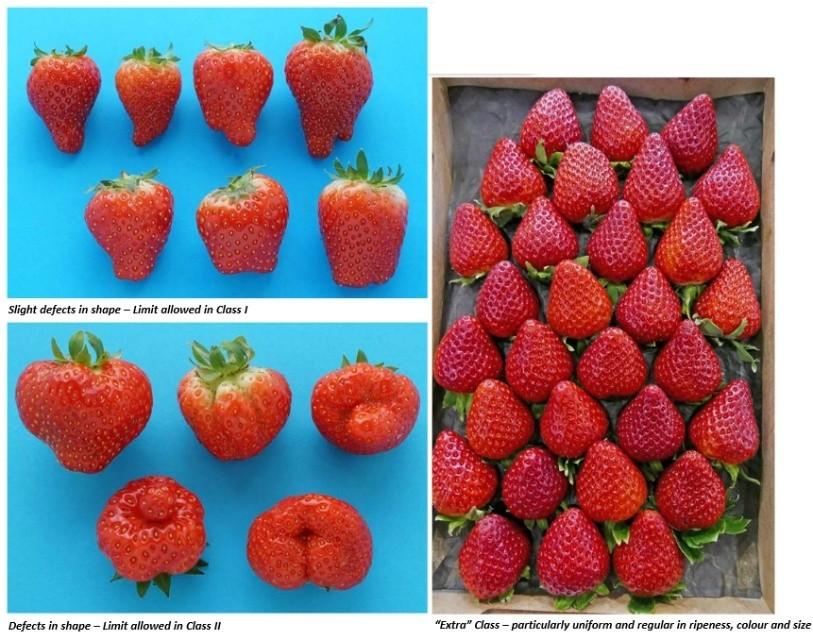
Source: OECD (2021), 'Strawberries', International Standards for Fruit and Vegetables, OECD Publishing, Paris.
Sweetness
In addition to the marketing standards, the sugar content (Brix-level) is an important measurement for the taste quality of strawberries.
Acceptable Brix levels start at 7 Brix, although buyers that purchase strawberries with a focus on taste quality, may not accept a Brix level lower than 8 Brix. On the other hand, some supermarkets extend shelf life by buying strawberries picked at a minimum ripeness and thus have a lower Brix level.
Strawberry varieties grown in Northern Europe are often less hardy, but sweeter than varieties that are cultivated in Spain or Northern Africa. New varieties such as Calinda, Sonata or Allegro reach a higher Brix level than traditional varieties such as Elsanta.
Table 2: Indication of taste quality and Brix levels
| Brix | Taste quality | Variety |
|---|---|---|
| 7–8 | Normal/acceptable to good | Elsanta |
| 8-9 | Sweet/good to excellent | Calinda, Sonata, Sonsation, Allegro |
| >9 | Very sweet/Excellent | magnum |
Source: Industry sources
Tip:
- Maintain strict compliance with quality requirements and deliver the quality as agreed with your buyer. Being careless with product requirements or stretching the minimum standards will give buyers a reason to file claims on quality issues.
Maintain temperature during post-harvest and product handling
Pre-cooling is an essential process in maintaining the quality of strawberries. To conserve strawberries during storage and transport, the relative moisture must be 90–95% and the best temperature is between 0 and 2 °C. Using small packing improves conservation.
Offer different packaging options
When you supply strawberries to Europe, you must be able to offer different packaging options for both retail and wholesale channels. Packages must be new and of a good quality.
Strawberries are usually packaged in boxes or trays with a maximum net content of 5kg, in units of direct sale or arranged in a single layer.
Retail buyers often require packages of up to 500g, such as clamshells, top-seal trays or flowpacks. Top-seal packaging is increasingly used to reduce the amount of plastic packaging. Carton or moulded paperboard pulp is also used as a sustainable alternative, especially for domestic and organic strawberries.
Food service buyers also buy strawberries in larger packages, such as 1kg or 2kg single-layer boxes.
Tips:
- Always discuss the specific requirements for size and packaging with your buyer.
- Study the proper post-harvest practices and handling for fresh strawberries. You can do so on Frutas-hortilizas.com or through the University of California postharvest centre’s vegetable produce facts for strawberries.
- Make sure your strawberries are kept at the right temperature and under the right conditions. This ensures optimal freshness and taste. Supply chain logistics should not affect the product taste in any significant way.
- Use the CBI module on the requirements for fresh fruit and vegetables for information on the details of labelling your product.
What additional requirements do buyers often have?
Obtain commonly used certifications
GlobalG.A.P. is a key requirement to show good agricultural practices. Without it, your strawberries will not enter European supermarkets, the main channel for this product. BRCGS, IFS and similar food safety management systems recognised by the Global Food Safety Initiative (GFSI) are important for packing and processing facilities to have.
Apply additional sustainability and social standards
Complying with sustainable and social standards has become common for all fresh fruit and vegetables. Besides GlobalG.A.P. to ensure good agricultural practices, a social certificate such as Sedex Members Ethical Trade Audit (SMETA) is highly recommended to get your product up to retail standards.
Follow the initiatives that impact your business
There are several initiatives that increase the focus on supplying a sustainable product.
The Sustainability Initiative Fruit and Vegetables (SIFAV) aims to contribute to more sustainable fresh fruit and vegetable supply chains. This includes reducing environmental footprints, using water sustainably and having a positive impact on working conditions and living wages. Among their members is Berries Pride. It works with strawberries from Morocco and Egypt.
The European Green Deal will influence how resources are used and greenhouse gas emissions are reduced. The new EU policies on sustainability will prepare Europe in becoming the first climate-neutral continent by 2050. The Farm to Fork Strategy is at the heart of the European Green Deal aiming to make food systems fair, healthy and environmentally-friendly. Sustainable food production will become part of trade agreements and the rules on pesticide use will become stricter.
Private retail standards dictate specific sustainability requirements, such as the Nurture Module for producers that supply Tesco. They define a number of factors, like the management of plant protection products. Larger retail chains in Northern Europe in particular will be more prepared to buy your product if you comply with social and sustainability standards. Several retailers have moved away from air-freighted strawberries due to the carbon footprint. However, the same is true for strawberries cultivated in heated greenhouses.
Tips:
- Implement the standards that help you to become a sustainable business. Familiarise yourself with the SIFAV’s social and environmental programmes.
- For other requirements such as payment and delivery terms, see the CBI studies on buyer requirements for fresh fruit and vegetables and tips for doing business with European buyers.
What are the requirements for niche markets?
Use organic certification to increase product value
Growing consumer awareness of the high risk of pesticides in strawberries has increased the interest in organic strawberries. However, strawberries are difficult to cultivate organically. The higher price can also be an obstacle for average consumers.
Organic strawberries can be an interesting niche, especially for smaller companies that can dedicate more attention to labour-intensive growing. Organic certification can be an interesting way to set your strawberries apart and market them at a higher value. The demand for organic vegetables is growing, although it is mainly fulfilled by few European growers. Europe cultivated around 21,000 tonnes of organic strawberries in 2024. This is not even equal to 2% of total production.
To market organic products in Europe, you need to use organic production methods according to European legislation for the organics sector and apply for organic certification from an accredited certifier. Regulation (EU) 2018/848 on organic production and labelling of organic products (consolidated version 25-3-2025) contains a number of rules on agricultural practices and inspections. It is key for producers to understand these rules before entering the certification process.
When producing and exporting organic strawberries to the European market, focus on maintaining shelf life and a competitive cost price.
Tips:
- Strive for residue-free strawberries, and certify your production as organic only if possible. It will broaden your market opportunities, but remember that implementing organic production and becoming certified can be expensive. You must be prepared to comply with the whole organic process.
- Download the most recent list of control bodies and authorities to see which certifiers are active in your region.
2. Through what channels can you get fresh strawberries on the European market?
Being part of a large growers’ organisation will give you good opportunities for getting your strawberries onto the European market. Alternatively, you can work together with soft fruit importers or importing wholesalers. To explore different channels and segments, product quality must be central.
How is the end-market segmented?
The supermarket channel is dominant for the sales of strawberries. Traditional markets such as street markets are declining, but for now they remain one of the preferred places for consumers to buy strawberries. Premium-quality, organic and perfectly ripened strawberries are often marketed in specific outlets and food service establishments.
Market outlets
On average, 84% of European consumers prefer buying their strawberries in supermarkets, including hypermarkets and discount supermarkets. Supermarkets are especially dominant in Northern Europe. The concentration in this channel makes these retailers powerful buyers. The larger supermarket chains include Lidl (Schwarz Group), Carrefour, Tesco, Rewe, among many others.
The market share of traditional markets is declining. However, street markets and farm stores remain popular places to buy strawberries. In Spain there is an exceptionally high percentage of 69% of the consumers who like to buy their strawberries at the farm.
The food service market is not mentioned in figure 2, but must not be underestimated. Restaurants, pastry shops and caterers are also important users of strawberries, mostly in pastries and desserts.
Source: Roamler Consumer report strawberry season, 2022
Quality segments
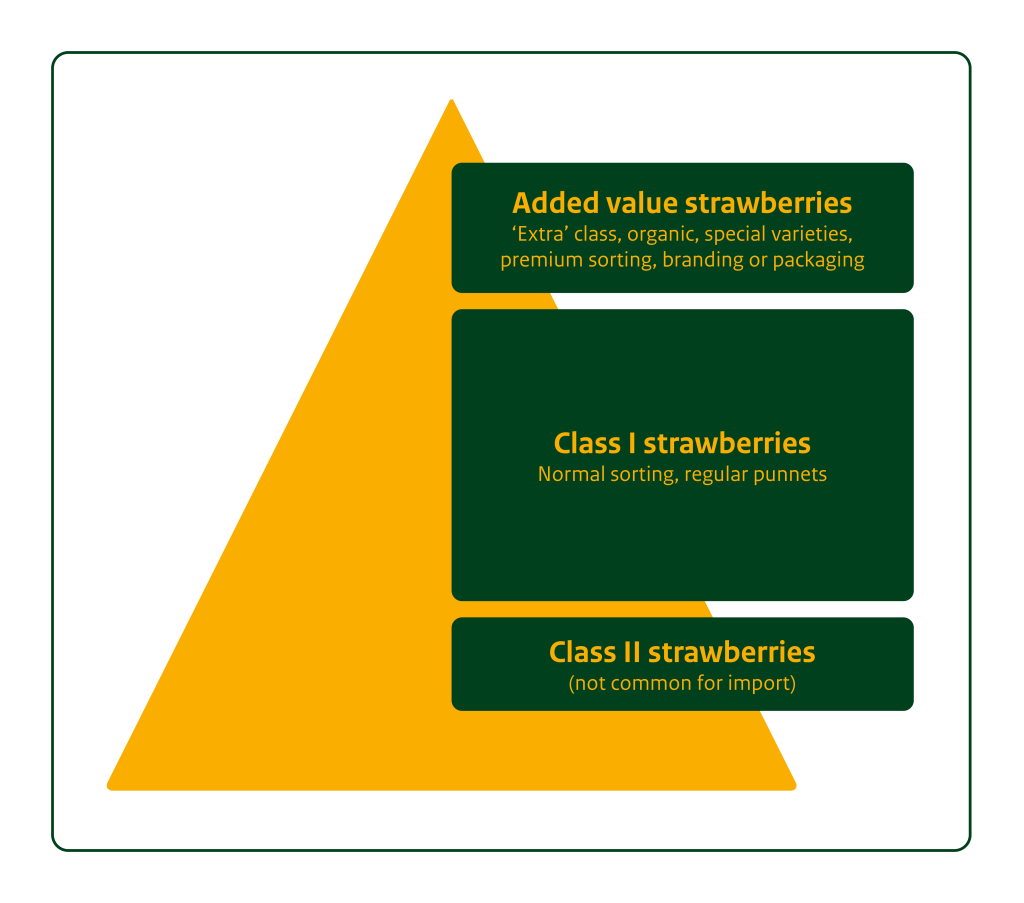
The main market segment is made up of Class I strawberries, which can be found in all types of market outlets. When supply is high, product promotions in supermarkets help to move more products.
The highest priced strawberries are ‘perfect’ looking strawberries with a superior taste (‘Extra’ Class), special varieties or organic strawberries, and premium presentations. For organic strawberries there are specialised organic grocery shops, but supermarkets also tend to sell them when available. ‘Extra’ Class strawberries are mainly sold in premium stores or used by professionals in the food service industry.
Lower-quality strawberries, such as Class II or oddly shaped strawberries, can be used in the processing industry for the production of frozen fruits, juices or as ingredients. Strawberries with minor defects can also be sold fresh at lower prices. Street merchants can drive good bargains with strawberries like these, and some supermarkets offer them with a distinct presentation. There is no market for Class II strawberries for imported strawberries.
Figure 3: Quality segments for fresh strawberries
Source: ICI Business
Tip:
- Adjust your focus according to the segment you are selling to. Quality, price and shelf life are important buying criteria for supermarkets, while gastronomic channels require high-quality strawberries.
- Find an overview of supermarkets on Wikipedia’s list of supermarket chains in Europe. Check out their online offer of fresh strawberries, including prices and presentation.
Through which channels can you get fresh strawberries on the European market?
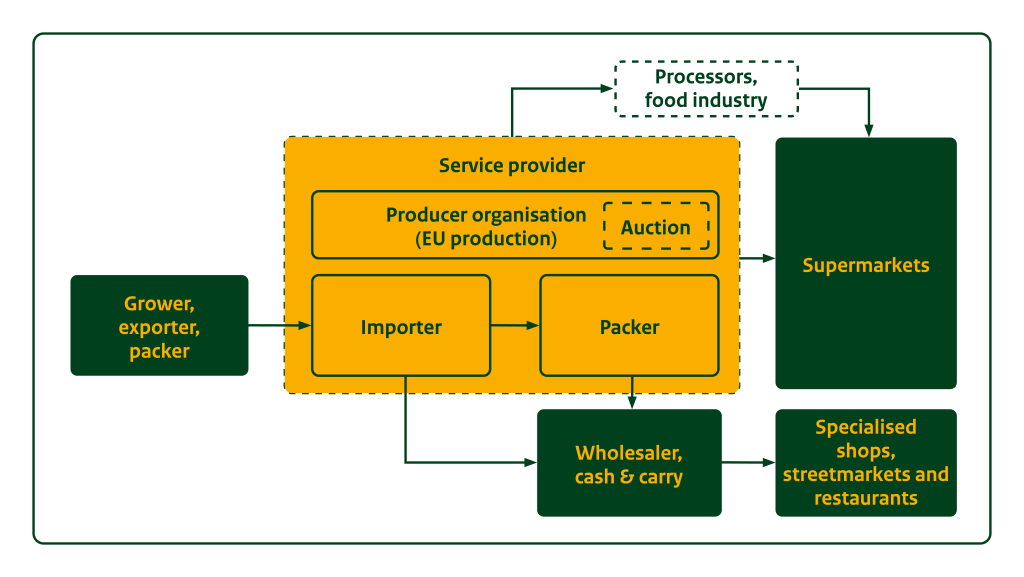
Most strawberries go directly from farmers organisations to wholesalers and distribution centres owned by large retailers. Importers complement this supply with strawberries from other regions. Companies that combine production, packing and import can become full-service providers. Wholesalers supply the food service segment and street markets.
Figure 4: European market channels for fresh strawberries
Source: ICI Business
Producer organisations supply a mayor share
Growers’ organisations play an important role in the supply of strawberries. As a result of the cooperation between strawberry breeders and growers, they become strong marketing companies and supply major clients. Growers’ organisations and their marketing and sales offices need a year-round supply to meet their clients’ demand. So import and cooperation with growers in other countries is often part of their activities.
Examples of grower organisations include:
- Berry Gardens Growers (UK): a growers’ group that has a direct relationship with Driscoll’s breeding programme. The growers are responsible for approximately 35% of UK-grown strawberries;
- BerryWorld Group (UK): formed after a successful joint venture breeding programme, expanding into the UK, the Netherlands, France, Spain, South Africa and Australia;
- Hoogstraten (Belgium): a cooperative auction house with its own grading system and branding;
- Angus Soft Fruits (UK): a soft fruit producer organisation with a global network of growers;
- Fresón de Palos (Spain): one of the largest strawberry growers’ cooperatives in Europe;
- CoopHuelva (Spain): a cooperative that is represented by the salesforce of Onubafruit;
- The Greenery (the Netherlands): a cooperative of growers and partners, and a market leader in soft fruit.
Tip:
- Use your browser’s translation function to read foreign websites in your own language or change to an English version.
Importers focus on additional supply and niche varieties
Importing companies make sure that the local supply is complemented by sufficient volumes from foreign producers. Importers can manage supply chains from different origins and perform quality control for imported strawberries. They are familiar with all the different requirements that end clients may have and distribute to different European markets.
There are importers of different sizes and each with their own focus. Most importers focus on the supply from European countries, Egypt or Morocco. Importers like these include Sofruce in France, S&A Fresh Produce and Primafruit (Fresca Group) in the UK and StaayFoodGroup in the Netherlands. AgroBerries (to which BerryWorld belongs) has a wider reach through a worldwide network of growers. This makes it one of world’s largest vertically integrated soft fruit producers and distributers.
Companies such as Berries Pride (part of Nature’s Pride) has included exotic varieties such as ‘strasberries’ (a raspberry flavoured strawberry) and pineberries, cultivated in Belgium. SpecialFruit commercialises Calinda strawberries as a separate strawberry category from regular strawberries.
Service providers provide access to supermarkets
Successful supermarket suppliers often position themselves as service providers. They organise the supply chain according to the needs of their clients, from sourcing to (re-)packing and branding. You can become part of this supply chain if you are able to offer the quality and logistics that a service provider requires.
Supermarkets are an important channel for strawberries. They usually work with supply programmes and want to buy as close to the source as possible. This gives them control and transparency in their supply chain.
Many producer organisations or cooperatives (see above) have turned into service providers. They provide complete services to retailers. For example, The Greenery, Berry Gardens Growers and Angus Soft Fruits supply supermarkets with pre-packed strawberries throughout the year.
Wholesalers (spot market)
Wholesalers often supply smaller quantities of fresh strawberries to secondary channels such as hospitality and food services, specialised fruit shops and street markets. The wholesale channel is important for strawberries, as they are a common product for local shops and street markets, restaurants and bakeries.
Some wholesalers also import products themselves, but most of them mainly handle local produce and products supplied by importers. Without a retail programme they only cover the spot market, moving with the fluctuations of the trade. Typical wholesale markets are for example Rungis in Paris, Mercabarna in Barcelona and New Spitalfields market in London.
Tip:
- Use the major market channels of service providers and growers’ cooperatives when you are offering large volumes of strawberries. Their retail programmes and supply contracts may provide some stability. Remember that supermarkets maintain strict rules and do not allow you or your buyer to change supply conditions.
What is the most interesting channel for you?
The most interesting way for foreign strawberry producers to enter the market is through cooperation with growers’ and marketing organisations. Using high-quality production as a strength makes it easier to integrate with these supply chains. This way you can not only share a larger sales network, but also knowledge and other resources.
Alternatively, you can try to find an importing company or trader. If you want to present yourself as a suitable exporter, a direct relation with strawberry production will be crucial. With a high-quality product, you will be able to fill potential gaps in the European market and help service providers guarantee a year-round supply.
For far-off suppliers, the European strawberry market is a niche. It can best be combined with fulfilling local and regional demand for strawberries. If you depend on air freight to export to Europe, you will likely need to aim for specific periods, such as Christmas, or buyers in a higher segment.
Tips:
- Visit trade fairs to find buyers. The most important trade fairs in Europe for fresh fruit and vegetables are Fruit Logistica in Berlin and Fruit Attraction in Madrid.
- Work together with breeding companies and find partnerships with growers’ organisations to become part of a large group with a dedicated sales force.
3. What competition do you face on the European strawberry market?
Strawberries are a major fruit category with ample supply throughout the spring and summer and a large number of competitors. Off-season competition is also increasing, in particular from companies in nearby countries that have invested in quality varieties and integrated in larger groups.
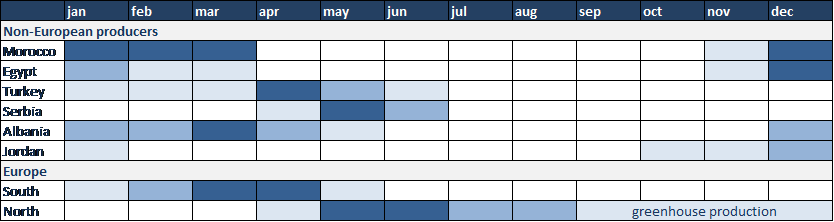
Figure 5: Indicative supply calendar
Source: ICI Business (2025) based on industry sources and supply data
Which countries are you competing with?
Your main competition will come from Europe itself. The demand mainly depends on how the local season develops. Outside of Europe, Morocco and Egypt are the strongest competitors. These countries are close to Europe, and are able to supply strawberries when production in Europe is low. Except for Morocco and Türkiye, most non-European countries export their strawberries by airfreight.
Europe: your main competitor
As a foreign producer, the best export opportunities are outside the European strawberry season. The European strawberry season starts off around February or March in southern Europe. This is followed by early Northern-European countries with greenhouse cultivation in the Netherlands, Belgium and the United Kingdom. All Northern-European countries are active on the market around the summer. The peak of Europe’s strawberry season is between April and July. Finally, there is smaller supply from greenhouse cultivation in the winter.
The average annual production in Europe (including the UK) is around 1.3 million tonnes. Spain, Poland, Greece, Italy and Germany are the largest producers of strawberries. Spain, Netherlands, Belgium and Greece have a positive trade balance and export the most strawberries.
Source: Eurostat (Norway data 2023), GOV.UK (for UK data)
Source: UN Comtrade (August 2025)
Table 3: Strawberry production volume of the main suppliers to Europe in 2023, in tonnes
| Country | Volume |
|---|---|
| Egypt | 731,145 |
| Morocco | 137,275 |
| Serbia | 23,704 |
| Türkiye | 676,818 |
Source: Faostat
Morocco: direct supply lines to Spain and the UK
Morocco is the main non-European supplier. It exported 22,000 tonnes of fresh strawberry to Europe in 2024. Over the years, the United Kingdom (UK) has become Morocco’s largest destination, taking 42% of the exported volume, followed by Spain, France and Germany.
For the UK, Morocco has become an attractive alternative for EU suppliers after Brexit. Spanish companies are among the main investors in Moroccan strawberry production. These include companies like Arofa and Surexport. For them, the country offers a good climate and affordable land and labour. They can also extend the Spanish season.
The Moroccan season starts slightly earlier than the Spanish one. Strawberries can be transported by road and ferry to mainland Europe. The peak harvest season is from December to January. However, strawberries are available year-round. The Moroccan fresh strawberry campaign runs until 31 March. After this date, Moroccan exporters need to pay customs duties on their exports to Europe. This protective is a measure for EU domestic production. It means exporters shift to frozen strawberries.
Egypt: a preferred origin for off-season strawberries
Egypt offers an ideal alternative for additional supplies during the off-season period. The country can supply strawberries exactly when European production is at its lowest and greenhouse production has become very expensive due to the dark winter climate. In 2024, the Egyptian export was mainly divided between the UK, Germany and France. However, this can vary year to year. British imports have undergone exceptional growth: from 1,700 to 9,800 tonnes.
The Egyptian cultivation of strawberries has been developing steadily. Growers have introduced new varieties of strawberries and technical improvements, increasing the yield and the quality of the produce. Strawberries from Egypt are hardy and known to have a good shelf life. The main strawberry varieties are Festival, Fortuna, Florida and the new variety Sweet Sensation.
Egyptian strawberry producers are competitive and close to Europe. Unlike Morocco, most of the strawberries are airfreighted to Europe, which increases the price.
Egyptian exporters can export up to 10,000 tonnes of duty-free strawberries to the EU until the end of April. Import duties come into force when the quota for strawberries is exceeded. The duty free quota for the UK is 6,000 tonnes.
Türkiye: mainly supplying Romania
Türkiye is a large producer of strawberries. It produces a volume equal to approximately 50% of the entire EU production. Despite this, Türkiye is not significant on the European market. Europe imported 1,900 tonnes in 2024. This was significantly less than in previous years. Romania is responsible for around 90% of Turkish strawberry imports.
Türkiye has enough potential on its local market and nearby Russia. It does not need to compete with producers from Morocco or Egypt. However, with such a large production and its proximity to the European market, it could become a stronger competitor. It can easily reach Eastern European markets by rail and air-freight to Western Europe.
Serbia: small supplier with growth potential
Serbia is a supplier of frozen soft fruit. With its proximity to Europe it has potential to grow into a larger exporter of fresh strawberries as well. Companies such as All Berries have introduced new varieties from Italy to make Serbia a more attractive origin for fresh strawberries. The drawback of Serbia is that most cultivation takes place in open fields. This makes it more dependable on weather conditions and results in more unpredictable harvests.
Practical markets for Serbia in Europe include Poland, Austria, Romania and Croatia. Exports to Europe fluctuate but remain small with a very short window. In 2024, European countries imported around 1,500 tonnes, mainly in May and June. Traditionally, Russia used to buy most of Serbian’s fresh supply. However, this volume has declined in the past five years.
Tips:
- Focus on the winter months to supply Europe. This is the principal period when supply from European producers is lower and often more expensive due to greenhouse cultivation.
- Differentiate in varieties that are suitable for your climate, soil and cultivation method. A longer distance to the market requires a hardy strawberry with good shelf life, but find a good balance between shelf life, flavour and cost of production.
Which companies are you competing with?
Companies that you have to compete with are generally producers or integrated companies that find their strength in cooperation and compliance with high quality standards.
Raimy: a competitive strawberry farm in Morocco
In Morocco, 75–80% of strawberry farms are small and family owned. Some companies produce more, such as Raimy, which was founded by Spanish entrepreneurs. Raimy produces over 7,000 tonnes of fruit every year, including strawberries. The company represents more than 5% of Morocco’s total strawberry exports. Raimy is particularly ambitious in minimising pesticides and fertilisers. They use biological control systems to keep residue levels below the legal Maximum Residue Limits (MRLs).
The Fruit Company Egypt: an integrated company
The Fruit Company (TFC) Egypt offers a wide assortment of fruit from Egypt. TFC is part of WJT International Group in Belgium and has a sister company in Lebanon. The company shows that you can cover several markets through strategic integration. Some strawberry growers also do this by joining an international producer cooperative.
Pico: focus on sustainable cultivation and the right varieties
Pico started with strawberry production in Egypt in the 1980s. After making the cultivation more sustainable the company grew to become a fully-certified international supplier. Today, the company has several production sites and their own packing facilities.
Another strength of the company is its focus on programmes with well-known strawberry breeders such as Driscoll’s, EMCO CAL, Red Eva and Angus Soft. Pico puts a lot of effort into testing new varieties and breeding programmes. The company grows hardy strawberry cultivars. These include Florida Brilliance, Sensation, Felicity, Hadar, Limvalnera, Red Rio, Red Cleo, Fortuna, Cleta and Leticia. These varieties have a relatively long shelf life. The harvest season stretches from November until March.
Eren: success through compliance
The Turkish company Eren is a grower, packer and exporter of strawberries. Their production and operations are GLOBALG.A.P., BRC, SMETA and ISO22000 certified. This allows them to export to 63 countries. Besides strawberries, the company supplies citrus fruit and stone fruit, as well as other fruit and vegetables. To market all these fruits, the company participates in trade fairs in Europe.
Tip:
- Clearly define your strengths as a company and your competitive advantage before entering the European market. You can differentiate in different ways, such as specialising in breeding or integrating in larger supply chains. Either way, your own strawberry cultivation or a direct link with production is a must-have asset.
Which products are you competing with?
Strawberries mainly compete with other soft fruits, such as raspberries and blueberries. Especially blueberry is a strong competitor because of its shelf life and long-lasting quality.
Within the strawberry category you may experience increasing competition of new cultivars that are high in yield, have a longer shelf life or a superior taste. As a producer, you can improve your competitiveness by differentiating in strawberry varieties. Consider that many of the new varieties are licensed – this means you must invest first before improving your margin or market potential.
When selecting a new cultivar, you can focus on the following ten criteria:
- Productivity: Crop productivity or yield;
- Plant resistance: Tolerance to pathogens;
- Plant adaptability: Adapting to local cultivation conditions (soils and climates) and systems (open field, protected, soil-less);
- Plants with ‘easy picking’ characteristics: Strawberries that grow away from centre of the foliage;
- Seasonality: Early, mid or late-season, or everbearing cultivars;
- Sensory quality: Taste, eating quality;
- Shape and size: Uniformity is more attractive to buyers and large fruit can reduce labour costs;
- Fruit hardiness: To reduce damage during picking and long travel shipment;
- Fruit colour: In general, bright red is considered attractive;
- Micronutrient content: Nutritional benefits that favour human health.
Tip:
- Choose the cultivar that fits you best as a supplier. Do not just consider the market demand, but also your growth climate, production method and local circumstances. Compare the offer of different local and international strawberry breeders and keep innovating.
4. What are the prices for fresh strawberries?
Prices for strawberries depend on the quality, origin (transport costs, local/import), production method (open field/greenhouse) and availability (supply and demand). Prices for local and imported (air-freighted) strawberries have different price structures. High prices in retail do not automatically translate to higher prices for producers.
Seasonal supply and demand
Strawberry prices fluctuate throughout the year. Prices are lowest when there is an abundant local supply, roughly as early as February–March until mid-summer in July or August. During the peak season, promotions in supermarkets – with deals like 2 for the price of 1 – push large amounts of strawberries into the market. Retail prices can go as low as €4–6/kg, which means that the farm price drops to €1.50 to €2.50/kg.
The highest import prices are achieved in November and December, when local supply is at its lowest and additional import is needed to fulfil the demand in mainly luxury segments. Depending on the package size, peak retail prices for strawberries reach €10–16/kg. Producer prices for greenhouse-grown strawberries from the Netherlands and Belgium can reach €8/kg in the winter months. This makes importing an attractive alternative.
Retailers often reduce the package size during the off-season from 400-500 g to 250 g to keep a similar price level per tray. In northern Europe (Germany, France, Netherlands, Belgium), retail prices for these package sizes commonly fluctuate between €2.99 and €3.99.
Source: ITC Trade Map, calculation by ICI Business
Local versus import
Local and import prices of strawberries increased between 2020 and 2024. Prices for imported strawberries increased 25–30% in the last two to three years. The average import price per kilogram for non-European strawberries reached €4.50/kg in 2024. Meanwhile, European supply sold for €3.80/kg on average. Transport makes imported strawberries relatively expensive, especially when they are air-freighted.
Source: UN Comtrade, calculations by Globally Cool (October 2025)
Price difference between origins and destinations
Quality plays an important role in price setting. For example, strawberries from the Netherlands were valued much higher than strawberries from Spain. For non-European exporters, quality is even more important because they lose the advantage of a locally cultivated strawberry, which often has the preference.
Destination can also be an influence. For example, production and import prices in Spain and Romania are generally lower, partly due to the lower cost of labour and terrestrial imports from (respectively) Morocco and Türkiye. Markets that are more difficult to reach or markets that require premium quality have higher import prices. These countries include for example Belgium, the United Kingdom, Germany and the Netherlands.
Price breakdown
The prices and price structure of strawberries vary a lot throughout the year. As such, it is not possible to define a reliable price breakdown scheme. The figure below is purely indicative and hypothetical.
The most important rule to remember, however, is that the market determines the trade price. Importers often calculate a minimum net margin of 8% over their selling price. They will also deduct handling and import-related costs. A perishable and fragile product like strawberries can easily lead to higher costs due to waste or quality issues.
The trade price of non-European strawberries must be attractively priced to compete with local strawberries. Local strawberries often have the preference. This means that imported strawberries have to either be superior in quality or lower in price.
Source: ICI Business (2025)
Tips:
- Find a French price history on the Market News Network of FranceAgriMer from producers, importers, wholesalers (‘gros’) and retail ('détail').
- Get regular market and price updates from the fruit and vegetables webpage of the Federal Agency for Agriculture and Food (BLE) in Germany. Select the year or week below 'Markt und Preisberichte Obst und Gemüse' (market and price news fruit and vegetables) to download price information (in German). Then search for 'erdbeeren' (German for 'strawberries').
- Check prices in Spain on Mercalicante or Junta de Andalucia. Use your browser’s translation function to access these websites.
GloballyCool and ICI Business carried out this study on behalf of the CBI.
Please review our market information disclaimer.
Search
Enter search terms to find market research
Do you have questions about this research?
Three things decide your success for strawberries: variety, timing and logistics. If one fails, the whole programme is at risk.
Muhammad Fayed, Regional Sales Manager of Pico