
8 tips on how to reduce carbon footprint in the cocoa sector
More European buyers expect you to demonstrate that your cocoa can be traced and is produced with low emissions. This is important because cocoa production adds to climate change and is also at risk to rising temperatures and changing rainfall patterns. By taking on agroforestry and other climate-smart practices, you can reduce your emissions while becoming more productive and resilient.
Contents of this page
- Understand what ‘carbon footprint’ is and where emissions come from
- Measure and report your footprint using accepted standards and tools
- Reduce your carbon emissions
- Share data transparently with buyers
- Comply with legal requirements
- Comply with non-legal buyer requirements
- Understand carbon finance
- Learn from proven climate-smart cocoa programmes
1. Understand what ‘carbon footprint’ is and where emissions come from
Before you can reduce your carbon footprint, you need to understand what it is and where the emissions on your farm come from.
Definition of carbon footprint
Your carbon footprint is the total amount of greenhouse gases your farm or business produces. These gases are measured in carbon dioxide equivalent (CO2e). In cocoa production, the main greenhouse gases are carbon dioxide from fuel use and land clearing, methane from waste and some farming activities, and nitrous oxide from fertiliser use.
The Greenhouse Gas Protocol groups emissions into three ‘scopes’ (Table 1). These scopes will help you understand what data your buyers need and where you can reduce emissions. For most European buyers, emissions from your farm or supply chain fall under their scope 3 emissions. This means they need your data to complete their reporting. For more information, read Tip 4 on sharing your data.
Table 1 shows how European cocoa companies usually group emissions under scope 1, scope 2 and scope 3. For most cocoa and chocolate companies, scope 3 makes up the largest share of total emissions. These emissions mainly come from cocoa farming, land-use change, processing at origin, transport to Europe and packaging.
This is why more European buyers are asking you for farm-level and processing data. Understanding Table 1 will help you support your buyers’ scope 3 reporting.
Table 1: Example of scope 1, scope 2 and scope 3 emission categories for a European cocoa company
| Scope | Definition (GHG Protocol) | Examples in the Cocoa Value Chain | Who Reports It? | Typical Data Sources |
|---|---|---|---|---|
| Scope 1 | Direct greenhouse gas emissions from sources owned or controlled by the company | Fuel used in company-owned roasting plants; natural gas used in cocoa grinders or roasters; diesel used in company-owned trucks; on-site generators | European cocoa company (trader, processor, chocolate manufacturer or retailer) | Fuel purchase records, facility energy logs, fleet management systems |
| Scope 2 | Indirect emissions from purchased electricity, heat, steam or cooling consumed by the company | Electricity used in cocoa grinding and chocolate manufacturing plants; energy used in warehouses, offices and storage facilities; purchased district heating | European cocoa company | Electricity and energy utility bills |
| Scope 3 | All other indirect emissions occurring in the company’s value chain, upstream and downstream | Cocoa cultivation (fertiliser use, agroforestry, land-use change); fermentation and drying at origin; transport from producing countries to Europe; packaging materials; waste disposal; distribution to retailers | European cocoa company, based on data from suppliers | Farm-level data, cooperative records, supplier sustainability reports, shipping and logistics documents |
Source: Greenhouse Gas Protocol, Corporate Accounting and Reporting Standard and Carbon Collective Climate Smart adapted for a European cocoa company
Table 2 shows how you can organise your own emissions data as a cooperative or exporter. Your scope 1, 2 and 3 emissions feed directly into the scope 3 emissions of your buyer.
Table 2: Example of scope 1, scope 2 and scope 3 emissions for cocoa cooperatives and exporters
| Scope | What it means | Examples on your farm or company |
|---|---|---|
| Scope 1 (Direct) | Emissions you control directly | For cooperatives who manage farms: Fuel for tractors, trucks, motorcycles, chainsaws, spraying machines, dryers and generators; fertiliser and pesticide application; biomass burning. For processors: On-site processing emissions, small-scale roasting, grinding and liquor production; refrigerant leaks from air conditioners and cooling systems in offices, warehouses and processing facilities. |
| Scope 2 (Indirect Energy) | Emissions from electricity you buy | Electricity used in cocoa processing facilities like fermentation centres using fans and temperature control and cocoa bean cleaning, grading and bagging operations; electricity used in warehouses and offices, including, lighting, computers, cold storage and processing facilities for cocoa liquor, butter and powder production in origin countries. |
| Scope 3 (Value Chain) | All other emissions in the supply chain | Fertiliser and pesticide production, transporting beans, production of planting materials (seedlings, hybrids), transport of inputs (fertilisers, pesticides, tools) to farm communities, buyer activity not directly controlled by farmers, processing outside origin, such as roasting, grinding, chocolate manufacturing and packaging. |
Source: Greenhouse Gas Protocol adapted for an exporter
Note that fertiliser-related emissions, pesticide-related emissions and land-use change only count as scope 1 emissions for you if you directly own or manage the farm or plantation. If you only buy cocoa from farmers, these emissions usually count as your scope 3 emissions.
Source of your emissions
At the farm level, cocoa emissions can be very different depending on how you manage your farm and if you had to clear forest to establish it. Studies estimate that, without deforestation, cocoa production has a median carbon footprint of about 0.25 tonnes of CO2e per hectare per year, ranging from 0.02 to 1.5 tonnes per hectare per year. This is equal to about 1.5 kg CO2e per kilogram of dried cocoa beans. If your emissions stay below this level, your cocoa farm can be considered relatively low-emission.
Emissions rise sharply when forests are cleared for cocoa production. In cases of land-use change, emissions can range from about 1.2 to 23 tonnes of CO2e per hectare per year. This is why deforestation is the biggest source of emissions in cocoa production by far. At the sector level, cocoa production generates around 65–75 million tonnes of CO2e every year.
The cocoa sector faces two related problems. First, cocoa production can release greenhouse gases, especially when forests are cleared for new farms. Second, cocoa farming itself is highly vulnerable to climate change. Rising temperatures and changing rainfall patterns already threaten yields and farm viability.
For farmers, land-use change and deforestation are your biggest sources of emissions by far. When forests are cleared to plant cocoa, carbon stored in trees and soils is released into the atmosphere. This often makes up most of the carbon footprint of cocoa production.
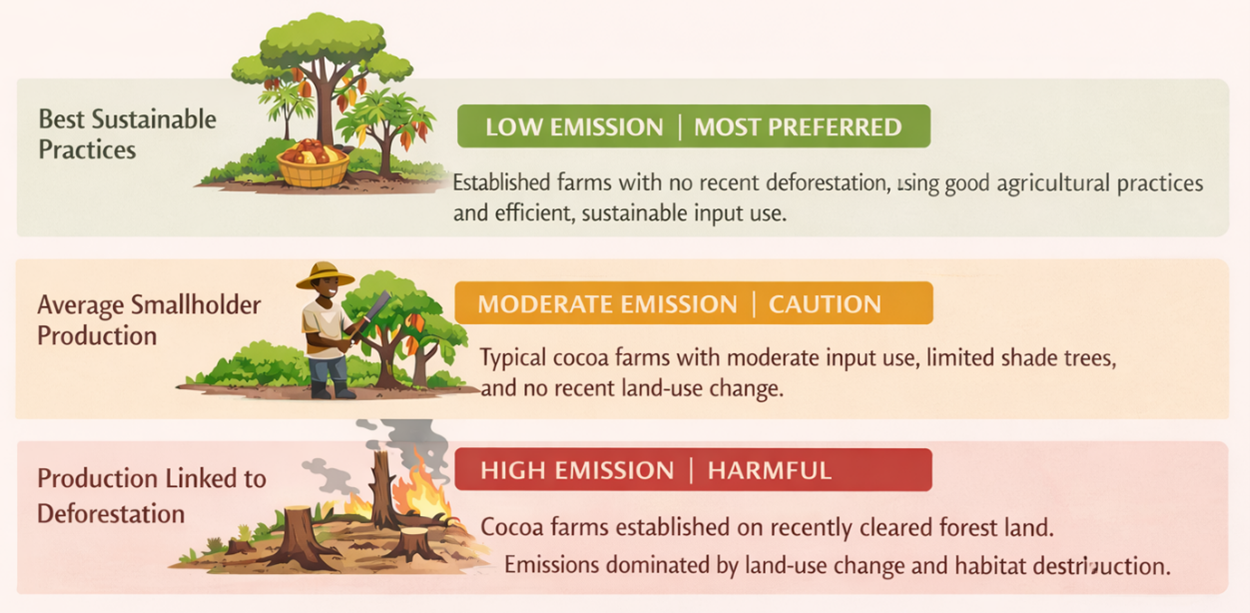
The emission levels of your farm also depend considerably on your farm management practices. Research from Wageningen University shows that farm management practices are a key factor in producing climate-friendly cocoa. Figure 1 shows how cocoa production systems linked to forest conversion have much higher emissions than systems established without deforestation or managed under agroforestry.
Figure 1: Cocoa production systems and their carbon emission levels
Source: Amonarmah Consults, 2026
The main sources of emissions on your cocoa farm include poorly managed cocoa residues, nitrogen fertiliser use, fuel consumption for tractors and generators, and biomass burning during land clearing and waste disposal. Residues can release methane and nitrous oxide if they decompose under poor conditions. Nitrogen fertilisers release nitrous oxide if you use more than what the plant needs. Nitrous oxide is a very strong greenhouse gas. Burning fuel and biomass releases carbon dioxide directly.
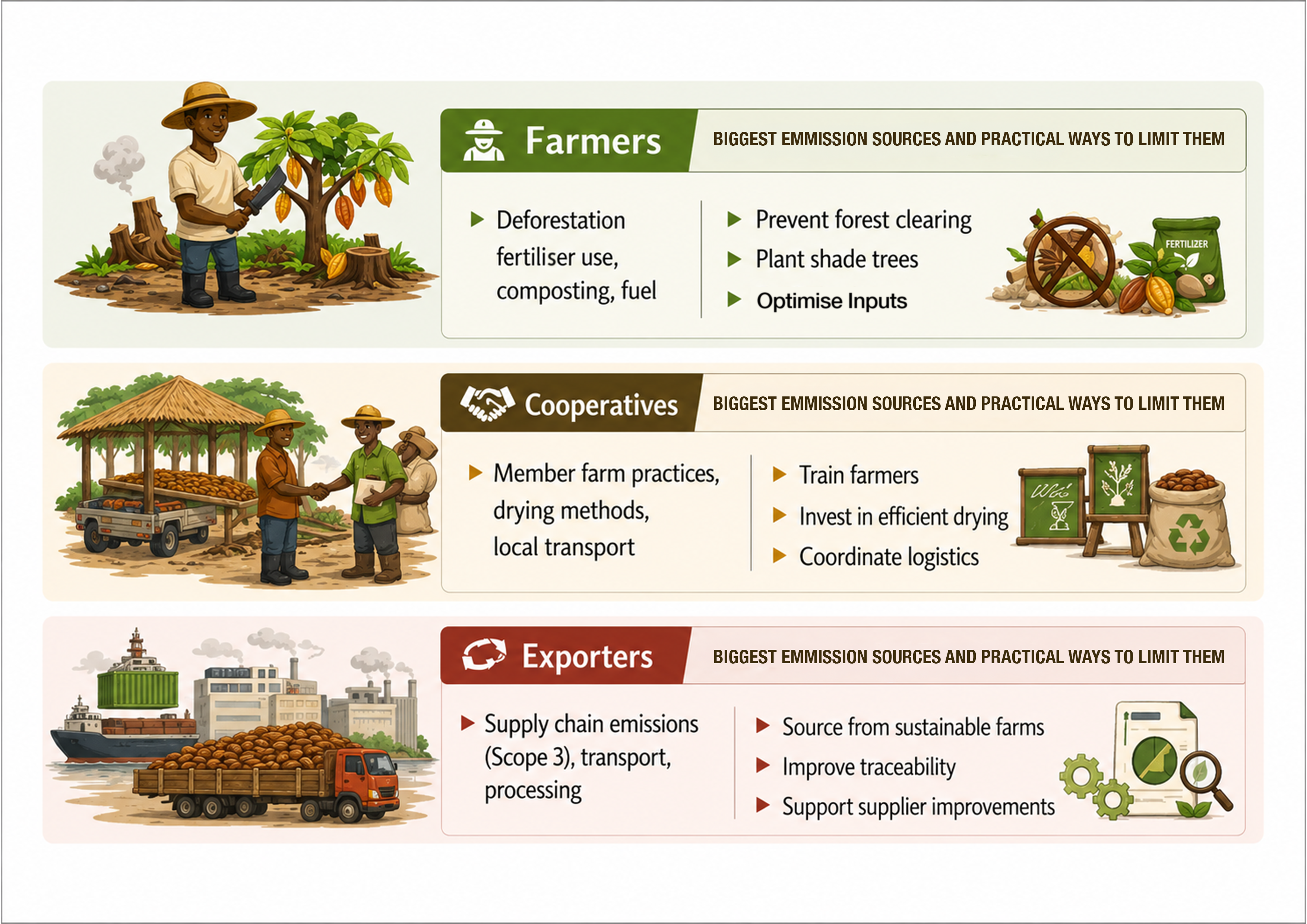
If you are a cooperative or exporter, your main emission sources are usually fuel used for mechanical drying, transport from origin to Europe, energy used in processing and the production of packaging materials. Shipping to Europe is also a major part of the total footprint, and buyers are asking more and more questions about it.
Figure 2: Where to focus to reduce the carbon footprint
Source: Amonarmah Consults, 2026
Tip:
- Read the Greenhouse Gas Protocol to understand how buyers classify and report emissions.
2. Measure and report your footprint using accepted standards and tools
Start by measuring your carbon footprint. You cannot reduce emissions if you do not measure them. European buyers, certification bodies and regulators expect you to provide clear and reliable data more and more often. Use simple methods at the beginning and make your system better over time.
Use recognised methods so your buyers accept your data. The most widely used approach is the Greenhouse Gas Protocol. It groups emissions into scope 1, scope 2 and scope 3. Many European buyers use this system already.
You can also use sector-specific guidance, such as the World Cocoa Foundation (WCF) GHG Accounting Standard. This helps you work out your emissions at the farm level and across the supply chain. For more detailed calculations, especially at the product level, you can use life-cycle approaches such as PAS 2050 and ISO standards (ISO 14040 and ISO 14044). However, you do not need to start with complex systems. Begin with simple methods and improve over time.
Tools to measure cocoa emissions
Beyond the methods mentioned above, you can use a range of digital tools and platforms to measure your emissions. When choosing a tool, you should select one that matches your size and capacity.
One option is the Cool Farm Tool, a free online calculator that estimates farm-level emissions. It is based on simple data, such as fertiliser use, yields and shade trees. It is well suited for smallholder cooperatives that want to start measuring emissions at a low cost. To use this tool, you need to have an email address so you can register a Cool Farm Tool account.
Commercial platforms like the Agridence Carbon Footprint Calculator help you measure emissions throughout the whole supply chain, including processing and transport. These systems also provide guidance on reduction actions and help with reporting to buyers.
Large cocoa companies also have their own reporting platforms. For example, CocoaWise by Cargill provides digital traceability and sustainability reporting for suppliers that work in Cargill’s supply chains. Barry Callebaut uses an internal methodology based on recognised lifecycle databases and geospatial farm mapping to work out emissions and carbon removals.
Types of data to collect
Good carbon measurement needs good data. You should focus on collecting a small number of key indicators that are already available on most farms and buying operations.
At the farm level, the most important information includes:
- Amount and type of fertiliser used, particularly nitrogen-based fertilisers and agrochemicals;
- Fuel used for farm activities or generators;
- Cocoa yield per hectare;
- Farm size and number of shade trees;
- Land-use history, particularly whether forest was cleared in the past;
- Soil and residue management practices.
For indirect energy use, you should collect electricity bills and records of any purchased heat or steam used in warehouses or processing facilities if you are an exporter. For value-chain emissions, useful data include transport distances, type of transport used, energy consumption during processing, packaging materials and waste management methods.
Most standards do not require perfect information from the beginning. A practical approach is to start with basic records and improve your accuracy over time.
Tips:
- If you are a cooperative, start your farm level records by looking at major sources first. For example, fertiliser (N2O), land-use change and energy use. Update these measurements regularly to track progress and find hotspots where you can reduce.
- Begin with free tools that give good estimates, then think about more detailed calculations if needed. Always choose tools that are easy to use and meet your buyers’ needs.
- Other sources that can help you estimate your carbon footprint are Quantis, South Pole, Carbon Roots and Carbon Trust.
- Watch How to Calculate Your Carbon Footprint on YouTube.
3. Reduce your carbon emissions
Reduce your emissions by focusing on your supply chain, where most of your emissions occur. You cannot rely on one action alone. Combine practical steps across farming, processing and transport to achieve real results.
Start by helping your farmers. Learn what practices reduce emissions and help farmers apply them. Provide training, access to seedlings, soil testing and better logistics. These actions reduce emissions and improve productivity.
Invest in agroforestry and climate smart farming practices
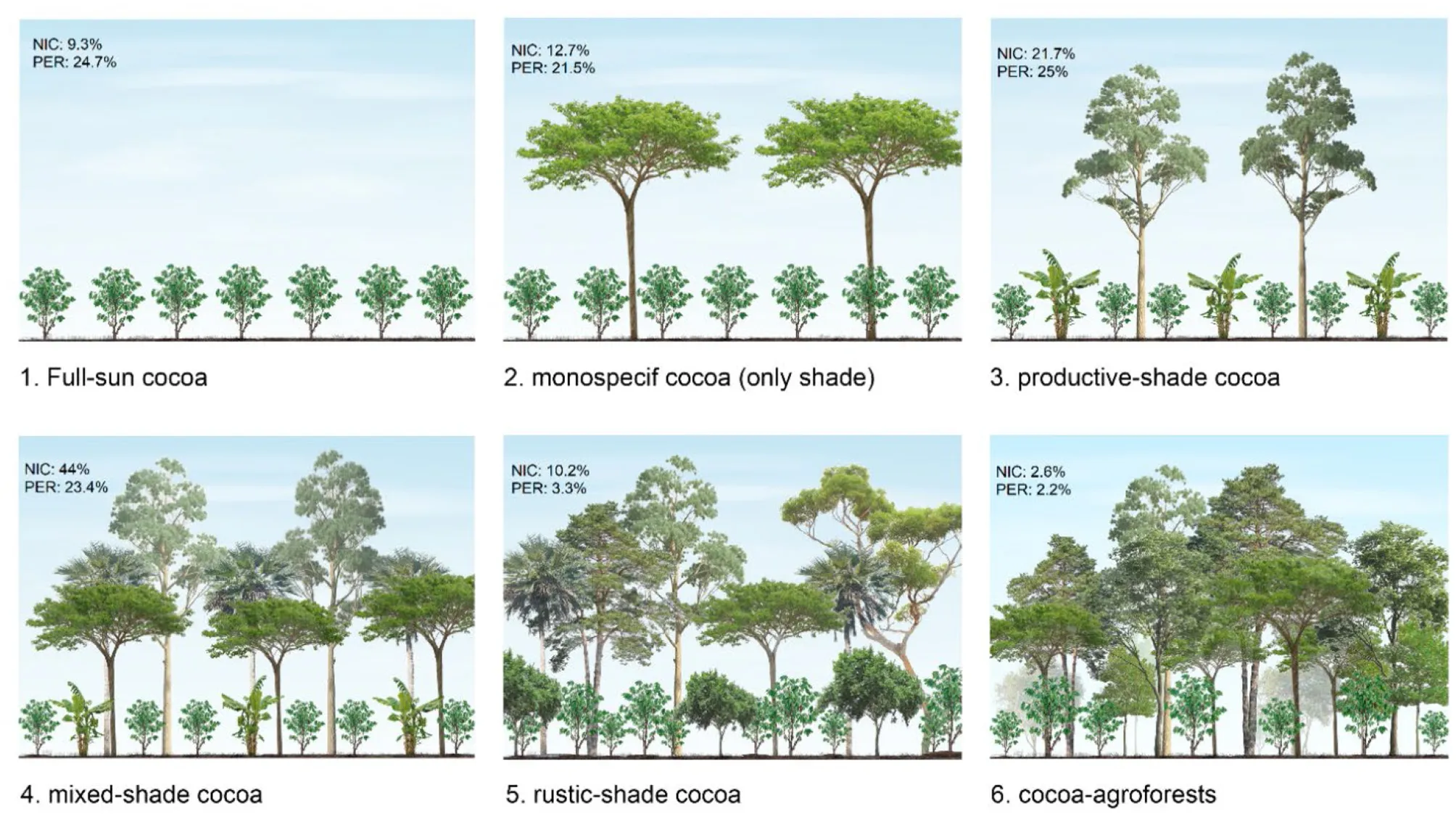
Agroforestry is growing cocoa together with shade trees. It is widely recognised as the most effective way to reduce the carbon footprint of cocoa farming. Cocoa grown under moderate shade stores and removes far more carbon than cocoa grown in full sun. The shade trees capture carbon in their trunks and roots while also protecting soil organic matter.
Figure 3: Different levels of shade in cocoa farms
Source: Orozco-Aguilar et al., 2021
Agroforestry has many other benefits. The shade trees help protect cocoa from extreme heat and drought, reduce pest and disease pressure, and improve soil fertility. They also provide farmers with extra income from fruits, timber and fuelwood. Because of these benefits, agroforestry systems make cocoa farms more resilient to climate change and more profitable in the long term.
Aim for moderate shade cover. In many cases, about 30% canopy cover or 15–30 trees per hectare is a good target depending on tree species and size. However, in current climatic conditions and with more and more extremely dry periods, 40–45 trees per hectare can be ideal.
Figure 4: Impact of agroforestry on carbon removal
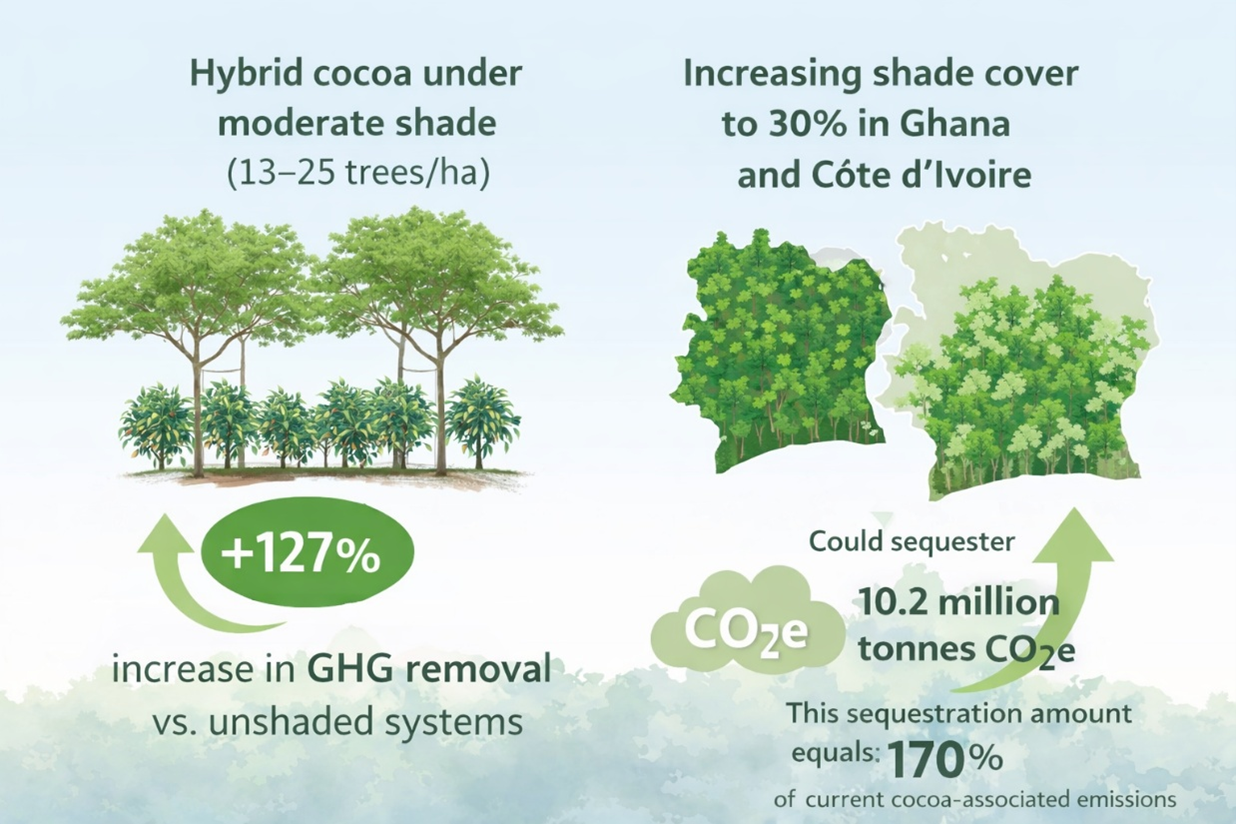
Source: Adapted from Hawkins et al., 2024
Help your farmers by providing tree seedlings and training. You can set up nurseries to produce suitable tree species such as native trees, fruit trees and nitrogen-fixing species. This reduces costs and helps you track tree planting throughout your supply chain. For example, Kuapa Kokoo, a cooperative in Ghana raised and planted 180,000 trees to convert cocoa farms into agroforestry systems.
Encourage farmers to apply climate-smart practices such as increasing shade, using integrated pest management, pruning trees and maintaining organic matter in the soil. These practices reduce emissions and help farms adapt to changing weather conditions while improving yields.
Large programmes like the Cocoa Forest Initiative and the Cocoa Forest REDD+ Programme (GCFRP) show how these practices can be applied at scale through training, land-use planning and monitoring. Under these programmes, over 63,000 hectares of forest were restored thanks to the efforts of government and industry in Côte d’Ivoire.
Agroforestry systems were also expanded across 250,000 hectares, supported by training, income diversification and savings mechanisms that reached over 735,000 cocoa farmers. A record 84,000 producers received payments for environmental services, reinforcing conservation and climate-smart cocoa practices. In 2024, Ghana also secured over $16 million in carbon finance through its Cocoa Forest REDD+ Programme. Restoration efforts scaled up a lot, with 2.5 million tree seedlings distributed.
Improve soil and fertiliser management
Reduce emissions from fertiliser use by only applying what you need. Encourage soil testing so farmers use the right amount at the right time. This reduces costs and improves efficiency. Also, promote organic practices such as composting cocoa pod husks, mulching and using cover crops. These practices improve soil health and reduce the need for synthetic fertilisers.
Figure 5: Cocoa pod husk can be used for composting
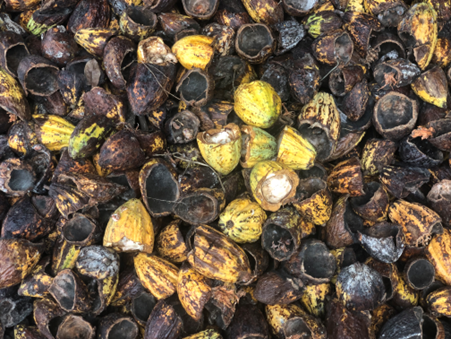
Source: Amonarmah Consults, 2026.
Another way to reduce emissions is by protecting the soil. Plant cover crops or nitrogen-fixing legumes to help maintain soil carbon and reduce the need for synthetic fertilisers. These practices improve soil structure, moisture retention and long-term productivity.
Another aspect of soil management is the production of biochar. Biochar is a substance like charcoal that can be used as an organic fertiliser. It captures carbon and prevents carbon from being released by decomposing cocoa husks. You can train your farmers to produce biochar from cocoa pod husks. For example, Beyond Beans invested in developing biochar facilities to help cocoa farmers in Cocoa Farming in Côte d’Ivoire reduce their carbon emissions.
Reduce emission from processing and transport
Emissions are not only created on the farm. Post-harvest handling, drying and transport also affect cocoa’s carbon footprint. You should try to lower emissions during post-harvest handling and drying. Sun drying has a much lower footprint than mechanical drying. If you use mechanical drying, choose energy-efficient equipment.
Lower your transport emissions by organising your logistics better. Combine shipments, plan efficient routes and share logistics to reduce the number of trips made between farms, buying centres and ports. You can also reduce your company’s carbon footprint using less energy and switching to green energy. Do this by installing solar panels, using wind energy or using another source of renewable energy.
Lastly, reduce your carbon footprint in packaging. For example, origin chocolate manufacturers can reduce or stop plastic use by switching to recycled or FSC certified paper or using compostable packaging. It is important to note that some of these practical steps can have high initial costs. However, they will save fuel and cut costs in the long run and lower the overall climate impact of cocoa exports.
Tips:
- Focus on the biggest emission sources first, such as deforestation, fertiliser use and processing energy. Start with simple actions and expand over time.
- Read the Tropenbos agroforestry consultation paper for more information on how to implement agroforestry in cocoa. Not all farmers may be ready to implement it, and you may need different approaches. Check the Smithsonian’s Cocoa Agroforestry Library for more information on agroforestry in cocoa.
- Access the farmers handbook and training manual Managing Soils for Increased Productivity and Decreased Deforestation in Cocoa for more information on managing soils and fertiliser use.
- Access the Biochar Training Manual to learn about making biochar.
- Read our tips to go green in the cocoa sector to study for tips on reducing your emissions.
4. Share data transparently with buyers
As mentioned in Tip 1, more and more buyers need information from you to meet obligations regarding scope 3 reporting. Under the EU Deforestation Regulation (EUDR), companies must also prove that their cocoa is deforestation-free and legally produced. At the same time, many buyers must report their GHG emissions under corporate sustainability frameworks.
This is impossible without farm-level data from suppliers. Providing clear, organised data thus enhances your appeal to potential buyers. When you share accurate data, you build trust, secure long-term contracts and open doors to premium markets and carbon finance opportunities.
Know the information buyers typically request
To meet buyer expectations and regulatory expectations, cocoa suppliers should be prepared to share a range of information. This includes:
- Traceability data, including GPS coordinates or digital maps that show the exact location of farms;
- Land-use history to demonstrate that cocoa is produced on land that was not deforested after the EUDR cut-off date;
- Carbon footprint estimates, covering farm activities, transport and processing;
- Proof of certification, such as Rainforest Alliance, Fairtrade and organic standards;
- Farm management records, for example on fertiliser use, shade trees and pest control;
- Yield and input data, which are needed to accurately calculate emissions.
Providing this information in a consistent and well-documented way makes compliance easier for suppliers and buyers.
Digital platforms can make data sharing easy
Digital tools can make data collection and reporting a lot easier. Some platforms that allow you to measure your emissions can be used to share data with your buyers, such as CocoaWise and the Cool Farm Tool. They can help you track your historical data and assess your progress.
Use recognised platforms to increase your credibility. The platforms are better because the data can be verified more easily by buyers and third-party auditors. For example, the Carbon Disclosure Project (CDP) allows companies to store information securely, track progress over time and generate standardised reports for buyers. When exporters share transparent information through platforms like CDP and buyer portals, they show they are professional and reliable. These systems help organise geolocation files, certification documents, carbon calculations and audit records, all in one place.
Establish a clear communication with farmers and partners
Communicating well with your farmers and local suppliers is just as important as sharing data with buyers. Cooperatives and exporters should explain to farmers why data collection is necessary and how it helps them. Farmers are more willing to participate if they understand that accurate records can lead to better prices, access to programmes and potential carbon payments.
Regular training, demonstrations on successful farms and transparent benefit-sharing systems help build your farmers’ trust. If you are a small cocoa or chocolate company, you should keep your management and boards informed by making climate metrics part of your business reporting and tracking progress toward targets.
Tip:
- Start collecting emissions data soon as you start the farm year. Preparing early will make compliance smoother and cheaper as requirements grow. It is important to start collecting basic farm data now, even if it is not perfect yet. Keep all geolocation and certification documents organised and up to date. Train field staff and farmers on simple record-keeping methods. Consider independent verification to increase credibility with buyers.
5. Comply with legal requirements
You must understand and comply with European sustainability rules if you want to sell cocoa in Europe. These rules focus on deforestation, traceability and environmental impact. If you do not follow the rules, your shipments may be rejected, and you will lose access to the market. Start preparing early to avoid risks and meet buyer expectations. This can help you build stronger relationships with buyers, access sustainability programmes and, in some cases, receive better prices.
European Union Deforestation Regulation (EUDR)
The EU Deforestation Regulation (EUDR) is the most important law for cocoa exports to Europe. It will come into effect on 30 December 2026 for large and medium-sized companies and on 30 June 2027 for small companies. The regulation links cocoa production to deforestation and requires you to prove that your cocoa is compliant.
To comply with EUDR, your cocoa must be deforestation-free, legally produced and fully traceable. This means it must not come from land where there were forests that were cleared after 31 December 2020. You must also show that production follows national laws and that you can trace the cocoa back to specific plots of land.
To meet these requirements, start collecting geolocation data for all farms using GPS coordinates. Use polygon mapping for larger farms. Make sure production follows national laws on land, environment and labour. Find risks in your supply chain and actively try to reduce them. Keep all documents and records for at least five years.
Corporate Sustainability Reporting Directive (CSRD)
The Corporate Sustainability Reporting Directive (CSRD) affects you indirectly through your buyers. Large European companies need to report their environmental and social impact, including greenhouse gas emissions.
Your buyers need to report emissions from their supply chains. This means they will ask you for data on your farming practices, emissions and resource use. Start collecting this data now so you are ready when buyers request it.
Future legal developments
Rules and market expectations are changing quickly. You need to stay informed and be ready to adapt to new requirements.
The Carbon Removals and Carbon Farming (CRCF) Regulation is one such new EU system. It will define how carbon removal and carbon farming activities are measured and certified. It does not regulate cocoa directly, but it will change how agroforestry and carbon projects are designed and evaluated.
The EU may also combine several sustainability rules into a single framework called Omnibus package. This could increase requirements on deforestation, carbon emissions and biodiversity. You should follow these developments and prepare your systems early.
Tips:
- Read our study on tips to become EUDR-compliant in cocoa to learn more about EU regulations.
- Help farmers so they comply. Farmers and cooperatives need to make a lot of investments to have mapping and traceability in place. Provide training and finances, and work with other stakeholders.
- Read more about the EU Omnibus on sustainability reporting and due diligence.
6. Comply with non-legal buyer requirements
Aside from EU laws, buyers have their own sustainability requirements. These are not legal rules, but they strongly influence who buyers buy from. Many buyers now expect you to reduce emissions, share data and take part in climate-smart programmes.
Company sustainability programmes
Many companies have made public climate commitments, such as reducing emissions and reaching net-zero targets. Major chocolate companies have committed to net-zero targets by 2030 and 2050 under initiatives like the Science Based Targets initiative (SBTi).
For example, Nestle and Mars aim to cut GHG emissions by 50% by 2030 and achieve net zero by 2050. Mondelez aims to reduce end-to-end GHG emissions by 35% by 2030 and to reach net zero by 2050. By 2030, Ferrero aims to halve all emissions from its owned operations (scope 1 and 2) and reduce emissions by 43% for each tonne of product produced across all scopes. Barry Callebaut has committed to reducing total emissions by 30% by 2030 and to get to net zero by 2050.
Buyers are working hard to meet these targets by reducing their own emissions and those of their suppliers, especially on farms. This is why reducing your own emissions and sharing data with buyers gives you an advantage over other suppliers. Carbon performance has become a requirement of the supplier codes of conduct that some buyers demand. Strong carbon performance can secure long-term supply contracts with buyers.
Many corporate sourcing policies also link sustainability performance to supply decisions. As a result, you will become a preferred supplier if you also participate in climate-smart or low-carbon sourcing programmes. Join big chocolate companies’ sustainability programmes to help reduce your carbon and to find a stable market.
For example, the Nestlé Cocoa Plan and the Income Accelerator Programme help farmers plant shade trees to remove more carbon. These programmes also help to improve soil health to reduce chemical fertiliser use and help farmers reduce costs. The Mondelēz Cocoa Life programme supports climate‑smart farming and trains cooperatives. Barry Callebaut’s Forever Chocolate programme helps farmers reduce their carbon emissions.
Most programmes have local field offices in major cocoa producing countries. Join the programmes by contacting the company team in your country, show that you are organised and ask for support. Start by sending a message through the company’s sustainability webpage, visiting their local buying office or speaking to an NGO partner that works with the programme. You need to show that you have good records, active members and are interested in climate‑smart farming. After that, the company will explain the next steps, give training and help you join the programme.
Certification programmes
Use certification programmes to improve your environmental practices and meet buyer expectations. Standards such as Fairtrade, Rainforest Alliance and organic certification include requirements that help reduce emissions and improve sustainability.
These standards may not require full carbon footprint calculations, but they often require practices that help reduce or manage emissions. These include:
- Protecting forests and high-carbon areas;
- Using agroforestry and shade trees;
- Improving soil and input management;
- Record-keeping on farm activities.
Many European buyers use certification as evidence that climate and sustainability practices are in place, even though these schemes are voluntary. Compare the different certification schemes to decide which programme fits your buyers’ needs best.
Some certification standards help you to manage sustainability risks through requirements on traceability, farm mapping and deforestation monitoring. There are different traceability systems, including Mass Balance, Segregated and Identity Preserved. Each offers a different level of control over where cocoa comes from.
Rainforest Alliance has aligned its standard with the EUDR and offers tools like its Deforestation Risk Assessment Tool to help compliance. Fairtrade works with partners such as Satelligence to help farmers map their plots and understand the risks of deforestation.
There are also regional initiatives such as the Africa Regional Standard (ARS) developed by Côte d’Ivoire and Ghana. However, meeting ARS requirements does not automatically guarantee compliance with EU due diligence rules.
You can also think about getting organic certification. It can open access to new buyers as demand for organic cocoa in Europe continues to grow. It is important to note that organic certification is strict. It requires careful farm management, technical support for farmers and strong controls to avoid contamination from pesticides used on nearby non-organic crops.
Choose a certification that fits your system and help your farmers to meet the requirements. This can improve your market position and long-term sustainability.
Tips:
- Read Entering the European market for organic cocoa for more information on organic cocoa.
- Read Entering the European market for certified cocoa for more details on certifications. Also read Tips to become a socially responsible exporter in the cocoa sector.
7. Understand carbon finance
Reducing emissions costs money. You can use carbon finance to help cover these costs. Carbon finance allows you to earn money by reducing emissions or storing carbon in your farms and landscapes.
A carbon credit represents one tonne of carbon dioxide (CO2) that is reduced or stored. You can generate these credits by planting shade trees, improving soil management or avoiding deforestation. You can then sell the credits to companies that want to reduce their emissions.
Carbon markets
There are two main types of carbon markets: compliance markets and voluntary markets. Compliance markets are regulated by governments and are difficult for smallholder farmers to access. Voluntary carbon markets are more flexible and more relevant to cocoa cooperatives.
Focus on voluntary markets. In these markets, companies buy carbon credits to meet sustainability goals. Many buyers also value additional benefits, such as biodiversity and improved farmer livelihoods.
Participate in the voluntary carbon market
Carbon markets do not function on their own. They depend on networks of actors who play specific roles. Understanding these roles will help you to navigate carbon markets. Table 3 shows the different actors and their roles.
Table 3: Roles of key actors in carbon markets
| Actor type | Role in carbon market |
|---|---|
| Buyer | Buys carbon credits to reduce their emissions or support sustainability goals |
| Project developer | Plans and carries out carbon projects, such as agroforestry or tree planting |
| Registry | Records and tracks carbon credits to make sure they are counted correctly |
| Intermediary | Gives technical, legal and financial support to help projects succeed |
Source: Awazi, 2025
As a cooperative, you can take part in the voluntary carbon market through collective models that bring together farms and share resources, share costs and create projects large enough to be viable. Awazi (2025) identifies three main models for entering the carbon market that have been tested and proven in different parts of the world.
The first is the public–private partnerships model. It brings together governments, development agencies, NGOs and private sector companies to develop and grow carbon projects. These partnerships can get access to more funding, provide policy support and connect projects to international markets. Public-private partnerships work even better when they operate at the landscape scale, covering large areas and involving multiple communities.
One example is the Forest Carbon Partnership Facility (FCPF). Under this programme, the Dominican Republic received a payment of $4.18 million for reducing approximately 840,000 tons of carbon dioxide equivalent in 2021. Ghana was also eligible to receive up to $50 million for 10 million tons of carbon emissions reduced by the end of 2024. The Farm of the Future project in Ghana is a partnership-driven implementation model. Many stakeholders, including government agencies, NGOs and private sector actors, work together to raise attention for agroforestry in cocoa systems while also providing smallholders access to carbon credits.
The second model for participating in the carbon market is the cooperative model. In this model, you act as the aggregator. This gives you more ownership and control. You coordinate your own activities, including planting, charring and composting, collect your own monitoring data, manage your certification process and distribute carbon revenues among your members. You also benefit from reduced transaction costs because you have relationships with your members and understand your local conditions. The cooperative model is most suitable if you have strong governance, transparent financial management and the technical capacity to handle monitoring, reporting and verification.
An example of the cooperative-based model is the Kenya Agricultural Carbon Project (KACP). This project supports around 30,000 smallholder farmers in adopting sustainable land management and agroforestry practices. The project enables participants to generate carbon credits, delivering environmental, economic and social benefits to participating communities.
Third is the aggregator-led model. It is the most common approach. In this model, a carbon project developer, which could be a private company, an NGO or a specialised carbon organisation, takes the lead as the aggregator. The aggregator identifies farming communities, provides upfront financing and technical assistance. They handle the whole certification process and manage the relationship with carbon credit buyers. Farmers or cooperatives are enrolled through contractual agreements and receive a share of the carbon revenue based on how well they maintain their agroforestry systems.
One example is the Bonding over Biochar project in Oti Region, Ghana, developed by Planboo and Carboneers. In this project, cocoa pods and pruning residues are converted into biochar. The project involves around 500 smallholder farmers. It is thought to remove around 41,000 tonnes of CO2 annually. About 62% of carbon credit revenues distributed to participating farmers. Another example is Rabobank’s Acorn initiative, which distributes about 80% of carbon credits to farmers.
Carbon markets have very complex requirements related to measurement, reporting and verification (MRV), as well as certification and credit issuance. As a result, the aggregator-led model may be a very good fit for you. The advantage of this model is that you do not need to understand the technical details of carbon accounting or pay for any of the upfront costs. The disadvantage is that you have less control over project design and revenue distribution. The aggregator also usually takes more of the income.
Estimate carbon project revenue
To work out the revenue you can earn from carbon projects like cocoa agroforestry, you need to consider three factors:
1. How much carbon the trees and soil store each year.
2. The price per tonne of carbon dioxide on the market, and
3. The total area of the project.
Note that the carbon credit prices are shaped by supply and demand, certification standards and market transparency. These influence the income potential for smallholder farmers (Lema et al. 2025). Table 4 presents the price range of carbon for different ecosystem services.
Table 4: Ecosystem services and price ranges in the Voluntary Carbon Market as at 2025
| Ecosystem Service (Project Type) | Price Range (USD/tonne CO2) | Project Activities |
|---|---|---|
| Agroforestry | $7–$11 | Integrating trees into agricultural landscapes to improve carbon sequestration |
| Deforestation Prevention (Conservation) | $8–$16 | Preventing deforestation and forest degradation, primarily in tropical areas, to avoid CO₂ emissions |
Source: Lema et al., 2025
A cocoa agroforestry system can sequester between 2 and 10 metric tonnes of carbon dioxide per hectare per year, according to Awazi (2025). However, this depends on tree density, species diversity and management practices.
Using conservative assumptions of 5 tonnes of carbon dioxide sequestered per hectare per year and a market price of $10 (USD) per tonne, we can calculate the potential revenue. This is 5 tonnes of carbon dioxide sequestered per hectare per year times $10 per tonne. This means that a single hectare of cocoa agroforest generates $50 per hectare per year in gross carbon revenue.
For a project of 500 hectares, this translates into $25,000 per year. This can be a meaningful additional income stream, especially for farming communities where annual household incomes may be only a few hundred dollars.
Over multiple years and across larger areas, the cumulative revenue can become significant. However, gross revenue is not the same as profit. You will incur substantial costs before you see any of this money.
Estimate carbon project costs
Carbon projects can bring you good revenue, but the cost of certification may be a big challenge for you as a cooperative. According to Awazi (2025), these costs must be paid at the start, before any money is earned. They include:
- Feasibility and design studies: This can be about $10,000–$30,000 (USD);
- Baseline carbon assessment: about $5–$10 per hectare;
- Monitoring, reporting and verification (MRV): about $10,000–$50,000 per cycle;
- Third-party checks and audits: about $15,000–$25,000;
- Registry and transaction fees: 1–3% of the credit value.
In total, a 500 hectare cocoa agroforestry project may cost between $60,000 and $120,000 at the beginning. Without support from external funding or carbon project partners, this is too high for most cooperatives. This is why you need to partner with project developers or aggregators.
Sharing costs and working with experts makes it easier to join carbon markets. Other upfront and ongoing costs you may incur while participating in a voluntary carbon market include input costs, certified seedling costs, labour costs and time for training (Lema et al. 2025).
Consider long term benefits
It is important to compare costs and benefits for your cocoa carbon projects before entering a carbon market. For cocoa agroforestry to be profitable, the benefits must be higher than the costs. These benefits include direct income from carbon credits and indirect benefits, such as higher yields, timber, fruits and better soil (Lema et al. 2025).
Using estimates from Awazi (2025), over 10 years, a well-managed 500 hectare project could earn:
- Carbon income: about $250,000 (USD) (around $50 per hectare per year);
- Timber and fruit income: about $100,000–$200,000;
- Lower fertiliser costs due to better soil fertility.
At the same time, total project costs may be about $120,000–$150,000. This means the project can still make a profit.
A typical 10-year example by Awazi (2025) shows:
- Total benefits: about $400,000
- Total costs: about $130,000
- Net benefit: about $270,000
This shows that cocoa agroforestry can be environmentally and economically beneficial. You can earn from carbon credits and from timber and fruits. Having different income sources reduces risk and improves long-term stability.
Tips:
- Read more about carbon credit pricing for the compliance and voluntary market.
- Monitor live carbon prices to stay informed about current market trends.
- Read the smallholder farmers and the voluntary carbon market paper to learn about your opportunities and barriers in accessing the voluntary carbon market.
8. Learn from proven climate-smart cocoa programmes
Sustainability investments can cost a lot. However, their benefits extend beyond individual businesses. They can reach local communities, national economies and the global environment. Many practical programmes in cocoa-producing countries show that low-emission cocoa farming is possible. You can learn valuable lessons from these experiences. Here are few examples from the leading cocoa producing countries.
Country-level programmes
Côte d’Ivoire, the world’s largest cocoa producer, is implementing large-scale programmes to transition farms toward agroforestry. The Cocoa & Forests Initiative (CFI) brings together the governments of Côte d’Ivoire and Ghana with more than 30 cocoa and chocolate companies to end deforestation and restore forests.
Nestlé, in partnership with Cargill and PUR, is advancing a 25-year agroforestry initiative in Côte d’Ivoire. Other multinational companies like Olam and Barry Callebaut also support farmers to plant shade trees, map farms and protect remaining forests. Community tree nurseries and reforestation projects are now common across the major cocoa regions.
Ghana, the second largest producer of cocoa, has become a global leader in linking cocoa production with climate action. Through national and private-sector programmes, thousands of farmers have adopted better shade management, pruning, soil improvement and responsible fertiliser use. These actions have helped raise yields while lowering emissions per tonne of cocoa. They also generate additional income from carbon credits.
The Ghana Cocoa Forest REDD+ Programme (GCFRP) connects sustainable farming with forest protection and carbon finance. By combining farmer training, landscape planning and digital monitoring, the programme has reduced deforestation in cocoa landscapes and led to verified emission reductions. Farmers benefit through training, better productivity and potential carbon payments.
Ghana has also received results-based payments from the Forest Carbon Partnership Facility (FCPF). These payments reward communities for reducing deforestation and improving land management. The experience shows that, when good data systems are in place, cocoa farmers can access new sources of income linked to climate action.
Cooperative-level programmes
ECOOKIM is a federation of Ivorian cocoa cooperatives that has become a regional model for cocoa agroforestry and reforestation with producer incentives. It works with members to plant shade trees, implement digital traceability and adopt better soil management.
Kuapa Kokoo, a large farmer-owned cooperative in Ghana, has made agroforestry and farmer training part of its sustainability approach. With support from partners like Grow Ahead, the cooperative promotes shade tree planting, composting and good agricultural practices. These actions help members reduce emissions while improving resilience and incomes.
Many stakeholders actively support low-carbon and sustainable sourcing. Kuapa Kokoo cooperative has shown that partnerships with buyers, NGOs or investors can help finance and scale efforts to reduce carbon emissions.
To attract such support, it is important that you take a structured approach. Start by finding key areas in the supply chain that need improving. Next, develop a clear sustainability strategy with measurable goals, practical actions and estimated costs. Begin with affordable, high-impact changes, and communicate your plans and progress clearly to potential partners.
Tips:
- Share your success stories internally and with buyers to attract partnerships and premiums.
- Look for and partner with successful cooperatives in your area who are implementing and benefiting from climate smart cocoa systems to learn from them.
Amonarmah Consults carried out this study in partnership with Ethos Agriculture on behalf of CBI.
Please review our market information disclaimer.
Search
Enter search terms to find market research
Do you have questions about this research?
Cocoa cooperatives can reduce their carbon footprint by adopting agroforestry and efficient farm management. Agroforestry recommendations involve increasing shade trees on farms from 15–25 to about 40–45 trees per hectare. Shade trees improve soil health, regulate temperature and protect cocoa trees during droughts. Practices like pruning, mulching and composting also support carbon storage and boost sustainable yields, making these approaches both environmentally and economically beneficial.

Dr Patricia Adu-Yeboah, Research Scientist – Agronomist at the Cocoa Research Institute of Ghana
It is often difficult for farmers or cooperatives to enter the carbon market because of high upfront costs and complex requirements. A more practical option is to join existing projects led by aggregators or participate in certification programmes that offer premiums for low-emission and climate-smart production systems.
Anonymous