

Entering the Dutch market for dried fruit and nuts
To enter the Dutch market, exporters need to meet EU food safety and labelling rules, and buyer demands for certification and traceability. Specialised importers and stockholding wholesalers are usually the best first buyers. New suppliers should compete through providing consistent quality, reliable delivery and a distinctive origin, product or service, rather than in terms of price alone.
Contents of this page
- What requirements and certifications must dried fruit and nuts comply with to be allowed on the Dutch market?
- Through which channels can you get dried fruit and nuts on the Dutch market?
- Who is your competition in the Dutch dried fruit and nuts market?
- What are the prices of dried fruit and nuts on the Dutch market?
1. What requirements and certifications must dried fruit and nuts comply with to be allowed on the Dutch market?
The Dutch market is open to reliable suppliers. However, Dutch buyers expect more than basic legal compliance. Exporters need safe products, clear specifications, recognised certification and strong traceability. Make sure to agree on all requirements with your buyer before production or shipment.
What are the mandatory requirements?
The Netherlands uses EU food law rather than having its own rules. Products need to meet requirements for contaminants, labelling and packaging. Proof of origin is necessary to claim reduced tariffs. Some products also require a phytosanitary certificate. Microorganisms, pesticide residues and mycotoxins are common reasons for rejection or withdrawal.
Coordinate documents for smooth customs clearance
Dutch importers or customs agents normally handle clearance. Before shipping, confirm the required proof of origin, certificates and whether increased border checks apply.
- Check tariffs and proof of origin – Many products from low- and middle-income countries (LMICs) can enter the Netherlands without paying import tax. Check tariffs and the required proof in the Dutch Customs Tariff Tool.
- Prepare for checks on higher-risk products – Some products and origins face increased EU border checks. The importer or agent must submit a Common Health Entry Document to the Netherlands Food and Consumer Product Safety Authority (NVWA) at least one working day before arrival. Examples of products that face increased checks include groundnuts, hazelnuts, pistachios and dried figs from certain countries. These products are mainly checked for aflatoxins and other mycotoxins.
- Check whether a phytosanitary certificate is required – This confirms that the shipment is free from regulated plant pests. It is mainly required for certain in-shell nuts. Check the EU plant-health regulation and Dutch KCB import guidance for more information.
Keep contaminants and residues below legal limits
Test each lot for relevant contaminants. The NVWA uses risk-based inspections, sampling and laboratory analysis. Agree on the tests with your buyer before shipment.
- Meet microbiological specifications – EU rules cover selected microorganisms. Where no EU criterion applies, the Dutch Food and Commodities Act requires salmonella, campylobacter and Shiga toxin-producing E. coli to be absent in 25 g/ml. Counts of coagulase-positive staphylococci (Staphylococcus aureus and other species), Clostridium perfringens and Bacillus cereus cannot exceed 100,000 colony-forming units per g or ml.
- Control mycotoxins – Aflatoxins and ochratoxin A are common reasons for rejection. The Netherlands enforces EU limits. EU limits vary by product, toxin and intended use. In a targeted 2025 sample, the NVWA found excessive levels in 50 of 513 nut samples. Nearly all were peanuts or peanut butter. The same checks found excessive levels in 13 of 28 fruit and vegetable samples, including dried fruit.
- Meet pesticide residue limits – Check your product in the EU Pesticides Database. Full screening may cover over 500 pesticides. Ask your buyer to recommend an accredited laboratory if suitable testing is unavailable locally.
- Use and declare additives correctly – Use only EU-permitted additives. Sulphur dioxide and sulphites above 10 mg/kg must be declared and emphasised as allergens. Separate additives, fumigants and processing aids in product documents.
Prepare labels and packaging for the Dutch market
Packaging and labels for the Dutch market need to meet Dutch and EU rules. Exporters should provide buyers with accurate packaging and label information.
- Provide packaging data – Dutch importers or brand owners normally report packaging and pay the Verpact waste-management fee. Provide data on materials, weight and recyclability. The EU Packaging and Packaging Waste Regulation came into force on 12 August 2026. It requires recyclable, material-efficient packaging.
- Provide information for Dutch labels – Mandatory information on consumer packs needs to be in Dutch. Give the importer, packer or retailer accurate information on ingredients, allergens, weight, nutrition, shelf life, storage, origin and lot number.
Prepare for mandatory sustainability rules
Some EU sustainability laws apply directly. Others encourage large Dutch companies to ask for supplier data. Keep records on traceability, labour, water and energy use, pesticides and packaging. Dutch SMEs can use the voluntary sustainability reporting standard to organise this information.
- Prepare information for large Dutch buyers – The Corporate Sustainability Reporting Directive (CSRD) requires large companies to report environmental and social impacts. Starting on 26 July 2029, the Corporate Sustainability Due Diligence Directive (CSDDD) will require companies within scope to identify and address serious supply-chain risks. Exporters may be asked for information on workers, farms, water, energy and traceability.
- Prevent forced labour – From 14 December 2027, products made wholly or partly with forced labour will not be able to be sold in the EU. Keep records on workers, recruitment and suppliers.
- Support environmental claims – From 27 September 2026, the Empowering Consumers for the Green Transition Directive will prohibit vague consumer claims such as ‘green’ or ‘environmentally friendly’ without reliable proof.
Tip:
- Use the CBI study on market requirements for processed fruit and vegetables as a checklist. The same rules also apply to dried fruit and nuts.
- For customs rules, use the EU Access2Markets and the Dutch Customs Tariff Tool. The Rules of Origin Self-Assessment tool can help to understand origin requirements.
- Use the Dutch NVWA Food Microbiology Handbook (PDF) to check criteria, sampling and testing requirements. Since the handbook is written in Dutch, you can either translate it using Adobe Acrobat’s translation option or use a translation tool, like Google Translate or DeepL.
What additional requirements do buyers often have?
Legal compliance is only the start. Dutch buyers also have extra rules for quality, food safety and working conditions. They usually ask for product details, test results, and records that show where the food came from. They also want to see packaging details and your procedures for handling complaints or taking back unsafe food. Exporters that provide this information quickly and consistently find it easier to be approved and retained.
Agree on the quality specification with your buyer
Each type of dried fruit and nut has its own quality requirements. See the relevant CBI product studies for more information. Many Dutch buyers use the United Nations Economic Commission for Europe standards as a benchmark. These are recognised in EU marketing rules, ingredients, foodservice and retail. However, Dutch buyers may set additional limits on moisture, size, colour, styles, defects, foreign matter, infestation, taste and packaging. Agree on the specification, sampling method, inspection place, tolerances and deadline before shipment.
Get food safety certified
EU law does not ask for a food safety certificate. However, you almost certainly need one to sell to supply established Dutch importers, processors and retailers. Most buyers request a programme recognised by the Global Food Safety Initiative, usually:
Dutch buyers may audit your factory before placing their first order. Confirm their preferred scheme before investing in certification. Control Union and Kiwa are international certification bodies based in the Netherlands.
Prepare for social audits
Dutch buyers may request social audits from suppliers in countries with higher labour risks. Audits cover working conditions, wages, health and safety, forced labour and child labour and business ethics. Albert Heijn accepts amfori BSCI, SMETA and equivalent audits for own-brand sites. According to Jumbo’s 2026 quality and CSR conditions, they accept SA8000, Fairtrade, Rainforest Alliance and Fair for Life.
Agree on payment and delivery terms
Before shipment, agree on the currency, payment method and deadline. Use Incoterms® 2020 to define transport costs, insurance, customs duties and at what point risk passes to the buyer. Dutch traders may use the NZV Conditions and Arbitration Rules for contracts, claims and disputes, although these must be included in the sales contract.
Tips:
- Confirm what food safety and social accountability schemes your buyer accepts before investing.
- Read the CBI’s tips on going green and CBI’s tips on becoming a socially responsible supplier to become familiar with growing sustainability requirements.
What are the requirements for niche markets?
Dutch niche markets require proof, not only sustainability claims. Organic products need to follow EU and Skal procedures. Social, ethical and religious certifications depend mainly on buyer demand. Before investing, confirm what scheme, certification body, products and production sites your Dutch buyer will accept.
Meet organic certification and import rules
To sell dried fruit and nuts as organic, exporters need to comply with the EU Organic Regulation and be certified by a control body recognised by the European Union. Each shipment needs an electronic certificate of inspection before leaving the exporting country. These are managed through the Trade Control and Expert System (TRACES). Without a valid certificate, shipments cannot be released or sold as organic in the EU.
Skal Biocontrole oversees Dutch organic imports. The importer and the company that first receives the goods after customs clearance must be Skal-certified. Coordinate before loading. Ensure that names, quantities, product codes and transport documents match the electronic certificate in TRACES.
The voluntary EKO label covers organic products with additional sustainability requirements. Demeter covers biodynamic production. Specialist retailer Ekoplaza requires organic products and values traceability, quality and fairtrade.
Use certification to enter ethical and religious niches
Certificates like Fairtrade and Fair for Life can help reach buyers seeking social impact. They look at working conditions, fair business, environmental protection and traceability. Rainforest Alliance may suit wild collected nuts. Meanwhile, buyers in water-stressed areas may value the Alliance for Water Stewardship Standard. These schemes are voluntary, so confirm demand before investing in them.
Halal and Kosher certificates can open religious niches. In 2025, about 6% of Dutch people aged 15 or older identified as Muslim. Certification is especially relevant for flavoured, coated or mixed products, as ingredients, processing aids and shared equipment must be checked. Relevant Dutch bodies include the Halal Feed and Food Inspection Authority and the Chief Rabbinate of Holland.
Tip:
- Use the Dutch Sustainability Label Guide to compare labels. Search by name or check the Tropical foods and fruit and vegetables categories. Compare environmental impact, working conditions, transparency and reliability scores. The website is in Dutch, so use your browser’s translation function.
2. Through which channels can you get dried fruit and nuts on the Dutch market?
The main route for dried fruit and nuts to enter the Dutch market is through specialised importers and stockholding wholesalers. These traders serve retail, food manufacturing and foodservice market segments. Direct supply to processors, private-label packers or retailers is possible. However, it is less common and usually more demanding for exporters.
How is the end market segmented?
The Dutch end market for nuts and dried fruit can be split into three main segments: retail for home consumption, food manufacturing for use as ingredients, and foodservice.
Figure 1: End-market segments for dried fruit and nuts in the Netherlands
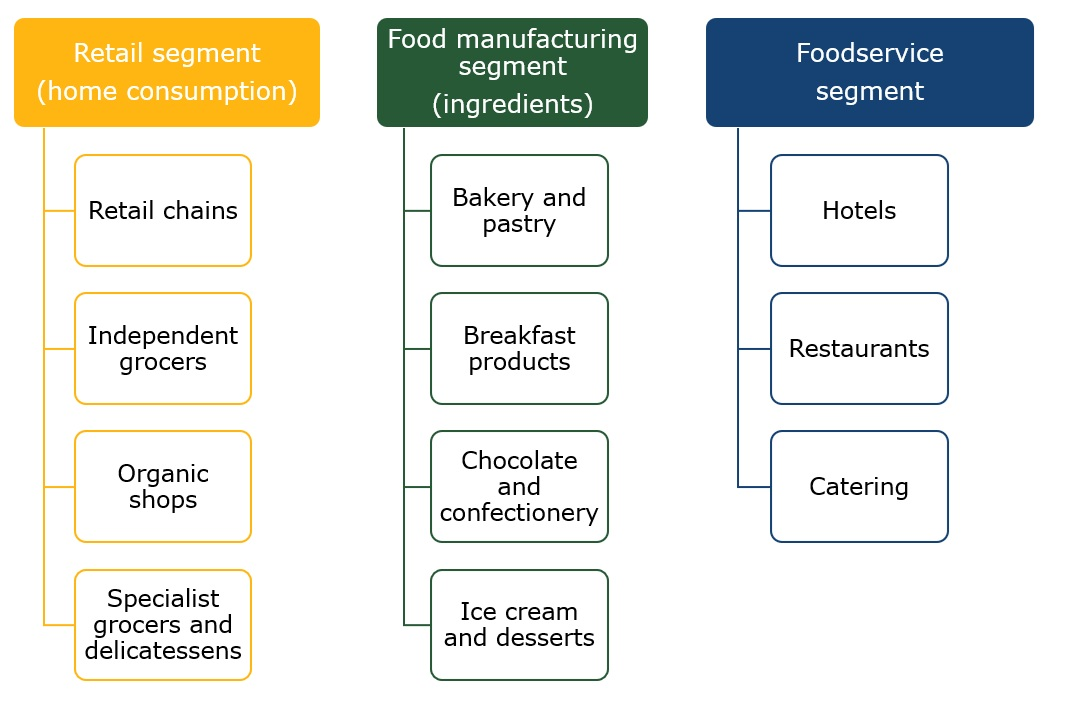
Source: Autentika Global, 2026
Retail and home consumption: snacks and cooking ingredients
Dutch retailers sell nuts and dried fruit as snacks and ingredients for breakfast, baking and cooking. The range includes plain, roasted and flavoured nuts, unsweetened and sugar-infused dried fruit, and mixes, usually in 100–500 g packs. Shelf position varies by use and price. Raisins, cranberries, nut pieces and selected nuts are sold alongside baking ingredients. Roasted and salted nuts are sold in the snack aisle, sometimes near beer. Premium nuts, dried fruit and fruit-and-nut mixes may be placed in the healthy-food section.
Figure 2: Albert Heijn dried fruit and nuts mix
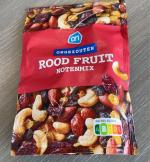
Source: kiliweb, CC BY-SA 3.0, via Open Food Facts, 2026
Demand is stable throughout the year. However, it rises before Dutch national holidays, Sinterklaas on 5 December and Christmas on 25–26 December. Seasonal products should therefore reach retailers in October and November. Nuts and dried fruit are used in festive baking, snack mixes and gift packs. Trade contacts claim the shopping season has shortened from about two months to mostly the final month before the holidays. De NotenBeurs and NOIX offer Christmas gift packs.
Dutch supermarkets dominate retail sales of nuts and dried fruit. In 2025, Albert Heijn made up 38.2% of supermarket sales and Jumbo 19.9%. Circana reported that private labels reached 55% of grocery sales by value and 56% by volume, leaving limited shelf space for small independent brands. As price becomes more important, Dutch consumers may replace premium nut mixes with cheaper private-label mixes, peanuts or products that contain fewer expensive nuts.
Other market channels include organic and health-food shops, ethnic supermarkets, online retailers, independent nut shops and weekly markets. Udea supplies Ekoplaza and other organic stores. Asian and Turkish shops, meanwhile, sell bulk products or larger packs. Amazing Oriental is the largest Asian supermarket chain. De Notenshop is a large specialist retailer. Market stalls usually buy from Dutch wholesalers like De NotenBeurs rather than directly from exporters.
Retailers prefer suppliers that offer several products and manage roasting, mixing, packaging, labelling, stock and distribution. This means retail packs are not always processed in the Netherlands. Some are roasted, salted and packed elsewhere in Europe. Snack Connection supplies private-label products. International discounters may buy centrally for several markets.
Albert Heijn and Jumbo use strict selection and checking systems for private-label suppliers. Albert Heijn’s rules look at quality, packaging, traceability and social conditions. Jumbo’s 2026 purchasing conditions state that suppliers must have a certificate approved by the GFSI. For most nuts, they also ask you to report where the products come from. They also set targets for water management and sustainable cashew supply. Retailers also want shorter, more transparent supply chains. Lidl’s Way To Go cashews, grown and processed in Tanzania, shows that preparing the food where it is grown can make it easier to trace and retain more value in the producing country.
Food manufacturing: bakery, cereals, confectionery and ice cream
Nuts and dried fruit are widely used in Dutch bakery, breakfast, confectionery and ice cream products as ingredients, fillings, toppings and decorations.
- Bakery and pastry – Bakeries use dried fruit and nuts in bread, biscuits, cakes and pastries. According to the Dutch Bakery Centre, Dutch bread sales rose by 3.7% in volume in 2025, and pastry and cake consumption by 1.2%. Large users include Borgesius and Bakker Goedhart, which supply retailers nationwide.
- Breakfast cereals and bars – Dried fruit and nuts are used in muesli, granola, cereals and snack bars. Demand is shifting from sugary cereals towards more natural, high-fibre and lower-sugar products. Euromonitor notes concerns about sugar and processing. Brands like Holie’s, De Halm and the raisin-based Sultana snack brand are growing. This creates demand for smaller pieces and customised mixes.
- Chocolate and confectionery – Hazelnuts, almonds and raisins are used in chocolate, biscuits and sweets. The Dutch sweets and snacks sector grew by over 14%, from about €3.7 billion in 2019 to almost €4.2 billion in 2023. Consumption per person fell by 3.4%. This suggests price-driven growth. Dutch chocolate brands Tony’s Chocolonely and Zaandam-based Verkade use nuts and dried fruit. Tony’s owns a factory in Belgium.
- Ice cream and desserts – Nuts, nut pastes, coconut and dried-fruit pieces are used in ice cream, frozen desserts, dairy products and plant-based alternatives. Holiday Ice produces over 400 private-label products under more than 60 labels. De Jong’s IJs develops products for retailers and brands, including vegan ice cream based on almond, coconut and cashew. These manufacturers need customised pieces and pastes that retain their taste and texture during freezing.
Figure 3: Calvé peanut butter
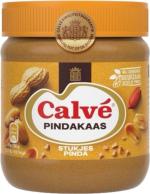
Source: kiliweb, CC BY-SA 3.0, via Open Food Facts, 2026
Food manufacturers usually buy through specialised importers and ingredient suppliers rather than directly from producing countries. These intermediaries offer year-round stock and processed forms, such as chopped, roasted and ground products. Buyers ask for consistent size, colour, moisture and texture, and strict control of contaminants and allergens. Ice cream makers usually require pasteurised or otherwise heat-treated nuts to reduce microbiological risks.
Foodservice: hotels, restaurants, catering and quick-service outlets
The Dutch foodservice includes hotels, restaurants and cafés, contract catering and convenience outlets. In 2025, Dutch consumers spent €23 billion on food and drinks outside the home, up 3.9% from 2024. Hotels, restaurants, cafés and bars accounted for €12.5 billion, contract catering for €4 billion, and convenience outlets for €6.5 billion.
Nuts and dried fruit are used in breakfasts, salads, international and plant-based dishes, bakery products, desserts and snacks. Operators prefer ready-to-use products, which save time and reduce waste. These include pitted dates, chopped nuts, pastes and dried-fruit pieces. Consistent cut size, moisture, taste and shelf life often matter more than perfect appearance.
Most of them do not import directly. Instead, they buy from specialised wholesalers that offer a wide range of products, professional pack sizes and frequent small deliveries. Large chains may use central contracts. Independent businesses, meanwhile, buy from cash-and-carry or delivery wholesalers. Exporters should therefore target Dutch importers, processors and foodservice wholesalers rather than individual restaurants.
Through which channels do dried fruit and nuts end up on the end market?
Most dried fruit and nuts enter the Dutch market through specialised importers, traders and processors that hold local stock. Direct supply to retailers, foodservice wholesalers and manufacturers is less common, as they need smaller deliveries, processing or retail packing. Exporters that offer competitive prices, consistent quality and reliable container shipments can also use international traders, brokers and large processors.
Figure 4: Market channels for dried fruit and nuts in the Netherlands
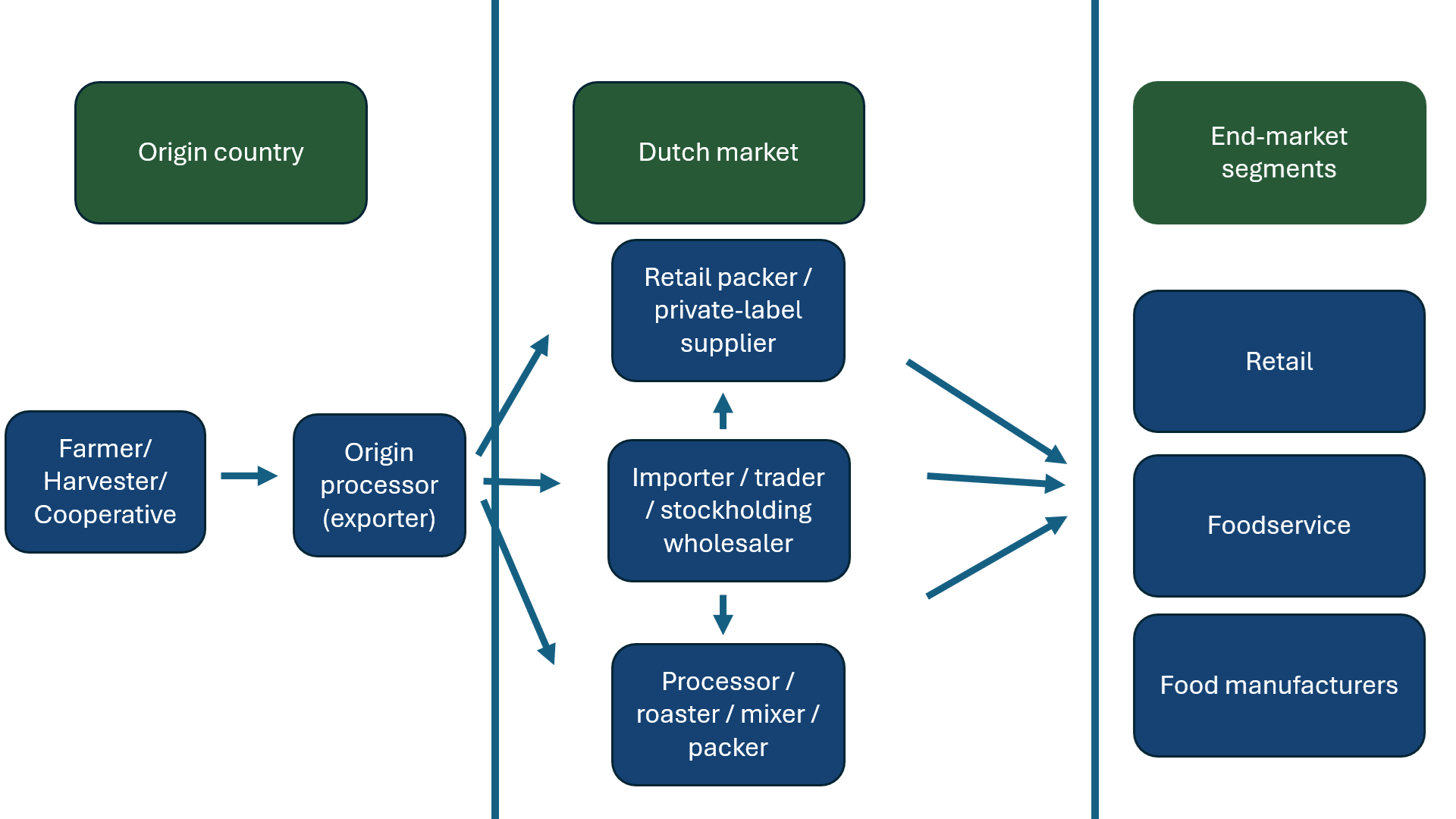
Note: Agents and brokers may facilitate any route but do not normally handle the products.
Source: Autentika Global, 2026
Specialised importers and stockholding wholesalers
These companies import containers, hold stock in Dutch warehouses and supply manufacturers, retail packers, foodservice distributors, specialist shops and Dutch buyers. Some also clean, roast, mix or pack products. Nutland imports nuts and dried fruit in bulk. It keeps large stocks in Rotterdam. Rhumveld, meanwhile, distributes conventional and organic nuts, dried fruit and seeds.
Importers buy containers or large pallets and resell smaller lots. Some focus on bakery and confectionery, while others serve several markets. They manage customs clearance, storage and delivery. However, they expect competitive prices, reliable shipments, consistent quality, food safety certification and social audits. Exporters usually provide samples, laboratory results and certificates before supply starts.
International traders and re-exporters
These companies import standard nuts and dried fruit in bulk and resell them to distributors, processors and traders across Europe. Some hold stock or arrange packing. This means they sometimes share the same role as specialised importers. Catz International is the leading trader of desiccated coconut and other dried fruit and nuts. Jas Trading sources nuts directly from producing countries and supplies European distributors and processors.
International traders usually work with full-container contracts and standard grades. They compare origins and may change suppliers if prices or crops change. Exporters need to respond quickly, meet specifications and provide accurate shipping documents. This channel offers large orders but little support with product development, small deliveries or market entry.
Processors, roasters, mixers and packers
These companies add value by cleaning, roasting, coating, mixing or packing raw or semi-processed products. They supply food manufacturers, retail private labels, specialist shops and foodservice businesses. Most buy smaller quantities from Dutch or European stockholding traders more frequently. Direct sourcing may suit larger manufacturers that need regular volumes or specific qualities, such as Turkish hazelnuts and nuts for ice cream production.
Yme Kuiper imports, cleans and mixes dried fruit, nuts and seeds for industrial bakeries and food producers. Virgin Nuts produces caramelised and dry-roasted nuts for retail, chocolate, ice cream and cereals. These buyers have detailed requirements for size, moisture, colour, roast, coating and packaging. Exporters normally provide trial samples and ensure consistent quality, traceability, certification and delivery.
Foodservice wholesalers
These companies supply hotels, restaurants, caterers and institutional kitchens. They usually buy packed products from importers, processors and packers rather than from producing countries directly. Sligro and HANOS offer nuts, mixes and dried fruit in professional pack sizes. Exporters normally reach this channel through Dutch suppliers that provide local stock, smaller quantities, regular deliveries and allergen information.
Direct supply to retailers or private-label packers
Direct supply from producing countries to retailers like Albert Heijn and Jumbo is uncommon. Exporters normally use approved importers, processors or packers that roast, mix and pack products for retail. Some companies combine these roles. Snack Connection and Intersnack Netherlands supply nuts and snacks to European retailers. This channel requires full traceability, retailer-approved certification and reliable logistics.
Agents and brokers
Agents and brokers connect exporters with European buyers, negotiate contracts and provide market information. They usually charge 2–4% commission and may represent suppliers or support private-label tenders. QFN Trading & Agency trades and brokers nuts, seeds and dried fruit. Comparatively, Rotterdam Commodity Trading specialises in peanuts, cashews and Brazil nuts. This channel works well for exporters without European sales offices, although they are still responsible for quality, documents and delivery.
Which is the most interesting channel for you?
Specialised importers and stockholding wholesalers are usually the best first contact for small and medium-sized exporters. They import from origin, hold stock, supply Dutch and European segments and manage customs, storage and local distribution. This makes entry easier than supplying retailers or end users directly.
Importers provide information about prices, crops, quality problems and buyer requirements. They trade several nuts and dried fruits. As a result, a small range of complementary products may be attractive, on the condition that quality remains consistent. New suppliers need reliable delivery, laboratory results and relevant certificates, plus a clear advantage in price, quality, origin or sustainability.
Processors, packers and retailers import directly less frequently. This is because they need frequent, smaller deliveries, local stock and rapid responses to quality or logistics problems. Direct supply mainly suits experienced exporters that can meet detailed specifications, audits, traceability and delivery schedules. Agents and brokers can help suppliers that do not have European sales offices to find buyers.
Foodservice wholesalers and most manufacturers buy from European stock rather than importing directly. Exporters should therefore identify importers and processors serving their target segment. The Dutch Association for the Trade in Dried Fruit, Spices and Related Products (NZV) and trade fairs, such as Food Ingredients Europe, PLMA Amsterdam and Anuga, can help identify Dutch buyers.
Tips:
- Contact selected Dutch buyers with a short offer that covers specifications, volumes, harvest period, certification, laboratory results, packaging and price terms. Contacting a few well-matched Dutch buyers is more effective than sending a standard message widely.
- Target ingredient users. Search the FNLI member list for food processors and manufacturers and the VBZ member list for producers of biscuits, confectionery, chocolate, savoury snacks and nut products.
- Use the Dutch Chamber of Commerce (KVK) Business Register to find and verify Dutch buyers. Try Dutch terms such as ‘noten’, ‘zuidvruchten’, ‘gedroogde vruchten’, ‘groothandel’ and ‘import/export’, as company descriptions vary. Check results against company websites. Order an online extract to verify directors and signing authority, and review financial statementsfor larger orders.
3. Who is your competition in the Dutch dried fruit and nuts market?
Competition in the Dutch dried fruit and nut market is high at every level. The United States, Argentina, Vietnam, Türkiye, China and the Philippines lead important product categories. Large processors compete through scale, advanced processing, certification and established buyer relationships. Dried fruit and nuts also compete with cheaper and more convenient alternatives. New suppliers can stand out through specialisation, consistent quality, traceability, flexible service and clear advantages.
Which countries are you competing with?
The Dutch market attracts some of the world’s strongest producing and processing countries. The United States, Argentina, Vietnam, Türkiye, China and the Philippines lead important categories through scale, processing capacity, quality and price. New suppliers should compete through distinctive, traceable and certified products rather than price alone.
Source: Autentika Global based on ITC TradeMap
The United States: Combines scale, quality and advanced processing
The United States is the Netherlands’ largest supplier by value. Between 2021 and 2025, import volume grew by 1% annually. The value rose by 11% as prices rose. Although Dutch and US figures differ, 2025 imports exceeded 100,000 tonnes and were worth around €400 million. Almonds represented 41% of US exports, followed by walnuts (19%), sweetened cranberries (14%), in-shell peanuts (8%), shelled peanuts (4%), pistachios (3%) and pecans (2%). Other products included raisins and prunes.
US suppliers combine large-scale production, reliable quality, advanced processing and promotion through the US Market Access Program. Major cooperatives and companies such as Blue Diamond, Sunsweet and Ocean Spray operate modern facilities with strict food safety controls. High production costs create opportunities for exporters that offer organic or fairtrade products or using less water and pesticides.
Argentina: Leading peanut supplier
Argentina is the world’s leading peanut exporter and the Netherlands’ main supplier. In 2025, Dutch imports reached around 240,000 tonnes of shelled peanuts, worth €379 million. Smaller imports included 740 tonnes of dried grapes, 170 tonnes of prunes and 40 tonnes of in-shell walnuts. Companies in the Córdoba province grow and prepare most peanuts from Argentina. Specialised companies produce and export Runner and High Oleic Runner peanuts using modern processing, storage, traceability and food-safety systems.
Competing with Argentina in standard bulk peanuts is difficult. This is because it offers large volumes, consistent quality and competitive prices. However, production is drought-exposed, the sector depends heavily on European demand and aflatoxin control remains important, despite pre-export testing. Emerging suppliers should focus on organic or distinctive varieties, smaller orders, flexible packaging or processed forms.
Vietnam: Dominates cashew processing
Vietnam is the Netherlands’ main cashew supplier. In 2025, Dutch imports reached 46,000 tonnes, worth €230 million, with smaller volumes of desiccated coconut and dried mango. Its strength is extensive shelling, grading and packing capacity. Domestic production cannot meet processing needs. This means Dutch companies import raw cashews from Cambodia and Africa. Vietnam also prepares imported almonds and re-exports them, including US almonds.
Vietnamese processors compete through large volumes, many grades, competitive prices and recognised food safety certification. Reliance on imported raw nuts creates supply, price and traceability risks. Emerging suppliers can process more at origin and offer organic or fairtrade products, value-added forms, distinctive dried fruit and flexible orders. Strong traceability and quality control may attract Dutch buyers that want shorter supply chains or alternatives to Vietnamese processing.
Türkiye: Leads in hazelnuts and dried fruit
Turkish exports to the Netherlands reached almost 40,000 tonnes in 2025. Sultanas accounted for almost half, followed by roasted hazelnuts (23%), raw hazelnut kernels (12%) and dried apricots (6%). Türkiye is the world’s largest exporter of hazelnuts, dried apricots, dried figs and dried grapes. Its strengths include a large production, experienced processors, many grades and organic products. Giresun hazelnuts, Aydın figs, Malatya apricots and Aegean sultanas are well-known for coming from these specific areas.
Suppliers of hazelnuts, sultanas, dried figs or apricots should not compete with Türkiye in terms of volume or in mainstream segments. Production is concentrated and vulnerable to frost, drought and heat. Mycotoxin-related rejections are also a risk, especially for dried figs. Alternative origins can compete through distinct varieties, consistent quality, organic certification, flexible orders and value-added forms.
China: Offers large quantities with competitive prices
Dutch imports from China grew by 10% annually between 2021 and 2025, reaching almost 50,000 tonnes. Peanuts accounted for 59%, raisins 9%, walnuts 8%, fruit-and-nut mixtures 3%, chestnuts 3% and pine nuts 2%. China is growing in several categories, especially raisins. Chinese data shows raisin shipments to the Netherlands increased sixfold, reaching over 6,000 tonnes in 2025.
China’s production and processing capacity supports large volumes and competitive prices. Instead, emerging suppliers should offer organic products, distinctive varieties, clear origin and consistent quality. Managing aflatoxins, pesticide residues and moisture, supported by food safety certification, reduces buyer risk. Suitable targets include premium retailers, specialist snack companies and manufacturers that want alternatives to standard bulk products.
The Philippines: Leading supplier of desiccated coconut
Philippine exports to the Netherlands consist mainly of desiccated coconut, plus small quantities of dried tropical fruit. Despite harvest-related fluctuations, imports are growing. In 2025, Dutch imports exceeded 27,000 tonnes of desiccated coconut, worth €82 million. The Philippines is the world’s largest exporter of this product.
About 2.5 million coconut farmers supply its large processing industry. Strengths include volume, experienced processors and a strong reputation for desiccated coconut and dried mango. Low farm productivity, a poorly organised supply chain and typhoons can disrupt supply and raise prices. Emerging suppliers can compete through consistent quality, reliable delivery, full traceability, organic certification and marketing coconut chips as a snack.
Tips:
- Learn from leading suppliers and specialise in a limited number of products. Invest in reliable processing, food safety systems, traceability and relevant certification.
- Compete beyond price: explain what makes your origin distinctive, support sustainability claims with evidence and adapt products to buyer needs.
Which companies are you competing with?
Large, specialised processors with established European customers are important competitors. The examples below combine scale, product variety, food safety certification, value-added processing and strong buyer relationships. Smaller exporters can learn from them while competing through specialisation, flexibility and clear origin stories.
Blue Diamond Growers
Blue Diamond Growers is the world’s largest almond producer. Owned by 3,000 growers, the California cooperative sells to over 90 countries. Its three plants produce whole, sliced, diced, slivered and flavoured almonds and almond flour. All almonds are pasteurised without propylene oxide. Its strengths are scale, consistent quality, food safety and innovation. Some Dutch traders buy their almonds through European partners, such as Bösch Boden Spies.
Aceitera General Deheza
Aceitera General Deheza (AGD) is Argentina’s main peanut exporter, accounting for around 25% of the country’s peanut exports for human consumption. Its three plants produce blanched, roasted and diced peanuts, peanut butter and paste; processed products represent around 75% of exports. AGD supplies confectionery-grade peanuts to European markets, including the Netherlands. Its plants are BRCGS certified and SMETA audited.
Long Son
Long Son is Vietnam’s largest cashew processor and one of the top two in the world. Founded in 2000, its ten factories export raw kernels and roasted cashews to over 40 countries. It supplies international supermarkets and roasters. Processing includes sorting, grading, pasteurisation and vacuum packing. Certifications include BRCGS, ISO 22000, organic, Fairtrade, Kosher and Halal.
Arslantürk
Arslantürk is a leading Turkish hazelnut processor and exporter with almost 70 years’ experience. It processes up to 25,000 tonnes of kernels annually. It offers natural, blanched and roasted hazelnuts as whole, sliced and diced kernels, meal and paste, with different sizes, roasting levels and packaging. Certifications include BRCGS, ISO, organic, Rainforest Alliance, Kosher and Halal, supported by SMETA audits.
Jilin City Changrong Agricultural & By Products Corporation
Jilin City Changrong offers Korean, Yunnan, dwarf-pine and cedar kernels for different price and quality segments. At Anuga 2025, it presented nuts as bakery ingredients and organic products to Northern and Western European markets, including the Netherlands. It also exhibited at the 2026 International Nut and Dried Fruit Council Congress to contact international buyers.
Peter Paul Philippine Corporation
Founded in 1946, the Peter Paul Philippine Corporation operates the world’s largest single desiccated coconut plant, which has an annual capacity of 22,000 tonnes. It originally supplied desiccated coconut for Almond Joy and Mounds bars. However, it now offers coconut cuts, oil, water, milk, flour and butter to European food manufacturers and retailers. Certifications include BRCGS, organic, Fair Trade and Regenerative Organic.
Tips:
- Learn from leading processors: specialise in a core product but offer several grades, cuts, processed forms and packaging options. Match food safety certification and social audits to buyer requirements, supported by traceability and documented controls.
- Use exhibitor lists and, where possible, visit European trade fairs, such as Anuga, SIAL Paris and BIOFACH, to compare competitors’ products, certifications, packaging and positioning.
Which products are you competing with?
Dried fruit and nuts compete with other snacks, fresh fruit and alternatives within their category:
- Cheaper nuts – Peanuts are common in nut mixes, as they cost much less than cashews and almonds.
- Seeds and pulses - Sunflower and pumpkin seeds and roasted chickpeas compete as lower-priced protein snacks and bar ingredients.
- Savoury snacks - Crisps and popcorn compete on price, flavour and convenience. Nuts cost more but offer protein, fibre and healthy fats.
- Fresh fruit – Fresh fruit has more water and fewer calories per serving. Dried fruit lasts longer and is easier to carry.
- Sweetened dried fruit - Sugar-infused fruit offers a sweeter and often more appealing taste. Naturally dried fruit attracts buyers seeking products with no added sugar.
- Snack bars – Fruit bars compete with cereal and protein bars. They offer convenient energy and sweetness. Protein bars contain more protein and are usually more filling.
- Nuts versus dried fruit – Both are used in snack mixes, breakfast products and baking. Nuts have a stronger position because consumers associate them with protein, healthy fats and fullness.
Exporters should emphasise clear uses, convenient formats and differences in variety, origin or processing rather than competing only in terms of price.
Tip:
- Match your product to its intended use and alternative. For bakery, emphasise consistent size, processing performance and price. For retail snacks, highlight convenience, origin and distinctive flavour, plus protein for nuts or no added sugar for dried fruit. Support your offer with specifications, samples and suggested applications.
4. What are the prices of dried fruit and nuts on the Dutch market?
Global harvest conditions affect worldwide supply and prices. Dutch retail prices also vary widely by product, form, pack size and sales channel. The examples below show private-label prices in Dutch retail chains in July 2026.
- Lower-priced products: Peanuts cost €2.30–2.39 per kg and raisins €6.30–6.58 per kg.
- Mid-priced products: Cashews cost €11.78–14.95 per kg, Medjool dates €15.96–17.73 per kg and dried apricots €17.96–21.96 per kg.
- Higher-priced products: Macadamia nuts cost €26.32–35.64 per kg and pine nuts €49.93–54.50 per kg.
Pack size, sales channel and organic certification also affect prices:
- Pack size: The price per kilogram falls as pack size increases. Savings are larger for expensive products. For raisins, a 1-kg pack was about 10% cheaper than a 250-g pack. For pine nuts, it was up to 60% cheaper than a 100 g pack. Packs of 1 kg or more are mainly sold by specialist and online retailers for foodservice.
- Organic products: The organic price premium varies widely by product and retail chain. Organic options can cost 10–70% more than comparable conventional products.
Dutch consumer prices for dried fruit and nuts increased between 2022 and 2025, following general inflation, which reached 3.2% in 2025. Over this period, the Dutch increase was slightly above the EU average for fruit and nuts. Trends differ per product. Côte d’Ivoire cut its 2026 raw cashew farmgate price by 6% to CFA 400 per kg. Vietnamese cashew kernel export prices, meanwhile, were around €5.40–5.50 per kg. Global raisin production is forecast to rise 22% in 2026/2027. This may lower raisin prices.
The figures below are indicative. They vary by origin, grade, processing and pack size. Processing costs also differ by product. For example, in Türkiye, grapes for raisins are usually sun-dried outdoors. This keeps drying costs relatively low. In contrast, cashew processing requires more machinery for grading, heat treatment, shelling, drying, peeling and optical sorting.
Table 1: Indicative breakdown of the Dutch retail price for cashew kernels and raisins, August 2026
| Supply-chain stage | Cashew kernels: share of retail price | Raisins: share of retail price |
|---|---|---|
| Farmer/raw material | 21% | 22% |
| Processing and export | 27% | 13% |
| Freight, insurance and import | 3% | 3% |
| Dutch packing and retail | 41% | 54% |
| VAT | 8% | 8% |
| Total | 100% | 100% |
Source: Autentika Global based on industry sources
Tips:
- Use Eurostat Comext or UN Comtrade to compare Dutch import values and volumes. These free sources show average unit-value trends, not prices for specific grades or packs. For current nut benchmarks, use paid sources like Expana.
Autentika Global carried out this study on behalf of CBI.
Please review our market information disclaimer
Search
Enter search terms to find market research