
Entering the European market for dried grapes
Selling dried grapes in Europe starts with strict food-safety and labelling rules. This includes limits for ochratoxin A and pesticide residues. Buyers also expect GFSI food-safety certificates, clear labelling and, in some cases, compliance with sustainability or ethical standards. Market entry is often made possible by specialised importers, who supply retail and food manufacturers across Europe. Competition is strong from Türkiye and other major producers, while prices depend on type, quality and recent crop volumes.
Contents of this page
1. What requirements and certifications must dried grapes meet to be allowed on the European market?
What are the mandatory requirements?
All foods, including dried grapes, sold in Europe must be safe. This applies to imported products as well. Additives must be approved. Levels of harmful contaminants, such as pesticide residues and mycotoxins, are limited by law. European Commission Regulation 2023/915 sets maximum levels for certain contaminants in food products. This regulation is frequently updated to adjust limits in foodstuffs in general, but also for specific products, including dried grapes. The most common requirements regarding contaminants in dried grapes are related to ochratoxin A and sulphite content.
Border control
When specific products coming from particular countries repeatedly go against rules (non-compliance). they can only be imported under stricter conditions. This can mean that imports must be accompanied by a health certificate and an analytical test report. Products from countries that have shown repeated non-compliance can be placed on a list included in the Annex of Regulation (EU) 2020/625. The list has details on the temporary increase of official controls and emergency measures for products entering the (European Union (EU)). Currently, 10% of dried grape shipments from Türkiye to Europe must be officially checked at EU border posts for the presence of ochratoxin A.
Mycotoxins
Presence of mycotoxins, and more specifically ochratoxin A, is the main reason for rejections of dried grape shipments in the European market. Between 2020 and 2024, the Rapid Alert System for Food and Feed (RASFF) recorded 17 notifications of the presence of ochratoxin A in sultanas and 31 such notifications in raisins. Most border rejections were for raisins imported from Türkiye and Uzbekistan. The maximum level of ochratoxin A in dried grapes intended for direct human consumption must be below 10 μg/kg.
Finding ochratoxin A in dried grapes is a result of contamination by certain mould species (Aspergillus). Presence and spread of such fungi is influenced by humid weather during the production and drying of grapes. Lack of pruning while the fruit is still on the tree can also lead to these fungi showing up. Good agricultural practices, controlled drying and proper storage are the most important prevention measures.
Pesticide residues
European countries have maximum residue levels (MRLs) for pesticides in and on food products. Products containing more pesticide residues than allowed will be withdrawn from the European market. Most European importers will request a detailed test to check for the presence of many pesticides.
The EU regularly publishes a list of approved pesticides that are authorised for use in the European Union. This list is frequently updated. Between 2020 and 2024, RASFF reported 31 detections of pesticides in raisins and 5 detections in sultana shipments.
Microbiological contaminants
The standard procedure before export includes laboratory testing of dried grapes for the presence of pathogenic microorganisms. These are things such as yeasts, moulds, Escherichia coli, salmonella, coliform and staphylococcus.
Product composition
European authorities can reject products if they have undeclared, unauthorised or too high levels of unnecessary materials. Although European consumers prefer dried grapes without additives, dried grapes are often packed with vegetable oil. This prevents the fruit from sticking together. If a preservative is used, such as sulphites, it must be declared too. Otherwise the product will be removed from the market. For example, in January 2024 France issued an alert for undeclared sulphites in organic sultanas from Germany.
Packaging requirements
The packaging of dried grapes must keep the product safe and clean. It should protect the taste, smell and quality of dried grapes. The packaging must not give grapes a strange smell, colour or flavour. Not all plastic materials can be used to pack dried fruit and food products. Consult Commission Regulation (EU) 2019/37 for a list of plastic materials and articles that are permitted to come into contact with dried grapes.
Dried grapes are usually packaged in carton boxes with a plastic liner inside. Common bulk packing sizes range from 5 kg to 15 kg. When packaged in corrugated or millboard cartons, the product should be transported on Euro pallets (80 cm x 120 cm) and further transported in containers. Containers measuring 20 feet (ft) canreceive 1,600 cartons of 12.5 kg each or 2,000 cartons of 10 kg each.
For retail sales, dried grapes are packed in various sizes. Sizes range from 25 g up to 1 kg. However, the most common sizes for retail packaging are between 200 g and 500 g.
The duration of storage is usually 12 months after the date of production, in the relative humidity of 60%–65%, at a temperature between 4ºC and 20°C.
Labelling requirements
For bulk packaging, you must write the product name on the container. Use names like ‘raisins’, ‘sultanas’ or ‘currants’ (in different languages) instead of just ‘dried grapes’. In varieties which are naturally not seedless, the label should declare the presence of the seeds. This is done with terms such as ‘seeded’, ‘with seeds removed’, ‘non-seeded’, ‘unseeded’ or ‘with seeds’, unless the product comes in cluster form or is the Malaga Muscatel type.
International standards require that you mention on the label whether dried grapes are treated or naturally processed. If dried grapes are bleached, part of the name must include ‘bleached’, ‘golden’, or ‘golden bleached’. Dried grapes may be described as ‘natural’ if they have not been dipped in an alkaline lye and oil solution to help them dry. They also should not have had bleach treatment.
In 2023, the European Commission introduced an obligation to indicate the origin of dried grapes on the label.
Bulk packaging specifications also need to include:
- Name of product, for example: ‘raisins’;
- Lot identification number;
- Country of origin, name and address of the manufacturer, packer, distributor or importer;
- Shelf life of the product;
- Storage instructions.
In case of retail packaging, product labelling must comply with the EU Regulation on the provision of food information to consumers. Sulphites must be stated as potential allergens, if they are used as preservatives.
Tips:
- Be sure to perform laboratory tests in ISO/IEC 17025:2017 accredited laboratories only.
- Review your treatment practices to ensure your dried grapes will not contain pesticide residues above accepted limits.
- Consult the OIV recommendations for proper production of dried grapes.
- Store your dried grapes in proper conditions (low humidity, cool temperatures) during and after production to avoid appearance of moulds and mycotoxins.
- Follow practical guidelines to help you meet the requirements of European food safety legislation. For dried grapes, consult the Codex Alimentarius Code of Hygienic Practice for Dried Fruits.
What additional requirements and certifications do buyers often have?
Together with the mandatory requirements, many company requests have become equally important. These include compliance with food safety, quality and sustainability standards.
Quality requirements
The quality of dried grapes is determined by the allowed percentage of defective produce, and by total number of defective fruits in 500g. The industry defines several criteria for quality. But some of them, such as taste and flavour, are subjective. These cannot be easily determined by physical characteristics.
The EU has no official quality standards for dried grapes. The most used standards for dried grapes are those published by the United Nations Economic Commission for Europe (UNECE) and the Codex Alimentarius. Besides those international standards, Türkiye (standard TS-3411) and the United States (USDA grades of processed raisings) have national standards. The Turkish Standards Institute recently prepared an update to the existing TS-3411 standard. The update was sent to the country’s ministry of trade for an opinion in 2025. The basic quality requirements for dried grapes are:
- Whole and sound fruit: Must be free from insects, mould, pieces of stem and pedicels (except for the Malaga Muscatel type);
- Maximum moisture content: The allowed moisture level depends on the variety: 31% for the Malaga Muscatel type, 19% for seed-bearing varieties and 18% for seedless varieties. UNECE also sets a limit of 19% for the Monukka variety and 20% for currants;
- Allowed food additives: Dried grapes may include only sulphur dioxide, food grade oil and sorbitol;
- Quality class: Dried grapes can be classified into three classes: Extra Class, Class I and Class II;
- Size classification: Size classification is optional. Very often, the Turkish size classification is used by traders. According to Turkish standards, dried grapes are classified as Jumbo, Standard, Medium or Small;
- Colour classification: It is important in trade, especially for sultanas. Traders often use a colour chart developed by the Turkish standard. The colour chart defines colours, from Type 7 (darkest) to Type 11 (lightest).
Figure 1: Dried grapes
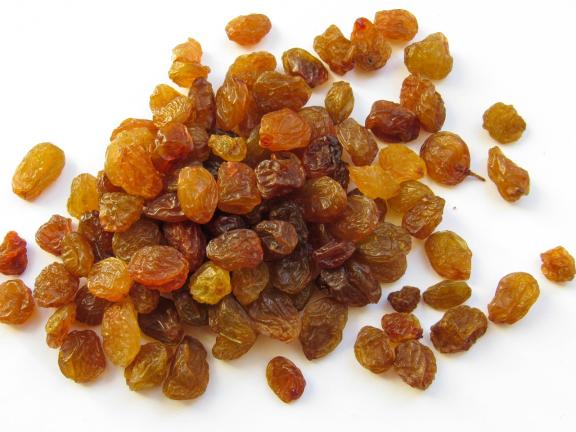
Source: Karyna Panchenko on Pixabay, (licensed under the Pixabay Content License)
Food safety certification
Food safety certification has become a must for almost all European food importers. Most established European importers will not work with you if you cannot provide some type of food safety certification.
Most European buyers will ask for Global Food Safety Initiative (GFSI) recognised certification. For dried grapes, the most popular certification programmes recognised by GFSI are:
- International Featured Standards (IFS);
- BRCGS Global Standard for Food Safety (BRCGS);
- Food Safety System Certification (FSSC 22000).
Some buyers may prefer one specific certification. For example, British buyers often require BRCGS, while IFS is more common among German retailers. Also note that food safety certification is just a starting point. Buyers will usually visit and audit your production facilities during the sourcing selection process.
Corporate social responsibility
Some companies require you to follow their own codes of conduct. Others may prefer that you use a common standard, such as the Supplier Ethical Data Exchange (SEDEX), Ethical Trading Initiative (ETI) or Business Social Compliance Initiative (amfori BSCI). If dried grapes are sold to the retail segment, suppliers will be asked to follow a specific code of conduct developed by the retailers. Many retailers have their own code of conduct, for example, Lidl, REWE, Carrefour, Tesco and Ahold Delhaize.
Tips:
- Get food safety certification. Carefully select a certifying company and consult with your buyers about their certification preferences.
- Do a self-assessment of your current practices and risk management systems using the OECD Due Diligence Checker for the Agricultural Sector.
What are the requirements for niche markets?
Organic dried grapes
To market dried grapes as organic in Europe, grapes must be grown using organic production methods, according to European legislation. Growing and processing facilities must be audited by an accredited certifier before exporters can put organic standards on the packaging. These include the EU’s organic logo, or the logo of the standard holder, such as the Soil Association organic logo in the UK and the Naturland logo in Germany.
Organically produced dried grapes cannot be treated with sulphites. However, they can be dipped in a solution of potassium carbonate and edible plant oil, to preserve the bright colour. If this is done, the oil used in the solution must be organic too.
Sustainability certification
In dried grape production, important goals include using water and energy efficiently, reducing emissions, protecting soil and ensuring fair labour. Currently, the best-known certifications cover broad environmental and ethical performance. For example, Fairtrade International remains a widely recognised ethical certificate. Fairtrade publishes a current minimum price and premium table (valid in 2025) for raisin production in many regions. Fairtrade minimum prices are defined separately for organic and conventional dried grapes.
Kosher or halal certification
If you want to focus on Jewish or Islamic ethnic niche markets, you should consider implementing Islamic dietary certification (halal) or Jewish dietary certification (kosher) schemes.
Tips:
- Read our study on trends in the European processed fruit and vegetables market for an overview of sustainability initiatives in the European market.
- Consult the Sustainability Map database for information on sustainability labels and standards.
- Check the EU guidelines for imports of organic products to familiarise yourself with the requirements of the European organic market.
2. Through which channels can you get dried grapes on the European market?
How is the end market segmented?
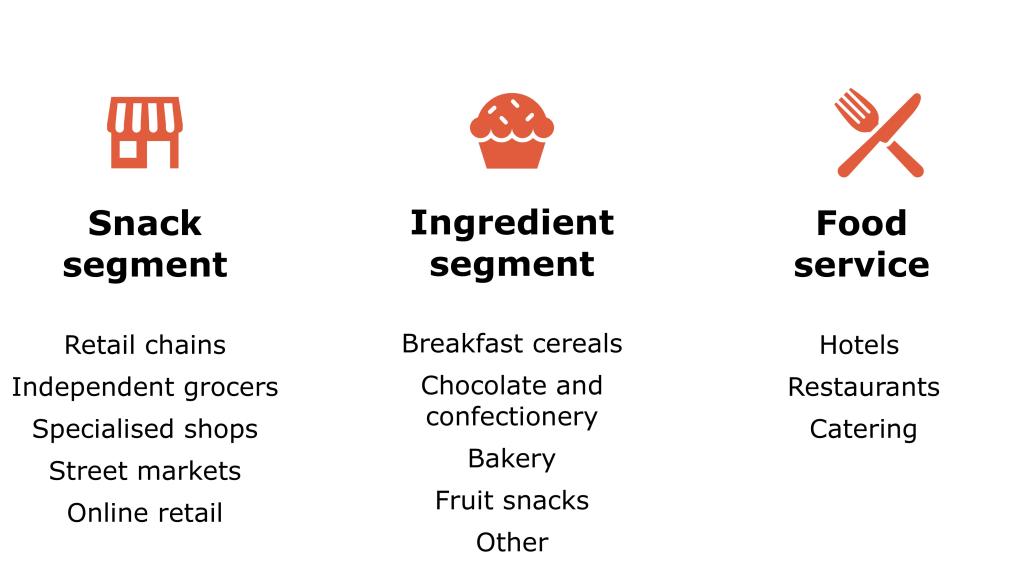
Dried grapes in Europe are mostly used as an ingredient in the bakery and confectionery industry, and much less as a snack. As snacks, they are mostly used in snack mixtures with nuts and other dried fruit. Still, dried grapes are sold in large volumes throughout the retail segment for home consumption and cooking. An estimated 60% of the dried grapes sold in Europe are sold through the retail segment, and the other 40% to industrial users. Within the retail segment, dried grapes are mostly sold in supermarkets.
Figure 2: End-market segments for dried grapes in Europe
Source: Autentika Global, 2025
Retail (snack segment)
Retailers mostly buy from intermediaries, such as specialised distributors.
The main sub-segments of the dried grapes retail segment in Europe are:
- Retail chains: Private labels keep growing across Europe. They reached about 39% of grocery value in 2024, and most shoppers say they will keep buying them. Snack packs (including kids’ mini boxes) and chocolate-coated raisins) remain popular products. Major groups include Schwarz Group (Lidl, Kaufland), ALDI, Carrefour, Ahold Delhaize, EDEKA, REWE, E.Leclerc and Intermarché;
- Specialised shops (including organic food and ethnic shops): Some organic shops are part of specialised organic food retail chains, especially in Germany. Organic dried grapes products are also sold in drugstores, for example, in dm and Rossmann. Ethnic shops provide specific opportunities for entering the market without having to compete with the leading retail brands. Ethnic/Turkish grocery stores still offer good entry points, but product ranges vary by city and buyer;
- Ethical stores: This is a niche segment that provides opportunities for suppliers of dried grapes that are certified fair trade or have some other ethical or sustainable certification. This is a niche, but the UK and Switzerland remain strong Fairtrade markets. In 2024, Switzerland’s Fairtrade sales passed CHF 1 billion;
- Online retail: Often part of the offer of existing retail traders or specialised shops, online retail grew dramatically during the Covid-19 pandemic. Online grocery sales stabilised after the pandemic surge. In 2023-2024, they represented around 6% of grocery sales in Europe. Online sales are expected to continue growing at the highest rate compared to other retail channels.
Food industry (ingredient segment)
The food industry segment is the main user of dried grapes:
- Bakery: Bakeries are among the largest users of dried grapes in Europe. Many companies use dried grapes in products such as breads, pastries, cookies, cakes, and buns. Some of the large bakery company groups in the European market using dried grapes are Finsbury Food Group, Le Duff, Aryzta, Jab Holding, Kingsmill, Lantmännen Unibake and Grupo Bimbo;
- Chocolate and confectionery:The largest industrial users of dried grapes. Dried grapes are a common ingredient in many sweets, but also as a traditional ingredient in chocolate products. Aside from conventional chocolate products, confectionery products include chocolate-coated dried grapes and yogurt coated balls with dried grapes. Leading chocolate producers in Europe include Mondelez, Nestlé, Mars, Hershey, Ferrero, and Lindt & Sprüngli;
- Breakfast cereals: Cereal producers are more often switching from using sugar infused fruit to natural fruit, such as dried grapes. Examples of companies producing breakfast cereals with raisins include Kellogg’s, Moma Foods and Jordans;
- Fruit snacks: Dried grapes are increasingly popular in products such as fruit snacks without added sugar. Examples of companies using dried grapes for fruit bars include Deliciously Ella, Eat Natural, and Oshee;
- Other users for dried grapes: These include ice creams, fruit preparations and fillings for the yogurt and bakery industries, and jams. A popular type of ice cream with raisins is Malaga ice cream.
Food service segment
The food service channel (hotels, restaurants and catering) is usually supplied by specialised importers and wholesalers. The food service segment often uses unbranded bulk packaging of 3–5kg. Consumer interest in trying new cuisines, healthy food and just simply enjoying food are the major driving forces in the food service channel in Europe. The fastest-growing business types are healthier fast food, street food, pop-up restaurants and international cuisines.
Through which channels do dried grapes reach the end market?
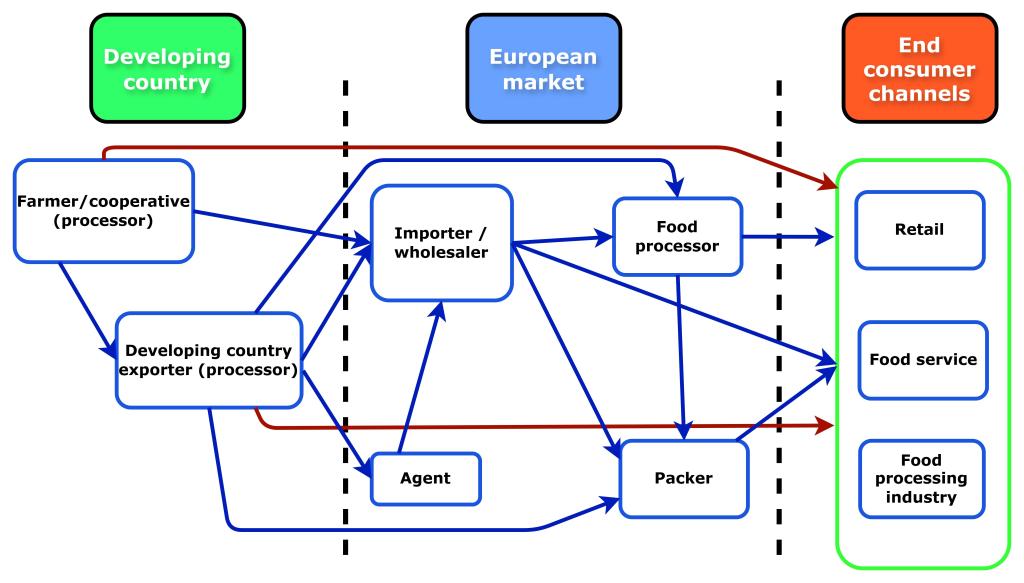
The most important channel for dried grapes in Europe is specialised dried fruit importers. After importing, dried grapes reach the different market segments described in Figure 2. In some cases, you can also supply different segments directly. However, for most exporters from developing countries, the first entry point into the European supply chain are specialised importers and wholesalers.
Figure 3: European market channels for dried grapes
Source: Autentika Global, 2025
Importers/Wholesalers
In most cases, importers act as wholesalers. They often sell dried grapes to packing companies who pack it into consumer packages. Some importers have processing and packing equipment, so they can also supply the retail and food service channels directly. However, many important dried fruit brands import dried grapes directly, instead of buying through specialised bulk importers.
Importers usually have good knowledge of the European market, and they monitor the situation in dried grapes producing countries closely. They can inform you about market developments and provide practical advice for your exports. Importers of dried grapes often import other types of dried fruit and edible nuts as well. So offering other products besides dried grapes can increase your competitiveness. There are also ethnic food importers, specialised in supplying ethnic shops.
Agent/broker
Agents involved in the dried grapes trade typically perform several types of activities. They act as independent companies that negotiate on behalf of their clients. They also act as intermediaries between buyers and sellers. For their intermediary services, they typically charge commissions between 2% and 4% of the sales price.
Another type of activity is the supply of private labels for retail chains in Europe. For most developing country suppliers, it is very challenging to participate in the demanding private label tender procedures. For these services, some agents work in cooperation with their dried grape suppliers to participate in such procurement procedures.
Food processing industry
Food processors such as bakeries and chocolate producers generally buy dried grapes from European wholesalers. There are two main reasons for intermediary sourcing. Despite the higher prices, they offer a broader range of products and easier sourcing control. However, some large food processing companies import dried grapes without intermediaries.
Table 1: Examples of companies active in different channels for dried grapes in European markets:
| Type of importer | Company example |
|---|---|
| General dried fruit importers and wholesalers | |
| Specialised organic food importers | |
| Importers specialised in supplying the food industry and food service | |
| Ethnic Food importers | |
| Food processors |
|
| Agents | |
| Packing companies |
Source: Autentika Global, 2025
What is the most interesting channel for you?
Specialised importers of dried fruit are the best contact for exporting dried grapes to Europe. This is relevant for new suppliers, as supplying the retail segment directly is very demanding. It requires a lot of quality-related and logistical investments. However, for well-equipped and price competitive producers, packing for private labels can be an option. As the cost of labour in Europe is high, importers of dried grapes sometimes search for more cost-effective packing operations, such as in developing countries.
Tips:
- Consult the exhibitor lists of large trade fairs such as ANUGA and SIAL to find potential buyers. If you want to supply to supermarkets’ private labels you can search for opportunities at PLMA.
- To reach the food service segment, look for buyers at specialised foodservice events like SIRHA and Internorga. For the UK market, look for opportunities within The Caterforce Group.
- Search the exhibitor list of the specialised trade fair Fi Europe to find potential buyers for your dried grapes. Also, check out IBA, the world’s leading trade fair for the baking and confectionery industry.
- Stay informed about developments in the bakery and snacks industry segment by reading the specialised market information portal BakeryandSnacks.com.
- Search through the member list of the European Trade Federation for Dried Fruit and Edible Nuts (FRUCOM), to find buyers from different channels and segments.
3. What competition do you face on the European dried grapes market?
Which countries are you competing with?
Türkiye is the main supplier of dried grapes to Europe. They are responsible for more than 50% of all dried grapes imported into Europe. Other important suppliers include South Africa, China, Chile, the US and Iran, which together supply an additional 34% of the market. Within Europe, Greece is the only serious competitor, supplying mainly currants. Other emerging suppliers include Uzbekistan, Afghanistan, Pakistan and Argentina.
Source: Autentika Global, ITC, 2025
Türkiye: The leading European supplier of dried grapes
Türkiye is the world’s second-largest producer of dried grapes, after India. With a production of 206,346 tonnes in the 2023/2024 season, Türkiye accounts for 17% of the world’s dried grape production. Türkiye is also the leading dried grape exporting country, with exports totalling 205,939 tonnes in 2024. Sultanas are the most exported type of dried grapes from Türkiye. The Turkish harvesting seasons starts in September. Exports areusually the highest in the last quarter of the year.
Turkish exports of dried grapes to Europe decreased at an annual rate of 5.5% between 2020 and 2024. Exports to Europe reached 159,720 tonnes in 2024, valued at €442 million. Within Europe, the major target market for Turkish dried grapes is the UK, where 35% of Türkiye’s dried grape exports went to in 2024, followed by the Netherlands (17%), Germany (12%), Italy (9%) and France (8%).
Most dried grapes in Türkiye are produced in the Aegean (west). The most important production areas are Manisa, Izmir and Aydin. Around 35% of all grapes produced in Türkiye are used for drying. The rest is sold as table grapes or used to produce alcoholic drinks, mainly the country’s national drink, raki. The planted area for dried grapes in Türkiye rose to 77,000 hectares in 2023/2024. The Aegean Exporters Association actively promotes exports of dried grapes from Türkiye to Europe.
In 2025, the Turkish raisin industry entered its third consecutive year of below-average harvests. However, the 2025 crop has shown remarkable quality, according to industry sources.
South Africa: A fast-growing supplier to Europe
South Africa was expected to produce around 100,000 tonnes of dried grapes in 2025. Most of the production consists of the Thompson variety. In 2024, South Africa was the world’s second-largest exporter of dried grapes, with 81,720 tonnes. South Africa exports more than 63% of its dried grapes to Europe, with Germany as the main destination. After Europe, the US and Canada are the main buyers. Harvesting season usually starts in January, reaching its peak in mid-February, so dried grapes are delivered by the end of April.
South Africa’s dried grape exports to Europe are increasing at an annual growth rate of 5%. In 2024, South Africa exported 51,980 tonnes to Europe, worth €111 million. Besides Germany, the main European buyers of South African dried grapes in 2024 were the Netherlands (23%), France (9%), the UK (9%) and Denmark (4%).
There are about 1,100 raisin producers and 7 major raisin processors and packers in South Africa. Production is concentrated along the Orange River in Northern Cape, an area that accounts for at least 90% of total annual production, while the Olifants River region in Western Cape accounts for the remaining 10%.
South Africa’s main varieties are Merbein Seedless, Sultana Seedless, Selma Pete, Sugra 39 and Flame Seedless.
Natural sun drying is the most common method used in South Africa. Other methods include dipping into alkaline solution and drying in the shade (Orange River raisins), dipping into alkaline solution and drying in the sun (WP sultanas), and ventilation in wooden trays (golden raisins). On average, export prices of South African dried grapes are higher than those of Turkish dried grapes, but lower than prices of American dried grapes. The most expensive types are golden raisins, whose production involves using ventilation facilities.
China: Gaining market share in Europe
China is the fourth-largest producer of dried grapes in the world, accounting for 12% of the world’s total production in 2023/2024. China produced 150,000 tonnes of dried grapes in 2023/2024. China significantly increased its dried grape exports to 76,378 tonnes in 2024, more than half of which went to Europe.
Chinese exports of dried grapes to Europe have increased at an annual rate of 23%, reaching 44,063 tonnes in 2024, worth €73 million. The Netherlands is the main European market for Chinese dried grapes, accounting for 23% of shipments, followed by Germany (20%), the UK (14%) and Belgium (9%).
The Turpan region of Xinjiang Province is the largest raisin processing region in China. Turpan produces more than 90% of the nation’s total raisins. Other raisin producing regions include Hami and Hetian, which are also located in Xinjiang. Xinjiang accounts for more than 95% of China’s total raisin production.
Thompson Seedless is the dominant variety in Turpan. Local farmers normally choose better quality grapes to produce green raisins that are mainly consumed as snacks. Lower grade grapes are used to produce dark raisins, which become ingredients in food processing. Green raisins are mostly wind-dried by hanging grape clusters in drying houses. The quality of the region’s raisins has increased in recent years, which is reflected in rising export volumes to Europe.
Chile: The leading South American supplier to Europe
Chile was the world’s seventh-largest exporter of dried grapes in 2024, with exports reaching 59,087 tonnes.
The main export destination for Chilean dried grapes is the US, with a 9% market share, followed by Peru and the Netherlands. Europe accounts for 34% of Chilean exports. In Chile, raisins are mainly produced from Thompson and Flame Seedless varieties. Other Chilean varieties are Autumn Royal, Black seedless, Crimson seedless, Superior and Red Globe.
Within Europe, the Netherlands accounts for 21% of the Chilean export share, followed by Poland (16%), the UK (16%), Spain (10%) and Denmark (9%). The Netherlands is a fast-growing import market for Chilean dried grapes. The Netherlands increased its imports from 3,819 tonnes in 2020 to 4,302 tonnes in 2024.
Despite the large production of dried grapes, Chile mostly produces them from fresh grapes that are unsuitable for exports. Chilean grapes that are not sold in fresh fruit or wine markets are processed into dried grapes. Major production regions are Atacama, Coquimbo and Valparasio, with production extending south to O’Higgins. Chile has a good reputation for size, and exporters routinely market Jumbo (≥12 mm) grades.
Which companies are you competing with?
Most dried grapes exporters are processors and packers. Still, farmers in many countries supply exporters with grapes which are already dried. Some companies have their own plantations, but many buy dried grapes from farmers through specialised collectors.
Companies in Türkiye
There are many dried grapes exporters in Türkiye. TARIS Sultana Raisins Cooperative is the largest exporter of dried grapes from Türkiye. TARIS is a cooperative union purchasing 15%-20% of the total sultana production in Türkiye. There are around 65,000 farmers producing sultanas in Türkiye, and about half of them are members of TARIS. In Manisa province, TARIS invested in a dried grape processing facility which has a yearly capacity of 45,000 tonnes.
The leading private company exporting dried grapes from Türkiye is Özgür Tarım. They produce dried grapes with pesticides far below the allowed limits by implementing integrated pest management. Ozgur is certified with BRCGS, FSSC 22000, IFS, halal and kosher certificates. They export to several European destinations, but especially to the UK, where they established their own subsidiary.
Other notable dried grapes exporters from Türkiye include companies such as Osman Akça (part of Akça holding), Tugrul Tarim, Ertürk, Anatolia (also known for its 2017 acquisition of UK-based dried fruit and nut supplier Whitworths), Isik and Pagmat (with its UK subsidiary).
Companies in South Africa
There are more than 1,000 dried grape producers in South Africa. They produce grapes and then transform them in processing facilities. Processors of dried grapes are also exporters. There are 7 major processors of dried grapes in South Africa: Carpe Diem, Red Sun Raisins, The Raisin Company, Safari (owned by PepsiCo), Desert Raisins (owned by BKB), Northern Cape Raisins and Prosperitas Foods.
- Carpe Diem: Accounts for nearly one quarter of all South African dried grape exports. Their processing facility has a capacity of approximately 12,000 tonnes. Approximately 5% of Carpe Diem’s production is sold to the local market, and 95% is exported. They are constantly increasing their production of organic dried grapes and have certifications that enable them to reach different market segments;
- Red Sun Raisins: Red Sun’s modern facility processes around 13,000 tonnes of dried grapes produced in a large network of around 250 farms;
- Safari: Aside from exports of bulk dried grapes, the company offers innovative dried fruit snacking solutions. These include fruit rolls, which are shaped dried fruits in moulds that are attractive to children, and fruit bars.
Examples of dried grapes exporters from other supplying countries
- China: Many processors in China started to invest in dried grapes production in Turpan province. Some examples include Turpan Sun Raisins Processing, Turpan ShengDa Raisin Processing Factory, Turpan Green Ruby Fresh And Dried Fruit Limited Company and Xinjiang Salam Trade;
- Chile: The leading exporters of dried grapes in Chile also export other types of dried fruit and nuts, especially prunes. There are more than 30 Chilean companies exporting raisins. Many of them do not process grapes, but only sell them. Some leading exporters also process dried grapes in Chile, for example Natural Chile (largest producer with an output of 10,000 tonnes), Frutexsa (with an export volume of more than 8,000 tonnes) and Mi Fruta.
Tips:
- Learn more about Turkish competition from the Aegean Exporters Association.
- Visit the website of Raisins SA to learn more about the South African dried grapes industry.
- Check the website of the Iranian Dried Fruit Exporters Union to learn about Iranian competitors.
Which products are you competing with?
Dried grapes compete with other dried fruit, nuts and snack mixes, and fresh fruit, especially fresh grapes. In Europe, fresh fruit is strongly promoted in schools and public campaigns, so it stays a strong rival for snacks. Retailers and health bodies highlight sugar and dental health when they talk about dried fruit. In the UK, dried fruit counts as 1 of your 5-A-day portions of fruit and vegetables. Local guidance says to eat it with meals, not as a between-meal snack, to protect teeth. Expect this message to continue shaping how dried grapes are sold and promoted.
European consumers have become increasingly health-conscious and prefer a healthy diet with more fresh fruit and vegetables. Marketing competition from the fresh sector includes claims about sugar levels in dried fruit and the risk of dried fruit to dental health, since it sticks to consumers’ teeth. However, the International Nut and Dried Fruit Council has countered these assertions with information claiming there is unconvincing evidence of too high levels of sugar in dried fruit.
Tip:
- Read CBI’s studies on fresh fruit and vegetables to better understand fresh fruit competition.
4. What are the prices of dried grapes on the European market?
Calculating margins according to final retail prices for dried grapes is not very reliable. This because there are different prices for certain varieties, origins and packaging.
In 2025, supermarket prices for raisins and sultanas in Europe were usually €4-€7 per kg for 250-500 g own-label packs. Branded or small packs often cost €7-€12 per kg or more. Currants were usually equal to or higher in price than raisins. Large own-label packs were priced between €5-€8 per kg, while premium/smaller packs ranged between €12-€20+ per kg.
Cost, insurance and freight (CIF) represent approximately 50% of the retail price, of the average retail price for dried grapes. When the final retail product is sold directly to retail chains, that share is much higher.
In 2019, the export (CIF based) prices per kilogram of the main types are illustrated below. Keep in mind that the changes were higher than shown. But the export price shown, including transportation and insurance costs, is one used for most of the amounts.
In March and April of 2025, severe frost in Türkiye impacted raisin production. Increased demand coupled with reduced supply drove raw material prices sharply upward—from 85-90 TL/kg to approximately 120-125 TL/kg within weeks.
Table 2: Export prices (FOB based) for different types and origins of dried grapes in August 2025
| Dried grape type | Price (FOB)/kg |
|---|---|
| Sultanas – Türkiye | Grade 9: €3.2 |
| Raisins – United States | €3.2 |
| Raisins – Iran | €1.5 |
| Raisins – South Africa | €2.7 |
| Raisins – Argentina | €1.9 |
| Raisins – Chile | €2.8 |
| Raisins - Türkiye | €3.0 |
Source: Autentika Global, 2025
If you add value to your produce through differentiated quality, food safety, certification and processing steps, your prices will be higher. For example, organic and fair-trade certification may add value to your products.
The price breakdown given below is a very rough indication. There are many different factors contributing to the costs, such as:
- Quality
- Variety
- Origin
- Food safety certification costs
- Consultants
- Social security
- Taxes
- Sales network margins.
Table 3: Dried grapes retail price breakdown
| Steps in the export process | Type of price | Price breakdown | Example (raisins) |
|---|---|---|---|
| Processing and packing | FOB | 45% | €1.8 |
| Shipping and customs clearance | CIF price | 50% | €2 |
| Intra-European distribution | Wholesale price (including value-added tax) | 60% | €2.45 |
| Retail sales of the final packed product | Retail price (250 g–500 g pack) | 100% | €4 |
Source: Autentika Global, 2025
Autentika Global carried out this study on behalf of CBI.
Please review our market information disclaimer.
Search
Enter search terms to find market research