

9 tips on how to go digital in the natural ingredients for health products sector
Digitalisation offers opportunities for improvement in almost every aspect of operational processes, including sales, sourcing, logistics, finance, quality and safety control, processing, marketing and supply chain management. The successful implementation of digitalisation in each of these areas can bring significant benefits to natural ingredient SMEs. The first step towards achieving this is to learn about the latest digital trends and understand their potential applications in your business operations. Going digital will help you increase your competitiveness.
Contents of this page
- Understand what digitalisation can do for your business
- Gather, analyse and use data to make better business decisions
- Reach new buyers through digital marketplaces
- Build traceability that earns trust and prepares you for regulation
- Showcase your brand story and impact with simple digital marketing
- Explore AI and agri-tech using simple online tools
- Solve daily production challenges with simple digital tools
- Access finance faster with simple digital tools
- Look for organisations and projects that can help you go digital
1. Understand what digitalisation can do for your business
If you supply natural ingredients for health products, you may think digital tools are only for big companies. But today, digitalisation is one of the strongest ways for SMEs to compete, grow and meet buyer expectations in the European market.
When used well, digital tools can help you:
- Save time and money: Automate tasks like inventory tracking to reduce manual work and costly errors;
- Improve product quality: Use tools like soil sensors to track moisture and deliver consistent results;
- Increase productivity: Use digital calendars, supply tracking and simple workflow tools to reduce delays;
- Meet traceability and compliance rules: Collect and share data on sourcing and handling, which is essential in the EU;
- Strengthen communication: Tools like customer-relationship management (CRM) software help you respond faster and look more professional to buyers.
Stakeholders in the value chain can use digital tools in different ways. Producers can use mobile tools to check soil conditions or crop health, helping them adapt to climate change and grow better plants. Exporters and aggregators can use digital platforms to track shipments, manage documents and respond quickly to buyers. Even simple tools like Google Sheets for inventory or WhatsApp to confirm deliveries can reduce mistakes and save hours each week.
However, many SMEs make the same mistakes when they first use digital tools:
- Trying too many tools at once.
- Choosing tools without a clear need means they never get used.
- Thinking they must be ‘good with technology’, even though most tools are user-friendly.
The key is to start small and solve one problem at a time. Here are simple tools you can explore while you get comfortable with digital systems:
- Business operations and management: Digital bookkeeping, documentation and inventory tracking tools (for example Google Workspace or Notion).
- Marketing and sales: Social media platforms to promote your products and connect with buyers (for example LinkedIn or Instagram).
- Traceability and compliance: Tools like KoltiTrace or Smallholdr to record sourcing, production and certification data.
- Automation and efficiency: Tools that speed up or simplify tasks, like ChatGPT or Claude.
- Finance and payments: Services like Agri-Wallet or mobile banking apps for payments, loans and savings.
- Product development and innovation: Tools that use market data or health trends (such as immunity or stress) to help design new formulations or improve existing ones. Some tools can also help you track regulatory changes. For example, you can use ChatGPT’s search feature to monitor updates on EU food safety rules, ingredient restrictions or certification requirements in real time.
Figure 1: Introduction to digitalisation in agriculture
Source: BMZ Digital Global Network, 2023
Tips:
- Stay up to date with the latest digital developments in agri-business to stay competitive. There are many ongoing developments in digitalisation in the agri-business. Search for updates online that discuss innovations in agriculture, such as New Technologies in Agriculture and Digital Innovation in Agri & Food.
- Read this article on Food Ingredients Global Insights to learn how digitalisation is helping to transform supply chain safety, transparency and compliance.
- Ask other suppliers what works and learn from others in your region or network. Many have already tested tools that may work for your business too.
- Start with tools you already use. WhatsApp, Google Sheets or even your phone can help you manage orders, track data and share documents more efficiently. No advanced skills are required.
2. Gather, analyse and use data to make better business decisions
If you want to work with European buyers, having reliable data is no longer optional, it is expected. Buyers will ask about your production, quality and sustainability practices. Without data, it is hard to answer these questions and even harder to prove the value of your product. Digital tools can help you collect, organise and analyse data so you can make smarter business decisions. Whether you are just starting or are already using digital tools, focusing on data is one of the strongest ways to improve how you grow, process and export natural ingredients.
Data can help you:
- Understand what works: See which plots give the best quality crops and the most profit.
- Spot problems early: Use real-time updates to respond quickly to pests or late shipments.
- Prove your quality: Share data with buyers to build trust (traceability, certification, sustainability).
- Make better choices: Choose when to harvest, how much to invest, or what to plant based on numbers.
However, if your data is not reliable, your decisions will not be reliable either. Collecting the wrong numbers or missing key information can lead to mistakes. Without a clear system, data becomes messy, inconsistent and hard to use. If your team is not trained, important data may be recorded incorrectly or lost. And if you ignore privacy rules when sharing data, you risk breaking regulations or losing buyer trust.
Figure 2: 4 simple steps to go from data to better decisions

Source: ProFound, 2025
Many tools are specifically designed for agricultural production or supply chain management. Most of these digital tools come with functionalities to collect data. Once the data is collected, the software automatically analyses it and will present you with relevant information and advice.
Examples of digital tools for data analysis include:
- iFormBuilder by Zerion is a data collection tool for agriculture. The system is customisable and easily linked to other platforms. Users can create lists, collect pictures, record GPS data and more. Cropin offers farmers data-driven advice on making strategic decisions. Their solutions improve oversight, productivity and input usage.
- Plantix and Geofarmer use image-based diagnosis to help farmers identify plant diseases and nutrient deficiencies, providing customised recommendations and community engagement features.
- KoBo Toolbox can be used by big organisations to collect data on producer practices and environmental factors. This data can be used to review and design production strategies tailored to the needs of farmers.
Using data does not mean you must be a tech expert. Start with a simple system that works for you and track only what matters. When you feel more confident, you can grow your data system and track more information.
Tips:
- Start with small data points: Choose one thing to track, like harvest dates or input costs, and build from there.
- Create a simple shared system: Make sure everyone in your team collects and records information the same way. Use a standard data form, a weekly check-in to review entries or one person to check for errors. A clear process avoids confusion, keeps data consistent and makes information more trustworthy for buyers and certifiers.
- Show your social impact: Share how many farmers or households are in your value chain, how much income has increased or how many training sessions you delivered.
3. Reach new buyers through digital marketplaces
If you want to sell your natural ingredients to European buyers without traveling or spending money on trade fairs, e-commerce platforms are a strong option. They connect you directly with new buyers, build trust through digital documentation and give your business international exposure – all from your phone or computer.
E-commerce has grown quickly, especially since COVID-19. During restrictions, many agricultural businesses used online platforms instead of meeting in person. After the pandemic, e-commerce kept growing and is now important in business-to-business (B2B) and business-to-consumer (B2C) trade. This trend also applies to the natural ingredients sector.
Buyers – especially those buying small or medium volumes – now use online platforms to find new suppliers. If you are not online, you may miss new opportunities. E-commerce is important for natural ingredients for health products (NIHP) because:
- It connects you directly to new buyers, without intermediaries who take part of your profits;
- It builds buyer confidence through digital documentation, reviews and product details;
- It saves time because communication, payment and shipping happen on the platform;
- It works all the time, so your listings are always active.
Modern e-commerce platforms rely heavily on artificial intelligence (AI). This means:
- Search results depend on your keywords, titles and categories;
- Product recommendations depend on how well your listing matches buyer interests;
- Some platforms use AI chatbots to answer questions for you.
How you write your product titles, describe your product and tag your ingredients with relevant keywords directly affects whether buyers see your listing. A good product listing includes everything a buyer needs – and everything the AI algorithm looks for.
Table 1: Example of a good and bad product listing
| Bad listing | Good listing | |
|---|---|---|
| Product name | Moringa | Organic Moringa Leaf Powder, Fine Grade: EU Organic |
| Description | Green powder, good quality | 100% organic Moringa oleifera leaf powder. Shade-dried and fine-milled. Certified organic under EU standards. Harvested in Ghana. Suitable for use in nutraceuticals, teas and supplements |
| Keywords | None | moringa powder, organic moringa, moringa for supplements, superfood ingredients, nutraceutical powders |
| Photos | 1 | 3 high-quality images (packaging, powder close-up, certification label) |
| Certificates | None | Updated certificates or lab tests to confirm quality |
| MOQ | Negotiable | 100 kg minimum order. Discounts available: 5% for 500 kg+, 10% for 1000 kg+ |
| Delivery | Fast shipping available | FOB Lagos port - 14 days lead time. CIF available to major European ports (Hamburg, Rotterdam, Antwerp) with 21-day delivery. Full container loads preferred |
Source: ProFound, 2025
If you sell small, packaged goods directly to individual buyers, you can use B2C platforms like Amazon or eBay. These are popular, but generally not focused on raw ingredients or bulk sales.
For most NIHP suppliers, B2B platforms are a better choice. These platforms let buyers filter by origin, price, certification or quantity, which makes it easier to find what they need. Examples include:
- Knowde (primarily North America and Europe) and Ingredients Online (US-based) – suited for nutraceutical and health ingredients buyers.
- Alibaba, IndiaMART, Tradekey, Tridge and NutraIngredients – good for global wholesale buyers.
- Agri Marketplace, Producers Market, TruTrade in Africa, ComX in Nigeria – suited for direct-from-farmer sourcing and small producers.
Figure 3: B2B e-commerce platform Ingredients Online
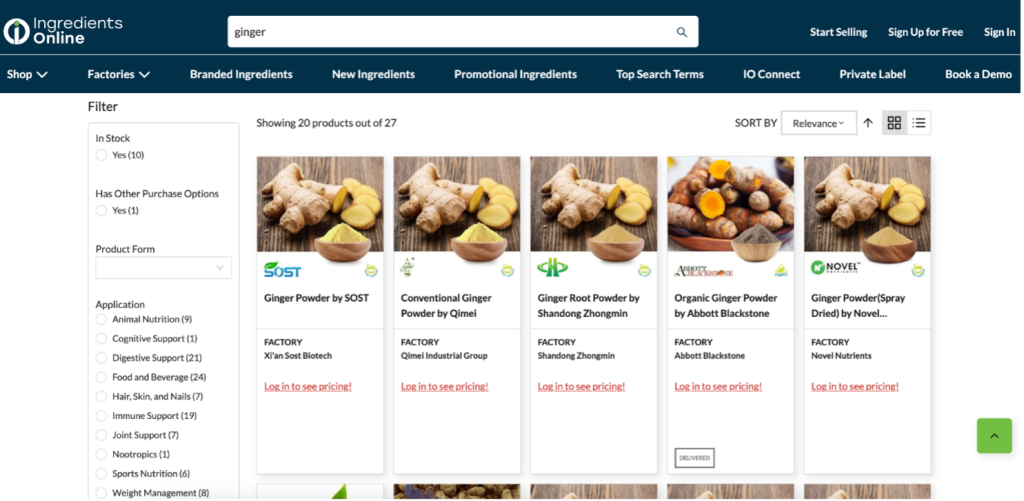
Source: Ingredients Online, 2025
Before getting started on an e-commerce platform, you must ensure you have the following in place:
- A stable internet connection is necessary to quickly respond to buyers’ questions, register and organise orders, and update product details and availability.
- A good understanding of e-commerce is necessary to set up a supplier account and manage sales.
- A digital banking account is needed because payments are made through direct online banking.
- Time to manage e-commerce to do business and satisfy your customers.
Start marketing your product on one e-commerce platform so you can get used to how online sales work and keep track of managing orders and questions more easily.
When active on e-commerce platforms, you must dedicate time to make it a success. Ensure every customer is satisfied with the product by providing accurate information on quality and certificates and responding to questions. Dissatisfied customers may leave negative reviews, which can harm your reputation and sales.
Tips:
- Convince buyers that your product stands out in terms of quality and price. Read CBI’s tips for finding buyers to learn how to market your products online.
- Check for any online marketplaces in your country and use them to expand your market.
- Setting up e-commerce takes some planning. Before you join a platform, make sure you have a clear product description with keywords and common uses; high-quality photos of the product, packaging and certifications; digital versions of your certificates such as Organic, FairWild or HACCP; a reliable internet connection and enough time to respond to buyers quickly; a mobile phone or online banking to manage payments; and a system to check and update your account each week.
4. Build traceability that earns trust and prepares you for regulation
If you export natural ingredients for health products to Europe, buyers will likely ask you to prove where the ingredients came from. European buyers increasingly expect transparency across the entire value chain, from farmer to exporter to final product. This is because consumers in Europe now care more about ethical sourcing and environmental and social impact. EU regulations such as the Corporate Sustainability Due Diligence Directive (CSDDD) also require businesses to show that they source responsibly and report correctly.
For NIHP suppliers, this means a system is needed to track and share supply chain data. Digital tools make this easier. Traceability matters because:
- Buyers trust traceable supply chains more than anonymous ones;
- Traceability helps avoid rejected shipments caused by missing documents or unclear sourcing;
- Traceability prepares suppliers for certifications like Organic, FairWild or Rainforest Alliance;
- Traceability allows suppliers to achieve higher prices, especially for verified sustainable products.
Without traceability, there is a risk of losing business to competitors who can prove where their products came from.
For example, consider a supplier exporting aloe vera powder for health and beauty products in Europe. Buyers want proof that your product is organic, responsibly handled and traceable back to the farm. Here is how to start, even with no previous digital experience.
Table 2: Example of a simple digital traceability system without expensive software
| Step | What to do | Tools to use | Tips |
|---|---|---|---|
| Identify each farmer | Assign each supplier/farmer a simple ID code (e.g., Farmer001). Keep a list with name, location and contact details | Notebook, Excel, Google Sheets | Keep records updated and consistent |
| Record each harvest | Write down the date of harvest, quantity (kg), farmer ID and location (village or GPS if possible). Use logbooks or Excel | Logbook, Excel, Google Sheets | Make sure each record links clearly to a farmer ID |
| Note handling or processing steps | Record cleaning steps, drying duration and storage or transport info. Use WhatsApp photos or notes | WhatsApp, notes, camera | Store data securely, back it up regularly |
| Link to batch number | When products are combined, assign a batch code (e.g., AV-Batch-2025-01) that links back to the collected data | Printed labels, Excel, Google Sheets | Use batch codes on packaging or delivery documents |
Source: ProFound, 2025
Even a basic setup like this can make a strong impression on European buyers, especially when it comes with clear documentation and regular updates. Once the basics are in place, digital tools can help scale traceability.
Some digital tools now use blockchain for added transparency.
- Smallholdr: Mobile and web-based tool designed for companies working with smallholder farmers. Tracks data like harvests, inputs, training and GPS coordinates.
- KoltiTrace: Not blockchain-based, but powerful for traceability, emission tracking, land use and deforestation. Digitises producer data and makes it available across the value chain. This is especially useful for sustainability-driven brands.
- Bext360 (Blockchain): Links all steps in the value chain on blockchain and provides real-time visibility from farm to port. Suitable for buyers who demand proof of origin and certification.
Blockchain is a digital system that creates permanent, transparent records of where products come from and how they move through the supply chain. Although blockchain technology offers promising solutions for agricultural traceability and transparency, it is not always the best starting point for individual farmers. These systems work best with groups of producers or cooperatives. Most blockchain providers partner with networks of exporters, aggregators and buyers who already use established digital systems.
Tips:
- Read CBI’s study on blockchain in Europe to understand blockchain better.
- Find examples of similar companies that have successfully adopted digital traceability tools. For example, look at how Tradin Organic in Sierra Leone has integrated Smallholdr into their value chain.
5. Showcase your brand story and impact with simple digital marketing
One of the easiest ways to go digital and build trust with international buyers is to create a simple educational email course as a buyer onboarding experience. This is a short series of 3-5 emails, each 500-800 words, that tells your brand story, explains your value and shows how your natural ingredients create value for the buyer.
Email marketing is one of the most effective ways for businesses to communicate with buyers, because consistent and helpful messages build trust, keep your business top of mind, and show that you are reliable and professional.
Personalised emails that address specific buyer needs, mention their industry challenges, or reference their company's products significantly increase engagement and response rates compared to generic messages.
Instead of sending one company introduction or a long PDF to buyers, an email series tells a story in small steps over five days. It is an easy way to stay on a buyer’s radar and give them information they need to decide. With AI, it is also easy to write emails quickly and get ideas for structure, wording and topics.
Here are some questions you can ask AI to help you create these emails:
- “Write an email that tells the story of how our baobab is harvested by women in rural Zimbabwe.”
- “Give me a short email that explains how our turmeric supports gut health trends in Europe.”
- “Help me explain how our business supports biodiversity and meets European buyer expectations.”
You can also ask AI to translate your emails into better English or make them more professional.
Here is a simple 5-day email sequence you can use:
- Our story: Explain who you are, what you grow and why you do it;
- Meet our producers: A short profile, photos or videos of your team or community;
- Our impact: Show how you support sustainability, local communities or biodiversity;
- What makes us different: A short explanation of your unique selling point with proof such as certifications, data or customer quotes.
- How to work with us: Explain the process for sampling, trial orders, buyer support and delivery terms.
These email series can be sent with free tools like Mailchimp. These tools allow you to create an automated welcome sequence, so when a buyer clicks or fills a form, they receive the emails over a few days without extra effort from you.
Tips:
- Write your first email with ChatGPT. Ask: “Write a short, professional email introducing our company that grows hibiscus and baobab in Uganda for the EU health market.” Edit it in your own voice.
- Start with a free tool like Mailchimp or Brevo. Both offer easy templates and free plans. You can upload your contacts and automate the email series.
- Use real photos from your farm or facility. Include 1–2 images per email to show your people, harvesting or community impact. This builds trust and brings your story to life.
- Add a simple call-to-action at the end of each email to invite the buyer to reply, request a sample or visit your website. Keep it low pressure and friendly.
6. Explore AI and agri-tech using simple online tools
According to The World Economic Forum, AI in agriculture is expected to grow from $1.7 billion in 2023 to $4.7 billion by 2028. If you want to export to Europe, you need to show potential buyers that you are adapting to the future. European buyers expect traceability, transparency and proof of sustainability. Learning about digital tools and taking small steps to use them in your business helps you provide this proof.
As a supplier of natural ingredients for health products, it is better to stay ahead of the trend. Even small exporters can now access free tools and training to get started with AI and digitalisation.
The best place to begin is ChatGPT. Use it as a thinking partner and ask questions like:
- How can I use digital tools to prove the origin of my moringa powder to European buyers?
- Can you help me create a checklist for preparing a Certificate of Analysis (CoA) for turmeric root?
You can also use ChatGPT to stay informed about changing regulations. Ask it to summarise the latest EU rules on pesticide limits, organic labelling or sustainability reporting. AI tools can help you stay ahead of buyer expectations and avoid surprises when preparing documentation.
The ITC SME Trade Academy is a free platform with simple courses for exporters. Two recommended courses are:
- Introduction to Artificial Intelligence for Digital Freelancers: teaches you the basics of AI, how tools like ChatGPT work and how freelancers and SMEs can use AI to save time and improve workflow.
- Special Session: Internationalization of Digital Businesses: shows how digital tools can help your business reach global markets, with practical strategies for marketing and international growth.
Here are some free resources to explore:
- SourceTrace tracks your supply chain and farm data;
- GS1 tools for barcodes and traceability;
- Canva for easy brochures and sell sheets;
- Loom for quick videos for buyer follow-up;
- COLEAD for agriculture and sustainability training;
- CBI for product fact sheets, market trends and buyer-connection tips for NIHP exporters;
- FAO for free publications on agriculture and food system innovations;
- Agrolearning by Solidaridad for mobile sustainability training in Latin America, East and Southern Africa and South-East Asia;
- Rodale Institute for free guides on organic farming.
Figure 4: AI tools that can be used to boost your productivity
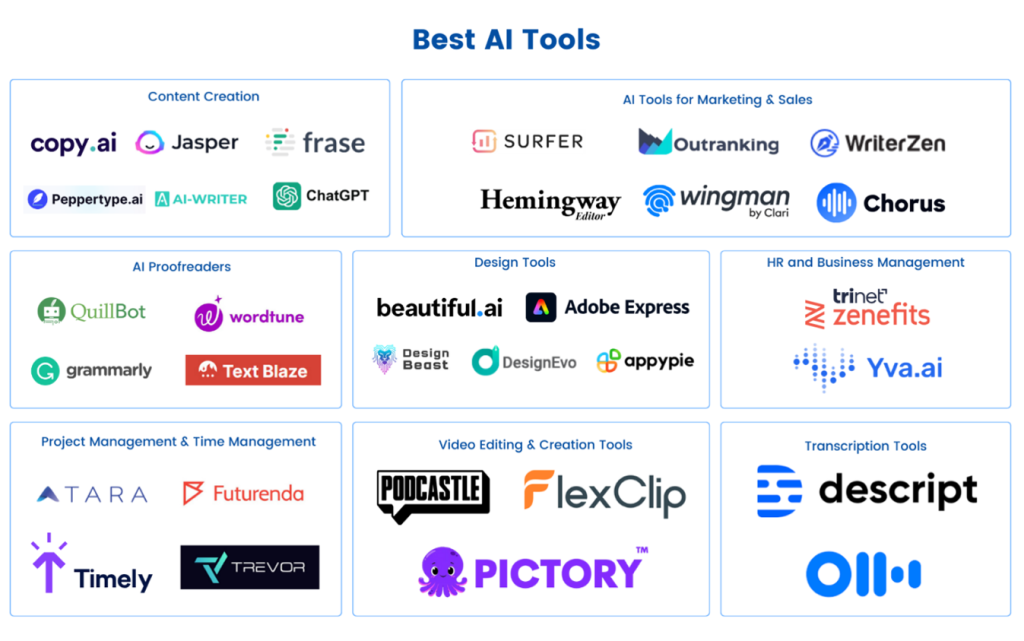
Source: Quixy, 2025
Tips:
- Choose a real challenge you are facing, like preparing export documents or improving traceability, and ask AI for help.
- Use AI to draft or improve sample request responses and follow-up messages.
- Role-play questions with AI. Ask what buyers might ask and practice answering. For example, “What questions might a European buyer ask me about my moringa powder at a trade fair?”
7. Solve daily production challenges with simple digital tools
Digital tools are no longer optional. They are becoming essential for suppliers of natural ingredients because they help you grow better products, reduce mistakes and meet the strict demands of buyers in Europe.
A research study on digital agriculture recommendations in cotton farming found that farms using digital agricultural recommendations, such as smart irrigation and weather planning, increased their yields by 12% to 17%. For NIHP suppliers – and especially those growing aloe vera, moringa, turmeric or baobab – digital tools often lead to better products, higher prices and more stable buyer relationships.
Figure 5: The impact of technology on agriculture
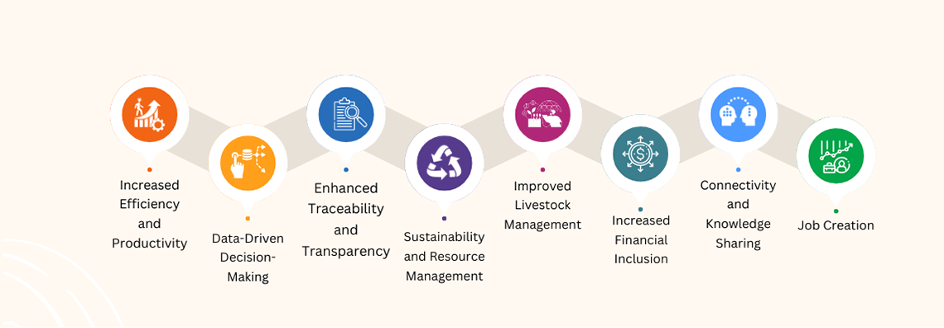
Source: CoreDevs, 2023
The benefits listed above are especially important if you want to start exporting or grow your presence in Europe. Better traceability, resource use and efficiency can give you a major edge when dealing with international buyers. However, many producers do not know where to begin. Start with a problem you already face and solve it with one digital tool.
Table 3: Problems farmers face and how digital tools can help
| Problem | Tools you can use | What it can help you do | Solution tutorial examples |
|---|---|---|---|
| Drying delayed by rain | Weather apps or affordable weather sensors | Plan harvest and drying to avoid spoilage and product loss | Weather stations for making more informed decisions |
| Too much or too little watering | Smart irrigation or soil-moisture sensors | Water only when needed, save water and grow healthier crops | Precision irrigation for smarter water management |
| Pest or disease outbreaks | Integrated pest management (IPM) solutions | Take a photo and get instant diagnosis and treatment advice | Pest management solutions for crop protection |
| Uneven crop quality | Drones or satellite crop monitors | Spot problems early and treat specific areas more efficiently | Satellite imagery for crop health monitoring |
| Too much manual labour | Auto-irrigation or auto-seeding equipment | Reduce manual work and increase consistency | Drip irrigation system for water conservation |
Source: ProFound, 2025
To solve farm-level problems, you can use Internet of Things (IoT) technologies. These tools include sensors and smart machines that help you monitor and automate farming activities. IoT technologies reduce guesswork, save time and improve yields, often with minimum effort.
Here is how IoT tools are used in agriculture:
- Smart irrigation: Monitor soil moisture and weather. You irrigate only when needed, saving water and improving yields;
- Precision farming: Track crop health, growth and nutrient needs. This helps apply fertiliser and pesticides only where necessary;
- Weather forecasting: Localised IoT weather tools help plan harvests, drying and other activities around rainfall or extreme conditions;
- Automation: Tools like auto-seeders or robotic harvesters reduce manual labour and improve consistency, although they often require higher initial investment;
- Drones: Help monitor crop health, identify problem areas and plan treatments. If buying is too expensive, consider renting or hiring a local drone operator.
Figure 6: Precision agriculture for SMEs
Source: Inter-American Development Bank, 2018
Tips:
- Assess which digital solutions align with your specific needs best. Identify a concrete problem that digital tools can provide a solution for. When comparing different options, think about who will be responsible for gathering data in your company and how (using which device).
- Ask within your network what tools others use and assess if they could be useful for you.
8. Access finance faster with simple digital tools
Accessing financial services is often difficult because of low availability, especially for smallholder farmers. A lack of financing can obstruct investments in inputs and productivity. Digital financial tools can help overcome this challenge by providing additional sources for loans, credits and banking services.
Several digital financing tools can be used to get financing for investment in agricultural inputs or practices, such as improved seeds and agricultural tools. Others offer basic banking services, such as digital financial transactions and savings accounts. You can receive payments and store funds using these tools.
In Indonesia, the company Koltiva helped small farmers to start using digital wallets. Their team trained farmers in the field and showed them how to get paid, save money and track their sales on their phones. As a result, more farmers now get paid faster and keep better records, which makes it easier to grow their businesses and work with bigger buyers.
Examples of digital finance tools include:
- Agri-Wallet: Gives farmers and aggregators easier access to financing from a global network of credit providers. It also helps manage payments and keep records digital.
- CashCard: Can be used by farmers in Nigeria. Farmers can access a savings account, payment services, and agricultural input credit through this tool.
- FarmerLine: Helps farmers by giving them access to credit and loans that can be used to buy agricultural inputs. The tool works with a flexible repayment system, allowing farmers to pay back loans when they have sufficient funds.
Figure 7: Functionality of the Agri-Wallet tool
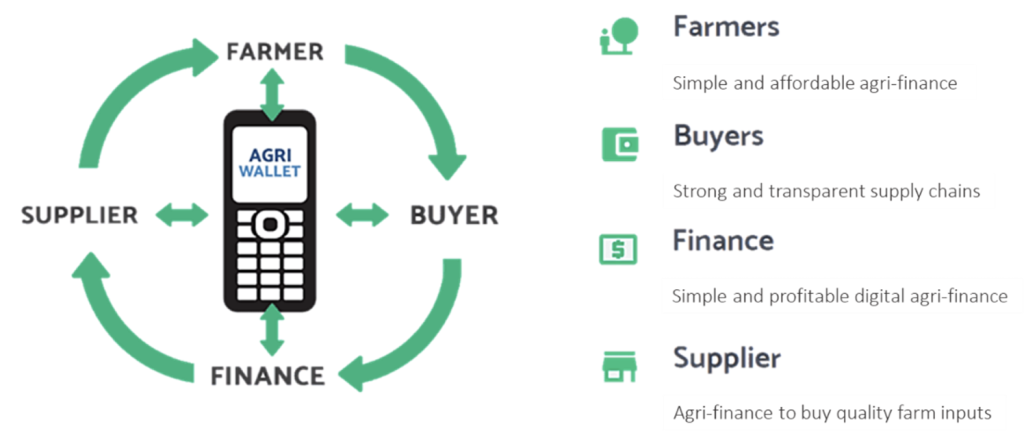
Source: Agri-Wallet, 2023
Not all tools will be available or suitable for you. Regional reach and product applicability can be significant constraints on who can use digital financing tools. Many of these tools help you track transactions and build a digital payment record, something that can improve trust with buyers and prepare you for traceability audits.
Tips:
- Read the Digital Financial Services for Agriculture Handbook by the IFC and Emerging business models to support the financial inclusion of smallholder farmers by the GSMA to understand the current development in digital financing tools for smallholder farmers.
- Build on your credit worthiness to get access to more credit. This requires you to keep track of your business records, have a coherent and robust business plan, have a clear investment plan and be able to provide information on your credit history and your assets.
- Ensure you understand how a digital finance tool works and that it aligns with what you need before you start using it. Sometimes, digital savings can only be used within the agricultural value chain.
9. Look for organisations and projects that can help you go digital
Integrating digital tools is challenging. It takes time, money and adequate digital skills. Therefore, you should consider asking organisations that offer support and guidance in going digital for help.
Digitalisation is an important topic for support organisations because it significantly improves business opportunities for SMEs. As a result, many NGOs, government agencies, and private sector organisations active in agricultural development have projects that support digitalisation. Using the support of these organisations makes your digitalisation easier and more effective.
You can find organisations active in your country by using search engines like Google. For example, if you are in Kenya, you can use the search terms ‘support digitalisation Kenya’.
Examples of support organisations and projects include:
- GIZ Digitalisation: A German international development agency that supports sustainable development in developing countries. Its digitalisation projects provide digital support in several developing countries.
- CCARDESA: An organisation that supports agriculture research implementation in southern Africa. Its website features an interactive map that shows where digital agriculture skills training is provided.
- Agrifin: a project that supports the introduction of digital technologies and innovation services to smallholders in Indonesia.
- Village Link: A digital support project in Myanmar. The same company developed the application Htwet Toe, which allows farmers to upload photos of their crop issues and ask questions in recorded voice messages. Farmers can receive advice from agricultural professionals on suggested treatments within 12 hours of asking.
- Markup: An EU-funded programme that supported the establishment of the East African Trade Information Portal and the Kenyan Trade Portal.
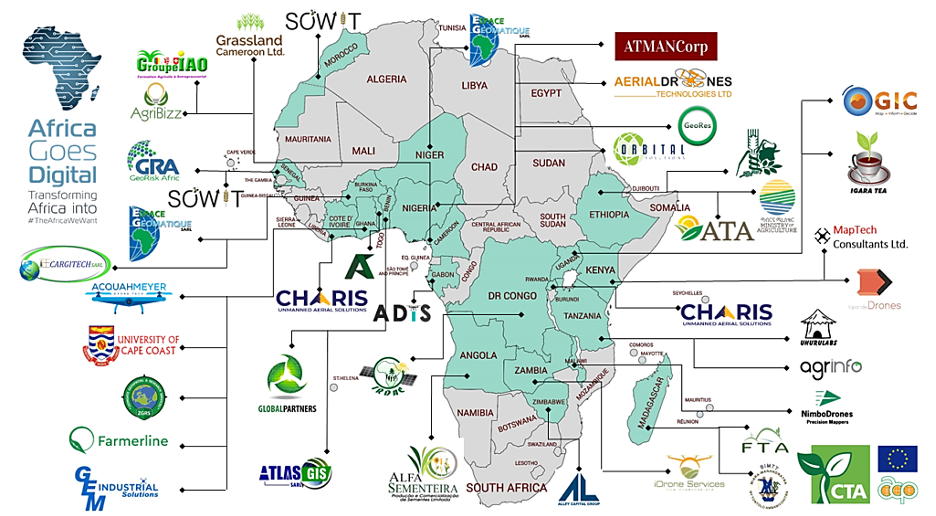
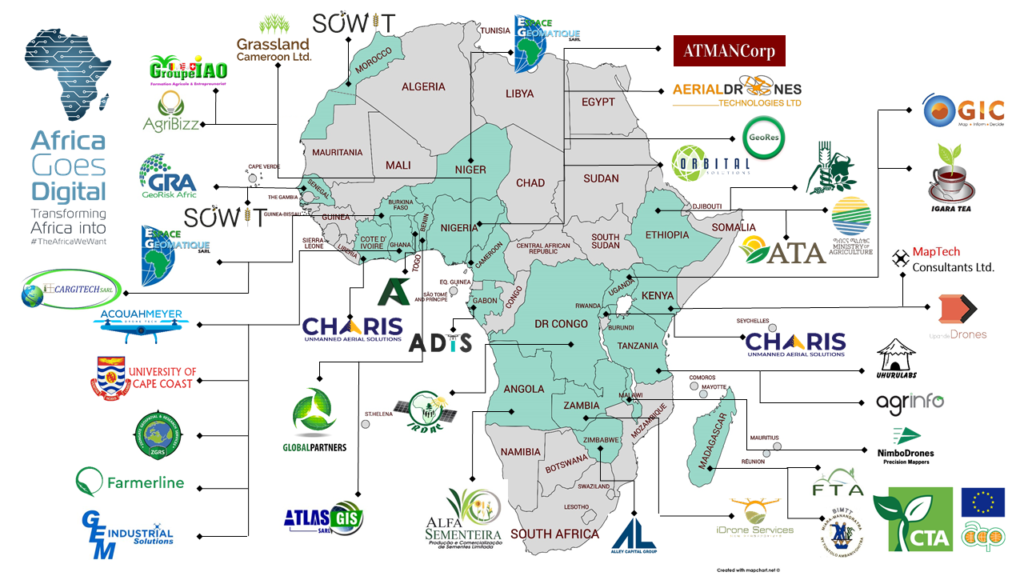
- Africa Goes Digital: An association of digital operators seeking to enable and promote the use of digital technologies for development in Africa. The members of this association offer multiple services, such as drone-based consultancy and training.
Figure 8: Members of Africa Goes Digital
Source: Africa Goes Digital, 2023
Tips:
- Search and connect with local organisations that can help digitalise your business.
- Participate in training organised by support organisations.
- Access the GIZ Innovation Fund website to see if they have any digitalisation projects of interest to you in your country.
- Read CBI’s tips for doing business and tips for finding buyers to learn more about using social media and optimising websites.
ProFound – Advisers In Development carried out this study on behalf of CBI.
Please review our market information disclaimer.
Search
Enter search terms to find market research