

Entering the European market for avocado oil
To enter the European market for avocado oil, you must meet mandatory requirements set by the EU. You should also consider meeting common additional requirements that European buyers and niche markets have, as this will help you with market access. The European market for avocado oil is divided into three segments, which provide different channels through which you can access the market. You will face competition from other countries, companies and products on the European market.
Contents of this page
- What certification and other requirements must avocado oil for cosmetics meet to be allowed on the European market?
- Through which channels can avocado oil enter the European market?
- What competition do you face on the European avocado oil market?
- What are the prices of avocado oil on the European market?
1. What certification and other requirements must avocado oil for cosmetics meet to be allowed on the European market?
Exporters of avocado oil from low and middle-income countries (LMICs) can only export to the European cosmetics market if their products comply with the EU’s mandatory legal requirements for natural ingredients for cosmetics. If you do not comply with these requirements, your avocado oil will not be admitted to the EU market.
What are the mandatory requirements for avocado oil?
Your products must comply with the EU’s mandatory legal requirements for natural ingredients for cosmetics. These include:
- Cosmetic Regulation (EC 1223/2009): the primary regulation for cosmetic products for the EU market, ensuring a high level of protection for human health. In May 2025, this regulation was updated by Regulation (EU) 2025/877 to include new restrictions on substances that can cause cancer, harm reproduction or change DNA (so-called CMR substances). Exporters should pay particular attention to Chapter III: Safety assessment, the Product Information File (PIF) and notification via the Cosmetic Products Notification Portal (CPNP).
- Registration, Evaluation, Authorisation and Restriction of Chemicals (REACH): this law applies to all chemical substances in the EU. Essential oils are not exempt. Companies in the EU must register essential oils with detailed safety data. Non-EU companies can appoint an Only Representative in the EU to register their product. While this is optional and expensive (around €40,000-€50,000 per oil), it does create new business opportunities. If your buyer wants less than 1 tonne per year, registration is not needed. If they want more than 1 tonne, they must buy from someone with REACH registration.
- The Classification, Labelling and Packaging Regulation (CLP) (EC No. 1272/2008): this regulation sets out the rules for labelling and classifying essential oils. It is based on the UN Global Harmonised System (GHS) and applies to many countries. You must provide a Safety Data Sheet (SDS) that includes hazard information for your oil and its main components. CLP data also appears in your SDS. CLP notifications submitted by EU manufacturers and importers are published by the European Chemicals Agency (ECHA). UNIDO has published a guide to understanding CLP for companies that have to produce their own data.
- In light of increased scrutiny under REACH and the EU Green Deal objectives, competent authorities have intensified checks on cosmetic ingredients. Demonstrating traceability, scientific claims and appropriate safety documentation is not only expected but essential.
Tips:
- Read our CBI study The EU Green Deal – How will it affect my business?, which provides valuable insights into how sustainability regulations, including EUDR and CSRD, impact exporters of natural ingredients.
- Visit the European Commission Access2Markets trade help desk, as it provides a complete list of requirements. Enter HS code 1515.90 for avocado oil and explore detailed information on regulations, tariffs and procedures.
- Familiarise yourself with the updated CLP guidance by ECHA, including the latest hazard icons and labelling obligations relevant to plant-based oils.
- Contact Open Trade Gate Sweden if you have specific questions regarding rules and requirements in Sweden and the EU.
Technical documentation
To comply with the EU’s legal requirements, European buyers of avocado oil expect complete and accurate technical documentation. This not only shows your commitment to quality but also to ethical and sustainable sourcing.
The technical dossier should include:
- Technical Data Sheet (TDS);
- Safety Data Sheet (SDS);
- Certificate of Analysis (COA);
- Allergen declaration;
- Traceability information;
- Sourcing policies and practices; and
- Certifications and standards applied.
Table 1: Contents of Safety Data Sheet (SDS), Technical Data Sheet (TDS) and Certificate of Analysis (CoA)
| Safety Data Sheet (SDS) | Technical Data Sheet (TDS) | Certificate of Analysis (CoA) which matches: |
|---|---|---|
| Product description | Product description | Data mentioned in the TDS |
| Product classification | Product classification | Pre-shipment samples approved by buyer |
| Hazard identification | Quality analysis | Contractual agreements with buyer |
| Information on safety measures | Information on applications | |
| Certificates |
Source: ProFound – Advisers in Development, 2023
Tips:
- Review the CBI study on preparing a technical dossier for cosmetic ingredients, which provides comprehensive information and guidance on preparing a technical dossier. Doing so will give you an advantage in your journey to enter the European market.
- Review the example Technical Data Sheet, Safety Data Sheet and Certificate of Analysis for avocado oil provided here.
- Use pre-existing information available about your avocado oil when preparing a dossier to substantiate any claims you make. This will likely save you time in your journey to enter the European market.
- If you have limited experience with Safety Data Sheets, engage a consultancy firm to help you prepare them. Laboratories and consultancy firms offering such services can be found by doing basic online searches.
Convention on Biological Diversity (CBD) / Access and Benefit-Sharing (ABS)
To export avocado oil to Europe, you must comply with requirements on using plant resources agreed under international treaties and protocols, including the Convention on Biological Diversity (CBD). This is because the CBD is a part of EU law. Furthermore, it is likely that your own country is also a signatory to the CBD. In that case, you have a legal obligation to comply with the CBD under the national law of your country.
The Nagoya Protocol on Access and Benefit-Sharing (ABS) provides guidelines on accessing and utilising genetic resources and traditional knowledge as well as the fair and equitable sharing of benefits. As with the CBD, European companies must comply with the ABS legislation, which is also likely to be a part of the national law of your country. As an exporter of avocado oil to the cosmetics sector, you should make sure you comply with the ABS legislation.
Tip:
- Visit the CBD website, as it provides a range of useful information on CBD and ABS. For example, the country profile function provides information about your country’s position on CBD and ABS and about exporting from your country.
What additional requirements and certifications do buyers of avocado oil ask for?
European buyers of avocado oil in the cosmetics industry are increasingly demanding that the avocado oil they buy is of the finest quality. You should therefore ensure that your avocado oil meets good and verifiable standards for raw material production and manufacturing processes.
There are no internationally defined parameters for avocado oil in the cosmetics industry. However, European buyers often have specific requirements, particularly with regard to chemical composition, colour, odour and texture. The concentration of fatty acids such as oleic and palmitic acid is especially relevant, as this impacts the oil’s emollient properties and absorption profile.
Avocado oil for cosmetic products has to be pure and free from chemicals and other contaminants. You must ensure that there are no foreign substances in your avocado oil.
Based on new environmental regulations such as the Green Deal, some buyers now request additional traceability information related to natural ingredients. This is also the case for avocado oil, particularly when it is sourced from countries at risk of deforestation. Buyers may also require proof of organic certification, pesticide-free production or cold-pressed extraction to ensure product integrity.
High-quality, consistent avocado oil is important to European buyers because it is vital to making cosmetics. Buyers therefore prefer high-quality avocado oil across all orders, in packaging that is suitable to the order volume; for example, avocado oil in a steel drum that can hold 25 kilograms.
Tips:
- Ensure that your product specifications align with the technical expectations of European buyers, including when it comes to fatty acid profile, appearance and scent. This demonstrates your commitment to quality and strengthens your market credibility.
- Only make agreements with buyers if you can guarantee that you will uphold them. Failing to fulfil commitments may damage or end your business relationship with buyers.
- Proactively share recent Certificates of Analysis (CoA) and Technical Data Sheets (TDS) with prospective buyers, and tell them about any additional certifications (COSMOS, ISO 16128, Fair for Life) you have that support your position in the market.
Quality management standards
European buyers of natural ingredients for cosmetics are increasingly using quality management standards when assessing the credibility of prospective exporters. Adopting quality management standards gives you credibility because it shows your commitment to delivering high-quality ingredients, along with giving your company a favourable image. It can also help to demonstrate your compliance with mandatory requirements.
You should therefore consider adopting quality management standards, as the system you need to have in place for this will help to increase the quality of your avocado oil and make it more appealing to buyers. Examples of standards which help to demonstrate the good quality of your avocado oil include:
- Good Agricultural and Collection Practices (GACP).
- Good Manufacturing Practices (GMP) developed by the European Federation for Cosmetic Ingredients.
You should also consider adopting quality standards for production methods, as these will help you to enter the European market. Examples include:
- ISO 22000 (Food safety management systems) and ISO 9001:2015 (Quality management systems) from the International Organization for Standardization (ISO).
- Food Safety System Certification (FSSC) 22000.
- Consider following the HACCP Hazard Analysis and Critical Control Points system.
Tips:
- Inform European buyers about the standards you meet, as it increases your appeal. It may give you an edge over other competitors, as buyers look for these standards when assessing exporters.
- If you have certifications or use sustainable practices that are valued by buyers, promote these on your website and in your marketing materials.
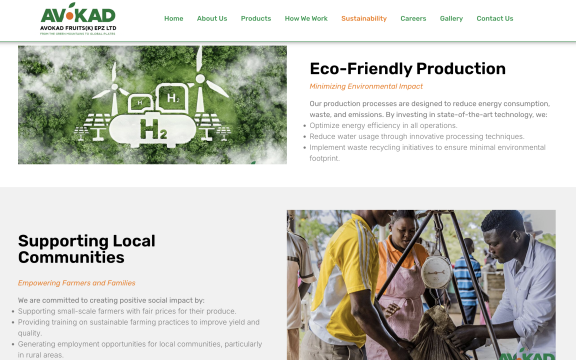
Avokadfruits, a Kenyan producer of cold-pressed avocado oil for cosmetics and food applications, with growing exports to the EU, is a good example. The company works with smallholder farmers using organic and sustainable farming protocols. It emphasises ethical sourcing, fair labour practices and environmentally responsible techniques.
Figure 1: Avokadfruits sustainability projects website
Source: Avokadfruits, 2025
Labelling and packaging
Along with complying with the EU’s mandatory Classification, Labelling and Packaging (CLP) requirements as set out in Regulation (EC) 1272/2008, consider meeting other common additional labelling and packaging requirements that European buyers have. This includes listing the following on your product documentation and labels in English unless asked otherwise:
- International Nomenclature Cosmetic Ingredient (INCI) name and product name;
- Name and address of exporter;
- Batch code;
- Place of origin;
- Date of manufacture;
- Best before date;
- Net weight;
- Recommended storage conditions; and
- Organic certification number along with the name/code of the certifying inspection body if you export organic avocado oil.
European buyers require good-quality avocado oil, so consider preserving the quality of your avocado oil by doing the following when it comes to packaging:
- Using aluminium-lined or lacquered steel containers, as they do not react with the components in avocado oil.
- Ensuring packaging materials such as drums are clean and dry before avocado oil is put into them.
- Filling the headspace in packaging, such as in shipping containers, with gases that do not react with components in avocado oil. Examples of such gases include carbon dioxide and nitrogen.
You can also preserve the quality of your avocado oil in other ways. These include ensuring your avocado oil is kept at an appropriate temperature throughout its supply chain, along with storing the oil in a dry place.
The EU has reaffirmed its strong commitment to environmental sustainability through initiatives such as the Circular Economy Action Plan and the European Green Deal. These frameworks aim to reduce environmental impact across all sectors, including cosmetics and packaging, by setting targets for waste reduction, recycling and responsible resource use.
As a result, European companies face increasing regulatory and reputational pressure to minimise packaging waste and enhance the recyclability of product materials.
In 2024, the EU adopted the Packaging and Packaging Waste Regulation (PPWR), which will gradually require all packaging to be recyclable by design by 2030. Exporters are therefore encouraged to eliminate unnecessary packaging and switch to sustainable options that meet recyclability and labelling criteria.
Figure 2: Examples of packaging for avocado oil

Source: Catania Oils, 2025
Tips:
- Speak to European buyers to find out if they have preferences as well as specific requirements concerning labelling and packaging. Consider meeting them, as it can help to increase your chances of entering the European market.
- Only agree to meet specific packaging requirements of European buyers if you can meet them. Failing to do so could end your business relationship with buyers.
- Inform your logistics provider that your avocado oil needs to be kept in a cool and dry place on its journey to the European market to preserve its quality.
- Consider using recycled and/or recyclable packaging materials, as environmental sustainability is becoming increasingly important to European buyers. Read the guide on packaging to reduce environmental impacts for information and guidance on ways to do this.
- Ensure certified organic avocado oil and conventional avocado oil are physically separated to prevent contamination.
Payment terms
Payment is central to all trade and presents risks to all parties involved. Before doing business with European buyers, you should do risk assessments of the available payment terms. As an exporter of avocado oil, you should ensure that you minimise your risks whilst working to meet the needs of European buyers.
There are several methods of payment. However, for both importers and exporters, Letters of Credit (LC) are considered to be the safest payment term. An LC allows both parties to contact a neutral arbitrator, usually a bank, to resolve any issues. For the exporter, the chosen bank is a guarantor of full payment as long as the goods have been dispatched.
Based upon their needs, importers and exporters can choose from several LC payment terms. They include standby, revocable, irrevocable, revolving, transferable, un-transferable, back-to-back, red clause, green clause and export/import. For exporters, a standby LC is considered to be the safest, and it is frequently used in international trade. This is because it provides security to both importers and exporters who have little trading experience with each other. Other payment terms include cash in advance, documentary collections and open account.
Tips:
- Minimise your risks whilst working to meet the needs of European buyers. You can do this firstly by assessing your needs, secondly by speaking to European buyers and finding out their needs, and thirdly by working out a compromise that satisfies both sides. Do not agree on terms you cannot meet.
- See the CBI study on tips for organising your exports of natural ingredients for cosmetics to Europe, which provides guidance on available payment terms used in this sector.
Delivery terms
Before agreeing on delivery terms with European buyers, you must carefully consider three important factors: delivery time, volume and cost.
- European buyers typically prefer short and reliable delivery timelines. Air freight is faster and often more predictable than sea freight. Planning and maintaining close communication with logistics providers is essential.
- The mode of transport should align with the volume being shipped. Larger quantities are generally more economical by sea, whereas smaller orders may be better served by air freight due to their urgency and limited scale. Buyers may request partial shipments for large orders to reduce warehousing costs or match production schedules. Discuss flexibility during contract negotiations.
- Sea freight continues to be 4 to 6 times more cost-effective than air freight. However, exporters should monitor new surcharges related to the EU Emissions Trading System (ETS), which now applies to emissions from maritime shipping. These changes may lead to increased sea freight costs in the coming years.
Exporters must manage increased volatility across supply chains. Port delays, container shortages and fuel surcharges continue to impact shipment schedules and delivery costs. Buyers in the EU expect proactive communication and transparency when disruptions occur.
Tips:
- Be open-minded and flexible and remember that there will be tensions and trade-offs with European buyers, especially if you are doing business with them for the first time.
- Learn about Incoterms. This knowledge will help you when negotiating payment and delivery terms with your potential buyers.
- Consult your logistics partners about recent regulatory changes, such as the EU’s Emissions Trading System (ETS) for maritime freight, and assess the impact of environmental and customs requirements on delivery timelines.
- Where possible, offer alternative shipping routes or staggered deliveries to help buyers manage uncertainty.
What are the requirements and requested certifications in the niche avocado oil markets?
There is growing demand for certified raw materials in the European cosmetics market. Buyers increasingly prioritise ingredients that meet natural and organic certification standards, as they seek to align with consumer expectations, regulatory trends and sustainability goals. The market for fair trade-certified avocado oil is expanding, especially among brands committed to transparent value chains and social impact.
The leading organic standards are:
There are over ten other natural and organic cosmetic standards in Europe; they include Demeter and Organic Farmers and Growers.
Exporters of avocado oil from LMICs can obtain various certifications that represent environmental and social standards. These include:
- UNCTAD BioTrade Initiative BioTrade Principles and Criteria.
- FLO Fairtrade and FairForLife standards.
- FairWild, which attests the use of sustainable collection, social responsibility, and fair-trade practices.
Figure 3: Logos of organic and fair-trade certifications

Source: NATRUE, Fair for Life, Fairtrade, FairWild, 2025
Tips:
- Consider obtaining natural and/or organic certification for your avocado oil, as this will likely give you an advantage in entering the European market.
- Visit the NATRUE website and the COSMOS website and review the information they provide on obtaining natural and/or organic certification for your avocado oil.
- Read our CBI study 9 tips to go green with natural ingredients for cosmetics about how you can prepare to make your business more environmentally friendly while ensuring that it will remain competitive and be attractive to European buyers.
- Visit and review the information available on the ITC Sustainability Map about certification schemes in the sector. This will make you more knowledgeable about popular certification schemes in the European consumer market for cosmetic products and their natural ingredients.
2. Through which channels can avocado oil enter the European market?
In the European market, avocado oil is mainly used in the food, cosmetics and health product industries. Avocado oil mainly enters the European market through importers/distributors. European processors may also directly source avocado oil from producing countries; this is another important channel. As an exporter, it is important to know how the European avocado oil end-market is segmented, through which channels avocado oil is brought into the European market, and which of those channels is the most interesting for you. This knowledge will help you to enter the European market.
How is the end-market segmented?
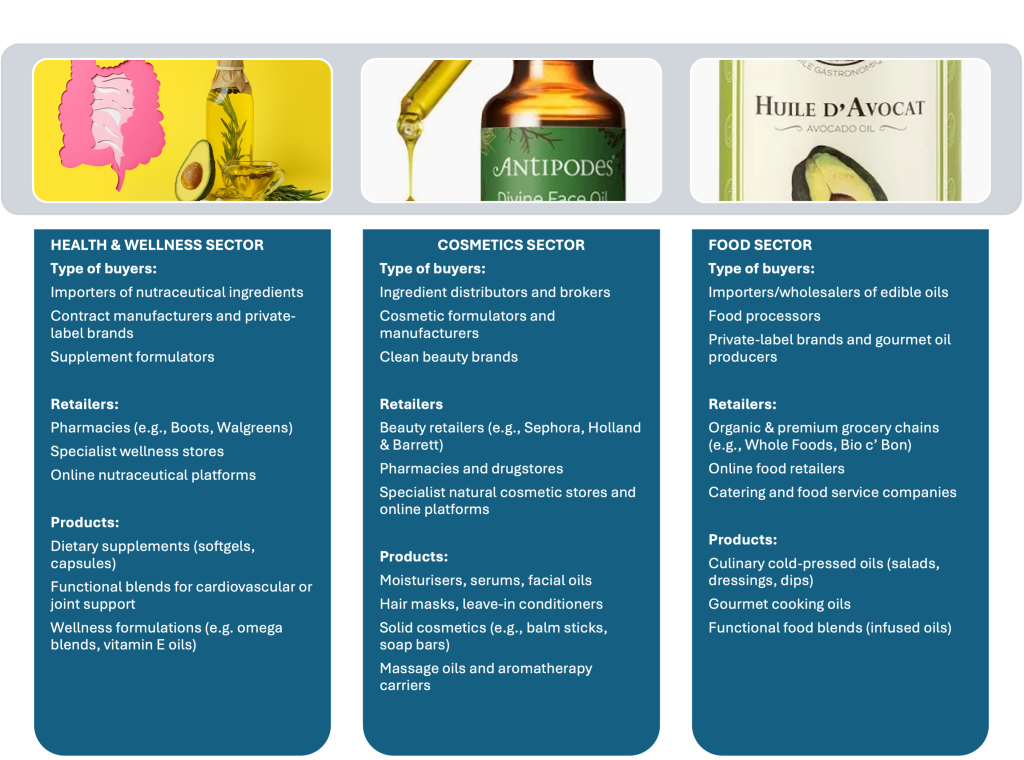
The European market for avocado oil can be segmented by end-user industries: the cosmetic, food and health product industries. Figure 4 gives examples of avocado oil products in each segment of the European market. This study focuses on avocado oil used by the cosmetics industry.
Figure 4: Examples of avocado oil products on the European market
Source: ProFound, 2025
Cosmetics sector
The cosmetics industry uses avocado oil in personal care products as an active ingredient because of its properties. It is a rich source of vitamins A, D, E, C, as well as omega 3 fatty acids and oleic acid. Avocado oil has several applications in the cosmetic sector because of its moisturising and antioxidant properties. These include the ability of avocado oil to replenish dry skin, calm itchy skin, moisturise skin, protect skin from ultraviolet radiation, protect against skin damage and help to heal sore skin.
Avocado oil is also used in haircare products because it gives shine, smoothness and softness, as well as being ideal for dry hair. Avocado oil is also used in massage oil because of its active ingredients. The global avocado oil market was valued at approximately US$ 610.5 million in 2024, and is projected to grow to US$ 886.0 million by 2033. This growth is supported by the rising interest of European brands in 'plant-powered' and 'farm-to-face' products, which avocado oil aligns with, particularly if it has organic production or sustainability certification.
In addition to pursuing organic production and sustainability certifications to validate the natural origin of your avocado oil, you should also prioritise social responsibility throughout your value chain. Have a look at our CBI study 9 tips on how to become more socially responsible in the natural ingredients for cosmetics sector.
Food sector
The food and beverage industry uses avocado oil because of its active ingredients, particularly its high oleic acid content. It is also used because it is high in fibre and potassium, is rich in texture and has a pleasant flavour. The food and beverage industry also uses avocado oil because it is considered to be a healthier alternative to other vegetable oils, such as olive oil.
Health and wellness sector
Avocado oil is used in health products such as supplements as an active ingredient because of its properties. These include its antioxidant and anti-inflammatory properties, oleic content and ability to help control cholesterol levels, lower blood pressure, improve heart health and enhance wound healing.
This study focuses on the use of avocado oil by the cosmetics industry.
Tips:
- Familiarise yourself with the beneficial properties avocado oil provides to the cosmetic industry. Avocado oil is a rich source of vitamins A, D, E, C, omega 3 fatty acids and oleic acid, which makes it ideal for a range of cosmetic applications.
- Visit trade fairs such as InCosmetics and BIOFACH to determine if the industry is open to your product, get market information and find potential buyers. Trade fairs also give you an opportunity to speak to end-users and distributors and see your competition marketing their products.
- See the CBI study on tips for finding buyers in the European cosmetics market for an overview of trade fairs in the sector.
Through which channels does avocado oil end up on the end-market?
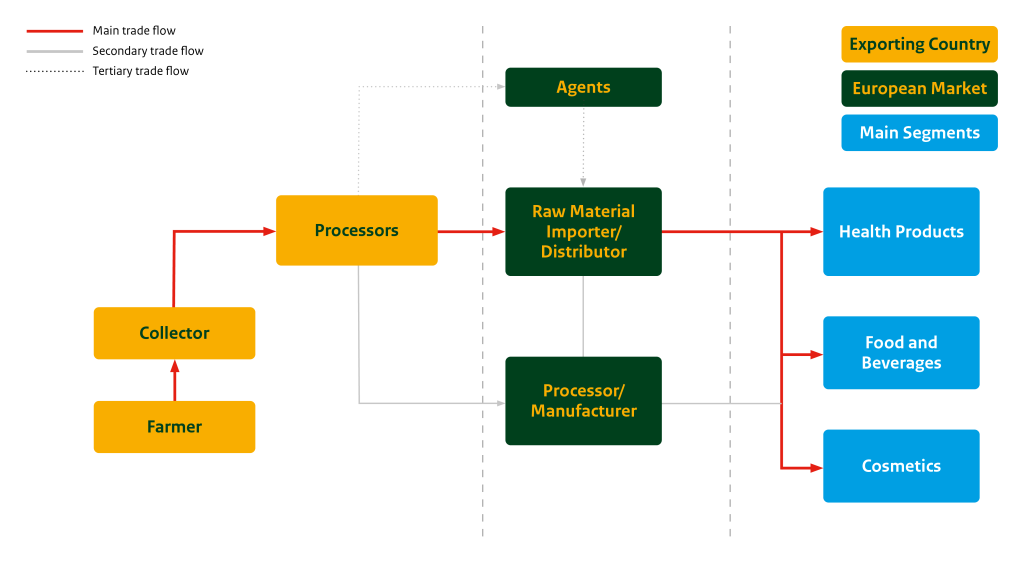
Avocado oil exports go through multiple channels before reaching the European market. Avocado oil is extracted from avocado fruits by several methods, including cold-press and solvent extraction. It usually reaches the European market in a liquid form.
Figure 5: Export value chain of avocado oil
Source: CBI, 2025
Importer/distributor
As a processor/exporter in a developing country, the main entry points to the European avocado oil market are importers/distributors. European importers/distributors often trade in a wide range of natural ingredients. Their expertise lies in global sourcing and storage of natural ingredients, ensuring product quality as well as documentary and regulatory compliance, while also selling to processors and cosmetic companies.
The importers/distributors De Lange, Gustav Hees and O&3 supply avocado oil to European companies. Some importers/distributors, such as SanaBio, specialise in trading and supplying organic avocado oil to European cosmetic companies.
Agents
An export agent is a firm or an individual that undertakes most of the exporting activities on behalf of an exporter, usually for a commission. Agents can be found in producing countries as well as in Europe; however, it is uncommon for companies to use agents in the European market. Exporters from LMICs can work with agents who represent them and act on their behalf on the European market.
Processor/manufacturer
European buyers frequently travel to producing countries to evaluate suppliers of avocado oil and build trust before entering a commercial relationship. In addition, European processors may source raw avocados directly from producing countries through long-term sourcing agreements or investment projects, and then extract the oil locally in Europe. Olvea (France) is an example of a company that uses this model.
Processing of avocado oil also takes place outside Europe, in countries such as Mexico, the US and New Zealand, where mature industrial capacities exist.
In recent years, several buyers have begun favouring vertically integrated supply chains, where the oil is processed close to the point of harvest. This is seen as a way to improve quality control and traceability while reducing the carbon footprint associated with transport.
Tips:
- Consider expanding your avocado oil portfolio by including organic avocado oil, as this is likely to help you find a wider range of customers. A wider product range gives you more attention on the market, thus making you stand out from your competition.
- Be prepared to provide high-quality samples to prospective buyers, who will test your samples to assess whether you are a credible exporter of avocado oil and someone they can do business with.
- Ensure that your final product matches the quality of the approved samples. European buyers expect full consistency between test batches and commercial orders.
What is the most interesting channel for you?
As an exporter of avocado oil, importers/distributors are the most interesting channel for you. This is because importers/distributors have expertise in importing and distributing natural ingredients and they usually have integrated supply chains. An integrated supply chain means having different parts of the supply chain working closer together to improve response time, production time, and reduce costs and waste. Because of their broad customer base, importers/distributors often require a range of avocado oils and are thus keen to find new suppliers.
Tips:
- Invest in the quality of your products before entering the European market. You have to ensure your avocado oil is of high quality and accompanied by a technical dossier. European buyers lose interest when a new supplier delivers a low-quality product or cannot provide a technical dossier.
- See the CBI study on tips for finding buyers in the European cosmetics market, which provides information and guidance on finding buyers in channels through which you can reach the European market, particularly importers/distributors, who are your main entry point into the European market.
3. What competition do you face on the European avocado oil market?
The European avocado oil market is increasingly competitive, with several origin countries establishing themselves as reliable suppliers. Exporters aiming to enter this market must understand the strengths, weaknesses, and positioning of key competitors.
Which countries are you competing with?
Producing countries successfully exporting avocado oil to the European market often share several key strengths that are fundamental to their success. These include having an established avocado production industry, favourable climatic conditions, government support and an improving infrastructure.
Mexico is a global leader facing challenges
Mexico is the world’s leading avocado producer and a top exporter of avocado oil. The country’s mature avocado industry, robust processing infrastructure and year-round production capacity contribute to its global competitiveness. However, concerns have been raised by EU buyers regarding environmental issues, including water stress, pesticide use and illegal deforestation in Michoacán. These risks may affect Mexico’s long-term position, unless sustainability practices are strengthened.
Peru is a reliable supplier with a strong export infrastructure
Peru is the second-largest global avocado exporter after Mexico, with avocado oil exports steadily growing thanks to private investment and modern processing facilities. Favourable climate conditions and efficient logistics strengthen its position. While recent El Niño weather events temporarily affected volumes, production is expected to rebound in 2025. Peru’s efforts to improve traceability, certification and sustainable farming practices enhance its reputation among EU buyers.
Kenya is an emerging responsible exporter to Europe
Kenya is gaining importance as a sustainable avocado oil supplier to Europe, producing around 114,000 tonnes in 2023, 20% of which was exported through Rotterdam. The country benefits from programmes such as NTF III and is developing blockchain-based traceability systems. However, temporary export restrictions and buyer demands for consistent year-round quality remain challenges. Kenya’s positioning as a ‘green and fair’ producer gives it growing visibility among European importers looking for ethical sourcing options.
Colombia is a year-round producer advancing in traceability
Colombia’s diverse microclimates allow year-round avocado production, offering European buyers a stable potential supply. The country is investing in traceability and certification through initiatives like Carbon Hass, and in developing post-harvest infrastructure. Although limited logistics capacity and export volumes are still constraints, Colombia’s growing alignment with EU sustainability requirements and focus on regenerative agriculture position it as an increasingly reliable supplier.
Tips:
- Find out if there are avocado trade associations in your country that could help you export avocado oil. The South African Avocado Growers Association, for instance, is a business development association that provides services, programmes and activities designed to support the business development objectives of its members. The Avocado Society of Kenya and the Colombian Hass Avocado Corporation Corpohass are also examples of organisations assisting exporters with certification, agronomic training and EU traceability tools.
- Highlight your competitive advantages over producers from other countries. For example, producers in countries where avocados are widely harvested and/or cultivated year-round should emphasise that they are in a position to supply avocado oil in larger volumes throughout the year.
- Read our CBI study The EU Green Deal – How will it affect my business?. If you export goods to the EU, you need to understand how the EU Green Deal might affect your business, and how you need to prepare for these changes.
Which companies are you competing with?
Several established companies in producing countries are successfully exporting avocado oil to the European market. These companies market themselves as being able to deliver high-quality avocados which meet common European buyer requirements, as well as requirements for niche markets. Thus, these companies have good reputation and credibility in the European market.
AETH – Mexico
Aceites Especiales TH (AETH) is a specialised Mexican manufacturer of cold-pressed avocado oil, with a strong export focus on the European market. The company operates out of Michoacán, Mexico’s main avocado-growing region, and controls the entire value chain, from fruit selection and processing to oil extraction and quality assurance.
Key characteristics:
- Cold-pressed extraction using advanced stainless-steel equipment designed to preserve the natural bioactive components of the fruit (oleic acid, vitamins, antioxidants);
- Holds EU Organic Certification and COSMOS Certification for cosmetic use, enabling it to meet the high demands of clean beauty brands in Europe; and
- Portfolio includes virgin, refined and deodorised avocado oil tailored for use in both food products and cosmetics.
AETH shows the benefits of full supply chain control and third-party certification. Its investment in transparency and technical standards helps meet European buyer expectations.
VIRU – Peru
VIRU is a leading Peruvian agro-industrial company that exports avocado oil alongside a range of processed avocado products. The company operates integrated farming and processing facilities across Peru, including modern oil extraction plants. VIRU focuses on delivering traceable and certified avocado oil that meets European standards for both cosmetic and food use. Its established partnerships with European buyers reflect strong performance in sustainability, food safety and supply consistency.
Key strengths:
- Offers cold-pressed and refined avocado oil certified under the EU Organic and GlobalG.A.P. schemes;
- Ensures consistent quality with in-house processing and traceability systems; and
- Supplies both food-grade and cosmetic-grade oils, tailored to buyer specifications.
Peruvian SMEs like VIRU benefit from Peru’s strong agro-industrial base and growing investment in sustainable production practices aligned with European market demands.
Fairoils – Kenya
Fairoils is a vertically integrated company sourcing avocado oil from Kenyan smallholders. It operates its own pressing facility in Kenya and refines oil in Belgium, allowing it to serve both food and cosmetic markets. The company prioritises ethical sourcing, organic agriculture and social impact.
Key characteristics:
- Strong emphasis on crude extra virgin oil for skincare and haircare formulations;
- Certified under FSSC 22000, ISO 9001, Ecocert and COSMOS for organic and natural ingredients;
- Traceable smallholder sourcing model, aligned with EU expectations; and
- Provides detailed CoAs, technical data sheets and batch traceability.
Fairoils demonstrates how SMEs can add value by linking smallholders to premium markets through certifications and partnerships. EU-based final processing enhances product acceptance.
Corpohass – Colombia
The Colombian Hass Avocado Corporation (Corpohass) supports Colombian producers and exporters of avocados and avocado oil. While not a commercial company itself, it helps companies that supply avocado oil by facilitating traceability innovation and quality systems. The Carbon Hass initiative, for example, supports blockchain-based traceability tools to strengthen Colombia’s presence in the EU market.
Key strengths:
- Promotes avocado oil producers with blockchain traceability pilots (Carbon Hass);
- Supports training, quality certification and international market access; and
- Strengthens Colombia’s reputation as a year-round avocado supplier.
Colombian SMEs benefit from industry support programmes that promote digital traceability, sustainability alignment and year-round availability.
Tip:
- If your country has an association like Corpohass, use it to access training, compliance tools and buyer contacts.
Which products are you competing with?
Avocado oil is primarily used in cosmetics for skincare and haircare products. This is because of its moisturising and antioxidant properties. Its main application is to soothe dry skin. There are various oils that compete with avocado oil in its personal care applications. Examples include baobab oil, jojoba oil and argan oil.
Baobab oil
According to industry sources, baobab oil is a competing alternative to avocado oil due to similar applications, especially in skincare and haircare products. However, awareness of baobab and baobab oil is not very high yet among European consumers. Formulators and European consumers are also more familiar with avocado oil because it has a well-established supply chain and is more widely used.
Figure 6: Baobab oil

Source: Deeza Organics, 2025
Jojoba oil
Jojoba oil is a competing alternative to avocado oil because of its essential fatty acid content, which gives it beneficial moisturising properties. It is used in haircare products, such as shampoos and conditioners. It can also be used to treat dry scalp and fight dandruff. Jojoba oil is a direct competitor, as cosmetics formulators are much more familiar with it and its use in personal care formulations and it has a well-established supply chain.
Argan oil
Argan oil is a product that competes with avocado oil because of its similar applications. Its main applications are skin moisturising, treating several skin conditions and imparting shine to hair. The anti-aging properties of argan oil are another of its key benefits. Formulators are also more familiar with argan oil, as it has a well-established supply chain and it is widely used, which are two of its key strengths. However, argan oil is significantly more expensive compared to avocado oil.
Figure 7: Argan oil

Source: myfmpa.ma, 2025
Tip:
- Familiarise yourself with products competing with avocado oil that are available in the European market. Learn about their strengths and weaknesses. You can do this, for example, by reading our CBI studies on baobab oil, which is one of the competing products.
4. What are the prices of avocado oil on the European market?
Avocado oil prices in Europe depend on the grade (virgin, refined, organic), extraction method and packaging volume. According to IMARC Group, export prices from Mexico in Q4 2024 were approximately US$14,220 per metric tonne (US$14.22 per litre). These reflect bulk commodity pricing trends.
Prices are expected to remain volatile due to climate change (El Niño), global logistics costs and sustainability compliance requirements under EU law.
Exporters offering traceability, sustainability certifications and low-carbon transport may be able to charge a 10-15% premium in European natural cosmetics markets.
Figure 8: Estimated price breakdown of avocado oil products in the European market
| Type | Typical price range | Notes |
|---|---|---|
| Crude avocado oil | US$5.00-7.00/kg | Food and cosmetic use. Often filtered but not refined. |
| Refined avocado oil | US$6.00-8.50/kg | Deodorised, filtered, neutral scent. Cosmetic-grade. |
| Organic certified oil | US$7.50-10.00/kg | EU Organic or COSMOS. Premium segment. |
| Cold-pressed extra virgin | US$8.00-12.00/kg | Niche/high-end use in premium cosmetics. Small volumes. |
Source: Tridge, 2025
Tips:
- Be flexible with prices when buyers order larger volumes. You can offer them a discount once you have established a relationship with them.
- Certification schemes allow you to charge a premium for your avocado oil. Ensure you can justify your price with relevant certifications.
ProFound – Advisers in Development carried out this study on behalf of CBI.
Please review our market information disclaimer.
Search
Enter search terms to find market research
Do you have questions about this research?
I believe that public-private coordination is key to boosting Colombia’s presence in the European cosmetics market. Initiatives like Corpohass illustrate how strong sectoral alliances can support traceability, sustainability and export competitiveness for Colombian avocado oil.

Camilo Martinez, Director of ProColombia France