
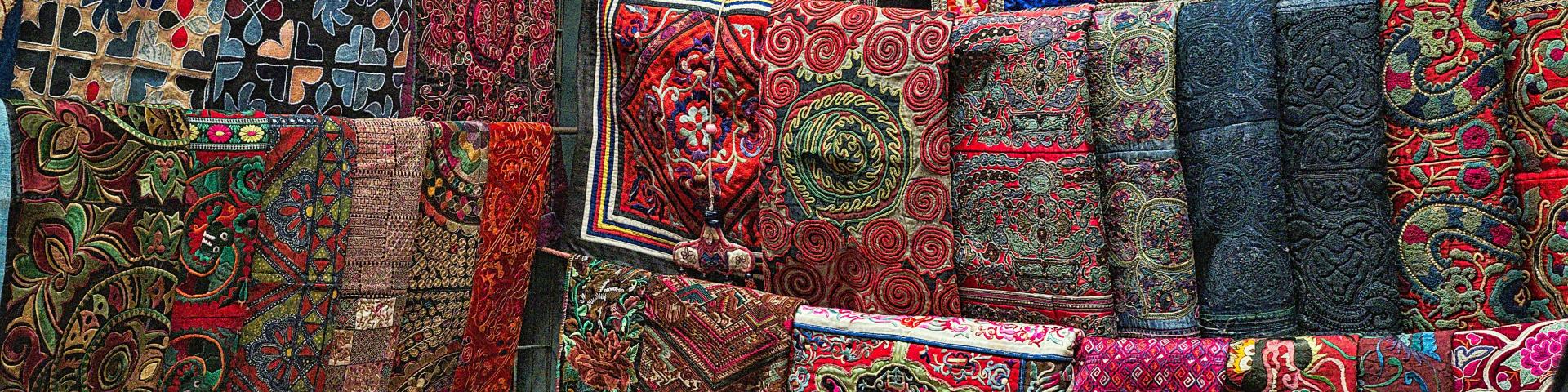
The European market potential for handwoven rugs
Europe sources about two-thirds of its handwoven rug imports from developing countries. This makes it an interesting market for you. For the production of handmade rugs, both environmental and social sustainability are highly relevant. Using traditional techniques and designs adds to your product’s story, which you can give a modern twist. Customisation and co-creation have become more important. If you can offer these options, it can make you more attractive as a supplier.
Contents of this page
1. Product description: handwoven rugs
In home decoration and home textiles (HDHT), there are several categories that are made up of various product groups. Handwoven rugs are categorised under ‘home textiles’. These handwoven floor coverings are produced all over the world under different names, like kilim, soumak, jajim and sotronji, or simply as handwoven or flatwoven rug.
This study uses the following code to indicate trade in handwoven rugs:
Table 1: Product code for handwoven rugs
| Harmonised system (HS) | Description |
|---|---|
| 5702 10 | Kelem, Schumacks, Karamanie and similar hand-woven rugs, whether or not made up |
The HS code for handwoven rugs (570210) used in this study refers specifically to Kelem, Schumacks, Karamanie, and similar handwoven rugs. Different types of handwoven rugs and mats, such as sotronjis, may be registered under other HS codes. These specify the materials used rather than whether they are handwoven or industrially produced.
Functionality
Most handwoven rugs are purchased to improve the atmosphere of the home. This makes their decorative value their most important quality. Rugs can also serve to provide warmth and noise reduction. They will be walked on, so they need to be durable. Some rugs are used as wall decoration, but this is a relatively small part of the market.
Material
Most handwoven rugs are made of wool or other fine animal hair, like alpaca, llama or yak. They can also be made of materials like cotton, silk, jute, hemp, viscose or recycled (manmade) materials. Blends of different fibres are possible as well. Weather-resistant materials like recycled PET are popular for outdoor rugs.
Size
Sizes are provided in feet or centimetres (1 foot = 30.48 cm). Typical sizes (in feet) are:
- 2’ x 3’
- 4’ x 6’
- 9’ x 12’
- 6’ x 9’
- 3’ x 3’
- 5’ x 5’
- 10’ x 14’
- 10’ x 10’
For smaller rugs, the sizes are often indicated in centimetres. Ask your European buyers what specific sizes they may be looking for in the early stages of collaboration.
Design
Handwoven rugs come in a wide variety of designs, styles and (woven) patterns, both traditional and modern. They can be colourful or plain, to match consumers’ personal taste. You can also print on rugs to add pattern and colour.
The fineness of the weave is a key quality aspect, shown in the fineness of the design. The finer the yarns, the higher the quality and sales price. The finishing is also important. A well-finished carpet lies flat and straight on the floor in a reasonably regular shape. It should not be unnaturally shiny or too bright and harsh, nor should colours fade or bleed.
Modern carpets with a vintage look are popular. The fabric is stonewashed to achieve this. A combination of printing first and then stonewashing also creates a popular vintage look. Stonewashed traditional carpets are in demand as well. However, you should avoid using acid to create the stonewashed look, as this process is not environmentally friendly.
2. What makes Europe an interesting market for handwoven rugs?
The European market for handwoven rugs has grown. It peaked in 2022. About two-thirds of the import value is sourced directly from developing countries, making Europe an interesting market for you.
Source: UN Comtrade & Eurostat Comext, 2025
European imports of handwoven rugs peaked at €70 million in 2022. Overall, they grew from €48 million in 2020 to €58 million in 2024, at a compound annual growth rate (CAGR) of 4.7%. The European market accounts for about a third of the worldwide handwoven rug imports, which showed a similar pattern.
About two-thirds of Europe’s imports of handwoven rugs came directly from developing countries. These imports grew from €31 million in 2020 to €35 million in 2024, with a peak of €45 million in 2022. This makes Europe an interesting market for you, as an exporter from a developing country.
Various international trade disruptions still affect the costs and availability of raw materials, energy and transport. At the same time, covid-related lockdowns have led to a continued focus on home and garden trends. Combined with trends like sustainability and ‘home sweet home’, this may partially compensate for the pressure that the cost-of-living crisis has put on consumer spending. For more drivers of demand, see the section on trends.
3. Which European countries offer the most opportunities for handwoven rugs?
The larger Western and Northern European economies are the main importers of handmade rugs. However, importers in these countries generally sell their products across Europe. Your best strategy therefore is to focus on a particular segment, rather than a specific country.
Source: UN Comtrade & Eurostat Comext, 2025
Figure 2 shows that handwoven rug imports tend to fluctuate per year and per country. This could well be caused by the strong influence large retail chains and their changing collections can have on this relatively small market.
Germany is Europe’s leading importer of handmade rugs. It accounted for 15% of imports in 2024. Denmark followed with 14%, the United Kingdom (UK) with 12% and Sweden with 11%. France (8.4%) and Switzerland (6.1%) completed the top 6 largest importing countries.
European countries have different roles in the HDHT market. Some are mainly importers and others are mainly manufacturers. Western European countries are mainly importers, and most Western European importers are re-exporters. They do not just sell their products in their own country, but they distribute them across the continent. This explains why in HDHT, small countries like Denmark often import much more than they consume.
In terms of marketing, you should know that countries are not markets. The HDHT market consists of different market segments, ranging from low to high (see the CBI’s study on market entry for handwoven rugs). Every European country has these segments, although their size may vary. As such, it makes more sense to focus on a segment in handwoven rugs and connect with importers in that segment. They will then sell your products in that segment across Europe.
Consumer spending is under pressure
Handwoven rug sales are sensitive to economic cycles. When economic circumstances and prospects are down, consumers hold off on buying items that they do not urgently ‘need’. When economic conditions are good, purchases of such non-essential products tend to rise. Reflecting this, 94% of consumers in an international survey would consider cutting spending on home décor in the event of an economic downturn. They mainly intend to ‘splurge’ on categories like travel and dining out, rather than on home goods.
European consumer confidence fell sharply in March 2022 due to the war in Ukraine and the cost-of-living crisis that followed. It has improved since. However, consumer confidence is fragile and still below the long-term average.
Source: OECD Economic Outlook 116, 2025
The cost-of-living crisis has clearly affected consumer spending (‘private consumption expenditure’) in the leading European markets. Forecasts for 2025/2026 continue to be modest, showing consumer confidence.
Germany is Europe’s largest importer of handwoven rugs
Germany is Europe’s leading handwoven rug importer. Its large domestic market and role as a European trade hub make it an interesting market. Its imports peaked at €13 million in 2022 before stabilising at about €9 million in 2023–2024. This is similar to 2020’s import values and resulted in a CAGR of -1.1%. In 2024, Germany’s main suppliers of handwoven rugs were India (39%) and Pakistan (11%).
Germany’s imports of handwoven rugs from developing countries decreased from €7.3 million in 2020 to €5.8 million in 2024 at a CAGR of -5.3%. This translated to a direct import market share of 68% in 2024. This was above the European average of 61%. Other leading suppliers from developing countries were Iran (5.3%) and Türkiye (4.1%). Their supplies declined compared to 2024. Smaller suppliers with more stable or growing market shares included Morocco (3%), Bangladesh (2%) and Afghanistan (1.7%).
Denmark is the home of Danish design
Denmark is a well-known player in the HDHT sector, as the home of Danish design and ‘hygge’. Many of its companies outsource some or all of their production to developing countries, which could create opportunities. For example, massimo copenhagen is a well-known handmade rug brand that produces its rugs in India. They are Care & Fair certified to ensure fair and ethical working conditions at their international production sites. The company also works with social audits BSCI, SA8000 and SMETA, as well as sustainable certifications like ISO 14001 and GRS.
Danish imports of handwoven rugs grew from €6.8 million in 2020 to €8.1 million in 2024, with some fluctuations. This translated to a CAGR of 4.3%. The origins of these imports varied considerably throughout the years. Sweden has become Denmark’s leading supplier with a market share of 53% in 2024. The next largest suppliers were India (36%) and Germany (3.9%). Bangladesh followed, after a strong performance that boosted its direct market share from 0.2% in 2020 to 1.5% in 2024. This suggests Denmark could offer opportunities, but the market is volatile.
Brexit stimulates direct trade with the United Kingdom
The UK’s imports of handwoven rugs dropped to €5.7 million in 2020. Since then, they have hovered at around €6 million. This translated to an overall CAGR of -5.0% between 2020 and 2024. Most of these imports were from developing countries directly. As their supplies increased from €3.8 million in 2020 to €6 million in 2024, their direct import market share grew from 66% to 86%. This is well above the European average.
In 2024, India (58%) and Türkiye (14%) were the UK’s main suppliers of handwoven rugs. Other suppliers from developing countries included Pakistan (5%), China (3.9%), South Africa, Bangladesh and Morocco (1% each). Brexit has boosted direct imports from developing countries. This because it allows British buyers to avoid additional fees now that they are no longer part of the European Union’s single market. As a result, the UK could present opportunities.
Sweden is another Scandinavian design powerhouse
Like its Scandinavian neighbour Denmark, Sweden is a well-known player in HDHT. The country is famous for its Swedish design and for being the birthplace of IKEA. Also like Denmark, rug brands in Sweden often make their products in developing countries. For example, Nordic Knots produces its rugs in India. The company has partnered with GoodWeave to guarantee that no child labour is used in producing its rugs. This kind of certification fits well with the international image of Scandinavian countries as leaders in sustainability.
Swedish imports of handwoven rugs dropped to €3 million in 2020. They have recovered well since then. They reached €6.6 million in 2024 with a strong CAGR of 21%. The country’s direct imports from developing countries grew from €2 million in 2020 to €3.5 million in 2024, at a CAGR of 15%. Most of this came from India, Sweden’s leading supplier of handwoven rugs. In 2024, India had a direct import market share of 49%. Denmark followed with 14%, the Netherlands with 12% and Germany with 9.6%. Other suppliers from developing countries included Pakistan (1.3%), Afghanistan (0.9%) and Iran (0.6%).
France increases its imports of handmade rugs from developing countries
France’s imports of handwoven rugs dropped to €3.6 million in 2020. After some fluctuation, they returned to €4.8 million in 2024. This is similar to pre-pandemic import levels. This translated to a CAGR of 7.7%.
The country’s imports of handwoven rugs from developing countries grew from €2.0 million in 2020 to €3.0 million in 2024, at a strong CAGR of 10%. As a result, their direct import market share grew from a relatively low 56% to 62%. In 2024, France’s leading suppliers were India (21%), Pakistan (14%), Morocco (13%), the United States of America and Türkiye (11% each). These countries all increased their exports of handwoven rugs to France. Other suppliers from developing countries included China (1.4%), Afghanistan (0.7%), Iran and Moldova (0.5% each).
Switzerland imports handwoven rugs from various developing countries
Switzerland’s imports of handwoven rugs fluctuate around €4 million. They peaked at €4.7 million in 2021. Overall, they decreased slightly from €3.8 million in 2020 to €3.5 million in 2024, at a CAGR of -2.0%. More than two-thirds came directly from developing countries. These imports followed a similar pattern, as they decreased from €2.6 million in 2020 to €2.4 million in 2024, at a CAGR of -2.4%.
India was Switzerland’s largest supplier of handwoven rugs by far. It had a direct import market share of 45% in 2024. Sweden followed with 7.8% and Iran with 6.7%. Switzerland also imported handwoven rugs from a variety of developing countries like Pakistan (4.4%), Türkiye (3.6%), Morocco (2.7%), China (1.7%), Afghanistan (1.5%) and Nepal (1.4%). This suggests the Swiss market could offer opportunities despite its fluctuations.
Tip:
- Do not just focus on specific European countries. Instead, identify the appropriate segment and let your buyers distribute your products across Europe within this segment.
4. Which trends offer opportunities in the European handwoven rug market?
The market for handwoven rugs is shaped by various trends, often related to the trends for HDHT on a sector level. Key themes include sustainability and ‘home sweet home’.
Sustainability: People and planet
European consumers and designers are making more and more sustainable choices, especially in the mid-high to high-end market segments. They are more and more aware of and concerned about the negative impacts of production and consumption. This is driving the popularity of sustainability labels and commitments in the textile industry.
According to an IFH KÖLN study for Messe Frankfurt, sustainability is highly or extremely important when buying rugs and other home textiles for many consumers in leading European markets. Most are prepared to spend a bit more on sustainable options. This study also shows that recyclability, sustainable materials, fair working conditions, sustainable production, environmentally friendly packaging and waste prevention are very important for textile floor coverings. Other key aspects include detailed product information and certification, especially regarding sustainable materials and production processes.
Video 1: H&M Home – handwoven rugs of natural materials
Source: H&M Home
For handwoven rugs, key topics regarding social and environmental sustainability include the following.
- Materials: are your materials renewable? Are they traceable and responsibly traded? Can you use recycled fibres or upcycle leftover materials?
- Production processes: can you reduce your energy use? Can you prevent water, air and soil pollution in the dyeing process, for example? Can you reuse waste inside the production system or elsewhere? In general, can you ensure low-impact production?
- Labour and ethical practices: does production take place in a safe and healthy way? Are your labour contracts fair? Do you actively prevent child labour even in home-based production?
- Transport: do you use clean transport options? Do you pack containers effectively? Are your packing materials recyclable?
Using natural materials such as wool or jute as your main raw material fits in well with this trend. Another option is to use recycled fibres or leftovers from the production of other textile products. Textile production is estimated to be responsible for about 20% of global clean water pollution from dyeing and finishing products. So natural dyes add an extra sustainable feature to your rugs. When it comes to social responsibility, banning illegal child labour is especially relevant in the carpet and rug sector.
Certification and audits are effective ways to ensure your rugs are produced ethically and sustainably. Besides general options like the World Fair Trade Organisation (WFTO) Guarantee System, SMETA and SA8000 certification, there are specific initiatives like GoodWeave, Label STEP and Care & Fair that focus on the rug and carpet industry.
Traditional craftsmanship and design
In what seems to be a long-term trend, ethnic motifs and traditional craftsmanship are popular in the European market. Carpets and rugs in particular are known for their history. This matches well with consumers’ increasing interest in the story behind the product, which adds to its uniqueness. Ethnic designs, often produced by the same peoples for centuries, are seen as ‘floor art’. You can also experiment with traditional designs and give them a modern twist, for example by playing with the colours.
Kilim rugs are a successful example of the influence of tradition. These handwoven Turkish woollen rugs are unique products with a story. Traditional (or even vintage) versions and modern interpretations are popular among European consumers. They are also commonly upcycled and used to make cushion covers in complementary styles.
Tips:
- Use sustainable or leftover materials and natural dyes, and invest in sustainable production, packaging and transport methods. Do not use illegal child labour in the production of your rugs.
- Use local materials, techniques and designs. Show your (traditional) craftsmanship by using intricate weaves, patterns or shapes. Consider experimenting with your traditional designs, reinventing them in a more modern manner.
- Clearly communicate your specific sustainable values and practices, and use storytelling in your promotion strategy. Make sure your product’s unique story comes across clearly to the consumer, for example by including a card about your traditional production methods and designs.
- For more information, see the CBI’s special study on sustainability in HDHT, tips to go green and become socially responsible, and webinars on sustainability in the European HDHT market, sustainable innovations for your HDHT business and the sustainable transition in apparel and home textiles.
- If your buyer is interested, consider certification options such as fair trade, organic or recycled. For more information, see our studies about market entry for handwoven rugs and buyer requirements for HDHT.
Home sweet home: cocooning
In this trend, the home works like a shelter – often for older consumers with relatively high disposable income. These consumers make the home a retreat from the world by creating a comfortable, luxurious interior.
‘Home sweet home’ is also about families and groups of friends enjoying each other’s company, entertaining, cooking, dining and just relaxing. Core to this is the idea of ‘cocooning’: the need to surround yourself with people and things you love, inside the familiarity of your own home. This also applies to the garden and balcony, which have become extensions to the home. The garden is decorated like part of the living room. Outdoor rugs in weather-resistant materials fit in well with this.
In general, handwoven rugs play a role in the cocooning trend by creating a cosy atmosphere (also known as ‘hygge’). They add a decorative touch, reflecting consumers’ personal style and taste. They provide softness and warmth in addition to their decorative value. A rug can also make a room more pleasant by reducing noise. Using a rug pad underneath helps to keep the rug in place, but it also provides extra cushioning and sound reduction.
Tips:
- Help consumers express their personal style with decorative designs.
- For optimal cocooning, use soft and comfortable fabrics. The thicker the rug, the greater the cushioning and sound reduction.
- Consider creating cushion covers in complementary styles. Kilim cushion covers are a good example of this.
- Offer rugs for outdoor use, preferably in weather-resistant materials like recycled PET fabric.
Co-creation
European buyers are increasingly trying to stand out from their competitors. To do so, they focus on their own image and design. They look for producers they can cooperate with to develop their own products, known as ‘co-creation’. This makes it extra important to showcase your special skills, production techniques and the variety of raw materials you work with.
If you want to work with buyers to help them develop their own rugs, you should become a specialist in this field. This gives buyers the confidence to select you as their development and production partner. It also means you need to keep developing your skills and material portfolio, and research design trends.
Video 2: Ethnicraft & Ashtari Carpets – traditionally handwoven kilim rugs with modern design
Source: Ethnicraft
Tip:
- Make sure your collection showcases the different materials and production techniques you have to offer.
Example company: Kiliim
Egyptian social enterprise and lifestyle brand Kiliim seeks to protect traditional local crafts by mixing classic weaving techniques with modern design. Its production is based in Fuwwah, a small village in the Nile Delta that used to have many kilim workshops. To keep the craft alive for the future, Kiliim has invited expert designers to collaborate with the local artisans.
Video 3: WFTO-compliant kilim weaving
Source: Kiliim
They provide the weavers with good WFTO-compliant working conditions and pay them 50% more than the industry average. This has allowed Kiliim to provide almost 40 artisans and their families with stable incomes. Now, the company is working to grow and support more artisans and traditional crafts across Egypt. They are also active on Faire.com, an online business-to-business (B2B) marketplace for small independent retailers and brands in Europe, North America and Australia.
Globally Cool carried out this study in collaboration with GO! Good Opportunity and Remco Kemper on behalf of CBI.
Please review our market information disclaimer.
Search
Enter search terms to find market research
Do you have questions about this research?
Rugs are a very big market, but this is a difficult time for business. To stay competitive, you must be innovative and bring new materials, new techniques, new colourways and new stories.

Tauhid Bin Abdus Salam, Managing Director at Classical Handmade Products BD Ltd
European customers appreciate handmade rugs and the fact that this production method is more sustainable. They often prefer handwoven over powerloom production, even though the price is a little higher.

Motalib Bhuiyan, Managing Director at Artisan House BD. Ltd