
8 tips to go green in the grains, pulses and oilseeds sector
Sustainability is very important in the grains, pulses and oilseeds sector. Using greener farming methods, lowering emissions, getting certifications and using green innovations prepare you for growing market demands. Caring about sustainability is good for the planet, improves your reputation and helps your business to better in a changing industry.
Contents of this page
- Analyse your supply chain and tackle the key issues
- Lower emissions at farm level
- Become a certified producer and comply with buyers’ and consumers’ demands
- Stay on top of new green European legislation
- Be aware of the challenges
- Make use of green innovations
- Embedding green principles in your code of conduct
- Find funding, investors and/or partners
1. Analyse your supply chain and tackle the key issues
The grains, pulses and oilseeds sector has an impact on the environment, but sustainable practices can reduce harm. Fertilisers are the most important pollutants. Processing, packaging and transport also contribute. Poor water management and deforestation disrupt ecosystems. Producers can make positive changes by using eco-friendly methods.
While you may not be able to influence every aspect of the supply chain, you can control your impact in key areas such as inputs, primary production, and primary processing. Note that some parties can have more than one task in the supply chain. For example, an importer/wholesaler can also be the processor/packer.
Figure 1: Sustainability impacts along the grains, pulses and oilseeds supply chain (not exhaustive)
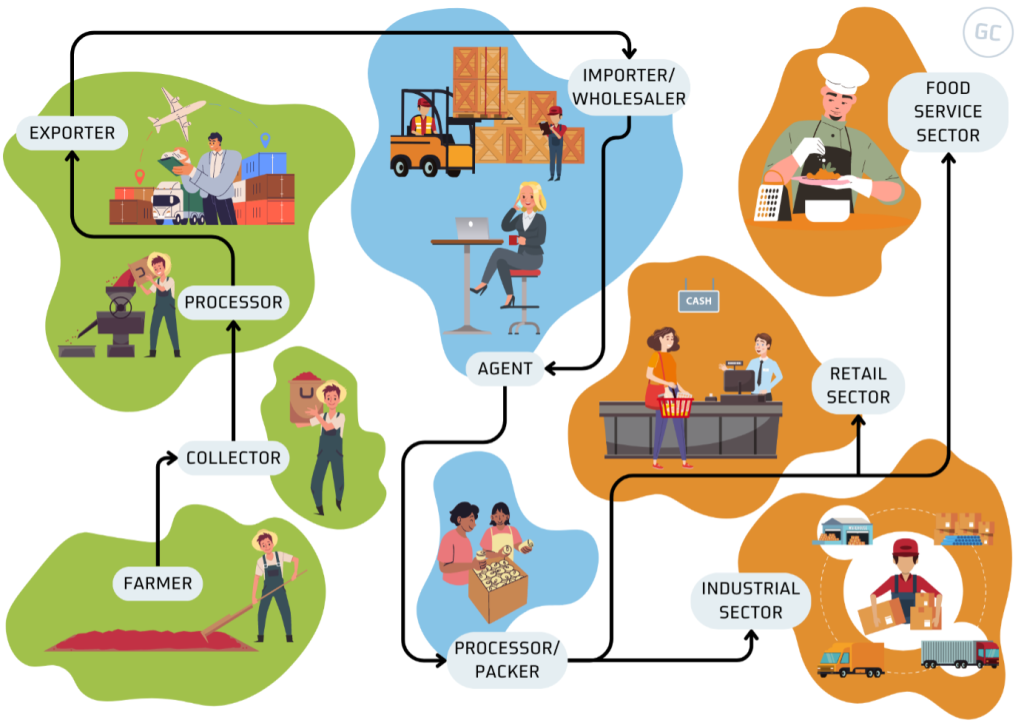
Source: GloballyCool, 2023
Fertilisers
The use of fertilisers is the biggest polluting factor in the grains, pulses and oilseeds sector. Going green means moving towards organic fertilisers like compost, liquid plant manures, humic acid, grain meal, amino acids and seaweed extracts.
Processing, packaging and transport
Processing, packaging and transport are also large polluting factors in this sector. You can become a greener player in the grains, pulses and oilseeds sector by diminishing your environmental impact during processing, packaging and transport of your products.
For quinoa, for example, there are new packaging options available that can hold 1 to 2 tons of quinoa, instead of the original 40 to 60kg bags. This means less packaging material per kg of quinoa.
Another way to minimise the environmental impact of your product through the improvement of its packaging is by improving the packaging in such a way that is minimises food waste. For quinoa that can be by reducing respiration through an impermeable flexible packaging with restricted oxygen transmission rate and controlled on the road atmosphere of reduced oxygen levels.
Deforestation
Deforestation is a major cause of biodiversity loss, soil erosion, reduction of carbon sequestration and ultimately climate change. The grains, pulses and oilseed industry in many parts of the world is a big disrupter to the environment. In the long run, deforestation has a negative effect on not only the environment, but also on the production of agricultural products and society as a whole. That is why growers should avoid clearing forest land for farming purposes.
Video 1: Deforestation of the Amazon forest due to agriculture
Source: @BBCNews on Youtube
A way to improve biodiversity that has been lost due to deforestation is by installing ‘forest curtains’. These forest curtains protect the agricultural fields in between, but also help maintain diversity and soil quality.
See how a Bolivian company specialised in chia and quinoa has installed forest curtains on their chia crops.
Video 2: Semear Chia Fields
Source: @yDarwin on Youtube
Use sustainable farming practises
A way to reduce the impact of fertilisers and reduce deforestation is to implement sustainable farming practices. This term refers to the use of resources, including land, fertile soil, and wildlife, in a way that allows for their natural or artificial renewal without depleting or polluting other resources. Two key sustainable farming methods are organic farming and regenerative agriculture.
Regenerative Agriculture
Implementing regenerative agricultural practices like inter-cropping (growing two or more crops in the same field), reducing, or stopping tillage, crop rotation, and precision agriculture (reducing chemical and biological input) improves soil health, fostering high productivity of high-quality food, and contributes to mitigating climate change and restoring biodiversity.
For example, ANAPQUI, the National Association of Quinoa Producers in Bolivia, grows organic quinoa and pays extra attention to crop rotation, use of natural fertilisers and pest control without agrochemicals. Their sustainable farming practices along with their social responsibility standards have been crucial in maintaining long-term relationships with important buyers in Europe like Rapunzel in Germany.
Organic production
Organic agricultural practices including avoiding synthetic pesticides, crop rotation, composting, and natural pest control, can reduce the environmental impact of farming. Additionally, using renewable energy sources, such as solar or wind power, to power irrigation and farm equipment can help reduce the carbon footprint of farming operations.
The Ugandan company Shares Uganda trains farmers in different aspects of their farming management. They train and promote, amongst others, intercropping and natural fertilisers. This company is currently selling organic-certified chia and sesame seeds to Europe.
How to improve your farming practices?
These practical measures will allow you to improve your farming practices in a fast and efficient way.
Track inputs and outputs
Keep a meticulous record of essential details such as the amount of seeds sown, the yield obtained, and the quantity of fertilizer used. By maintaining these records, you can gain insights into the effectiveness of different approaches and make informed decisions.
Monitor water usage
Install a water meter to accurately measure the rainfall received on your farm. This data will allow you to determine the amount of extra water you need to provide and the frequency at which it should be supplied. Understanding your water usage patterns helps you optimize irrigation practices and conserve resources.
Analyse results
Regularly review and analyse the information collected. Look for patterns and trends to identify areas where improvements can be made. For example, if you notice low yields despite high fertilizer usage, it might be an indication to reassess your fertilization strategy.
Continual improvement
Strive to understand your farming practices better with each season. Experiment with different techniques and approaches, implementing changes based on your findings. This iterative process will enable you to refine your methods over time and achieve more efficient and sustainable outcomes.
Tips:
- Look for an agricultural advisor to help you when you start using sustainable practices. Their experience will help you implement the new farming methods faster. This speeds up the learning process of the people working at the farm and creates trust in the process.
- Adopt circular economy principles. This can help reduce waste and maximize resource utilization. It includes implementing practices such as composting food waste, using recycled materials in packaging, and creating closed-loop supply chains.
- Visit Organic Africa. if you are interested in further educating yourself on this topic. It has some interesting sources. For example this poster on how to prepare organic compost. They are also working on a poster on how to prepare liquid fertilizer. Keep an eye on their website to find out when it will be published. Also read this document on reducing emissions from fertilizer use by the International Fertilizer Association. Or learn about how regenerative farming increased yields in cereal and oilseed crops in Germany.
- Watch the recording of the CBI Webinar on Speciality and Sustainable rice, if you are a rice producer, to learn more about the product and the opportunities in these niche markets.
2. Lower emissions at farm level
Food system emissions globally account for 5.8 GtCO2e, equating to 30% of the world’s GHG emissions.
Products from animal origin like meat or dairy as well as animal feeds (like some grains that are included in this study) have a high participation in the emissions. Of course, pulses, oilseeds and grains that are grown for other purposes also contribute to these emissions.
The majority of the emissions caused by grains, pulses and oilseeds happen due to both change in land use (deforestation) and agricultural activities at farm level. Making better use of fertilisers and improving soil health will have an important impact on gas reduction in the short and long term.
Making better use of fertiliser
Synthetic fertilisers, especially nitrogen-based, release nitrous oxide (NO2), which is 300 times more harmful to the environment than CO₂. Fertiliser production is energy-intensive and contributes to CO₂ emissions. Also, the production of nitrogen fertilisers is energy-intensive, and emits CO₂. Reduce your nitrous oxide (NO2) emissions by using enhanced-efficiency fertilisers and implementing precision fertilisation.
Use enhanced-efficiency fertilisers (EEF)
EEFs are fertilisers that have better nutrient availability and cause fewer losses to the environment. For example, fertilisers with nitrification inhibitors reduce the emissions of NO2. Farmers can change to this type of input and reduce their greenhouse emissions (GHG) in the short term.
Video 3: What are Enhanced Efficiency Fertilizers?
Source: @SmartNitrogen on Youtube
Use precision fertilisation
Farmers should use fertilisers in responsible quantities and only when needed. Variable Rate Technology (VRT), for example, lets farmers adjust the amount of fertiliser they use based on real-time data, cutting emissions and improving yields. It works by using GPS, sensors, and software to check the soil and crop needs in different parts of a field.
Video 4: Variable rate fertilizer
Source: @AGPhD on Youtube
Improve soil health
Healthy soil stores carbon and prevents emissions from land degradation. Better soil reduces the need for fertilisers and irrigation, further cutting emissions.
Increasing organic matter in the soil
Increase soil organic matter to reduce input costs and lower emissions. Healthier soil stores more carbon, reduces the need for fertilisers and pesticides, and provides crops with natural nutrients. It also holds more water, prevents erosion, and supports beneficial microbes that protect plants from pests and diseases. All this helps farmers use fewer chemicals and save money.
Important strategies to improve soil health and carbon sequestration:
- Cover crops: Planting cover crops between main crops improves soil structure and sequesters carbon.
- Organic matter management: Adding, maintaining and recycling natural materials in the soil improves its health, fertility and carbon storage. Organic matter includes things like compost, manure, crop residues and cover crops.
- No-till or low-till farming: Avoid too much ploughing, as it keeps carbon stored in the soil and prevents it from being released into the air.
- Crop rotation: Use complex crop rotation adapted to your specific crops and location.
- Biochar: To improve soil quality and increase yield in dry areas, farmers can produce this special type of charcoal, biochar, from crop residues by using low oxygen, spreading it onto fields and mixing it into the soil before planting. They can also combine biochar with compost or manure to create a powerful natural fertiliser.
- Composting: Farmers can turn food scraps and plant waste into natural fertiliser, reducing the need for chemicals. It adds nutrients, improves soil, holds water and cuts emissions from rotting waste. Seed husks, shells, bean stalks, and stems are all good materials to use.
Agroforestry
Agroforestry combines trees and crops on the same land. Trees offer shade, prevent erosion, retain water and store CO₂, and so help reduce greenhouse gases. Trees also absorb carbon dioxide (CO₂) from the air. Farmers can plant rows of trees along their fields (windbreaks) to protect crops, grow nitrogen-fixing trees to enrich soil, or use alley cropping to reduce water loss and expand carbon storage. Table 1 shows the different crops and their emissions (sorted from low to high).
Table 1: Selected grains, pulses or oilseeds with their CO2 emissions per kg of product
| Product | In store | Kg Co2 e/kg |
|---|---|---|
| Chickpeas (dry) | Europe | 0.74 |
| Dried beans | Europe | 0.81 |
| Linseeds | Europe | 1.2 |
| Chia seeds | Europe | 1.2 |
| Dried lentils | Europe | 1.2 |
| Sunflower seeds | Europe | 1.3 |
| Peanuts | Europe | 1.5 |
| Jasmine rice | Europe | 2.9 |
| Nut bar | Europe | 3 |
Source: Carbon Cloud
Tips:
- To reduce waste and overapplication, pay attention to measuring inputs and storing them properly. Use technology that helps you optimise the use of inputs, reducing emissions and costs. For example, you can make use of satellite data to make fertiliser-application decisions.
- Reduce soil disturbance like tillage. This might work differently depending on the type of crop and weed pressure, so you might want to start experimenting with low-tillage variants.
3. Become a certified producer and comply with buyers’ and consumers’ demands
Consumers around the world are becoming more aware of environmental problems. Many Europeans are worried about climate change and want to buy products that help protect the planet. Because of this, more shoppers are choosing goods that are organic and made in a responsible way. Supermarkets are reacting to this by offering more sustainable products.
This means that supermarket chains in Europe are asking importers and exporters to show certificates that prove they follow good environmental and social practices. If you are a supplier outside Europe, you need to meet the same sustainability standards as European farmers. This can help you enter the European market and build stronger, long-term business relationships with buyers.
Organic
If you want to sell your products as organic in Europe, they must be grown using organic production methods that meet the European legislation. Growing and processing facilities must be audited by an accredited certifier. You may put the European Union’s organic logo and the logo of your standard holder only after certification. Examples of the standard holders are Soil Association in the United Kingdom and Naturland in Germany.
Importing organic products to Europe is only possible with an electronic certificate of inspection (e‑COI). Each batch of organic products imported into the EU has to be accompanied by an electronic certificate of inspection as defined in Annex V of Regulation defining imports of organic products from third countries.
It is important to know that the market for organic grains and oilseeds is mostly driven by the strong growth of organic animal products, especially dairy and eggs. These organic feed grains are often low-cost products with a strong competition from European farmers. Only a very small part of all organic certified organic cereals and oilseeds are eaten by people. In this case, the rarer a grain or oilseed, the greater the potential benefits of organic certification because there is less competition. This creates opportunities for niche products like specialty rice, teff, fonio, quinoa, and chia.
Figure 2: Beans and pulses in organic supermarket Alnatura in Germany
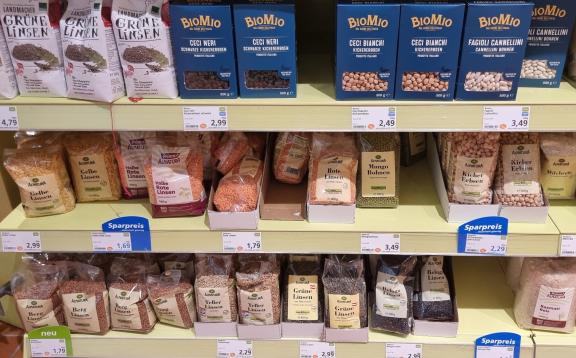
Source: GloballyCool, February 2025
Other standards and certification programmes
There are several other standards and certification programmes used in the grains, pulses, and oilseeds industry:
- GlobalG.A.P. Integrated Farm Assurance (IFA) is an accredited, farm-level standard for producers of crops, livestock and aquaculture. It focuses on food safety, environmental protection and worker welfare. This standard is suitable for producers of grains, pulses and oilseeds that are dried, cleaned, packed and sold for direct human consumption.
- GlobalG.A.P. Crops for Processing is a non-accredited, farm-level standard designed for producers of crops that are not consumed fresh but are intended for further processing. This includes products like grains, pulses and oilseeds that are grown only for industrial use or ingredient production.
- ISO 14001 is an internationally recognised standard for environmental management systems, helping organisations improve environmental performance, comply with regulations, and reduce their environmental impact by using a structured framework. ETG, one of the biggest African suppliers of sesame seeds and pulses, has obtained an ISO 14001 certification.
- Sustainability initiatives from the sector, like the ProTerra Foundation, which has developed the Standard on Social Responsibility and Environmental Sustainability for soy. The ProTerra Foundation is a not-for-profit organisation that advances and promotes sustainability at all levels of the feed and food. Its members include large multinationals like Cargill, Bunge, and Alpro.
- Regenerative Organic Certification (ROC) is a certification for food, textiles, and personal care products that meet the highest standards in soil health, animal welfare, and social fairness. It builds on existing organic standards by emphasizing regenerative farming practices that restore soil, improve biodiversity, and combat climate change. ROC has three levels, Bronze, Silver, and Gold, based on the extent of regenerative practices used. Certified farms must avoid synthetic chemicals, ensure ethical treatment of workers, and promote animal welfare. Overseen by the Regenerative Organic Alliance (ROA), ROC helps businesses demonstrate a commitment to sustainability beyond standard organic certifications.
Tips:
- Realise that most certifications are not free to obtain. The costs to get certified fall in the hands of the producer (you). Work together with European buyers, non-governmental organisations, national or international governmental organisations to make it economically feasible for you to receive certification. Further information is available on websites such as the Netherlands Enterprise Agency, and the German Ministry for Economic Cooperation and Development.
- Check the guidelines for imports of organic products into the European Union to familiarise yourself with the requirements for European traders.
- Read about the steps for agricultural producers to prepare for Regenerative Organic Certification.
4. Stay on top of new green European legislation
It is important to stay on top of green European legislation. New legislation is always in the making. The European Due Diligence Act and the European Green Deal are among most important green legislations that currently exist in the European Union.
The Corporate Sustainability Due Diligence Directive (CSDDD)
The Corporate Sustainability Due Diligence Directive (CSDDD) is a European Union law that requires large companies to identify and address negative impacts on human rights and the environment in their operations and supply chains. As of July 25, 2024, the directive is in force, and EU member states have until July 26, 2026, to incorporate it into national law. The rules will start applying to companies in phases starting in 2027.
At the moment, the EU is thinking about changes that may adjust the scope and timeline of the CSDDD. Because of these developments, interested parties can expect more updates as the EU is thinking about other changes to the directive.
The European Green Deal
The Green Deal is the European Union’s plan to fight climate change and make Europe climate-neutral by 2050. In the coming years, the Green Deal will influence how resources are used and greenhouse gas emissions are reduced.
The Farm to Fork Strategy is at the heart of the European Green Deal aiming to make food systems fair, healthy and environmentally friendly. This goal of this strategy is to reduce the use of chemical pesticides and fertilisers, increase organic farming and improve animal welfare. This will not only apply to agriculture in Europe but also to products exported and sold in the EU market. One example of this is the target of 50% reduction in pesticide use by 2030. To achieve that, the maximum residue limits on imported products are further tightened.
Tips:
- On the CBI website you can find more information on the European Due Diligence Act, The EU Green Deal - how will it impact my business? and an overview of sustainability developments in the European grains, pulses and oilseeds market in Trends on the European GPO Market.
- For more information on certification and other buyer requirements for this sector, refer to specific market studies on the market information page of CBI , the study how to organise your export, and at the buyer requirements study.
5. Be aware of the challenges
As a producer and exporter in this sector you can face a combination of challenges when you try to become more sustainable. The biggest challenges are:
- Growing demand (with yields falling back): Globally, the demand for most grains, pulses and oilseeds is growing. This makes it hard for farmers to meet demand. On top of that, many grains, pulses and oilseed farmers are seeing their yields falling back.
- Higher farming costs: Inflation is high in most parts of the world. This also leads to higher farming costs. Also, investments in green technology, or even just switching to greener agricultural practises generally cost money.
- Changing requirements that must be met by suppliers: These the certifications costs are carried by supplier.
- New knowledge and skills are needed: Investment in knowledge and skills require time, effort and often also money.
Rising costs in the grains, pulses and oilseeds sector make profitability challenging, especially for primary producers. Low profit margins and low production make it hard to invest in sustainable farming. However, going green can be profitable on the long run. Although yields may go down at first, they may go back up, and buyers will be more likely to pay more for sustainable products. Staying informed about market trends and buyer requirements is very important for success.
6. Make use of green innovations
The grains, pulses and oilseeds industry is changing, and new technologies are improving sustainability. Precision agriculture makes input efficiency better, and innovative pest-control methods offer eco-friendly alternatives. As climate change impacts agriculture, these improvements help farmers to use more sustainable and efficient practices.
Robots
Technological advancements are going fast in the agricultural sector. For example, the use of robots to harvest has become available for an increasing number of crops. There are also robots for weeding, seeding and planting, and fertilizing. For example these farming robots to help you grow grain.
Online platform for farmers
The Alliance for a Green Revolution in Africa (AGRA) and CropIn, a supplier of digital solutions for farmers launched a project for smallholder farmers in Ghana, Nigeria, Burkina Faso, Mali, Tanzania, and Mozambique to provide digital solutions aiming to promote climate change mitigation and resilience.
On the Cropin website you can request a free demo of their product. With no obligation to buy. The website is also a good source to find case studies, blogs, webinars, white papers and other resources to learn about ‘intelligent agriculture’.
In the six countries where it was launched, Cropin's platform facilitated the digitalization of end-to-end agricultural operations. This involved geotagging agricultural plots and digitizing farm and farmer data, making it easily accessible through a centralized cloud platform. The platform also provided farmers with tailored support through the Package of Practice (PoP), which included tracking of agricultural inputs, providing guidance on optimal sowing periods, and issuing timely pest and disease alerts to prevent crop losses.
For example, 2Scale created a traceable rice value chain in Africa. They did this by digitizing farm operations and adding real-time farm intelligence using satellite imaging and precision agriculture. Benefits for the farmers included:
- Digitized purchase and post-harvest process;
- Business intelligence;
- More predictability in the supply chain;
- Improved harvest and acreage.
Contact 2Scale for support if you are a producer of rice, or a local SME rice trader or processer. They are currently active in Burkina Faso, Ghana, Egypt, Ethiopia, Ivory Coast, Kenya, Mali, Niger, Nigeria and South Sudan.
Video 5: 2SCALE Inclusive Agribusiness in Africa
Source: @2Sccale on Youtube
There are more examples of how farmers incorporated technology and innovation into agricultural projects. The UDNP report about precision agriculture for smallholder farmers is a good source to learn more about that. It gives an overview of technologies and how they can be applied in precision agriculture. They do this by presenting real-life examples and practical scenarios.
The report also emphasizes important factors that need to be considered, such as the practicality of implementing these technologies, identifying viable business models for widespread adoption, and recognizing potential obstacles like limited digital infrastructure, low levels of digital literacy, and insufficient digital skills among farmers.
Tips:
- When attending international trade shows, look for new solutions and ask the manufacturers for options for your type of crop. Very often, new developments are presented in the academic program of the show.
- Read more about precision agriculture in the study 10 tips to go digital in the GPO sector and find out more ways to use technology to improve your competitiveness and sustainability.
- Watch the videos from FarmKenya, they have interesting videos about farming, like this one about data driven agriculture.
- Look at what the Indian oilseed sector has developed in sustainable innovations, if you are an oilseed producer.
7. Embedding green principles in your code of conduct
A code of conduct (COC) defines expected behaviours within an organisation. If you make environmental principles part of your COC, you show that you are serious about sustainability. This is not just for large companies. Many smaller buyers in the grains, pulses and oilseeds sectors also want to see social and environmental policies. You can expect more and more pressure to show documentation that proves responsible practices in your whole supply chain. Updating your COC with green principles strengthens your sustainability efforts and is in line with industry expectations. Valamis has written a good article about what to include in your code of conduct.
The EU Code of Conduct as guideline
The EU Code of Conduct on Responsible Food Business and Marketing Practices is a set of voluntary guidelines developed by the European Union as part of the Farm to Fork Strategy. It was created to help businesses adopt sustainable and ethical practices in the food industry. The code aims to reduce food waste, use resources efficiently, and promote responsible sourcing. It also encourages companies to lower their carbon footprint and support healthier diets.
For SMEs in developing countries, following this code can improve chances of selling agricultural products in Europe. European buyers prefer suppliers that meet sustainability and ethical standards. By adopting these practices, SMEs can build trust, improve market access and strengthen their reputation.
The EU has also developed a tool to assist businesses in aligning with the EU Code of Conduct’s sustainability objectives. It offers practical guidance on implementing sustainable practices across various aspects of the food supply chain. SMEs can use the Agri-food Code of Conduct tool to understand and meet the sustainability expectations of European buyers. On their own codes SMEs can also mirror the criteria in the EU’s Code of Conduct.
Best practices in Code of Conducts
Both Unilever and Cargill have an extensive code of conduct written towards sustainability. These documents show what these companies expect from their suppliers and the whole supply chain when it comes to social and environmental sustainability. You can use them to learn the concept of self-verification. This means you as a supplier, asses your own compliance with the sustainability code of the buyer. This is the Sustainable Agricultural Code (SAC) by Unilever, and this is Cargill's Supplier Code of Conduct.
The Mexican company Sesajal, for example, shows its commitment to environmental sustainability on its website. This company processes and exports chia and sesame seeds and oils, creams and spreads. Sesajan also has an ethics code with information about their commitment to environmentally sustainable practices.
Video 6: Sesajal’s corporate video on environmental responsibility
Source: @GrupoSesajal on Youtube
Tip:
- Regularly monitor and report on your environmental performance, including your greenhouse gas emissions, water usage, and waste generation. This can help identify areas for improvement and demonstrate a commitment to sustainability.
8. Find funding, investors and/or partners
As a grower of grains, pulses and/or oilseeds, based in a developing country, it can be interesting to find funding, investors, or partners to support your sustainability efforts.
Centre for the Promotion of Imports from developing countries (CBI)
Centre for the Promotion of Imports from developing countries (CBI) provides small and medium-sized enterprises with market intelligence and trade support in export coaching programmes. The tailored programmes also include training on doing business in Europe. You can find relevant projects on the website.
GIZ
GIZ is a German based organization. Their goal is to provide tailor-made, cost-efficient and effective services for sustainable development. They have various programs in countries around the world, including in the agricultural sector.
Sustainable Rice Platform (SRP)
The Sustainable Rice Platform unites rice companies worldwide. For example, AMRU Rice in Cambodia helps farmers implement the SRP standard.
Import Promotion Desk (IPD)
The Import Promotion Desk (IPD) establishes contacts in the European Union for exporters from partner countries and provides them with market information and capacity building. One of the sectors they operate in is natural ingredients, which includes grains and seeds (quinoa, amaranth, rice) and pulses (kidney beans, pinto beans, white beans, peas).
International Trade Centre (ITC)
International Trade Centre (ITC) is a development agency for sustainable trade with publications and an SME Trade Academy that provides online courses (some are free of charge). Courses such as ‘Export Sales and Negotiation’ and ‘Helping SMEs Generate Export Business’ may be relevant if you want to develop yourself as an exporter of grains, pulses or oilseeds.
What can you do yourself?
Research potential partners
- Look for government programs or grants that promote sustainable agriculture and offer funding or technical assistance to farmers.
- Look for NGOs or non-profits that work with farmers to promote sustainable agriculture and offer funding or technical assistance. Examples of organizations (besides the ones mentioned above) are the World Bank, the United Nations, and NGOs like the International Fund for Agricultural Development (IFAD). They provide funding and technical support to SMEs in developing countries. This usually happens as part of projects that comprise not only funding, but training and technical assistance and are limited in time. Therefore, SMEs will have to research which new projects are being launched in their regions.
- Participate in certification programs that promote sustainable agriculture, such as Fair Trade or Rainforest Alliance. These programs can provide access to markets and buyers who are interested in sustainably produced goods.
Find funding through a national agricultural or development bank
Agricultural banks are specialized in giving loans for companies in the agricultural sector. Strengthen your network around organisations supporting farming, development, or exports. These are very often selected by international NGOs to implement projects that might include grants and other type of business support. Look for new project openings and register in their databases, so they can contact you for upcoming opportunities.
The Agricultura Bank of Egypt is an example of such a bank who provides special loan types and services for agricultural activities and has branches in rural areas of Egypt. Look into your country´s agricultural or development bank. These institutions often have special schemes for the agricultural sector.
Self-initiate
- Collaborate with other farmers or cooperatives to pool resources and expertise to implement sustainable agriculture practices.
- Attend sustainability-focused events or conferences to network with potential partners or investors and learn about funding opportunities.
- Partner with universities or research institutions to access funding or technical expertise to implement sustainable agriculture practices.
- Look for investors or partners who are interested in supporting sustainable agriculture projects. This could include impact investors, socially responsible investors, or companies that have sustainability goals.
- Consider crowdfunding to raise funds from a community of individuals who are passionate about sustainable agriculture.
GloballyCool carried out this study in partnership with ICI Business on behalf of CBI.
Please review our market information disclaimer.
Search
Enter search terms to find market research
Do you have questions about this research?
I recommend farmers to switch to organic agriculture. It is the best proven method to reduce soil depletion and it is overall a more sustainable way of farming.

Maarten Molenaar, Food Safety & Quality Director at DO IT ORGANIC