

Entering the European market for workwear
This report explains what the most important opportunities and requirements are in the European market for workwear. You will learn about the rules and regulations for exporting workwear to Europe, about the best channels to get your product on the market, about the countries where your competitors are and the best ways to provide a quotation for a potential buyer.
Contents of this page
Figure 1: Many companies require workwear with company-specific logos or other forms of customisation
Source: Photo by Frank Albrecht on Unsplash
1. What requirements and certifications must workwear meet to be allowed on the European market?
You need to meet a range of requirements if you want to export workwear to Europe. Some are mandatory (legal and non-legal). Others are voluntary, but meeting them can give you a competitive advantage. Some requirements only apply to certain niches in the workwear market.
What are mandatory requirements?
There are several legal requirements for exporting workwear to Europe. These concern product safety, use of chemicals (REACH), quality and labelling. Check the European Union (EU) Access2Markets online helpdesk for an overview.
Product safety
The health and safety performance of workwear apparel is mainly governed by EU Regulation 2016/425 on the design, manufacturing, material use, testing and user instructions regarding protective wear, or ‘Personal Protective Equipment’ (PPE).
This is different from most other apparel products. These fall under the EU’s General Product Safety Regulation (GPSR: 2023/988), which ensures consumer safety. This regulation only applies to workwear if the PPE legislation does not cover specific risks.
Note that the GPSR: 2023/988 requires that all products placed on the EU market must have an EU-based ‘economic operator’. This means an importer, representative or service provider responsible for safety and compliance issues.
The EU has determined three categories of risk against which PPE is intended to protect. The categories are specified below.
Category I PPE includes exclusively the following minimal risks:
- Superficial mechanical injury;
- Contact with cleaning materials of weak action or prolonged contact with water;
- Contact with hot surfaces not exceeding 50 °C;
- Damage to the eyes due to exposure to sunlight (other than during observation of the sun);
- Atmospheric conditions that are not of an extreme nature.
Category II PPE includes risks other than those listed in Categories I and III.
Category III PPE includes exclusively the risks that may cause very serious consequences such as death or irreversible damage to health relating to:
- Substances and mixtures which are hazardous to health;
- Atmospheres with oxygen deficiency;
- Harmful biological agents;
- Ionising radiation;
- High-temperature environments the effects of which are comparable to those of an air temperature of at least 100 °C;
- Low-temperature environments the effects of which are comparable to those of an air temperature of – 50 °C or less;
- Falling from a height;
- Electric shock and live working;
- Drowning;
- Cuts by hand-held chainsaws;
- High-pressure jets;
- Bullet wounds or knife stabs;
- Harmful noise.
Testing compliancy
If you produce Category I PPE, you yourself can perform the necessary tests to follow regulation 2016/425. If you produce Category II PPE, a ‘notified body’ (independent test institute) must assess your compliancy.
Category III PPE is subject to strict regular testing: ‘Module C2’ or ‘Module D’ conformity assessments. Module C2 means that a notified body regularly tests samples of your finished product at the factory, at import or when your product is already on the market. Smaller factories usually use this system. Large, well-organised factories typically apply Module D, requiring you to have a formal quality management system (such as ISO 9001). A notified body regularly audits this system, not individual products.
User instructions
You must supply user instructions with any item of PPE that you export to Europe. These instructions must be written in the language of your target market. They need to include (among other things) your company name and address and information on the following:
- Proper way to store, clean, maintain and disinfect the product;
- Protection level;
- Risk against which the PPE is designed to protect;
- EU Declaration of Conformity reference or link;
- Name, address and identification number of the notified body.
Check article 1.4 of Annex II of EU Regulation 2016/425 for a full overview of the information that you must include in the user instructions.
Note that digital or online instructions are allowed, but buyers still usually require instructions on paper.
Technical documentation
Besides user instructions, you must supply technical documentation with any item of PPE that you export to Europe. The technical documentation must include (among other things): a complete description of the PPE and its intended use; an assessment of the risks against which the PPE is intended to protect; a list of the essential health and safety requirements that apply to the product; design drawings of the PPE and test reports. This documentation should be available for 10 years after products are placed on the market.
Check Annex III of EU Regulation 2016/425 for a full overview of the information that you must include in the technical documentation.
REACH
Make sure you follow the EU’s REACH Regulation. This restricts the use of chemicals in apparel and trims, including certain Azo-dyes; flame retardants; waterproofing and stain-repelling chemicals and nickel. Check the following link to familiarise yourself with the complete list of chemicals restricted by REACH.
Also ask your buyer if they use a Restricted Substances List (RSL). These are often inspired by the guideline on safe chemicals use from the Zero Discharge of Hazardous Chemicals (ZDHC) foundation. Download the ZDHC Conformance Guidance here.
Labelling
A CE-marking on PPE is a visible indication that your product conforms with the PPE health and safety requirements. You must affix the CE marking to the PPE ‘visibly, legibly and indelibly’ (users must be able to see the label, text and symbols must be sharp and clear and they must not fade).
If it is not possible to affix the CE marking to the PPE itself, you must affix it to the packaging and accompanying documents. The number of the notified body should be visible next to the CE mark, as well as the manufacturer’s name and address.
Read more on the EU’s rules and regulation for affixing CE-marking to PPE.
You must also specify the material content of every workwear item that you export to the EU, in accordance with EU Regulation 1007/2001.
If you use the care symbols recommended in the internationally recognised standard for care labelling ISO 3758: 2012, be aware that the care symbols are property of the company GINETEX. You need to pay a fixed compensation to GINETEX for the use of these symbols.
Intellectual Property Rights
Do not violate any Intellectual Property (IP) rights and do not copy or share designs with other buyers. If your buyer provides the design, they will be liable in case the item is found to violate a property right.
Non-legal requirements
Buyers may confront you with additional, company-specific terms and conditions. Such requirements are usually written down in a buyer manual. By signing a contract, you confirm that you will meet all the requirements listed in the manual. If a buyer does not have a manual, make sure all terms and conditions are clear and agreed beforehand. The following topics may be included in a buyer manual.
Payment terms
For first-time orders, European buyers may give you a down payment via bank transfer (for instance 30%). They will pay the rest after the order has been completed, again via bank transfer. Another payment method is the L/C (Letter of Credit). With an L/C, the buyer’s bank must pay the supplier when both parties meet the conditions they have agreed upon. This is the safest payment method for a manufacturer. Be aware that L/Cs do not offer financial protection against bankruptcies.
For any further orders, most European buyers will ask for a TT (Telegraphic Transfer/Open Account) after 30, 60, 90 or sometimes even 120 days. This means you as a manufacturer finish the production and hand over the shipment to the buyer, including the original documents, before payment is due. The payment will be made after the number of days that you have agreed on with the buyer. Be aware that this agreement puts the full financial risk on the manufacturer.
Delivery terms
Free on Board (FOB) is the standard Incoterm used by buyers and sellers to agree on delivery of goods. With FOB, the buyer becomes responsible for the goods once you have delivered them to the vessel.
Nominated suppliers
Many workwear buyers will require you to source materials (fabrics, trims, labels, packing materials) from a specific supplier. This means that you are responsible for the ordering, delivery and payment of the materials (but not the quality, as this is confirmed beforehand by the buyer). This may negatively impact your flexibility, cost, speed and liquidity. Always discuss locally-available solutions with your buyer as an alternative.
Acceptance quality limit
To guarantee product quality, buyers may set an acceptance quality limit (AQL). This refers to the worst quality level that is still acceptable. For instance, AQL 2.5 means that your buyer will reject a batch if more than 2.5% of the items are defective. Defects are classified as critical, major and minor defects. Buyers will specify their expectations in the inspection protocols. Check industry network Eurofins’ website for instructions.
Garment care requirements
EU Regulation 2023:988 states that PPE must keep its protective properties during its lifetime, including after wearing, washing and drying. Buyers may add specific requirements to this, such as a minimum number of wash cycles, industrial laundry resistance, shape retention, colourfastness and durability requirements for trims (zippers, buttons, reflective details). Such requirements are more and more connected to European workwear companies that offer rental models. This requires workwear apparel to be more durable and traceable.
Packaging requirements
Typically, your buyer will give you instructions on how to package the order. If you agree on delivering FOB, your buyer will clear customs in the country of import. It is their responsibility to ensure the instructions on the packaging follow EU import procedures. Always try to reduce the environmental impact (and financial cost) of packaging materials. Try using less packaging by putting more items in a polybag, or use materials made from recycled cardboard (including hangers) or biodegradable plastics (polybags).
Restricted substances
Ask your buyer if they use a Restricted Substances List (RSL). These lists are often inspired by the guideline on safe chemicals use from the Zero Discharge of Hazardous Chemicals (ZDHC) foundation. Download the ZDHC Conformance Guidance here.
Transparency and recycling
Supply chain transparency is important for the European apparel industry, motivated by ever stricter laws at EU and national levels:
- The Ecodesign for Sustainable Products Regulations (ESPR) sets sustainability standards at product level, including a ‘right to repair’. It also requires a Digital Product Passport (details pending), which provides detailed traceability and environmental impact data to customers.
- The Corporate Sustainability Reporting Directive (CSRD, 2023) puts ESG reporting requirements on large companies (more than 1,000 employees and above €450 million net annual turnover). This means European workwear buyers will ask their suppliers for sourcing data.
- The Corporate Sustainability Due Diligence Directive (CSDDD, 2024, full compliance postponed to 2029) requires risk mapping and mitigation from large (European) companies (more than 5,000 employees and above €1.5 billion net annual turnover) across their value chains.
- The EU-wide Extended Producer Responsibility (EPR) policy framework makes companies responsible for the way their products are disposed of, recycled or repaired. This is included in the Waste Framework Directive. France, the Netherlands and Sweden have already introduced national EPRs.
Equality
All individuals in your company should have equal opportunities, regardless of gender, race, religion or other characteristics. Cover basic needs such as safety, fair treatment, social security, healthcare, daycare, transportation and a living wage. Workers also need respect, open communication and opportunities for growth (training).
It is also important to understand younger generations. Young workers mostly want flexibility, freedom, learning opportunities and personal growth. This CBI webinar on improving worker happiness offers tips.
Regenerative agriculture
Several workwear brands use organic cotton. Efforts to make cotton production more sustainable have expanded to include ‘regenerative agriculture’. Check, for example, Dutch workwear brand Schijvens.
Carbon footprint
Many European brands and retailers have committed to climate neutrality and CO2-reduction. Calculating the CO2-footprint of an apparel item is a complicated process. It starts with carefully measuring your emissions before reducing them. Several organisations have set benchmarks for certain materials and/or products. Check the CBI study Tips to go green for more information.
Certification
- European workwear companies, primarily those operating in the B2B-market, have been among the first buyers to require (and invest in) verified sustainable production and social compliancy. Regarding harmful substances and/ or sustainable production, Standard 100 by Oekotex® is the most widely required standard. European buyers may also require standards such as the EU Ecolabel, BCI (Better Cotton Initiative), GOTS (Global Organic Textile Standard) or Bluesign®.
- Regarding the use of recycled or ‘circular’ materials, buyers may require standards such as the GRS (Global Recycled Standard) or C2C™ (Cradle to Cradle).
- Regarding social compliance, BSCI (Business Social Compliance Initiative) is almost a basic requirement amongst European apparel companies, including workwear companies. Other popular social standards are FWF, WRAP, SEDEX, ETI, SA8000, ISO 26000, and Fair Trade.
Tips:
- Check the CBI study ‘What requirements must apparel meet to be allowed on the European market” for a comprehensive overview of buyer requirements.
- Read the buyers manual carefully and don’t be afraid to negotiate terms and conditions (such as shorter payment periods or partial payments throughout production) before signing any agreement.
- Do not take financial risks with new buyers. Check their credibility, insure your orders via an insurance company or insist on a Letter of Credit. If you agree to an extended payment, don’t forget to calculate and add interest.
- Consider factoring to finance materials. This means that you sell your order to a bank or factoring company that pre-pays you a certain percentage of the value of the order in exchange for a commission. The bank will perform due diligence on the buyer, which tells you if they are a trustworthy business partner.
- If inflation in your country is high, maximise local sourcing to cut costs. If your buyer has foreign nominated suppliers, try to advise about local alternatives. Also make sure that your buyers pay in US dollars or euros. Getting paid in local currency will increase the risk of lower profits in case of inflation.
What additional requirements and certifications do buyers often have?
Next to non-legal, but mandatory requirements like standards and certifications, there are many services that buyers implicitly expect or at least highly appreciate if you want to do business with them.
Product design and development
Workwear is not as sensitive to seasonal trends as (fast) fashion, but product design is still important. Many European importers of workwear will sell to their buyers further up the value chain styles from stock, with the option to customise fabrics, striping, (type and number of) pockets, zippers, prints and logos.
Besides styling, product design and innovation are very important in the workwear market. Innovations that have recently found their way into the workwear market include:
- Circular workwear systems, based on take-back, reuse and fibre-to-fibre recycling. These include Schijvens, HAVEP and Tricorp.
- Regenerated fibres, such as Circulose, Infinited Fiber and Alsico.
- Mono-material sustainable workwear fabrics, such as Concordia Textiles.
- Ergonomic stretch performance fabrics and innovative knitting technologies. Check KÜBLER, Fristads and HAVEP.
- Antibacterial and anti-odour finishes, such as Polygiene Freshness technologies and HeiQ.
- Heat-regulating materials that regulate body temperature, such as Outlast and Schoeller.
- Durable, industrial laundry-resistant workwear for rental purposes and repair services. Check CWS, KÜBLER and Fristads.
- Digital traceability systems that use QR codes, digital IDs or fibre tracers, such as Aware™ by Schijvens.
- Per- and polyfluoroalkyl substances (PFAS)-free water-resistant coatings, such as Sympatex and Klopman. Note that PFAS-free coatings that protect against water-based chemicals are available, but coatings that protect against oil-based chemicals are not available yet.
- Sustainable alternative materials, such as bio-based PLA, bio-based anti-odour finishes, sustainable stretch materials, and organic and regenerative cotton or rPET (preferably the certified textile-to-textile recycled version).
To ensure quality (and in some cases also environmentally respectful production methods), buyers may require you to source your base materials at a preferred supplier. For instance:
Figure 2: Recycled materials and sustainable finishings must not reduce safety and comfort.

Source: Photo by Pascal Bernardon on Unsplash
Communication
Smooth communication is an implicit requirement that all buyers have. Always reply every e-mail within 24 hours. Even if it is just to confirm that you have received the e-mail and will reply more elaborately later. If you encounter a problem with a production order, immediately notify the customer and try to offer a solution.
Another good tip is to create a T&A (time and arrival) of every order and share it with your buyer. This file will help you to manage expectations, monitor progress and is the best guarantee for on-time delivery.
Flexibility
If you want to start a business relationship with a European buyer, be prepared to accept complicated orders first. Buyers will want to test your factory before giving you big, easy orders. Make sure at the start that a buyer will not continue to place only difficult orders with you and convenient orders elsewhere.
Many customers also look for manufacturers that can offer them stock service in products or fabrics. This will increase their flexibility. Be aware that within the workwear product category orders can vary from big to single pieces of which the majority part is personalised.
Tips:
- Not only ‘sell’ your company to a new buyer, but also ‘sell’ the buyer to your company. Make sure your whole team sees the opportunity and makes a big effort to service the new buyer in the best way possible.
- Factor in extra lead-time for the first order from your new buyer to get it 100% right the first time.
- Be transparent about this to your buyer.
What are the requirements for niche markets?
The workwear market has many sub-categories, each associated with workwear items that have very distinct characteristics, including workwear designed:
- For use in different dangerous environments;
- To protect different parts of the body, such as eyes, face, respiratory system, hands, and feet;
- To protect against different risks, such as mechanical impact, cold, heat, rain and foul weather, liquid chemicals, fire and flames, electric shock, radiation, drowning, harmful noise and viral or bacterial contamination.
Be aware that each type of PPE can have very distinct requirements concerning design, material use, production, packaging, use and maintenance. For a full overview of PPE sub-categories check the EU’s harmonised norms and standards list for PPE.
Health-protective workwear
Anti-viral and anti-bacterial workwear has been a growing niche since the early 2020s in healthcare, food processing and other high-contact work environments. Note that the materials you use need to follow REACH and that anti-viral claims will be checked closely.
Wearable technologies
Wearable technology is emerging as a niche in high-risk working environments. With the help of integrated sensors and connected devices, employers can better monitor worker safety and environmental conditions. Check, for instance, Interactive Wear, Clim8, Proglove and Myant for inspiration.
Recycled materials
A popular trend among European workwear companies is to implement return logistics to collect workwear after use and to process the items into new fibres for circular designs. Schijvens, for instance, sells workwear T-shirts and polo shirts made with 50% pre- and post-consumer recycled cotton and 50% recycled PET. The company positions itself in the market as a ‘circular’ workwear company.
Tips:
- Always ask your buyer about the specific performance characteristics and the legislation and standards your product needs to meet. Confirm this information (in written form) and do an honest self-assessment of your capabilities before you confirm any order.
- Check the Cradle-to-cradle Certified Products Registry for an overview of 50 innovative recycled fabrics.
- Follow Innovation in Textiles for the latest updates on technical textiles for the workwear market.
- Check the Green Gear Alliance’s website for inspiration on circular solutions for post-consumer workwear. It is a collaboration of several different workwear brands that want to increase circular workwear on the European market.
2. Through which channels can you get workwear on the European market?
Before you start to approach European workwear buyers, you need to determine what market segment fits your company best and through what channel(s) you want to sell your product.
How is the end-market segmented?
Besides price-level and the specific risks against which the workwear is intended to protect, the most significant segmentation concerns the employment position of end users. End consumers of workwear are either non-professional hobbyists, self-employed professionals or employees. This largely determines what requirements your buyer will have and through what channels you can best sell your product.
Table 1: Workwear market segmentation
| Buyer type | B2C/ B2B | Functionality | Price | Material use | Compliancy level |
|---|---|---|---|---|---|
DIY consumer
| B2C (business to consumer) | Basic, functional styles | Price- conscious | Low – medium quality materials | Few additional buyer requirements |
Self-employed professional | B2C and B2B (business to business) | Focus on functionality, price, durability and safety | Price- conscious | Good quality materials | Few additional buyer requirements |
Employee (uniforms, PPE) | B2B | Highly functional, safe and/or durable styles | Less focus on price | High-quality, fit-for-purpose materials | Strict compliancy requirements regarding safety, corporate identity and sustainability |
Source: FT Journalistiek
The DIY consumer
End-consumers buy workwear to work in and around the house in leisure time. This so-called DIY-market (Do It Yourself) is one of Europe’s biggest retail markets, dominated by companies such as Hornbach and OBI. The focus is mainly on functionality and price, not on compliancy.
The self-employed professional
Self-employed professionals such as plumbers, electricians, carpenters and installation workers buy their workwear for their occupation and are free to choose the vendor. This market is catered by DIY shops and specialised workwear suppliers such as Cofra, Mascot and Carhartt.
This is the so-called SEWE-market (Self-Employed Without Employees). SEWE’s are focused on functionality, price, durability and safety, not much on compliancy. SEWE’s are usually very brand-loyal.
The employee
If an employee is required to wear (protective) workwear or a uniform, it will usually be issued by the employer. This segment can be further split into 3 sub-segments.
- Public sector workwear consists of uniforms and PPE for police, military and other government services. Procurement typically takes place through regulated public tenders. These can be found on TED (EU procurement platform), national platforms, such as TenderNed (the Netherlands), and general platforms, such as TenderRadar and Global Tenders. Major characteristics: strict safety requirements, long-term contracts and heavy focus on compliance, durability and consistency.
- Industrial and service company workwear is the largest employee workwear segment. It includes companies in construction, logistics, manufacturing, retail, cleaning and security. Major characteristics: focus on comfort (stretch fabrics), durability and functionality, a combination of PPE and casual styles, service models (automated online ordering, laundry and repair services), and demand for repeat orders and consistency. Market entry is easier than via tenders, but there is a lot of competition.
- Corporate workwear is used in industries such as hospitality, retail, airlines and facility management. Professional appearance, brand identity and functionality are important. Major characteristics: logos, colour identity and consistency, fashion-influenced design (tailoring), and comfort. Common items include polos, shirts, blazers, chinos, softshell jackets and uniforms.
Tips:
- Read the CBI study on Finding buyers for an extensive overview of European apparel market segments, channels and requirements.
- Do thorough research of the market your ideal buyer is operating in and adjust your proposition to his or her requirements and ambitions.
- Find traders specialised in workwear by using an online search engine. Use keywords such as ‘full service’, ‘workwear’ plus ‘solution’. Trader’s websites usually show the buyers they are working with.
Through which channels does a product end up on the end-market?
Their place up the value chain determines how buyers will do business with you. Each buyer requires a specific approach. Always try to find out in what part of the value chain your buyer is operating, what challenges they face in the market and how you can contribute to their sales strategy.
Table 2: Workwear sales channels in the European market
| Sales channel | Who’s your buyer? | Requirements | Examples |
|---|---|---|---|
| 1 | European end-consumer | You can target European end-consumers directly with your own online shop (with promotion via social media), or indirectly via existing platforms. You will need to invest in an online shop, stock, order management and customer service. Your biggest challenges will be return policies and a lack of brand awareness.
You need a legal representative in Europe to ensure compliance with the EU’s General Product Safety Regulation (GPSR: 2023/988). | |
| 2 | Employer | The shortest and perhaps most profitable route to employees is via their employer. Your biggest obstacles however will be: lack of awareness and authority in the market; sales capacity and customer service.
Following health and safety rules and regulations is crucial. You will also need the capacity to design, sample and test products and you will need to keep stock (for quick re-delivery). If you want to target companies directly, try to contact the manager of ‘indirect purchasing’. | Any European company requiring employees to wear PPE or professional workwear. |
| 3 | Retailer | Workwear retailers sell to end-consumers and SEWEs. They can place an order relatively easy as they only need one development sample for order confirmation. Order quantities are usually high, just as price pressure. Retailers focus heavily on compliancy with health and safety regulations, sustainability and social standards. | |
| 4 | Brand | B2B workwear specialists target SEWEs and employees. They will supply the design but highly appreciate product development and innovation. This group of buyers requires high-quality materials and workmanship. You will often need to keep stock of materials and trims (possibly from preferred suppliers).
Following health and safety rules and regulations is crucial, with sustainability and social standards often required. Expect several sampling rounds. | |
| 5 | Intermediary | Agents, traders, importers and private label companies sell your product on to buyers up the value chain. They are extremely price focused and require flexibility in quantities and qualities.
Some are located near or in the production countries and primarily do sourcing and logistics, others work from Europe and also do market research, design and stock keeping. The commission rate is determined by the service level. |
Source: FT Journalistiek
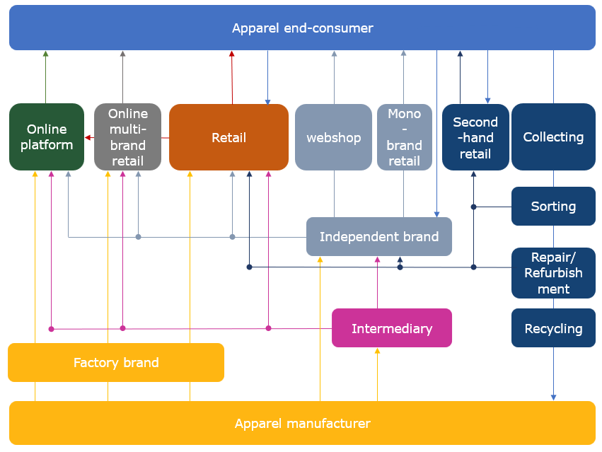
The figure below shows the many ways you can get your product onto the European market.
Figure 3: Workwear market value chain
Source: FT Journalistiek
Tips:
- Read the CBI study on Finding buyers for an extensive overview of European apparel market segments, channels and requirements.
- Do a thorough research of the market your ideal buyer is operating in and adjust your proposition to his or her requirements and ambitions.
- You can find traders specialised in workwear by using an online search engine. Use keywords such as ‘full service’, ‘workwear’ plus ‘solution’. Trader’s websites usually show the buyers they are working with.
What is the most interesting channel for you?
As you move higher up the value chain, your margin will increase, but so will the service level that your buyer will require from you. If you are a small workwear manufacturer with little experience with exporting to Europe, intermediaries or retailers are likely the best starting point for you.
Intermediaries
Intermediaries are usually the first to explore new sourcing destinations. By doing business with them, you will have access to many different buyers further up the value chain and you can learn how to service them by following the trader’s instructions.
Retail
Is your company’s strong point producing large quantities of relatively low-tech workwear items with a low level of compliance? In that case, large (DIY) retailers such as the ones mentioned above or Auchan and Hornbach may be interesting channel for you. Such companies sell low-tech workwear products at relatively low retail prices. Expect large order quantities and relatively long lead times.
Tips:
- You can find potential buyers on the exhibitor list of workwear trade fairs, such as WorkwearExpo (the Netherlands) and A+A (Germany). If you plan to meet a (potential) buyer at a fair, check what collections they have, buy one or two items and prepare matching or even improved samples. Also work out your costing before you introduce your company and samples to a potential buyer.
- Otherwise check European workwear sector associations PCIAW or Textile Services for contacts and industry news.
3. What competition do you face on the European workwear market?
The workwear market in the EU is dominated by European brands. This is because services such as continuous stock and made-to-measure are in high demand in Europe and often only provided by European brands that are close to the market.
Which countries are you competing with?
Workwear is manufactured around the world. Your level of competitiveness depends on your technical knowledge, service level, flexibility, efficiency and beneficial trade agreements.
Table 3: Competing countries
| Country | Strengths | Weaknesses | Image in Europe | Future developments |
|---|---|---|---|---|
| Tunisia | Quality production compliant with heavy duty requirements. Free trade agreement with the EU. Proximity to Europe. | Order flexibility and ability to manufacture small quantities. | High quality manufacturing. | Investing in local fabric-making to increase production flexibility. |
China | Scale, technical innovation, high efficiency, excellent customer service and local availability of materials. | Inconsistent quality standards, rising labour and production costs and no General Scheme of Preferences (GSP). | Flexible, service minded and innovative. | Shifting toward high-value, technology-driven and sustainable manufacturing. China’s advanced supply chains, automation, and innovation keep it central in sourcing strategies |
| Bangladesh | Relatively cheap basic apparel of fair quality, including relatively low-tech workwear. Efficiency is high and the country benefits from low production and labour costs and enjoys GSP status. | The biggest challenge for Bangladesh will be to increase technical expertise, facilitate smaller orders and to get more factories to meet international safety and sustainability standards. | High-volume production with high risk of sustainability non-compliance. | Increased manufacturing speed and flexibility on MOQ. |
| Pakistan | Specialised in leather items such as gloves and protective wear, motorbike collections. The country has GSP+ status. | Due to safety concerns, European employees are sometimes not allowed to visit the country. | High-risk country with high-volume requirements. | Increasing flexibility and moving towards DDP deliveries to reduce risks for buyers. |
Source: FT Journalistiek
Tips:
- Check if and how other countries benefit from the Generalised Scheme of Preferences on the EU’s website on international trade.
- Study the countries you are competing with, compare their strengths and weaknesses to yours and advertise the competitive advantages of doing business with you. Besides GSP, consider factors such as distance to Europe, ease of doing business, sustainability risks and transparency.
- Most online search engines will let you create a ‘news alert’ on a topic. This way you can automatically follow the latest developments in the apparel industry in a specific country.
Which companies are you competing with?
Many of the professional workwear manufacturers in Tunesia have foreign owners or are in Joint Ventures with a foreign company. Wearwell is a successful example of a foreign owned company with a production location in Tunesia. The setup within the UK has a sales and marketing focus to build turnover and service buyers. This adds value especially regarding the production and sale of complicated workwear styles.
Euro Plus is a Pakistani family-owned workwear company that supplies customers around the world. It produces relatively low-tech items, such as overalls, trousers and gloves, as well as certified PPE. The company holds standard 100 by OEKO-TEX® certification and is BSCI-compliant. Euro Plus is also ISO 14001 certified for environmental management.
Cutting Edge in Bangladesh is an example of a fashion apparel manufacturer that has expanded its product range to relatively low-tech workwear uniforms. Currently the company sells to buyers in the US and Europe. Cutting Edge stresses its compliancy with local labour and safety laws and is BSCI and SEDEX certified.
Tips:
- Check the exhibitors list of the A+A workwear trade fair for an overview of workwear manufacturers worldwide. You can search the attendees by country and check how they present their company and products on their website for inspiration.
- Study your competitors and try to understand why European buyers are interested in placing orders there. Understanding your competitor will help you to diversify and improve your USP’s.
- Read the CBI study 10 Tips for Doing Business with European Buyers to learn how to approach and engage with buyers. This report also describes how you can get practical help with understanding European business culture, analysing your USP’s and doing business with European buyers.
Which products are you competing with?
Cheap (fast) fashion poses a threat to low-tech, basic workwear. With basic T-shirts on sale anywhere in Europe for less than €5 (often conveniently packed in quantities of 5, 7 or 12) and trousers for less than €10, it is possible for both professionals and hobbyists to replace traditional basic workwear items with casualwear since it is not a great loss if it is damaged or destroyed during work. This does not apply to uniforms because this product category is based on very specific designs.
An upcoming trend in the European workwear market is towards durable workwear items which can be repaired or recycled. Ever more workwear brands offer leasing package deals that include repair/replacement and regular cleaning of the workwear. This way of doing business creates secured revenue for the supplier and reliability of quality for the buyer. Check for instance the workwear rental service by CWS.
Tips:
- Look beyond manufacturing products. Keeping stock and increasing your service level by adding cleaning, repairs and lease constructions might enable you to increase your business.
- Consider opening a local office in your target market, perhaps in a joint effort with other (workwear) manufacturers in your country. The high service level required in the European market needs local support.
4. What are the prices of workwear on the European market?
The factory price of your product (your ‘FOB-price’: Free On Board) is influenced by many factors, such as the cost of materials, the efficiency of your employees and your overhead and profit margin. For a step-by-step guide on how to calculate the FOB-price of an apparel item, check this CBI study on cost price calculation.
The following chart shows the average cost breakdown of your FOB-price:
Note that these percentages may differ per factory, style (set of technical requirements) and order. Some factories accept lower profit margins when order volumes are high. Besides this, the percentages for labour versus fabrics may differ, depending on the efficiency and wage level of the workforce and the price of the materials (especially in the workwear industry, safety compliant materials are relatively expensive). Efficiency goes up and material prices go down when producing large volume orders.
Wholesale and retail pricing
The B2B price for which specialised workwear brands sell on your product or retailers sell on to end-consumers, is on average 4-8 times the FOB-price (this is called the ‘retail markup’). Exceptions do occur. In the budget market some large European retail chains may markup the FOB-price only by 2 times. The FOB-price is marked up because buyers need to account for (among other things) import duties, transport, rent, marketing, overhead, stock keeping, returns, markdowns and/or VAT (15-27% in EU-countries).
Tips:
- Read the CBI study How to calculate the cost price of an apparel item? to find the most suitable calculation method for your business.
- Check the CBI study 7 tips on how to increase efficiency in an apparel factory to maximise your efficiency and increase profits.
FT Journalistiek carried out this study in partnership with Frans Tilstra and Giovanni Beatrice on behalf of CBI.
Please review our market information disclaimer.
Search
Enter search terms to find market research