

7 tips to go green in the spices and herbs sector
Becoming more sustainable can lower your production costs, reduce your use of agrochemicals and improve access to higher-value markets. You can improve your farming and processing practices and use suitable technologies. This can help you perform better, reduce waste and cut emissions.
At the same time, more European buyers expect spices and herbs to be produced in a sustainable and transparent way. If you take on better practices and get recognised certifications, you can improve your reputation and competitiveness. You also reduce the risk of not following EU regulations. Start with practical, low-cost improvements and invest more when you can see a clear commercial benefit.
Contents of this page
- Improve your production practices and become a more attractive supplier
- Improve your process to reduce your emissions
- Make use of green innovations
- Reduce your risk by investing in sustainability step by step
- Meet European sustainability legislation
- Embedding green principles in your code of conduct
- Find funding, investors and/or partners
1. Improve your production practices and become a more attractive supplier
European buyers want to reduce the environmental impact of their business. This includes their own activities and those carried out by others in their supply chains, especially their suppliers. As a producer of spices and herbs, you have the power to have a positive effect on the environment through sustainable practices. This will make you more interesting for potential European buyers.
For producers of spices and herbs, the most effective way to protect the environment is to use sustainable farming practices. You need to get environmental certification to profit from these improvements. In the spices and herbs sector, the most common certifications are EU organic, Rainforest Alliance, Fairtrade and Fair for Life. The sections below explain these certifications in more detail.
Use sustainable farming practices
Sustainable farming refers to the use of resources, including land, fertile soil and wildlife, in a way that allows for their natural or artificial renewal without depleting or polluting other resources. Two major sustainable farming methods are organic farming and regenerative agriculture.
Organic farming methods can lower the impact agriculture has on the environment. Organic methods include avoiding synthetic pesticides, rotating crops, and using compost and natural pest control. A lot of farm emissions come from the production and use of agrochemicals. Organic farming does not allow synthetic agrochemicals, which helps lower emissions.
If you cannot switch to organic production, you can use regenerative agricultural practices to improve soil health. These are practices like intercropping (growing two or more crops in the same field), reducing or stopping tillage, crop rotation and precision agriculture (reducing chemical and biological input). This encourages production of high-quality food and helps to reduce climate change and restore biodiversity.
Herbs are often used as intercrops, especially economically valuable herbs like forage and flowering ground cover plants. They are known to improve the soil quality for other plants. Read more about how intercropping with aromatic plants increased the soil organic matter content and changed the microbial community in a pear orchard. Intercropping is also done with cardamom and cayenne pepper.
Figure 1: Mixed field with pepper vines and coffee beans in Vietnam
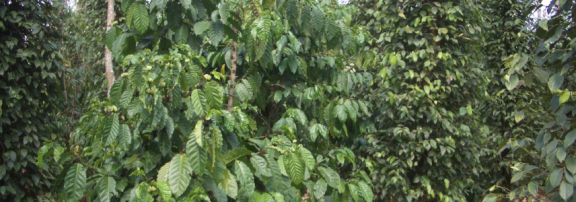
Source: Poul Wiertsema
According to industry experts from the spices and herbs sector, good examples of sustainable farming for the spices and herbs sector are food forests, wild picking and strip cropping.
Many agricultural experts agree that working with a food forest is one of the best paths towards sustainable (agricultural) farming. In a food forest, spices and herbs are often the crop that grows on the first layer of the forest (ground level). Growing crop in layers allows more plants to grow in a denser area. This allows for a better harvest, despite the unavailability of a large crop field.
Indonesian spice exporter adds value with agroforestry and low-energy processing
The Indonesian company Agradaya is an example of how sustainable practices can create added value, even without formal certification. The company produces several spices in agroforestry systems and promotes this as part of its value proposition. Agroforestry supports biodiversity, improves soil health and increases climate resilience.
Agradaya also produces its own compost and dries spices using solar energy and biomass furnaces instead of gas or electricity. Although the company is not certified under any sustainability standards, it can clearly show buyers its environmental efforts. At the same time, these practices help reduce energy and input costs while improving long-term soil fertility. This strengthens both Agradaya’s environmental performance and its business model.
Become a certified spices and herbs producer
To make the most from your sustainability efforts, it is important to get certified. Certification makes your performance clear and believable for buyers because it is verified by an independent body. This makes you more competitive.
Certification also gives you a clear, step-by-step approach and helps you see risks and areas where you can improve. Certification can also open up markets where sustainability is a major requirement, such as certain retailers, food processors and re-packers.
Many European buyers who support sustainable sourcing of spices are members of the Sustainable Supply Initiative (SSI). This is an organisation that promotes more sustainable trade practices in global supply chains. SSI has a ‘basket of standards’. This is a group of standards that the organisation recognises as credible sustainability schemes for conventional (not organic) spices.
If you want to sell conventional spices to these buyers, it is useful to check what standards are included. Being certified under one of the recognised schemes can make you seem more reliable to buyers and improve market access.
Organic
EU organic certification shows that a product has been produced according to the European Union’s rules for organic farming. These rules put limits on the use of synthetic pesticides and fertilisers, ban GMOs and require strict control of processing and storage. Farms and processors need to be inspected every year by an approved control body. Only certified operators can use the EU organic logo on their products. This logo shows buyers and consumers that the product meets EU organic standards.
There are also other European private standards that build on the EU organic standard and add other requirements. These include Soil Association in the UK and Naturland in Germany. It can be interesting to adopt them if you have a potential buyer who specifically wants them.
The market for organic spices and herbs is still quite small, but it will probably grow in the future. Still, high inflation in 2022 and 2023 meant that people spent less on premium products, including organic food. Many buyers started using conventional spices and herbs. This has lowered demand for organic products. In 2024, inflation fell to 2.6%, and EU imports of organic spices and herbs went up by 14%. Future growth will depend on the economy in Europe.
Turmeric, ginger and black pepper are some of the most popular organic spices. They are often used in herbal teas and products positioned between food and supplements. Consumers who buy these products for health reasons are more likely to choose organic options.
Rainforest Alliance
Rainforest Alliance is one of the largest and best-known certification schemes in the spices and herbs sector. It mainly focuses on environmental sustainability. Together with the Dutch organisation UEBT – Sourcing with Respect (Union for Ethical BioTrade), it developed a programme dedicated to spices and herbs.
You can find the documents you need to comply with the standard on the Rainforest Alliance website. These include useful tools like the field checklist, which explains what farms need to do under the UEBT/Rainforest Alliance standard. The website also has information for other actors in the supply chain, not only for producers. It also explains any special exceptions or extra rules that may apply to certain spices, such as pepper and chilli.
Fair trade certifications
There are several certification schemes based on the idea of ‘fair trade’. Fair trade means that producers receive a fair price and work in good labour conditions. It also helps to build long-term trading relationships and community development.
Fairtrade International is the best-known fair trade standard. It mainly focuses on social issues, such as fair prices and workers’ rights. It pays less attention to the environment. This is why some organisations, such as the Sustainable Supply Initiative (SSI), do not fully recognise it as an environmental sustainability standard. The SSI sees the Fair for Life standard as more similar to schemes like Rainforest Alliance.
GLOBALG.A.P.
GLOBALG.A.P. is a well-known farm assurance standard in the food sector. It focuses on good agricultural practices, including food safety, traceability, environmental management and responsible use of water and crop protection products. It is not an advanced sustainability standard, but it does show a basic level of environmental care. It also shows buyers that production is well organised and that the supplier is prepared to meet quality requirements, including limits for pesticide residues.
SAI Platform’s Farm Sustainability Assessment (FSA)
The SAI Platform FSA is a tool that helps farms measure and improve their sustainability performance. It looks at areas such as soil health, water use, biodiversity, labour conditions and greenhouse gas emissions. The results can be shown in levels (Bronze, Silver and Gold). They can also be checked by an independent third party. Farmers can begin with a self-assessment, but European buyers usually only accept the results as reliable proof if they have been checked by someone else.
FSA can also be linked to GLOBALG.A.P. through the GGFSA add-on. This lets producers combine FSA verification with a GLOBALG.A.P. audit in a single process. This helps reduce double work and makes it easier to talk to buyers about your sustainability performance.
Certified spice exporters gain edge with organic and sustainability actions
The Sri Lankan company Cinnatopia is a good example of how organic certification can support sustainability and create a competitive advantage. The company supplies organic spices, including Ceylon cinnamon, white and black pepper, mace and cloves. By choosing organic production, it reduces the use of synthetic agrochemicals and lowers its environmental impact.
At the same time, Cinnatopia combines organic certification with a well-recognised social certification, Fairtrade, and high-level food safety standards, BRCGS and IFS. This allows the company to serve European buyers. Because it offers both sustainability and high-quality assurance, it becomes a strong and reliable partner. This combination makes the company more competitive and harder to replace.
The Malagasy company BioVanilla is another good example of how certification and environmental action can make each other stronger. Its vanilla is certified organic and Rainforest Alliance, and it also has Fair for Life, Fairtrade and FSSC 22000 certifications, among others. This combination covers environmental, social and food safety standards.
BioVanilla also invests in reforestation. The company has planted more than one million trees since 2020. By combining recognised standards with concrete environmental action, BioVanilla strengthens its sustainability profile and its position in demanding export markets.
Tips:
- Analyse your current production process carefully before introducing new practices. Decide where your activities have the biggest environmental impact and focus on measures in those areas first. This helps you use your time and resources more effectively.
- Work with an agricultural advisor to implement sustainable practices. An experienced advisor can help you apply new farming methods correctly and efficiently. This helps your team learn faster and avoid mistakes. It also builds trust among workers and increases confidence in the transition process.
2. Improve your process to reduce your emissions
Food system emissions globally account for 5.8 Gt CO2e, equating to 30% of the world’s GHG emissions.
Products of animal origin like meat and dairy, as well as animal feeds, contribute highly to these emissions. But spices and herbs also play a role.
Table 1: Selected spices and herbs with a relatively higher CO2 emitted per kg produced
| Product | In distribution centre | Kg Co2e / kg |
|---|---|---|
| Ground white pepper | Europe | 7.7 |
| Turmeric powder | Europe | 4.2 |
| Ground black pepper | Europe | 4 |
| Vanilla extract | Europe | 3.2 |
| Cumin ground | Europe | 3 |
Source: Carbon Cloud
Table 2: Selected spices and herbs with a relatively lower CO2 emitted per kg produced
| Product | In distribution centre | Kg Co2e / kg |
|---|---|---|
| Coriander | Europe | 0.38 |
| Cinnamon | Europe | 1.2 |
| Cardamom powder | Europe | 1.3 |
| Dried garlic | Europe | 1.3 |
| Dried ginger | Europe | 1.9 |
Source: Carbon Cloud
These emissions are produced mainly during the farming, processing and transportation. How you can reduce your emissions depends mainly on your process.
Farming
Conventional farming creates greenhouse gases in several ways. One major source is the use of synthetic nitrogen fertilisers. When used on soil, these fertilisers release nitrous oxide (N₂O). This is a greenhouse gas that is much more powerful than CO₂. In many farming systems, nitrogen fertilisers are the largest single source of agricultural emissions.
You can reduce these emissions by replacing synthetic fertilisers with compost made from farm residues and animal manure. This means you use chemical inputs less, and you can also reduce costs. If you still need nitrogen fertiliser, only use it when necessary, in exact amounts, and combined with organic fertilisers.
Farming can also create emissions by making the soil worse. Intensive ploughing brings soil organic matter in contact with air. This speeds up decomposition and releases CO₂. Pesticides and herbicides can reduce soil biodiversity and earthworms, fungi and bacteria that keep soil healthy. Depleted soil can contain fewer nutrients, so you need more fertiliser, creating a cycle of higher emissions.
Video 1: Compost making tutorial by Tanzanian farmers
Source: Sustainable Agriculture Tanzania on YouTube
You can break this cycle by managing your soil better. Planting cover crops helps fix nitrogen naturally, and reduced or no tillage protects soil structure and carbon stocks. Tractors and machinery that use fossil fuels also produce emissions. Choosing more efficient equipment and renewable energy sources, such as solar power, can further lower your environmental impact.
Processing
Some spices, like chillies or peppers, are often dried using open fires. This turned out to be a polycyclic aromatic hydrocarbons (PAH) contamination hazard. PAH exposure can increase the risk of cancer. The EU has set limits to the amount of PAH that is allowed in spices and herbs imports.
You can use sun-drying to lower your emissions and follow the rules around EU PAH limits.
Figure 2: Sun-drying facility for spices in Thailand, from the outside
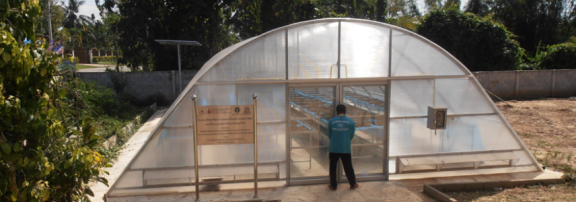
Source: Poul Wiertsema
Figure 3: Sun-drying facility for chillies in India, from the inside
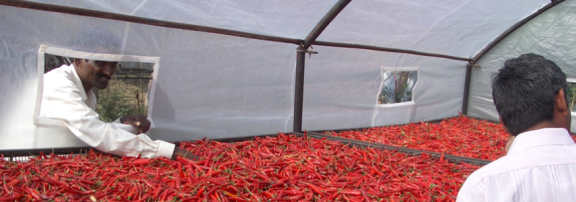
Source: Poul Wiertsema
Even if black pepper is not dried using open fires, the drying process demands a lot of energy. To lower the emissions produced when drying and grinding, you can use solar energy instead of fossil fuels.
Tip:
- Start making your own compost. This is easy and cheap, and can help you use less nitrogen-based fertilisers and lower your emissions at the farm level.
3. Make use of green innovations
Spices and herbs cultivation is a big industry, and new technologies are emerging all the time. These offer solutions and improvements for farmers. As the link between agriculture and climate change has become evident, many new developments are targeting this issue and providing opportunities to be more sustainable.
At the moment, precision agriculture with the help of technology offers opportunities to be more efficient with the use of inputs like water and fertilisers. On the other hand, new sustainable methods for plague control are being researched to provide more environmentally friendly alternatives to farmers.
Invest in precision agriculture tools
Producers can use several new technologies to increase yield, improve quality and become more environmentally sustainable. Below are some examples tested in cardamom production.
Table 3: How technology is used in cardamom production
| Technology | Use | Benefits |
|---|---|---|
| Soil and environmental sensors | Devices measure soil moisture, nutrients, pH and other conditions across the field in real time. | Enables precise nutrient management, reduces over-fertilisation and optimises irrigation, improving soil health and reducing waste. |
| IoT (Internet of Things) | Connects sensors and devices to a network that collects real-time field data automatically. | Provides continuous data flow for decisions, supports automated irrigation and fertilisation, and improves resource use efficiency. |
| Remote sensing (drones and satellite imagery) | Aerial tools monitor large areas of crops for plant health, stress, pest outbreaks and field variability. | Detects issues early, supports targeted interventions and reduces unnecessary chemical use. |
| GIS mapping and field visualisation | Geographic Information Systems map field variability (soil types, micro-climates). | Helps define management zones and tailor practices to specific field areas, reducing input use and improving yield. |
| AI and Machine learning | Analyses large data sets from sensors and remote tools to predict yield, pests and disease risks. | Improves decision-making, supports early pest/disease detection and optimises timing for irrigation and fertiliser application. |
Source: “Precision Farming and Cardamom Cultivation: A Sustainable Approach” International Journal of Precision Research in Engineering, Management and Sciences (IJPREMS).
Online platforms for farmers
The Alliance for a Green Revolution in Africa (AGRA) and CropIn, a supplier of digital solutions for farmers, launched a project for smallholder farmers in Ghana, Nigeria, Burkina Faso, Mali, Tanzania and Mozambique to provide digital solutions to promote climate change mitigation and resilience. In the six countries where it was launched, CropIn’s platform has facilitated the digitalisation of end-to-end agricultural operations. This involves geotagging agricultural plots and digitising farm and farmer data, making it easily accessible through a centralised cloud platform.
The AGRA platform provides farmers with tailored support through the Package of Practice (PoP). It includes tracking of agricultural inputs, providing guidance on optimal sowing periods, and issuing timely pest and disease alerts to prevent crop losses. They have several projects in the spices and herbs sector, such as ways to enhance your traceability as a sustainable spice business.
The AGRA platform website is a valuable source of information for farmers who are interested in incorporating technology and innovation into agricultural projects. For example, their report about precision agriculture for smallholder farmers gives an overview of technologies and how they can be applied in precision agriculture. They do this by presenting real-life examples and practical scenarios.
The report also emphasises important factors that need to be considered, such as the practicality of implementing these technologies, identifying viable business models for widespread adoption. It also recognises potential obstacles like limited digital infrastructure, low levels of digital literacy and insufficient digital skills among farmers.
Tips:
- Look for new solutions at international trade shows, and ask manufacturers for options for your crop. Very often, new developments are presented in the academic program of the show.
- Watch relevant videos like FarmKenya’s video about spices and herbs data driven agriculture.
4. Reduce your risk by investing in sustainability step by step
As a producer and exporter of spices and herbs you can face a combination of challenges when trying to become more sustainable. The biggest challenges are:
- The supplier pays for changing requirements and certifications costs;
- Buyers can be unwilling to pay more for sustainability;
- New knowledge and skills are needed to improve.
Changing requirements
Over the past 15 years, European buyer requirements on sustainability have changed a lot. It started with stricter limits on agrochemical and tighter maximum residue levels. Now it has become a complex set of standards that are updated all the time. This can be very difficult for growers in developing countries. They need to keep changing their practices while also paying for most of the extra costs.
This challenge is even greater in the early stages of doing business internationally or if companies mainly work with spot sales. Without stable buyers, it is harder to argue for new investments in certification or traceability systems. The risk is higher and margins are often lower.
But once a company has a solid certification level for the EU market, changing and adapting becomes easier. New requirements usually build on existing systems rather than replacing them. In long-term partnerships, buyers are also more likely to help with new investments.
Unwillingness of buyers in paying a premium for sustainability
Many importers want to improve the sustainability of their supply chains. However, this comes with extra costs. Some spice brands that sell directly to consumers can show their sustainability story on the label. This helps them explain their higher prices.
However, most spices in Europe are used by the food industry. They go into products like sausages, cold cuts and ready meals. In this segment, only a small niche really values sustainability. As a result, importers often cannot charge a premium price. This limits their ability to pay higher prices to suppliers or invest in further improvements.
To reduce this risk, you should improve sustainability step by step. Start with actions that fit your current buyers. If your buyers do not ask for certification yet, you can still use low-cost practices. For example, use your own compost, cover the soil with crop residues to protect it and plant cover crops to reduce erosion. These actions improve soil health and do not require large investments.
If you work with buyers who ask for certified products, focus on the certifications they value. Only make further investments if there is a clear business case and willingness to pay. Also remember that some sustainability measures save money over time. Compost reduces fertiliser costs, and solar energy can lower energy bills in the long run.
New knowledge and skill needed to improve
You need proper guidance to start using sustainable practices. You need to understand which type of compost is good for your crop, how to apply it and how to use your resources efficiently. Good soil management requires planning; you cannot just guess.
If you want to start multi-cropping, choose crops carefully. They should support soil fertility and not compete with your main crop too much. The same is true of cover crops. They need to protect and enrich the soil but not reduce yields. Sometimes it is a good idea to hire an expert to speed up this process. Certification bodies in your country can often recommend agronomists or sustainability advisors. The ministry of agriculture sometimes also offers extension services or might be able to suggest qualified specialists.
Your buyers can also be a source of knowledge. Some importers work closely with sustainability experts in spice production. Some may be willing to share expertise or support improvements in your farming practices.
Tips:
- Start by adopting good agricultural practices that follow the GLOBAL G.A.P. standard. This gives you a good baseline for quality and sustainability at the farm level. It also gives you a foundation you can build on as you continue to improve.
- Check the Sustainable Spices Initiative’s (SSI) basket of standards to stay up to date on what industry frontrunners define as ‘sustainable.’
5. Meet European sustainability legislation
The European Union (EU) has introduced several policies to make the economy more sustainable and reduce environmental and social risks in global supply chains. These policies are part of the European Green Deal, which wants to make Europe climate-neutral by 2050.
Most of these laws apply directly to companies operating in the EU. But they also affect suppliers from developing countries. More and more often, European buyers need to collect information about the environmental and social impact of their supply chains. This means that exporters of herbs and spices are sometimes asked to give more information about farming practices, labour conditions, traceability and environmental impact. Two EU laws are especially relevant for suppliers.
CSRD: Corporate Sustainability Reporting Directive
The CSRD says that large EU companies must report on their environmental, social and governance (ESG) impact. They need to use standardised European Sustainability Reporting Standards (ESRS). The goal is to make sustainability reporting as reliable and transparent as financial reporting.
For spice and herb suppliers, this means that EU buyers need to report on the impact of their supply chains. This means that buyers may ask for more data on farming practices, emissions, labour conditions and traceability. This can increase their interest in supporting more sustainable farming systems.
CSDDD: Corporate Sustainability Due Diligence Directive
The Corporate Sustainability Due Diligence Directive entered into force on 25 July 2024. It says that large companies must identify and address negative human rights and environmental impacts. This includes issues such as child labour, unsafe working conditions and environmental damage. The directive covers company’s own operations, but also their subsidiaries and chains of activities. There is a focus on areas where risks are most likely.
Like the CSRD, this directive encourages European companies to look more closely at risks in their supply chains. In theory, this encourages working with responsible suppliers and investing in improvements at the farm level.
Tips:
- Find more information about the European Due Diligence Act, the EU Green Deal and an overview of sustainability developments in the European spices and herbs market in Trends on the European Spices and Herbs Market on the CBI platform.
- Check out the details of certification and other buyer requirements for the spices and herbs sector, including for specific spices and herbs like cinnamon, turmeric and thyme, on the market information page of CBI and the buyer requirements study.
6. Embedding green principles in your code of conduct
A code of conduct is a set of guidelines that outlines expected and appropriate behaviours within an organisation. It is important for every company to have a code of conduct. By integrating environmentally friendly principles into your code of conduct, you can show your dedication to sustainability and encourage a more environmentally responsible industry. To achieve this, consider the following steps:
- Review: Take the time to revisit and assess your organisation’s existing code of conduct.
- Introduce green principles: Incorporate concise and straightforward statements that emphasise environmental responsibility and sustainability.
- Promote awareness: Share the updated code of conduct widely within your organisation to ensure that all employees are aware of the newly added green principles.
- Encourage adherence: Follow the code of conduct and encourage employees to adopt environmentally friendly practices in their daily work routines.
By rewriting your organisation’s code of conduct to include green principles, you demonstrate your commitment to sustainability and contribute to a more environmentally conscious industry.
Your code of conduct should include information about:
- The values your company believes in;
- Guidelines for behaviour;
- Day-to-day business practices;
- How your employees should interact with outside parties.
Valamis has written a good article about what to include in a code of conduct.
Best practices in the Spices and Herbs Sector
Two major players, Unilever (Unilever Sustainable Agricultural Principles (SAP)) and McCormick (Supplier Code of Conduct), have extensive codes of conduct regarding sustainability. You can use these to learn about the concept of self-verification. This means that you as a supplier assess your own compliance with the sustainability code of the buyer.
Tips:
- Encourage sustainable behaviour among your employees and customers by promoting recycling, reducing waste and conserving energy. This can be done through training, education and communication.
- As a spices and herbs grower, engage with your suppliers to encourage sustainable practices throughout the supply chain. This includes promoting sustainable farming practices and reducing the use of harmful chemicals.
- Regularly monitor and report on your environmental performance, including your greenhouse gas emissions, water usage and waste generation. This can help identify areas for improvement and demonstrate a commitment to sustainability.
7. Find funding, investors and/or partners
As a grower or exporter of spices and herbs based in a developing country, it can be interesting to find funding, investors or partners to support your sustainability efforts. There are several approaches to explore.
Sustainable Spice Initiative
The Sustainable Spice Initiative (SSI), a sector-wide consortium, was established by IDH in 2012. It brings together an international group of companies in the spices and herbs sector.
The members of SSI share the belief that in today’s environment sustainability needs to be part of their long-term strategy. This not only to secure sufficient products for future use, but also to recognise that in a connected global society business can only be successful if it is inclusive and responsible.
They have regional platforms for Vietnam, India and Indonesia.
Sustainable Herbs Initiative
The Sustainable Herbs Initiative (SHI) is a global, multi-stakeholder platform that works to improve sustainability and transparency in herbal supply chains. It brings companies, producers and practitioners together to deal with ethical and environmental challenges in sourcing. It also supports collaborative learning and practical tools that promote more sustainable and fair value chains.
Smallholder producers and processors can get involved with SHI by taking part. By joining its community, following its tools and webinars, and taking part in Learning Labs or Working Groups, they can align with international buyer expectations. Producers can also make their position stronger by recording their sustainability practices in line with SHI principles. Another way to do this is to approach SHI-affiliated brands with partnership proposals that focus on regeneration, transparency and long-term collaboration.
Running programs:
- Look for government programmes or grants that promote sustainable agriculture and offer funding or technical assistance to farmers.
- Look for NGOs or non-profits that work with farmers to promote sustainable agriculture and offer funding or technical assistance. Organisations include the World Bank, the United Nations, the Sustainable Spice initiative, CBI, GIZ, and NGOs like the International Fund for Agricultural Development (IFAD). They provide funding and technical support to SMEs in developing countries. This usually takes place as part of projects that comprise not only funding but training and technical assistance too, and are limited in time. SMEs would therefore have to research which new projects are being launched in their regions.
- Participate in certification programmes that promote sustainable agriculture, such as Fair Trade or Rainforest Alliance. These programmes can provide access to markets and buyers who are interested in sustainably produced goods.
REAF
The Rural Entrepreneurs in Agri-Food (REAF) programme, funded by the GIZ and implemented by Berytech in Lebanon, aims to enhance the business and product viability of innovative start-ups that focus on sustainable rural economic development in South Mount Lebanon, as well as Central and West Bekaa. This project includes financial grants for the participating start-ups.
What you can do to start out:
- Collaborate with other farmers or cooperatives to pool resources and expertise to implement sustainable agriculture practices.
- Attend sustainability-focused events or conferences to network with potential partners or investors and learn about funding opportunities.
- Partner with universities or research institutions to access funding or technical expertise to implement sustainable agriculture practices.
- Look for investors or partners who are interested in supporting sustainable agriculture projects. This could include impact investors, socially responsible investors, or companies that have sustainability goals.
- Consider crowdfunding to raise funds from a community of individuals who are passionate about sustainable agriculture.
- Agricultural and national development banks: Agricultural banks are specialised in giving loans for companies in the agricultural sector. Strengthen your network around organisations supporting farming, development or exports. These are very often selected by international NGOs to implement projects that might include grants and other type of business support. Look for new project openings and register in their databases, so they can contact you for upcoming opportunities.
Loans and services for agricultural activities provided by banks
The Agricultura Bank of Egypt provides special loan types and services for agricultural activities and has branches in rural areas of Egypt. Also look into your country’s agricultural or development bank. These institutions often have special schemes for the agricultural sector.
GloballyCool conducted this study for CBI.
Please review our market information disclaimer.
Search
Enter search terms to find market research