
Entering the European market for pine nuts
To sell pine nuts in Europe, suppliers need to prove food safety, origin, species and consistent quality. Test every lot for cadmium, aflatoxins, nickel, microbes, rancidity and residues. Buyers expect Global Food Safety Initiative (GFSI) certification, UNECE-based specifications, traceability and protective packaging.
Contents of this page
1. Which requirements and certifications must pine nuts meet to be allowed on the European market?
All pine nuts sold in Europe need to be safe and comply with rules on contaminants, labelling, traceability and food contact packaging. Buyers also expect proof of origin, correct species declaration, lot testing, food safety certification and evidence of responsible forest-based sourcing. This article highlights the main pine nut requirements. For a general overview, read the CBI study on buyer requirements for processed fruit, vegetables and edible nuts.
What are mandatory requirements?
To export pine nuts to Europe, you need to follow strict rules on contaminants, labelling and traceability. Cadmium is the main reason for pine nut rejections, while aflatoxins, nickel, mineral oil hydrocarbons and packaging contaminants also need attention. Buyers also expect strong hygiene control, clear batch documents and evidence that you follow new EU sustainability rules.
Compare customs duties with competing countries
Most pine nut exporters from the main producing countries can export pine nuts to the European Union with 0% import duties. This is on the condition that they can provide valid proof of origin. This rule, however, does not apply to pine nuts of Russian or Belarusian origin. Since 1 July 2025, the European Union (EU) has applied an additional 50% import duty to many agricultural products from Russia and Belarus, including pine nuts.
Assess contamination risks at each step of the pine nut supply chain
Follow changes to EU contaminant legislation to ensure your pine nuts meet current limits. Read more about the main risks below:
- Cadmium and nickel: Cadmium is the main cause of pine nut rejections in Europe. In 2025, the Rapid Alert System for Food and Feed reported two rejections from China and Türkiye. The cadmium limit is 0.30 mg/kg. A 10 mg/kg nickel limit has applied since 1 July 2025.
- Aflatoxins: In-shell pine nuts for further processing may contain up to 5.0 μg/kg aflatoxin B1 and 10.0 μg/kg total aflatoxins. For shelled pine nuts sold to consumers or used as ingredients, the limits are 2.0 and 4.0 μg/kg, respectively.
- Microbiological contaminants: EU microbiological criteria cover pathogens, including Salmonella, in several food categories, but pine nuts have no separate criterion. Buyers often require tests for total plate count, yeast and moulds, coliforms, E. coli and Salmonella. Make sure to control shelling, sorting, storage and factory hygiene.
- Pesticide residues: The EU sets maximum residue levelson pine nut kernels. For Great Britain, check the GB MRL Statutory Register. The risk is generally low because pine nuts are rarely sprayed, and kernels are protected by shells. Residues may still result from forest treatments against pests, such as Leptoglossus occidentalis or from storage chemicals.
- Mineral oil hydrocarbons: Mineral oil saturated hydrocarbons (MOSH) and mineral oil aromatic hydrocarbons (MOAH) may come from lubricants, processing aids, transport bags, dust or packaging. On 13 May 2026, EU Member States supported a draft on MOAH limits, including 2 mg/kg for tree nuts. Germany uses a 4 mg/kg MOSH benchmark for nuts.
- Packaging contaminants: Food-contact packaging must meet EU food-contact material rules, including migration limits. Plastic packaging requires a Declaration of Compliance. Check phthalates, new BPA and bisphenol restrictions, and the PFAS rules that came into force on 12 August 2026.
Follow labelling rules
Identify each bulk lot under the EU lot identification rules. Keep traceability records and give buyers the product name, origin, lot code, net weight, shelf life and relevant allergen or cross-contact information. Retail packs need to comply with the EU Food Information to Consumers Regulation. Labels need to meet minimum font-size rules and show the product name, net quantity, durability date, nutrition declaration, origin (where required) and allergens. The information needs to be in a language easily understood by consumers in the target country.
Comply with the legislative requirements on sustainability
Several European Green Deal laws on environmental and social sustainability affect buyer requirements and supply-chain checks, although most are not specific to pine nuts. Important legislation includes:
- Organic food regulation. The regulation has applied to organic pine nuts since 1 January 2022. Some third-country equivalence arrangements remain until 31 December 2026.
- Corporate Sustainability Due Diligence Directive. In force; amended national measures will apply from 26 July 2029.
- Corporate sustainability reporting. The first reports under the revised rules are expected in 2028, covering the 2027 financial year.
- Forced Labour Regulation. In force; the ban will apply from 14 December 2027.
- Packaging and Packaging Waste Regulation. It generally applies from 12 August 2026, with major recyclability targets from 2030.
- Empowering Consumers for the Green Transition Directive. EU countries must apply its greenwashing rules from 27 September 2026.
- Sustainability labels and green claims. The Green Claims proposal remains uncertain, but buyers still expect proof of environmental claims.
Tips:
- Check the pine nut import duty in Access2Markets. Use the correct CN code and country of origin, and keep valid proof of origin for each shipment.
- Recheck aflatoxin, cadmium and nickel limits before each season and for each new origin, supplier or lot. EU limits can change.
- Read the CBI sector study on general rules on processed fruit, vegetables and edible nuts.
What additional requirements and certifications do buyers often have?
Besides mandatory requirements, buyers expect strong food safety, correct species declaration, consistent quality, traceability and sustainability.
Meet specific quality characteristics
Since 1 January 2025, EU marketing rules have required unroasted shelled pine nuts sold for direct consumption to show their country of origin. Single-product packs must contain pine nuts of one origin and name that country. Only packs mixing different nuts or species may use ‘EU’, ‘non-EU’ or ‘EU and non-EU’.
The main commercial reference is UNECE Standard DDP-12 for pine nut kernels. It covers several species, including:
- Pinus pinea;
- Pinus koraiensis;
- Pinus sibirica;
- Pinus yunnanensis;
- Pinus wallichiana;
- Pinus gerardiana;
- Pinus pumila.
Buyers add specifications based on use. Pesto producers focus on flavour, colour and low resin notes. Bakery and confectionery buyers on size, appearance and breakage. Ingredient users on stable microbiology, clean taste and shelf life.
Important quality indicators include:
- Species and origin: Species differ in size, shape, colour, flavour and price. Mediterranean Pinus pinea is usually a premium product, especially for pesto. Asian Pinus koraiensis and Pinus sibirica are more common in standard trade.
- Class and defects: UNECE grades kernels as Extra Class, Class I or Class II, based on tolerances for foreign matter, shell fragments, broken kernels, mould, rancidity, pest damage, poor development, discolouration and kernels from other species.
- Size: Optional under UNECE but common in trade, size is expressed as kernels per 100 g. Pinus koraiensis often has 500–750 kernels per 100 g, compared with 800–1,200 for Pinus sibirica.
- Moisture: The general UNECE limit is 3.5%, rising to 6.0% for Pinus pinea and 7.0% for Pinus gerardiana. Buyers may set stricter limits for retail packing or a longer shelf life.
- Freshness and rancidity: High fat content makes pine nuts vulnerable to rancidity during poor storage. Buyers may test free fatty acids and peroxide value. Aim for below 0.5% free fatty acids and below 5 meq/kg peroxide value.
- Organoleptic quality: Buyers check colour, smell, taste, texture and the absence of bitterness or resin notes. Declare the species correctly, as some non-standard species have been linked to bitter or metallic ‘pine mouth’ complaints, especially Pinus armandii.
Buyers often ask for a lot-specific certificate of analysis before shipment. It should confirm compliance with the agreed specification and cover the following specifications:
- Moisture,
- Size;
- Defects;
- Microbiology;
- Aflatoxins;
- Heavy metals;
- Peroxide value;
- Free fatty acids;
- Pesticide residues.
Offer safe and protective bulk packaging
Most pine nut kernels reach Europe in bulk or semi-bulk packs for later repacking, roasting or food manufacturing. Common formats are 25 kg cartons with two 12.5 kg food-grade PE/PP vacuum bags, 10 kg vacuum boxes and 25 kg raffia sacks with inner bags. Packs must be sealed, clean, undamaged and free from foreign matter.
These high-fat, expensive kernels need to be protected from moisture, oxygen, light, insects and heat. Store them in dry and cool conditions, away from sunlight and heat sources. Some buyers use 6–10°C storage to preserve freshness and prevent infestation.
Get food safety certified
Most established European importers require third-party food safety certification for processing, shelling, sorting or packing facilities. They may also visit or audit your factory before the first contract. Buyers usually require a GFSI-recognised programme, especially:
Certification does not replace product testing. Buyers still expect lot-specific analysis of aflatoxins, heavy metals, microbiology, moisture and rancidity.
Invest in sustainability
European demand for sustainably sourced food is growing. For pine nuts, this means responsible forest collection, clear origin, legal harvesting and fair conditions for collectors and factory workers. Organic certification can support wild-collected products, but buyers also expect forest-to-processor traceability.
Retailers and brands assess environmental claims and labels more and more often, such as Green-Score and Planet-Score. From 27 September 2026, EU countries must apply the Empowering Consumers for the Green Transition Directive. It restricts generic claims and labels without recognised evidence.
Use standards suited to wild collection. FairWild covers wild-collected products, while Fair for Life supports fair and transparent supply chains. FSC and PEFC can support forest-management claims for certified collection areas. Buyers may also request Sedex SMETA or amfori BSCI social audits.
Use flexible contracts for a changing crop
Keep payment and delivery terms simple, especially with new buyers. As pine nut crops fluctuate, avoid fixed quantities before you know the actual harvest volume, quality and timing. Agree shipment windows, quantity tolerances, documents and claim procedures. FOB and CIF are common Incoterms in nut trade. For first shipments, use cash in advance, a letter of credit or cash against documents.
For larger contracts, consider recognised nut trade terms, such as the INC Short Form Contractand Waren-Verein conditions, including arbitration or expert dispute procedures.
Tips:
- Keep moisture below the UNECE limit where possible. UNECE allows up to 3.5% for most kernels, but some processors target 2.0–2.5% for premium quality, crunchier texture, better taste and longer shelf life.
- State the test method for each major parameter, especially moisture, peroxide value, free fatty acids and microbiology. This helps buyers repeat tests using the same method and resolve claims faster.
- Read CBI’s tips to go green and tips to become a socially responsible supplier to understand growing European buyer requirements for sustainability and social responsibility.
What are the requirements for niche markets?
The most relevant niche opportunities for pine nuts are organic wild collection, premium single-origin products and responsible forest-based sourcing.
Consider organic and wild collection certification
Organic is the most realistic niche. To sell as organic in Europe, collection, processing, storage and export need to meet EU organic rules. Wild collection areas must be free from unauthorised treatments, and harvesting must not harm habitats or future production. EU imports need an electronic certificate of inspection in TRACES.
For Great Britain, importers need to be UK-based and certified by an approved UK control body. Imports from outside the EU, EEA and Switzerland need a GB certificate of inspection.
Consider premium and responsible-sourcing niches
Premium quality depends on species, origin and flavour. Mediterranean Pinus pinea leads the gourmet niche in pesto, premium retail and confectionery. Asian Pinus koraiensis and Pinus sibirica are common in standard trade. Halal and Kosher certification can serve retail, foodservice and ingredient niches.
Tips:
- For organic wild collection, map the area, list approved collectors and record volumes, labour conditions and transport.
- Use the ITC Standards Map to compare sustainability standards and choose suitable labels.
2. Through which channels can you get pine nuts on the European market?
Specialised nut importers and ingredient suppliers are good entry points for pine nut exporters. The strongest demand comes from pesto, sauces, prepared foods and premium cooking uses, while retail and foodservice are usually reached through European packers and distributors. Exporters with organic certification, proven Mediterranean-type quality, single origin or strong traceability can target premium and private-label channels.
How is the end-market segmented?
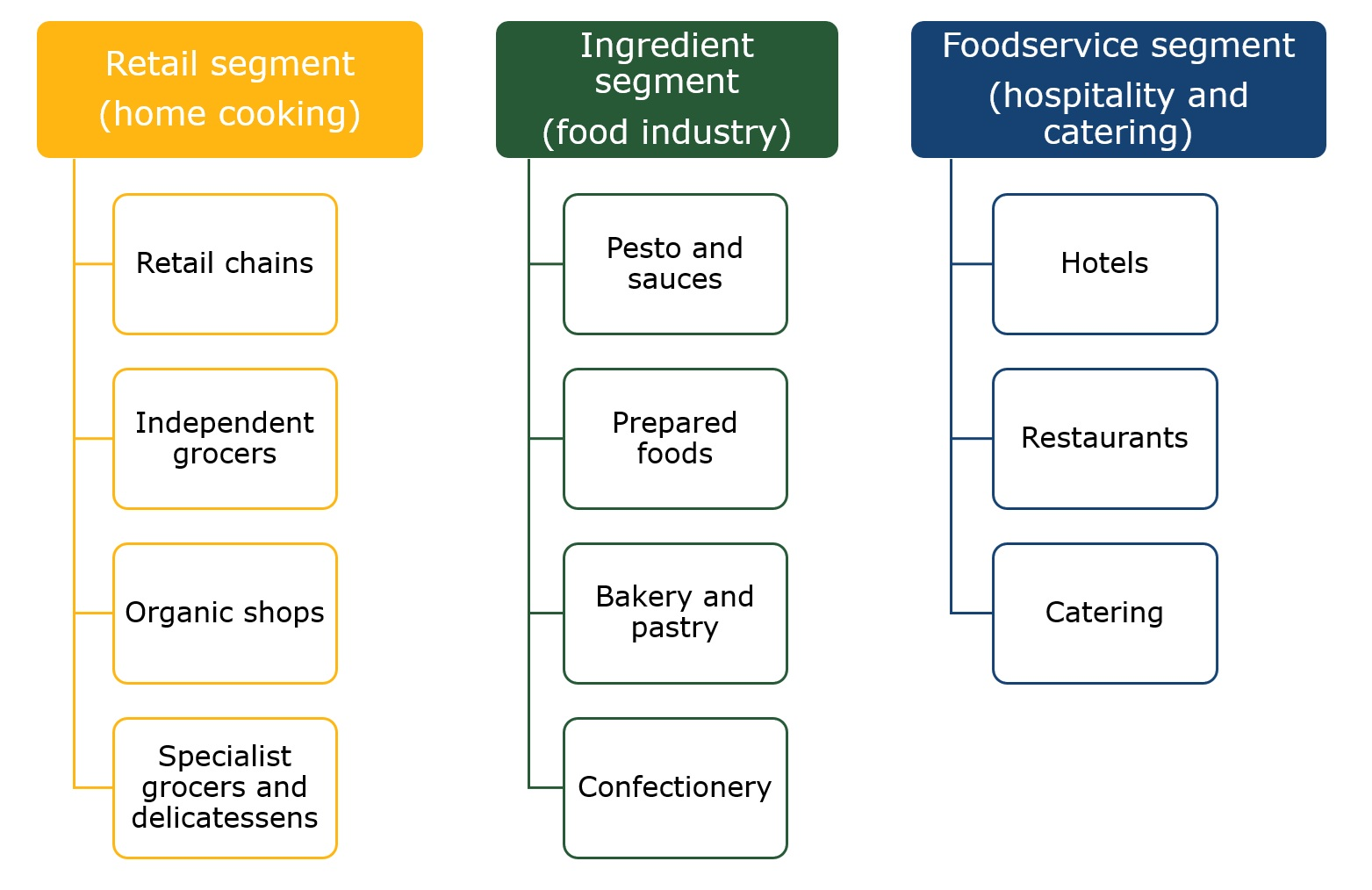
Exporters can best segment the European pine nut market by end use. The food industry probably takes the largest share, mainly for pesto, sauces, bakery, confectionery and ready meals. Retail is also important, but pine nuts are sold in small packs as cooking ingredients rather than everyday snacks. Foodservice is smaller but attractive for premium restaurants, caterers and Mediterranean cuisine. Premium Mediterranean, organic and single-origin pine nuts are quality positions across all segments, not separate end markets.
Figure 1: End-market segments for pine nuts in Europe
Source: Autentika Global, 2026
Retail
Leading European retailers very rarely buy retail-packed pine nuts from non-European origins directly. Exporters usually supply importers, nut traders, packers or private-label specialists, which clean, sort, pack, label and deliver pine nuts to supermarkets, organic shops and specialist food retailers.
Retail chains include supermarkets and hypermarkets, such as Tesco, EDEKA, Albert Heijn, Carrefour, Coop and Mercadona, and discounters, such as Lidl and ALDI. Pine nuts are mostly sold under retailers’ private labels or specialised nut brands. Examples include Tesco Wholefoods Pine Nuts in the UK, Jumbo Ongeroosterde Pijnboompitten in the Netherlands, dmBio Pinienkerne in Germany, Conad pinoli in Italy, Monoprix Bio Pignons de Pin in France and Piñones Hacendado in Spain.
Retail pine nuts are usually sold in small packs of around 30–50 g. Because of their high price, retailers mainly sell them as cooking or baking ingredients for pesto, salads, pastry and Mediterranean dishes. Some brands also present them as snacks, such as Jumbo roasted pine nuts in 30 g packs and the Seeberger vital seed mix.
Premium retail includes organic, Mediterranean and Iberian, single-origin pine nuts and branded cooking ranges. Seeberger promotes Mediterranean pine nuts with a mild, aromatic taste and a typically long shape, while Waitrose Duchy Organic and Monoprix Bio showcase the organic niche. Noberasco In Cucina also positions pine nuts as a premium cooking ingredient. In this niche, buyers pay more attention to species, flavour, colour, shape, traceability and origin.
Specialised distributors usually supply other retail formats such as independent grocers, fine-food shops and delicatessens. Organic and health-food retailers are also relevant, including Alnatura and dm in Germany, Veritas in Spain, NaturaSì in Italy and Ekoplaza in the Netherlands. Specialised online retailers and premium food platforms also sell pine nuts, such as Ocado in the United Kingdom and KoRo in Germany.
Retail buyers demand clean and uniform kernels, stable flavour, good shelf life and a low rancidity risk. Direct access is difficult, so exporters usually work through European importers, packers, organic specialists or private-label suppliers.
Food industry
The food industry is probably the largest end-use segment for pine nuts in Europe, although there is no reliable public data on its exact share. Food manufacturers use pine nuts as whole kernels, broken kernels, granules and paste. Saatenberg lists uses in bakery, fine pastries, pesto, ready-made meals, spice and herb blends.
Pesto and sauces are the main ingredient use. European producers use pine nuts in standard, organic and premium recipes. Saclà Organic Classic Basil Pesto combines pine nuts with cheese, cashew nuts and extra virgin olive oil. Polli highlights selected pine nuts in pestos made with 100% Italian basil from a certified supply chain. Il Pesto di Pra’ uses pine nuts in traditional Genoese pesto.
Pine nuts are also used in prepared foods like fresh pasta, salads and premium convenience products. Giovanni Rana sells fresh pasta with basil and pine nut pesto, while Barilla recipe pages show pine nuts in pesto pasta.
Finally, pine nuts are commonly used in the bakery, pastry and confectionery segment. Pine nuts are used as toppings, fillings and ingredients in traditional Mediterranean products. Examples include Bindi’s frozen Torta della Nonna and Biscuiterie L’Or tourons. This shows their role in industrial pastry and traditional confectionery, mainly in premium or regional products.
Food industry buyers need stable quality, reliable service, clear grade or count, a uniform flavour, low breakage, low rancidity risk, traceability and complete documents. Regular deliveries are important where recipes must remain consistent. Exporters with mixed quality, weak paperwork or uncertain supply will struggle.
Foodservice
This segment covers restaurants, hotels, cafés, bakeries and caterers. Chefs use pine nuts in pesto, salads, pasta, Mediterranean dishes, fillings, bakery toppings and desserts. Although smaller than the food industry, it supports demand for better-quality and premium nuts.
Packs are larger than retail formats, often 500 g, 900 g, 1 kg and sometimes 10 kg. They are sold through cash-and-carry chains and wholesalers, such as METRO Germany, Brakes, HANOS and Transgourmet France.
Buyers require consistent quality, good flavour, low breakage, kitchen-friendly packs and reliable supplies for regular menu items.
Tip:
- Do not present pine nuts as a single product. Buyers compare origin, species, size, flavour, colour, price and use. Prepare separate samples and specifications for standard, premium, organic and single-origin offers.
Through which channels does a product end up on the end-market?
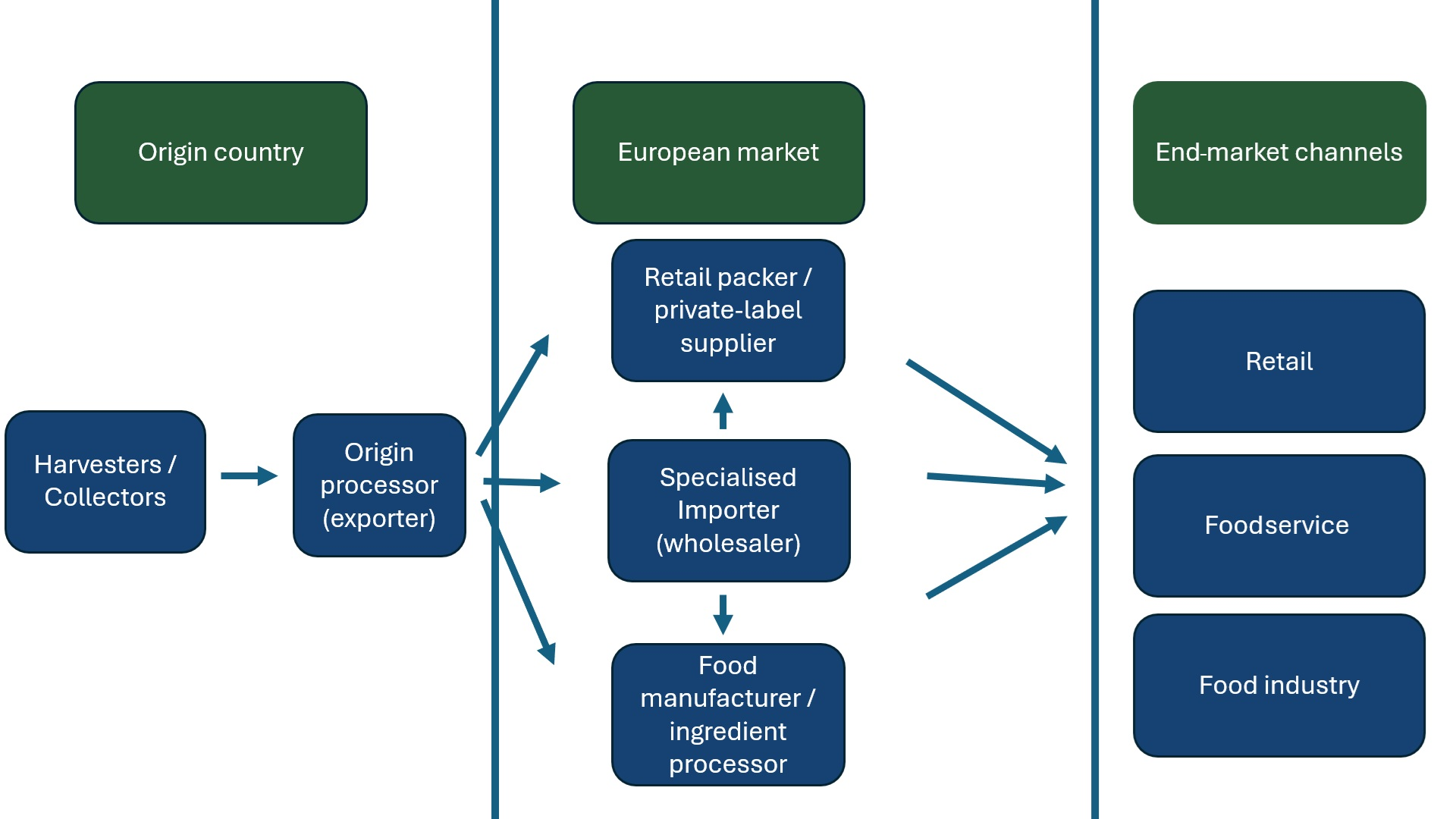
Most pine nuts first pass through a specialised importer, trader or ingredient supplier. From there, they move on to retail packers, food manufacturers, foodservice distributors or private-label suppliers.
Figure 2: European market channels for pine nuts
Source: Autentika Global, 2026
European importers and traders
The main gateway consists of specialised nut and dried fruit importers. These companies import bulk kernels, handle customs, quality checks, warehousing, financing and logistics, and sell to different customer groups. Examples include From Wild in the Czech Republic, Kruse, Hess & Co and Michael Priestoph in Germany, and Rhumveld and Catz International in the Netherlands. This is usually the most realistic first route, as these buyers understand origins, species, grades and harvest risks.
Agents and brokers
Agents and brokers can help exporters find buyers without taking ownership of the product. Some also support documentation, logistics, packaging or re-exports. They also agree on commissions, customer ownership and complaint handling in writing. FRUCOM is a useful starting point for understanding the European dried fruit and nut trade network.
Retail packers and private-label suppliers
Retail packers buy pine nuts in bulk and prepare them for supermarkets, organic shops and branded ranges. They clean, sort, pack, label and supply small consumer packs. Examples include Brüning, which offers bulk and small packs, RM Curtis, which works with industrial, wholesale, retail and own-label customers, and Blife, which supplies organic pine nuts. This route is attractive, but exporters must meet strict retail specifications, shelf-life rules and documentation requirements.
Food industry users
Food manufacturers use pine nuts in pesto, sauces, prepared foods, bakery, pastry and confectionery. Large manufacturers may buy directly, but most reduce risk by working through importers or ingredient suppliers. Direct sales are possible for exporters with strong volume control, testing, certification and traceability, especially with pesto or premium food producers such as Saclà, Polli and Il Pesto di Pra’.
Foodservice wholesalers and distributors
Foodservice wholesalers supply restaurants, hotels, cafés and caterers with kitchen-friendly packs. They usually buy from importers, packers or manufacturers, and not from origin exporters directly. Examples include Brakes, METRO, HANOS and Transgourmet France. This is an important downstream channel, but rarely the best first direct route for SME exporters.
Tip:
- Send potential buyers a clear offer sheet, not only a price list. Show the specification, volume, packing, certificates, shelf life and recent lot analysis. For premium pine nuts, include samples, as buyers judge flavour, colour and breakage as well as documents.
What is the most interesting channel for you?
For exporters from producing countries, 3 channels offer the best market entry:
- Specialised importers and traders: This is the main route. They buy bulk kernels and supply manufacturers, packers and foodservice distributors. They understand origins, species, grades, harvest and quality risks.
- Ingredient suppliers and food manufacturers: Suitable for exporters offering consistent industrial lots, clear specifications, lost control and documentation. Direct sales can improve margins, but supplier approval takes time.
- Organic, premium and private-label packers: Suitable for exporters with organic certification, Mediterranean quality, single origin or strong sustainability evidence. This channel can add more value than bulk trade, but it requires strict retail specifications, shelf-life control and reliable replenishment.
Brokers and agents can find buyers but mainly provide support. Direct supply to large retailers or foodservice wholesalers is less realistic at first.
Tip:
- Find buyers through trade fairs and nut networks. Search exhibitors at Anuga, SIAL Paris and Fi Europe, then company websites for pine nuts, nuts, dried fruit or ingredients. Use FRUCOM to find European nut associations, and attend INC Congresses to meet traders.
3. What competition do you face on the European pine nut market?
China dominates the European pine nut market through scale, processing capacity and strong buyer links. However, traceability remains a weakness. Russia offers distinctive Siberian pine nuts, but faces trade, customs and reputational barriers. Mongolia is an alternative wild-harvest origin, while Türkiye, Spain, Italy and Portugal compete in premium Mediterranean Pinus pinea, but have a limited and unstable supply.
In cheaper pesto-style products, pine nuts also compete with cashews, almonds, seeds, walnuts and hazelnuts.
Which countries are you competing with?
Europe depends heavily on imported pine nuts. European production mainly comes from Italy, Spain and Portugal, with additional Mediterranean supply from Türkiye. Customs data may not show the biological origin because nuts can be collected, processed and exported from different countries. Germany therefore appears as a major supplier in Figure 3 even though it is mainly a trading and re-export hub.
Source: Autentika Global and ITC Trade Map, 2026
Customs data and sector estimates suggest that about 80% of pine nuts consumed in Europe originate in China, followed by Russia (10%), Türkiye (5%), Mongolia (3%) and other origins (2%). These estimates are uncertain because processing and re-exports can hide the forest origin.
North Korea is a hidden origin risk rather than a direct supplier. A source from Jilin reports that Meihekou processors buy raw North Korean pine nuts for processing and export. Lebanon is a minor competitor with Pinus pinea forests and a premium tradition, but there is little evidence of significant European exports.
Other Mediterranean and Middle Eastern countries have some pine nut potential, but they are not strong competitors in Europe. Lebanon is the most relevant case, with Pinus pinea forests and a premium pine nut tradition. Tunisia uses Aleppo pine seeds, known as ‘zgougou’, but this is a different product from large Pinus pinea kernels used in pesto.
Source: Autentika Global and ITC Trade Map, 2026
China: Global leader with weak traceability
China is Europe’s main pine nut supplier. Its crop consists mainly of Pinus koraiensis from north-east China, especially Jilin, Liaoning and Heilongjiang. Sector estimates attribute 80–90% of the commercial crop to Korean pine and around 10% to Pinus yunnanensis with a smaller share for Masson pine.
Production fluctuates a lot. Good harvests can exceed 100,000 tonnes of in-shell nuts and 40,000 tonnes of kernels, while under 10,000 tonnes of kernels can be produced in weak years. Recent data indicate around 7,500 tonnes were produced in 2025/2026 and forecast a recovery to 15,000 tonnes in 2026/2027.
China is also a processing hub. Meihekou in Jilin is not a main growing area, but it has become the world’s largest pine nut processing centre, with over 300 processors according to local sources. They source from China, Russia, North Korea, Mongolia, Pakistan and Kazakhstan, then dry, shell, sort and export the kernels.
China exported around 15,000 tonnes of kernels in 2025. Germany was the main market, followed by the United States, the Netherlands, Italy and the United Kingdom. China competes in terms of scale, sorting capacity, price and buyer relationships. However, traceability is weak. Buyers may question forest origin, species, mixed lots and reliance on a single processing hub more and more often.
Russia: Unique Siberian pine nuts face trade and customs barriers
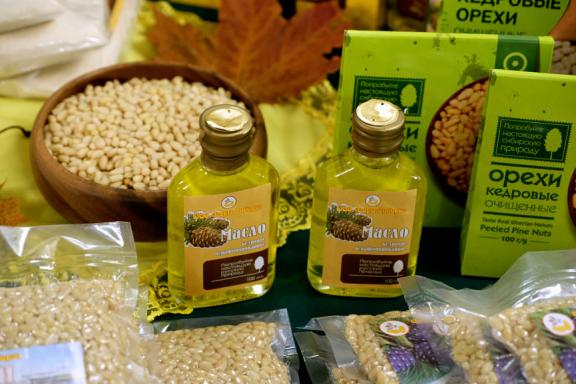
Russian pine nuts are mainly wild-harvested ‘cedar’ nuts from Siberian pine (Pinus sibirica) in the Siberian taiga. A smaller Far Eastern supply is linked to Korean pine (Pinus koraiensis). Local collectors gather cones and sell them to intermediaries and processors, which dry, crack, shell, sort, clean and pack kernels, or use them for cedar oil.
Figure 5: Siberian pine nuts and cedar oil in Buryatia, Russia
Source: Photo by Petr Sanzhiev / Newspaper ‘Number One’ via Wikimedia Commons, released under the Creative Commons CC0 1.0 Public Domain Dedication

Sector data show that Russian kernel exports have averaged about 7,000 tonnes over the last 5 years. Recent supply has been weaker. The 2025/2026 crop is estimated at around 4,000 tonnes of kernels, with a possible recovery in 2026/2027. China is now the main external buyer. Chinese customs data reported by the Russian trade media show that China imported pine nuts from Russia worth $34.6 million (USD) in 2025, 6.4 times more than in 2024.
Since 1 August 2025, Russian exports of pine nuts, also called cedar nuts, in shell or in cones to countries outside the Eurasian Economic Union have faced an export duty of 50%, but no less than €160 per tonne. This measure is intended to keep more shelling and processing inside Russia.
Russian-origin pine nuts also face a separate import barrier on the EU side. Since 1 July 2025, the EU has applied an additional 50% ad valorem customs duty to many agricultural products from Russia and Belarus, including edible fruit and nuts. This duty is applied in addition to the normal EU Common Customs Tariff.
For European buyers, Russia’s main weakness is not product quality. Russian pine nuts have a strong Siberian origin story, a wild-harvest image and an attractive taste. The bigger risks are political, commercial and reputational. The additional EU customs duty, Russian export policy, insurance issues and reputational concerns make Russian supply more challenging.
Mongolia: supplier to China with increasing export to Europe
Most Mongolian pine nuts come from Pinus sibirica. The collection is mainly wild harvest from northern and mountain forest areas, where local collectors gather cones and sell them to traders and processors.
Because pine nuts are wild-harvested, production depends heavily on the biological crop cycle, weather, forest access and annual collection rules. Sector estimates show that the Mongolian crop can vary from less than 600 tonnes to over 9,000 tonnes of kernels. On average, Mongolia produces around 4,500 tonnes of pine nut kernels.
The 2025 crop was relatively low. Mongolia exported around 2,900 tonnes of pine nut kernels. China remained the main destination, making up 89% of the exported volume, while Germany accounted for around 5%, Spain for 4% and Russia for 2%. This shows that Mongolia has some direct trade with Europe, but still depends mainly on China.
Mongolia’s strengths are its wild-harvest story and clean nature image. Mongolia also has a better tariff position than Russia, as it is not affected by the additional EU duty applied to Russian agricultural goods. Mongolia’s weaknesses are its unstable supply, smaller scale, less processing depth and heavy dependence on Chinese buyers and processors.
Mediterranean suppliers: Authentic Pinus pinea, but a limited and unstable supply
Mediterranean suppliers are linked to Pinus pinea, the classic Mediterranean stone pine. These kernels are longer, have a more premium image and are closely linked to authentic pesto, Mediterranean cuisine and higher-end foodservice.
Türkiye is the largest Mediterranean producer of pine nuts, with an average production of around 1,000 tonnes. Aydın is an important origin. Aydın pine nuts gained EU geographical indication protection in 2025. Türkiye is also a regional trading hub. It imports and re-exports other pine nuts, including kernels from China, Afghanistan and Pakistan. In 2025, Türkiye exported 657 tonnes of pine nut kernels. Italy was the main destination, making up almost 59% of exports, followed by Germany, Portugal and Jordan.
Italy is the largest pine nut consumer in Europe. Italian origin is positioned as a high-priced premium niche closely linked to pesto. Italy produces around 400 tonnes in standard years, but recent harvests have decreased to 100 tonnes. Italy also imports large volumes of pine nuts for processing, packing and re-export. In 2025, Italy imported around 3,000 tonnes of kernels mostly from Türkiye and China and almost 600 tonnes of in-shell pine nuts, mostly from Spain. Italy exported 568 tonnes of kernels, mainly to the Netherlands, Belgium and Switzerland.
Spain is both a producer and an important processing hub for Mediterranean pine nuts. Average Spanish production is around 300 tonnes, but Spain also processes in-shell pine nuts and cones from Portugal and other Mediterranean origins. In 2025, Spain exported 625 tonnes of kernels. Italy was the main destination, with 64% of exports, followed by France and Portugal.
Portugal is a smaller producer, with an average production of around 150 tonnes of kernels. Most Portuguese pine nuts are consumed locally or move through Iberian supply chains, mostly towards Spain for further processing.
For European buyers, Mediterranean suppliers compete on species, taste, authenticity and origin story. Their pine nuts are most interesting for premium pesto, Mediterranean foodservice, organic and local-origin retail packs. Their main weaknesses are small volumes, high prices and unstable supply caused by weather, pests and low cone productivity.
Tip:
- Do not use the Pinus pinea story if you sell non-Mediterranean pine nuts. Build your offer around your real strengths, such as a wild harvest, stable quality, traceability, organic certification and direct links with collectors and processors. European buyers usually respect honest positioning more than weak imitation.
Which companies are you competing with?
Chinese processors compete through scale, technology and certification. Russian, Mongolian and Turkish suppliers compete more through origin, species and processing experience. Smaller Mediterranean companies from Spain, Italy and Portugal are relevant in premium and organic pine nuts.
Jilin City Changrong Agricultural & By Products Corporation
The company was established in 1996. It presents itself as a processor and exporter of wild-collected agricultural products, including pine nut kernels, seeds and beans. Its strengths are scale, export experience, food safety and organic certification, and modern processing such as colour sorting, X-ray detection, microwave sterilisation and vacuum packing.
Eco-factory Siberian Cedar
Eco-Factory Siberian Cedar shows how Siberian pine nuts can move from raw kernel trade into value-added products. Based in Petrovo, the Tomsk region, it offers pine nut kernels, cedar oil and other Siberian forest products. Its strength is the combination of a Pinus sibirica origin, processing experience and branded consumer products.
Nord Road
Nord Road is one of the clearest Mongolian branded examples. The company presents itself as an exporter and manufacturer with a capacity of 3,000 tonnes of natural pine nut kernels from the Mongolian Pinus sibirica. It sells under the HushKhan brand and offers kernels, snacks and pine nut oil.
Kermes Tarım
Kermes Tarım is a Turkish exporter that links the Kozak pine nut area with processing, export and European buyers. Its German link through European Bio Foods & Nuts Export Import GmbH helps it stay close to European customers and respond to smaller or more specialised orders.
Besides suppliers in China, Russia, Mongolia and Türkiye, exporters should also watch European competitors. Examples include Biopiñón S.L. and Piñonsol in Spain, Grassini Pinoli in Italy and Pine Flavour in Portugal. These companies are smaller in volume but compete in premium, Mediterranean and sometimes organic pine nuts.
Tip:
- Do not compare your company only with the largest Chinese processors. Also study smaller Mediterranean and Mongolian competitors, as they show how origin, species, organic production, story and value-added products can create a stronger position than volume alone.
Which products are you competing with?
Pine nuts mostly face competition in price-sensitive products such as pesto, sauces, spreads, ready meals and foodservice recipes. When buyers want a cheaper ‘pesto-style’ product, they can reduce or replace pine nuts with 4 main alternatives:
- Cashew nuts: The strongest substitute in mainstream pesto. They are mild, creamy and cheaper, but fail to support an authentic Mediterranean pesto story.
- Almonds: Often used in red pesto, spreads and roasted flavours. They have a Mediterranean image but do not have the classic pine nut taste.
- Sunflower and pumpkin seeds: Common in budget, vegan and plant-forward recipes. They are cheap and easy to use, but less premium.
- Walnuts and hazelnuts: Used in creative pesto and recipe-led products, but less in traditional basil pesto.
Tip:
- Defend applications where pine nuts are hardest to replace: authentic pesto, premium Mediterranean retail packs, high-end foodservice and visible toppings. This is where pine nuts have the strongest value against cheaper nuts and seeds.
4. What are the prices of pine nuts on the European market?
Pine nuts are the most expensive nuts sold in European retail. Throughout 2026, small retail packs of standard pine nut kernels were largely sold around €37–55/kg at the low end; organic packs were often €55–83/kg, and premium Mediterranean Pinus pinea packs often reached the €80–170/kg range. The price of pine nuts also varies from season to season. However, over the last 5 years, prices have also increased because of general inflation in Europe.
Pine nuts do not follow a common agricultural model. In many origins, the chain starts with forest access rights, not with a farm. In public forests, entrepreneurs may pay the harvesting price in advance and place a deposit, while private rights are often agreed less formally. Cone collection is then one of the most expensive and risky steps. Teams include climbers, who cut cones, and ground workers, who collect and bag them. Skilled climbers can pick about 400 kg of fresh cones per day, so labour scarcity quickly pushes prices up.
The table below is an illustrative model. It works backwards from a Dutch retail price of €60/kg for a small pack of conventional pine nut kernels, including the Dutch reduced 9% VAT for food. The model assumes that about 28 kg of fresh cones are needed for 1 kg of exportable kernels.
Table 1: Pine nuts kernel price breakdown, 2026
| Costs step | Share of final retail price | EUR/kg kernel equivalent |
|---|---|---|
| Forest access, collection and cone handling | 20% | 12 |
| Extraction of in-shell nuts | 1.7% | 13 |
| Shelling, sorting, grading and food safety processing | 1.7% | 14 |
| Exporter packing and margin (FOB price) | 6.7% | 18 |
| Freight, insurance and import handling (CIF price) | 2.5% | 19.5 |
| Importer/wholesaler margin (wholesale price) | 4.2% | 22 |
| Retail packing and distribution costs (price sold to retailers) | 30.0% | 40 |
| Retailer gross margin and store costs (average retail price to consumers for a 100 g private-label pack) including VAT | 33.3% | 60 |
Source: Autentika Global, 2026
Tip:
- Monitor pine nut prices from industry intelligence sources such as Mintec (requires a paid subscription).
Autentika Global carried out this study on behalf of CBI.
Please review our market information disclaimer.
Search
Enter search terms to find market research
Do you have questions about this research?
European buyers are placing increasing importance on consistent quality, low moisture content, adequate shelf life, and reliable traceability. Suppliers that can demonstrate strong quality control and supply chain transparency are better positioned to meet these evolving market expectations.

Antonina Blanc, Responsable Export & Développement Commercial at From Wild International s.r.o. (Czech Republic)