

The European market potential for passion fruit juice
Europe offers good opportunities for passion fruit juice, mainly as an ingredient for blends, nectars, smoothies and flavour-led drinks. Concentrate remains the main way to sell this product, while not-from-concentrate (NFC) is becoming more popular in some markets, especially France. There will probably not be much growth in volume, but higher prices, premium uses and reduced-sugar product development support stronger growth in value. Suppliers that offer stable quality, good technical support and a clear sustainability story are in the strongest position.
Contents of this page
1. Product description: passion fruit juice
Passion fruit is a tropical and subtropical climbing vine that is native to Brazil, Paraguay and northeast Argentina. There are more than 500 species of passion fruit in the world, including around 50 edible ones. The passion fruit plant grows well in wet, tropical biomes. Today it is also grown in Africa, Central America, Southeast Asia and Australia. The fruit is also known as maracujá in Portuguese and maracuyá in Spanish. These names are often used in producing and trading countries.
The passion fruit trade recognises the purple and yellow forms of passion fruit as different varieties. In scientific works, these varieties are usually described as Passiflora edulis f. edulis Sims (purple) and Passiflora edulis f. flavicarpa (yellow). The fruit has an inedible peel.
Table 1: Commercially significant passion fruit varieties
| Name | Yellow passion fruit | Purple passion fruit |
|---|---|---|
| Scientific name | Passiflora edulis f. flavicarpa | Passiflora edulis f. edulis Sims |
| Region | South America | Southeast Asia |
| Appearance | Bright yellow, round-to-oval, slightly larger | Green to deep-purple skin, round, slightly smaller |
| Aroma | Strong, tropical and fruity | Sweet, floral and exotic |
| Flavour profile | High acidity, delivers tangy tart sensation | Milder acidity than the yellow variety |
| Texture | Juicy and more pulp-rich, thicker | Juicy, less fibrous texture, slightly thinner pulp |
Source: Quicornac presentation, Juice Conference Sao Paulo, 2025 (adapted by Autentika Global)
The most resilient and scalable production model is fragmented production. This model is recommended by global passion juice industry leaders like Quicornac. Fragmented production means working with smallholder farmers managing plots of no more than 5 hectares, located in diverse and distanced regions. To coordinate this, producers should use cooperative structures for delivery, quality, consistency and long-term sustainability.
Supply and price fluctuations are almost unavoidable in the passion fruit juice market due to the nature of the crop and the fragmented production. Passion fruit has a unique and well-defined production cycle. It typically follows a 3-to-4-year pattern, with a period of around 1.5–2 years of plentiful and stable supply. This stable supply phase is usually followed by a contraction phase which has lower yields. These lead to replanting, during which availability lessens, prices rise and market volatility increases.
The sugar-acid ratio is an important indicator to measure the flavour and maturation of fruit. There are differences in sugar-acid balance between yellow and purple types. These differences matter for juice processors because they affect acidity and recipe design. In industrial processing, buyers often prefer a more acidic juice because it can support taste stability. It can also reduce the need for added acidifiers in recipes and increase shelf life.
Aroma is another important trade factor. The aroma of passion fruit is one of the main factors used to evaluate its quality. Its tropical aroma and flavour make passion fruit juice a popular choice for processing into juice or for use in tropical fruit juice blends.
Figure 1: Passion fruit
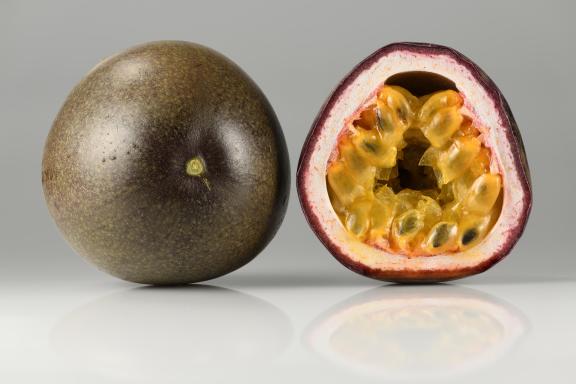
Source: Passion fruits (Passiflora edulis), Author: Ivar Leidus, Wikimedia Commons, CC BY-SA 4.0 license

As passion fruits ripen, the aroma increases a lot. This means that the proper timing of fruit harvesting is very important to the juice quality. Buyers often pay extra for strong natural aroma in concentrate, because it improves blends where passion fruit is used at low dosage.
European buyers trade passion fruit juice mainly as juice concentrate for industrial use. Concentration reduces transport and storage costs, and is commonly used in long-distance trade. European Union (EU) customs code descriptions use Brix levels determined at 20°C. They include categories for tropical fruit juices with a Brix value exceeding 67 °Bx or equal to/lower than 67 °Bx. The Brix value shows the sugar content of juice.
In Europe, when concentrated passion fruit juice is used to produce reconstituted fruit juice, the end product must have a minimum value of 13.5 °Bx. Single-strength yellow passion fruit juice at ~17 °Bx and 2.8 pH is too strong for direct consumption. The purple cultivar is less acidic and needs less sugar and dilution as a base for nectar production.
Industrial users mostly handle passion fruit juice in bulk. The common bulk packs are 200-litre drums and aseptic bags-in-drum, plus larger bag-in-box formats for some users.
There is no international HS code that only covers passion fruit juice. Most customs data are inside HS chapter 2009 (fruit and vegetable juices). Passion fruit juice concentrate and single-strength juice are part of ‘other single fruit juices’ and blends. They fall under HS code 2009.8, 'juices of single fruits that are not tracked or listed separately'. This creates a data gap for European pure passion fruit juice trade statistics.
The most relevant HS subheading for passion fruit juice is 200989 (other single fruit juices). This subheading also includes juices from fruits like mango, guava, papaya, lychee, acerola, and other tropical fruits.
Table 2: European import codes for single fruit tropical juices, covering passion fruit juice
| HS (6-digit) and CN (8-digit) codes | Brief description |
|---|---|
| 200989 | Juice (excluding juice of citrus fruit, pineapples, tomatoes, grapes; incl. grape must, apples, cranberries) |
| 20098973 | Juices of tropical fruit, value >€30 per 100 kg net weight, containing added sugar, ≤67 °Bx |
| 20098985 | Juices of tropical fruit, with an added sugar content >30% by weight, ≤67 °Bx |
| 20098988 | Juices of tropical fruit, with an added sugar content ≤30% by weight, ≤67 °Bx |
| 20098997 | Juices of tropical fruit, not containing sugar, ≤67 °Bx |
Source: Autentika Global, Access2Markets, 2026
The typical passion fruit concentrate, used as an industrial ingredient and generally unsweetened, most often falls under Europe’s Combined Nomenclature (CN) code 20098997. Less commonly, it can be found under codes 20098988 (added sugar ≤30%, Bx ≤67 °Bx) and 20098985 (added sugar >30%, Bx ≤67 °Bx).
It is difficult to only get the statistics for concentrated from not-from-concentrate (NFC) and from reconstituted passion fruit juice using European CN import data. Both NFC passion fruit juice (~13-15° Bx) and typical passion fruit concentrate (~50-55 °Bx) are still ≤ 67 °Bx, and if both are unsweetened they both end up in 20098997.
Europe in this report is used to refer to the EU-27 and EFTA countries, as well as to the UK.
2. What makes Europe an interesting market for passion fruit juice?
Europe is a large buyer of imported fruit juice ingredients. Passion fruit juice usually serves as an ingredient in blended juices, nectars, dilutable fruit drink concentrate (squash/cordial or syrup) and flavour-led drinks. Cordials are concentrated sweetened fruit drinks that are diluted with water before drinking.
Even in small quantities, passion fruit juice gives an exotic flavour and aroma to beverages. This makes it a very useful ingredient for the food and beverage industry. European soft drink manufacturers often use small quantities of passion fruit juice because of its highly recognisable and intense flavour. This percentage can be very low in some soft drinks, like Fanta Exotic or Fuze Tea. Yet thanks to its unique and powerful aromatic compounds, it is difficult to mistake for other juices.
Europe still leans clearly towards concentrate overall, especially for industrial beverage use, blending, storage efficiency and freight economics. However, sales of not-from-concentrate (NFC) passion fruit juice have been growing by a good amount, particularly in France.
Table 3: Examples of European soft drinks with passion fruit juice (ranked by content)
| Product | Market | Passion fruit % | Basis of % |
|---|---|---|---|
| M-Budget Tropical (Migros) | Switzerland | 4.2% | Within 12% juice blend |
| Belvoir Sparkling Passion Fruit & Mango | UK | 3% | Whole drink |
| J2O Orange & Passion Fruit | UK | 3% | Whole drink |
| Bottlegreen Mango & Passionfruit Cordial | UK/Ireland | 2% | Whole drink (cordial) |
| Fanta Exotic | EU | 0.2% | Within 3% juice blend |
| Fuze Tea Passionfruit Zero | EU | 0.1% | Whole drink |
Source: Autentika Global, 2026
European regulation also influences demand and product design. In 2024, the EU amended the ‘breakfast directives’, including the fruit juice directive, and added new ‘reduced‑sugar’ juice categories. This supports juice reformulation and is likely to increase demand for high‑impact fruit ingredients that keep a strong flavour after sugar reduction.
Table 4: Examples of European non-soft drink products with passion fruit juice (ranked by content)
| Product | Category | Market | Passion fruit % | Basis of % |
|---|---|---|---|---|
| CaramanFruit Passion Fruit Purée | Fruit purée (HoReCa) | EU (France) | 84.3% | Fruit (juice + pulp) in product |
| Simply Passionfruit Purée | Fruit purée mix | UK/EU foodservice | 20.1% | Passion fruit juice from concentrate |
| Funkin Passion Fruit Syrup (70cl) | Cocktail syrup | UK/EU retail | 11% | Passion fruit juice from concentrate |
| Solero Exotic Ice Cream Lolly | Ice cream lolly | EU/UK | 6% | Passion fruit juice in product |
| Mango and Passion Fruit Kefir Yogurt Drink | Kefir yoghurt drink | UK/Ireland | 4.2% | Passion fruit juice from concentrate |
| Twister Mini Tropical | Ice lolly | EU/UK | 2.5% | Passion fruit juice in product |
Source: Autentika Global, 2026
The main use cases for passion fruit juice in Europe are:
- Juice blends and nectars;
- Multifruit beverages;
- Smoothies and premium refrigerated drinks;
- Carbonated drinks (cans);
- Flavoured dairy and dessert applications;
- Syrups, sauces and foodservice;
- (More and more often) flavour positioning in ‘tropical’ or ‘functional-style’ beverages.
The European market for passion fruit juice is very concentrated. The 3 largest suppliers (Peru, Vietnam and Ecuador) dominate the market. Brazil and Colombia are also active in the market but export much smaller volumes to Europe.
While precise data is not available, some general estimates can be made based on national statistics. Figure 2 shows the combined exports from Peru, Vietnam, Ecuador, Brazil and Colombia to Europe, based on exporter country data and estimates from leading industry sources. Vietnamese data for 2025 is based on directional estimates from the industry.
Publicly available passion fruit trade data has limitations. It is not always fully accurate from origin, as trade codes sometimes mix fresh fruit, frozen, juice and concentrate. Leading industry players also find it very difficult to isolate precise figures. Vietnamese trade data is particularly challenging, as product classifications and naming are inconsistent and data is often fragmented. These constraints apply to all the trade statistics that are presented in this report.
Source: Autentika Global, Dian, BCE, ASEANstats, Exportemos, Comex Stat, industry sources, 2026
In 2021-2025, passion fruit juice volume of imports from the 5 major suppliers decreased by around 4.5% per year while the value of imports rose by 12.5%. This difference reflects higher juice prices and possible changes in the structure of passion fruit juice imports. Frozen concentrated passion fruit juice is cheaper than the not-from-concentrate variant.
In the next 1-3 years, the European market for passion fruit juice is likely to grow at an annual rate of 1-2% in volume and by around 7-8% in value. The expectation is that in the 2 years after that, the European market for passion fruit juice will grow at an annual rate of 2-3% in volume and 5-6% in value.
European buyers need competitive prices but also expect technical consistency, food safety, traceability and social compliance.
Tips:
- Consult multiple sources of information on passion fruit juice trade data before making decisions. Be careful about how you interpret the available data. Summary statistics overlook shifts in destination mix from one year to another, re-exports through trading hubs, and differences in how NFC, single-strength juice, purée/pulp and concentrate are recorded.
- Follow the AIJN reference guideline for passion fruit juice. Europe’s fruit juice industry relies heavily on the AIJN reference framework. Following the AIJN Code of Practice makes it easier for small suppliers with inconsistent quality systems to grow their presence in Europe.
3. Which European countries offer the most opportunities for passion fruit juice?
Passion fruit juice imports are not spread evenly across Europe. Trade concentrates in a few large entry hubs and processing countries. In 2025, the largest direct importers of passion fruit juice from the 5 main producer countries were the Netherlands, France, Poland, Spain, the UK and Italy.
Source: Autentika Global, Dian, BCE, ASEANstats, Exportemos, Comex Stat, industry sources, 2026
Do note that the imported juice is not consumed in these countries only. Available trade data does not include the very large intra-European trade, which would provide better insight into the largest end-importer and consumer markets. The Netherlands is a large import hub for many European countries. One of these is Germany, the largest fruit and vegetable juice market in Europe.
The 6 most important consumer markets for citrus and tropical juices in Europe, including passion fruit juice, are Germany, France, the UK, Poland, Spain and Italy.
Germany: World’s second-largest organic market
Germany is Europe’s largest fruit juice market and a major market for passion fruit juice suppliers. German per capita consumption of fruit juices and nectars has been declining since the record year of 2000, when it reached 40.6 litres. Germany’s fruit juice industry association VdF estimates that consumption fell to 24.0 litres in 2024.
Figure 4: Passion fruit juice
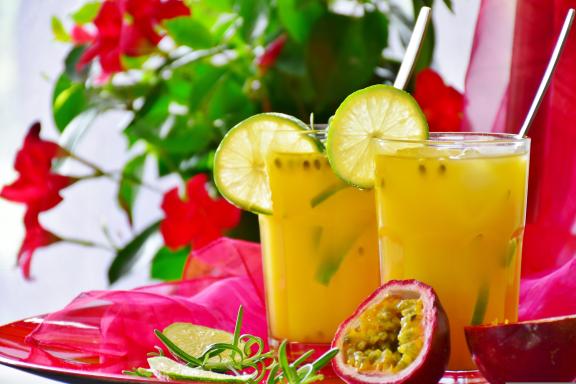
Source: Image by -Rita-👩🍳 und 📷 mit ❤ from Pixabay, Pixabay content license
For organic passion fruit juice suppliers, Germany is an important market in Europe. It is the world’s second-largest organic market, after the United States. In 2024, organic sales reached a new record at €17 billion, up by 5.7% from 2023 (report available in German). Sales of organic products are projected to increase again in 2025. Most organic sales are made in regular supermarkets (31% share), followed by discounted supermarkets (27%).
Juice manufacturers often go through traders to import raw materials. Chief importers, industry suppliers and traders are Döhler, Agrana Germany, Grünewald, Carrière, STL Fruits, THOMS, Saprex and Juice Trade. Germany has many major fruit juice producers, like Eckes-Granini Group and riha WeserGold Getränke.
Over the past 5 years, Germany’s direct imports volume from the 5 largest passion fruit juice suppliers to Europe fell by an estimated 8.9% per year. Based on national trade statistics and industry estimates, for 2021-2025 estimated German imports dropped from 498 tonnes to 342 tonnes, while imports from the 5 major supplier countries (Peru, Ecuador, Vietnam, Brazil and Colombia) increased by an estimated 16.9%, to €1.3 million. Data for German imports of passion fruit juice through intra-European trade is not available.
Short- and long-term export opportunities remain very good for Germany, as for most of Europe. Passion fruit’s unique flavour is not easily replaced. The German market will remain a major player for its valuable domestic demand, its strong processing industry, and reexports.
Tip:
- Participate in German food and beverage trade shows to find the right distributor and make contact with German traders, importers and wholesalers. Anuga is a leading show for the food and beverage business.
France: Rising imports of NFC passion fruit juice
Fruit juices have seen a continuous decline in sales volume since 2013. In just 10 years, the sector has lost 25% of its sales volume, according to French Juice Association Unijus. Exporters to France should be aware that the French would rather not consume ultra-processed products and are looking for drinks without any additives or colourings. According to industry sources, this is one of the reasons why NFC passion fruit juice supplies to France have increased noticeably.
Over the past 5 years, France’s direct imports volume from the 5 largest passion fruit juice suppliers to Europe rose by an estimated 29.1% annually. Based on figures from industry estimates and national trade statistics from exporter countries, France imported an estimated 2,947 tonnes directly from outside Europe in 2025, up from 1,062 tonnes in 2021, while the value of French imports increased by 53.3% annually to an estimated €8.3 million in 2025.
Passion fruit juice is mostly used in tropical juice and multi-fruit blends. According to the last published Unijus market report, in 2023 sales of multifruit juices fell by 8.5% while organic juice sales fell by 1.5%. Industry experts say France is a growing market for NFC passion fruit juice.
Passion fruit juice suppliers may find opportunities with French-based food and beverage industries that use the juice. These include major players like Allain Milliat, Andros, Caraïbos, Bureau Couecou, Jus de Fruits Caraïbes and Fructa Partner. Danone Group is a large multinational that uses passion fruit juice for its dairy, probiotic and high-protein products. Giffard and Mathieu Teisseire are major players in the foodservice industry, with syrups and cocktails.
Tip:
- Search and connect with potential French buyers in the list of Unijus members.
United Kingdom: Innovative and import-dependent market
The UK is a large, import-dependent and highly innovative drinks market. The food and drink industry is the UK’s largest manufacturing sector.
Importantly for passion fruit juice suppliers, the UK’s soft drinks market experienced 1.7% annual growth in 2024. Demand comes from established and new products. One new product is Twinings’ ready-to-drink Sparkling Tea Defence with its zesty orange and passion fruit flavour, launched in September 2024.
As in the rest of Europe, the main opportunity in the UK market is not 100% passion fruit juice. UK demand is broad and industrial, and is not limited to one retail format. Suppliers should focus on selling concentrate, NFC juice or purée to UK manufacturers that use passion fruit for flavour, acidity, colour and a tropical touch in finished products. UK law lists passion fruit nectar at a 25% minimum juice or purée content, the same as in the EU.
Kiril Mischeff is a leading importer of ingredients for food and beverage manufacturing, and its NFC passion fruit juice ingredient is used in baked goods, patisserie, juices and smoothies. E.E. & Brian Smith also offers passion fruit NFC juice and concentrate for use in cocktails, smoothies, yoghurts, desserts, ice cream and sorbets. Gerald McDonald & Company is a UK ingredient supplier and expert blender that offers a range of passion fruit juice ingredients.
The UK soft drinks sector is highly dynamic, and the British Soft Drinks Association (BSDA) says consumers look for new tastes, healthy alternatives and added functionality. Consumption of still and juice drinks has greatly increased in recent years, according to the BSDA.
In the next 1-3 years, UK demand should stay strong in blends, smoothies, still juice drinks and functional beverages. Demand for organic and Fairtrade should also stay promising, because the UK organic market kept growing in 2024 and 2025, while Fairtrade juice sales also grew in 2024.
Longer term, passion fruit juice will keep its place among premium tropical blends and functional-style drinks. Exporters with strong traceability, climate-risk management and a clear sustainability story are likely to gain an advantage over suppliers that compete only on price. Businesses should conduct risk-based human rights and environmental due diligence, as responsible business conduct is a part of the UK government’s mission to grow the economy.
In 2021-2025, the UK’s volume of direct imports from the 5 largest passion fruit juice suppliers to Europe rose by an estimated 5.9% per year. According to industry estimates and national trade statistics from exporter countries, the UK imported an estimated 781 tonnes directly from non-European suppliers in 2025. Also for 2021-2025, the value of UK imports increased by 29.4% annually to an estimated €2.9 million.
Tip:
- Offer more than one format: NFC, concentrate and purée. For each product, prepare strong technical sheets with Brix, acidity, microbiology, and colour and pack options.
Poland: Fast-growing importer from origin
Poland is an interesting market for passion fruit juice as it has a large food and beverage market with a strong juice and processing industry. It is also Central and Eastern Europe’s largest market for food and beverage products, with 38 million consumers. The country’s largest food processing sectors include juices and non-alcoholic beverages.
Passion fruit juice often enters Poland as an ingredient for blends, smoothies, fruit drinks and functional beverages. NielsenIQ data shows that from April 2024 to March 2025 the soft-drinks market in Poland reached nearly PLN 28 billion (€6.58 billion), growing at a rate of 7% compared to the same period a year earlier, and sales volume increased by 2%.
However, there is lowered interest in the classic juices, nectars and still drinks category. The NielsenIQ data shows that while the sales value for this group remains stable, volume decreased by 8.5% over one year. In 2024, Poland ranked fourth in Europe in terms of fruit juice and fruit nectar consumption per capita.
Figure 5: Passion fruit concentrate used as an ingredient in a fruit-flavoured yoghurt
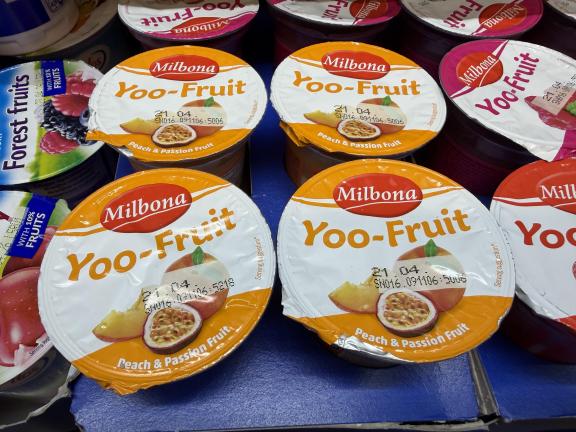
Source: Autentika Global, 2026
The best opportunities lie in business-to-business supply to processors, bottlers and ingredient users that want tropical flavours in blends and premium products. Passion fruit works well in juice blends with apple, orange, mango, peach or carrot. It also fits smoothies, children’s fruit products, kombucha and premium chilled drinks.
Polish market examples already show passion fruit in blended products from major brands like Tymbark, Kubuś and Hortex, and in niche products such as organic kombucha. Companies active in the Polish beverage and ingredients market include Maspex, Tymbark, Kubuś, Hortex and Döhler Poland.
Several factors support increased Polish juice consumption in the years ahead, such as the rise in average temperatures. According to Poland’s data from the Institute of Meteorology and Water Management (IMGW), 2024 was a record year for average annual temperatures in Poland, recording its warmest December in 74 years in December 2025. The trend of rising temperatures will benefit beverage consumption.
In 2021-2025, Poland’s direct imports from the 5 largest passion fruit juice suppliers to Europe rose by an estimated 13.2% annually, from 659 tonnes to 1,082 tonnes, while Polish imports from the 5 main non-European supplier countries rose by an estimated 40.2% to €3.4 million.
Spain: Big consumer of tropical juices
Spain is an attractive market because it is a major importer and consumer of tropical juices. Long-standing ties with former colonies Peru and Ecuador are also factors that influence consumer familiarity with South American fruit juice flavours.
Spain has a large food and beverage industry that leads the manufacturing sector, with a strong juice- and beverage-processing base. Passion fruit juice suppliers also benefit from opportunities in Spain’s large foodservice market linked to tourism. Spain received 93.8 million international tourists in 2024, a new record.
Spain has a strong domestic juice culture. The national juice association says 63% of Spaniards drink juice more than 3 times per week. Spain is a major citrus country and has a strong local processing base for juice ingredients. This means imported passion fruit juice works best when it adds something that complements local fruits. These can be things like a unique taste, acidity balance and a sustainability story.
Relevant buyers and market players in Spain include AMC Natural Drinks, Refresco Iberia and Juver. Spanish ingredient suppliers like Lemon Concentrate and Baor Products also market tropical fruit preparations and passion fruit concentrate for industrial use.
In 2021-2025 Spain saw moderate growth of direct imports from suppliers outside Europe with import volumes rising by 3.1% annually, from 747 tonnes to 844 tonnes, and import values increasing by 27.8% annually to an estimated €2.8 million.
Tip:
- Find potential partners by contacting relevant member associations of the food and beverage industry association FIAB. Examples are the associations Espirituosos España, Asefapre and Zumos y Gazpachos de España.
Italy: Producing and trading country
Italy is an interesting market for passion fruit juice. The country has a strong juice- and beverage-processing industry and a very large HoReCa and tourism economy. It is also a very large exporter of processed food and beverage products globally.
For passion fruit juice, the best opportunity is not the low-price retail market for pure juice. Italy already has strong local juice brands and processors, but also has a very large tourism sector that has demand for exotic and premium ingredients.
In 2024, tourist accommodations in Italy recorded 466.2 million overnight stays, up 4.2% from 2023. This supports higher demand for drinks in hotels, bars and foodservice. Similarly to Spain, this segment of the economy supports demand for premium juice products like tropical passion fruit juice.
Conserve Italia says Yoga is still the number-1 juice brand in Italian bars, and its Massa Lombarda plant produces nectars, 100% juices and fruit drinks. La Doria is a major Italian producer of fruit juices and fruit drinks. Other notable players are Fruttagel, Zuegg and Sterilgarda.
In 2021-2025, Italy’s volume of direct imports from the 5 largest passion fruit juice suppliers to Europe rose by an estimated 22.7% per year. Based on national trade statistics and industry estimates, imports fell from 284 tonnes to 643 tonnes while import value increased by 37.6% to €1.9 million.
Tips:
- Position passion fruit juice as a flavour-rich ingredient for reduced-sugar, tropical and premium drinks. This fits current product development better than a low-price commodity offer.
- Target processors, private-label bottlers and HoReCa suppliers first. Italy is stronger as an ingredient and formulation market.
4. Which trends offer opportunities or pose threats in the European passion fruit juice market?
Passion fruit juice is a very specific juice product that is not easy to replace. It also has unique natural production cycles that influence supply.
Passion fruit production cycles can lead to extreme market volatility
Not all European buyers are aware that good passion fruit juice pricing depends on the timing of purchases and maintaining regular supplies.
Passion fruit has a natural cycle between peak crop exhaustion and replanting. Passion fruit demonstrates a unique and well-defined cycle of 3–4 years. Due to disease pressure, intensive commercial exploitation and soil-weather conditions, the period in which the passion fruit vine is most productive is just 1.5–2.5 years. Crop yields can vary dramatically, from 8 to as much as 80 tonnes/ha in a year.
The peak production phase is followed by a contraction phase and a replanting phase. During these phases availability is reduced, prices rise and market volatility increases.
This means that there are recurring periods of low and high fruit availability. To keep buyers for the long term, it is very important for suppliers to maintain a close relationship with buyers. You should also keep them informed so that they can adapt their purchasing to this natural rhythm.
Although passion fruit NFC and concentrate can often be sourced on a spot basis from multiple sources, this is not the best practice. Leading players in the passion fruit juice industry advise buyers to lock in inventory (get extra stock for reserves) when the market timing is good for you. Buyers should be proactively informed to make sure that their stock levels are sufficient to cover production needs for at least 6 to 18 months. Buyers who rely on traditional, reactive buying strategies risk facing stock-outs, price shocks or quality compromises.
Rising demand for natural tropical flavour and product versatility
Passion fruit’s unique value is that it delivers a very distinctive aromatic profile and strong flavour, even at relatively low inclusion rates in composite products. It combines acidity, freshness and a recognisable tropical note that works extremely well. This keeps it attractive as an ingredient in Europe even when prices are high, according to industry sources.
The European market continues to value natural positioning, exotic taste and more premium flavour profiles. Passion fruit works well when brands want a stronger sensory identity rather than just sweetness.
Consulted industry sources have shown that this is not only a important ingredient in tropical juices and smoothies, but also in the rapidly growing world of cocktails and mocktails.
Figure 6: Tropical juice cocktails
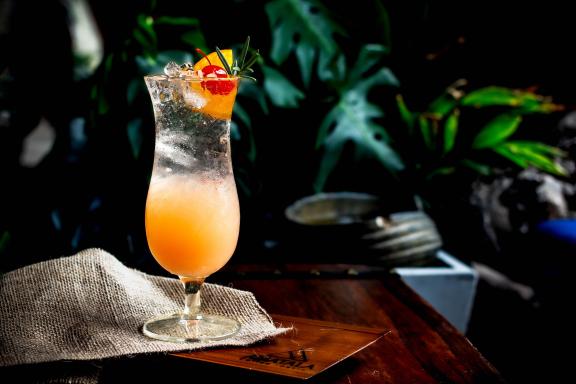
Source: Image by pum88888 from Pixabay, Pixabay content license
European countries are also famous for their restaurants and unique cuisines. High-end cuisine and Michelin-starred restaurants are using more and more passion fruit juice and purée in elaborate desserts and sauces. This is because its tangy tropical sweetness can help balance rich or complex dishes.
New research shows that European consumers are more and more interested in unique flavour combinations and that taste remains the most important factor in beverage choice. These trends benefit the continued demand for passion fruit juice.
Sustainable farming ensures resilience in the face of climate change
Recent research reveals that passion fruit and other tropical fruits are highly sensitive to weather changes. Shifts in temperature and rainfall can affect crop growth and production. The minimum threshold temperature for passion fruit cultivation is 1–2°C, while the optimum temperature range is 20–30°C. The maximum threshold temperature is 30°C. When ambient temperature rises above the threshold limit, it causes irreversible damage to plant growth and development.
Climate change can turn existing plant diseases into more serious problems. It can also help new diseases enter growing areas. Warmer temperatures, milder winters, droughts and heavy rain can help pests and pathogens survive, spread and become more damaging. For passion fruit juice, this raises risks for fruit quality, juice yield and steady supply.
Passion fruit production is sensitive to very wet weather. The plant needs water, but does not tolerate flooded or badly drained soils. If vines stay under water for more than a few days, their roots can die because they lack oxygen. Long wet periods also increase the risk of diseases such as Phytophthora root rot and blight. Suppliers should expect European buyers to ask more questions about farm support, irrigation and agronomy. In the longer term, climate-resilient supply chains will likely become a buyer requirement, not only a bonus.
Passion fruit juice supplier Quicornac bases its supply chain with South American smallholder farmers. With the Don Maracuyá campaign, launched in January 2024, Quicornac made substantial strides in promoting sustainable farming practices in Ecuador. The company says that its model lifts rural families, protects natural resources, and meets the highest global standards for quality and traceability. Quicornac also launched a similar Maracuchito campaign in Peru, adapting it to the local realities.
SCRIMAD in Madagascar is fair trade-certified and works with Ethiquable, a European co-op specialised in organic agriculture and fair trade. SCRIMAD’s processing arm, Madagascar Premium Exotica, produces tropical fruit ingredients, including passion fruit purée.
Tips:
- Read more about Quicornac’s Don Maracuyá and Maracuchito sustainable farming campaigns in the Global Juice Sustainability Report 2024.
- Explore possibilities for using passion fruit by-products together with local farmers. Read more in the Global Juice Sustainability Report 2025 about Quicornac’s campaign to use organic waste as affordable cattle feed in Vietnam.
Autentika Global carried out this study on behalf of CBI.
Please review our market information disclaimer.
Search
Enter search terms to find market research