
Entering the European market for dates
Successful entry into Europe starts with safe, clean and well-documented dates. Buyers pay close attention to insects, mycotoxins, pesticide residues and clear labelling. Retail offers the largest route to market, but food processors also need date paste, syrup and chopped dates. Specialised dried fruit importers are the best first channel for most exporters. Competition is strong, especially from Tunisia, Algeria, Israel and Iran. Prices for standard dates, organic dates and premium Medjool dates can vary significantly. Medjool and Deglet Nour dates have the strongest presence in Europe.
Contents of this page
1. What requirements and certifications must dates meet to be allowed on the European market?
All foods, including dates, sold in Europe must be safe. Limits are placed on the levels of harmful contaminants. Producers should ensure that dates are free from. This is achieved through permitted fumigation practices and strict quality control.
However, meeting legal requirements is just the first step toward a successful export to Europe. Date suppliers also have to meet buyer requests related to quality, certification and sustainable supply chains.
What are mandatory requirements?
All dates sold Europe must meet legal requirements. Additives must be approved. Levels of harmful contaminants, such as pesticide residues and mycotoxins, must be limited. Between 2021 and 2025, the Rapid Alert System for Food and Feed (RASFF) recorded 30 notifications for irregularities with date shipments to the EU. The system also published an alert for 1 date paste shipment and 7 alerts for date syrup shipments.
In this study, ‘Europe’ refers to the 27 European Union (EU) countries, the United Kingdom (UK) and the 4 European Free Trade Association (EFTA) countries.
Contaminant control in dates
A 2023 European Commission Regulation sets maximum levels for certain contaminants in food products. This regulation sets limits for general foodstuffs and specific contaminant limits for certain products, including dates.
Contamination caused by insects
Contamination caused by insects is one of the biggest issues for dates on the European market. The main pests that affect dates are the carob moth (Ectomyelois ceratoniae), the lesser date moth (Batrachedra amydraula) and the raisin moth (Cadra figulilella). They can develop inside the fruit and continue their growth upon arrival at the packaging plant and during storage.
Preventive measures after harvesting are recommended. Currently, fumigation with phosphine or CO2 is the preferred way to control insect development in stored conventional dates. For organic dates, temporary freezing (-22°C) is used as treatment. Methyl bromide is banned as a post-harvest fumigant in the EU. Adult insects and eggs die if exposed to temperatures above 50°C for a longer period. Cold storage can also be used to prevent infestation in places where insects are likely to be present in storage.
Tips:
- Search the European Commission Pesticides Database for officially approved fumigants such as CO2, phosphane and sulfuryl fluoride. For a fast check of recent changes, consult the latest updates on active substances.
- Be aware that for organic dates CO2 is approved as a fumigant, while phosphine and sulfuryl fluoride are not.
Mycotoxins
Mycotoxins are a common food safety risk for dates. They can form before harvest, during drying and during storage. Warm and humid conditions increase this risk. Damage caused by insects, birds and poor handling can also increase mould growth. The main risks are aflatoxins and ochratoxin A. EU limits are strict and are set in Annex I of Commission Regulation (EU) 2023/915.
For dates, the limit is 2.0 µg/kg for aflatoxin B1 and ochratoxin A. The limit for total aflatoxins is 4.0 µg/kg. For date syrup, the limit for ochratoxin A is 15 µg/kg.
Tips:
- Protect date bunches with nets to reduce bird and insect damage.
- Dry dates well before storage.
- Keep moisture at 20% or lower where possible.
Pesticide residues
The EU sets maximum residue levels for pesticides in food. Exporters need to check the current limits before each shipment. Use the EU Pesticides Database and check the official legal text. The database is only for informative purposes.
Many European importers ask for multi-residue tests. These tests often cover hundreds of pesticides. This is important for dates because pesticide rules change often. Pay particular attention to chlorpyrifos and chlorpyrifos-methyl. The EU did not renew their approval in 2020. The maximum permitted limit is 0.01 mg/kg of chlorpyrifos for all products.
Microbiological contaminants
The main risks include yeasts, moulds, Salmonella, E. coli and norovirus. Buyers often ask for laboratory tests before shipment. EU microbiological criteria are set out in Regulation (EC) No 2073/2005. Use good hygiene during harvesting, drying, storage and packing. The Codex Alimentarius Code of Hygienic Practice for Dried Fruits gives practical hygiene guidance for dried fruits, including dates.
Product composition
European authorities can reject dates with undeclared or unauthorised ingredients. The Codex Alimentarius General Standard for Dried Fruits allows glucose syrup, sugar, flour and vegetable oils as optional ingredients in dates. Declare them clearly if you use them. Since 2025, there has also been a special Codex Alimentarius Standard for fresh dates. However, this study only discusses the European market for dried dates (also called ‘table dates’).
Food additives must be authorised under EU food additive rules. Potassium sorbate is allowed for dried fruit within EU limits. If you use it, declare it in the ingredients list.
Packaging and labelling requirements
The label should indicate the name of the product (‘dates’ or ’dates coated with glucose syrup’), and the date style (cluster, stems, pitted where appropriate), among other requirements. When dates undergo thermal treatment (hydration and drying), they are commonly declared as processed or conditioned dates. Without these treatments, dates are declared as natural dates. Read the UNECE standard for dates for more information.
In the case of retail packaging, product labelling must follow the EU Regulation on the provision of food information to consumers. However, sulphites must be indicated as potential allergens if used as preservatives.
Products from Israeli settlements need special origin labelling. EU case law says the label must not mislead consumers about the product’s true origin.
Tips:
- Test dates in ISO/IEC 17025-accredited laboratories.
- Check pesticide MRLs before every shipment, and keep full records of pesticide use and treatments.
- Follow the Codex Alimentarius hygiene code for dried fruits.
What additional requirements and certifications do buyers often have?
European buyers often ask for extra proof of quality, food safety and sustainability. These requirements are not always mandated by law. Still, they often decide whether a buyer accepts your dates or not.
Quality requirements
European buyers usually use the UNECE standard for dates and Codex Alimentarius General Standard for Dried Fruits. These standards cover whole dates for direct consumption. They do not cover date pieces, date paste or dates for industrial use, which are usually covered by buyer specifications.
Dates must be clean, sound (not affected by rotting or deterioration) and fit for transport. They must be free from live insects, insect eggs, mites, mould and fermentation. The Codex also sets limits for pits in pitted dates. Moisture is an important quality point. The Codex sets the maximum moisture at 26% for cane sugar varieties. It sets the maximum moisture at 30% for Deglet Nour in its natural state and for invert sugar varieties.
Dates may be sold as pitted, unpitted, pressed, unpressed or in clusters. Buyers may also ask for a certain size, colour or variety. The Codex gives optional size classes for both pitted and unpitted dates. Most dates sold in Europe are of the light colour variety, although colour is not related to quality. The light-coloured dates on the market belong to the cultivars grown in the main supplying countries (Tunisia and Algeria).
Packaging requirements
Bulk dates are usually packed in cartons with food-safe liners. These cartons usually weigh 5 kg or 10 kg. Retail dates are often packed in small boxes or trays. The packaging must protect the dates from moisture, heat, insects and foreign smells.
Dried dates are best stored refrigerated at 4–10°C, especially if they have a high moisture content. At temperatures higher than 25°C, the syrup or date honey may seep out of the packaging. The shelf life can be prolonged if dates are vacuum packed in an inert atmosphere.
Food safety certification
Food safety certification is not an EU requirement by law. In practice, most established buyers will ask for it. Most European buyers will ask for certification that is recognised by the Global Food Safety Initiative (GFSI). Common schemes for dates include:
- International Featured Standards (IFS) Food;
- Brand Reputation Compliance Global Standards (BRCGS) Food Safety;
- Food Safety System Certification (FSSC) 22000.
Some buyers prefer to use one particular scheme. British buyers often ask for BRCGS. German and French retailers often use IFS.
Tips:
- Be aware that buyers may want to audit your site. Always be prepared for unannounced visits.
- Smaller suppliers can start with step-by-step schemes. Options include gradual certification schemes, such as IFS Progress Food, the FSSC 22000 Development Program and BRCGS START.
Sustainability requirements
European buyers ask for proof of responsible sourcing more and more often. This often covers labour, traceability, pesticide use, water use and packaging. One way to show that you look out for farmers and seasonal workers is to get certified with standards such as Fairtrade, Fair for Life and Rainforest Alliance. Fairtrade international has developed a standard for fruit (including dates) for small-scale producer organisations. This standard defines the terms of payment and is linked to the Fairtrade Minimum Price for organic and conventional dates.
Buyers may also ask for social audits or codes of conduct. Common examples include the Supplier Ethical Data Exchange (Sedex) SMETA audit, the Ethical Trading Initiative (ETI) Base Code and the Business Social Compliance Initiative (amfori BSCI).
Tips:
- Be careful with ‘green’ claims. Starting on 27 September 2026, Directive (EU) 2024/825 will strengthen EU rules against greenwashing.
- Use ITC Standards Map to compare sustainability standards.
What are the requirements for niche markets?
Organic, biodynamic, Halal and Kosher dates can offer niche opportunities. These niches can bring better prices. However, they also require extra proof, controls and documents.
Organic dates
To market dates as organic in Europe, they must be grown using organic production methods. Growing and processing facilities must be audited by an accredited certifier before exporters can place the relevant European organic logo on the packaging. Demeter certification can offer a small premium niche. It requires biodynamic farming and an annual inspection by Demeter.
Organic date producers can only use allowed inputs. This includes products for pest control, fertilisation and post-harvest treatment. Regulation (EU) 2021/1165 lists the authorised products and substances for organic production.
Religious certification
Halal and Kosher certification can help you reach Muslim and Jewish consumers. Dates are especially important during Ramadan. They are also used in Jewish households and festive foods. Certification is most useful for processed dates. Additives, oils, processing aids and shared equipment can affect the Kosher and Halal status of date products. Do not assume these markets are easier. Buyers will still ask for food safety certification, origin documents and residue tests.
Tips:
- Read the CBI study on widertrends in the European processed fruit and vegetables market for an overview of sector-wide developments.
- Read the CBI study about buyer requirements for processed fruit and vegetables for a general overview of buyer requirements in Europe.
- Treat Demeter as a small premium niche, not a mass-market route.
2. Through which channels can you get dates on the European market?
Dates are mostly used as a snack in Europe. Therefore, the most important channel to sell dates are specialised suppliers with experience in supplying the retail segment. Dates are also used more and more often as an ingredient in the food processing industry, as a natural sweetener. Dried fruit and nut bars are the ingredient segments with the most significant growth rate.
How is the end-market segmented?
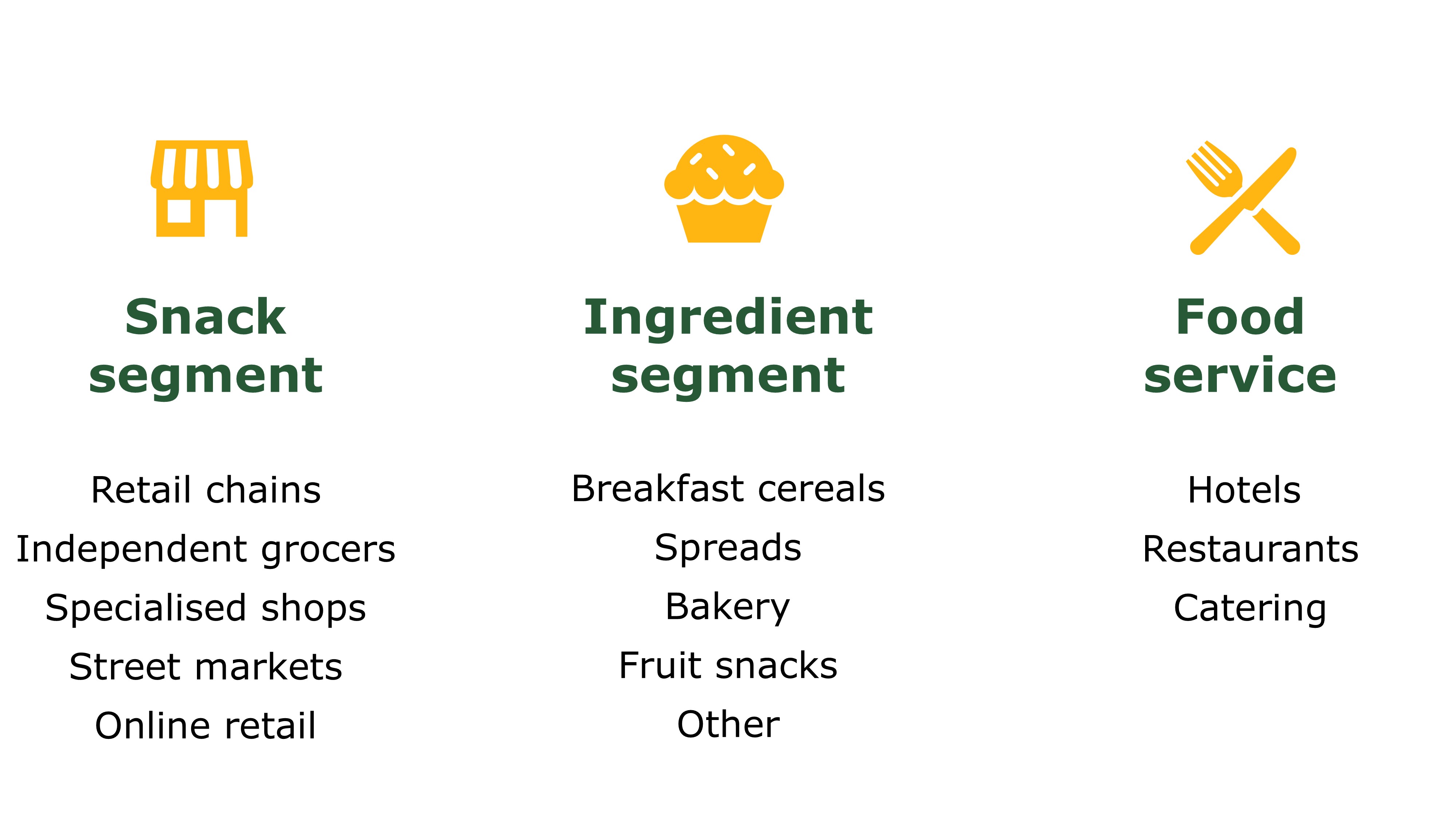
The European date market has 3 main segments: retail, food industry and foodservice. Retail is the largest channel. Dates are mainly sold as snacks through supermarkets, discounters, organic shops, ethnic shops and online shops. There is no exact public data on the retail share. Many industry sources estimate that retail represents around 60% of the market.
Figure 1: End-market segments for dates and date products in Europe
Source: Autentika Global, 2026
Retail (snack segment)
Retail is the main channel for packaged dates. Exporters usually reach retailers through importers, packers or specialised distributors. Direct supply to large retailers is possible, but it requires strong food safety systems, steady volumes and reliable service. Private label is very important in the European grocery market, accounting for 40% of grocery value sales across 11 major European markets in 2025. This supports demand for supplier-packed dates under retailer brands. It also creates pressure on prices and quality.
Retail dates are sold in several subsegments, such as:
- Retail chains: Sell an increasing share of private label dates and own organic and luxury brands (such as small packs with large Medjool dates). Large players include Schwarz Group (owns the Lidl and Kaufland brands), Carrefour, Tesco, ALDI, EDEKA, Leclerc, REWE Group, Auchan, Intermarché and Ahold Delhaize.
- Specialised shops: Including organic food and ethnic shops. Some organic shops are part of specialised organic food retail chains, especially in Germany. Examples include drugstores (dm and Rossmann) and variety shops (HEMA). Ethnic shops selling food from the Middle East and North Africa provide more opportunities for entering the market;
- Ethical stores: A niche segment. They provide opportunities for Fairtrade and ethically certified suppliers;
- Online retail: Often part of the offer of existing retail traders or specialised shops. Ocado is an example of a pure online grocery retailer in the UK. It has more than 1 million active customers.
Food industry (ingredient segment)
Food industry processors are supplied by European wholesalers, but some also purchase dates and date products directly. Date paste, chopped dates, date syrup and date powder are used in fruit bars, breakfast cereals, bakery products, confectionery and spreads. The biggest users of dates in the European food industry include:
- Fruit snacks: These often include dates and date paste as they can provide sweetness and the desired consistency;
- Breakfast cereals: Producers are switching from using sugar-infused fruit to natural fruit, such as dates. Chopped dates are used for breakfast cereals;
- Bakery industry: Date paste is used to produce various sweets;
- Date spreads, pastes and syrups: These still lack a large presence on the European market, although they are emerging more and more often;
- Other users: Other users of date products include confectionery producers (e.g. chocolate-coated and nut-stuffed dates) and producers of innovative products such as date butter. Date products are also packed as sugar replacements, such as date sweetener powder and date syrup.
Foodservice
Foodservice includes hotels, restaurants, cafés, caterers and canteens. Importers and wholesalers mostly supply this segment. It often needs larger packs, such as 5 kg cartons.
Foodservice can use dates in desserts, breakfast buffets, bakery products and Middle Eastern dishes. However, this segment is smaller and less direct for most exporters. It also remains under cost pressure. In early 2025, foodservice traffic fell by 1% in Europe’s 5 largest markets, while spending grew by 1%.
Tips:
- Focus first on importers and packers that supply retail.
- Offer chopped dates, paste or syrup for food processors.
Through which channels do products end up on the end-market?
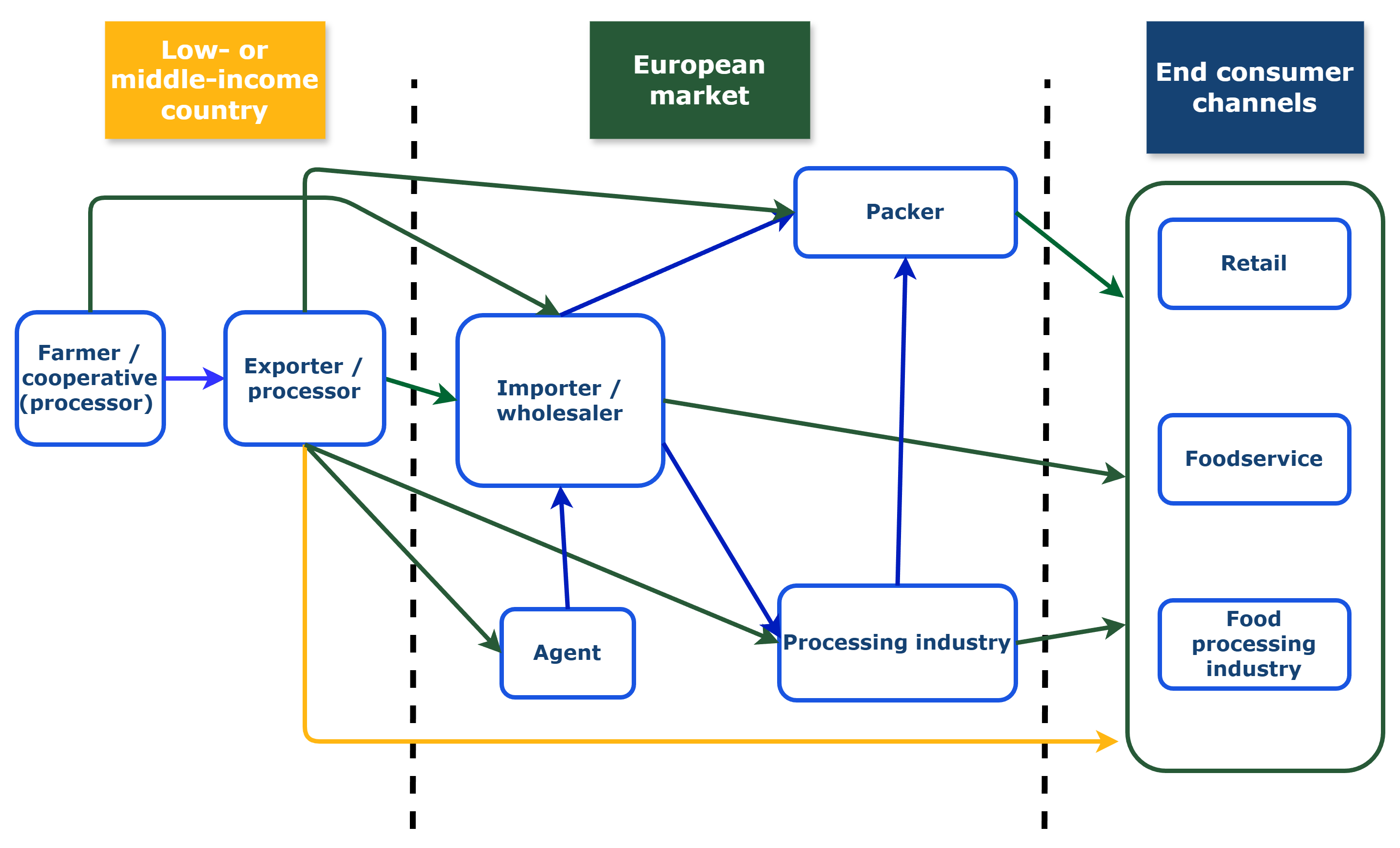
Most dates enter Europe through specialised dried fruit importers and wholesalers. They are usually the first entry point for exporters from low- and middle-income countries (LMICs). They supply packers, food processors, retailers and foodservice wholesalers. Some exporters sell to European packers or food manufacturers directly. This is more likely when exporters can offer stable volumes, strong food safety systems and reliable logistics.
Figure 2: European market channels for dates
Source: Autentika Global, 2026
Importers/Wholesalers
Importers often act as wholesalers. They buy bulk dates and supply other companies in Europe. Some also sort, process or pack dates for retail and foodservice.
This channel is important because buyers want short delivery times and stable quality. Importers understand European rules, buyer audits and labelling needs. For example, Chelmer Foods in the UK imports and distributes dates. It supplies wholesale, foodservice and retail customers.
However, many important dried fruit brands import dates directly, instead of buying them through specialised bulk importers.
Retailers put a lot of pressure on the supply chain. They ask for low prices, private label packs, food safety certification and sustainability proof. This pressure moves down the chain to importers and exporters.
Agent/broker
Agents and brokers connect exporters with European buyers. They can help with price talks, contracts, documents and market information. They are useful when exporters do not yet know the European market well. Some examples of European companies active in different channels for dates include:
- Importers and wholesalers: Brousse Vergez (France), Midi Sec (France), Die Frischebox (Germany), Richard Janssen (Germany), Chelmer Foods (UK), Evolution Foods (United Kingdom), OrganicUK (UK) and Petrow Food (UK);
- Agents: Eurobroker (France), PALM Nuts & More (Germany) and Kenkko (UK);
- Packing companies: Maître Prunille (France), Color Foods (France), Seeberger (Germany), Maryland (Germany) and Whitworths (UK);
- Companies selling processed dates: Alnatura (organic date syrup, breakfast cereals, Germany), Rapunzel (date syrup, fruit bars, Germany), Windmill Organics (organic date syrup, breakfast cereals, UK) and Meridian Foods (date syrup, UK).
Tips:
- Start with a specialised importer if you are new to the European market. Importers can help you understand buyer specifications, labelling and logistics.
- Consider working with an importer or packer that supplies several end-market channels. A partner active in retail, food manufacturing and foodservice can provide more sales opportunities.
What is the most interesting channel for you?
Specialised dried fruit importers are the best first channel for most date exporters. This is especially true for new suppliers.
Well-equipped suppliers can also pack dates for private labels. This can work if you offer stable quality, good prices and flexible packaging. Importers know the European market well. They keep track of supply, prices and quality in producing countries. They can also advise you on buyer needs, documents and packaging.
Many dried fruit importers also trade nuts, seeds and other dried fruits. You may be more attractive if you can offer a wider range. Only do this if you can keep the same quality and food safety level. Some importers focus on Middle Eastern and North African foods. These buyers can be useful for exporters of specific varieties, Ramadan packs and regional brands.
Pressed dates can also offer added value. Many buyers still import bulk dates for repacking. If you can press, sort and pack well at origin, you may reduce work for European buyers.
Tips:
- Study the lists of exhibitors for large trade fairs, such as Anuga, SIAL and Alimentaria, to find potential buyers for your dates. If you aim to supply private labels of supermarkets, search for opportunities at thePLMA fair.
- To reach the food service segment, look for suppliers at specialised food service events such as SIRHA and Internorga.
- Search the list of exhibitors of the specialised trade fair Fi Europe to find potential buyers for date products such as date paste and syrup.
3. What competition do you face on the European dates market?
New date suppliers should study offers from Tunisia, Algeria and other established suppliers. The European date market is competitive, with many origins and product types. Tunisia, Israel and Algeria are major suppliers. Deglet Nour and Medjool dates still have the strongest position in mainstream retail.
However, they are not the only varieties on the market. Buyers and consumers are also showing more interest in other date types and date-based snacks. This creates opportunities for suppliers that can compete on quality, variety and processing.
Which countries are you competing with?
The main competitors for emerging date suppliers in Europe are Tunisia and Algeria. These 2 countries supply 52% of all dates to Europe. Israel, and Iran are 3 other important competitors, supplying around 20% of the market.
Tunisia is also very strong in the organic segment. A 2025 market report stated that Tunisian organic date exports had reached 9,000 tonnes. Germany took 36% of these exports.
Some Algerian suppliers offer Naturland-certified Deglet Nour dates, which can be interesting for German organic buyers. Emerging suppliers include the United Arab Emirates, Saudi Arabia, Türkiye, the Palestinian territories, Jordan, the USA, South Africa and Egypt.
Source: Autentika Global, Eurostat, ITC, 2026
Tunisia: Leading European supplier of dates
Tunisia is the world’s fifth-largest producer of table dates. Dates are Tunisia’s second-most important agricultural export commodity. With a production of 100,000 tonnes in 2024/2025, Tunisia produces 8% of the world’s table dates. The Tunisian export of dates is ranked 6th in the world, after Iran, Saudi Arabia, Iraq, the United Arab Emirates, and Algeria. Although Tunisia has a 7% share in the world’s exports, it has a 36% share of the European market. Nearly 6% of Tunisian dates are exported as organic.
Tunisian exports to Europe increased at an annual rate of 8% and reached 78,630 tonnes in 2025, or €159 million. Within Europe, the major target market for Tunisian dates is France with 21,864 tonnes, followed by Italy (20,283 tonnes), Germany (14,030 tonnes), the UK (5,003 tonnes) and Spain (3,972 tonnes).
The Deglet Nour variety is the foundation of Tunisian date production, making up more than 85% of the nation's overall yield. Tunisia is home to 6 million date palm trees. Date production is concentrated in the oasis areas of southern Tunisia, mainly in 4 governorates: Kébili, Tozeur, Gabès and Gafsa. Kébili accounts for 66% of Tunisia’s oasis area, followed by Tozeur with 17%, Gabès with 12% and Gafsa with 5%. The harvesting period in Tunisia lasts from the beginning of October until the end of December. Although there are more than 150 date varieties in Tunisia, only 4 varieties are of economic interest: Deglet Nour, Allig, Khouat Allig and Kenta.
Algeria: Growing supplier to Europe
Algeria is the world’s sixth-largest producer of table dates. On average, Algeria produced around 105,000 tonnes of table dates between 2020/2021 and 2024/2025. Algeria was the world’s seventh-largest exporter of dates, with exports of almost 85,000 tonnes. Algeria exports most of its dates to France (a 26% share in 2025), followed by Morocco (22%), the United Arab Emirates (6%), the Russian Federation (5%) and the USA (4%). Deglet Nour represents more than 84% of Algerian date exports.
Algerian exports to Europe increased by 1.6% every year between 2021 and 2025. Exports reached a peak of 35,799 tonnes in 2025. Poor weather conditions combined with price increases caused exports to drop to 27,685 tonnes in 2022 and 27,322 tonnes in 2023. France is the main European destination for Algerian dates, accounting for a 71% European export share in 2025, followed by Spain (14%), Belgium (5%) and the UK (4%).
Algeria has more than 19 million date palms and is continuously increasing production. Date production in Algeria is concentrated in the south-eastern part of the country. The province of Biskra ranks first in Algerian date production (23% of date palm trees), followed by El Oued (23%), Adrar (17%) and Ouargla (14%). Around 50% of Algerian dates are of the Deglet Nour variety, followed by Degla Beida and Ghars. Together, they represent almost 90% of Algerian dates.
Israel: A leading Medjool supplier
Israel is one of the world’s leading exporters of high-value dates. It has a strong export position because it focuses on premium Medjool dates. Medjool is also the leading date variety in the country, with an 80% production share. Israel’s date production is much smaller than production in Egypt, Algeria or Saudi Arabia, but it is the world’s largest Medjool date exporter, producing around 60% of all Medjool dates. Almost half of Israeli dates are grown in the Jordan Rift Valley and Arava.
The European import of dates from Israel has increased at an annual rate of 10%, reaching 28,725 tonnes in 2025. In terms of value, Israel is the largest supplier to Europe, which is explained by the higher prices of Medjool dates compared to Deglet Nour. The leading European importer of dates from Israel is the Netherlands, accounting for 38% of European imports, followed by the UK (17%), France (9%), Spain (8%) and Italy (6%).
Iran: Leading supplier of North Europe
With table date exports of 346,462 tonnes in 2024, Iran was the largest exporter of dates in the world. Still, less than 5% of the exported quantities reach Europe. The main export destinations for Iranian dates are Asian countries: India, Pakistan, Kazakhstan, Afghanistan and Türkiye. European date imports from Iran slightly decreased in 2022 to 12,720 tonnes, due to price inflation. In 2023, imports were also below 13,000 tonnes.
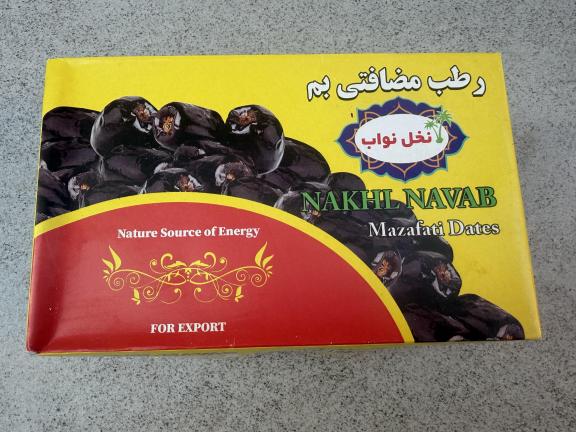
Figure 4: Mazafati dates from Iran
Source: Autentika Global
Iranian dates compete on price. Mazafati is the main soft snack variety in Europe. These dates often have high moisture and need refrigerated transport and storage. Sayer is widely used for processing and cutting. Other important varieties include Zahedi, Kabkab, Shahani and Piarom.
In 2025, Denmark accounted for 25% of European imports from Iran, followed by Sweden (18%), Germany (11%), Poland (9%) and the UK (8%). Iranian dates are price competitive and average prices are usually lower than those from other origins. Most Iranian dates are exported as soft with a high moisture content so they must be kept refrigerated during transport and storage.
Most dates are cultivated in southern Iran. The largest date-producing provinces are Khuzestan, Sistan and Baluchestan, Kerman, Fars, Bushehr and Hormozgan. There are more than 400 date palm varieties in Iran. The main commercial and export-oriented Iranian date varieties include Piarom, Sayer, Mazafati, Zahedi, Kabkab, Rotab, Rabbi, Kalooteh and Shahabi. Piarom is Iran’s premium variety. It has a darker colour, a firmer texture and a higher price. It can compete in the premium segment, but it serves a much smaller niche than Mazafati.
Tips:
- If you are selling a lesser-known variety, compare your dates with competing varieties already sold in Europe. Describe the size, colour and taste. Buyers will expect you to clearly explain how your product differs from Deglet Nour, Medjool, Mazafati and other well-known varieties.
- Select certification according to your target market and buyer. Organic certification can be very useful in Germany and other northern European markets, but certification alone will not guarantee sales.
Which companies are you competing with?
Most date exporters are processors and packers. Some companies have their own plantations, although most buy dates from farmers through specialised collectors. The examples listed below are illustrations of the leading date exporters. Direct competitors are different for each exporter and cannot be generalised. For example, exporters of Deglet Nour, Medjool or Sayer varieties target different market segments and therefore do not compete directly.
Companies in Tunisia
Producers of dates in Tunisia are switching from traditional oases, where several different varieties are grown, to modern ones with Deglet Nour as the only variety. Tunisia now has 141 modern oases or date palm plantations, with ever more surface area based on groundwater exploitation. The sector still depends on many small farmers, collectors, packers and exporters. Most collectors purchase 50–300 tonnes of dates and transfer them to packers. Most storage capacities are located in the south of Tunisia, with Kébili and Tozeur as the leading centres.
- Boudjebel S.A. VACPA (VAlorisation et Conditionnement du Produit Agricole) is the leading exporter of dates in Tunisia. It is the world’s leading exporter of Deglet Nour dates, with annual exports of 18,000 tonnes. including a significant share of organic dates. It has included more than 600 farmers in its vertical integration programme and some farmers have Fairtrade (Max Havelaar), Fair for Life, and Demeter certification. Besides its several food safety certificates, Boudjebel has its own ISO 17025-accredited laboratory for quality control.
- Nouri&Cie is a date packing and exporting company with over 800 employees. The company exports around 6,000 tonnes annually and has 2 conditioning facilities and a large storage facility with a capacity of 13,000 tonnes. Nouri owns its own palm farms in the south of Tunisia. The company exports dates to many different markets, but exports are focused on Asia, especially India and Southeast Asian countries.
- Horchani Dates is a part of the Horchani Group. It has a long tradition in date production. It processes and exports almost 9,500 tonnes of dates a year to over 50 countries. It has the largest processing facility in Tozeur, which can process around 10,000 tonnes per year. Horchani Dattes owns a unit for organic dates called Horchani Bio Dates, which processes 1,000 tonnes of certified organic dates per year.
Examples of other date exporters include Beni Ghreb, Rose de Sable, Golden Agriproduct, House of Dates, SAFT and Biosca Tamara.
Tunisian companies have formed the association Groupement Interprofessionnel des Fruits (GiFruits) to promote the export of Tunisian fruit, including dates. The Pole of Djérid (private public partnership) also established the Dates and Palms Cluster to improve the competitiveness of the Tunisian date sector.
Companies in Algeria
Algeria’s date-packing sector is concentrated in Biskra, especially around Tolga. Biskra is the main area for Deglet Nour dates. Recent research says Biskra had 52 date conditioning units in 2020. Of these, 37 were approved for export. Besides this, there are more than 150 storage facilities for dates in Algeria. The conditioning of dates in Algeria usually does not include coating in glycose syrup, as Algerian dates are prized for their high sweetness.
- Haddoud Salim: A long-established date grower, packer and exporter from Tolga. The company has been active since 1990. It exports more than 4,000 tonnes of dates per year to more than 20 countries. Its offer includes natural, processed and pitted Deglet Nour dates.
- Biodattes Algérie: A strong example in the organic segment. The company processes and exports organic Deglet Nour dates. Its offer includes fresh dates, pitted dates, date paste and date syrup.
- Sed Oasis: Another relevant Algerian exporter. It sells Deglet Nour dates from Biskra and offers dates on the branch, pitted dates, packed dates and date paste. The company also offers organic products.
Other examples of date exporters in Algeria include Ghezzal Dates, Ziban Garden, and Tolga Agrofood. Several important date processors in Algeria do not have websites. Some examples are Lakhder Hlimet ETS, Sud Datte, Ouadah Toumour, Datol Export and Sodapal.
Companies in Israel
Hadiklaim, the Israel Date Growers’ Cooperative, is the best-known Israeli date exporter. It is a leading supplier of Medjool dates and exports 9 date varieties to 50 countries. Its brands include King Solomon, Jordan River and MyJool. Hadiklaim also sells through Palm Fruits B.V. in the Netherlands. Palm Fruits was founded in 2018. It imports and supplies Medjool dates to wholesalers and retailers across Europe. Its brands include MyJool, King Solomon and Shomisha. Mehadrin is another important Israeli date exporter. It offers Medjool dates and is a vertically integrated grower and exporter.
Other important date producers and exporters in Israel include Carmel Agrexco, Galilee Export and Kibbutz Samar.
Companies in Iran
Iran has many table date exporters. Examples include Aban Arya, Sajad Dates and Crystal Dates. These companies offer several Iranian varieties, including Mazafati, Sayer, Piarom and Zahedi. For processed dates and certified supply, exporters such as Arat Company, AHT Foods and Nakhl Sabz Sobhi are also important. Other export-oriented players in the market include Sun Export, Hasas Export, Pariz Nuts, Ario, Tropical Sunshine Green Palm and Middle East Product Export.
Tips:
- Visit leading European trade fairs, such as Anuga, SIAL, Fruit Logistica and BIOFACH, to meet your competitors.
- Study Algerian exporters that already sell certified Deglet Nour dates. Pay attention to their origin story, positioning, organic offer, food safety certification and pitted-date products.
Which products are you competing with?
The main product competition for dried fruit, including dates, is fresh fruit. European consumers have become more and more health-conscious and prefer a healthy diet with an increased consumption of fresh fruit and vegetables. This trend can influence the consumption of all dried fruit, especially if it is coated with glucose syrup or sorbitol. The strong competition of fresh fruits will remain a major challenge for the European date market in the coming years.
Marketing competition from the fresh sector includes claims about sugar levels in dried fruit and the risk of dried fruit for dental health, as they stick to consumers’ teeth. However, the International Council for Nut and Dried Fruit counters the competition with information claiming there is unconvincing evidence of extreme levels of sugar in dried fruit.
Tip:
- Read CBI’s fresh fruit and vegetables studies to better understand the competition from fresh fruit.
4. What are the prices for dates on the European market?
Calculating margins according to final retail prices for dates is not very reliable, as the entire sector has varying prices for different varieties, origins and packaging. For example, Medjool dates normally reach higher prices than Deglet Nour or Sayer. Current price inflation makes price forecasting more difficult. For example, the FOB price of Sayer dates reached €0.77/kg in April 2026, which is significantly lower than the average price seen a year earlier.
In 2026, mainstream pitted dates in 200-250 g retail packs often sell at around €8–14/kg. Larger packs and value brands can be cheaper. Medjool dates sell at a clear premium. Mainstream Medjool packs often sell around €15–18/kg. Import prices are much lower than retail prices. In the first 3 quarters of 2025, the average EU import unit price for dates was about €2.26/kg. This was based on EU imports of 107,003 tonnes and €241.8 million. This import value can make up around 15–30% of many small-pack retail prices. The share is higher for cheaper bulk retail packs.
The price breakdown given below is a very rough indication. There are many factors contributing to the price, such as quality, variety, origin, food safety certification costs, consultants, social security, taxes, sales and network margins.
Table 1: Sample breakdown of dates retail price, price per kg
| Steps in the export process | Type of price | Price breakdown | Example (Deglet Nour) |
|---|---|---|---|
| Production of dates | Farmer price | 15% | €1.20 |
| Collectors’ price | Collectors’ fee | 16% | €1.30 |
| Processing and packing of dates | Factory price | 25% | €2 |
| Storing, handling and shipping | CIF price | 50% | €4 |
| Selling to retail | Wholesale price (incl. value-added tax) | 75% | €6 |
| Retail sales of the final packed product | Retail price | 100% | €8 |
Source: Autentika Global, 2026
Tips:
- Check dried-date prices in the Mundus Agri price charts. Combine these figures with quotations from importers and check European retail and wholesale prices.
- Prepare different price offers for different grades and uses. Premium whole dates can target retail and gift markets, while smaller or visually imperfect dates may be offered for industrial uses.
Autentika Global carried out this study on behalf of CBI.
Please review our market information disclaimer.
Search
Enter search terms to find market research