

The European market potential for canned pineapple
Europe buys about one‑third of the world’s canned‑pineapple trade because the region produces almost none itself. Demand is found across retail, food service and food industry channels, thanks to the product’s long shelf-life and year-round convenience. After peaking during the COVID-19 pandemic, volumes fell when raw‑material shortages tightened supply. Canned pineapple imports are expected to stabilise and return to 1-3% annual growth once fruit output normalises. Opportunities lie in juice-packed or light-syrup lines that fit with Europe’s health trend, and in verifiable social and environmental compliance claims that large buyers now require.
Contents of this page
1. Product description: canned pineapple
Pineapple (Ananas comosus) is grown in many tropical and subtropical countries. Farmers grow pineapple both for fresh consumption and for processing. Pineapple is mostly grown in Southeast Asia, Central and South America, and parts of Africa, typically between latitudes 31°N and 34°S. These regions offer warm temperatures and relatively high humidity, which is ideal for cultivation.
Global pineapple production reached about 29.6 million tonnes in 2023. The crop was harvested from around 1.1 million hectares of farmland, according to FAOSTAT. In 2023, the leading producers of pineapples were Indonesia (3.1 million tonnes), the Philippines (2.9 million), Costa Rica (2.9 million) and Brazil (2.4 million).
Figure 1: Pineapple fruit
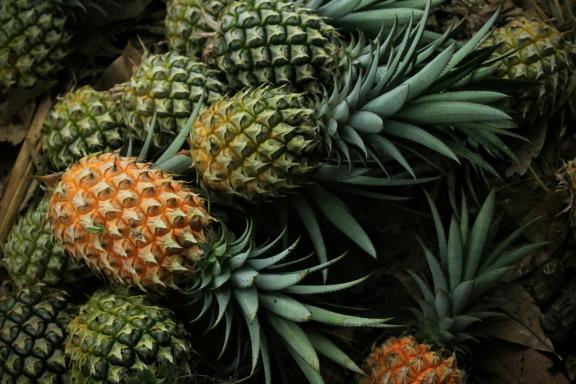
Source: Pixabay
Several pineapple varieties are commercially prominent. Smooth Cayenne has long been the main variety used for canning. Its fibrous texture, cylindrical shape and balanced sweet‑tart flavour make it ideal for canning. It provides slices that stay firm during food processing.
Another well‑known variety is MD2, also called Sweet Gold. MD2 has transformed the European fresh pineapple market due to its exceptional sweetness, longer shelf life and strong consumer appeal. However, it is not widely used for canning. Its softer texture is less suited to high‑temperature preservation methods.
Some niche canned products use MD2 or other varieties such as Queen or Abacaxi. This tends to happen when there is a surplus on the fresh‑fruit market. Even so, Smooth Cayenne remains the industry standard for canned pineapple because of its processing advantages.
Canned pineapple is popular in Europe because it is easy to use and has a long shelf life. Consumers enjoy it as a snack and it is also an ingredient for many dishes. It is one of the easiest ways to give a tropical flavour to a dish in any season of the year.
Figure 2: Del Monte pineapple slices in its own juice
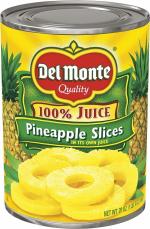
Source: Ananas in Scheiben
In international trade, canned pineapple falls under Harmonised System (HS) code 200820. The European Union (EU) uses its own classification system, called the eight-digit Combined Nomenclature (CN). CN codes link directly to the EU’s Integrated Tariff (TARIC). TARIC adds two more digits to create a 10-digit EU customs code derived from the CN.
Table 1: EU CN eight-digit codes for canned pineapple products
| CN code | Canned pineapple type |
|---|---|
| 200820 11 / 19 | With added spirit, >1 kg: sugar >17% / other |
| 200820 31 / 39 | With added spirit, ≤1 kg: sugar >19% / other |
| 200820 51 / 59 | No spirit, with added sugar, >1 kg: sugar >17% / other |
| 200820 71 / 79 | No spirit, with added sugar, ≤1 kg: sugar >19% / other |
| 200820 90 | No spirit, no added sugar |
Source: Autentika Global, Combined Nomenclature, 2025
In Europe, canned pineapple is sold under trade names that describe its cut and preservation method. The Codex Alimentarius standard for certain canned fruits defines two versions of canned pineapple: cored and uncored.
Table 2: Styles of canned pineapple
| Style | Type (cored/uncored) | Brief description |
|---|---|---|
| Whole | Cored | Cylindrical whole unit |
| Slices or spiral slices or whole slices or rings | Cored/uncored (slices or whole slices only for uncored) | Uniformly cut circular slices or rings cut across the axis |
| Half slices | Cored/uncored | Uniformly cut semi-circular halves of slices |
| Quarter slices | Cored/uncored | Uniformly cut, one-fourth portions of slices |
| Broken slices | Cored | Arc-shaped portions, may not be uniform |
| Spears or fingers | Cored/uncored | Long, slender pieces cut radially and lengthwise |
| Titbits | Cored | Reasonably uniform, wedge-shaped sectors |
| Chunks | Cored | Short, thick pieces cut from thick slices |
| Dice or cubes | Cored | Reasonably uniform, cube-shaped pieces |
| Pieces | Cored | Irregular shapes and sizes |
| Chips | Cored | Small, irregular shapes and sizes |
| Crushed or crisp cut | Cored | Finely cut or shredded or grated or diced pieces |
Source: Autentika Global, FAO Codex Alimentarius, 2025
International brands like Dole and Del Monte dominate the canned pineapple market. Both brands enjoy strong recognition across European retailers.
In this study, ‘Europe’ means the 27 EU member states, the United Kingdom (UK) and the EFTA countries (Iceland, Liechtenstein, Norway and Switzerland). ‘Developing countries’ refers to nations on the OECD-DAC list of aid recipients for 2025.
2. What makes Europe an interesting market for canned pineapple?
Europe ranks among the world’s largest markets for canned pineapple. In 2024, Europe’s imports accounted for 34% of global canned pineapple trade by value. This includes trade between European countries.
Most canned pineapple sold in Europe comes from tropical developing countries. Europe grows almost no pineapples because the climate is not suitable for commercial cultivation. A tiny pineapple crop grown on the island São Miguel, which is part of Portugal’s Azores archipelago, is the sole exception. This volume is far too small to meet European demand. As a result, European importers rely entirely on external suppliers, which makes the region attractive to exporters in developing countries.
Import volumes rose sharply during the pandemic. People spent more time at home and stocked up on food. Imports exceeded 300,000 tonnes in both 2021 and 2022.
Imports later fell as COVID-era stockpiles returned to normal-demand levels. Volumes fell to 247,642 tonnes in 2023 and 226,605 tonnes in 2024. Between 2020 and 2024, canned pineapple imports recorded a compound annual growth rate (CAGR) of ‑6.6%, indicating a yearly decline. By 2024 the import value fell to €354.5 million, down from a 5-year peak of €535 million in 2022. Over the same period, the CAGR value stood at ‑1.9%. The smaller decline in value reflects higher unit prices.
The recent drop was mostly caused by supply problems and lower pineapple output. Thailand’s pineapple harvest fell sharply in 2023 and 2024. Thailand is one of Europe’s leading canned-pineapple suppliers. The same period saw a sudden higher demand for pineapple juice as a component in tropical fruit juice blends and nectars. Due to a sharp increase in orange juice prices, some drink makers switched to pineapple juice instead. As a result, canned pineapple became scarce and overall canned pineapple prices rose.
Over the next 1 to 3 years, canned pineapple imports are expected to stabilise or grow by about 1% per year. Short-term volumes will still depend on crop size and prices in producing countries.
Beyond 3 years, Europe’s canned pineapple use is expected to rise slowly but steadily. Canned fruit is a mature product in Europe. Even so, Europe’s large consumer base buys considerable amounts of canned pineapple every year. If supplies recover, annual growth could rebound to a stronger 2-3%. It is unclear whether the rise of fresh pre-cut pineapple will boost or harm canned-pineapple sales in the long term.
Source: Autentika Global, ITC, Eurostat, 2025
The main reasons for demand in Europe are still the same though. They include a large, steady-consuming population, no local production, and strong distribution of imported canned tropical fruit. Together, these factors make Europe a reliable and attractive market.
Source: Autentika Global, ITC, Eurostat, 2025
Canned pineapple in Europe serves 3 main market segments: retail, foodservice and food manufacturing. In retail it is a staple on supermarket shelves. European consumers value its convenience and long shelf life, allowing them to enjoy an exotic fruit all year.
In foodservice, restaurants and caterers use canned pineapple widely. Uses range from pizzerias that add pineapple as a topping to hotels and bakeries that mix it into fruit salads, pastries and desserts. Food processors also buy large volumes, using canned pineapple in yoghurt, ice cream, smoothies and confectionery. Because both households and businesses use canned pineapple, demand is broad and stable.
Tips:
- Contact your national fruit and vegetable processing association for processed-fruit market insights. The European Association of Fruit and Vegetable Processing Industries (PROFEL) publishes member association contact details.
- Attend European food trade fairs like Anuga (Germany) or SIAL (France) to meet European buyers and track canned-fruit trends.
3. Which European countries offer the most opportunities for canned pineapple?
The Netherlands is one of Europe’s largest importers of canned pineapple, but re-exports about 80% of these goods to other countries. Large volumes enter Dutch ports and are then shipped onward within Europe. Rotterdam, Europe’s largest commercial port, serves as a key trading hub. As a result, import statistics of canned pineapple do not reflect actual Dutch consumption.
Figure 5 shows the 6 largest European markets measured by apparent consumption. Apparent consumption equals imports minus exports. Analysts use this to measure market size indirectly. Apparent-consumption data ignores stock levels. Large stockpiles in trading hubs such as the Netherlands can distort trade figures. Most major traders hold canned pineapple stocks to keep supply stable.
By apparent consumption, the 6 largest European markets for canned pineapple are Germany, Spain, the UK, France, Poland and Italy. In these countries, canned pineapple is available all year and is used in home cooking as well as by the catering industry. Demand is supported by Europe’s long tradition of eating canned fruits.
Source: Autentika Global, ITC, Eurostat, 2025
Germany: declining market in recent years
Since Germany does not grow any tropical fruit, 100% of its canned pineapple supply is imported. German fruit-canning companies focus on local fruits and do not process pineapple domestically. Exporters from abroad fill that gap.
In 2024, Germany imported 38,346 tonnes of canned pineapple, far below the 5-year peak of 77,212 tonnes recorded in 2022. In 2020-2024, the volume CAGR was ‑15% per year. Imports have fallen sharply since the COVID-19 pandemic. The drop partly reflects a post-pandemic correction after unusually high imports of canned pineapple.
Developing countries supply 98% of Germany’s canned pineapple. This share reveals opportunities for exporters in developing countries. Three countries dominate Germany’s supply: Indonesia, the Philippines and Thailand. In 2024, Indonesia exported 10,997 tonnes, the Philippines 10,559 tonnes, and Thailand 9,205 tonnes to Germany. Thailand’s share dropped from 39% in 2023 to 24% in 2024 because fruit shortages cut its canning output. Kenya ranked as the fourth-largest exporter of canned pineapple to Germany, with 6,028 tonnes in 2024.
Global pineapple supply is under severe strain, according to Germany’s food-industry federation BVE. Extreme weather in key pineapple-producing countries like Costa Rica and Thailand has led to limited supply. In Costa Rica, alternating La Niña and El Niño phases have cut rainfall, resulting in smaller fruits and lower yields. German imports are likely to grow again over the next 1-3 years and longer term if pineapple production recovers in major canning origins.
Germany re-exports part of the canned pineapple volume it buys. In 2024, re-exports reached 11,663 tonnes. About 98% of those re-exports stay within Europe, mainly going to Poland, Austria and the Czech Republic.
Canned pineapple is popular in Germany, featured in retro dishes such as Toast Hawaii. It also tops the popular ‘Hawaii’ pizza. Pineapple is the best-selling canned fruit in Germany. A 2021 independent competition authority (Bundeskartellamt) study shows it made up 33.4% of canned-fruit sales by value.
Germany’s retail landscape is dominated by large supermarkets and discounters that widely stock canned pineapple. Leading grocers EDEKA and REWE, plus discounters ALDI and Lidl, all offer canned pineapple. The product is often sold under their private labels. These stores also stock international brands like Dole and Del Monte. Private labels dominate, accounting for about 80% of fruit-preserve sales in retail.
Retailers usually buy canned fruit through annual tenders, which put price pressures on suppliers. New exporters may struggle because German buyers demand sharp prices and consistent volumes. However, a private-label contract with a major retailer can secure large, steady orders.
Foodservice and manufacturers also drive demand. Bakeries, pizzerias and hotels buy bulk 3-5 kg catering cans. The popularity of Hawaiian pizza means pizzeria chains in Germany use canned pineapple regularly.
Key importers are EDEKA Einkaufskontor, Otto Franck Import, Central-Import Münster, Delina, I. Schmidt Handelsgesellschaft (Mikado Foods).
Organic and ethically certified lines form an important niche in Germany. The Bio-Siegel organic label is well-established, and some importers offer organic canned pineapple to serve this segment. Naturland, a German organic certifier, approves canned pineapples from developing-country suppliers.
Spain: one of Europe’s biggest canned pineapple markets
Spain is one of Europe’s largest canned-pineapple markets. Supply relies entirely on imports, serving both consumer and industrial demand. In 2024, Spain imported 36,259 tonnes, ranking second in the EU after Germany.
Tropical fruits like pineapple are popular in Spain, especially in sweet dishes and drinks. Spanish households eat canned pineapple as a dessert or add it to fruit salads (‘macedonia’). Pineapple also flavours sangría, the red wine and chopped fruit punch.
Foodservice operators use canned pineapple too. Hotels and restaurants add it to cocktails, desserts and buffet dishes. Because Spain grows almost no pineapple, supply comes entirely from abroad.
Imports totalled 36,259 tonnes in 2024. However, the 5-year volume CAGR was ‑1.3%. Shipments from developing countries still grew by 0.5% per year. Developing countries now supply 93.5% of Spain’s canned-pineapple imports. In 2024, Indonesia led with 13,256 tonnes, followed by the Philippines (11,686 tonnes) and Kenya (7,929 tonnes). Thailand, a major global producer of canned pineapple, holds a surprisingly small share.
Spain re-exports roughly 10% of its canned pineapple, mostly to other European buyers. About two-thirds go to Portugal, which took 2,500 tonnes in 2024.
Spanish makers of fruit cocktails and preserves also import pineapple to pack mixed-fruit cans. Exporters can therefore ship retail-ready cans or bulk pineapple for processors.
Spanish consumers value convenience but also fresh taste. Overall canned-fruit sales have dropped slightly as shoppers prefer fresh produce when prices allow. Household purchases of canned pineapple fell by 6% by volume in 2023 compared to 2022. By value, purchases grew by 8.0% over the same period. Per-capita intake of canned pineapple fell from 1.41 kg in 2022 to 1.31 kg in 2023.
This decline poses a short-term challenge for exporters. Demand could stagnate or drop if weaker economics make shoppers cut non-essentials. Even so, long shelf life and usefulness keep canned pineapple a Spanish staple, so the outlook remains steady.
Exporters can target value-added niches, like packing pineapple in 100% juice for health-conscious buyers or offering small single-serve cans. Retailers already sell multipacks of small cans to suit modern households. Sustainable and ethical lines form another growing niche. Spain’s organic market is smaller than Germany’s, yet interest in organic tropical fruit is rising. Spaniards spent €2,916 billion on organic products in 2023, up 9.8% on 2022.
Spain’s big grocery chains, Mercadona, Carrefour, Alcampo and Eroski all stock canned pineapple. Many also carry brands like Del Monte, which is available at retailers like El Corte Inglés alongside its own private labels. Mercadona, for instance, sells pineapple in juice under its Hacendado brand. Retailers usually source through importers or wholesale distributors.
Importers and distributors play a central role in Spain. Firms like Nudisco, Videca and Frutapac specialise in canned fruit and supply both retail and foodservice. New exporters should target these importers first. These partners handle compliance and already have distribution in place. Spain’s foodservice sector also consumes significant volumes. The country’s tourism industry means many resorts and buffets regularly use canned fruits for practicality.
Tip:
- Consider supplying pineapple chunks to Spain’s mixed-fruit preserve makers, especially in renowned canning hubs Murcia and Valencia. Notable players include Conservas Ferba and Nudisco.
United Kingdom: an open market for tropical fruits
The UK is an attractive market for canned pineapple. The country depends heavily on imports, and shoppers are open to tropical fruits. Because it has no domestic pineapple canning, supply is entirely global. The UK offers a robust market with year-round demand. Exporters must still compete on quality and price, plus meet the UK’s high food safety standards.
British consumers often buy pineapple rings or chunks for desserts like pineapple upside-down cake, as well as for baking and cooking. Pineapple pizza is popular, so most supermarkets and pizzerias offer a ‘Hawaiian’ option. Food manufacturers use canned pineapple in sweet-and-sour ready meals and fruit-cocktail mixes, and the foodservice sector buys it too. Together, these factors support steady demand and create chances for developing-country exporters.
UK imports fell at a ‑5.0% CAGR between 2020 and 2024. Volumes dropped to 23,124 tonnes in 2024. The peak came in 2021 at 30,119 tonnes. The UK re-exports only small amounts of canned pineapple. It ships under 500 tonnes a year, mostly to Ireland.
Short-term prospects are shaped by economic factors. High inflation in 2022-2023 made some British consumers cut non-essentials. Yet canned pineapple, especially own-label lines, is viewed as affordable and less wasteful than fresh fruit. It can therefore benefit as a cheaper alternative to fresh fruit in tight times.
Inflation in the UK is slowing down but remains above the 2% target. Food and non-alcoholic beverages prices rose by 3.0% in March 2024-2025. Imports in the near term will probably stay the same or rise by about 1%. In the long term, demand may grow a modest 1-2% a year, driven by interest in world cuisines and healthy eating. The use of pineapple in Chinese, Polynesian and Caribbean dishes is popular in Britain.
British importers source about 96% of canned pineapple from developing countries. In 2024, the top-4 suppliers were Indonesia (6,626 tonnes), the Philippines (6,369 tonnes), Thailand (3,547 tonnes) and Vietnam (2,155 tonnes). These rankings shift with market conditions and crop size – for instance, Kenya was the top supplier in 2020, ahead of those 4 countries.
Diversified sourcing creates openings for new exporters. Suppliers range from large Thai and Indonesian canneries to African producers that can benefit from trade preferences. The UK charges no duty on many developing-country farm goods. After Brexit, the UK introduced the Developing Countries Trading Scheme (DCTS), which cuts duties on products such as canned fruit. A list of DCTS-eligible countries and tiers is available online.
Fierce competition is a key threat for exporters. UK supermarkets compete hard on price and keep several suppliers for canned goods.
The UK grocery market is dominated by a few large chains: Tesco, Sainsbury’s, ASDA, Morrisons, and discounters ALDI and Lidl. All stock canned pineapple, sold under own-label lines (often cheaper), and manufacturer brands such as Del Monte. Winning shelf space with a major retailer is competitive. Importers or agents usually leverage existing ties to place products on shelves.
Tips:
- Consult Canned Food UK for more insight into the market; the organisation promotes canned-food benefits nationwide.
- Reach out to Sugro UK, a buying group for 80+ independent wholesalers that negotiates prices and supply for its members.
- Use the UK Integrated Online Tariff tool for up-to-date duties on canned pineapple (HS 200820).
France: strong ties to suppliers in West Africa
France is a sizable canned-pineapple market, though slightly smaller than the UK by volume. In 2024, France imported 18,417 tonnes of canned pineapple, the lowest volume in 5 years. Imports peaked at 25,786 tonnes in 2022.
Developing countries supplied 76% of French imports, with the remaining 24% coming from other European countries. Most of that volume arrives via intra-EU trade, mainly from the Netherlands and Germany. Developing-country exporters therefore have two routes to export to France: they can ship directly to French importers or supply via intermediaries, mainly in Rotterdam (the Netherlands) or Hamburg (Germany).
France has long-standing ties to West African pineapple growers. Côte d’Ivoire is a major supplier of fresh pineapple to France. For canned pineapple, however, Asian producers dominate due to their large-scale canning industries.
France imports most canned pineapple from tropical Asia. In 2024, Indonesia led with 4,878 tonnes, followed by the Philippines (3,679 tonnes) and Thailand (2,281 tonnes). Kenya held 10% of the market and Vietnam 4%. Thailand dominated in 2020 and 2021. Indonesia overtook Thailand in 2022 and has remained in front since.
In 2024-2024, French imports fell at a ‑6.3% CAGR. That period saw growing shipments from Indonesia (by 3.9%) and the Philippines (by 5.7%), and dropping volumes from Thailand (by 22.0%). French imports should stabilise and then rise as supply recovers in origin countries.
France re-exported 2,172 tonnes of canned pineapple in 2024; 84% stayed within Europe. France’s main buyers were Spain (45%), Belgium (11%) and Portugal (10%).
French consumers prefer fresh fruit, although canned fruits in syrup (‘fruits au sirop’) remain a pantry staple for baking and desserts. Pineapple in syrup (‘ananas au sirop’) is popular in classics like ‘gâteau à l’ananas’ and often appears in fruit salads or as a garnish.
In the long run, eco‑friendly packaging will be very important in this market. Packaged-goods suppliers must meet France’s strict packaging rules. These rules cover both importers and domestic producers. As a result, French importers may expect higher standards from canned-pineapple suppliers.
France is known for strict environmental initiatives, and packaging waste is closely watched. Fully recyclable metal cans count as a plus. Buyers have also shown interest in packaging innovation, such as fruit in jars or Tetra Pak-style cartons.
Hypermarkets like Carrefour, E.Leclerc, Intermarché and Auchan, plus smaller supermarkets, all stock canned pineapple. Retailers carry international brands like Dole, national lines, and private labels. Securing shelf space usually requires working through importers or large distributors.
Part of the volume arrives in bulk for industry; pastry and confectionery makers use it in fruit-flan toppings and tropical yoghurt flavours. Foodservice is smaller in terms of demand but buys catering-size cans.
Tip:
- Consult the Federation of Food Importers (FIPA) for regulatory and market updates. FIPA represents about 70 firms active in France’s food trade.
Poland: rising European market with growing demand for tropical fruits
Poland is an emerging large market for canned pineapple in Europe. Overall consumption is still lower than in Western Europe, but is rising as Poles diversify their diets and international products reach store shelves.
In 2024, Poland imported about 14,000 tonnes of canned pineapple. Imports reached a 0.3% CAGR in 2020-2024, the highest among Europe’s 6 biggest consumer markets. Imports peaked at 17,650 tonnes in 2022. As European inflation stabilises, growth should accelerate in the next 1-3 years and stay firm, provided producer countries can supply enough volume.
Apparent consumption is about 13,200 tonnes, the fifth-largest in Europe, and rose at a 1.3% CAGR in 2020-2024. The 1-3 year outlook is positive: canned fruit remains affordable despite inflation, and its long shelf life appeals to shoppers who like to stock up. For the long term, as Polish cuisine globalises, ingredients like pineapple are becoming mainstream. This leads to stronger and less variable demand.
Thailand dominates Poland’s import mix, supplying 58% of canned-pineapple imports in 2020-2024. Cost-competitive and experienced Thai exporters actively cater to Eastern Europe. Other suppliers are the Philippines and Kenya. In addition, about 4,500 tonnes arrived from the EU in 2024. Most of these imports came from Germany and Spain. Exporters can reach Poland directly or via EU partners and compete by underpricing Thai and Indonesian cans or by offering niche cuts and pack sizes.
Poland’s economy should stay robust in 2025-2026, supported by strong private consumption and investment. GDP growth is expected to reach 3.3% in 2025 and 3% in 2026. Inflation is projected to fall. Expanding demand and expected strong economic growth makes Poland an interesting market for developing-country exporters. Poland’s membership in the EU means it follows EU import regulations. However, being in Eastern Europe importers might be somewhat more price-sensitive and open to new supplier relationships as the market grows.
Poles use canned pineapple at home, for example in cakes. The food industry adds it to bakery items and pizzas. It is often used in some Polish chicken salads that include pineapple chunks, like Polish Royal Salad (Sałatka Królewska) and chicken pineapple salad.
Canned pineapple retail is dominated by Biedronka (the largest discounter), Lidl, ALDI, Carrefour, Auchan, and convenience chain Żabka.
Italy: market with a strong food service sector
Italy imports less canned pineapple than Germany or Spain. Italians traditionally consume a diet rich in fresh fruits, so canned fruit occupies a niche position. Today some pizzerias catering to international tastes add canned pineapple to their pizzas, even though it is not a traditional Italian topping.
Bakers use it in confections and other desserts. It is commonly used in upside-down cakes (torta rovesciata all’ananas). Cooks also add pineapple to savoury dishes like pollo all’ananas (pineapple chicken), where the fruit gives a sweet contrast to the rest of the dish.
Italy buys canned pineapple from both Asian and African suppliers. Recent 2024 data from ITC Trade Map show Indonesia (32%), Kenya (23%), the Philippines (15%) and Thailand (13%) as the top suppliers. Direct shipments from developing countries made up 85% of imports. Kenya’s strong share is notable. Del Monte’s Kenyan cannery is well-positioned to supply Italy and enjoys duty-free EU access, keeping it competitive.
Italy’s imports fell at a ‑6.8% CAGR between 2020 and 2024. Shipments from developing countries declined even faster, at ‑7.2%. Over the next 1-3 years this trend should ease if canning fruit supply normalises and prices fall. Exporters must ensure their product meets Italy’s taste expectations. Italian consumers have high food quality standards.
Italy also imports large volumes of fresh pineapple. If canned pineapple supply normalises, Italian demand could grow again in the next 3-5 years. Foodservice distributors buy canned pineapple in bulk. This channel is important because Italy has tens of thousands of pizzerias.
4. Which trends offer opportunities or pose threats in the European canned pineapple market?
Canned pineapple suppliers face 2 shifts. First, a boom in ‘crownless’ pineapples for fresh-cut snacks forces canneries to compete harder and pay more for good fruit. Second, buyers now demand solid proof of human-rights records. Firms that pass these checks can win long contracts; those that fail risk lost orders and damaged reputations.
Popularity of crownless pineapple is pushing up raw fruit prices
The pineapple supply chain is becoming more complex and competitive. A once-stable pipeline is now contested by juice blenders, fresh-cut suppliers and retail logistics optimisers. Canners must grasp these forces to secure fruit at steady prices and defend shelf space. Today’s market is shaped by freshness, convenience and cost-efficiency.
Industry sources highlight a clear change in consumer behaviour, especially in Europe. Supermarkets now increasingly sell fresh pineapples without crowns, known in the trade as crownless fruit. The switch affects more than just logistics. It hits canners too, because crownless fruit is also in high demand for fresh-cut formats. These formats are ready-to-eat cups and trays in every supermarket’s fresh aisle.
Leading European retailers like Sainsbury's, ALDI and Albert Heijn now sell fresh crownless pineapples. Sainsbury’s launched the range in November 2023, citing less packaging and waste. Without crowns, fresh pineapples pack more efficiently. The change cuts costs, minimises waste and lowers carbon footprints. Colruyt says 7 crownless pineapples fit in a carton, versus 5 regular ones. Albert Heijn adds that removing crowns lets each container hold 5,000 extra pineapples, saving 28 containers a year. The logistics gain is attractive to retailers.
The crownless shift squeezes canners by reducing the fruit available for processing. As more pineapples are directed towards fresh-cut and juice markets, canning supply tightens. Industry sources report fierce bidding for fruit once reserved for canning or juice. Juice and canning plants now compete for raw fruit, while crownless stock flows into fresh-cut packs.
Fresh-cut demand has surged since the pandemic, and sources say the trend is here to stay. European shoppers increasingly buy these pre-cut pineapples packed in cylinder-shaped tubs.
Responsible business conduct is vital in the pineapple industry
Canned pineapple suppliers in developing countries must address the risks that threaten their business. In 2024, the Food and Agriculture Organization (FAO) listed 29 risks it sees as ‘particularly relevant’ to the global pineapple industry. The list came from stakeholder consultations and a wide literature review.
Responsible business conduct (RBC) is growing in importance for pineapple suppliers to Europe. Demand for corporate sustainability reports is rising among European buyers. Voluntary standards and certificates alone may no longer satisfy retailers’ tougher requirements.
Human-rights risks are ranked as the most urgent within RBC. Key issues include gender-based violence, forced labour and child labour. They carry extra weight because they link directly to wider environmental and social risks.
Table 3: Global risks for the canned pineapple industry
| Environmental | Social | Economic | Cross‑cutting |
|---|---|---|---|
| Water use and effluents | Food safety | Smallholder inclusion in global value chains and equitable sharing of value along the chain | Governance, including compliance with national policies, laws and regulations; and disclosure, anti‑corruption, advocacy and lobbying |
| Soil health | Food security and nutrition | ||
| Agrochemical use (fertilizers, pesticides, and flowering inducers) | Employment practices and working conditions | Anti‑competitive behaviour | Consultation |
| Deforestation and forest degradation | Living income and living wage | Increasing costs of production | Grievance mechanisms |
| Biodiversity and protection of ecosystems and ecosystem services | Occupational health and safety (OHS) | Logistics | Right to effective remedy |
| Land use, land expansion and land rights | Forced or compulsory labour | Political risk: war, civil unrest and political instability | |
| Food loss and agricultural waste, waste disposal, upcycling and valorisation | Child labour | ||
| Climate change effects | Freedom of association and collective bargaining | ||
| Carbon emissions and energy use | Non‑discrimination and equal opportunity, including rights of women, migrants and indigenous and tribal Peoples | ||
| Technology and innovation | Local communities |
Source: FAO, 2024
Ignoring human-rights risks can have real economic costs. In 2023-2024, UK retailers Morrisons, Tesco, ASDA, Sainsbury’s and Waitrose reportedly halted purchases of Del Monte Kenya canned pineapple. The Business & Human Rights Resource Centre linked the suspensions to alleged human rights abuses on the Kenya farm.
Samroiyod Corporation, a mid-sized Thai firm, exports Fairtrade canned pineapple to Europe. The company holds Fairtrade, amfori BSCI, BRCGS and IFS certificates, verified through annual social audits. Audits ban child labour and require the factory to maintain safe, respectful workplaces. Many Fairtrade farmers in Trat province, eastern Thailand, supply Samroiyod. These farmers use their Fairtrade premium for strict quality tests and on-farm safety training. Because Fairtrade rules ban child and forced labour, the premium reinforces core human rights goals.
Tips:
- Watch EcoVadis’ free videos on building a more sustainable supply chain.
- Use the FAO guide for tropical fruit value chains to build clear evidence of your supply chain’s sustainability.
- Review the FAO webinar on RBC and risk management in pineapple value chains.
- Read more about responsible business practices in CBI’s guide for firms on how to become more socially responsible.
- Check out CBI’s fresh pineapple market and pineapple juice market studies for a wider picture of the pineapple fruit markets.
Autentika Global carried out this study on behalf of CBI.
Please review our market information disclaimer.
Search
Enter search terms to find market research
Do you have questions about this research?
By using our own brand in retail packaging, we can add more value to our canned pineapple product. However, in Europe our brand is not well-known so it is more challenging. So the best way forward for SMEs is to partner with a company that will sell your product under its own brand. Using someone else’s established brand is a good first step, to break into the European market.

Albert Owusu, Director at Astek Fruit Processing Ltd. & Nano Foods Ghana
In my opinion, there is only one major processed pineapple product that is primarily exported to Europe’s retail market directly. It is canned pineapple for home consumption in the 400g or the 20-ounce format. This is sold directly to retail consumers. Countries in the whole Mediterranean region love pineapple and they don’t have it themselves. Most of the remaining processed pineapple produce goes to the food industry.
Steffen Lafrenz, CEO, Steffen Lafrenz GmbH (STL Fruits)