
Entering the European market for avocado pulp
Exporters who want to enter the European market for avocado pulp need to meet strict food safety, quality and sustainability requirements. They should also do regular laboratory testing and have recognised certification. You may have a competitive advantage if you can offer consistent quality, stable colour and texture, reliable shelf life and clear proof of responsible production. The strongest competition comes from established suppliers like Mexico, Peru, Colombia and South Africa.
Contents of this page
1. What requirements and certifications must avocado pulp comply with to be allowed on the European market?
Avocado pulp meant for the European market must meet a combination of legal, quality, food safety and sustainability requirements. Exporters need to follow rules on contaminants, additives, labelling and packaging. European buyers also expect proof of consistent product quality, recognised food safety certification, and stronger environmental and social responsibility practices more and more often. Besides these mainstream requirements, exporters targeting niche segments may also need organic, ethical or ethnic certification.
What are the mandatory requirements?
To enter the European market, avocado pulp must follow European limits for harmful contaminants. For avocado pulp, microbiological contamination is one of the main reasons for withdrawals from the market. Important recent legal developments include the European Directives on due diligence and corporate sustainability reporting and the Packaging Waste Regulation. These rules are pushing companies throughout the supply chain to pay more attention to social responsibility, environmental impact and packaging sustainability.
Make sure the absence of contaminants is confirmed by official laboratory testing
For maximum levels of specific contaminants, check the European Commission Regulation, which is updated often.
Contaminants to check for:
- Pesticide residues: The European Union regularly publishes a list of approved pesticides that are authorised for use, and sets the maximum residue levels (MRL). For example, in 2025 the EU reduced the MRL for thiabendazole on avocados from 20 to 15 mg/kg.
- Microbiological contaminants: The European regulation on microbiological criteria for foodstuff sets the limits for pathogenic microorganisms, their toxins and metabolites. According to the Rapid Alert System for Food and Feed (RASFF) database, in 2024 guacamole dip was removed from the Belgian market due to the presence of Listeria monocytogenes.
- Packaging contaminants: Packaging materials must be in line with the European Regulation on Packaging and Packaging Waste. As of August 2026, food-contact packaging cannot be placed on the market if per- and polyfluoroalkyl substances (PFAS) are present or exceed PPWR limits. Set PFAS limits are 25 ppb of any single PFAS, 250 ppb for the sum of targeted PFAS, or 50 ppm total PFAS including polymeric PFAS.
- Mineral Oil Aromatic Hydrocarbons (MOAH): The European Union is currently in the process of amending food contaminant regulations to set maximum levels for MOAH in food, with a projected application date expected from January 2027. Among the affected products are oil fruits, including avocado.
Always precisely declare additives used
If you use additives in avocado pulp or avocado-based dips and sauces, you must follow rules set in the EU additives regulation. The most common additives used in avocado processing are:
- Citric acid (E 330): Used as an acidifier to prevent avocado pulp from turning brown. Avocado pulp is very prone to enzymatic browning because of polyphenol oxidase. Acidification is a common way to reduce that reaction. The natural but more expensive solution is use of lemon and lime juices. These are declared as ingredients and not additives.
- Ascorbic acid (E300): Used as an antioxidant (anti-browning agent) and often paired with citric acid.
- Sodium metabisulfite (E223): Used as a preservative and antioxidant to prevent browning and protect the colour. According to the EU law on food information to consumers, it must be declared as an allergen when levels used exceed 10 mg/kg.
- Sorbic acid (E200): A less typical preservative in pulp and used more frequently in shelf-stable guacamole dips. It extends shelf life.
- Guar gum (E 412): A natural food additive often used as a stabiliser and thickener in avocado-based dips and sauces.
- Xanthan gum (E 415): Used in avocado-based dips and sauces as a stabiliser and thickening agent. It keeps the ingredients emulsified and prevents a watery separation.
Tip:
- Read the CBI study on market requirements for processed fruit and vegetables as a checklist for the general rules, like labelling and packaging, that also apply for avocado pulp.
Comply with the legislative requirements on sustainability
The European Green Deal and the Farm to Fork strategy lead the foodservice sector towards a lower environmental impact and more sustainable supply chains. This in turn increases sustainability questions from buyers. EU sustainability reporting rules under the Corporate Sustainability Reporting Directive (CSRD) already apply to many large companies, and buyers ask suppliers for data on climate, water, labour and governance more and more often. UK buyers are not covered by CSRD, though they request similar data, especially when supplying EU customers.
The major legislative sustainability requirements to be aware of are:
- Organic food regulation (in force);
- CSRD (in force, and will be applied from 29 July 2029 to companies with >5,000 employees and >€1.5 billion turnover);
- Packaging and packaging waste (from August 2026, though the rules on recyclability and single-use plastic will be applied from 2030);
- Corporate sustainability reporting (from 2027 for the fiscal year 2026 for listed SMEs, and voluntary for non-listed SMEs);
- The EU Forced Labour Regulation (in force, applicable from 14 December 2027);
- Empowering consumers for the green transition Directive (from September 2026).
What additional requirements do buyers often have?
Besides the mandatory requirements, food safety, quality and sustainability standards have become equally important.
Meet specific quality characteristics
There is no official European standard for avocado pulp, but the main signs of quality are as follows:
- Raw material: Typically, the avocado cultivar is named and full ripeness is required for processing.
- Processing method: Preservation is described as freezing, use of antioxidants/stabilisers or HPP (high pressure processing).
- Texture: Pulp can be processed as smooth or with chunks. If there are chunks, they are usually declared as a percentage of the total pulp volume.
- Colour: This is especially important for avocado pulp, as browning is one of the main visible quality problems. A visual description (such as green, green-yellow, light green) and a statement on the absence of browning or oxidised areas should be supported by instrumental colour charts, if possible.
- Oil content: Avocado oil is a rich nutrient, and its minimum content – typically above 9% – is often declared as a proof of quality.
- Oxidation time: When avocado pulp is processed without additives (by freezing or HPP), it will start browning after defrosting or opening the package. Because of this, oxidation time is sometimes declared.
- Percentage of soluble solids (or Brix level).
- Consistency and viscosity: Describes the thickness of the paste. This is commonly measured with a Bostwick consistometer.
- Ingredients and seasonings: Specifically declared if pulp is processed in dips like guacamole. Typical ingredients include salt, chillies, onion and garlic. If the ingredients are dried, that should be declared too.
- Chemical and physical characteristics: The most declared are pH value and dry matter.
Get food safety-certified
Although food safety certification is not mandatory under European legislation, it has become a must for almost all European food importers. Most established European importers will not work with you unless you can provide some type of food safety certification. Besides certification, serious buyers will usually visit or audit your production facilities before buying.
Most European buyers will ask for a Global Food Safety Initiative (GFSI) recognised certification. For avocado pulp, the most popular certification programmes recognised by GFSI are:
- International Featured Standards (IFS);
- British Retail Consortium Global Standards (BRCGS);
- Food Safety System Certification (FSSC 22000).
Invest in social accountability
Social compliance checks are also common. Buyers may ask for Sedex SMETA or amfori BSCI audits (or accept them as evidence) to review labour conditions, health & safety, ethics and environmental management.
Tips:
- To become familiar with increasing market requests on sustainability, read CBI’s tips to go green and tips to become a socially responsible supplier.
- To avoid repeat audits, research your focus market and choose the scheme your target buyers already use. For example, the British market prefers the BRCGS certification while the German market prefers IFS.
What are the requirements for niche markets?
There is growing European demand for sustainably sourced food. To help consumers make more ecological choices, more and more labelling systems are developed. These cover different sustainability areas such as organic production, environmental impact, labour conditions and farmer support.
Consider organic certification
Organic avocado pulp is a clear niche in Europe. To sell as organic avocado to the EU, you must follow the EU organic regulation and be certified by an approved controlling body. After certification, you can place the European Union’s organic logo on the packaging. You can also use the logo of the standard holder, like Soil Association in the UK and Naturland in Germany.
The new EU organic regulation included a transition period for non-EU organic suppliers that ended on 15 October 2025. This regulation is accompanied by over 20 secondary acts. These regulate in more detail the production, control and trade of organic products. Some of the important acts to be aware of are detailed organic production rules, the list of authorised substances for plant protection and the rules on documentation requirements for imports.
Show buyers your environmental and social compliance
Fairtrade is a smaller niche for avocado products, though some buyers use it to show social impact. You will need full traceability and follow standards like Fairtrade or Fair for Life. Sustainability-led buyers may also accept Rainforest Alliance certification. They will expect traceability of certified volumes for any claim. For water-sensitive sourcing, some buyers ask for a credible water programme, such as an Alliance for Water Stewardship certification.
You can also assess your environmental impact by following some of the European labelling schemes, such as Eco-Score, Eco Impact, Planet-score or Enviroscore, which is expanding.
Consider halal or kosher certification
Islamic (halal) and Jewish dietary laws (kosher) lay out specific dietary restrictions. If you want to focus on these ethnic niche markets, consider adding halal or kosher certification schemes.
Tips:
- Start with auditable basics (farm list, pesticide plan, water risk actions, and employee due diligence evidence) and build from there.
- Consult the Sustainability Map database for information on a wide range of sustainability labels and standards.
Protect your cash flow before accepting deferred payment
For avocado pulp exports, contracts are often agreed under FOB or CIF Incoterms. But payment terms should be negotiated with equal care.
European buyers may ask for deferred payment after delivery. However, new suppliers should avoid long open-account terms until they have built trust with the buyer. For first orders, negotiate safer options such as partial advance payment, documentary collection, a confirmed letter of credit, export credit insurance or a limited credit period. Read more in CBI’s tips for organising processed fruit and vegetable exports to Europe.
2. Through which channels can you bring avocado pulp to the European market?
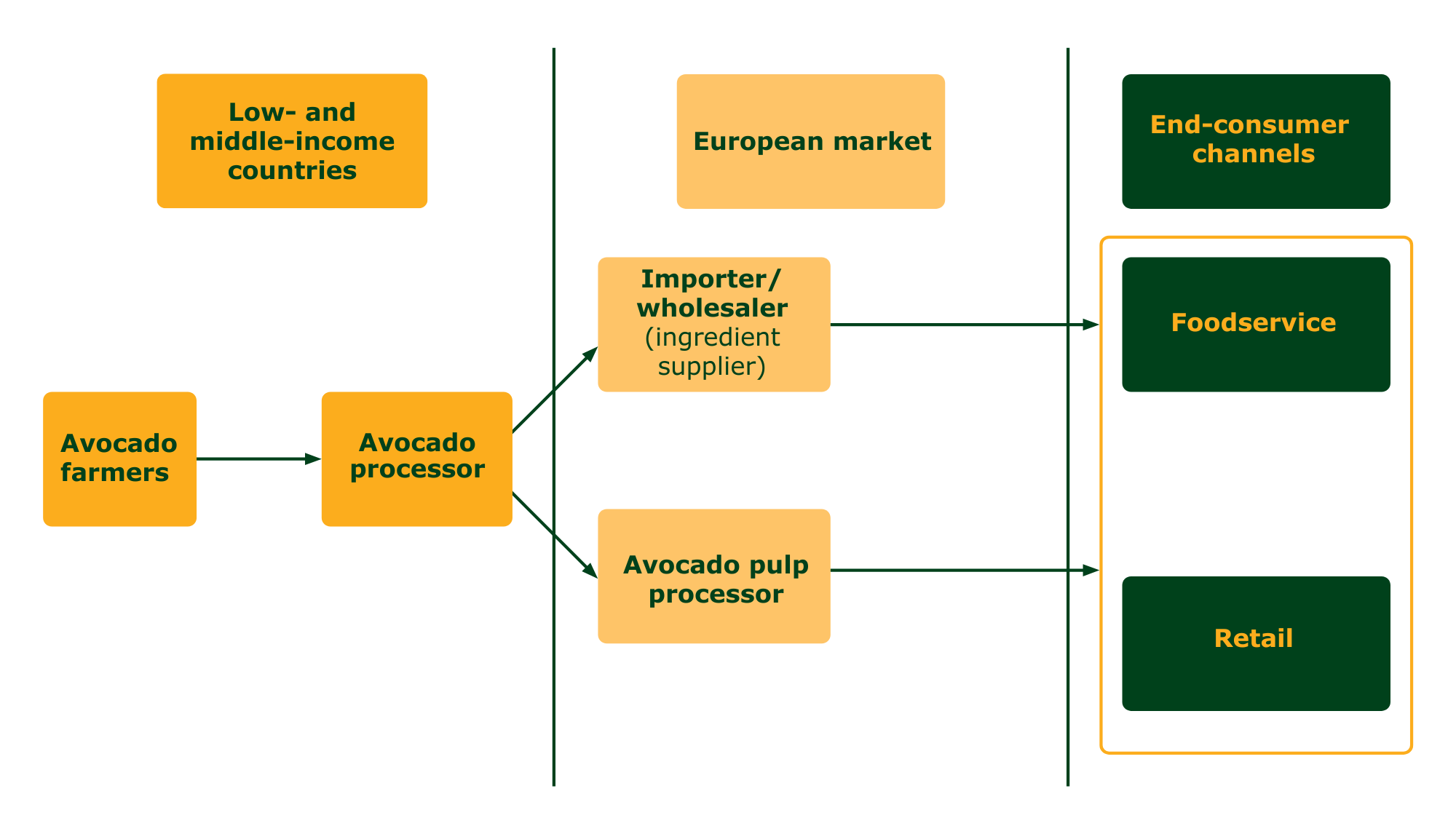
The main route for avocado pulp to enter the European market is through specialised importers serving foodservice and industrial users. There is a direct supply to processors or retailers, though it is less common and usually more demanding for exporters.
How is the end market segmented?
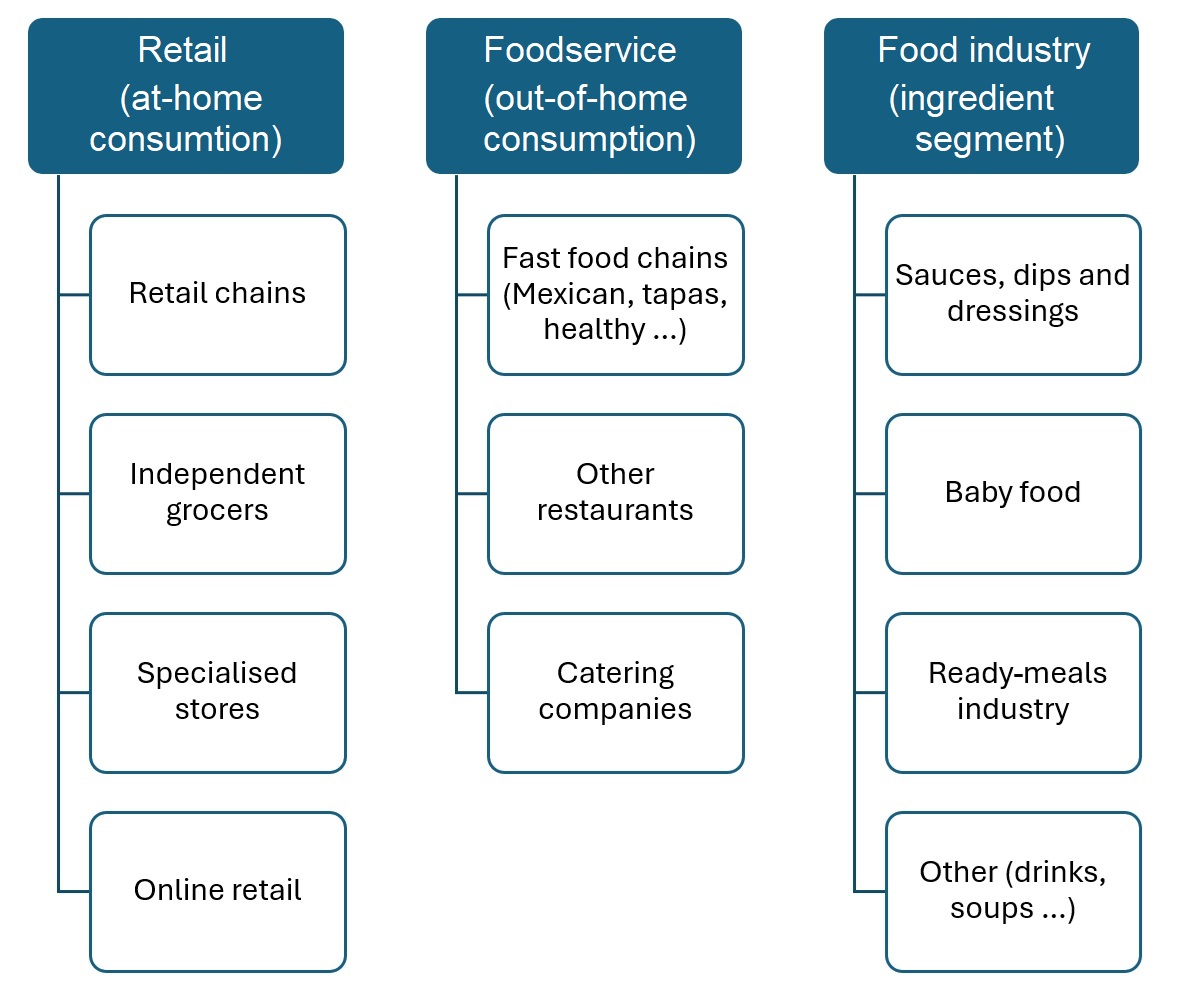
The main way to segment the avocado pulp market is by end use. Here 3 major segments are defined: the food industry plus the foodservice and retail sectors. Besides that, the market can also be segmented by quality into premium (with fresh-like pulp with minimum ingredients) and standard segments.
Figure 1: End-market segments for avocado pulp in Europe
Source: Autentika Global
The foodservice segment
The European foodservice or HoReCa segment (hotels, restaurants, catering) is the largest user of avocado pulp and avocado-based dips. This segment is supplied through specialised distributors and in some cases directly by avocado pulp-importing companies. The most relevant restaurant types using avocado pulp or guacamole in Europe are Mexican/Tex-Mex fast-casual chains, healthy bowl concepts, avocado-specialist brunch chains and some sandwich-to-go chains.
Major users of avocado-based dips are fast-food chains that can be divided into subgroups:
- Mexican/Tex-Mex fast-casual chains: These chains use guacamole either as standard topping, side dish, or add-on in burritos, tacos, healthy bowls and nachos. Examples: Taco Bell, Tortilla, Zambrero, Nachos, Boojum, Salsa Shop.
- Sandwich/tortilla/coffee-to-go chains: These chains use avocado dips in sandwich fillings. The best-known example is the UK-headquartered, globally distributed sandwich chain Subway, though there are also European-based chains (such as Pret a Manger, backWERK and La Piadineria).
The food industry
Food processors use avocado pulp as an ingredient for products like guacamole, baby foods, sauces, dressings and snacks. These buyers need consistent product specifications such as smooth texture and a stable green colour. The volume is significant and growing, with trends in convenience foods. Producers of guacamole-type dips use the largest quantities. As described in the market potential study for avocado pulp, most of the leading avocado processors are located in Spain and include names like TROPS, Freshfy, Frutas Montosa and Avomix.
Retail
The leading European retailers rarely buy plain avocado pulp, although retail avocado pulp was launched in Italy recently. Instead of avocado pulp, retailers are selling guacamole-type dips, either chilled or preserved and packed for a longer shelf life. Some exceptions are foodservice specialised retailers like METRO. Retailers are supplied through specialised distributors or directly by food processors. In the case of ethnic shops (such as Latin stores), importing retail-packed avocado dips is more common.
Types of sub-segments (points of sale) of the avocado pulp retail segment in Europe include:
- Retail chains: European retail chains are roughly divided into discounters (such as Lidl, ALDI and Penny) and supermarkets/hypermarkets (such as Carrefour, Tesco, EDEKA, REWE, Delhaize and Albert Heijn). The main retail chains trend is an increasing share of private labels (own retail brands).
- Specialised organic, vegan and health food shops: Many organic shops are part of specialised organic food retail chains, which include BioMarkt (Germany), Alnatura (Germany), Ekoplaza (Netherlands), NaturaSì (Italy) and Naturalia (France).
- Specialised ethnic supermarkets: The most relevant types of ethnic supermarkets for avocado pulp are Latin supermarkets like Latino Market (France), Mex-Al (Germany) and Mexican Mama. Europe lacks big mainstream Latin supermarket chains. Instead, this sub-segment is usually represented by a single store, often active in online sales.
- Online retailers: Online trade is often part of the business model of regular supermarket chains. Specialised online retailers include companies like Ocado (UK) and KoRo (Germany). Specifically relevant for avocado pulp are Latin-type online supermarkets like Mexgrocer, Mexhaus and Mercado Amigo.
Through which channels does avocado pulp land on the end market?
In terms of volume, the most important channel for avocado pulp is the foodservice segment, followed by the food industry. Both segments are rarely supplied by direct import but rather through specialised importers. Retail-packed avocado based dips are difficult to export to Europe, with the exception of some ethnic supermarkets.
Figure 2: European market channels for avocado pulp
Source: Autentika Global
Importers (wholesalers)
A large share of avocado pulp importers are general traders in frozen fruit and vegetables. A smaller group consists of specialised importers. Some specialised importers also have processing equipment such as mixing lines for sauces and HPP pasteurisation lines. This allows them to supply both the retail and the foodservice segments. Typically, the importer handles customs clearance, quality checks and storage. They then sell the pulp, often in bulk frozen or aseptic form, to industrial processors or food manufacturers.
European food processors
This is a more direct channel, without a trading intermediary, though it is less common than supplying through importers. For example, exporters may supply baby food producers, condiment manufacturers or vegan product companies directly. This channel avoids large distributors and can offer higher margins, but requires strong relationships with buyers. Volumes are usually smaller and more suited to specific customer needs.
Retail
Avocado pulp and avocado-based dips can reach supermarkets directly, but they usually obtain these products through specialised private-label suppliers. Along this route to the market, these suppliers often outsource production to avocado processors outside Europe, while the commercial contract is made with the supplier rather than the processor. Smaller volumes may also be supplied without such intermediaries, especially to some ethnic supermarkets.
This method can be difficult for suppliers outside Europe. The supermarket and private-label business is often highly competitive and based on tenders. Buyers may require frequent deliveries of small retail volumes. Without storage, logistics and a commercial presence in Europe, this can be hard to manage.
What is the most interesting channel for you?
Working with specialised importers and frozen fruit importers is the best multiple-entry point for most avocado pulp suppliers. Ingredient importers in the Netherlands, Germany and Spain regularly seek avocado pulp for their foodservice suppliers and manufacturing clients. Working through these distributors also lowers barriers, as they handle customs and are aware of local regulations. These distributors have multiple clients, so they spread risk.
Tips:
- To get in touch with foodservice suppliers, visit some specialised trade events, like SIRHA (France) or INTERNORGA (Germany).
- Study the exhibitor lists of large trade fairs, like Anuga, SIAL or Food Ingredients Europe, to find potential buyers for your avocado pulp.
- Understand retailers’ demand for sustainable products and make yourself more competitive by investing in various audit schemes, such as those involving corporate social responsibility (CSR) practices.
3. Who is your competition on the European avocado pulp market?
Avocado pulp processing is managed mainly by suppliers from Mexico, Peru and Colombia, and to a lesser extent South Africa. You can expect increasing competition from other avocado-processing countries like Kenya. Leading processors combine access to raw material with freezing, HPP, food-safety certification and social compliance. At the product level, there is no close substitute for avocado pulp in foodservice and processing, except for fresh avocado.
Which countries are you competing with?
Competition on the European avocado pulp market comes mainly from Mexico, Peru and Colombia, and to a lesser extent South Africa. Mexico remains the global processing leader. Peru is becoming an important supplier of frozen pulp. Colombia is developing a fast-growing HPP processing segment. Together, these countries show that competition is increasing not only in volume, but also in its processing capacity, product quality and technical sophistication.
Mexico: Origin of guacamole
Mexico is the world’s largest avocado producer and has a long supply season. It has two main harvesting and processing seasons: June-September and September-February. Predictions put Mexico's avocado production at 2.8 million tonnes in 2026, of which over 500,000 tonnes are used in industrial processing. These are mainly used for guacamole and pulp, but also for avocado oil and cosmetics. Over 95% of avocado exports are estimated to be a fresh product, while less than 5% is exported as guacamole and pulp.
According to industry sources, Mexico’s average annual exports over the last five years are estimated at around 35,000 tonnes of guacamole and 16,000 tonnes of avocado pulp. Most Mexican avocado pulp is traditionally exported to the United States, which makes up over 80% of the export share. Exports to Europe are growing, though they still account for less than 5% of total exports. Mexican processors offer avocado in several processed forms, including frozen pulp, guacamole, cubes, halves and HPP-treated pulp. Some companies combine freezing and HPP to produce pulp with a longer shelf life and without significant loss of quality over time.
Peru: Expanding frozen pulp supplier
Peru is a strong competitor in processed avocado, as it combines a large export industry with a rapidly expanding freezing segment. PROMPERÚ states that almost 9% of the country’s total avocado production is now destined for freezing. Peru already has over 30 freezing companies producing slices, halves and pulp. According to Peru’s Ministry of Agrarian Development and Irrigation, a typical Peruvian frozen avocado pulp is a product typically based on 99.9% avocado. It may use ascorbic and citric acid as stabilisers and can have a shelf life of 18–24 months.
Although frozen pulp is the main type of avocado pulp exporter from Peru, the sector is not limited to simple frozen formats. Peruvian avocado processors are investing more in HPP processing, expanding into retail and foodservice products like baby food, guacamole, vegetable juices and smoothies.
Colombia: A rapidly growing supplier
Colombia’s avocado industry is clearly moving beyond fresh exports towards a more visible processing segment. Producers, processors and exporters are united under the Corpohass association. Until a few years ago, avocado pulp was produced by only a limited number of companies. But investment in processing equipment is now growing, also among established fresh-avocado exporters. According to Corpohass, Colombia had 17 avocado-processing companies in 2025. Of the avocados used in processing, around 50% are avocado pulp, 35% is avocado oil, and 15% are frozen avocado products.
Emerging African suppliers
South Africa produces roughly 80,000–120,000 tonnes of avocados per year, of which an estimated 10–15% is processed into products like avocado oil and pulp. South African exporters are generally associated with strong food safety compliance and product innovation. A good example is Westfalia Fruit, the country’s leading avocado company. Westfalia Fruit offers HPP avocado pulp and guacamole as well as fresh avocados. Kenya, as Africa’s leading avocado exporter, is also emerging in avocado processing, including the production and export of avocado pulp.
Tips:
- Learn from leading suppliers and invest in good processing equipment, consistent quality and food safety;
- Compete with Mexico, Peru and Colombia by avoiding the bulk segment. Focus on smaller certified batches, full farm traceability, organic pulp and flexible specifications for European importers that need alternatives to large Latin American suppliers.
Which companies are you competing against?
The number of avocado-pulp processors worldwide is increasing. One of the leading global exporters is the Mexican company Congeladora y Empacadora Nacional, which operates under the Simplot umbrella. Note that this company is mainly focused on the US market rather than Europe. For that reason, the examples below focus on companies that are among the stronger suppliers to the European market.
RV FRESH
RV Fresh Foods is a large avocado processor with advanced processing technology. Besides bulk exports, the company supplies packed avocado products both as a private-label manufacturer and under its own consumer brand, Guac On!. The company processes about 34 tonnes of avocado per day and operates 3 production lines, using IQF (individual quick frozen) and HPP technology. Its products are sold in over 32 countries and 10,000 retail stores. RV Fresh also established a Netherlands-based subsidiary. This has strengthened its access to European markets as a supplier of avocado products for a private label as well as foodservice and food-processing customers.
Agroempaques
Agroempaques is a Peruvian processor specialised in premium frozen fruit products, including avocado pulp. The company has over 40 years’ experience in international markets and operates from Callao, Peru's main seaport, using both IQF and HPP technology. Its facilities include an IQF tunnel with a capacity of 1 tonne/hour, HPP equipment processing 1.1 tonnes/hour, and eight ripening chambers. The company is food safety- and organic-certified with regular SMETA social audits.
La Fábrica de la Felicidad
La Fábrica de la Felicidad S.A.S., which sells under the Juancamole brand, is the leading Colombian avocado pulp processor and exporter. The company has been active since 2006 and produces guacamole, avocado pulp and IQF frozen avocado. Its plant in Pereira can process about 20 tonnes of fruit per day, yielding roughly 11 tonnes of finished product in the form of guacamole and avocado pulp. They use HPP technology to extend shelf life and meet strict microbiological requirements in export markets. The company exports to demanding destinations, including the UK, France, Sweden, Denmark and the Netherlands.
Westfalia Fruit
Westfalia Fruit is a South African company with a significant value-added avocado business alongside its fresh and dried fruit operations. When processing avocado, it focuses mainly on avocado pulp and guacamole for retail and the foodservice segment. These products are largely preserved through HPP, helping maintain a fresh taste with minimal or no preservatives. Westfalia is also expanding in Peru, where it has IQF avocado and avocado pulp lines with HPP technology, delivering to customers in Europe, Asia and the USA.
Which products are you competing against?
Avocado pulp is a relatively unique product in both the foodservice segment and retail, and has few direct substitutes. The main alternative is fresh avocado, which can be used to prepare pulp at home or in restaurants. However, the trade channels are quite different from those for processed avocado pulp. IQF avocado pieces, such as halves, slices and cubes, are often produced alongside pulp and usually complement rather than compete directly with it.
Tip:
- Emphasise the practical advantages of pulp when competing with fresh avocado. Advantages include year-round availability, standardised quality, lower labour needs, reduced waste and faster preparation for professional users.
4. What are the prices of avocado pulp on the European market?
Prices of avocado pulp vary from season to season and depend on product type and processing method. The harvesting season also influences prices, as they drop during low seasons in leading producing countries and vice versa. On the European market, Mexican prices may be slightly higher than those from Peru but this should not be generalised.
Over the last five years, avocado pulp prices have mainly followed fresh avocado raw-material prices and have remained volatile. Prices rose in 2025 because of strong supply-and-demand constraints in major origins like Mexico and Peru. In the short term, prices are expected to remain relatively high because of continued demand, supply risks and higher logistics costs. The higher costs are partly due to the war in Ukraine and instability in the Middle East. In the longer term, prices may stabilise or decrease slightly towards 2034 if global avocado production continues to expand.
The price breakdown below is a very rough indication. This is because many different factors affect production costs, such as season, quality, origin, packaging and certification. The examples are based on calculation of export of HPP-processed frozen pulp used in the foodservice segment. This is illustrative only and cannot be used as a precise reference.
Organic avocado pulp is usually sold at a higher price than conventional pulp. Indicative market sources suggest an organic premium of around 20–30%, depending on certification, available volumes, origin, quality, processing method and contract conditions.
Table 1: Avocado pulp breakdown
| Export process steps | Type of price | Price breakdown (share of the retail price) | Price per kg (example) |
|---|---|---|---|
| Fresh avocados | Raw material price | 12% | €1.3/kg (based on the assumption that the average pulp yield is 70–80% for Hass avocados) |
| Processing costs (reception/washing, preparation, pulping, preserving, freezing and packing) | Production costs | 23% | €2.5/kg (based on the assumption that processing costs are €1.2/kg) |
| Export price | FOB price | 36% | €4/kg |
| Import, shipping, handling and storing | CIF price | 38% | €4.25/kg |
| Wholesale price of bulk traders in Europe | Wholesale price | 55% | €6/kg |
| Wholesale price (for foodservice customers in 1-kg packs) | Foodservice price (value-added tax included) | 100% | €11/kg |
Source: Autentika Global based on industry sources
Tips:
- When setting prices, avoid competing only on the cost of raw avocado, as buyers usually assess avocado pulp on the total value, including yield after thawing, colour stability and shelf life.
- Consider subscribing to Mintec, now part of Expana, to check avocado pulp prices.
Autentika Global carried out this study on behalf of CBI.
Please review our market information disclaimer.
Search
Enter search terms to find market research