

Entering the European market for (Industrial) Internet of Things services
To enter the European market for IIoT services you must comply with various laws and regulations, including the General Data Protection Regulation. Buyers often have other requirements too, like a quality management system and an information security and management system. The best way to access the European market is by working with a strategic partner. Your strongest competition comes from Central and Eastern Europe (CEE), India, Egypt and Vietnam.
Contents of this page
1. What requirements and certifications must IIoT services meet to be allowed on the European market?
To enter the European market for IIoT services, you must comply with various mandatory (legal) requirements. You should also follow any other requirements from your buyers. Niche markets may have specific requirements as well.
General market entry requirements for IT and business process outsourcing (ITO and BPO) are listed in our study on the requirements outsourcing providers must meet. This chapter discusses the most common requirements for IIoT services. New legislation is always being developed, especially in relation to the European Green Deal (Europe’s roadmap to become a climate-neutral continent by 2050) and the EU’s Digital transformation. So stay up to date.
What are mandatory requirements?
When offering IIoT services in the European market, the following legal requirements may apply to you:
- Directive on the legal protection of computer programmes (2009/24/EC);
- General Data Protection Regulation (EU 2016/679);
- Data Act (EU 2023/2854);
- ePrivacy Directive (2002/58/EC);
- General Product Safety Regulation (EU 2023/988);
- Artificial Intelligence Act (EU 2024/1689);
- Cyber Resilience Act (EU 2024/2847);
- Cybersecurity Act (EU 2019/881);
- NIS2 Directive (EU 2022/2555);
- Product Security and Telecommunications Infrastructure (PSTI) Act 2022 (for the UK market).
Other important legal requirements are the Radio Equipment Directive and the Machinery Regulation.
Radio Equipment Directive and Delegated Regulation
The Radio Equipment Directive (RED - 2014/53/EU) sets rules on how radio equipment should be placed on the market of the European Union (EU). Radio equipment is any electrical or electronic product that uses radio waves to send or receive messages. Examples are IIoT devices (like industrial sensors and vehicle telematics), consumer electronics (like smartphones and laptops), and networking equipment (like Wi-Fi routers and modems). The Directive sets essential requirements for safety, electromagnetic compatibility, and efficient radio spectrum use.
Since August 2025, internet-connected devices must also meet cybersecurity, privacy and fraud-prevention requirements under the Delegated Regulation (EU) 2022/30 that supplements the RED.
Cybersecurity standard for radio equipment
The EN 18031 series is a set of harmonised European cybersecurity standards to meet the new security requirements for radio equipment outlined in the RED. It was officially published in January 2025. Compliance with the standards will be mandatory from 1 August 2025. The series is divided into 3 parts:
- EN 18031-1:2024: General security requirements for internet-connected radio equipment;
- EN 18031-2:2024: Technical requirements for radio equipment that handles personal, traffic or location data;
- EN 18031-3:2024: Cybersecurity requirements for radio equipment that processes virtual money/monetary value and can connect to the internet.
Machinery Regulation
The Machinery Regulation (EU) 2023/1230 is the updated legal framework covering health and safety requirements for the design, manufacture and market placement of (partly completed) machinery in the EU. It replaces the current Machinery Directive (2006/42/EC). The regulation was adopted in June 2023 and will apply in full from 20 January 2027.
The new rules are related to digitalisation and connectivity, among others. The regulation modernises health and safety requirements to address emerging technologies, including artificial intelligence (AI), robotics and IIoT. Machinery must also meet cybersecurity requirements to make sure that cyber risks do not form a danger to its safety functions.
Tips:
- Make sure you fully understand how each legal requirement affects the IIoT services you want to offer. For more information on IoT-related regulations, see Nabto’s Guide to the RED and article on the challenge of regulatory compliance in IoT.
- For an overview of IoT cyber security regulations across the world, look at CETOME’s overview per country.
What additional requirements and certifications do buyers often have?
European buyers often have extra requirements when choosing an IIoT service provider, like:
- A quality management system, often ISO 9001:2015 or CMMI;
- An information security management system, preferably ISO 27001 compliant/certified;
- A privacy information management system, ISO/IEC 27701:2019;
- Agile project management methodologies.
You can find more details on the above requirements in our study on the requirements outsourcing providers must meet.
Cybersecurity standard for consumer IoT
In 2020, the European Telecommunications Standards Institute (ETSI) introduced the Cyber Security Standard for Consumer IoT: ETSI EN 303 645. This is an important standard for consumer security in IoT. It is important to keep an eye out for other standards that are being developed and might increase in importance, for example ISO 27403:2024.
Cybersecurity standard for industrial automation and control systems (IACS)
ISA/IEC 62443 is an international series of standards that offers a complete framework for securing industrial automation and control systems (IACS) across their lifecycle. Its goal is to reduce cybersecurity risks for systems used in critical infrastructure, manufacturing and other industrial environments, including IIoT.
The ISA/IEC 62443 series of standards provides guidance in several areas:
- Defining common cybersecurity terms, concepts and models;
- Identifying the security level a business needs for its specific risks and operations;
- Setting requirements and a cybersecurity lifecycle methodology for product developers;
- Describing risk assessment processes critical to protecting control systems.
See the ISA/IEC 62443 Quick start guide for more information.
Security Evaluation Standard for IoT Platforms (SESIP)
SESIP is an internationally recognised framework for assessing and certifying the security of IoT products. It is designed to simplify and streamline the certification process. SESIP helps make security certification faster, easier and cheaper. It works like building blocks: once a component is certified, you can reuse that component in new devices without having to evaluate it again and again. The European Standardisation Organisations CEN and CENELEC adopted SESIP as a European Standard (EN 17927).
OneM2M Standards
OneM2M is an international standards initiative focused on IoT and machine-to-machine technologies. It sets requirements that help IoT systems work together and grow. As a general-purpose standard, oneM2M is applicable across all industry verticals. The ETSI TS 118 series includes a set of technical specifications to define and formalise the oneM2M standard.
Up-to-date knowledge and skills
As an IIoT service provider, you must stay on top of the developments in the market. European buyers expect you to be able to offer them the possibility to work with the latest technology. So it is very important to stay informed about specific IoT technologies, IoT platforms, frameworks and innovation. Also, make sure to keep your skills up to date, like IoT technical and technological skills; business, marketing and management skills; regulatory skills; and IoT end-user skills.
Figure 1: IoT technical and technological skills
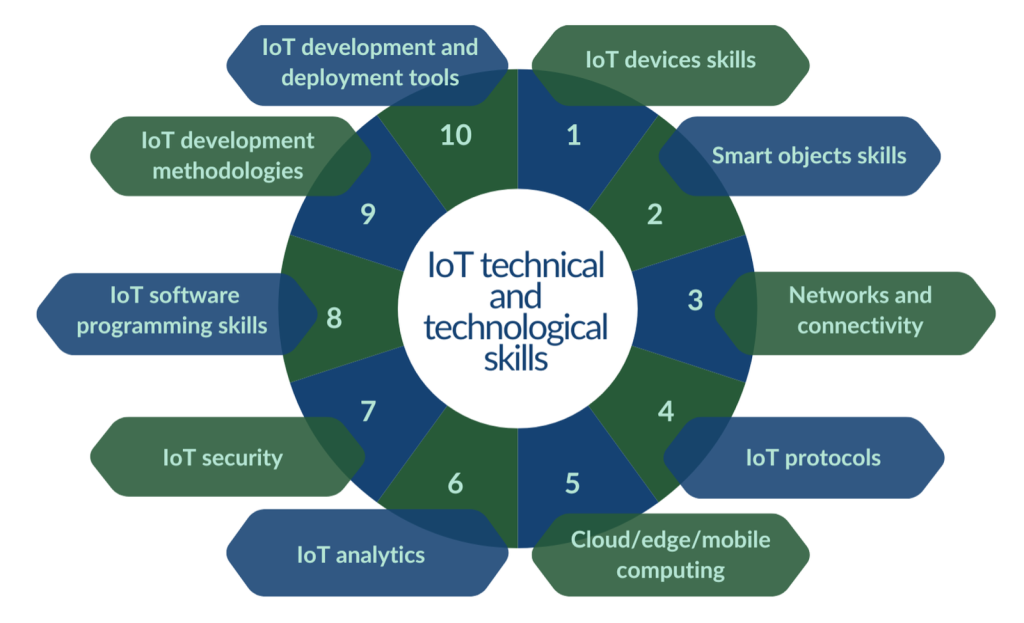
Source: Globally Cool, based on information from the EU-IoT framework for IoT skills: Closing the talent gap
European buyers of IIoT services also want to understand why you choose to work with certain coding programs and technology. Your motivation should be clearly visible on your website.
Soft skills
Besides technical knowledge and experience, professionals must also have good soft skills. Clear communication helps them understand clients’ needs and improve collaboration. This also builds trust. Skills like problem-solving and flexibility help developers deal with issues and adapt to project changes. Understanding what end users want and making software easy to use is also important. Good leadership and teamwork skills keep everyone on track and motivated, so that projects can run smoothly.
Sustainability
Companies are more often required to demonstrate their socially and environmentally sustainable business practices. Voluntary standards like ISO 26000 (social) and ISO 14001 (environmental) can help you demonstrate that you are responsible.
Tips:
- Read about sustainability in ITO/BPO in our tips on how to go green and how to become more socially responsible in the outsourcing sector.
- Show that you care about your impact on society by implementing your own Corporate Social Responsibility (CSR) policy. Clearly communicate this commitment in your marketing activities. It can be a unique selling point (USP).
- Check if there are resources that might give your company financial support to get quality certification. Contact your national IT association (for example, BPESA from South Africa) or one of the business support organisations in your country responsible for (IT) export promotion.
- Other standards that are gaining importance in the IoT sector are standards by the Standards Association. This is a globally recognised standards-setting body. Keep an eye on their standards that are applicable to IoT.
- IIoT standards are evolving. Keep up with the latest developments by following the Industrial Internet Consortium, the Object Management Group, the ITU-T Study Group 20 (SG20), and oneM2M.
What are the requirements for niche markets?
European buyers often require you to comply with industry-specific standards or codes of practice (if available). There are also many technologies, technical standards, protocols, and frameworks related to IIoT. They are developed and maintained by a large number of organisations, and they can differ significantly between niche markets. Please note that most requirements on this list are not IoT-specific.
Industry
If you develop IoT services for a specific industry, you need to take its specific requirements into account. For example:
- In the healthcare sector, the Health Level 7 (HL7), the Health Insurance Portability and Accountability Act (HIPAA), ISO 13485, ISO 14971, and IEC 62304 are important, among others;
- In the automotive industry, MISRA and AUTOSAR are the 2 main coding standards used. Other standards include ISO/SAE 21434 and UN Regulation No. 155;
- In the financial sector, relevant standards and regulations include the Digital Operational Resilience Act (DORA, EU 2022/2554), Payment Services Directive 2 (PSD2, EU 2015/2366), Payment Card Industry Data Security Standard (PCI DSS) and Basel III.
Keep in mind that these are only examples. Requirements for niche markets vary greatly because the IIoT market is very diverse. There is a huge amount of technology, and companies often focus on horizontal and/or vertical markets, so you have to research your own specific situation, market, and requirements.
Tips:
- If you (aim to) specialise in offering IIoT services for particular sectors, find out which certifications are relevant. When you are considering a particular quality certification, ask yourself 3 questions before working out the details: Is it good for my company? Is it good for my clients? Does it have marketing value?
- Regularly check the latest information on IoT standards. Check your target market legislation for country-specific IoT requirements. For example, Finland and Germany have implemented a cybersecurity label for IoT.
2. Through which channels can you get IIoT services on the European market?
The European market for IIoT services can be divided into several segments: industry vertical, horizontal segmentation, business model/value chain position, deployment model and end user. You can tap into these segments through several market channels. The most realistic channel for you is working with a strategic partner.
How is the end market segmented?
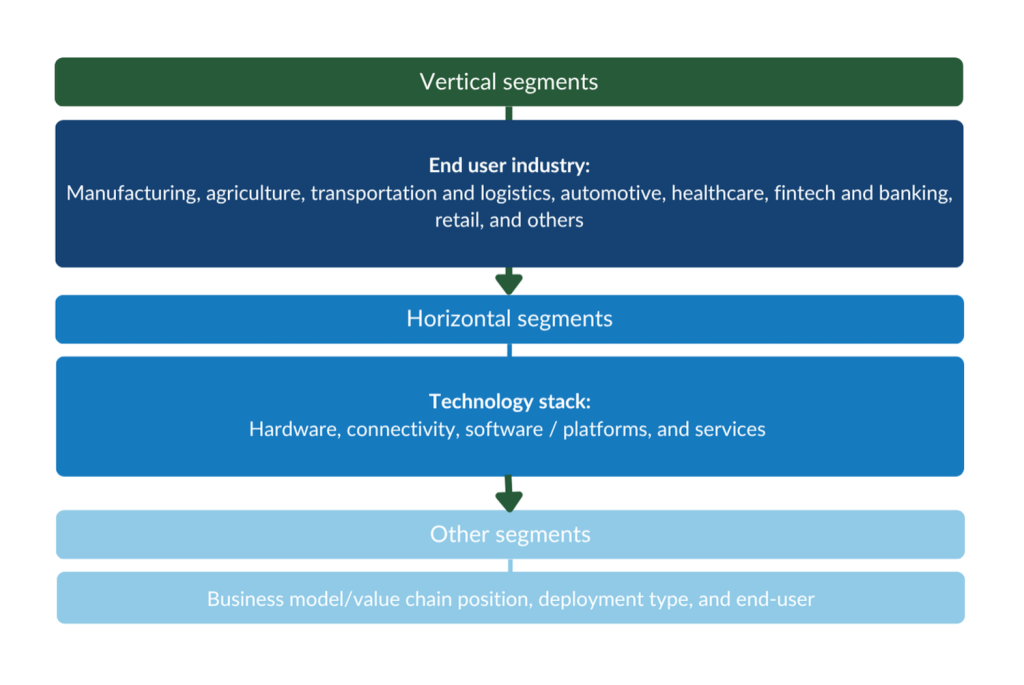
The market for IoT services can be segmented in multiple ways: by industry vertical, horizontal segmentation, business model/value chain position, deployment model and end user.
Figure 2: IoT market segmentation
Source: Globally Cool
Industry vertical refers to segmenting the market by end-user industry, like manufacturing, agriculture, transportation and logistics, and automotive. There is a variety of sectors that show potential. For example, Europe’s healthcare IoT market is expected to show a compound annual growth rate (CAGR) of 7.7% in 2025-2029. Germany is leading in healthcare IoT in Europe, driven by its strong infrastructure and innovative medical technology firms. There is also a strong demand for Smart Cities in Europe (cities that use technology to improve quality of life), with an expected CAGR of 10.6% over the same period.
Horizontal segmentation means dividing the market by technology stack. For example, hardware, connectivity, software/platforms and services.
Business model/value chain position segments the company by the role businesses play in delivering IoT value. Examples are end-to-end solution providers, component providers, platform providers, system integrators, network operators, and analytics and AI specialists.
Deployment type deals with where and how the IoT solution’s computing, storage and data processing take place. This can be cloud-based IoT, edge-based IoT, hybrid IoT and on-site IoT.
End-user segmentation classifies the market based on the ultimate user type:
- Consumer IoT (CIoT) like smart home devices, smart watches and connected vehicles for personal use;
- Enterprise IoT (EIoT): IoT solutions for businesses like smart office, asset tracking and retail IoT;
- IIoT: IoT applications in industrial settings like manufacturing, energy and logistics;
- Public sector IoT (B2G): IoT solutions for governments and public services like smart city infrastructure.
The consumer IoT market is expected to generate around €39.63 billion in revenue in 2025 and grow at a CAGR of 9.4% in 2025-2030. Germany leads Europe in adoption of smart home technology. This is driven by a strong demand for connected appliances and home security systems. The European market for IIoT is projected to reach a revenue of €46.22 billion in 2025 and is expected to grow at a CAGR of 11.8% in 2025-2030.
On the service provider side, there are generalists and specialists. Generalists are IIoT service providers without a focus on a particular market segment. Specialists in the IIoT services market do focus on a particular market segment.
For smaller IIoT providers, industry sources predict that the best chances in the IoT market lie within smart manufacturing, connected health and wearables, retail, and smart homes. There are also good opportunities in smart agriculture.
Tips:
- Research the market segment that you want to focus on. This allows you to effectively market your company.
- Specialise in a niche market. Especially if you can find a niche market that is underserved with software or has room for digital innovation/transformation.
Through which channels do IIoT services land on the end market?
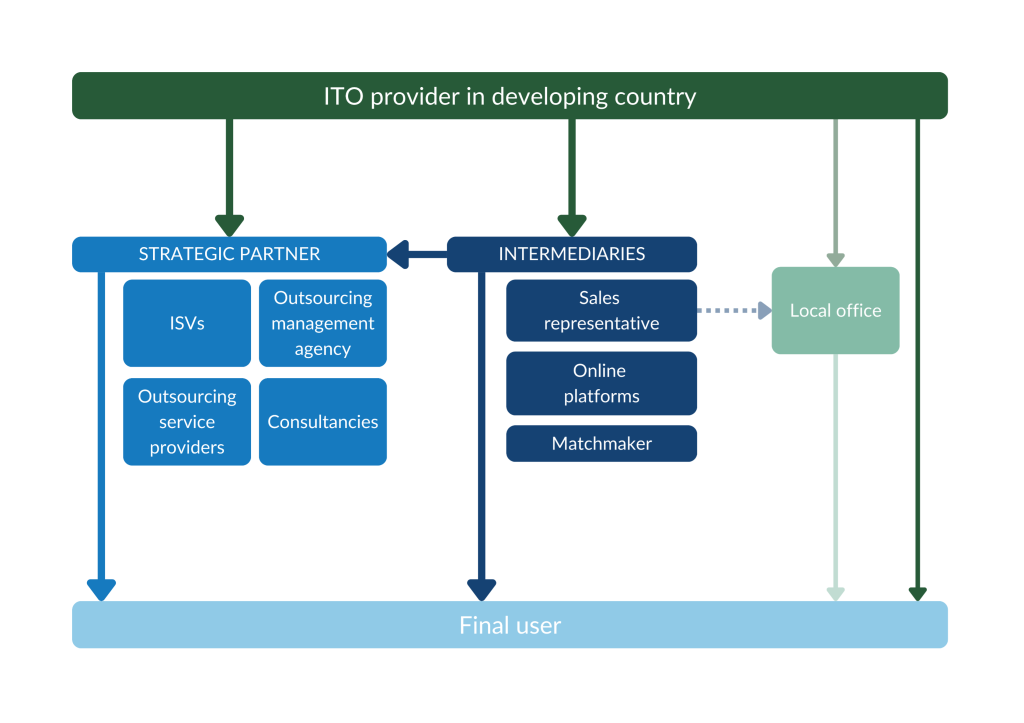
Figure 3 provides an overview of the trade channels you can use to enter the European market. This structure is more or less the same in every European country. Working with a strategic partner is your most realistic option.
Figure 3: Trade structure for outsourcing IIoT services in the European market
Source: Globally Cool
Strategic partners
Working with a strategic partner is the recommended way to enter the market. This could be Independent Software Vendors (ISVs), outsourcing management agencies, outsourcing service providers or consultancies.
A provider that is similar to your company (for example in size, technology portfolio or customer portfolio) would be most suitable. Ideally, this IT company should design, develop, market, sell and maintain IIoT solutions.
The relationship between a strategic partner and a subcontracted supplier (you) is generally characterised by:
- Trust;
- Interdependence;
- A structured relationship (functions, tasks, communication, and procedures);
- Potentially limited marketing visibility and market access opportunities for the subcontracted supplier;
- No intellectual property (IP) rights, or a loss of IP rights for the subcontracted supplier;
- Work orders on an as-needed basis.
Keep in mind that when you work with a strategic partner, they communicate with the final user of the software or IoT solutions you are developing. You are just a subcontractor, who will probably not appear in their marketing communications. They will call you the ‘delivery centre’.
You can find a strategic partner either directly or by working with an intermediary. Because many European companies prefer to deal with a local contact person, an intermediary is a good option.
Tips:
- Attend relevant (online) industry events in your target country to meet potential partners. This also allows you to learn more about their business culture. For example, IoT Tech Expo in the Netherlands and the United Kingdom (UK) and AUTOMATICA in Germany.
- Use IT-industry associations to find potential customers in Europe, such as Bitkom in Germany, NL Digital in the Netherlands and Tech UK and BIMA in the UK. If you specialise in a particular industry, you can also use associations for those specific niches, such as the Association of British HealthTech Industries.
Intermediaries
You can work with an intermediary to find a buyer or strategic partner.
Matchmakers
A matchmaker is a person or company with many relevant contacts in a specific market segment or industry. They do not make cold calls. Always properly inform your matchmaker about your company. This helps them match you with suitable leads from their network.
If you work with a matchmaker:
- They make appointments with prospects for you;
- Presentation and sales process remains your responsibility;
- You often pay a retainer plus success fee (which can be expensive);
- They usually have multiple clients;
- You need to set clear expectations and objectives (and exit criteria) to measure their performance.
A retainer plus success fee can be expensive. The success fee depends on what the matchmaker has delivered. But you must pay the retainer (usually a fixed monthly payment) regardless of their performance. The retainer should be high enough to cover some of the costs, but low enough to encourage delivery. A properly drafted contract, by a lawyer, is a must.
You also need to include a trial period (usually no longer than 3-4 months) after which you can end the contract without further consequences. The delivery expectations and targets for this initial period must be clearly defined, such as the number of relevant contacts, meetings and leads. Your contract should also have clear exit options.
Sales representatives
Another type of intermediary is a sales representative. These are more involved in the sales process than matchmakers.
When working with a sales representative:
- They contact prospects for you;
- They also make the sales and sometimes manages projects to a certain degree;
- You often pay a retainer and success fee (which can be expensive), or a fixed monthly fee;
- They can have multiple clients or work exclusively for you.
A good sales representative has a large, relevant network, so they do not make cold calls. Their success fee is often a percentage of the value of the projects they bring in.
Online platforms
Electronic marketplaces are a cheap marketing tool that may make direct sales easier. They are expected to lead to lower transaction costs for searching, evaluating, integrating and monitoring IIoT services. These platforms used to focus on freelancers, but some serve SMEs now too. However, you would need excellent end-market knowledge to stand out.
Tips:
- Make sure that any selected matchmaker or sales representative has a large relevant business network.
- Be careful when intermediaries only ask for a success fee. This could mean they are excellent at their job, but can also mean they are desperate and may not be able to deliver. You should also be careful if intermediaries want to work for you part-time besides their regular job. They are often too busy to deliver.
- Work with a good lawyer who knows the laws of the country where the intermediary resides and has experience with this type of contracting. Pay special attention to exit clauses, success criteria, deliverables, and payments.
- Try to avoid limitations to your marketing coverage and activities in your contracts.
- Look for potential leads in the field of IIoT services on online platforms. For example, UpWork, Fiverr and Freelancer can be interesting for freelancers or very small companies. For more information on online marketplaces, read our study about finding buyers on the European outsourcing market.
Local office
Another option is to set up a local office in your European target market. You can also open an office in one of Europe’s nearshoring destinations (like Central and Eastern European markets), which is often cheaper.
Having a local presence makes it easier to build long-term relationships with customers through personal contact. It also gives you more credibility, builds trust and allows you to keep complete control over your marketing and sales activities. However, this can be difficult, as it requires a lot of experience and large investments. Many IT service providers in developing countries are simply too small. They do not have the financial strength or enough verified market opportunities for this.
Tips:
- Consider setting up your own office if you already have a client base in the target market, or if you have a well-founded indication of the demand for your services/products. If you decide to set up an office, involve your sales or marketing representative.
- Be aware that setting up a local sales office is very expensive and you need a strong financial position.
Direct sales
You can also try to sell your IIoT services directly to European end users. Many European companies are looking for cost reduction and delivery capacity, which developing countries can often provide. This is one of your unique selling points. However, you should be aware that these end users might not have qualified IT staff to work with.
For direct sales, you need experience in the European market. This method is most suitable for relatively large providers that want to target large European end users. Your best chance is to focus on a small, underserved niche market. For most suppliers from developing countries, it is very challenging to sell IIoT services directly. Having existing customers in Europe will help because you need references for direct sales.
Tips:
- Build a professional, high-quality company website, where you present full, accurate, and up-to-date details of your product/service offering. Make it compatible with mobile devices and invest in Search Engine Marketing and Search Engine Optimisation (SEO), so potential customers can easily find you online.
- Combine offline and online promotion channels to develop as many contacts as possible. This maximises your chances of finding suitable partners/customers. Use social media as a marketing tool to reach potential customers. LinkedIn can be particularly useful for making initial contacts and for conducting market research. It is also a very important platform to display your skills.
What is the most interesting channel for you?
European strategic partners are often the most promising market entry channel for providers like you. Selecting a channel depends on your type of company, the nature of your product or service, your target market, and the available resources for market entry. Regardless of the channel you choose, your own marketing and promotion is a vital part of your market entry strategy, for which you are responsible.
Tip:
- Decide on a business model and create your ideal client persona. It helps you to tailor your offer.
3. What competition do you face on the European IIoT services market?
European end-user companies often prefer outsourcing to providers within their country. Especially smaller companies outsource tasks locally. But European ITO providers often subcontract to nearshore and offshore outsourcing companies. They usually prefer nearshore locations because of proximity, language, cultural similarities and the minimal time difference.
Which countries are you competing with?
European companies often prefer to outsource to nearshore destinations. This means that your main competitors are based in Europe. Important competing countries include those in CEE. They offer a strong mix of tech hubs, skilled talent, competitive costs compared to Northern and Western Europe, high English proficiency, minimal time differences and a similar culture. You also have competition from the offshore outsourcing leader, India. Egypt and Vietnam are other important players.
The Global Services Location Index (GSLI) shows countries’ attractiveness as offshore locations for ITO/BPO services. It ranks their competitiveness based on 4 categories:
- Financial attractiveness;
- People skills and availability;
- Business environment;
- Digital resonance.
Based on the GSLI, India is the most attractive ITO/BPO destination. CEE countries score lower but are leading outsourcing locations for European companies. Vietnam also scores high on the GSLI, ranking seventh. Egypt ranks 23rd.
Source: Kearney, 2023
CEE countries: Preferred nearshoring destinations
European ITO providers often subcontract to nearshore destinations in CEE. Companies from these countries have a positive image in the European market and are often seen as a reliable choice. CEE countries are important outsourcing hotspots because of their skilled talent They are also close to to Northern and Western Europe, both geographically and culturally. Poland and Romania stand out as very large suppliers; they both have a large pool of IT professionals. Also, being part of the EU gives these countries advantages in legal compliance and easier business integration when serving European clients.
Growing challenges in CEE countries are rising costs and talent shortages. The success of the tech sector has driven up talent competition and salaries in major hubs. The higher rates have narrowed the cost gap with Western Europe. Also, being in the EU means businesses have higher operating costs compared to some offshore locations. The result is that some CEE companies subcontract work to offshore destinations. Although companies from CEE countries are your competitors, they also offer opportunities for partnerships.
Poland
Poland is the most attractive destination. It ranks 13th on the GSLI 2023. It has many higher education institutions and has trained around 400,000 IT specialists. Polish IT specialists have experience working with international companies and are skilled in advanced technologies. The HackerRank shows that Poland’s programmers are among the best in the world.
Poland has created the IoT and AI cluster Sinotaic. This cluster brings together different stakeholders including technology providers, SMEs, research institutes, and industry organisations that operate in IoT and smart technologies. They also created an IoT innovation showroom that showcases the latest Polish technological solutions in IoT and Smart Cities.
Romania
Romania is another strong nearshore destination, known for its exceptional price-to-quality ratio. It has the leading position in Europe and is the sixth country worldwide for the number of certified IT specialists per 1,000 inhabitants. The country has a large tech workforce of 120,000 programmers and over 360 custom software development companies. This makes Romania the fourth-largest technology market in Eastern Europe. Bucharest is the country’s main IT hub, with 63% of the country’s software development revenues.
Romania is a good nearshore destination for innovation-driven outsourcing like IoT and AI. This is because the country has a strong academic base as well as a rising number of deep-tech startups. Around 25,000 students (7% of all applicants) enrol in computer science programmes each year. Romania ranks high on the English proficiency index; English is the primary working language among Romanian tech companies.
Czechia
Czechia is currently in 31st position on the GSLIThe country has over 221,000 ICT professionals. According to HackerRank, Czech developers are rated as the ninth-best developers in the world. But the industry is dealing with a challenge: attracting new employees. After Germany, Czechia is the EU country with the greatest challenges in filling ICT specialist vacancies (70.5% in 2024). This may drive Czech companies towards subcontracting.
India: Low-cost destination, mostly known for ‘bulk’ projects
India continues to lead the GSLI. This leading position is mainly due to the country’s unique combination of low-cost services, high English proficiency and a skilled workforce. This makes India a strong competitor in the IT outsourcing market. To stay ahead, the country needs to prepare for the shift from lower-skilled jobs that may be replaced by robots to more creative and high-skilled work. Technological advancements and socioeconomic changes will reduce India’s labour cost advantage. This applies to other low-cost countries as well.
India is known to be a ‘bulk’ destination. Buyers often associate extremely low developer rates in Asian countries with poorer project quality. They think that cheap service providers must compromise on the skills and experience of the IIoT service developers, or even their working circumstances.
The Indian government wants to upskill its people on Industry 4.0 technologies (including IoT) by launching programmes like PMKVY 4.0. India also has a Centre of Excellence for IoT and AI to develop the country’s IoT and AI ecosystem. It brings together startups, innovators, companies and the government. The goal is to create innovative applications and domain capability, and maintain a leadership role in the fields of hardware and software.
Vietnam: Relatively young, but strong outsourcing destination
Vietnam is a strong outsourcing destination. It ranks seventh on the GSLI. Compared to India, the Vietnamese outsourcing industry is relatively young. But because of the presence of large technology companies, Vietnam is seen as a global digital hub. This also stimulates the country to keep improving the skills of its workforce. Although English proficiency is generally low across the population, it is better (moderate-level English) in larger cities.
Vietnam’s IoT market is expanding rapidly. More companies are developing innovative solutions for the agriculture and manufacturing sectors. The automotive IoT sector is expected to be the dominant segment in the country’s IoT landscape. Also, since 2019 the country has an IoT innovation hub at the Hoa Lac Hi-Tech Park in Hanoi. This hub supports startup businesses, and researchers and students develop and test IoT applications while also facilitating their commercialisation.
Egypt: An ITO destination with Smart City ambitions
Egypt is an emerging African destination for IT outsourcing. Its time zone (GMT+2) partly overlaps with Western and Northern Europe, eliminating the time differences generally associated with offshoring. Egypt ranks 23rd in the GSLI, 8 places lower than in 2021. This appears to come from a limited emphasis on digital initiatives, although rising labour costs and currency changes also played a role. Despite its relatively modest technological innovation, the country is steadily developing its emerging technological skill base.
Egypt’s Information Technology Industry Development Agency (ITIDA) plays an important role in developing the country’s IT industry and promoting trade in international markets. It has also established Innovation Labs, including an Expert IoT Development Lab. This lab focuses on innovative applications across a variety of sectors, including home appliances, healthcare and smart cities.
Also, Egypt’s government launched a Smart Cities programme. The second phase is planned for completion in 2030. These Smart Cities are designed to offer residents modern and integrated living environments using advanced technologies, digital solutions and IoT. One of the most well-known smart city projects is the New Administrative Capital (NAC), located east of Cairo.
Tips:
- Compete on the quality of your services, rather than just on costs.
- Specialise in specific emerging technologies and/or niche market segments to avoid competition.
- Visit leading European trade fairs regularly to meet competitors and potential customers. Do your homework and select the events carefully. Only attend events that fit your profile well. Many trade event directories are available online, such as 10Times, and UK Exhibitions.
Which companies are you competing with?
Examples of IIoT service providers are:
Rinf.tech (Romania)
Rinf.tech is a Romania-based company that also has delivery centres in Bulgaria, Ukraine, and India. They have representation offices in Germany, the USA and Mexico. The company offers a broad variety of custom software engineering solutions, including custom IoT and connectivity solutions. They hold several certifications to demonstrate their quality and compliance, such as ISO 9001, ISO/IEC 27001 and ISO/IEC 27701.
Moweb (India)
Moweb is an IT outsourcing company focused on custom software development and system integration services. It is headquartered in India and has offices in the UK, the USA and other locations. The company offers many services, from enterprise software development, artificial intelligence (AI) and machine learning (ML) development to IoT solutions. To show its expertise, on its website Moweb highlights a diverse portfolio of successful projects across multiple industries and using a wide range of technologies.
Digital Fortress (Vietnam)
Digital Fortress is a Vietnam-based tech company dedicated to IoT development. They have clients in different parts of the world, including European countries like Spain, Finland and the UK. To showcase their expertise, they have included a project portfolio on their website that also lists the technologies used in each project.
Avelabs (Egypt)
Avelabs has its headquarters in Egypt, with offices in Germany and the USA. The company is a supplier of embedded solutions and services for the automotive industry. They work, for example, on advanced platforms to support the evolution of smart vehicles through Over The Air (OTA) and differential software updates.
Tip:
- Learn from your competitors. Look for competitors that operate in the European market. Compare them on factors like price, their offer, and the segments and industries they focus on.
Which products are you competing with?
In the IIoT sector, the product is the service. This means that the real question here is: what makes one service provider different from another? There are many different factors. Some examples:
- Technical knowledge;
- Available capacity;
- References;
- Domain knowledge;
- Flexibility;
- Reliability;
- Communication and language capabilities;
- Quality management;
- Security infrastructure;
- Market segment focus;
- Niche market orientation.
There is space in the market for innovation and developing your own products. More space than in generic software development for IoT. It is a challenging market, but it holds opportunities for companies that want to develop and sell their own innovative product.
Tips:
- Look at successful IoT development companies. See how they position and promote themselves. Find out how you can get a competitive advantage, based on factors such as cost, quality, technology or product characteristics. For example, see The Manifest’s list of the top 100 IoT development companies.
- Keep an eye on innovation initiatives for IoT. One particularly good source is the Alliance for AI, IoT, and Edge Continuum Innovation.
4. What are the prices of IIoT services on the European market?
When trying to make a sale in Europe, it is very important to offer the right price. For IIoT services outsourcing, price is often not the most important, but it has to be competitive. Price is influenced by factors such as:
- Technology requirements;
- Skill levels;
- Complexity of the project;
- Length of the contract;
- Other SLA requirements.
Your offer should include the price, with your hourly rates and an honest estimation of the number of hours you expect to work on the project.
You must also choose a price model. There are 4 popular working models: Fixed-Price, Time and Materials, Incentive Based, and Shared Risk-Reward. For IIoT, it is most common to work with all-inclusive offers, also known as a fixed-price contract. Depending on your situation, you should choose the price model that fits best.
Salaries make up a large share of the costs. The average annual salary of a mid-level IoT developer in Western Europe is between €64,000 and €82,000 (2025). In nearshore locations like Poland and Romania, mid-level salaries are lower, around €37,000 per year. In offshore destinations, salaries are usually much lower. For example, in India annual salaries are around €5,000. This means that outsourcing to countries where salaries are lower can lead to big cost savings.
Tips:
- Study average prices in reports such as those by Cleveroad and IT Jobs Watch. You can also research the average salaries for various roles in the software development process via platforms like Payscale.
- Go beyond setting the right price. Work out your pricing strategy, including your preferred pricing model (read Pricing models in outsourcing for more information), payment terms, how and when you provide discounts, and so on.
- Create the “ideal” client person to help you tailor your offer. For example: “A technology provider with less than 200 staff in Germany, specialised in IoT and big data services”.
Globally Cool carried out this study in partnership with Laszlo Klucs on behalf of CBI.
Please review our market information disclaimer.
Search
Enter search terms to find market research
Do you have questions about this research?
If a company offers software development, it is important to clearly show where the focus is and why. Is it Java, Microsoft or a low code platform? Or a combination? Making clear what customers can expect is crucial to gain credibility from buyers in the EU.

Ad Hesseling, CBI outsourcing expert and senior IT recruiter