
Entering the European market for aloe vera
To access the European health products market for aloe vera, you must comply with EU legal requirements and buyer expectations for safety, quality and documentation. Rules differ depending on whether your aloe is used in food supplements or herbal medicines. Importers and manufacturers are key entry points. But competition is strong, both from low-cost suppliers like China and India and certified producers from Brazil and Vietnam. To be successful, focus on traceability, meeting technical standards, and offering consistent, high-quality aloe.
Contents of this page
1. What requirements and certifications must aloe vera meet to be allowed on the European market?
To export aloe vera ingredients to Europe, you must understand legal and technical rules for your aloe’s intended use. Requirements differ between herbal medicinal products and food supplements. This section outlines the key EU laws, quality standards, and biodiversity agreements you must follow to ensure compliance and market access.
What are mandatory requirements?
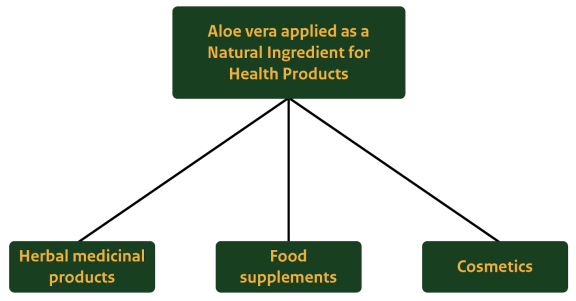
The requirements for the herbal medicinal product sector are stricter than those for food supplements. To understand the requirements you must meet, you have to know in which part of the market your ingredient is used.
Figure 1: The applications of aloe vera as a natural ingredient for health products
Source: ProFound, 2025
Specific requirements for herbal medicinal products
If your aloe vera ingredient is intended for use in herbal medicinal products, you must follow strict EU laws and pharmaceutical-grade quality standards. You can find these requirements in Directive 2004/24/EC, which applies to all herbal medicinal products sold in the EU.
To meet the requirements of this directive, exporters must comply with several technical and regulatory standards. One of these is the Good Agricultural and Collection Practices (GACP), which are required for raw aloe materials to ensure safe and sustainable cultivation or wild collection. Another is the Good Manufacturing Practices (GMP), which are required for aloe extracts or active substances used as starting materials in pharmaceutical products. The GMP ensure the identity, quality, safety and efficacy of medicinal-grade ingredients.
The European Medicines Agency (EMA) has also developed EU herbal monographs. They act as official references for many accepted ingredients in herbal medicinal products, including Aloe vera (L.) Burm.f.
These monographs include:
- The product’s botanical name, composition and dosage forms;
- Intended use and usage instructions;
- Target groups (for example, adults only, children over 12);
- Safety and preclinical data, such as side effects and potential drug interactions.
If your aloe format or derivative (for example, latex powder or a novel extract) is not covered by a monograph, you can apply for registration through the Traditional Herbal Medicinal Products Directive (THMPD). This is an easier way to register your product, but only if you can demonstrate at least 30 years of traditional medicinal use, including 15 years within the EU.
Tips:
- New natural ingredients for the European market must be registered for use as a traditional herbal medicinal product (THMP). If your species of aloe vera is not listed, you must comply with this procedure. Failure to comply will result in your inability to enter the European market. Check if your species of aloe vera is listed by searching for it in the EMA database.
- Visit the European Pharmacopoeia (Ph. Eur.) website, which is a reference for the quality control of medicines. It contains the official, legally mandatory standards you must comply with to enter the European market. The European Pharmacopoeia monographs outline how different species may be used in medicine, and you must comply with them.
Specific requirements for food supplements
If you are supplying aloe vera for use in food supplements, you must comply with all applicable EU food laws and safety regulations. Below is a list of the legal obligations every supplier of aloe vera for food supplements must comply with to market their aloe vera for use in food supplements:
- EU food supplement legislation: governs product composition and labelling.
- European General Food Law: ensures that all food products are safe for EU consumers.
- Hazard Analysis and Critical Control Points (HACCP): explains hygiene rules for food processing and handling.
- GACP: required for raw aloe plant materials.
- GMP: required for extracts or active ingredients used in finished supplements.
You must also follow rules on maximum residue levels (MRLs), food contaminants, microbiological contamination and traceability throughout the value chain. These rules are based on the ‘one step back, one step forward’ principle.
Although the use of aloe vera gels and extracts is allowed in food supplements in the EU, aloe latex is more strictly controlled due to its anthraquinone (aloin) content. This may pose health risks in high doses. For example, Italy allows aloe latex from multiple species, including A. africana, A. arborescens, A. ferox, A. perryi, A. plicatilis, Aloe vera (L.), A. barbadensis and A. chinensis. Germany permits only aloe vera gels and extracts, but not latex. No other aloe species is permitted in food supplements.
The BELFRIT list (used by Belgium, France and Italy) allows 6 aloe species and explains permitted forms for each. But it does not specify maximum aloin levels. Each EU member state can set its own aloin limits. Many European manufacturers choose decolourised aloe vera or forms with minimal aloin content to ensure compliance.
Under EU law, there are no authorised health claims for botanicals, including aloe vera. Most claims are either rejected or still classified as ‘pending’ by the European Food Safety Authority (EFSA). Companies often use authorised vitamin and mineral claims instead, to avoid regulatory disputes or misleading advertising.
Tips:
- Check the CBI study on buyer requirements for more information on mandatory and additional requirements for this sector.
- Avoid health claims, unless they are explicitly allowed under EFSA or national legislation. Focus on describing aloe’s traditional uses and botanical properties.
- Use aloe formats with low aloin content to reduce regulatory risk, especially when exporting to markets like Germany.
- Find out if there are any safety issues for your specific ingredient by checking the EFSA compendium of botanicals.
Protection of species and biodiversity
If you export aloe vera, you must comply with international agreements that protect biodiversity and ensure the sustainable and legal use of plant resources. For example, you must follow the Convention on International Trade in Endangered Species of Wild Fauna and Flora (CITES). This convention regulates the international trade of endangered plants and animals.
CITES is enforced in the EU under Regulation (EC) No 338/97, and aloe species are listed under CITES to prevent overexploitation. Depending on the species of aloe vera you export, it might be listed in Annex A, B or C. If it is listed in Annex A, this means international trade is prohibited. If it is listed in Annex B or C, you must apply for an export permit from your country’s CITES authority, and an import permit from the destination country.
In addition to CITES, you must follow the rules set by the Nagoya Protocol on Access and Benefit Sharing (ABS) under the Convention on Biological Diversity (CBD). These rules ensure that if you are using traditional knowledge or genetic resources, the benefits are fairly shared with the communities or countries of origin.
Tips:
- Visit the CITES website and review the information it provides, because certain aloe species require permits for trade as they are threatened by extinction. It will give you a better understanding of the mandatory requirements you must comply with to enter the European market.
- Use the CITES website’s National CITES Authorities tool to find contact points in your country.
- Visit the Species+ website, which is designed to help implement CITES and use its features. Doing so will help you comply with a mandatory requirement to enter the European market.
What additional requirements and certifications do buyers often have?
Apart from meeting mandatory legal standards, European buyers often require additional proof of quality, safety and professionalism. These requirements are not legally enforced, but they can decide whether a buyer will work with you. Meeting these expectations helps you build trust, access premium buyers and compete more effectively in the European market. This section covers the most common additional requirements aloe vera exporters must meet when it comes to quality, labelling, packaging, payment terms and delivery.
Quality requirements
European buyers expect high and consistent quality when sourcing aloe vera for food supplements and herbal medicinal products. Meeting strict quality and food safety standards not only helps you comply with EU regulations, but also makes your business more competitive.
Quality goes further than appearance alone, and buyers want aloe with a specific composition and chemical profile, including:
- Defined levels of active compounds (for example, aloin or acemannan);
- Low moisture content for powders or dried formats;
- Minimal levels of contaminants or pesticide residues.
Table 1: Key quality and food safety standards for aloe vera exporters
| Standard | Full name | Relevance |
|---|---|---|
| ISO 9001:2015 | International Standard for Quality Management Systems | Essential for exporters supplying herbal medicinal products |
| ISO 22000 | Food Safety Management System | Global food safety system, relevant for aloe vera used in food supplements |
| FSSC 22000 | Food Safety System Certification | Builds on ISO 22000, tailored to food manufacturers |
| IFS Food 7 | International Featured Standards – Food | Focuses on food safety and quality of processes and products |
| BRCGS | British Retail Consortium Global Standards | Used by large retailers to ensure supplier safety and regulatory compliance |
Source: ProFound, 2025
There are also aloe-specific quality certifications. The International Aloe Science Council (IASC) has developed the IASC Aloe Vera Quality Standard for aloe raw materials used in finished products. Meeting this standard shows buyers that your aloe vera meets recognised international quality benchmarks.
Tips:
- Consider joining IASC, review its certification programme and consider meeting its requirements for the IASC Aloe Vera Quality Standard.
- See the CBI study on buyer requirements for natural health products. It provides guidance on quality requirements for natural health products.
Labelling requirements
Labelling your products for export is mandatory. It is especially important for traceability and safety purposes during transport and storage. Use English on your labels, unless your buyer has asked for a different language. You can usually find this information in the technical data sheet.
Generally, you should include the following labelling information in the technical data sheet:
- Name of product;
- Quantity;
- Batch number/lot number;
- Expiry date;
- Certification.
If you supply organic ingredients, your label needs to include the name and code of the inspection body and certification number. Mark all containers with a batch number and enter each batch into a record-keeping system. This ensures traceability in case of food safety audits or complaints. If you are selling in bulk to manufacturers, make a digital label template and documentation package. These should include a technical data sheet, safety data sheet and certificate of analysis for easy integration into their systems.
Tip:
- See the labelling of foodstuffs section under the labelling and packaging guidelines section on the International Trade Administration’s EU Country Commercial Guide page for an overview of labelling and marking requirements you must comply with.
Packaging requirements
European buyers expect high-quality aloe vera, and your packaging plays an important role in maintaining quality. Although packaging requirements might differ from buyer to buyer, you can follow these basic guidelines to meet the expectations of most buyers:
- Choose containers that do not react negatively with aloe vera. Good examples are aluminium, lacquered or lined steel, and stainless steel. This is important because reactive materials can change the composition and reduce the quality of your product.
- Always use clean and hygienic packaging to avoid contamination. Dirty or unsterile containers can introduce bacteria and lower the quality of your aloe vera.
- If you supply both organic and conventional aloe vera, make sure they are clearly separated and packaged independently to maintain their integrity and certification status.
Tips:
- Consider recycling or reusing packaging materials. Environmental sustainability is becoming increasingly important for European buyers.
- Only agree to meet specific packaging requirements that European buyers have if you can meet them. Failure to do so could end your business relationship with them.
Payment terms
Payment is one of the most important parts of international trade. As an aloe vera exporter, you need to protect yourself while also offering terms that meet the expectations of European buyers. Before agreeing to any trade terms, check the risks of different payment options. Consider:
- The reliability of your buyer;
- The size of the order;
- Your cash flow needs;
- Political and economic stability in your country and the buyer’s country.
A Letter of Credit (LC) is one of the safest payment methods for both parties. It involves a neutral third party, usually a bank, that guarantees payment if you meet the agreed shipping terms. For new trading relationships, a standby LC is often the best choice. It offers strong security for both parties.
Tips:
- Ask your bank or a trade advisor to help you choose the right payment type based on your needs.
- See the CBI study on organising your export of natural ingredients for health products to Europe for more information about the available payment terms in the sector.
Delivery terms
Meeting delivery expectations is extremely important when doing business with European buyers. If you do not meet agreed terms (whether for timing, volume or cost), this can damage or end your trading relationship. Talk to your buyers about their preferences and priorities. Some may accept slower delivery for a lower price. Others will pay more for speed and reliability.
Table 2: Key factors influencing the type of freight chosen
| Factor | Air freight | Sea freight |
|---|---|---|
| Delivery time | Fastest option, reliable for time-sensitive deliveries | Slower, can take several weeks depending on the destination |
| Delivery volume | More suitable for small shipments; cost per kg is higher | More economical for large shipments due to lower cost per unit |
| Cost of shipping | Higher cost overall, especially for bulk orders | 4–6 times cheaper for large volumes |
| Best use case | Small, high-value or urgent shipments | Bulk orders, dried aloe powder or extract |
Source: ProFound, 2025
Tips:
- Use the Freightos freight calculator to get instant international freight rate price information for shipping by sea and air. Doing so will allow you to make a more informed decision before agreeing on delivery terms with buyers.
- See the CBI study on organising your export of natural ingredients for health products to Europe. It provides guidance on the payment terms used in this sector.
What are the requirements for niche markets?
Niche markets in Europe offer higher prices and stronger buyer loyalty, but they require additional certifications and proof of ethical practices. These markets include organic, fair trade, and sustainably sourced aloe vera. While not legally mandatory, certifications in these areas help you access premium buyers, stand out from competitors, and align with European consumer values around health, sustainability, and social responsibility.
Organic, fair trade and other certifications
More and more buyers are looking for natural health products that are ethically sourced and organically certified. Demand for organic ingredients is still growing, and aloe vera exporters who can meet these expectations are more likely to access high-value buyers. To market aloe vera as organic in Europe, you must meet EU organic certification standards. These standards ensure that products are grown without synthetic pesticides or fertilisers, and that they comply with strict traceability and labelling requirements. You can find more information on the IFOAM Organics Europe website.
Apart from organic certification, many buyers also prioritise certification that demonstrates fair trade, ethical sourcing and social responsibility. These certifications show buyers that you care about your environmental impact, labour practices and biodiversity. Below is a summary of some of the most important certifications for aloe vera exporters.
Table 3: Key certifications for aloe vera exporters
| Certification | Type | Estimated cost | How to get certified |
|---|---|---|---|
| EU Organic | Organic certification | Varies by scale, set-up and product complexity | Check EU Regulation 2018/848; see EU Control Bodies List. |
| FairWild | Sustainability for wild-harvested plants | Based on location, size, inspection and complexity | Visit FairWild.org; check the list of approved certification bodies and fees. |
| Fairtrade International | Social sustainability | Use the FLOCERT calculator for cost estimates | Learn how to become certified on the Fairtrade website. Certification is usually valid for 1-2 years. |
| Fair for Life | Social sustainability (wild and cultivated) | Based on operation size, location and complexity | Visit Fair for Life. Certification is reviewed annually. |
| UEBT | Ethical sourcing and biodiversity | Based on certification type (sourcing, ingredient or programme participation) | See the UEBT website for certifiers and programme information. |
Source: ProFound, 2025
Tips:
- If you have organic aloe vera, make sure you have a Certification of Inspection (COI), which proves your aloe vera is organic. This gives you an advantage when entering the European market. Inform your prospective buyers if you already have a COI. Make sure you have a COI that is up to date with the latest changes made by the EU, which came into force on 3 February 2020. This is a mandatory EU requirement if you want to trade organic aloe vera on the European market.
- For a full overview of certification schemes in the sector, consult the ITC Sustainability Map.
2. Through which channels can you get aloe vera on the European market?
There are several ways to enter the European market for aloe vera. This section outlines the main market channels, including importers, agents, and direct export of finished products. It also explains how aloe vera is segmented by end use, helping you identify the most suitable buyers for your product.
How is the end-market segmented?
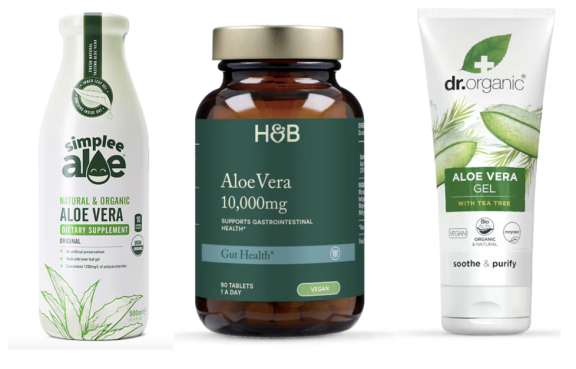
The European market for aloe vera can be divided by end-user industry: food and beverage products, health products and cosmetics.
Figure 2: Examples of health products containing aloe vera
Source: ProFound, 2025
Table 4: End-market segmentation for aloe vera
| Food and beverages | Health and wellness | Cosmetics |
|---|---|---|
| This segment includes aloe vera for health drinks, smoothies, detox and yoghurts. This example from Simplee uses the inner leaf for digestion purposes. | Aloe vera is widely used as a functional food or nutritional supplement in tablets, drinks and oral supplements (gummies). It is valued for its ability to support gut health and digestion. | Aloe vera is often used in gels, creams and lotions for its soothing, hydrating and anti-inflammatory effects on the skin. |
| Example: Simplee organic aloe vera juice from Holland & Barrett (UK) | Example: Holland & Barrett aloe vera tablets | Example: Dr. Organic aloe vera gel from Holland & Barrett (UK) |
Source: Simplee, Holland & Barrett and Dr. Organic, 2025
Understanding the format and application of aloe vera helps exporters tailor their offering:
- Formats: Decolourised inner leaf gel is used in capsules and drinks, powder is common in supplement blends, and latex is restricted to medicinal use.
- Applications: Aloe is valued for digestive support, inflammation reduction and antioxidant benefits. Its versatility also makes it suitable for weight management and detox products.
Tips:
- See the CBI study Which trends offer opportunities or pose threats on the European natural ingredients for health products market? for useful information about the European health product segment.
- Visit trade fairs to test if the industry is open to your product, get market information and find potential buyers. They will also give you the chance to speak to end-users and distributors, and to gauge your competition, especially the way they are marketing their products. See the CBI study 7 tips for finding buyers in the natural ingredients for health products sector for an overview of trade fairs in this sector.
- Read CBI’s study on exporting natural ingredients for digestive health products to Europe.
Through which channels does aloe vera end up on the end-market?
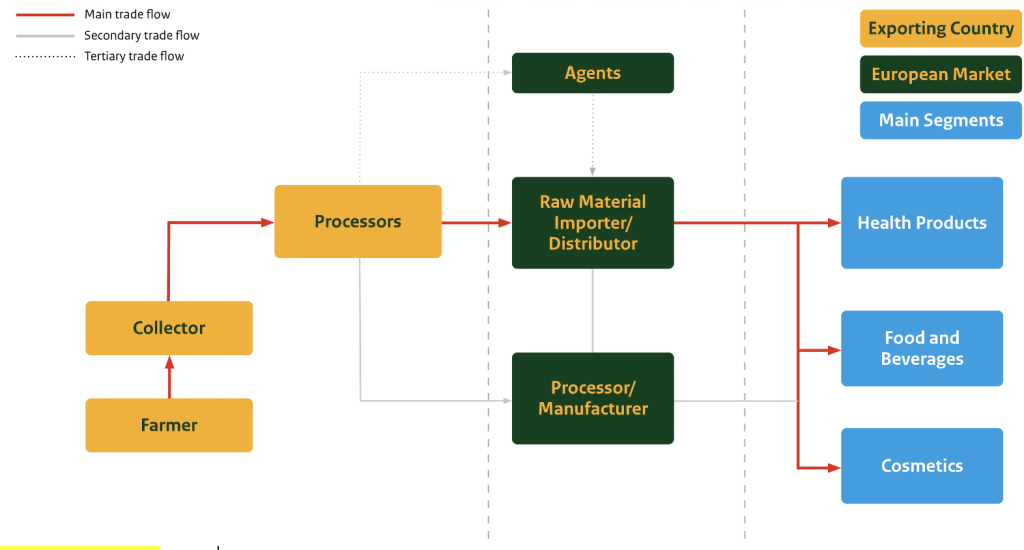
To enter the European aloe vera market, exporters can use several channels. Importers/distributors are the most common partners, because they manage compliance, quality and buyer connections. Agents play a smaller role but can help new exporters navigate the market. In some cases, processors will export ingredients or finished products directly. Choosing the right channel depends on your capacity, certification and market strategy.
Figure 3: Export value chain for aloe vera
Source: ProFound, 2025
Raw material importer/distributor
Most European importers handle hundreds of ingredients at a time and specialise in sourcing a wide range of natural ingredients, including aloe vera, from around the world. The most important responsibilities of raw material importers/distributors include ensuring regulatory compliance, verifying documentation and maintaining high-quality standards. They supply aloe vera to manufacturers of food supplements and cosmetics, functional foods and natural health products.
More and more consumers demand ethical sourcing and supply chain transparency. This is why importers are now working closely with their aloe suppliers to make sure that all documentation and origin claims are checked.
Working with an importer offers several advantages. For example, they:
- Conduct independent laboratory testing to check the quality and safety of your aloe vera;
- Manage all documentation, including product specifications, certificates and compliance records;
- Keep accurate records of every batch and ingredient they import;
- Have access to big customer networks, so forming a partnership can help find long-term buyers.
Leading aloe vera importers in Europe include Gustav Heess (Germany), Dr. Behr (Germany), Aplantis (Germany) and Forward Farma BV (Netherlands). Others, such as BioImport, specialise in certified organic aloe vera and cater specifically to Europe’s growing natural health product segment. Building relationships with importers and distributors is essential for entering and growing in the European aloe vera market.
Agents
An export agent is an individual or company that manages export activities on behalf of an exporter. They usually get paid a commission to do this. Agents can help you find buyers, negotiate deals and manage logistics, and act as your representative in the European market. While some agents are based in developing countries, others operate directly in Europe. But the use of agents in the European aloe vera market is relatively limited. Most buyers prefer to work directly with exporters or importers who can guarantee quality and compliance.
Still, working with a trusted agent can be helpful, especially if you are new to exporting and need support navigating the European market. Agents can provide valuable market insights, facilitate introductions and help you meet buyer expectations around documentation, packaging and regulations.
Other channels
Some companies process and export aloe vera themselves, maintaining control over quality and traceability. For example, Interagro Aloe supplies organic aloe vera directly from their farm in Mexico. Others, such as Shivalik Herbals in India, also supply finished aloe vera health products directly to European retailers.
Tips:
- Be prepared to send high-quality samples to prospective buyers, who will test them to assess whether you are a credible exporter of aloe vera. It is standard procedure to request samples in the natural health product sector. Being prepared to do so gives you an advantage when you are looking to enter the European market.
- Be prepared to meet prospective buyers who are interested in directly sourcing aloe vera from you if you can supply large volumes.
What is the most interesting channel for you?
As an exporter of aloe vera from a developing country, importers/distributors are the most interesting channel for you. This is because importers have expertise in importing and distributing aloe vera on the European market, a good understanding of the European health products market and a wide range of customers. European importers also have storage facilities and an established logistics network. This can be very helpful to you as a small or medium-sized exporter of aloe vera from a developing country.
Tip:
- See the CBI study 7 tips for finding buyers in the natural ingredients for health products sector for useful information and guidance on finding buyers in channels that allow you to enter the European market. Focus on importers/distributors, as they are your main entry point into the European market.
3. What competition do you face on the European aloe vera market?
Competition in the European aloe vera market is strong. China and India are dominating supply, Vietnam shows rapid growth, and Mexico is building on its organic reputation. Brazil’s exports remain modest, and Morocco has lost ground.
Figure 3 shows that the export value of vegetable saps and extracts imported by the EU from developing countries has grown over the last 5 years. In 2024, total imports from developing market economies reached a value of €459.3 million. This was a 49% increase compared to 2020. This reflects strong and rising demand for plant-based extracts.
Source: ITC Trade Map, 2025
Figure 5 shows that China and India are still the leading suppliers, with 10,425 metric tonnes and 5,339 metric tonnes, respectively. Other suppliers included Brazil, Vietnam, Mexico and Morocco.
Source: ITC Trade Map, 2025
Table 5: Key figures on vegetable sap exports (HS 130219) from selected countries to Europe, 2020-2024
| Country | Value in 2024 (million €) | % change in value (2020-2024) | Volume in 2024 (metric tonnes) | % change in volume (2020-2024) |
|---|---|---|---|---|
| China | 263.4 | 84.1 | 10,425 | 99.6 |
| India | 84.5 | 79.1 | 5,339 | 224.4 |
| Brazil | 8.1 | 17.2 | 3,238 | 4 |
| Vietnam | 22.9 | 7,889.2 | 518 | 10,260 |
| Mexico | 12.1 | 56 | 233 | 18.3 |
| Morocco | 11.5 | -57.4 | 138 | -64.5 |
Source: ITC Trade Map, 2025
Which countries are you competing with?
China, India, Brazil and Vietnam compete on aloe vera exports to the EU by offering affordability and established networks. They also benefit from growing demand for organic, ayurveda and clean-label products, although processing capacity and consistency differ.
China
Spain, Germany and the Netherlands were China’s top 3 EU destinations, respectively accounting for €57 million, €47 million and €38 million in exports. Together, they represented 54.3% of China’s EU export value. These countries prefer Chinese aloe because it is affordable and the supply is consistent. The Netherlands stands out as a re-export hub. Spain is still a key end-market for aloe-based drinks and cosmetics, supported by local formulation and private-label activity.
India
India’s top EU destinations were Germany (€22 million), Italy (€17 million) and France (€8 million). Together, they made up 58.1% of India’s total aloe vera export value to the EU. India’s growth reflects rising interest in organic and ayurveda-linked aloe products. It is attractive because of competitive pricing and established farming networks. This is especially true for processed formats like powders and gels used in supplements and cosmetics.
Brazil
Spain (€2 million), Germany (€2 million) and Italy (€700,000) were Brazil’s top 3 EU buyers. Together, they made up around 71% of EU export value. While total volume remains modest, Brazil is well-positioned because of its focus on clean-label, non-GMO ingredients. Still, being reliant on bulk aloe exports and vulnerability to price shifts pose risks. Most aloe exports are still raw or minimally processed. This limits Brazil’s value capture in premium European segments.
Vietnam
The Netherlands (€14 million), Italy (€7 million) and Spain (€97,000) were Vietnam’s biggest EU destinations. The Netherlands and Italy made up 98.9% of the country’s EU export value. Vietnam’s exports have grown rapidly, probably because of its low-cost production and new commercial partnerships. But the country’s export volumes often go up and down, with big changes from one year to the next. To keep up the good work, suppliers need to demonstrate consistent quality, food safety and traceability to build trust with European buyers.
Tip:
- Find out if your country has programmes helping exporters harvest, cultivate, process and/or export aloe vera. You can do this by contacting the government ministries of trade in your country. They sometimes help you export aloe vera.
Which companies are you competing with?
Several aloe vera suppliers from developing countries show strong market positioning through quality certifications, transparent communication and a professional online presence.
Chinese companies
China has a highly developed e-commerce and B2B marketplace landscape. Many aloe vera suppliers list their products on platforms like Made-in-China. This approach makes it easy for buyers to compare suppliers, review product specifications and certifications, and place bulk orders. Many of the suppliers on this platform are verified and audited. This gives international buyers more confidence. Examples include Hangzhou Kindherb Biotechnology Co., Shengchuan Biochem Co. and Hubei Sanxin Pharmaceutical Technology Co.
Indian companies
Aryan International is a well-known Indian supplier of ayurvedic and botanical extracts, including aloe vera. One of its key strengths is its professional presentation. On its homepage, the company prominently displays its major certifications, such as BRC, FSSC 22000, Non-GMO and EU Organic. It also highlights its social impact. One example is a training school where children are taught to grow organic vegetables. This helps to build trust with buyers who value ethical sourcing and community development. Herbal Creations markets its aloe vera products as 100% natural, with shelf lives of up to 3 years. The company provides aloe vera in bulk formats such as 25-40 kg units or HDPE drums. This makes it easier for buyers to plan production. Its downloadable product brochure includes all relevant certifications (ISO, HACCP and SGS-audited), and clear information on application areas. This transparency helps reassure buyers about product quality and safety.
Brazilian companies
Sinaloina offers aloe vera in multiple formats, including gel, powder, spray-dried and pulp. These products can be used in food, cosmetics, medicines and supplements. The company provides comprehensive technical data sheets and material safety data sheets for each product format on its website. This detailed technical documentation helps buyers quickly check product specifications and regulatory compliance for their specific applications.
Vietnamese companies
PEROMA is a Vietnamese manufacturer with over 20 years of experience in flavours, fragrances and natural ingredients. The company offers aloe vera powder in 25 kg drums, with a minimum order quantity of 10 kg, suitable for food applications. PEROMA highlights key certifications on its website, including ISO 9001:2015, FSSC 22000, Kosher, Halal and ISO 13485:2016. It also has a special CSR section about initiatives in employee development, environmental commitment and raw material quality. This is how they show their transparency and responsible business practices.
Tips:
- Consider obtaining certification like International Aloe Science Council, ISO 2200:2018, Good Manufacturing Practice, or British Retail Consortium Global Standard for Food Safety certification, which proves the high quality of your aloe vera. You should also consider following HACCP guidelines.
- Consider acquiring certification that proves you meet and uphold organic, social and environmental standards. Examples include EU Organic, Ecocert Organic, Ecocert Fair Trade, Fairtrade, Fair for Life and Fair Wild certification. Doing so will give you an advantage when you are looking to enter the European market.
Which products are you competing with?
In the European health products market, aloe vera competes with several natural ingredients, especially ginger, ginseng and turmeric. These ingredients offer similar health benefits and are often chosen for their anti-inflammatory, digestive or immune-supporting properties.
Ginger
Ginger is used in digestive and immunity supplements. It is known for its anti-inflammatory and nausea-relieving effects, and you can find it in capsules, functional drinks and oral care products. Consumer interest rose sharply during COVID-19 and is still strong. Products like Mother Root’s non-alcoholic ginger aperitif and Finca Canaria’s natural toothpaste with aloe vera and ginger show how these ingredients are used together for complementary benefits. India dominates global production, but concerns about pesticide residues have pushed buyers towards Nigeria, China and Indonesia.
Figure 6: Example of a ginger product on the European market
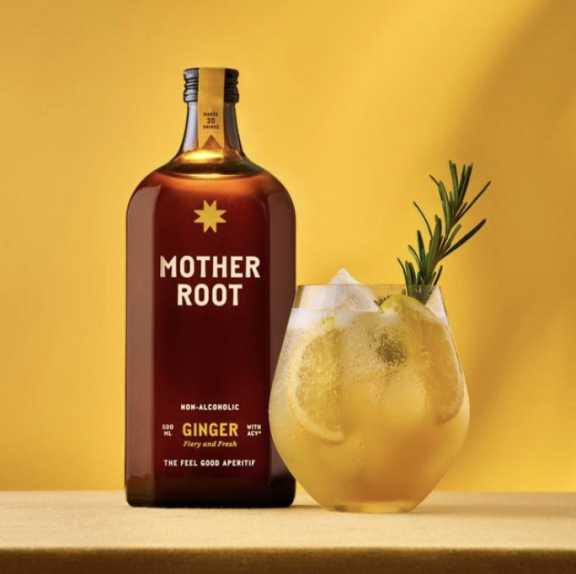
Source: Mother Root, 2025
Ginseng
Ginseng is valued as an adaptogen that helps the body manage stress and restore balance. It appeals to consumers who are looking for cognitive performance and resilience support. Products like London Nootropics’ mojo adaptogenic coffee containing Siberian ginseng demonstrate the ingredient’s positioning in the mental wellness field. Although it is less familiar to European consumers than aloe vera, ginseng’s science-backed benefits give it strong potential in premium supplement categories.
Figure 7: Example of a ginseng product on the European market
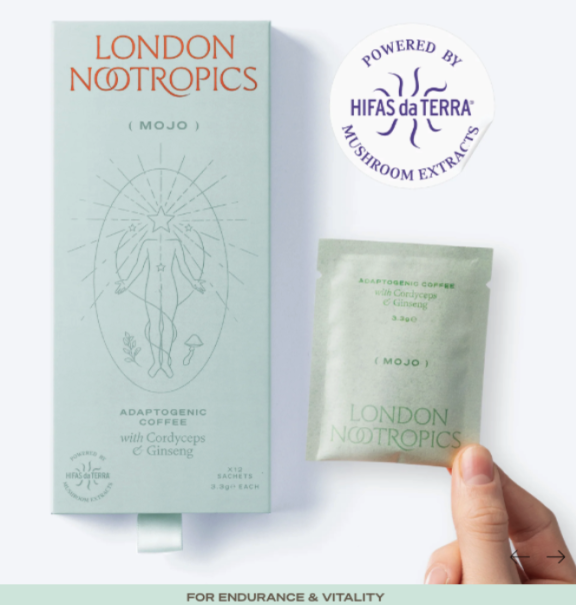
Source: London Nootropics, 2025
Turmeric
Turmeric is a big competitor. It is valued for its anti-inflammatory and antioxidant properties driven by curcumin. It is commonly used in capsules, tablets and functional foods, often combined with ginger and black pepper for enhanced absorption. Products like Nutrition Geeks’ turmeric tablets (95% curcumin extract) show demand for high-potency, standardised formulations. Turmeric is grown in Peru, Madagascar, Thailand, Costa Rica and Vietnam. Adulteration concerns from some Indian suppliers are still an issue.
Figure 8: Example of a turmeric product on the European market
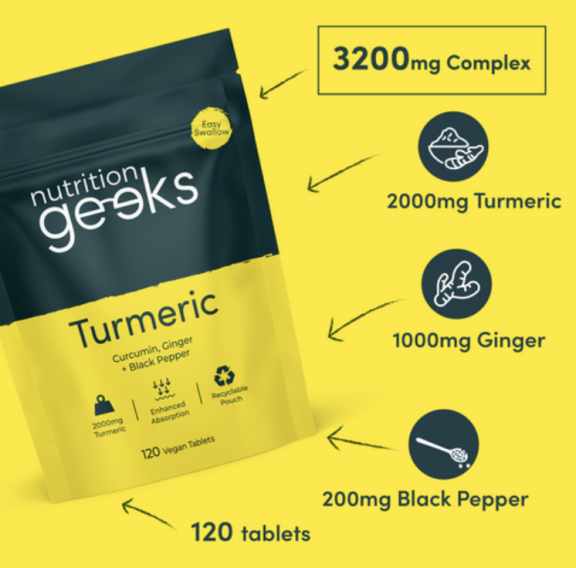
Source: Nutrition Geeks, 2025
Table 6: Comparison of aloe vera and its key competitors
| Ingredient | Key health benefits | Main applications | Notable product example |
|---|---|---|---|
| Aloe vera | Digestive health, skin support, anti-inflammatory and immune modulation | Supplements, functional drinks, oral care, skin care | Fushi organic aloe vera juice |
| Ginger | Anti-inflammatory, blood sugar-lowering, nausea relief and gut health | Capsules, functional drinks, powders, oral care | Mother Root non-alcoholic ginger drink |
| Ginseng | Adaptogenic (stress relief), cognitive performance and immune support | Adaptogenic drinks, capsules and focus-enhancing blends | London Nootropics mojo coffee (with Siberian ginseng) |
| Turmeric | Anti-inflammatory, antioxidant, immune support, joint and liver health | Capsules, tablets, powdered blends, functional foods | Nutrition Geeks turmeric tablets (95% curcumin) |
Source: ProFound, 2025
Tips:
- Position yourself against competing products by highlighting your company and aloe vera’s strengths. For example, highlight its high quality, which you can prove through certification. You can find various studies comparing the properties of aloe and other alternative products.
- Build a marketing story for your aloe vera which places emphasis on its key strengths. Natural & Organic Farms Mexico is a Mexican company that does this well, clearly informing prospective buyers about its aloe vera strengths.
4. What are the prices of aloe vera on the European market?
For exporters, understanding price drivers is essential for competitive positioning and risk management. Here are the most common factors influencing aloe vera prices on the EU market:
- Concentrated supply: weather events, limits on processing capacity and regulatory changes in these supplier countries can cause big price disruptions. New suppliers like Vietnam and Mexico offer diversification opportunities, although their smaller volumes mean they have limited impact on overall market stability.
- Demand for natural and organic: European buyers pay higher prices more often for organic-certified aloe vera products. Countries like Mexico use EU Organic and Ecocert certification to ask for higher prices, and Indian suppliers capitalise on ayurveda-linked organic products.
- Quality and processing format premiums: fresh aloe vera leaves can get different prices than processed formats like powders, gels or IQF cubes. Vietnamese supplier Nafoods’ IQF aloe vera cubes target higher pricing through innovation, and bulk powder formats compete mainly on cost. Processing capabilities and food safety compliance have a big impact on pricing power.
- Sustainability and certification premiums: IASC certification, EU Organic, GLOBALG.A.P., and Fairtrade certifications usually get 15-35% price premiums.
- Market volatility and emerging suppliers: Vietnam’s dramatic growth from €287,000 to €22.9 million (2020-2024) shows how quickly new suppliers can disrupt pricing. Morocco’s drop from €27 million to €11.5 million also shows how quickly market positions can change.
Retail and bulk prices for aloe vera extract in Europe vary widely depending on origin, quality, and whether the product has organic or other sustainability certifications.
Table 7: Retail and bulk aloe vera extract prices in the European market
| Company | Product and origin | Volume | Price (€) | €/kg (or L) | Notes |
|---|---|---|---|---|---|
| Dragonspice (Germany) | Organic Aloe Vera Powder 200:1 – origin not specified (organic) (wholesale) | 1 kg | 299.30 | 299.30 | EU organic; highly concentrated (200×); reconstitutes to gel/juice; ~€1.5/kg finished gel equivalent. |
| CODE OILS (France) | Aloe Vera Gel (cosmetic) – likely sourced from Spain/Mexico (wholesale) | 5 kg | 170.00 | 34.00 | Cosmetic grade; bulk pricing scales down to ~€14/kg at 200 kg; compliant with EU cosmetic standards. |
| YouWish (Netherlands) | Aloe Vera Gel Base – cosmetic, origin not specified (wholesale) | 5 kg | 59.95 | 12.00 | Ready-to-use base for cosmetics; paraben/silicone-free; mix-in up to 1% active; 2–3 year shelf life. |
| Gran Velada (Spain) | Pure Aloe Vera Gel (juice) – sourced from Spain (wholesale) | 20 kg | 221.40 | 11.10 | 99.7% pure aloe juice with minimal preservatives; cosmetic ingredient; economy bulk format. |
| Naissance (UK) | 99% Aloe Vera Gel – aloe grown in Spain, processed in the UK/EU (wholesale) | 5 kg | 46.33 | 9.26 | Vegan, cruelty-free; farm-to-shelf traceability; contains mild stabilisers; widely used by formulators. |
| Tenuta degli Eremi (Italy) | Pure Organic Aloe Vera Gel – farm-grown in Italy (wholesale) | 5 kg | 38.00 | 7.60 | Farm-direct organic gel; no additives/preservatives; perishable, requires refrigeration; local Italian source. |
Source: ProFound, 2025
Tips:
- Use commercial platforms like Tridge that offer real-time commodity prices and market analysis.
- Take a look at the products above and ask yourself: what allows these suppliers to charge a certain price? Does it have to do with certification, traceability, quality or documentation?
- Search for “aloe vera extracts wholesale suppliers Europe” on Google to find wholesale websites.
ProFound – Advisers In Development carried out this study on behalf of CBI.
Please read our market information disclaimer.
Search
Enter search terms to find market research