
8 tips on how to reduce carbon footprint in the coffee sector
Reducing greenhouse gas emissions is becoming a competitive requirement in international coffee markets. Many European buyers have committed to zero carbon emission targets by 2030 and 2050. For most of these companies, supply chain emissions make up the largest share of their carbon footprint. This means that progress toward their targets depends largely on actions taken at farm and processing level.
Contents of this page
- Understand what carbon footprint is and how emissions are categorised across the coffee value chain
- Measure and share your carbon footprint
- Identify your biggest emission hotspots
- Reduce your carbon emissions
- Comply with legal requirements
- Join certification and buyer programmes to reduce emissions and meet buyer expectations
- Access carbon finance
- Learn from successful low carbon programmes
1. Understand what carbon footprint is and how emissions are categorised across the coffee value chain
A carbon footprint shows how much greenhouse gas is produced. Greenhouse gas is measured in metric tonnes of carbon dioxide equivalent (CO2e). The coffee supply chain contributes about 135–178 million tonnes of CO2e annually. This is 1% of global food sector emissions. Research shows a wide spectrum of carbon footprint values for coffee. These values range from 0.38 to about 15.33 kg CO2e per kg of green coffee, depending on origin, processing type and supply chain scope (see Table 1 for examples).
Table 1: Carbon footprint of coffee across origins and processing systems (kg CO2e per kg)
| Origin | Processing type | CF (kg CO₂e/kg) | Main emission driver |
|---|---|---|---|
| India | Dry (Robusta), local value chain (farm → processing → local roasting and grinding) | 0.62 | Roasting (78%) |
| India | Dry (Robusta), export to Europe (farm → processing → export) | 0.38 | Sea transport (66%) |
| Costa Rica | Full value chain including European roasting, packaging, distribution, consumption and disposal | 4.82 | European roasting (3.05 kg CO₂e) |
| Brazil/Vietnam (sustainable) | Certified and improved practices (Rainforest Alliance, 4C), reduced fertiliser use, improved waste management, export to Europe | 3.51 | Fertiliser use and transport |
| Brazil/Vietnam (conventional) | Conventional Arabica production with high synthetic fertiliser use, limited waste treatment, standard processing and transport | about 15.33 | Synthetic fertiliser (N₂O emissions) |
Source: Iglesias et al., (2025)
To manage carbon footprint effectively, you need to speak the same ‘carbon language’ as your buyers. Almost all big coffee companies in Europe measure and report emissions using the Greenhouse Gas (GHG) Protocol, which divides emissions into three main categories: Scope 1, Scope 2 and Scope 3. For example, JDE reported their Scope 1, 2 and 3 emissions in their 2024 report.
Table 2 presents an example of reporting Scope 1, Scope 2 and Scope 3 emission categories by European coffee companies. For most companies, Scope 3 – which is not their direct emission – represents the largest share (>80%) of their total carbon emissions. These Scope 3 emissions mainly occur at farm level (fertiliser use, land-use change, soil emissions), during processing at origin, during international shipping and logistics, and in production of packaging.
This is why your buyers request farm-level and processing data from you more and more often.
Table 2: Example of Scope 1, Scope 2 and Scope 3 emission categories for European coffee companies
| Scope | Definition (GHG Protocol) | Coffee sector examples (Europe-based company) | Who reports it? | Data sources |
|---|---|---|---|---|
| Scope 1 | Direct emissions from sources owned or controlled by the company. |
| The European coffee company (roaster, trader, retailer). | Fuel receipts and fleet management logs. |
| Scope 2 | Indirect emissions from purchased energy (electricity, heat, steam, cooling). |
| The European coffee company. | Utility bills from energy providers. |
| Scope 3 | All other indirect emissions across the value chain (upstream and downstream). |
| The European coffee company reports Scope 3, but relies on data from suppliers (farmers, cooperatives, exporters, logistics providers). | Supplier reports, farm-level data and shipping invoices |
Source: Various sources including Greenhouse Gas Protocol, Corporate Accounting and Reporting Standard and Carbon Collective Climate Smart, adapted for a European coffee company.
Understanding this structure is the foundation to help you support your buyer in reporting their Scope 3 emissions. If an EU buyer wants to reduce their Scope 3, they will ask you, the cooperative or exporter, to improve your practices and reduce your footprint. For cooperatives and exporters, Table 3 provides a cooperative- or exporter-level emission reporting structure that can help you organise your own emission data for your buyers.
Table 3: Example of Scope 1, Scope 2 and Scope 3 emission categories for coffee cooperatives (aggregators only) and exporters
| Scope | Definition | Coffee sector examples | Who reports it? |
|---|---|---|---|
| Scope 1 | Direct emissions from activities you control |
| Cooperatives, exporters, or farmers who own vehicles/equipment |
| Scope 2 | Indirect emissions from purchased energy |
| Any organisation that buys electricity (cooperatives, exporters, offices) |
| Scope 3 | All other indirect emissions across the supply chain |
| Exporters and cooperatives (largest share, often >80% of total footprint) |
Source: Greenhouse Gas Protocol adapted for an exporter
Note that for cooperatives that own or operate coffee farms, emissions from fertilisers and pesticides are Scope 1 (direct emissions). For coffee bought or aggregated from farms you do not manage, these emissions are Scope 3 (supply chain emissions). See Table 4 for examples.
Table 4: Fertiliser and pesticide emissions categorised for farmers, cooperatives and exporters
| Actor | Owns/controls land & applies inputs | Fertiliser & pesticide emissions category | Scope 1 or Scope 3? |
|---|---|---|---|
| Farmers | Yes: they directly farm the land | Direct soil emissions (N2O from fertiliser, pesticide degradation) | Scope 1 (direct process emissions) |
| Cooperatives | Depends:
|
|
|
| Exporters | Usually no: they buy crops from farmers | Emissions from fertiliser/pesticide use happen upstream in supply chain | Scope 3 (purchased goods & services) |
Source: Greenhouse Gas Protocol adapted for an exporter
Thinking in these three scopes helps you organise your data collection and understand who is responsible for what. It also allows you to focus improvement efforts where they will have the biggest impact.
Tips:
- Train your staff as an exporter on basic carbon concepts. Make sure managers and field officers understand the difference between Scope 1, 2 and 3 so they can respond correctly to buyer questions.
- Create a simple emissions map by drawing your supply chain on paper and listing which activities belong to each scope (example, farm inputs, transport, processing energy, etc.).
2. Measure and share your carbon footprint
You cannot reduce your emissions if you do not measure them. Start estimating your carbon footprint using the data you already have. You do not need perfect data at the beginning. What matters is to start simple and improve over time.
Use recognised methods
Use methods that your buyers already trust. As already mentioned, most European companies follow the Greenhouse Gas (GHG) Protocol, which groups emissions into Scope 1, Scope 2 and Scope 3. Align your data with this structure so your buyers can understand your emission sources easily and use it in compiling their supply chain emissions report.
To calculate the footprint of a specific product, such as kilograms of CO2e per kilogram of green coffee, most credible approaches are based on life cycle assessment (LCA) methods aligned with ISO 14040 and ISO 14044 standards.
These standards provide clear rules on how to define system boundaries, collect data and present results in a transparent way. Another commonly referenced specification is PAS 2050, which gives you practical guidance on how to measure life-cycle greenhouse gas emissions of goods and services.
Use practical tools
You can use tools to make carbon measurement easier. The widely used Cool Farm Tool allows you to estimate emissions based on real farm data such as fertiliser use, yields and energy consumption.
You can also work with service providers if your system becomes more advanced. Other source and service providers that can help you estimate your carbon footprint are Quantis, South Pole, Carbon Roots and Carbon Trust. But the most important principle is consistency. Choose one main method and apply it year after year, improving data quality as you grow.
Start with the data you already have
In reality, you already collect a large share of the required data. Typical information you need for basic carbon foot printing includes:
- Farm size and annual coffee yields;
- Quantities of fertilisers and agrochemicals used;
- Fuel and electricity consumption at processing sites;
- Type of processing and drying methods;
- Transport distances and modes or routes;
- Basic land-use history;
- Soil and residue management practices.
You do not need perfect data from day 1. What matters most is to begin with available information, document assumptions clearly and improve accuracy over time. Consistent, transparent estimates are usually better and more informative to buyers than one-off reports based on incomplete data. If data quality is still limited, be honest about this and present a plan for improvement.
Over time, transparent communication about progress can strengthen your long-term relationships. Many buyers are willing to support suppliers with training, tools and technical assistance.
Build systems for continuous improvement
Carbon measurement is not a single exercise but an ongoing process. As your data systems mature, you can gradually move from rough estimates to more detailed and reliable calculations. This may involve:
- Introducing digital record-keeping at farm level;
- Training field staff on data collection;
- Standardising input records across member farmers;
- Installing energy meters at processing facilities;
- Improving traceability systems to link data to specific farms.
You can seek third-party verification once your systems are more advanced. Independent audits aligned with ISO 14044 or similar standards can add credibility, especially when working with large international buyers or applying for sustainability programmes.
Share data transparently and regularly
Measured emissions only create value when your information is shared in a clear and consistent way.
The most effective approach is to agree openly with your main buyers on:
- What data you will provide (such as farm practices, inputs, yields, energy use, traceability information);
- How often you will update it (often once per year);
- How you plan to improve data quality over time.
Use simple but structured formats, such as spreadsheets, traceability platforms or recognised reporting systems, which can make it easier to respond quickly to buyer requests.
Tips:
- Start using the Cool Farm Tool to measure carbon by creating a free account.
- Ask buyers which standards or tools they prefer before investing in any software or application.
3. Identify your biggest emission hotspots
Once you understand the Scope 1, 2 and 3 structure, the next step is to identify where most emissions actually come from in your own coffee chain. Not every activity matters equally. Smart carbon management focuses on the few activities that create the largest impact.
A good hotspot analysis helps you avoid spending money on actions that have little effect. It shows which steps have the biggest impact on climate and helps you answer buyer questions clearly. It also allows you to design realistic plans to cut emissions and focus on farmer or staff training where it is most useful.
The main hotspots are usually:
- Land-use change and deforestation where forests or natural vegetation are cleared for coffee. Cutting down forests to grow coffee releases a lot of carbon from trees, and this causes up to 75% of the emissions during coffee production.
Nitrogen fertiliser use – Nitrogen fertilisers can lead to nitrous oxide (N2O), a very strong greenhouse gas. Coffee farmers often use a lot of these fertilisers to grow more beans. But plants only take in some of the nitrogen: the rest stays in the soil and changes into N2O, which is almost 300 times stronger than CO2.
Organic fertilisers usually produce few emissions. The type of organic material and how it breaks down matters. For example, coffee waste left in piles without oxygen can make up to 33 times more CO₂ equivalent than when used as mulch in the field, where it breaks down slowly and safely.
Synthetic nitrogen fertilisers also harm land and water. Extra N2O can make soils acidic and wash into rivers and seas. In coastal areas this can cause overgrowth of algae, which use up oxygen and kill marine life.
- Energy used in processing and drying, especially in mechanical dryers and wet mills. In the milling process, fossil fuel use and electricity cause the most carbon emissions.
- Transport and logistics – Moving coffee from farms to mills and ports, and shipping it to international markets, as well as transporting fertilisers to farms, adds to emissions.
- Wastewater from wet processing – Wet processing is common for Arabica coffee because it maintains good quality, but it uses a lot of water and produces wastewater. If not treated, this water can release methane (CH4) and ammonia (NH4), both strong greenhouse gases. Methane is 28 times stronger than CO2.
Your exact footprint will depend on your location, production system, altitude, processing method and distance to markets. Looking at production systems, a study in Vietnam found that Robusta farms with only coffee plants (monoculture) had a much bigger carbon footprint than agroforestry farms. This is because with monoculture coffee farming more fertilisers are used, less carbon is stored in the soil, and there is lower biodiversity.
Washed, natural and honey processing methods have different carbon footprints, mainly due to their varying water and energy needs (Table 5). For example, a washed Arabica supply chain with long transport routes will look different from a naturally processed Robusta chain close to the port.
Table 5: Comparing carbon footprint levels of coffee processing methods
| Method | Water usage | Energy consumption | Waste generation | Relative carbon emissions |
|---|---|---|---|---|
| Natural Process | Minimal, no additional water | Low, relies on sun/solar drying | Organic pulp (cherry pulp), potential methane emissions | Low |
| Washed Process | Very high (130 L per kg cherries) | High (mechanical pulping, drying) | Large wastewater, high consumption of oxygen as microbes decompose organic waste | High |
| Honey Process | Moderate (60–70% less than washed) | Moderate (depends on drying method) | Less wastewater and organic pulp waste | Moderate |
Source: Espresso Outlet Blog, 2024
When reducing your footprint, do not try to fix everything at once. Focus first on the activities that create the largest share of emissions. If you are an exporter, start by looking at office electricity use or plastic packaging, as those are easy to address. However, in coffee these are rarely the largest problems. In many origins, most total emissions occur at farm and primary processing levels.
Tips:
- Collect basic data on fertiliser use, farm size, yields and processing. This helps you quickly identify your main emission hotspots.
- Check how much electricity, diesel, firewood or other energy sources your washing stations and warehouses use.
- Identify the longest and least efficient routes between farms, mills and buyers.
- Ask buyers for guidance on priorities. Many buyers already know which hotspots they want suppliers to address first.
4. Reduce your carbon emissions
Reduce your emissions by taking simple actions in your coffee production. For example, you can support your farmers to plant high-yield coffee varieties to produce more coffee on the same land instead of expanding current farmland. You can also support them to grow coffee under shade trees and plant more trees, which helps store carbon and protect soil and water. Support your farmers to use fertiliser in a smarter way and adopt regenerative farming, like composting, mulching and cover crops. After harvest, cut emissions by switching to efficient energy sources such as using cleaner drying methods, treating wastewater and reusing coffee waste. Finally, reduce transport emissions by planning routes better and using fuller trucks with fewer trips.
Understand deforestation and its effects
Across the global coffee sector, deforestation is often the single largest driver of carbon emissions. When forests are cleared to create new coffee farms, decades of stored carbon in trees and soils are released at once. Even small amounts of land-use change can outweigh many years of efficiency improvements on existing farms. Therefore, stopping deforestation is one of the most powerful ways to reduce the carbon footprint of coffee.
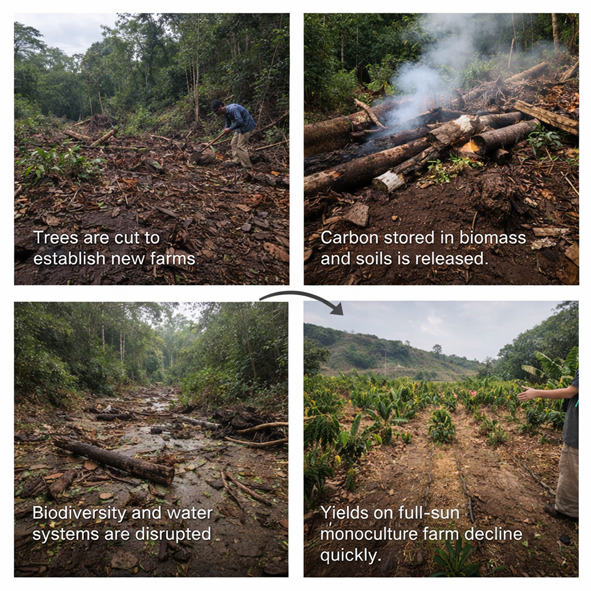
In many coffee-producing regions, farmers expand production by converting forested land into new farms. This can happen because of growing global demand, low yields on existing plots, or the search for more fertile soils. However, this expansion creates a damaging cycle:
- Trees are cut to establish new farms;
- Carbon stored in biomass and soils is released;
- Biodiversity and water systems are disrupted;
- Yields on full-sun monoculture farms decline quickly;
- Farmers then clear more land to compensate for falling yields (Figure 1).
Figure 1: The damaging deforestation cycle
Source: Amonarmah Consults, 2026.
This pattern causes high emissions and long-term environmental damage. Preventing it is therefore essential for any credible low-carbon coffee strategy.
Deforestation pressure is not only caused by farm expansion. It can also be driven by everyday practices such as:
- Cutting trees for wooden drying beds;
- Using firewood for mechanical dryers;
- Clearing shade trees to increase short-term yields.
Many cooperatives use raised wooden beds for sun-drying coffee. These beds may need to be replaced frequently because of weather exposure, which creates a constant demand for timber. Over time, this use of timber for raised wooden beds contributes to local deforestation.
If you use wood, switch to longer-lasting alternatives like concrete or metallic drying beds (Figure 2). This will reduce the need for new wood and lower pressure on nearby forests. Although these alternatives require higher initial investment, they are more durable and cheaper in the long term.
Figure 2: Raised metallic beds for sun-drying coffee

Source: Amonarmah Consults, 2026.
Tips:
- Invest in longer-term infrastructure. Help suppliers move from wooden to durable drying beds and more efficient energy sources.
- Support farmers in acquiring improved varieties that are high-yielding and require less planting space (with high land efficiency).
- Train farmers on the risks of full-sun monoculture and the benefits of shade systems.
- Learn more about adaptation strategies for farmers, plantations and producers. Sustainable practices include climate adaptation strategies.
Support farmers to grow coffee under shade and plant more trees
Agroforestry systems are an advantage for the coffee ecosystem. By keeping a mix of shade and fruit trees, coffee farms can store more carbon. This can turn coffee landscapes into net carbon sinks rather than emission sources. Research shows that carbon sequestration in these systems is, on average, 1.8 times greater than in monocultures. This system helps balance emissions, meets the growing demand for coffee that is free from deforestation, and improves biodiversity.
Figure 3: A diversified coffee-based agroforestry system featuring shade trees, coffee plants and intercropped seasonal crops.

Source: Amonarmah Consults 2026.
High-density shade-grown coffee farms with many trees can store a lot of carbon, about 70–80 tonnes per hectare. This amount of carbon storage is about the same as what a natural forest can capture. For importers, this makes shaded coffee a good example of a ‘nature-based solution’ that can be sold as a premium, eco-friendly product.
Shade trees also help regulate soil moisture and reduce the need for chemical inputs. Moderate shade levels of around 30–40% canopy cover generally provide the best balance between good yields and strong environmental performance. However, this depends on the coffee variety grown.
If you are a cooperative managing coffee farms or plantations, shift from full-sun monoculture to shaded agroforestry systems. Fairtrade profile and cooperative documentation show that Sidama Coffee Farmers Cooperative Union (SCFCU) in Southern Ethiopia grows coffee under indigenous shade trees and enset (false banana), a traditional agroforestry practice. Also, support your farmers by training them in agroforestry practices.
Tip:
- Work with other cooperatives to set up nurseries of tree species for farmers. Or provide free seedlings of timber and forest trees to farmers to interplant in their coffee farms.
- Learn more about planting trees in a coffee farm, the types of trees to avoid and the characteristics of trees you can interplant with coffee.
- Learn more about agroforestry from the coffee agroforestry training handbook, Complete Agroforestry Coffee Tutorial, simple agroforestry manual for women and conversion of a coffee plantation into a successful agroforestry system manual.
Support farmers to optimise fertiliser use and build soil carbon with regenerative practices
Reduce emissions by testing soils before applying fertiliser, applying smaller doses at the right time, and placing fertilisers close to plant roots rather than spreading them broadly. Research in Central America shows that farms that follow this careful fertiliser management approach produce only 1.21 kg of CO2e per kg of coffee. This is much lower than the 3.21 kg of CO2e per kg of coffee from farms that use a lot of conventional inputs.
Regenerative farming also gives you a way to turn farms into systems to store more carbon. It also enhances the ecosystems by improving soil, water and biodiversity. Unlike organic farming, which focuses on what is not used, regenerative farming focuses on restoring the soil.
Studies show that regenerative methods can make soil healthier, help farms resist climate problems, and even raise farm income by 20–30%. But the initial cost or transition cost can be high. For instance, a farmer in Nicaragua allocating approximately 2.8 hectares incurred a transition cost of about €500 due to the adoption of a revised fertiliser regime to reduce carbon emissions and additional labour for planting and maintaining shade trees.
The main idea of regenerative farming is to disturb the soil less and help it absorb more carbon with natural methods. Practices like cover crops and composting reduce carbon loss and grow helpful soil organisms. Intercropping coffee with nitrogen-fixing plants, such as legumes, can naturally enrich soils and lower dependence on chemical fertilisers. When combined with planting different crops and shade trees, these methods increase carbon storage above and below ground, keeping the soil fertile and the coffee farm productive for the long term.
These farm-level improvements deliver multiple benefits at once, like lower emissions, better yields, healthier soils, and greater resilience to drought and extreme weather. Because of these benefits many European buyers now actively support and are investing in programmes that promote agroforestry and regenerative coffee farming.
The EIT Food Project, an EU-backed 10-year project in Western Uganda, also aims to bring regenerative and traceable coffee to the EU market. The objective is to establish 10,000 agroforestry plots, create 1,000 jobs, and directly benefit 18,000 farms and 90,000 people, generating €40 million in sustainable income.
Farmers of Coopervass in Brazil are also moving towards regenerative production. They are focusing on soil health as the foundation and training farmers in composting, use of organic fertilisers, compost tea and organic pesticides. Coopervass is also pursuing Regen Agri certification even though it is not mandatory, to help farmers structure their transition. Follow this example to reduce your carbon footprint and benefit from certification premiums.
Tips:
- Read more about the Rainforest Alliance’s Regenerative Agriculture Approach.
- Read the Global Coffee Platform’s Regencoffee Guidance to learn more about regenerative coffee.
Reduce emissions from processing and energy use
Energy use at washing stations, dry mills and warehouses (for pulping, drying, pumping water and processing) is a major source of emissions, especially when based on diesel or fossil-based electricity.
Traditional mechanical dryers powered by firewood, diesel or conventional electricity can have a high carbon impact. Switch to renewable energy sources: they are mostly direct, measurable and more and more affordable ways for you to reduce your carbon footprint. Cleaner and more efficient options include installing solar photovoltaic (PV) systems, solar dryers and energy-efficient electric dryers, and using coffee husks as biofuel. These can sharply reduce emissions while also protecting bean quality. These solutions also improve energy reliability in rural areas.
For example, when managed well, sun-drying coffee on raised beds (Figure 4) is one of the lowest-emission options available. There is also the drying dome or the solar dome dryer technology. This technology makes sun-drying less labour-intensive and also offers other benefits due to low emission.
Figure 4: Raised beds for sun-drying coffee

Source: Amonarmah Consults 2026
Initial investment costs can be high. But solar technologies are becoming more affordable and many projects achieve payback through savings on fuel and electricity. Financial barriers can be reduced by working with development partners, accessing grants or concessional loans, and integrating renewable energy into carbon finance or sustainability projects. Tip 9 will help you understand carbon finance.
Another important issue is wastewater management in wet processing. Fermentation water from washing stations can produce methane if it is not treated properly. Methane gas is a lot more potent than carbon dioxide.
Install simple treatment systems like bio-digesters (Figure 5), settling ponds or filtration beds to help you prevent these emissions and reduce local water pollution at the same time. Anaerobic digestion is a well-known process used around the world. It turns organic waste into biogas and digestate, which can be used as biofertiliser. This helps manage waste, produce clean energy and cut methane emissions from landfills.
In Colombia, coffee farmers are using new systems like the Ecomill. This machine lets them process coffee with very little water, saving about 10 billion litres each year and almost stopping polluted runoff. This system saves water in areas with drought and protects rivers and ecosystems from pollution downstream.
Figure 5: Bio-digester system

Source: Amonarmah Consults, 2026.
Tips:
- Turn coffee waste into compost to help you manage waste. Composting coffee waste lowers harmful compounds like phenolics, caffeine and tannins, and makes compost a useful soil.
- Watch this video to learn how to make compost from coffee pulp.
- Turn coffee waste into biofuel or biochar. You can also turn coffee waste into building materials. These circular economy methods help you avoid disposal problems and ultimately reduce greenhouse gas emissions.
Improve transport and logistics efficiency across the supply chain
Logistics emissions are among the easiest to reduce, because they depend mainly on planning and efficiency rather than on complex changes at farm level.
In a typical coffee supply chain, transport and logistics emissions come from different stages. First, cherries are moved from farms to washing stations or drying areas and then to hulling stations. Then parchment or green coffee is taken to warehouses. Next, trucks carry the coffee from warehouses to ports. From there, international shipping brings it to destination markets. Finally, in importing countries the coffee is repackaged and redistributed.
Poorly planned local transport, such as many small trips, under-loaded trucks and inefficient routes, often creates more avoidable emissions. But one of the most effective strategies is consolidation. Instead of many small deliveries, cooperatives can organise centralised collection systems that combine volumes from multiple farmers into fewer, fuller truckloads. Better aggregation greatly reduces fuel consumption per kilogram transported.
Also, route planning makes a major difference. By mapping optimal collection routes and scheduling pick-ups efficiently, cooperatives can reduce total kilometres travelled. Switching to lower-emission transport modes can further reduce impact.
The European Environment Agency (EEA) reports that rail transportation typically produces much lower emissions per tonne-kilometre than road transport. Exporters that can move coffee from inland warehouses to ports by rail rather than truck can cut emissions substantially.
To improve logistics, you first need basic information. This includes knowing the distance travelled at each stage, the type and size of vehicle used, how much fuel each trip consumes, the size and frequency of shipments, and the number of times the coffee is handled. Keep simple records of these activities to help you identify where most fuel is being used and where changes will have the biggest impact.
Tip:
- Read our study 9 tips to go green in the coffee sector to learn more about reducing emissions.
5. Comply with legal requirements
The European Union, representing major consumers of coffee, is developing different regulations to address sustainable production. The EU aims to ensure importers report where their coffee comes from as well as their carbon emission levels. They do this through two major legal requirements, the European Union Deforestation Regulation (EUDR) and the Corporate Sustainability Reporting Directive (CSRD).
European Union Deforestation Regulation (EUDR)
With the EUDR, buyers legally have to prove that coffee purchased was not produced from land where forest was cleared after 31 December 2020. The EUDR will apply from 30 December 2026 for large and medium-sized companies, and from 30 June 2027 for micro and small enterprises (SMEs). European buyers are under increasing legal and reputational pressure to avoid sourcing products linked to deforestation. The Regulation requires that coffee placed on the EU market be:
- Deforestation-free;
- Legally produced, meaning production should have followed all laws in the country where it was grown;
- Fully traceable to the farm plot.
Although the regulation applies to importers, you will often need to provide the required data. If you cannot demonstrate that your coffee is not linked to deforestation, you risk losing access to European markets.
Though EUDR does not require you to calculate your carbon footprint, complying with it can indirectly help you manage and reduce emissions. By preventing deforestation, improving traceability and strengthening farm-level data collection, EUDR compliance supports better land-use management and lowers the risk of high emissions linked to forest conversion.
Corporate Sustainability Reporting Directive (CSRD)
The CSRD is another EU law that affects coffee suppliers indirectly. It requires large EU companies to report their greenhouse gas emissions. Companies must report detailed information on environmental, social and governance (ESG) matters. The law applies mainly to companies with 1,000–1,750 employees and turnover above €450 million. The first reports are expected in 2028–2029.
Even though CSRD applies to EU companies and not to you directly, your European buyers must report on their supply chains. This means they will ask you for data on your greenhouse gas emissions, farming practices, labour conditions and resource use (water, fertilisers, energy). They will need this information to complete their own reports to pass third-party checks.
Keep your system flexible for future legal developments
The rules and market expectations around carbon footprints keep changing and getting stricter in many instances. So you need to stay informed and be ready to adapt. Keep informed to update yourself on sustainability rules by regularly following the news on the European Commission website.
Updates to the EUDR continue to clarify and strengthen due diligence requirements for companies placing coffee on the EU market. In the future, the European Commission may combine the CSRD with the Corporate Sustainability Due Diligence Directive (CSDDD) and EU taxonomy frameworks in an Omnibus package. This would create more integrated compliance requirements covering deforestation prevention, carbon neutrality and biodiversity protection.
The EU is also taking the lead with new initiatives like the Carbon Removals and Carbon Farming (CRCF) Regulation. The CRCF is a new EU system for certifying carbon removal and carbon farming. It will influence how coffee agroforestry projects are designed and evaluated. The CRCF Certification Framework for different farming systems (including tropical crops like coffee) is still being developed. Follow the CRCF website for updates.
The fact that EU rules and market expectations keep changing and are becoming stricter means you should not wait until requirements become mandatory. Instead, prepare gradually and strategically. When you are always prepared, you face lower compliance risk and gain the favour of coffee buyers.
Tips:
- Read our study 7 tips on how to become EUDR-compliant in coffee to learn more about the EU regulations.
- Watch our webinar on Tips to meet EUDR requirements in the coffee sector to learn more.
- Communicate your deforestation policy to buyers. A written policy and basic monitoring system can already strengthen your market position.
- Learn more about the Omnibus package.
6. Join certification and buyer programmes to reduce emissions and meet buyer expectations
Not all climate and sustainability expectations in the coffee sector come from government regulations. Many of the requirements are set by buyers, certification schemes and company sustainability programmes. This is because European roasters and traders want to meet their own climate targets, net-zero commitments and due diligence obligations. Although these are technically voluntary, in practice they often determine who can sell to European markets and under what conditions.
Certification programmes
Certification schemes can help you cut down your carbon footprint in practical ways. They prescribe training on agroforestry, soil care and efficient use of inputs. They also require traceability systems that make it possible to track emissions. Farmers are asked to keep records, which are needed for carbon calculations. These programmes support monitoring and mapping of deforestation, often providing premiums or long-term contracts that reward better practices.
But note that not every certification or programme fits every cooperative or exporter. The best choice depends on your main markets, buyers and production situation. The main idea is: if you already invest in these systems, explore how they might help you meet future climate goals.
Most well-known coffee certification schemes now include requirements that are directly or indirectly related to climate and emissions. For example:
- Rainforest Alliance standards require protection of forests, shade management, soil conservation and reduced use of agrochemicals, all of which influence your carbon footprint;
- Fairtrade encourages sustainable farming practices, agroforestry and responsible input use, and supports producer organizations with climate adaptation and mitigation projects more and more often;
- 4C (Common Code for the Coffee Community) includes criteria on environmental protection, resource efficiency and deforestation avoidance;
- Organic certification promotes farming without synthetic fertilisers and pesticides, which can reduce emissions linked to input production and improve soil carbon.
These systems may not explicitly calculate carbon footprints, but they provide guidance and opportunities for lower-emission coffee and to access the carbon market.
Company sustainability programmes
Beyond certifications, many large coffee companies run their own programmes that function as de facto market requirements:
- Nespresso AAA Sustainable Quality Program, combining agronomic training, ecosystem protection and traceability to reduce environmental impact;
- Nestlé Responsible Sourcing Program and Nestlé Net Zero Roadmap, requiring suppliers to provide climate data and adopt lower-emission practices;
- Starbucks Coffee and Farmer Equity (C.A.F.E.) Practices, including environmental criteria on energy use, soil health and biodiversity;
- JDE Peet’s Nature Transition Plan, supporting regenerative agriculture and carbon reduction in coffee supply chains.
Exporters will benefit from participating in these programmes to maintain long-term contracts. Even though these are not governmental laws, they strongly influence who buyers choose to work with.
7. Access carbon finance
Reducing emissions in coffee production costs money. You can use carbon finance to help cover these costs. Carbon finance allows you to earn income by reducing emissions or storing carbon in your farms.
A carbon credit represents one tonne of carbon dioxide (CO2) that has been removed from the atmosphere or avoided. You can generate these credits by planting shade trees, improving soil management or preventing deforestation. You can then sell the credits to companies that want to reduce their emissions.
Understand where you can participate
There are two main types of carbon markets: compliance markets and voluntary markets. Compliance markets are created by law and are usually difficult for smallholder farmers to access because of strict rules and high costs. Voluntary markets are more flexible and better suited to coffee cooperatives. Companies choose to buy credits to meet sustainability goals. These markets also value benefits such as biodiversity and improved farmer livelihoods. Focus on voluntary carbon markets as your main entry point.
Work with partners to enter the market
Carbon markets require technical knowledge, data collection and certification. You do not need to do this alone. You can join carbon projects through project developers (private companies or NGOs), certification programmes and buyer-led sustainability programmes.
In many cases, a project developer will organise farmers, manage certification and verification, connect you to buyers and share revenue with you. This is often the easiest and most practical way to start. For example, in Uganda the Trees for Global Benefit project pays farmers for planting and maintaining trees. Farmers receive payments over time, which encourages long-term commitment.
Working with project developers reduces your workload and upfront costs. However, you may receive a smaller share of the revenue. If you want more control, you can develop your own project as a cooperative, but this requires strong organisation and investment.
Ensure that any agroforestry or carbon project you participate in follows recognised accounting standards. The standards include the Greenhouse Gas (GHG) Protocol, ISO 14064, ISO 14040/44, Verified Carbon Standard (VCS – Verra), the Gold Standard and Plan Vivo (widely used for smallholder agroforestry). If the project developer cannot clearly state which methodology is used, this is a warning sign. Also, avoid making carbon claims that cannot be verified under emerging EU quality standards.
Tips:
- Start by planting shade trees and improving farm practices. Then partner with a project developer or certification programme to turn these actions into carbon credits.
- Read more on carbon credit pricing for both the compliance and the voluntary market.
- Monitor live carbon prices to stay informed about current market trends.
8. Learn from successful low carbon programmes
Across producing countries, several initiatives show that reducing carbon emissions can improve yields, protect ecosystems and strengthen farmer incomes when the right support systems are in place. The examples below highlight practical approaches and what you can learn from them.
Change Brewing Project – Uganda
This project worked with cooperatives in Uganda’s Greater Masaka region. It was implemented by ETG (Export Trading Group), the Norwegian Geotechnical Institute (NGI) and Rikolto, with funding from the AGRI3 Fund (managed by IDH). Nearly 2,000 farmers (68% women) were trained in agroforestry, soil health, energy-efficient processing, biodigesters, biochar and organic manure use. Demonstration plots and Village Savings and Loans Associations supported adoption. The project showed that combining climate-smart practices with financial inclusion and cooperative strengthening can reduce emissions while improving quality and income stability.
If your cooperative is still building capacity, start by combining climate-smart training with access to finance (such as savings groups or credit schemes). Focus first on practices that improve both productivity and resilience, such as soil health and agroforestry.
Coopedota – Costa Rica
Coopedota is widely recognised as the first carbon-neutral coffee cooperative. It achieved certification through careful measurement of emissions, agroforestry systems, energy-efficient wet mills and increased use of renewable energy such as solar drying. The case demonstrates that early investment in carbon accounting and processing efficiency can create both environmental benefits and a strong marketing position.
Learn from Coopedota by measuring your carbon footprint and improving processing efficiency (energy, water, drying). Use this data to build a sustainability story that can attract buyers and price premiums.
Kopakama Cooperative – Rwanda
Kopakama Cooperative reduced emissions from wet processing by installing biodigesters at its washing stations. These systems treat wastewater and capture methane for renewable energy use. This reduced pollution, lowered fuel costs and improved environmental performance.
If you operate washing stations, start by improving your wastewater management. Investing in biodigesters or similar systems can quickly lower emissions. Although the initial cost may be high, long-term operating costs drop because the system generates biogas, reducing the need to purchase external fuels while delivering clear environmental benefits.
Landscape and agroforestry programmes in Latin America
In countries like Peru and Colombia, climate-smart coffee initiatives supported by international buyers and NGOs have integrated shade trees plus improved soil management and traceability systems. These programmes link farm-level mitigation with improved resilience to heat stress and erratic rainfall. Two such initiatives are the climate-smart solutions for coffee farmers project in Peru by Rikolto and the Asómbrate programme in Columbia by Solidaridad.
If you work with many farmers, prioritise agroforestry and soil management at scale. Partner with buyers or NGOs to support training, tree planting and traceability systems that improve both resilience and market access.
There is a clear pattern across these examples: successful low-carbon programmes focus on practical actions and strong organisation rather than standalone climate projects. Specifically:
- Programmes work best when cooperatives are active, organised and able to coordinate training, data collection and investments in shared infrastructure such as washing stations or drying systems.
- The most successful initiatives do not treat carbon reduction as a separate activity. Instead, they embed it into extension services, quality improvement, input supply and farm management support.
- Carbon-neutral or low-carbon claims are credible only when supported by recognised accounting methods and regular monitoring. Programmes that invest early in data collection and traceability gain market advantages.
- Access to credit, savings groups or blended finance (such as AGRI3) helps farmers invest in shade trees, composting, irrigation and energy-efficient equipment.
- Practices such as agroforestry, mulching and soil health management reduce emissions while improving resilience to droughts and floods. This dual benefit boosts farmer motivation.
- Energy-efficient drying, renewable energy use and wastewater treatment are often easier to implement at cooperative-level than farm-level system changes, and can show visible impact quickly.
Tips:
- Join your national Global Coffee Platform initiatives to learn more about successful low carbon emission programmes and initiatives.
- Do not copy programmes exactly. Instead, identify what made them work and adapt these elements to your local context.
Amonarmah Consults carried out this study in partnership with Ethos Agriculture on behalf of CBI.
Please review our market information disclaimer.
Search
Enter search terms to find market research
Do you have questions about this research?
Cooperatives can access carbon markets through certification schemes such as Rainforest Alliance, 4C, Fairtrade and Regen Agri. These organisations provide guidance, ensure compliance and support verification to convert sustainable practices into measurable and tradable carbon credits. Coffee cooperatives must consider promoting improved varieties from approved sources, as traditional varieties require more land and inputs, increasing emissions from fertiliser use and deforestation.

Dr. Abraham Akpertey, Senior Research Scientist (Coffee Breeder) at the Cocoa Research Institute of Ghana