

8 tips on how to go digital in the coffee sector
Coffee trade is still done mainly through personal relations and traditional trade. However, technological developments have improved many areas of the coffee supply chain and related operations. This includes traceability, farm mapping, farming practices and market analytics. In this study, we share practical tips on how digitalisation plays a role in the coffee sector and what this could mean for you.
Contents of this page
- Learn about the most common types of digitalisation
- Find data that can improve your business
- Consider B2B platforms to sell your products
- Learn about new technologies
- Present clear and updated information online
- Invest in traceability and geolocation tools
- Use digital tools to empower farmers and boost gender equality
- Work with partners that have a network or experience in your region
1. Learn about the most common types of digitalisation
Digitalisation can help improve your business. More and more information is being requested from all actors across the supply chain, including coffee producers and exporters. This includes information on quality, origin and sustainability. Digitalisation is also important for following new laws and regulations. The most important of these is the EUDR, which requires GPS-verified farm-level traceability for all coffee exported to the EU (postponed until 2027). New technologies can help you collect and share this information more effectively.
You can choose from multiple types of digital tools. They commonly focus on improving productivity, traceability, geolocation mapping, monitoring and remote sensing, accounting, procurement and shipping. Other digitalisation tools are sales platforms/digital buying, e-commerce platforms and new technologies like drones, blockchain and artificial intelligence (AI).
There are many ways to benefit from working more digitally in the coffee sector. There are also many different tools to choose from, in all parts of the coffee supply chain. Before deciding which digitalisation is most suitable for your organisation, it is important to understand the level of digitalisation that works for you.
Determine your current level of digitalisation
Before selecting a tool, it is important to ask if this tool can be used in your organisation. Users will need different levels of digital knowledge, depending on the solution. Consider questions such as:
- Which hardware and software are you already using?
- What is the current level of digital capacity of the people that will use the tools?
These steps help you assess how ready your organisation is for new digital tools, plus determine what is needed when a tool is selected. New users may need training, or additional staff may need to be hired. Engaging younger community members who are comfortable with technology can be an effective way to bridge the digital literacy gap.
Consider how demanding a new tool is. Many tools require a level of digital knowledge that may be unavailable in your organisation. For some farmer groups, using online forms or Excel is already challenging. Rather than taking a big step up in digitalisation, it might be better to take a smaller step first. For example, if you operate on paper-based traceability, it might not make sense to go straight to full blockchain traceability.
In some countries, coffee farmers are older and less familiar with digital tools. A simpler, off-the-shelf solution might be a better choice. In some cases, a simple Excel-based administration makes more sense as a first step.
It's also important to consider internet connectivity. If an application doesn’t work offline but your internet access is limited or unreliable, then it might not be the best tool for you. Look for tools that also work offline and can be synchronised later.
Determine where digital tools can help you improve the most
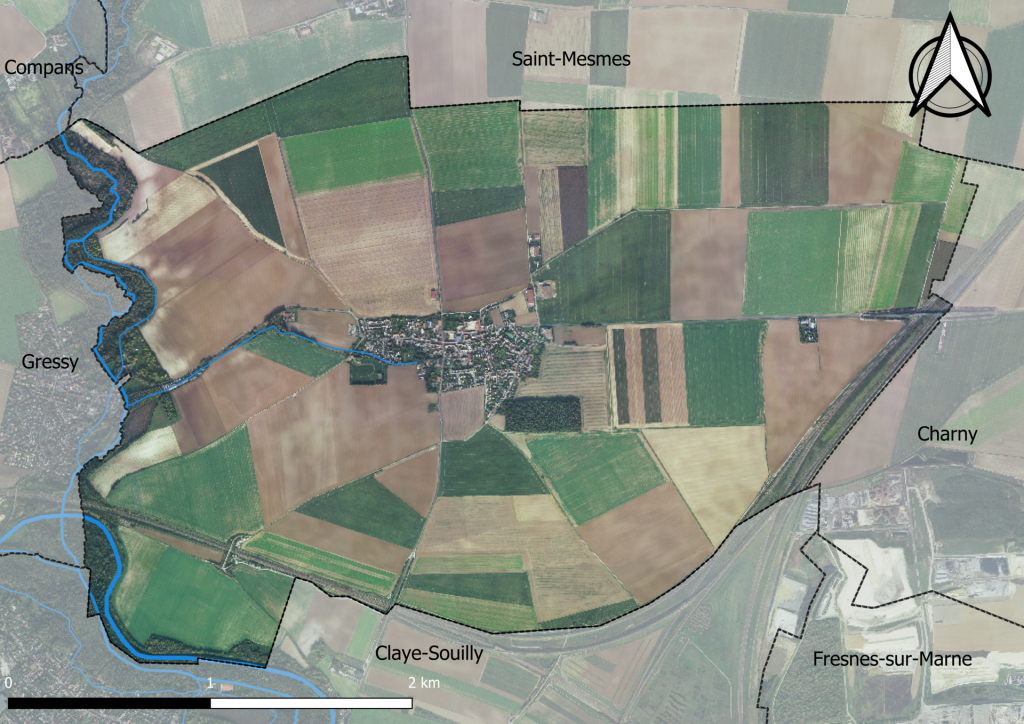
Next, look closely at where a digital tool can help you the most. Think about your main challenges or needs. Developing a process map of your operation can help identify your needs. For example, the biggest need for exporters might be mapping the coffee farms and production zones they source from; QGIS and ArcGIS are two software packages that help map farms. For other exporters this might be improvements further down the supply chain, such as quality or processing improvements.
Figure 1: Mapping in QGIs
Source: Wikimedia Commons (2026)

It is important to consider the wider benefits of a digital tool. For example, data collection is often done with one objective in mind. However, certain tools might help you improve in other areas as well. They can, for example, help you gain better insight into your stocks – so you can determine when to buy coffee and how much – as well as into future purchases, sales and logistical issues. SourceTrace and AgUnity are two software tools suited for this purpose. So it is important to think about how the tool or data can serve multiple purposes, so you can potentially get more value out of your investment.
Consider data ownership
Data on farmers and farms has been collected for many years, but stakeholders rarely share it. In most cases, farmers do not own their own data. They often lack the polygon or GPS data required by buyers to comply with the EU Regulation on Deforestation-free Products (EUDR). Often, one of their main buyers owns this data after investing in mapping and does not share it.
It is important that farmers and farmer groups own the data about their farms and households. Data ownership gives greater flexibility in choosing who they sell to and allows them to pursue new market opportunities. This in turn can improve farmers’ financial security. Open-source software systems, like INATrace and Beyco, ensure that data remains with the producing organisations.
As an exporter, it is therefore important to share farm data with the farmers themselves and the producer groups they belong to. Exporters can support producer groups in setting up systems to store and share the data, but they should address and agree on data ownership throughout this process.
Tips:
- Invest in tools that can serve multiple needs. For example, mapping data can help not only with compliance but also with yield estimates, buying the right amount of fertiliser, weather predictions – even reducing the risk of child labour. The Farmforce tool is used across 32 countries and by 1 million+ farmers for deforestation monitoring, child labour risk management and general farm management, all from a single dataset.
- Look for software that can be linked to other digital solutions. Digital tools are more useful when they are inter-operable with other tools.
- Determine how ready your organisation is for new digital tools. New users might need training, or new people might need to be hired. Recognise the need and opportunity to engage young people that are more technology-savvy to support the older generation of coffee farmers.
- Ensure that you own your data, also if it is collected by someone else. Negotiate about data ownership with your buyers, certification schemes or NGOs.
2. Find data that can improve your business
Collecting accurate data on coffee farming practices, yields and incomes is crucial for improving productivity and sustainability. Modern technology allows coffee producers and exporters to gather and analyse information quickly and efficiently. It enables better decision-making and access to new opportunities in the market.
Major coffee sustainability research databases
Stay updated and informed by using acclaimed research databases and initiatives:
- KIT, Wageningen University and Smithsonian Coffee Agroforestry Library: Offer comprehensive reports and data sets related to coffee agroforestry and sustainability.
- Coffee Sustainability Support Database: Centralises research focused on sustainable coffee production and environmental stewardship.
- The Coffee Sustainability Tool: provides an overview of many sustainability initiatives in the coffee industry.
Data tools for improved coffee farm management
A selection of platforms and services support coffee producers and exporters in streamlining operations. These tools offer solutions for farm mapping, supply chain management, data analytics and knowledge sharing, tailored to the needs of coffee producers and exporters.
- FarmGrow developed by Rainforest Alliance and Grameen Foundation. FarmGrow combines farmer household data with information about the coffee plots and helps create a business plan;
- Farmerline gives farmers access to quality inputs, training and markets through their digital platform;
- Mergdata tools can be used to improve yields and income;
- PlantwisePlus is an app that helps address plant health threats and reduce crop losses;
- World Coffee Research: combines knowledge around coffee variety growth statistics.
Tip:
- Collecting data can help you improve your coffee production and your business. Ensure that you own any data that is collected, so you can use it for the purposes you have in mind.
3. Consider B2B platforms to sell your products
Coffee beans are often sold in physical transactions, especially during first-time transactions. As such, in-person contact and long-term trade relationships are important in the coffee market. However, digital platforms are starting to become more relevant. There are some B2B platforms that can help producers and exporters enter the European market. Digital marketplaces might also be an interesting way to showcase your products, learn about your competition and find new buyers.
There are two types of platforms: business-to-business (B2B) and business-to-consumer (B2C).
Use B2B marketplaces for coffee beans or derivatives
B2B marketplaces for coffee beans usually focus on high quality or specialty coffee. It is important to realise that only a very small part of global coffee production is sold through such platforms. Still, it might be interesting to explore a few marketplaces to find new buyers and understand what type of information buyers are looking for. Typically, they expect digital quality documentation (cupping scores), lot-level traceability, etc.
Using online marketplaces for coffee sales offers both great benefits and notable risks for producers and exporters. Marketplaces connect sellers directly with buyers. By using these marketplaces, you can expand market access and potentially improve profit margins. These digital platforms often require robust quality documentation and traceability. This allows producers to showcase the origins and attributes of their coffee to buyers who increasingly demand transparency.
Using such tools does present challenges. Mastering the necessary digital skills, ensuring consistent data entry and maintaining accurate traceability records can be demanding. This applies especially for organisations new to these systems. Besides this, while these platforms can open doors to new markets, you will also become more dependent on them.
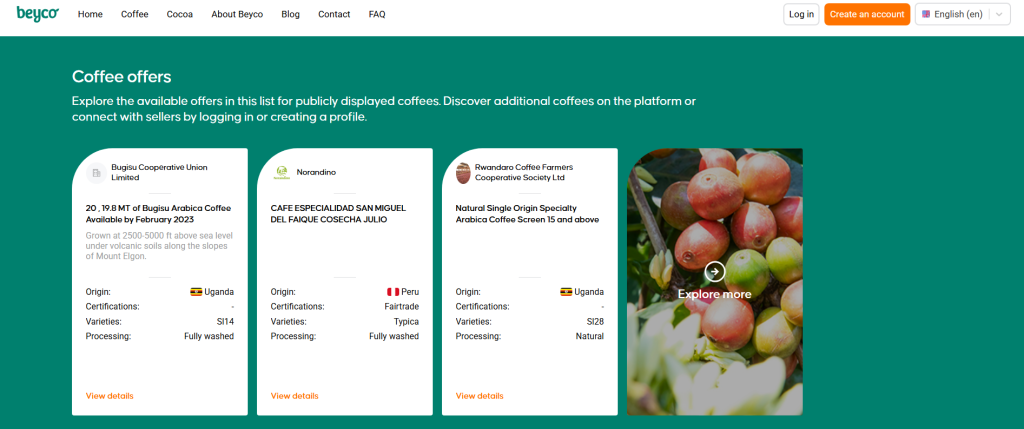
One digital marketplace is Algrano. The platform connects coffee sellers with global buyers. It also offers options for shipping, warehousing, financing, quality assurance and risk management.
Other platforms are:
- Beyco, a traceability platform where producers can market their coffee free of charge (operated by a non-profit);
- Green Trade, where users can buy and sell organic ingredients, including coffee;
- Leroma, where you can buy and sell many raw materials, including some coffee products;
- Producers Market, a global market for producers, buyers and sellers;
- Raw Material, connecting buyers with sellers. They also work on other projects to support local communities;
- TYPICA, specialising in rare and micro-lot specialty coffees;
- V-Auction, Cup of Excellence auctions for the highest-priced specialty lots.
Figure 2: Coffee offers via the Beyco marketplace
Source: Beyco (2026)
Use B2C marketplaces for coffee exports
B2C platforms allow you to sell directly to consumers. These platforms are rarely used for green coffee beans. This is because consumers typically look for roasted or soluble coffee. Availability is controlled by the platform owner. Sellers usually need to go through a vetting process before their coffee can be displayed and sold on the platform. Examples are:
- Koffiezone, selling all kinds of coffees and some tea (Netherlands);
- Kaffee Zentrale, selling a range of coffee qualities (Germany);
- Alternative Café, focusing on specialty coffee roasted at origin (France).
For more information, see our study Exporting roasted coffee to Europe.
Tips:
- Use digital platforms to complement existing coffee trade practices. Continue investing in long-term buyer relationships, since many coffee buyers continue to do trade in the traditional way. While personal contact and trust remain central to the coffee trade, also start developing a digital product profile of your coffee. This reduces your dependency on online marketplaces.
- Build a strong digital product profile. Buyers expect professional cupping scores, detailed origin and processing data at lot level, and sustainability documentation. Digital storytelling (farm photos, producer profiles, processing videos) can strengthen buyer loyalty.
- Before joining a platform, review the type and quality of coffees it features. If a platform sells mainstream coffee qualities and you manage higher-quality products, that platform might not be the right match for you.
- Trading online demands speed and organisation. Monitor your communication channels regularly and answer within 1-2 days. Keep your information up-to-date and be honest about what you can offer. Transparency and trust between buyer and seller are key in the coffee sector, also in a digital world.
4. Learn about new technologies
For many farmer groups and exporters, starting with basic digital tools can be the most effective approach. Simple systems for data collection, administration and traceability can already deliver significant benefits. More advanced technologies tend to be used at other stages in the supply chain.
For farmer groups, increasing their level of digitalisation is often hard. Major barriers at the farming level include digital illiteracy, questions of data ownership, limited integration between systems, costs in time and money, limited smartphone penetration and data costs.
At the same time, digitalisation is evolving quickly. For more experienced farmer groups and exporters, it is increasingly relevant to understand and explore new technologies. One example is the rapid development of solutions based on AI. AI is beginning to create new opportunities at origin, from farm management to quality control and market information. Examples of such tools are WSEEDS and Cropster. These tools can enable better harvest planning and resource use. Exporters can use quality control tools like Agrivero, Demetria or avercasso to assess bean quality.
Satellite images and remote sensing have become increasingly popular in the sector. Tools like Satelligence use satellite images from Sentinel-2 and Landsat-8, public Earth‑observation satellites that provide frequent, high‑resolution optical data for tracking land‑cover change to monitor deforestation risks in coffee-growing regions. Satelligence has partnered with CIAT to create detailed, free access coffee maps for producers.
Major industry players like Neumann Kaffee Gruppe and Fairtrade International are working together to check compliance with new European laws that restrict products grown in areas affected by deforestation. Global Forest Watch makes free deforestation alerts available to everyone. Meanwhile, Starling is adapting its experience in palm oil monitoring to support the coffee sector. Starling is a partnership between Airbus and the Earthworm Foundation.
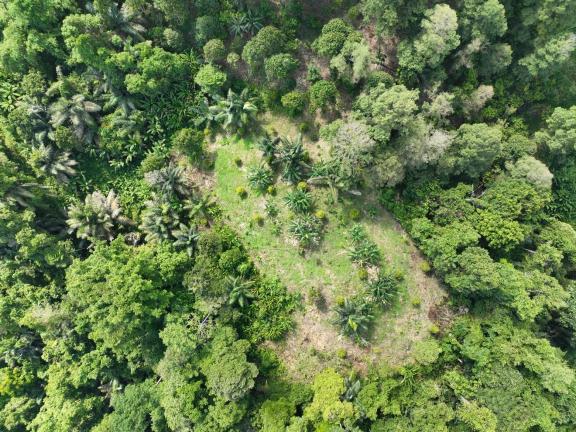
Drones are another technology worth exploring. Drones are becoming a practical tool for coffee farmers because they enable users to quickly and cost-effectively monitor large or hard-to-reach areas. This reduces the need for slow, costly manual inspections that usually sample only small parts of a farm. Some potential benefits:
- Faster, more complete crop monitoring across entire farms;
- Early detection of pests, diseases and plant malnourishment through aerial imagery;
- Targeted pesticide application, which lowers chemical use and cost while improving accuracy;
- Creation of precise digital maps (like yield and soil erosion maps) using sensors and mapping software.
These maps help farmers, researchers and officials make better agronomic decisions.
Figure 3: Drone mapping in Terpedo Jaya Community Forests
Source: Aryo Condro (2026)
Tip:
- AI is developing fast. Many new initiatives and organisations are developing new tools based on AI that can help you as a producer or exporter. Stay involved and informed about new solutions by subscribing to newsletters, visiting events, and speaking with companies and service providers. A good source is Digital Coffee Future. AI-powered tools are mostly interesting for producers and exporters that already have a high level of digitalisation.
5. Present clear and updated information online
Many organisations lack a website or only have a very basic one that does not include the essential details buyers expect. Information about volumes, quality, harvest periods and processing methods is often missing or outdated. However, this is exactly what roasters look for when assessing potential suppliers. Updating this information on a seasonal or semi-annual basis helps buyers understand what is available, how it is processed and when it can be shipped.
Although stock levels change regularly, cooperatives are usually ahead in tracking core data such as number of farmers, cultivated area, varieties and historical sales. These can be used to provide reasonable online estimates. Making this information easy to find builds trust and helps new buyers start doing business.
Presenting information online does not need to be expensive or complex. Simple tools like Canva allow cooperatives to create clear templates or brochures that organise key information in a buyer-friendly format. These templates can serve multiple purposes. They can be used to upgrade a website, share at trade events, or send together with coffee samples to make them stand out.
Since labels on sample bags can easily get damaged, attaching a clean, well-designed document ensures that important details reach the buyer intact. This basic effort often gives producers an advantage over others who present little or disorganised information.
Some exporting cooperatives that share a large amount of relevant information on their websites are:
- COOPEDOTA (Costa Rica), which shares processing methods, harvest periods and quality information;
- Sidama Coffee Farmers Cooperative Union (Ethiopia), which provides descriptions of processing styles and regional volumes.
6. Invest in traceability and geolocation tools
The coffee industry has made significant progress in improving traceability across the coffee supply chain. This is critical to improving coffee production. Through traceable supply chains, it is easier to identify inefficiencies. This enables you to support producers effectively and drive sustainability improvements across your supply chain. Traceability has also become more important for legal compliance, for example with the EUDR.
Learn about available traceability systems
Most large coffee companies have their own internal traceability platform. Certification programmes like Rainforest Alliance and Fairtrade also have their own systems.
You can get traceability systems via independent service providers as well. Beyco, developed by the Progreso Foundation, is a traceability service provider. It makes coffee traceable at each step of the chain, integrates producer stories, and offers tools for EUDR compliance and financial management. It also supports users in organising essential farm-level data such as location, unique farmer IDs, cultivated area, tree counts and varieties. This is information that can help cooperatives better understand their production capacity, financing needs and market opportunities. Other systems are Source Intelligence, Cropin, Fairfood, Farmforce, Global Forest Watch, Satelligence, Sourcemap and Trade in Space.
Because multiple systems often track the same coffee but are not integrated, exporters and cooperatives may need to use multiple platforms simultaneously. This can be confusing and time-consuming, but nowadays there are modern tools designed to link with others to create smoother, end-to-end traceability.
Consider whether Blockchain is useful to you
Some traceability systems also use blockchain technology. Blockchain is an open system of decentralised data tracking and storage. Blockchains store data in blocks linked together via cryptography. They are used to increase accountability, transparency and traceability along the supply chain.
Blockchain platforms have matured from consumer-transparency experiments into compliance infrastructure. They are transparent and auditable, enabling innovative solutions to improve transparency and efficiency in carbon markets. Blockchain technology can help monitor and prevent child labour in coffee production by creating transparent records of supply‑chain activities. This makes it easier to trace products back to their origin and identify potential labour violations. However, blockchain is not required or necessary for coffee traceability. The industry understands its potential, but it is not used at scale for traceability in the coffee sector.
There are many examples of coffee companies using blockchain technology:
- With the Seedtrace tool, consumers can see how much a coffee farmer was paid in real time;
- Sucafina and others collaborate withFarmer Connect and use the Thank my Farmer app to close the gap between consumers and farmers;
- Starbucks coffee traces its coffee via Microsoft Azure Blockchain;
- Beyco includes blockchain to create smart contracts that create a digital track record of the transaction;
- Fairfood Trace has developed Navigate, a dashboard overlaying traceability and deforestation data.
Invest in mapping and monitoring
Many buyers require the geographic locations of the farms where the coffee was produced. This may be for purposes of risk management, reporting, public commitments or regulatory compliance, such as the EUDR.
As part of the EUDR, companies must conduct due diligence to ensure that the coffee they buy is not produced on land deforested after 31 December 2020. Companies must comply with the EUDR as of 30 December 2026 (with more time for SMEs). The EUDR requires GPS or polygon mapping of farm plots. These plots must be compared with maps of protected areas and classified forests to ensure that the coffee is not produced illegally. They also need to be overlaid with deforestation and land change maps. See our study 7 tips on how to become EUDR compliant in coffee for more information and examples of service providers that can help you with this.
Another use of remote sensing is measuring biomass on coffee farms. This technology is used by Acorn, which is part of Rabobank. Acorn works with farmer cooperatives and other local partners to help coffee farmers set up agroforestry systems. The technology enables Acorn to measure the biomass generated on the farm and convert it into Carbon Removal Units (CRUs). The Cool Farm Tool, by Cool Farm Alliance, is the most established greenhouse gas calculator in agriculture. It is used in over 100 countries.
The approach benefits companies, farmers and the planet. The CRUs are sold to organisations for off-setting or in-setting strategies. This can help them meet their climate goals. Farmers also benefit from generating CRUs: 80% of the income from CRU sales flows back to the original smallholder. The planet benefits through increased biodiversity and CO2 removal from the atmosphere.
Digitalise production and exports
Digitalisation can help make exports more efficient. For example, exporters of coffee must obtain a government-issued document called a phytosanitary certificate. This document assures trading partners that the product meets the expected quality standards. ePhyto is the system that replaces paper documents with digital ones. Using ePhyto can speed up information exchange and shipment tracing, making exporters more competitive in international markets.
Digital tools can also simplify the administration of the process. They can help you track production costs. This can help you optimise expenses and increase profits. Tools can also be used for supply chain management.
Tips:
- EUDR compliance is the responsibility of the coffee buyer or importer. However, demonstrating that your coffee complies with EUDR can give you a competitive advantage over other exporters. Invest in a system that provides buyers with the data and traceability they need for EUDR compliance.
- For EUDR compliance, it is important to map your entire coffee supply chain, including cooperatives, purchasing centres and farms. Collect geolocations using polygon boundaries rather than single point coordinates (GPS points).
- Using open-source applications can make it easier to ensure that you own your data. They can also be cheaper, since you do not have to pay a licence fee to your supplier.
7. Use digital tools to empower farmers and boost gender equality
There are many digital tools available to help farmers. They vary from helping farmers become more productive and more resilient to creating easier access to loans or improving internal administrative processes.
Digitalise payment to create income records for farmers
Digital payments to farmers provide greater assurance that funds reach the intended recipients. They are more secure and make it easier to create a record of the payments. Digital payments also help create income records for farmers, which can help farmers and farmer groups get better access to finance.
Mobile money is already widely available in some countries; growth in the African electronic payments market is expected to continue. For example, Ugacof, part of Sucafina, has decided to digitalise their payments in Uganda, including those of thousands of farmers. Several countries and companies are starting to pay farmers digitally: many Kenyan coffee cooperatives use M-PESA to pay their farmers.
There are many tools available for digital payments. Often the tools also give farmers extra benefits. Examples include:
- Agri-wallet provides supply chain actors with access to financing through a global network of lenders. For farmers it means that they receive income in a digital wallet in either mobile money or tokens. The money received in the Agri-wallet can be spent on inputs like seeds and fertilisers.
- KoltiPay is a digital payment solution developed by Koltiva. It offers loans, savings, micro-insurance, bill payments and prepaid top-ups. It can also be used for coffee price and premium payments.
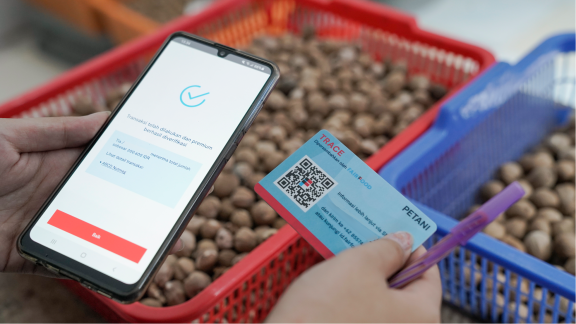
- Connect is a payment verification tool developed by Fairfood. Farmers receive a Farmer Card to verify payment, and do not need a mobile phone. The collector uses the Connect app to record the transactions. The app can also be used without an internet connection, synchronising data later.
Figure 4: Farmer Card developed by Fairfood
Source: Fairfood (2026)
Get access to financial institutions and lenders
A major issue for farmers and farmer groups is a lack of access to finance. Many coffee producers need credit to invest in their farms or sustain themselves between harvests. However, many are not able to access finance.
Smallholder farmers are often seen as high-risk by banks. Digital tools can help producers and exporters get access to finance by showing their creditworthiness. By capturing transaction histories, yields and payment records, digital systems help producers demonstrate creditworthiness more convincingly than cash-based, paper records ever could. When farmers are paid digitally rather than in cash, lenders gain clearer insights into price and risk assessment.
Access to credit has helped coffee farmers with their productivity in many coffee-producing countries. Village Savings and Loan Associations (VSLAs) can help banks provide farmers with access to finance. Digital payments can also help farmers gain better access to financial services such as savings accounts, credit and insurance tailored to rural households.
Ensure gender equality in access to digital tools
In many producing countries, women may have less access to digital tools. Supporting women in the use of digital tools has many benefits. Besides contributing to gender equality, it can improve the productivity and the viability of the farm where women are actively involved. For instance, directing digital payments straight to women farmers’ accounts can empower women in coffee by increasing their control over income and strengthening their bargaining power within households and communities.
Tips:
- Read the website of the Better Than Cash Alliance for more information about how everyone can benefit from using digital payments.
- If you want to access larger loans, it is important to build creditworthiness. This means keeping accurate (digital) business records and data related to your business. This could include a clear business plan plus information on your credit history and your assets.
- Support coffee producers in getting access to finance with digital payments, Village Savings and Loans Associations and bank accounts.
- For more information about sustainability in coffee, read the CBI studies with tips on how to go green and become more socially responsible in the coffee sector.
8. Work with partners that have a network or experience in your region
Most of the technology providers mentioned in this study also have a local presence or experience in producing countries. When you explore options with a technology provider, always ask about their experience with other companies in your country or region. Local contexts can vary widely across countries. It is crucial to learn from those with experience.
It can also be helpful to check if they have staff based in your country. This will make it easier for them to support you in the implementation, and gives you more confidence that they understand the local context.
Tips:
- Check whether technology providers have local presence and experience in your country.
- Check out international organisations like TechnoServe, Rikolto, Agriterra and Solidaridad to see if they offer assistance and practical guidance on digital tools in your country.
- Access the website of GIZ Innovation Fund (also on X and YouTube) to see if they are working on any digitalisation projects in your country.
- Access the members page of AfricaGoesDigital for an overview of data technology suppliers in Africa.
Molgo Research carried out this study in partnership with Ethos Agriculture on behalf of CBI.
Please review our market information disclaimer.
Search
Enter search terms to find market research
Do you have questions about this research?
Small and medium-sized exporters who actively use the data they already collect such as volumes, processing methods, cupping scores, soil, varieties and traceability along with photos, stories and information about the landscape, can quickly build trust with buyers and distinguish themselves from competitors.

Saurin Nanavati, founder at Ethos Agriculture