
Entering the Italian market for cocoa
To enter the Italian market you need to navigate regulatory and buyer standards, choose the right distribution channels and understand the competitive landscape. You should also respond to price trends influenced by global supply dynamics and value-added preferences. In the following sections, we explore these factors to help producers and exporters who are looking to access and thrive in the Italian cocoa market.
Contents of this page
1. What requirements and certifications must cocoa meet to be allowed on the Italian market?
Italy does not have an Initiative for Sustainable Cocoa (ISCO). Because of this you can export cocoa to Italy if you follow strict rules set by the European Union. These can be categorised into:
- Mandatory requirements;
- Additional requirements and certifications that buyers often have;
- Requirements for niche markets.
We explain these requirements in the following sub-sections. Keep in mind that your Italian importer may re-export cocoa beans to other places in Europe. These buyers and destination markets may have their own requirements. Thesecould lead to a need for additional certifications or standards. This will depend on the final market and associated sales channel. See for instance our studies on interesting export markets, including Belgium, Eastern Europe, France, Netherlands, Scandinavia, Spain, Switzerland and the United Kingdom. In this study we focus on requirements specific to Italy.
What are mandatory requirements?
In the cocoa sector, there are some important regulations that impact export. These are the EU Regulation on Deforestation-free Products (EUDR), the Corporate Sustainability Due Diligence Directive (CSDDD) and the Corporate Sustainability Reporting Directive (CSRD). These regulations are introduced to make sure that products entering the EU market are free from deforestation. They also guarantee that companies in the supply chain meet high environmental, social and governance sustainability standards.
The EUDR bans imports of cocoa products into the European Union (EU) from land that was deforested after 31 December 2020. This means that all companies that import cocoa into the EU need to make sure their products did not cause deforestation. Companies must also provide data on the geolocation and legality of where their cocoa was grown.
This requirement was supposed to be enforced on 30 December 2025 (or 30 June 2026 for SMEs). However, on 23 September 2025 the European Commission proposed a one‑year delay to enforcement for high‑risk commodities such as cocoa. So now enforcement will begin from 30 December 2026 (or 30 June 2027 for SMEs). Companies placing cocoa on the EU market must prove that their supply is deforestation‑free and legally produced. The cocoa should also be traceable to the exact plot of land where it was grown. Exporters will need to conduct due diligence. This includes geolocation mapping, legal compliance checks and risk mitigation measures.
This delay is backed by the Council. The intention is to give businesses more time to prepare and to make sure the EU’s central IT system is fully operational. Simplification measures are also under discussion. Only the first operator placing cocoa on the EU market would need to file a due diligence statement. Downstream traders would keep reference numbers instead of filing separate reports. Micro and small operators could submit a one‑off simplified declaration.
Besides the EUDR, cocoa businesses must also align with the Corporate Sustainability Due Diligence Directive (CSDDD). This came into force in July 2024 but now only for very large firms (5,000+ workers and €1.5B turnover). It requires companies to prevent and address human rights and environmental risks across their supply chains. This is done through, among other things, fair pay, biodiversity protection and carbon neutrality. Focus is now risk‑based. Companies should check their own operations and Tier 1 suppliers to make sure they follow the rule. Climate plans are no longer required.
EU Countries must put this into law by July 2028. Exporters should expect buyers to ask about labour rights, fair pay, biodiversity and environment. They can demonstrate compliance through codes of conduct covering ethics, social responsibility and environmental stewardship. Watch our cocoa webinar on meeting European market requirements (from minute 21 onwards) to see how Bara Union from Côte d’Ivoire prevents and addresses human rights to improve sustainability in their cocoa farming community.
Meanwhile, the Corporate Sustainability Reporting Directive (CSRD), effective since January 2023, mandates standardised ESG reporting and third-party verification. The scope has been reduced to firms with 1,000-1,750 workers and €450 million turnover. First reports are now due in 2028-2029. Cocoa suppliers must provide data on emissions, labour practices and resource use to help EU buyers meet their obligations.
To simplify these overlapping rules, in February 2025 the EU proposed an omnibus package aiming to harmonise CSDDD, CSRD and the EU Taxonomy. This reform is meant to reduce administrative burdens by 25% overall and by 35% for SMEs. However, major chocolate companies (e.g. Ferrero, Mars, Nestlé, Tony’s Chocolonely) and several NGOs are opposing the proposal. They ask the EU to maintain strong sustainability standards. The final decision is still pending.
These regulations and associated changes in timeline and implications require close coordination and communication with your buyers. It demonstrates you are ready to support them to make sure that their supply chains are transparent and responsible. This is in line with the current EUDR, CSDDD and CSRD requirements. Refer to our studies What trends offer opportunities or pose threats in the European cocoa market?, 8 Tips on how to become EUDR-compliant in cocoa and New EU rules reshape the cocoa industry for more information regarding these regulations.
Other mandatory requirements for cocoa
General Food Safety
In the European Union there are different regulations in place to ensure food safety of cocoa beans and products entering the European market. Exporters must follow the General Food Law (Regulation (EC) 178/2002). Hygiene standards, like those set out in Regulation (EU) 2017/625, are very important for maintaining food safety throughout the supply chain. These regulations aim to prevent contamination and ensure that only safe, high-quality cocoa products reach European consumers. Typically, following these regulations leads to fewer rejections associated with quality issues – like free fatty acids limits. If your cocoa supplied contains more than 1.75%, chocolate makers will reject the cocoa. Products from countries that repeatedly fail to comply with these standards are put on a list that is included in the Annex of European Commission Implementing Regulation (EU) 2019/1793.
Contaminants
Several contaminants are regulated in cocoa products, based on advice from the European Food Safety Authority (EFSA). These include heavy metals (like cadmium), pesticide residues, mycotoxins (like ochratoxin A), polycyclic aromatic hydrocarbons (PAHs), microbes and foreign matter.
Extraction
Solvents Directive 2009/32/EC regulates the use of extraction solvents in food production. For cocoa there is a maximum residue limit of 1 mg/kg of 2-methyloxolane in cocoa butter extraction. This solvent is commonly used in the production or fractionation of fats, oils or cocoa butter.
Quality requirements
The guide Cocoa Beans: Chocolate & Cocoa Industry Quality Requirements offers advice on cocoa growing, post-harvest practices and quality evaluation methods that help improve cocoa quality. Not having the right quality can lead to losses.
Labelling requirements
Labelling rules make sure that consumers receive essential information. The information provided by labels must be easy to understand, easily visible, clearly readable and written in a language easily understood by the purchaser. This is mostly English.
The label should include the following items to ensure traceability of individual batches:
- Product name;
- Grade;
- Lot or batch code;
- Country of origin;
Net weight in kilograms.
If your cocoa is organic- and/or Fairtrade-certified, the label should contain the name/code of the inspection body and certification number.
Packaging requirements
Although no specific packaging regulations exist for cocoa or cocoa products, all food packaging must follow Regulation (EC) no. 1935/2004 on food contact materials.
Payment and delivery terms
A proposed rule for EU suggests a 30-day maximum for all food products. The EU’s Access2Markets website provides detailed information about taxes, rules and other factors affecting trade, including specific details for chocolate (HS code 1806).
Tips:
- For the full buyer requirements, read our study on buyer requirements for exporting cocoa to the European market.
- Read more about the quality requirements of the European industry for cocoa beans on the Cocoa Quality website.
- Learn more about maintaining the quality of your cocoa during transportation on the website of the Transportation Information Service.
- Read more about trading and shipping cocoa beans in the Cocoa guide to trade practices of the International Trade Centre.
What additional requirements and certifications do buyers often have?
You can expect buyers in Italy to request extra food safety guarantees from you. Requirements for the documentation of your production and handling processes may depend on your buyer. You may be required to:
- Implement good agricultural practices (GAPs). The main standard for good agricultural practices is provided by GLOBALG.A.P. This is a voluntary standard for the certification of agricultural production processes that provide safe and traceable products. Certification organisations (such as Rainforest Alliance) often incorporate GAPs in their standards.
- Implement a Quality Management System (QMS). A system based on Hazard Analysis and Critical Control Points (HACCP) is often a minimum standard required at the level of storage and handling of cocoa beans. If you export semi-finished cocoa products, some buyers will also expect you to have certification, such as International Featured Standards: Food (IFS) or British Retail Consortium Global Standards (BRC) certificates, for your manufacturing facilities.
Some buyers also have codes of conduct or sustainability policies related to environmental and social impacts. You may have to adopt these as a supplier. For example, leading companies on the Italian chocolate market such as Ferrero and ICAM have sustainability policies. These policies highlight their relationship with farmers, transparency in their operations, and their social and environmental impact at origin.
Lastly, as a cooperative or exporter obtaining Rainforest Alliance (RA) or Fairtrade certification will enhance your entry into the Italian cocoa market. But carefully consider the cost of certification to be sure that it’s economically viable and that it ensures long-term relationships with buyers. The share of certified cocoa imported by Italy has grown significantly in recent years. For instance, Italy’s direct import of RA cocoa from cocoa-producing countries grew by 48% (Figure 1) in 2023-2024 – that is from around 3,800 tonnes to about 5,600 tonnes.
Cocoa was among the most widely purchased Fairtrade raw materials in Italy. Italian market sales reached 9,756 tonnes in 2022, up 9% from 2021. They grew by 4.6% from 2023 to 2024 surpassing 10,000 tonnes. About 82% of Italy’s Fairtrade cocoa supply is sourced from Côte d’Ivoire, Ghana and the Dominican Republic. Though these quantities are small relative to other major European cocoa markets, this suggests potential for growth.
Source: Rainforest cocoa certification data report, 2024
What are the requirements for the niche market?
The Italian organic retail sales market is growing and was valued at €3,882 million in 2023 (Figure 2). But imports of organic cocoa beans have remained relatively stable. In 2020, Italy imported about 8,700 tonnes of organic cocoa beans. This is equal to 8.7% of its total cocoa-bean imports that year. In 2022, this dropped to around 7,000 tonnes, and in 2024 it climbed to 8,000 tonnes.
Source: Research Institute of Organic Agriculture FiBL
EU Organic certification is the minimum legislative requirement for organic cocoa in Italy. This lines up with consumer preferences for health-focused and sustainable products. On 1 January 2025, the new EU organic regulation came into effect. There are several changes that could impact organic producers and exporters. See our study Exporting organic cocoa to Europe for more details on these changes.
Tips:
- For detailed information on EU regulations, including those applicable to Italy, visit the European Commission’s Access2Markets.
- Check the EUDR country classification list to know the risk level of your country and associated consequences.
- Review comprehensive buyer requirements in the CBI study What requirements must cocoa meet to be allowed on the European market?
- Learn about delivery and payment terms in the CBI study Organising your cocoa exports to Europe.
- Explore certification processes in the CBI study Exporting certified cocoa to Europe.
2. Through which channels can you get cocoa on the Italian market?
You have several channels to get your cocoa and cocoa products on the Italian market. Your entry strategy will depend on the quality and quantity of your beans. Some Italian chocolatiers and retailers increasingly prioritise direct sourcing to ensure traceability and sustainability. This allows exporters to benefit from shorter supply chains. Some Italian manufacturers are also partnering with local processors to create premium, artisanal products. These are tailored to consumer demand for organic and fine flavour cocoa.
How is the end market segmented?
The confectionery industry can be segmented according to the quality of the end products. For cocoa beans, the end products mainly consist of chocolate. Therefore, the end market is usually segmented into high-end, middle-range and low-end chocolate products (Figure 3).
Figure 3: Percentage of market share for chocolate product segments
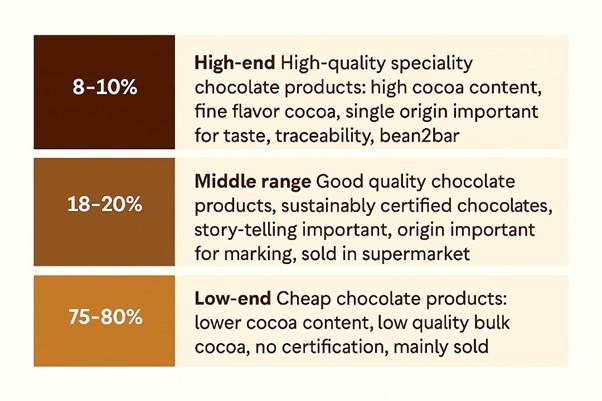
Source: Mordor Intelligence
In Italy, supermarkets remain the main sales channel for chocolate products. They stock a wide variety ranging from low-end to higher-end products. The largest supermarkets in Italy are:
- Conad (Consorzio Nazionale Dettaglianti, Italy)
- Coop Italia (Coop Group, Italy)
- Esselunga (Esselunga S.p.A., Italy)
- Selex (Selex Gruppo Cooperativo, Italy)
- Gruppo VéGé (VéGé Group, Italy)
Supermarkets also sell an extensive range of own-label chocolate products that continue to grow in popularity. These products offer the same characteristics as branded products but usually at lower prices. The total share of Italy’s private-label market reached approximately 30% in 2025.
Low-end
The low-end segment offers affordable chocolate products with lower cocoa content. It is primarily produced by large chocolate manufacturers using bulk cocoa from West Africa (Forastero variety). Bulk cocoa is characterised by high volumes, low value and standard quality.
Table 1: Examples of lower-end chocolate brands found in Italian supermarkets based on 2025 prices
| Product | Image | Price (€/kg) |
| Ritter Sport Dark Chocolate | 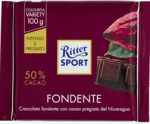
| 20 |
| Ritter Sport Gianduia | 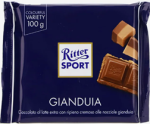
| 20 |
Middle-range
The middle-range segment includes chocolate products of good quality. They are mainly sold through supermarkets, alongside other everyday confectionery items. Mid-range chocolate represents a step up from low-end chocolate, with higher cocoa content and some origin notes. It appeals to consumers seeking quality without luxury prices.
The table below gives some examples of middle-range chocolate brands as well as an indication of consumer prices for these products.
Table 2: Examples of middle-range chocolate brands found in Italian supermarkets based on 2025 prices
| Product | Image | Price (€/kg) |
| Venchi Extra Dark Bar 75% | 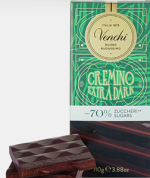
| 51.8 |
| Dark Almond bar with no added sugar | 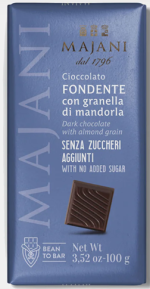
| 58 |
High-end
Smaller, more specialised chocolate makers produce high-end chocolate products, mainly using fine flavour cocoa (usually Criollo and Trinitario varieties). These products are characterised by a high cocoa content. Single-origin cocoa beans are important, for both the taste and the traceability of the cocoa. Bean-to-bar is one of the categories of the high-end chocolate market, with Italian brands like Karuna, Donna Elvira and Slitti.
While supermarkets stock high-end chocolates, specialty shops dominate the premium segment by offering deeper product differentiation and exclusivity. High-end products are also usually sold at chocolate events. Specialty shops in Italy include Chocolate7 and Chocolats-de-luxe. Examples of high-end chocolate makers/brands and an indication of consumer prices for these high-end products are given below.
Table 3: Examples of high-end chocolate brands found in Italian supermarkets based on 2025 prices
| Product | Image | Price (€/kg) |
| Amedi Toscana Ecuador Extra Dark Chocolate 77% Single origin | 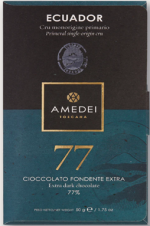
| 128.7 |
| Venchi Venezuela 85% bar | 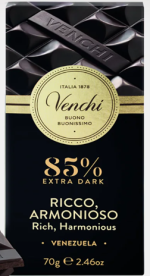
| 78.6 |
Tip:
- Try to establish direct trade relationships with smaller traders and chocolate makers to find shorter entry channels into the market. Explore what matters to them and learn more about how you can improve your cocoa quality. You might be interested in participating in one of the cocoa programmes of the Chocolate Institute, such as its cocoa-grading course or the speciality cocoa-growing training.
Through which channels does cocoa land on the end market?
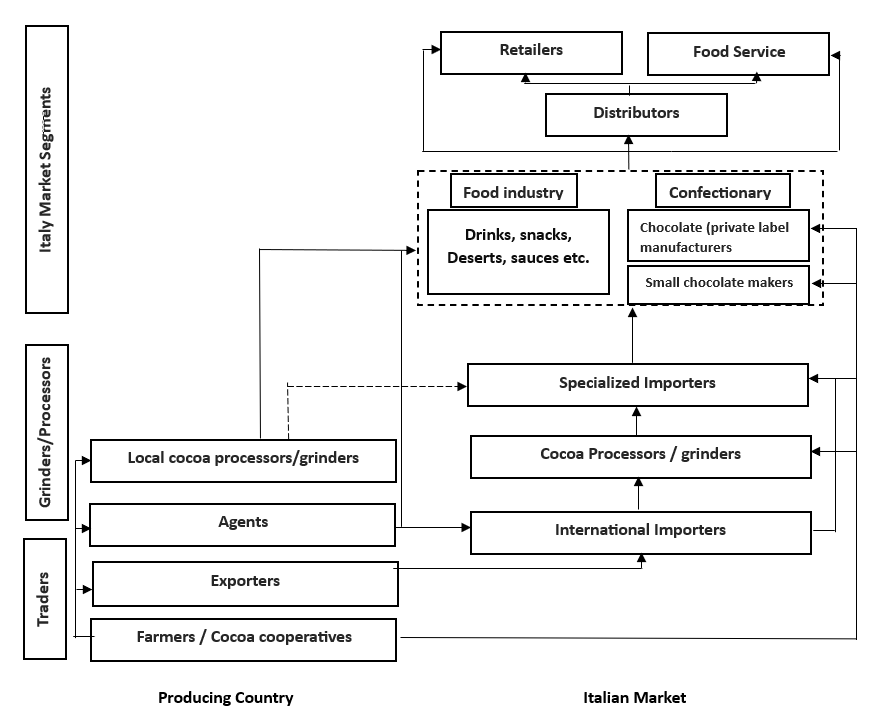
As an exporter, you can use different channels to access the Italian market with your cocoa. Entry into the market will depend largely on the quality of your beans and your supply capacity. The figure below shows you the most important channels for cocoa beans in Italy.
Figure 4: Visualisation of the supply chain for bulk cocoa in Italy
Source: Profound
Below is a brief description of each channel through which your cocoa can enter the Italian market.
Processors/Grinders
Big cocoa processors buy cocoa beans straight from the countries where they are grown. They turn the beans into cocoa mass, cocoa butter and cocoa powder. Then they sell these to companies in Europe that make sweets, food, cosmetics and medicines. Some processors also make finished products and sell them directly to shops or to the food service sector.
Companies that process/grind cocoa beans in Italy include chocolate manufacturers Barry Callebaut, Nestlé, Elah Dufour, Majani, Jacopey Cioccolato Peyrano, Agostoni and Ferrero.
If you export large volumes of bulk cocoa beans, your main trading partner is usually a cocoa grinder or processor. These companies buy big volumes of standard-quality beans. They often have cocoa-buying stations in producing countries where you can sell your beans directly. If you sell bulk cocoa, talk with your buyer about any certification they need.
Importers
Importers of bulk cocoa beans usually work with large volumes and deal directly with exporters in producing countries. These are mainly big international companies. Most importers have long-term relationships with their suppliers. They sell cocoa beans to companies in Italy or re-export them to other buyers in Europe. Overall, re-export volumes of cocoa beans from Italy are not very big.
Only a few Italian companies focus just on trading, and these are usually small. There is Cacao Dominicano, which also has an export office in the Dominican Republic, and Aurea Tradings, which works between Italy and El Salvador. Both companies mainly work in the specialty market and handle smaller quantities. Their offices in producing countries help them supply small and medium Italian companies directly.
Large importers are usually the main entry point if you export big volumes of bulk beans. This can be a good opportunity for farmers or cooperatives that have enough money and knowledge to reach the market directly.
Large (private-label) chocolate manufacturers
Several big chocolate makers work in the Italian market. Barry Callebaut, Nestlé and Ferrero not only export and process cocoa beans, they also make chocolate themselves. Other chocolate makers are ICAM and Caffarel. These companies have their own import teams and buy cocoa beans directly from the producing countries.
Private-label chocolate makers can be a good channel to sell your cocoa beans. Most big supermarkets in Italy have their own private-label chocolate. Other private-label chocolate makers in Italy are Walcor and Laica. Selling to these players is interesting if you have large volumes of cocoa beans of standard quality.
Small chocolate makers
In the specialty and fine flavour segment, more cocoa beans are sold directly by farmers (or their associations and cooperatives) to chocolate makers. This type of direct trade is growing, but is still a very small part of the cocoa market. Not all chocolate makers can manage direct trade and the tasks that traders usually handle, like logistics, paperwork and pre-financing.
Direct trade can also work with importers as middlemen. The importer provides services and is the main contact between the producer and the chocolate maker. Importers can also demonstrate traceability and share the true story of the cocoa beans along the supply chain.
There are many specialised bean-to-bar chocolate makers in Italy, like Amedei, Aruntam, Bodrato Cioccolato, Domori, Guido Castagna, Guido Gobino and Majani. Italian chocolate makers that focus on fairtrade cocoa include Quetzal and Libero Mondo.
Exporters
Exporters aggregate, grade and ship cocoa from origin. They handle logistics, financing, certification and traceability to meet Italian buyers’ requirements. They can place both bulk and specialty lots directly with Italian processors/grinders, importers or manufacturers. They often operate in origin labs and buying stations to secure consistent quality and documentation. Working with a reputable exporter helps cooperatives and SMEs meet EU due diligence, residue limits and sustainability standards. It also makes you able to negotiate freight and make sure that products are delivered on time.
Exporters that cooperatives or SMEs can partner with include Olam/ofi (in multiple West African origins), ECOM Agroindustrial (in Ghana and Côte d’Ivoire) and Touton (in Côte d’Ivoire and Ghana). These exporters can contract and consolidate volumes to supply Italian buyers efficiently.
Intermediaries/Agents
In cocoa trade, intermediaries/agents connect exporters, importers and chocolate manufacturers. Agents facilitate trade by navigating EU regulations and buyer requirements. They may operate independently or be contracted to source beans, using market expertise to link exporters with reliable buyers. Some cocoa brokers in Europe are H.C.C.O Hanseatic Cocoa & Commodity Office (Germany) and Amius (UK), which also serve Italian markets.
Tips:
- Find buyers in Italy who match your business philosophy and export capacities (in terms of quality, volume, certifications). For more tips on finding the right buyer for you, see our study on finding buyers on the European cocoa market.
- Attend trade fairs in Europe to meet potential buyers and learn about their needs. Relevant trade fairs include Biofach (Germany, specialised in organic products), Chocoa (Netherlands) and Salon du Chocolat (France). Attending such events can provide you with additional insight into the preferences of Italian buyers in terms of origin, flavour and sustainability certification. By understanding the market better, you can ensure that your specific product fits the demand and requirements.
- Connect to platforms or traders like Direct Cacao and Cocoanect; they help establish links between farmers and chocolate makers. Read more about direct trade and shorter cocoa chains in our study on trends in the cocoa sector.
What is the most interesting channel for you?
The best market channel for your business depends on your product, volumes and organisation. For larger producer groups (like unions) and exporters with proven experience, you can try to supply directly to bigger chocolate makers, if your product fits their needs. Some producers set up local processing to add more value, but this requires a lot of money and technical skills.
If you offer specialised cocoa, the most promising direct channels are often small chocolate makers and joint ventures with Italian companies. You can also take advantage of the growth of e-commerce in Italy through online retail stores if you make semi-finished cocoa products or chocolate. Read our study on the European market for semi-finished cocoa products.
Small chocolate makers
A producer group that sells specialty cocoa has the potential to benefit from selling directly to specialised cocoa importers or high-end chocolate makers. For this, you need sufficient money and technical skills to manage the exports yourself. Otherwise, you can go through middlemen or agents (see the next section).
Artisanal chocolate producers often seek high-quality, fine flavour beans and are willing to pay premiums for unique profiles. They emphasise direct trade with producers to ensure quality, traceability and sustainability. They typically require detailed information on the cocoa’s origin, processing, and certifications like organic or Fairtrade. Notable small bean-to-bar makers in Italy are Venchi, Amedei and Slitti.
Representative/Agent
If you have limited experience exporting to European countries, agents can play a very important role. Agents are also interesting if you have limited quantities of non-specialty cocoa or if you lack the financial and logistical resources to carry out trade activities. Working with an agent is also useful if you need a trusted and reputable partner within the cocoa sector. Be prepared to pay a commission for their work. COM.EX.IM. is one such agent in Italy.
Online retail stores
Online chocolate sales in Italy are expected to grow by about 7% per year until 2029. More consumers are buying chocolate on brand websites, curated marketplaces, and even subscription services. This growth is powered by home delivery, a wider choice of products, and the ease of checking prices and ingredients online. Growth is further boosted by demand for fast solutions, diverse selections and competitive pricing. The latter includes discounts that attract value-driven consumers.
For chocolate makers from producing countries, this could be an interesting channel. This digital transformation is allowing smaller, innovative chocolate makers to reach wider audiences without wide physical retail networks. Ghanaian Decokraft, for instance, sells chocolate to EU countries, including Italy, through e-commerce. Major sites like Amazon.it can offer user-friendly interfaces, secure payments and loyalty perks.
Tips:
- Use industry associations to find potential buyers in Italy, like the Italian Association of Confectionary Industry and Pasta Industries (AIDEPI).
- Invest in long-term relationships. Whether you are working through an importer or directly with a chocolate maker, it is important to establish a strategic and sustainable relationship with them. This will help you manage market risks, improve the quality of your product and reach a fair quality/price balance. For more tips, read our study on doing business with European cocoa buyers.
- Increase your visibility with social media. Refer to Dame Cacao’s series, which includes guides on social media basics for small businesses, using Instagram for your business, creating better Instagram content, building an engaged Instagram audience and making effective Instagram ads
3. What competition do you face on the Italian cocoa market?
Italy’s cocoa market is very competitive. Big suppliers lead the bulk segment and compete on volume. But the record-high cocoa prices of 2024 have made this market more difficult for small exporters to participate. The specialty segment is growing. Italian chocolate makers are focusing more on quality, flavour, traceability and sustainability. New rules, especially the EU Deforestation Regulation (EUDR), will also raise the bar. These rules increase entry costs and make competition tougher.
Which countries are you competing with?
Competition on the Italian cocoa market remains intense in the bulk segment. Major suppliers like Côte d’Ivoire, Ghana and Ecuador have sharply expanded their export volumes and continue to dominate. Small and medium-sized exporters still face difficulties competing here. However, the specialty cocoa segment has become more dynamic than in previous years. Growing contributions from origins like Ecuador and Peru reflect a growing emphasis on quality, flavour diversity and sustainability. While Côte d’Ivoire is a reliable source of bulk cocoa, its beans are often perceived as lower in quality compared to fine flavour varieties from regions like Ecuador or Peru.
Source: ITC calculations based on UN COMTRADE and ITC statistics
Côte d’Ivoire: Leading exporter of cocoa beans to Italy
Côte d’Ivoire remains the leading exporter of cocoa beans to Italy, supplying over 40,000 tonnes of cocoa beans on average to Italy in 2020-2024. This accounts for about 41% of Italy’s direct cocoa bean imports from producing countries. The cocoa industry has made significant investments in the country.
However, it faces substantial threats of decline in production. This is due to changing weather patterns and cocoa swollen shoot virus disease (CSSVD), endemic to West Africa. Its future sustainability hinges on addressing these threats effectively. In the meantime, it continues to serve as a dependable source of bulk cocoa to meet chocolate demand in Italy.
Côte d’Ivoire relies on a well-established cocoa supply chain. The conseil du Café-Cacao (CCC) is the regulating body in Côte d’Ivoire. The CCC is responsible for the management and promotion of the country’s cocoa sector. They sell 70-80% of the main crop before the harvest starts. Six multinational traders dominate Ivorian cocoa trade: Cargill, Barry Callebaut, ofi, Ecom, Sucden and Touton.
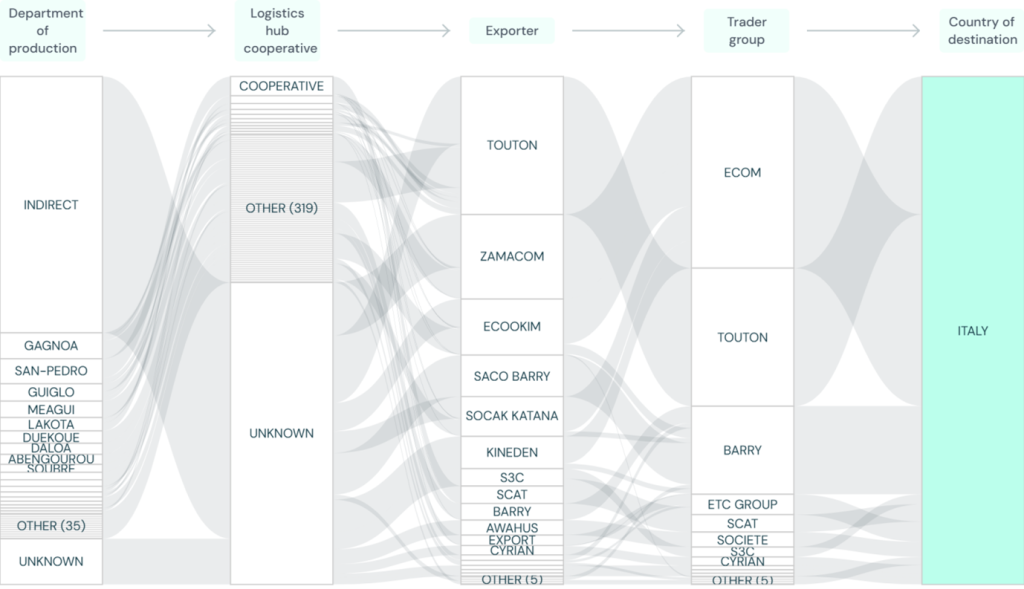
Côte d’Ivoire’s government wants to promote local participation and build a more resilient cocoa industry. Because of this, from 2022 onward it requires that at least 20% of cocoa beans from Côte d’Ivoire be handled/exported by local processors and exporters. This is because in the past major international players dominated the export market. These players use their stronger financial capacity to purchase and export nearly all available cocoa. This left local exporters unable to compete on equal terms, forcing about half of them out of business. This would mean that at least 159,000 tons of total bean exports from Côte d’Ivoire to Europe should be available to local exporters. Among the top-10 Ivorian exporters are AWAHUS, S3C and SCAT cooperative.
Figure 6: How cocoa from Côte d’Ivoire ends up in Italy
Source: TRASE 2024
Source: ITC calculations based on UN COMTRADE and ITC statistics
Côte d’Ivoire is not only Italy’s leading supplier of cocoa beans. It is also a key exporter of semi-finished products like cocoa butter and paste. Their volumes far exceed those of other suppliers, with Ghana ranking second in each segment but at roughly half of Côte d’Ivoire’s levels. This strong position reflects the country’s well-developed grinding industry. This industry has consistently expanded through investments by multinational processors like Barry Callebaut, Cargill and Olam.
Côte d’Ivoire exports not only raw beans but also value-added derivatives. This has allowed the country to make its influence over Italy’s cocoa supply chain stronger. In doing this, it gets greater value at origin while reinforcing its role as the dominant West African cocoa hub. This strong position is also supported by the reduction of export taxes on processed cocoa products for companies that expanded their processing facilities. Instead of a fixed rate of 14.6%, export taxes on cocoa butter were reduced to 11%, on cocoa paste to 13.2% and on cocoa powder to 9.6%.
Source: ITC calculations based on UN COMTRADE and ITC statistics
Ghana: Second-leading exporter of cocoa bean to Italy
Ghana is renowned for its high-quality cocoa beans, widely recognised for their strong flavour profile and consistency. Among bulk cocoa origins, Ghanaian beans are often considered premium. This makes them highly valued by Italian chocolate manufacturers. In 2020-2024, Ghana supplied nearly 68.7 thousand tonnes of cocoa beans to Italy. On average, they supply close to 13.7 thousand tonnes per year. This makes Ghana Italy's second-largest supplier after Côte d’Ivoire.
Beside beans, Ghana also supplies value-added derivatives such as cocoa paste, butter and powder. Ghana positioned itself as the largest supplier of cocoa powder to the market with more than 6.1 thousand tonnes. This sets it far ahead of competitors like India and Bolivia. The ability to export both raw and semi-finished products highlights the growing strength of Ghana’s grinding industry. Their industry has been strategically developed to capture more value within the country.
However, as in Côte d’Ivoire, Ghana’s cocoa sector is under significant environmental and biological stress. There are changes in annual rainfall, as documented by the World Bank (2023) and temperatures are rising. This places substantial pressure on production. This environmental variability is further compounded by the spread of CSSVD. The disease has led to an estimated 17% annual loss in production. It has affected over 592,230 hectares, representing an 88% increase in just six years. Illegal mining also poses a serious risk to Ghana’s cocoa farms. The combination of these factors is not only a danger immediate yields. It also threatens the long-term sustainability of Ghana’s cocoa industry.
As a response, the Ghana Cocoa Board (Cocobod) has put measures in place to rehabilitate the diseased farms for replanting. Also, Cocobod initiated a pilot programme to trace cocoa beans from farms to ports. They aim to comply with the European Union’s deforestation regulations through this programme. This makes Ghana particularly attractive to buyers interested in ethical sourcing and consistent quality, while meeting latest EU requirements.
In Ghana, the cocoa is purchased by licensed buying companies (LBCs) and then taken over by the Cocoa Marketing Company (CMC). The CMC then sells the cocoa to registered buyers and delivers it to the ports. In 2022, there were over 44 active LBCs. Many LBCs are owned by multinational traders, including Barry Callebaut. Some cocoa exporters and producers’ organisations from Ghana are ABOCFA and Kuapa Kokoo Co-operative Cocoa Farmers and Marketing Union Limited.
Source: ITC calculations based on UN COMTRADE and ITC statistics
Ecuador: The largest producer of fine flavour cocoa
Ecuador’s export of cocoa beans to Italy rose from 7,878 tonnes in 2020 to 13,235 tonnes in 2024. This is an increase of about 13.7% per year. Ecuador remains Italy’s primary Latin American cocoa supplier. However, challenges such as El Niño weather patterns, pests and aging cocoa trees have impacted yields and quality. This puts pressure on Ecuador’s fine flavour cocoa segment. Besides this, the stricter EU regulation on cadmium levels in chocolate presents a challenge for Ecuadorian cocoa producers.
To address these challenges, Ecuador has implemented significant reforms in its cocoa sector. Supported by international partners like the EU, FAO and UNDP, the country is introducing various maesures. These include national traceability systems, piloting deforestation-free certification schemes, and promoting good agricultural practices (GAP) among farmers. Initiatives like PROAmazonía and AL-Invest Verde are helping smallholder farmers adopt improved varieties, adapt to climate challenges and comply with the EU Deforestation Regulation (EUDR). These efforts are meant to ensure Ecuador remains a reliable supplier of fine flavour cocoa with strong traceability and sustainability credentials. It helps them meet the demands of Italy’s premium chocolate market.
Some successful exporters of cocoa beans from Ecuador are UNOCACE, COFINA, Ecuacoffee SA and Cacaos Finos Ecuatorianos SA.
Nigeria: Fourth biggest exporter of cocoa beans to Italy
Imports from Nigeria increased from 1,625 tonnes in 2020 to 8,659 tonnes in 2024, about 50.2% per year. Among cocoa-producing countries, Nigeria is also the top exporter of chocolate to Italy (Figure 10). However, international processors and exporters lead the Nigerian market. They have advantages over local exporters, like better access to money and technology plus lower interest rates. Barry Callebaut, for example, has an office in Nigeria.
Source: ITC calculations based on UN COMTRADE and ITC statistics
There are many local processors and exporters too, like FTN Cocoa Processing and Ile-Oluji. Local exporters include Sunbeth Global, Olatunde International, SAO Agro and Starlink.
Nigerian cocoa generally has a more variable quality perception on the Italian market compared to cocoa from Ghana and, to a lesser extent, Côte d’Ivoire. This is due to variable post-harvest practices. Upgrading fermentation and drying can improve quality and a good price increase can boost the competitiveness of Nigerian cocoa.
Deforestation is a serious problem in Nigeria. The United Nations says Nigeria has the highest deforestation rate in the world. Forest maps are not always updated. This makes it hard to check legal compliance with the EUDR. Some companies and farmers are mapping cocoa plots to get ready for the EUDR. Try to provide geolocations and prove your cocoa comes from legal sources. This will help you access the Italian market when the EUDR starts.
Peru: Stands out for its production of organic and high-quality cocoa beans
Peru has strengthened its position as a key supplier of organic and fine flavour cocoa. Peru’s export of cocoa beans to Italy rose from 3,515 tonnes in 2020 to 5,557 tonnes in 2024. In percentage, this is about 12.2% per year. This steady growth underscores the country’s reputation as a producer of high-quality and organic cocoa. Peru is also the second exporter of chocolate from origin countries to Italy (Figure 10).
Peru primarily produces Trinitario and Criollo beans. Approximately 75% of its cocoa exports is classified as fine flavour. Peru is the world’s second-largest producer of organic cocoa by area,. This makes it a critical supplier for Europe’s organic and specialty markets. However, just like in Ecuador the stricter EU regulation on cadmium levels in chocolate is a threat to the Peruvian cocoa industry. The national association APPCACAO has been instrumental in uniting farmers, exporters and institutions to promote Peruvian cocoa globally. Exporters like Ecoandino and Norandino supply high-quality organic beans to Italy. This supports the country’s premium chocolate industry with sustainable and traceable products.
Dominican Republic: Leading origin for organic and certified cocoa
The Dominican Republic (DR) is the sixth largest exporter of cocoa beans and the fourth largest exporter of cocoa paste to Italy. DR is one of the world’s most important origins for organic cocoa. In 2022, it was the largest supplier of organic cocoa beans to the EU, delivering 23,684 tonnes.
Organic cocoa production is deeply established in DR. In 2022, around 114,811 hectares – which is about 87.5% of the country’s cocoa farmland – were considered organic areas. This makes DR the second largest organic cocoa area worldwide after Sierra Leone.
Certification plays a central role. Much of the country’s organic cocoa is also Fairtrade-certified. However, the cocoa sector in DR is faced with low farm productivity. This is due to over 80% of producers being smallholders who mostly lack knowledge on improved production techniques. You may be able to improve cocoa productivity by expanding farmer knowledge, providing targeted training and ensuring access to cocoa-focused inputs.
One of its main suppliers is the Confederación Nacional de Cacaocultores Dominicanos (CONACADO). CONACADO is a union of cocoa cooperatives that promotes organic and Fairtrade certification. Other notable exporters are Rizek Cacao and Öko-Caribe. Beyond certification, CONACADO operates processing facilities with a capacity of 26,000 tonnes per year. It also collaborates with premium chocolate makers like Valrhona, including projects to map farm plots for traceability.
Which companies are you competing with?
Italy hosts some of the world’s leading chocolate producers and cocoa traders. This creates a highly competitive environment for cocoa exporters. The country imports both raw cocoa beans and semi-finished products. Depending on the segment you are operating in, your competitors are either large multinational corporations or smaller import traders and chocolate makers.
Major multinational corporations
Italy’s chocolate sector is dominated by giants like Ferrero, Nestlé and Barry Callebaut, alongside global processors like Cargill, Olam and ECOM. These companies often run processing facilities in cocoa-producing nations. It allows them to secure large volumes at lower costs. This approach is supported by favourable policies in producing countries. For example, in Côte d’Ivoire, the top cocoa producer, companies with expanded processing facilities benefit from reduced export taxes on processed products. In Ghana, the second largest producer, the Ghana Free Zones offer incentives to processing companies exporting at least 70% of their products. This includes tax exemptions on raw materials and machinery imports.
These multinationals leverage their scale to invest in sustainability initiatives and establish direct farmer partnerships. For instance, Cargill has expanded processing in Côte d’Ivoire and supports farmers through its Cocoa Promise programme, focusing on traceability and sustainability. Similarly, Barry Callebaut’s Cocoa Horizons initiative aligns with demand for ethical chocolate. Ferrero, known for Nutella and Kinder, has achieved 97% traceability for cocoa, aiming for 100% responsibly sourced cocoa.
These companies dominate Italy’s cocoa supply chain. Because of this, it is challenging for smaller exporters to compete. But you can become competitive by being a very reliable, transparent and responsive partner in specific niches. Focus on delivering consistent quality with bulletproof compliance and flexible contract terms. You should also build strong relationships with Italian buyers.
Small and medium-sized chocolate producers
Next to global giants, Italy’s market includes smaller chocolate makers. These companies focus on bean-to-bar production, sustainability and niche markets. They compete by emphasising quality, transparency and ethical sourcing rather than scale.
Karuna is a bean-to-bar producer working with smallholder farmers to create organic chocolates that highlight unique origins like Tanzania and Belize. Guido Castagna, a Turin-based craft chocolate maker, stands out for its meticulous bean selection and aging processes. They appeal to consumers seeking ethical products. Slitti, another smaller player, is known among chefs for sourcing fine flavour cocoa and maintaining strong ties with farmer cooperatives for consistent quality.
These smaller producers position themselves as premium, ethical alternatives to multinational brands. This resonates with Italian consumers who value traceability, craftsmanship and sustainability. Their focus on direct trade, and origin-specific cocoa appeals to buyers seeking transparency. Other notable players are Domori, Amedei, and emerging bean-to-bar brands. These are gaining traction as demand for traceable, high-quality chocolate grows in Italy.
Tips:
- If your business is small or has limited cocoa supply, consider partnering with other local cocoa companies to strengthen your position. Collaborative efforts can help produce high-quality, region-specific cocoa products to compete in Italy’s market.
- Differentiate your offerings to stand out. Competing with Italy’s major cocoa companies is tough, so highlight what makes your cocoa unique, such as specific flavour or sustainability attributes.
- To succeed as a chocolate exporter, it is essential to study your possible competitors. Analyse their business models, product offerings and highlighted characteristics. Research how they market their cocoa beans and relationships with cocoa-growing communities, as well as any awards they’ve received. Look at their websites for insights into their processing techniques and sustainability practices. Understanding these elements can help you find your unique selling point and make your product stand out on the market.
4. What are the prices of cocoa on the Italian market?
Cocoa prices in Italy align with global and EU trends, as the country relies entirely on imports for its cocoa supply. The market has experienced great instability over the past five years due to supply disruptions and growing demand. Prices peaked in 2023 and 2024 due to poor harvests and weather challenges in West Africa. As of 26 September 2025, the global cocoa price was $6,936.63 per tonne. This is down from a 2024 high of over $10,000 but still well above historical averages. Italy, a hub for major chocolate manufacturers, has seen these price shifts directly impact processing costs.
Retail chocolate prices in Italy have climbed steadily, particularly in 2023-2024. These are driven by high cocoa prices and broader inflationary pressures. Major brands and smaller bean-to-bar producers have raised prices to offset costs. Besides this, the EU Deforestation Regulation (EUDR), which Italy adheres to as an EU member, mandates traceability and deforestation-free sourcing by 30 December 2025 (or December 2026 if the delay proposal is approved). This would increase costs for sourcing cocoa due to compliance with the new EU laws.
Sustainable cocoa, such as Fairtrade- or Rainforest Alliance-certified products, commands premiums in Italy. Fairtrade cocoa carries a $240 per metric ton premium, with an additional $300 per ton for organic certification. Rainforest Alliance requires a minimum sustainability differential of $70 per ton. For exporters, meeting these strict sustainability and traceability standards is essential to enter the Italian market. But it may also offer opportunities for more profits.
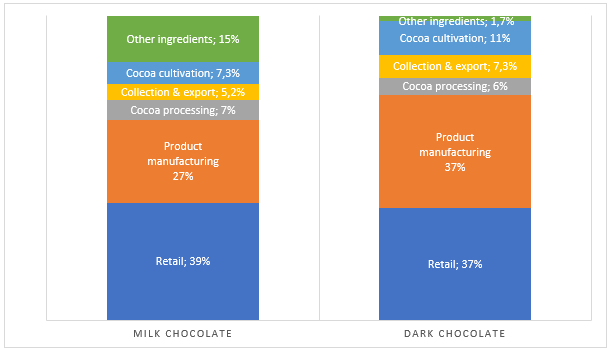
For exporters it is important to realise that trade and retail prices for chocolates are not always directly linked. As the figure below shows, depending on the end product in which cocoa beans will be used, between 7.3% and 11% of the added value goes to farmers. In general, cocoa bean export prices, and the share kept by cocoa producers, will depend on the beans’ quality, the size of the lot and the supplier’s relationship with the buyer. The largest shares are kept by chocolate companies and retailers.
Figure 11: Estimated value distribution per actor in %, for dark and milk chocolate.
Source: BASIC, 2020.
Tips:
- Research end-consumer prices of chocolate to get an idea of price ranges. Good sources for price information are the websites of supermarket chains and specialist chocolate stores – see the examples listed above.
- Visit the websites of Fairtrade and Rainforest alliance to get regular updates on premiums for cocoa.
- Visit the International Cocoa Organization (ICCO) website to get regular updates on cocoa prices.
Amonarmah Consults carried out this study in partnership with Molgo Research on behalf of CBI.
Please review our market information disclaimer.
Search
Enter search terms to find market research
Do you have questions about this research?
If you want to supply cocoa to the Italian market, clearly communicate the quality attributes of your beans to buyers. Consistency is also very essential. Italian chocolate makers value stable, high-quality cocoa more than quantity.

Antico Paolo, Pastry Chef and Managing Director at Antico Dolce Idea