
The German market potential for cocoa
If you are thinking about exporting cocoa to Germany, you are looking at Europe's largest economy and an important hub for cocoa processing. This is attributed because there are many multinational chocolate manufacturers that operate their production facilities in the German market. Because of this, Germany is an attractive market for cocoa exports.
Contents of this page
1. Country description: Germany
Germany is officially known as the Federal Republic of Germany. It is one of Europe’s most influential and economically powerful countries. Germany is located in Central Europe. It shares borders with nine countries: Denmark to the north; Poland and the Czech Republic to the east; Austria and Switzerland to the south; and France, Luxembourg, Belgium and the Netherlands to the west.
The capital of Germany is Berlin and the official language of the country is German. It is the country with the most people in the European Union, about 84 million people. With this population, Germany offers you access to a very big consumer market. The Port of Hamburg is your main entry point for cocoa imports. You can also get onto the German market through Bremen. Other ports through which cocoa is imported into Germany are the Port of Amsterdam in the Netherlands and the Port of Antwerp-Bruges in Belgium.
Cocoa products are exported to Germany under these trade classifications:
- Raw cocoa beans (HS code 1801);
- Cocoa paste (HS code 1803);
- Cocoa butter (HS code 1804);
- Cocoa powder (HS code 1805).
If you want to export any of these products to Germany, it’s important to understand the German market and its specific demands. In the next sections, we will find out more what makes Germany an interesting market for cocoa. We will also look at which type of products offer most opportunities and which trends you can take advantage of.
2. What makes Germany an interesting market for cocoa?
Germany plays a central role in the European cocoa sector. The country is a major importer and a leading processor of cocoa beans and semi-finished products. In recent times, there have been changes in import volumes caused by global supply constraints and price increases. Despite this, Germany’s demand for cocoa is still strong. This is thanks to its large chocolate manufacturing industry, strategic trade infrastructure, and growing consumer appetite for chocolate.
Germany is Europe’s second-largest cocoa grinder and an important hub for cocoa butter, paste, and powder imports. This means that Germany offers significant opportunities for suppliers from producing countries. This is especially true for suppliers that can meet the market's rising demand for traceability, quality, and sustainability.
Germany is a major cocoa importer
Germany imports around 19% of Europe's cocoa bean. It is the second-largest importer of cocoa beans in Europe. The Netherlands, which holds about 46% of total European imports (Figure 1), is the largest.
Source: EUROSTAT, 2025
Total German cocoa bean imports were nearly 400,000 tonnes in 2024 (Figure 1). Between 2020 and 2024, the total volume of cocoa beans imported by Germany went down slightly at a compound annual growth rate (CAGR) of 2.49% (Figure 2). This was, however, because of global supply challenges and rising prices over the years. This meant that the value of imports went up by a CAGR of 22.30% between 2020 and 2024 (Figure 3).
Source: EUROSTAT, 2025
Source: EUROSTAT, 2025
Côte d’Ivoire (122,780 tonnes), Ghana (21,403 tonnes) and Nigeria (19,941 tonnes) have been the most important exporting countries of cocoa beans to Germany (Figure 4). Direct imports from producing countries went down between 2020 and 2024 (CAGR = 6.49%) in volume but went up in value (CAGR = 18.6%) for the same period (Figure 5) because of higher prices. This was in line with the overall trend in Germany’s cocoa bean import.
Source: EUROSTAT, 2025
Source: EUROSTAT, 2025
Germany is a top importer of semi-finished cocoa products in Europe
Germany is one of Europe’s largest buyers of cocoa paste, cocoa butter and cocoa powder. It is Europe’s second-largest cocoa grinder. After grinding went down in 2020 because of the COVID pandemic, German grinding went up again in 2021. It went down a little in 2022 because of rising energy costs, but grindings recovered in 2024. EThis was happening while grinding volumes in the rest of Europe continued to go down.
Germany’s large chocolate consumer base and its important food-processing industry are the reason for strong demand for semi-finished cocoa products. The country is also a trade hub thanks to its central location and excellent logistics network. Some companies dealing with semi-finished cocoa products based in Germany are Stollwerck, Storck, Albrecht & Dill Trading, CARE Naturkost and Naturkost Übelhör (only organic-certified products).
Germany is the largest importer of cocoa butter in Europe, with a share of about 25%. The Netherlands is the second-largest (Figure 6). Total German cocoa butter imports were more than 180,295 tonnes in 2024. Between 2020 and 2024, the total volume and value of cocoa butter imported by Germany went up at a CAGR of 4.34% and 26.26% respectively.
Source: EUROSTAT, 2025
About 38% of total German imports of cocoa butter came directly from producing countries in 2024. Côte d’Ivoire (23,127 tonnes), Nigeria (8,824 tonnes) and Ghana (8,436 tonnes) were the biggest direct suppliers. Germany’s imports coming directly from producing countries went up between 2020 and 2024, at a CAGR of 12.18% in volume (Figure 7).
Source: EUROSTAT, 2025
Germany was the second-largest importer of cocoa paste in Europe in 2024 (Figure 8). They had a share of 18% of the European market. In total, Germany imported over 137,516 tonnes of cocoa paste in 2024. Between 2020 and 2024, the volume of cocoa paste imported by Germany grew at a CAGR of 8.03%. The total value of imports rose by 35% over the same period.
Source: EUROSTAT, 2025
In 2024, around 17% of Germany’s cocoa paste imports came directly from cocoa-producing countries. The main direct suppliers were Ghana (8,436 tonnes), Côte d’Ivoire (4,450 tonnes) and Cameroon (3,148 tonnes). Between 2020 and 2024, the volume of direct imports from producing countries grew at a CAGR of 4.9% (Figure 9).
Source: EUROSTAT, 2025
In 2024, Germany was the fourth-largest importer of cocoa powder in Europe (Figure 10). They had a 12% share of the market. That year, Germany imported a total of 36,026 tonnes of cocoa powder. Between 2020 and 2024, the volume of cocoa powder Germany imported went down a little, by an average of 3.24% per year. The value of imports, however, went up by 13% during the same period. This meant the prices of those imports went up as well (Figure 11).
Source: EUROSTAT, 2025
Source: EUROSTAT, 2025
In 2024, the main cocoa producing countries that supplied cocoa powder directly to Germany were, Malaysia – 939 tonnes, Indonesia – 384 tonnes and Côte d’Ivoire – 37 tonnes.
Germany has growing interest in sustainable and ethical cocoa
Companies in Germany are very interested in making cocoa production more sustainable. This means that sustainability and ethical sourcing have become important themes in the German chocolate market. Companies are using responsibly farmed cocoa more often through different commitment programs. They are also working directly with farmer groups to help them with sustainable practices.
The German Initiative on Sustainable Cocoa (GISCO) shows commitment to sustainability. GISCO is a partnership between the German government (through the Ministry for Economic Cooperation and Development and the Ministry of Food and Agriculture), the chocolate and sweets industry, food retailers, and civil society.
GISCO’s goal is to make sure that cocoa farmers and their families earn better incomes. They also want to protect the environment in cocoa-growing countries, and increase the amount of cocoa that is grown and sold in a sustainable way. The members of GISCO have promised to work towards these goals. By 2030, the goal is for at least 90% of cocoa-farming families, whose main income comes from cocoa and who supply the German market, to earn a living income. GISCO also wants 95% of cocoa used in German products to be sustainable by the end of 2025. Germany also has laws to protect human rights in the supply chains of cocoa products. These laws ensure companies respect workers and protect the environment.
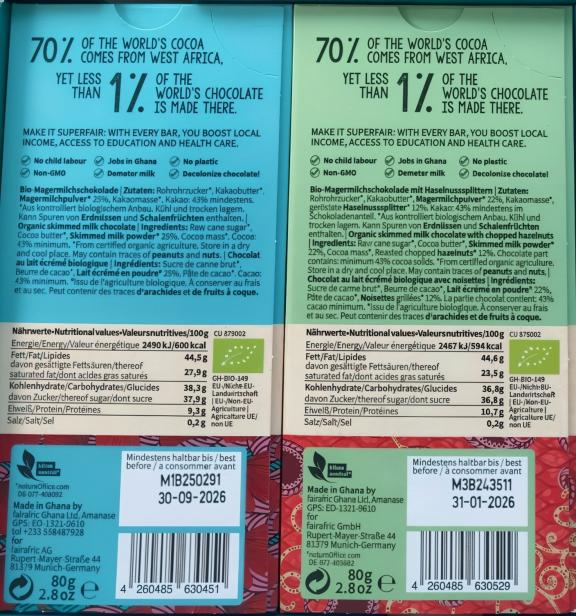
Today, about 75% of cocoa products sold in Germany have at least one sustainability label. This shows the German cocoa industry's response to growing consumer awareness about environmental and social responsibility. This trend is clear in the higher-priced segment, where customers are happy to pay more for products that have good sustainability features. For example, Fairafric chocolate, which is made in Ghana and sold in Germany, labels their chocolate as organic (Figure 12). Overall, sustainability is becoming more important in Germany. This creates good opportunities for exporters of responsible cocoa products.
Figure 12: Fairafric chocolate labelling
Source: Amonarmah Consults
Germany imports and consumes lots of chocolate
Globally, Germany is the fifth largest importer of chocolate and other food products that contain cocoa from cocoa-producing countries. Germans eat an average of 11 kg of chocolate per capita annually, making them one of the biggest consumers in the world. The biggest suppliers of chocolate and food preparations containing cocoa to Germany are Côte d’Ivoire, Colombia, Thailand, Mexico, and Ghana. As the world’s top exporter of chocolate products worldwide, Germany also plays an important role in global exports.
The German chocolate market gives exporters challenges and opportunities. Despite rising cocoa prices, volume sales stabilised in 2023, showing a 0.8% rise after a drop in 2022. With a chocolate market value of $10.4 billion in 2024, Germany had a 9.2% growth in value sales. It is thought to be at 10.92 billion USD in 2025, and will reach 13.98 billion USD by 2030, growing at a CAGR of 5.07% from 2025 to 2030.
Tips:
- Have a look at the website of the Port of Hamburg to learn more about the port itself and opportunities for cocoa.
- Use EU Access2Markets to analyse European and German trade dynamics and design your export strategy. If you select Germany as your reporting country, you can follow developments such as trade flows with established suppliers, the emergence of new suppliers and changing patterns in direct and indirect imports.
- Find out more about Germany’s import procedures and tariffs and your own country’s export procedures and regulations.
- Clearly communicate your commitment to sustainability on packaging and marketing materials. This is a good way to attract German consumers who want to buy ethical products.
- Read more about Germany’s Commitment for Sustainable Cocoa on the website of the Federal Ministry of Agriculture, Food and Regional Identity.
3. Which cocoa products offer the most opportunities on the German market?
German consumers often prefer high-quality and ethically produced cocoa products. This is because they are thinking about health, sustainability and taste. This means that there are promising opportunities in segments such as high-quality chocolate, organic cocoa, single-origin products, and certified cocoa. Cooperatives, chocolate producers and exporters that are in line with these trends can secure a competitive position in the German market. They can do this by offering distinctive flavours, transparent sourcing, and verified standards.
High-quality (premium) chocolates
Germany’s imports of chocolate and cocoa-based products show an upwards trend as seen in the previous section. This means that there are more opportunities for cocoa origin exporters. Such products from cocoa origin countries are usually seen as premium compared to what is produced locally in Germany or within Europe. This is because of their high cocoa content and because they meet strict German sustainability requirements. German consumers see chocolate as premium when it has a high cocoa content and is made with sustainable ingredients. That is why the German market shows a lot of interest in high-quality (premium) chocolates. This includes chocolate with unique flavours and textures, and vegan options.
Consumers in Germany are eating more dark chocolate. Examples of brands that sell dark chocolate options are the Ritter sport, Zotter and Fassbender & Rausch chocolate brands. Auro Chocolate (Philippines) and Fairafric (Ghana) are also examples of origin-made chocolate brands that are getting more in Germany.
German consumers also like fine-flavour chocolate. Rausch is a German chocolate company that is famous for its commitment to fine-flavour cocoa. They produce 100% pure fine-flavour cocoa, which is unbelievably rare. They make their chocolates with simple methods to keep the cocoa’s natural rich taste. This makes them stand out in Germany’s premium chocolate market.
Rausch sources from specific cocoa plantations around the world, in countries like Costa Rica, Ecuador, Grenada, Madagascar, Peru and Venezuela. Each of these countries has its own special aroma profile. They get fine flavour cocoa through direct trade and deliberately avoid middlemen. They also work closely, personally and long-term with the cocoa farmers.
About 47% of German chocolate consumers say they are happy to try new flavours. As a cocoa exporter, or origin chocolate company, you can offer cocoa with unique flavours or special origins that support innovation. Vegan chocolate is also becoming more popular, especially with young people. Around 23% of consumers aged 16 to 34 say they would try a chocolate if it was vegan. But in 2024, the growth of vegan and vegetarian chocolate became slower. This means the market is still young and developing. That is why it is important to watch this trend, but do not fully rely on it yet.
Younger German consumers also like chocolate with special textures, and chocolate bars with two or more flavours. These are more attractive to people between 16 and 44 years old. Origin chocolate makers can make these types of chocolate to appeal to the young German consumers. Cocoa exporters can also work together with chocolate makers to develop vegan-friendly or multi-flavour products that younger consumers like. If you keep in mind what is popular, such as vegan options and creative flavour combinations, you will find it easier to position yourself in the changing German chocolate market.
Organic cocoa beans and chocolate products
Germany is the biggest market for organic food in Europe. In 2024, about 97% of households bought organic products. Germany's organic food sector broke records in 2024 with €17 billion in sales. The yearly growth from 2023 to 2024 was 5.7 % compared to 2.1 % for non-organic food products. This means that consumers are interested in food products made in a natural way that does not harm the environment. They are happy to pay a premium for products that are in line with their values.
Germany’s successful organic and healthy food sector is a niche opportunity for exporters who offer organic certified cocoa. Its leading position in Europe’s organic food market makes demand for organic cocoa and chocolate higher. This means that Germany is Europe’s biggest buyer of organic cocoa. Organic cocoa import went down in 2023 but started rising again in 2023 (Figure 13).
The organic chocolate confectionery market is also growing steadily (Figure 15) and will probably reach 65.5 million USD by 2028 with a CAGR of 8.4%. The growth is mostly driven by growing consumer awareness of health and environmental issues. However, although Germany’s general organic market is moving from niche to mainstream, the market for organic chocolate is still a small (but growing) segment. This gives organic cocoa exporters lots of opportunities.
Source: TRACES 2025
Single-origin cocoa beans and chocolate
Germany has a growing group of careful buyers who look for high-quality and ethically produced products. This group likes single-origin cocoa because they think it has a unique flavour profile and they know where it comes from. It also has a story that consumers can connect with.
In 2022, reports said that 75% of German consumers preferred single-origin chocolate over standard varieties. This shows a broader trend towards awareness about quality and where the chocolate comes from. The dark chocolate segment, which people often link to single-origin products, is becoming the fastest-growing chocolate category. The growth rate will probably be about 6% until 2029.
Cocoa cooperatives can improve their presence in the German market by partnering with specialty retailers, bean to bar makers, and premium chocolate brands. These premium buyers are often small or medium-sized chocolate makers who look for special cocoa varieties and flavours. They sometimes get their cocoa directly from specific origins. They value quality and often explain the cocoa’s origin and story on their packaging. By sharing real stories about farming, the land, cultural heritage, and social impact, cooperatives can build emotional connections with German consumers.
For example, the Kuapa Kokoo cooperative in Ghana partners with Weinrich Schokolade in Germany to supply cocoa that is used for Divine chocolates in the UK. This brand is known for its farmer-owned model and ethical sourcing.
Certified cocoa is important on the German market
Germany has a strong market for certified cocoa. This type of cocoa is used in Germany, but also re-exported to other European countries. Germany is the fourth-biggest importer of Rainforest Alliance cocoa in Europe. It has the highest number of RA Certified members. About 45% of German consumers know about the Rainforest Alliance brand.
Germany is also seen as one of the main European markets for Fairtrade-certified cocoa, alongside the United Kingdom, the Netherlands, Ireland, and Switzerland. Although sales of Fairtrade cocoa beans went down by 1.4%, to 80,300 tonnes in 2023, the market share stayed the same, at 17%. Germany is home to GEPA – The Fair Trade Company, one of Europe's largest Fairtrade organisations and a founding member of the European Fair Trade Association (EFTA). CONACADO, a union of cocoa cooperatives in the Dominican Republic, successfully entered the German market by offering organic and Fairtrade-certified cocoa.
The proportion of certified cocoa in German confectionery has mostly been going up steadily since 2011. In 2011, only 3% of chocolate confectionery in Germany used certified cocoa. But this went up to around 81% by 2022, and the share is still growing (Figure 14).
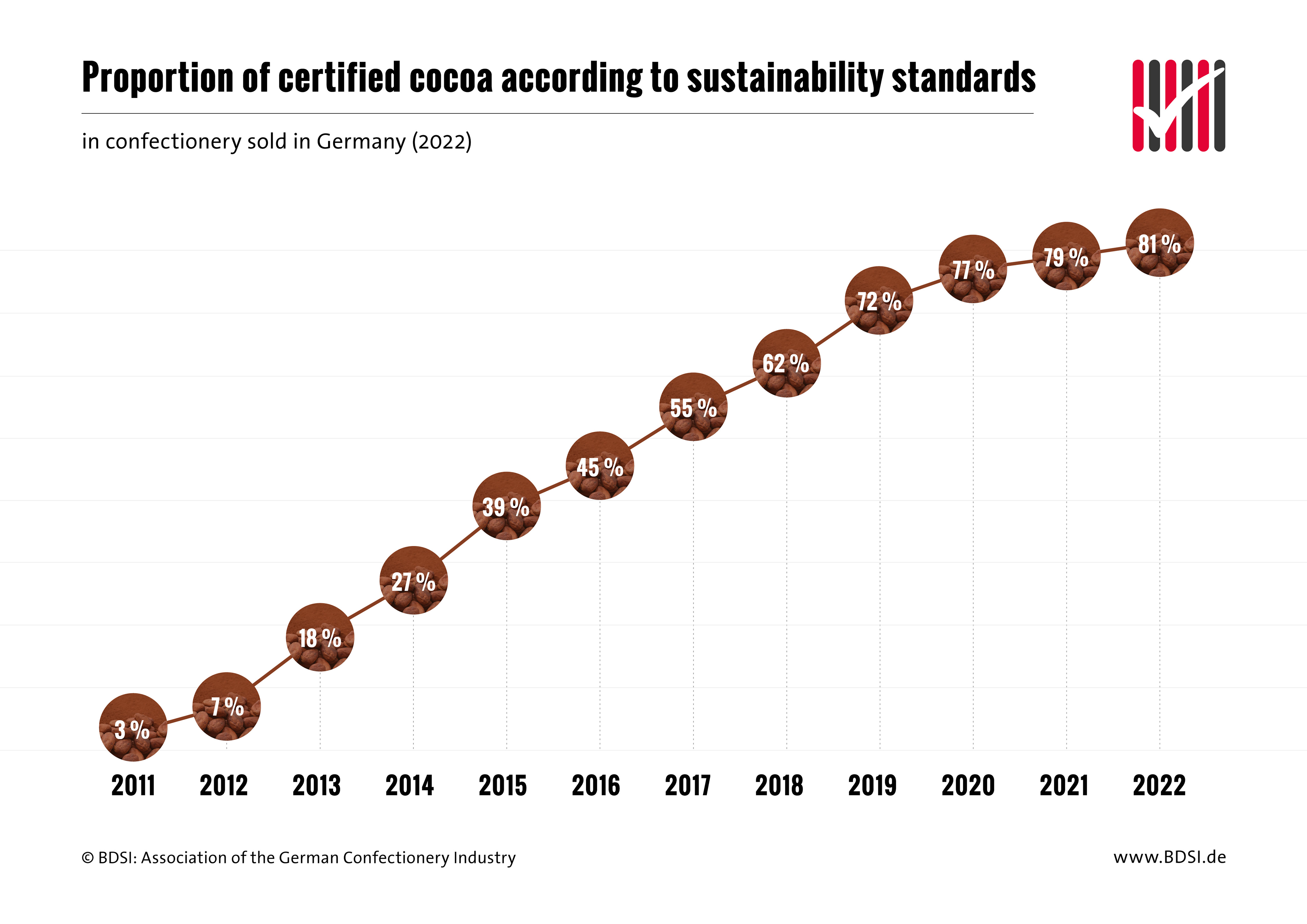
Source: Association of the German Confectionery Industry, 2022
Retailers are very important if you want to sell certified cocoa. In Germany, retail is controlled by a few large companies. In 2020, four big supermarket groups — Edeka-Group, Schwarz-Group (Lidl and Kaufland), REWE Group, and Aldi (Süd and Nord) — sold about 80% of all food in Germany. These retailers mostly use Rainforest Alliance and Fairtrade labels, and fewer products have organic or special labels. As an example, REWE wants to reach 100% certified cocoa soon.
Most cocoa products in Germany are made by private label companies like Stollwerck and Storck. At Aldi Süd, all cocoa products are certified, and at Aldi Nord, 99% are certified. Examples of local importers are Albrecht & Dill Trading and Walter Matter. The biggest chocolate brands are Milka (owned by Mondelēz), Ritter Sport and Lindt & Sprüngli. These three brands sell more than 57% of all chocolate bars in Germany. They all use certified cocoa.
To be successful in the German market for certified cocoa, exporters from developing countries should prioritise obtaining well-known certifications like Rainforest Alliance and Fairtrade. It is also important to focus on building relationships with key importers, private label manufacturers, and major supermarket groups. This is especially important when you attend cocoa events. It is also important to keep the retailer’s sustainability goals in mind. You should also make sure that the quality is consistent and that you know where the products came from. If possible, make sure that you have a local presence in Germany. Stay informed about changing market trends and certification requirements. This helps you stay competitive and meet the expectations of both retailers and leading chocolate brands.
Tips:
- Go to German or European trade fairs such as ISM Cologne or Chocoa in Amsterdam. This will give you a good platform to show your cocoa and chocolate products, meet German buyers face-to-face, and set up long-term business relationships. These events are great opportunities to promote the cooperative’s values, quality, and certifications directly to important industry players.
- There is a large and growing demand for certified cocoa in Germany. Use the Rainforest Alliance certificate database to search for certified companies in Germany as potential buyers. Also, check the Fairtrade Business Catalogue for Fairtrade and organic certified chocolate companies in Germany. You may have an advantage as an exporter if you are ready to export certified cocoa.
- Read our studies on The European market potential for certified cocoa and Entering the European market for certified cocoa for more information on Supply and Demand of the different certification labels.
- When you apply for certification, always think about the real costs compared to potential market opportunities and extra revenue.
- This website has a list of cocoa importers and buyers in Germany.
4. Which trends offer opportunities in the German cocoa market?
Germany is one of the largest cocoa markets in Europe. It is very focused on sustainability, digital innovation and premium products. If exporters and producers understand the important trends that shape this market, this will help them to make the most of their strategies.
Sustainability takes centre stage
Germany is leading the way in the promotion of sustainable cocoa sourcing. This is clear from initiatives like the German Initiative on Sustainable Cocoa (GISCO) that we mentioned earlier. Also, two very important European regulations that want to promote sustainability are the EU Regulation on Deforestation-free Products (EUDR) and the Corporate Sustainability Due Diligence Directive (CSDDD). We will talk about these regulations in the following sub-sections. They are in line with Germany’s 10-Point Plan for a Sustainable Cocoa Sector. This plan was updated and presented in January 2025 and focuses on:
- living incomes for farmers as a human right;
- deforestation-free cocoa;
- strong support for certified cocoa (Fairtrade, Organic, Rainforest Alliance);
- promotion of agroforestry (growing trees and crops together on the same land) and organic cocoa as climate-friendly income sources.
Thanks to these initiatives, Pro Planteurs project in Côte d’Ivoire, supported by the German government, has successfully helped 30,000 cocoa-producing families to start using sustainable practices. In this way, their incomes and living conditions have improved.
The growing consumer awareness, environmental concerns, and regulatory pressures are still driving the demand for sustainably sourced cocoa. The bulk and premium segments are feeling the effects of regulatory requirements more. Examples of these effects are the EU Deforestation Regulation (EUDR) and other due diligence obligations. Premium cocoa buyers and chocolate makers are already focusing on sustainability and where the cocoa comes from. But many medium-sized and larger companies are still getting used to these new expectations about compliance.
For exporters, this means that although the bulk market offers big volume opportunities, the premium segment is smaller but it is still open to unique, high-quality, and well-documented cocoa. Understanding the needs of potential buyers and whether they are ready to comply is crucial for a successful entry into the market.
Cocoa exporters who can really show how they meet buyer requirements and the regulations that come with that have an advantage when they enter the German market. In the short-term, compliance with sustainability standards will become more and more mandatory. In the long term,sustainability will still be a critical factor as consumer demand for ethically produced cocoa products goes up.
European Union Deforestation Regulation (EUDR)
The EU Regulation on Deforestation-free Products was officially adopted and started on 29 June 2023.
It has 3 main goals:
- Stop companies from selling products in the EU that are linked to deforestation.
- Reduce greenhouse gas emissions caused by deforestation by making sure products that come into the EU are deforestation-free. The goal is a yearly reduction of at least 32 million metric tonnes of carbon.
- Stop the loss of global biodiversity.
The EUDR bans imports of cocoa products from land that was deforested after 31 December 2020 into the European Union (EU). This means that all companies that import cocoa into the EU need to make sure their products did not cause deforestation. Companies must also provide data on where their cocoa was grown, and if this was done legally. This requirement starts in December 2025 for large operators and June 2026 for small and micro businesses. Large operators are companies with 250+ employees and over €50 million in annual turnover. Small businesses have fewer than 50 employees and an annual turnover below €10 million. Micro businesses usually have less than 10 employees and an annual turnover below €2 million.
The Corporate Sustainability Due Diligence Directive (CSDDD)
This directive started on 25 July 2024. However, the European Union's Omnibus Package, introduced in February 2025, has brought important changes to the CSDDD. The goal is to reduce the number of rules and make it easier to compete for companies operating within the EU, including companies that export to Germany.
The CSDDD sets common sustainability standards for all EU member states, including Germany. It applies to both EU-based companies and non-EU companies operating within the EU market. The CSDDD says that companies must put due diligence processes in place. These processes must identify, prevent, reduce and explain negative impacts on human rights and the environment throughout their operations and supply chains.
Because of the omnibus package, new deadlines were set for the CSDDD to give companies more time and reduce paperwork:
- Companies with 5,000+ workers and €1.5 billion turnover: must follow the rules by July 2027;
- Companies with 3,000+ workers and €900 million turnover: by July 2028;
- Companies with 1,000+ workers and €450 million turnover: by July 2029.
Businesses that export cocoa or cocoa products to Germany can comply with the CSDDD by setting up codes of conducts focused on:
- business ethics;
- social responsibility, including the fair treatment of workers and farmers and making sure they earn living incomes;
- environmental responsibility, dealing with issues such as carbon neutrality, biodiversity preservation and the prevention of deforestation.
These codes of conduct will be guiding principles for business operations. They will also be important for businesses to show that they are following the CSDDD requirements.
Businesses need to check their direct suppliers that are seen as Tier 1 suppliers. Indirect suppliers should be checked only if there is a known risk or a complaint. Businesses must review and report on risks every five years, instead of every year, as was planned originally. These changes give cocoa exporters more time to get ready. As an exporter, you should focus on working closely with direct suppliers and making your supply chain more transparent and responsible, in line with the regulation requirements.
Digital transformation and e-commerce growth
Germany has a high Internet penetration rate. At the start of 2024, Germany's Internet penetration rate stood at 93.3% of the total population, with 77.70 million internet users. This is a small increase of 165,000 users (+0.2%) compared to January 2023.
Germany's strong digital infrastructure has caused a big rise in online chocolate sales. The online retail segment is projected to grow at around 6% every year until 2029. This trend will probably lead to more competition and a need for strong digital marketing strategies. So, in the long term, we can expect that advanced technologies like AI will be used for personalised shopping experiences and to make the supply chain more transparent.
In 2023, for example, online chocolate sales in Germany increased by 15%. This happened thanks to direct-to-consumer (DTC) channels and personalised digital marketing campaigns from brands like Ferrero and Milka. E-commerce platforms offer features like home delivery and click-and-collect services. They are a good way to respond to changing consumer preferences.
Technological advancements and changing consumer behaviours making online shopping more popular. Consumers more often prefer the ease of online shopping. Companies are leveraging digital platforms to reach wider audiences. Ghanaian chocolate makers like Fairafric, Chocoluv Ghana, 57chocolate, Bioko treats and Kabi chocolate reach more people, including consumers in Germany and other European countries, through e-commerce. This shows how SMEs from developing countries can use e-commerce to enter the German market.
Small and medium-sized enterprises (SMEs) can use e-commerce platforms like Amazon.de or create their own online stores to sell value-added cocoa products directly to consumers. Sharing real stories and what they do to improve sustainability can make a brand more appealing for consumers.
Volatile but high cocoa prices
Cocoa prices have changed a lot in a short time. In 2023, the price was around 2,500 USD per tonne. In 2024, it went up to over 10,000 USD per tonne. This big rise is mostly because of bad weather and diseases in cocoa-growing countries. These problems made it hard to grow enough cocoa, so there is now less cocoa on the market. When supply goes down, prices go up.
For cocoa exporters in producing countries, this can be both good and bad. The good part is that you can earn more money now if you have cocoa to sell. Buyers are looking for good-quality cocoa that is produced in a fair and sustainable way. If exporters can offer that, they might get better deals. But the bad part is that high prices also scare buyers. Many companies are now more focused on price and consistent supply than quality, especially now that cocoa prices are so high. Some buyers may stop buying, buy less, or look for cheaper products and sometimes lower the cocoa content in products to save costs. Others may also start using non-cocoa ingredients such as cookies to keep the prices the same and still stay within their budget. This trend is seen more in periods of high cocoa prices, and it makes income less stable for exporters.
To manage these risks in the short term, you can make contracts with buyers ahead of time to fix the price. You can also work closely with farmers to make sure they have enough good-quality cocoa. In the long term, exporters should help farmers use better farming methods that can deal with bad weather and disease. Exporters who invest in quality, sustainability, and strong partnerships will do better in the future, even if prices go up and down.
Steady growth in demand for organic and health-conscious products
Germany's organic chocolate market is growing at a steady pace. The organic chocolate market will probably grow at a compound annual growth rate (CAGR) of around 6.5% to 7% until 2028. Many German consumers are becoming more health conscious. They are interested in products that are healthier, such as dark chocolate, chocolate without sugar, vegan chocolate, and chocolate made with organic ingredients. This trend is part of a bigger focus on health and wellness across the country.
For chocolate makers from producing countries who want to try to get into the German chocolate market, this trend offers a good opportunity. Consumers are looking for chocolate that is not only tasty but also seen as healthy and clean. You can take advantage of this trend by developing organic chocolate products and clearly showing the health benefits in your marketing. For example, you can promote dark chocolate with a high percentage of cocoa or offer vegan-friendly options made with natural ingredients. But you must also be ready to compete, because many companies are trying to enter this market. The niche markets for health-oriented chocolate products will probably keep growing steadily in the short and long term.
Tips:
- Build your own online shop using platforms like Shopify to sell value-added products such as chocolate bars and cocoa nibs directly to German consumers. Focus on consumers who are looking for ethical brands that show where the product comes from. Sharing real farmer stories and the impact of sustainability through social media creates more consumer engagement. If you have a fairtrade certification, listing products on sustainable B2B marketplaces like Fairtrade Finder can also open new export opportunities for you. E-commerce offers better margins, brand visibility, and direct access to conscious consumers in Germany.
- Create a strong online presence through a professional website and social media to talk to customers and show them your products.
- Read our study on 8 tips to go green in the cocoa sector and 9 tips on how to become more socially responsible in the cocoa sector if you want more information on how to be a responsible supplier who follows the sustainability requirements.
- Also read our study, What requirements must cocoa meet to be allowed on the European market?
- Read the CBI Trends Study on Cocoa for more insights into trends in the sector.
Amonarmah Consults carried out this study in partnership with Molgo Research and Ethos Agriculture on behalf of CBI.
Please read our market information disclaimer.
Search
Enter search terms to find market research
Do you have questions about this research?
Despite the strong push for sustainability and ethical sourcing, many mid-sized companies are still struggling to comply with new regulations like the EUDR. Some hope to meet the minimum requirements or count on traders for due diligence. This means that although interest in sustainability is high, cocoa exporters should be ready to support buyers with good documentation and traceability to help them meet these changing legal demands.

Dr. Silke Elwers, VP Product Integrity - COOKO