
The Digital Product Passport brings greater transparency to the European apparel market

The European Union’s (EU) new Digital Product Passport (DPP) regulation aims to provide radical transparency to consumers by 2027. It answers questions such as: How was an apparel item made? Which materials were used and what was their origin? Which parts can be reused? The DPP has serious consequences for supply chain partners, including small and medium-sized enterprises (SMEs) exporting apparel products to the EU. How must you adapt?
Demand for transparency and traceability
The Digital Product Passport is a standardised digital document that can be accessed via the hangtag of an apparel item. This digital document contains detailed information about a product’s:
- Composition
- Origin
- Production
- Environmental impact
- Use
- Reusability.
The DPP intends to close the gap between consumer demands for transparency and the lack of reliable product data. The EU aims to promote traceability and make it easier for consumers to choose sustainable apparel.
Legal responsibilities
The EU still needs to decide on some details for the DPP. For example, if all apparel items are included and if the data needs to be provided for every single product, or for entire batches. How much detail should be provided, and who is responsible if data is incorrect, also still pends. What is clear is that the DPP will ask for much more supply chain data from European brands and retailers than they currently can provide.
In many cases, buyers push these legal responsibilities to suppliers. They, in turn, are rarely compensated fairly for the financial and operational costs. Meeting DPP requirements can demand a major investment in time, IT systems, and processes. This is a particular challenge for SMEs, who dominate the sector but often have limited resources. If cost increases are not reflected in pricing, suppliers are left with greater risks and smaller margins.
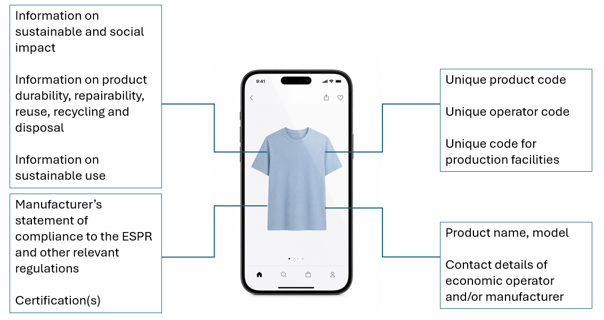
Figure 1: Proposed information required to be included in the Digital Product Passport
Source: FT Journalistiek
Prepare, but carefully
The best way forward if you represent an SME is first to ask EU buyers about their requirements. In any case, prepare carefully. Do not make any major investments in IT systems before you are certain that they will pay off, because not all details of the regulation are known yet. What you can do is start mapping your supply chain and collect data. First for models, not yet for batches or individual items. You can collect data on:
- Composition
- Care
- Design features
- Durability and repairability
- Certifications
- Environmental impacts.
The next step is a bigger challenge: verifying the data to ensure compliance. If an SME cannot invest in software systems right away, they should at least keep an accurate administration and keep proof on paper by saving purchase orders, invoices, bills of materials, production records and certificates. It is best not to blindly trust information suppliers provide, but to provide a standard information form and cross-check with invoices. Check and test materials regularly.
Helpful tools
If you do want to invest in a digital platform to help collect and verify data, choose carefully. A platform should fit your needs and preferably be compatible with your other software systems (ERP) and those of buyers. A practical approach is to follow leading companies and align with the most widely used platforms. For example, check the following (paid) software systems for supply chain transparency:
Make sure to inform about the costs. Tools such as bAwear, Ecochain and the Higg Index are specifically made to calculate the environmental impact of different garments.
Competitive advantage
Complying with the Digital Product Passport can be difficult, but it also creates a clear opportunity at the same time. Apparel manufacturers that can provide European brands and retailers with practical guidance on the type of data that need to be collected will have an immediate competitive advantage. Many European buyers currently lack almost all data on fibre origin, material composition, and the environmental impact of most production processes, including spinning, knitting, weaving, washing, dyeing, finishing and printing. Any data that you can provide is usually progress.
Organisations such as CBI or ITC, and national industry associations, can support you with coaching and provide information on digitalisation in the apparel industry. Innovation platform CIRPASS-2 provides the latest news on testing the implementation of the DPP. The Centre of Excellence DPP provides information, events and webinars on the DPP.
Learn more
Read the CBI study What requirements must apparel meet to be allowed on the European market?
FT Journalistiek wrote this news article in partnership with Giovanni Beatrice for CBI.
Stay informed
To stay informed on the latest developments in the apparel sector, subscribe to our newsletter.