

Entering the European market for software testing services
The European software testing market offers good opportunities for specialised providers from developing countries. On the European market you need to comply with mandatory requirements and additional requirements that buyers may have. Finding and partnering with European software developers or specialised testing companies is the easiest possibility for market entry. Since competition is strong, you should differentiate through quality, specialisation, innovation, and expertise instead of relying purely on cost.
Contents of this page
- What requirements and certifications must software testing services meet to be allowed on the European market?
- Through which channels can you get software testing services on the European market?
- What competition do you face on the European software testing services market?
- What are the prices of software testing services on the European market?
1. What requirements and certifications must software testing services meet to be allowed on the European market?
To enter the European market for software testing services, you must comply with various mandatory (legal) requirements. On top of that, your buyers may also have requirements. Niche markets may also have specific requirements.
The general market entry requirements for IT and business process outsourcing (ITO and BPO) are listed in our buyer requirement study for outsourcing providers. This chapter discusses the most common requirements for software testing services. New legislation is always being developed, especially around the European Green Deal (Europe’s roadmap to become a climate-neutral continent by 2050) and EU’s Digital transformation, so stay up to date.
What are mandatory requirements?
When offering software testing services in the European market, the following legal requirements may apply to you:
- Directive on the legal protection of computer programmes (2009/24/EC);
- General Data Protection Regulation (EU 2016/679);
- ePrivacy Directive (2002/58/EC);
- Cyber Resilience Act (EU 2024/2847);
- NIS2 Directive (EU 2022/2555);
- European Accessibility Act (EAA – EU 2019/882);
- Artificial Intelligence Act (EU 2024/1689).
You might feel that the above legal requirements do not directly apply to you. But they may apply indirectly and also through the requirements and expectations of your European clients. We advise you to check the exact regulations that apply to you in your European target market.
Tips:
- Pay attention to copyright and infringement (the act of breaking or disobeying the contract) clauses in the contracts that you sign with European buyers.
- Carefully read and assess the European laws that are applicable to your situation. Prepare plans on how to comply. Compliance will support your entry into the European market and strengthen the credibility and trust you need from your potential European buyers.
What additional requirements and certifications do buyers often have?
Although you are not obliged to comply by law, non-legal requirements are considered important requirements to enter the European market.
Quality management and testing-related standards
European buyers often require service providers to have a specific quality management system (QMS) in place. Acknowledged and common quality management systems are ISO 9001 and the Capability Maturity Model Integration (CMMI).
Other standards that are specifically applicable to software testing are ISO/IEC/IEEE 29119, IEEE 1012-2024, ISO/IEC 25002, ISO/IEC 25000 and ISO/IEC 25051.
Tip:
- It is very common to apply for financial support to achieve quality certification. Contact your national IT association or a business support organisation in your country responsible for (IT) export promotion.
Security
All kinds of security, such as data, system, recovery, risk mitigation and cybersecurity, come with challenges for IT outsourcing service providers. European buyers might expect you to implement an information security and management system, especially in industries where security is essential, such as finance and banking, healthcare, manufacturing and energy. The ISO 27000 series contain common standards and guidelines for information security.
Tips:
- Make sure you have effective security processes and systems in place, from business continuity and disaster recovery to virus protection.
- Ask your buyer to what extent they require you to implement a security management system like the ISO 27001 standard.
- Consider obtaining ISO/IEC 27701 certification. To do so, you will need to either have an existing ISO 27001 certification or implement ISO 27001 and ISO 27701 together as a single implementation audit.
Sustainability
More and more often, the EU demands that European companies demonstrate their socially and environmentally sustainable business practices. Various voluntary standards can help you demonstrate responsibility, such as ISO 26000 (social) and ISO 14001 (environmental).
Tip:
- Read about sustainability in ITO/BPO in our studies 7 tips on how to go green in the outsourcing sector and 7 tips on how to become more socially responsible in the outsourcing sector.
Up-to-date technical knowledge and skills
European buyers expect you to be able to offer them the possibility to work with the latest technologies. It is therefore very important to stay informed about the latest tools, innovations, and to keep your skills up to date.
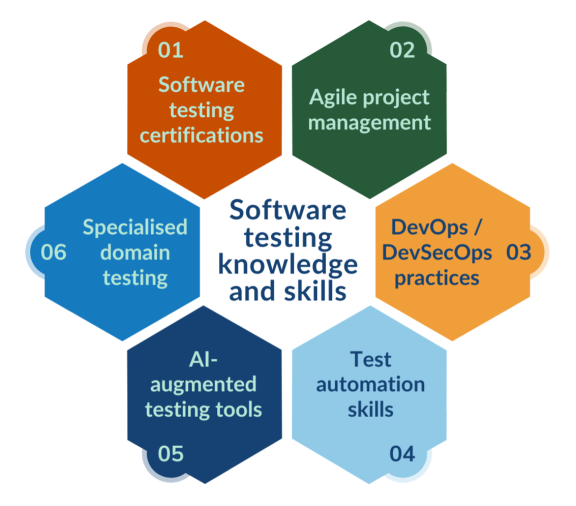
Figure 1: Up-to-date software testing knowledge and skills
Source: Globally Cool
Software testing becomes more important, complex and competitive. So European buyers often demand software testing certification from service providers. The most widely recognised certifications in Europe are those offered by the International Software Testing Qualifications Board (ISTQB). Other options include TMap and the Certified Software Testing Engineer (CSTE) certification from the Global Association for Quality Management.
Also, European buyers may expect you to work according to Agile principles and adopt DevOps/DevSecOps practices. Agile practices are based on the Agile Manifesto. Scrum is the most widely used methodology. Agile testing follows the principles and processes of Agile software development. Continuous Integration and Continuous Delivery (CI/CD) are core practices in DevOps and DevSecOps.
Software systems are becoming more complex and interconnected. Manual testing alone cannot keep up with changing requirements and expectations, like speed and accuracy. To meet requirements for compatibility, performance, security and integration, software testers should learn test automation skills and tools. You should have skills for the most established testing frameworks like Playwright and Cypress.
The fast development of artificial intelligence (AI) requires new skills and tools in software testing. AI is changing software testing, because teams now use AI-augmented testing tools in which AI generates test data and automation scripts are self-healing. Also, ethical AI testing is becoming increasingly important. Using AI in software testing is no longer optional. It has become essential for ensuring fast delivery, high quality, security and competitiveness. In July 2025, ISTQB released a new specialist certification on using AI technologies for software testing: Certified Tester – Testing with Generative AI (CT-GenAI).
Specialised domain testing offers good opportunities for ITO service providers from developing countries. There are opportunities in sectors like automotive, healthcare, finance and banking, and e-commerce and retail. In the automotive industry, an example is Software Defined Vehicle (SDV) testing. In SDV, mechanical functions are controlled and improved by software and a centralised computing environment. SDV testing focuses on software functionality, performance, cybersecurity, integration, and validation and verification (for example, to confirm that the system meets ISO 26262).
Tips:
- Stay on top of the latest software testing technologies in the market.
- Provide references, testimonials and examples of recent work, preferably on your website, as European companies often require proof of your technical skills.
- Make sure your website has an extensive quality assurance service portfolio. It should present a wide range of manual and automated testing services and address a variety of methodologies and platforms.
- In Europe, testing professionals can join specialised professional associations. They may also organise events that are open to non-members. Follow these organisations and try to take part in the events they organise. Examples include TestNet from the Netherlands, the Danish Software Testing Board, and the software testing specialist group of the British Computer Society.
Soft skills
Besides technical knowledge and experience, software testers must also have strong soft skills:
- Analytical and critical thinking helps testers break down complex problems and discover hidden defects;
- Attention to detail ensures that even the smallest issues are identified;
- Clear and open communication is very important. Software testers must create documentation that is easily understandable to developers, managers and clients;
- Time management and prioritisation skills help testers deliver results under time pressure;
- Adaptability and curiosity help testers to learn new tools and methods fast;
- Showing initiative and proactively engaging with your European clients helps build strong relationships.
What are the requirements for niche markets?
Requirements for software testing services can vary per industry. When planning to offer software testing services in a specific niche, make sure to check the applicable requirements.
For example, in the financial sector the Digital Operational Resilience Act (DORA, EU 2022/2554) applies. It requires independent testing of all ICT systems for vulnerabilities and resilience. Also, the Payment Card Industry Data Security Standard (PCI DSS) requires security and penetration testing for systems that manage credit card data. Basel III/MiFID II require strict validation and audit trails in testing. Although these financial regulations do not directly describe how to test software, they strongly influence what must be tested.
Other sectors with specific requirements include healthcare and life sciences, automotive, aerospace and defence.
Tip:
- If you (aim to) specialise in particular sectors, find out which standards and certifications are relevant. Assess carefully which standards and industry best practices fit your situation. Evaluate whether putting a certain standard into place would benefit your organisation, if European clients demand the standard, and if it has long-term marketing value for your company.
2. Through which channels can you get software testing services on the European market?
The European software testing market can be divided into several segments. These includeesting type, industry vertical, delivery model and technology/tool type. You can tap into these segments through several market channels. The most realistic channel for you is to collaborate with software developers and specialised software testing companies.
How is the end market segmented?
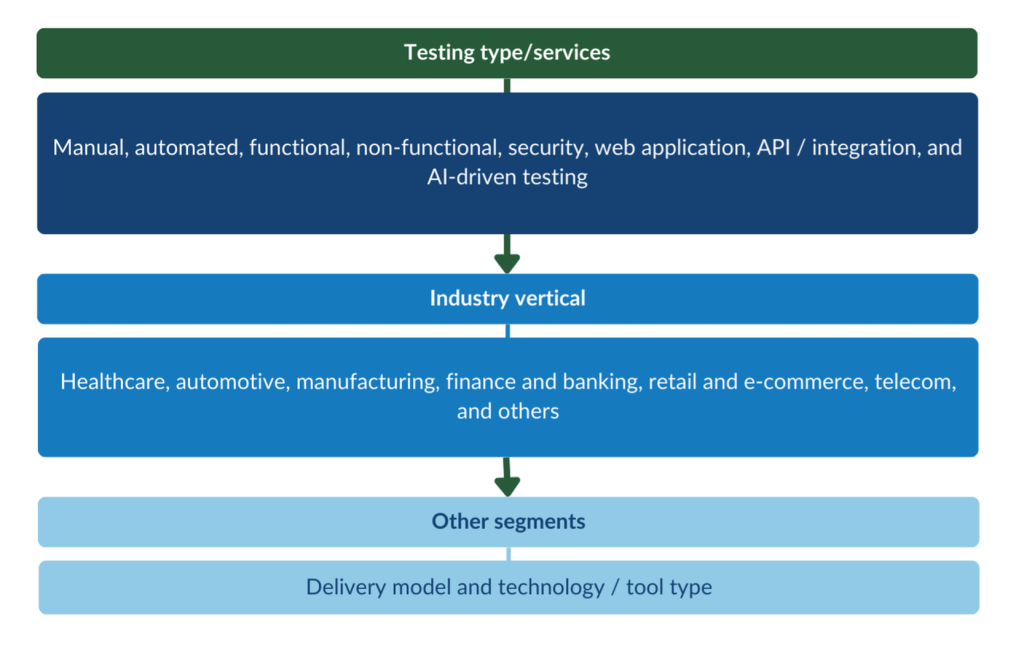
The software testing market is competitive and very fragmented. The market can be segmented in various ways:
- Testing type/services: this means segmenting the market by type of testing service, like manual, automated, functional, non-functional, security, web application, API/integration, cloud-based and AI-driven testing;
- Industry vertical: this segmentation divides the market by end-user industry. Sectors include healthcare, automotive, manufacturing, finance and banking, and retail;
- Delivery model: this can be divided into Software as a Service (SaaS), in-house, outsourced and crowdsourced testing;
- Technology/tool type: this segmentation focuses on the tools and technologies companies use for software testing. This includes open-source tools, commercial tools, cloud-based platforms and AI-augmented testing tools.
Figure 2: Software testing market segments
Source: Globally Cool
All software that is being developed, or changed, has to be tested to check that it meets the required standards and functions. That is why the most interesting market segments for the software development industry are also the most interesting for the software testing industry.
The most promising sectors are those that lead innovation and development in AI, cloud, cybersecurity, digital transformation, mobile application development, and other advanced technologies such as robotics and virtual/augmented reality (VR/AR).
For small ITO service providers, interesting market segments are those that require specialised testing capabilities. Examples are healthTech, e-commerce and retail, and banking, financial services and insurance (BFSI). Smaller niche segments, like the Internet of Things/Industrial Internet of Things (IoT/IIoT), agritech, and high-frequency and algorithmic trading, may also be a good fit.
European software testing and QA companies include Qualitest, a1qa, DeviQA, Eficode, Roq and nFocus Testing. These companies cover many of the above market segments.
Tips:
- Stay up-to-date with software testing market developments by following relevant websites and blogs like Software Testing Help, Lambda Test, TestBytes, DZone Testing and Ministry of Testing. Also attend webinars and software testing events.
- Try to focus on a niche market segment and offer specialised software testing services based on the latest technologies. In specialised, niche market segments you will have less competition, more customer loyalty and more stable/higher prices.
- The best opportunities exist for companies that are specialised in software testing and not those that do software testing as a part of their Software Development Life Cycle (SDLC).
Through which channels do software testing services land on the end market?
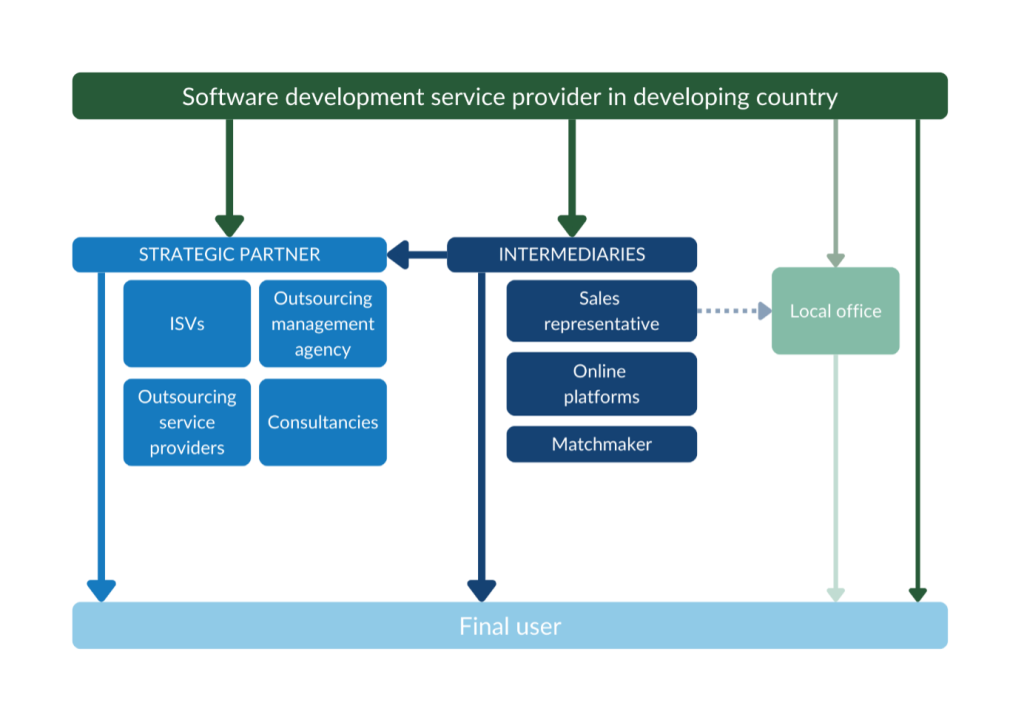
As a service provider in a developing country, you can use several trade channels to enter the European market. Figure 2 provides an overview of that trade structure. This structure is more or less the same in every European country.
Figure 3: Trade structure for outsourcing software testing services in the European market
Source: Globally Cool
Strategic partners
Working with a strategic partner is your most realistic market entry channel. Ideally, the European company should design, develop, maintain or integrate software products, manage software development projects, or offer software testing services similar to yours.
For testing services, a European strategic partner is often an Independent Software Vendor (ISV) or an independent software testing provider that does not necessarily develop software. System integrators, consultancies and outsourcing management agencies can also serve as strategic partners.
The relationship between a strategic partner and an offshore service provider is generally characterised by:
- Trust;
- Interdependence;
- A structured relationship (functions, tasks, communication, and procedures);
- Intensive communication and collaboration;
- Potentially limited marketing visibility and market access opportunities for you;
- No intellectual property (IP) rights, or a loss of IP rights for the subcontracted supplier. IP is important in software testing, because you might have access to the source code or create proprietary testing processes;
- Work orders on an as-needed basis. Contracts might be project based.
You can find a strategic partner either directly or by working together with intermediaries. Because many European companies prefer to deal with a local contact person, an intermediary is a good option.
Tips:
- Attend relevant industry events in your target country to meet potential partners. For example, Agile Testing Days in Germany, EuroSTARin Norway for the 2026 edition, National Software Testing Conference in the United Kingdom (UK), Nordic Testing Days in Estonia, and Swiss Testing Day in Switzerland. If you have never attended a testing event (or an IT event), keep in mind that good preparation is important.
- Use outsourcing associations to find potential customers in Europe: for example the Global Sourcing Association (GSA) in the UK, Outsourcing Verband in Germany, and Sourcing Nederland in the Netherlands.
Intermediaries
You can work with an intermediary to find a buyer or strategic partner.
Matchmakers
A matchmaker is a person or a company with a relevant professional network in a specific market segment. As an intermediary, they are a ‘door opener’ and not an agent to make cold calls or send cold emails.
Make sure you properly inform your matchmaker about your company. The better they understand your company, capabilities and offer, the better they can target potential customers for you.
If you work with a matchmaker:
- They make appointments with prospects for you;
- Sales process remains your responsibility;
- You usually pay a retainer plus success fee;
- They often have multiple clients;
- You need to set clear expectations and objectives (and exit criteria) to measure their performance.
A retainer plus success fee can be expensive. The success fee depends on what the matchmaker has delivered. But you have to pay the retainer (usually a fixed monthly payment) regardless of their performance. The retainer should be high enough to cover some of the costs, but low enough to encourage delivery.
You should protect yourself. It is a good practice to negotiate a trial period. This is a clearly defined period after which the contract can be ended without any further consequences. This period is usually not longer than 3 or 4 months, after which the contract will be evaluated and can be terminated or prolonged. For this period, there should be clearly defined delivery expectations and targets for the matchmaker (such as the number of relevant contacts, meetings, and leads).
A properly drafted contract, by your lawyer, is a must. Contract evaluation periods, delivery expectations, key performance indicators (KPIs), payment terms and exit criteria must be carefully determined.
Sales representatives
Another type of intermediary is a sales representative. They are more involved in the sales process than matchmakers.
When working with a sales representative:
- They contact prospects for you;
- They also handle the sales (partly), and may be involved in project management and client communication. But delivery is still your responsibility;
- You often pay a retainer plus success fee, or a fixed monthly fee;
- They can have multiple clients or work exclusively for you.
A good sales representative has a large, relevant professional network, so they do not make cold calls. Their success fee is often a percentage of the projects they bring in.
Online platforms
Online marketplaces are digital intermediaries. Many showcase company profiles, portfolios and client reviews. There is strong competition on these platforms. You must maintain high ratings and reviews to improve your visibility. Although some of them focus on freelancers, there is also a growing number of marketplaces for companies. Some of the marketplaces are free, others may charge you for listing your company.
The primary professional social media platform in Europe (and globally) is LinkedIn; XING is popular in German-speaking countries.
Tips:
- Be cautious if intermediaries offer to work with you based only on a success fee. In this case, either they are excellent at their job or desperate to make some income, and may not be able to deliver. Also be cautious if intermediaries want to work for you part-time besides their regular job.
- Keep in mind that your relative or friend living in Europe might not be the best intermediary for you. At first this option looks attractive, but often it is not. But it can help to find someone from the diaspora community of your country in the target market. This person can act as a bridge between you and the client, to overcome potential cultural differences.
- Look for potential leads in the field of software testing on online outsourcing marketplaces. For example, UpWork, Freelancer, Fiverr, Clutch, GoodFirms, Crunchbase and ITFirms.
Local sales office
Ideally, you should establish a local sales office in Europe. A local presence makes it easier to build long-term partnerships with customers. It also increases your trustworthyness, builds trust, and allows you to keep complete control over your marketing and sales activities. But setting up your own office in Europe can be challenging as the costs are high. Most smaller companies in developing countries do not have the financial strength for this. You should only do this if there is a verified market demand (and ideally a few clients already) for your services.
Tips:
- You can lower costs if you set up your European office in a nearshore country within the EU.
- If you decide to establish an office, involve your European sales representative (if you have one already).
- Look for alternatives to lower your costs, such as business incubators or government incentives to bring your business to a particular country or region.
Direct sales
You can also try to sell your software testing services directly to European end users. Many European companies are looking for cost reduction and delivery capacity, which developing countries can often provide. However, you should be aware that these end users might not have qualified staff to work with. They also do not always have experience managing teams in different locations.
Direct sales require experience in the European market. This strategy is most suitable for larger service providers that want to target large European end users. Your best bet is to focus on a specialised, underserved niche market. However, for most suppliers from developing countries it is challenging to sell software testing services directly. Having a few existing customers in Europe will help. Strong references are mandatory for direct sales.
Tips:
- Combine offline and online promotion channels to develop high-quality European contacts. This maximises your chances of finding customers. Use LinkedIn as a marketing tool to reach and research potential customers. Build a company page on LinkedIn, follow industry leaders and join software testing industry groups.
- Have a professional, high-quality website. Invest in Search Engine Optimisation (SEO). Also consider Search Engine Marketing so potential customers can easily find you online.
What is the most interesting channel for you?
Your most common and most promising market entry channel is to work together with software developers and specialised software testing companies. But selecting the right market entry channel depends on your type of company, the nature of your service, your target market, and the available resources for market entry.
Regardless of the channel you choose, your own marketing and promotion is a vital part of your market entry strategy, and you are responsible for it. In any case, the software testing market is a trust business. You have to build and earn trust and credibility. Business opportunities happen, and deals are often closed, based on personal connections and recommendations. Your ability to build a strong, professional network of European contacts is very important for a successful entry into the European market.
Tip:
- Decide on a business model. You can try to work directly for European end users or focus on becoming a subcontractor for European partners. You should also create your ideal client persona, which helps you tailor your offer.
3. What competition do you face on the European software testing services market?
European end-user companies often prefer outsourcing to providers within their country. Especially smaller companies outsource tasks locally. But European ITO providers often subcontract to nearshore and offshore outsourcing companies. They often prefer nearshore locations because of proximity, language, cultural similarities and the minimal time difference.
Which countries are you competing with?
European companies often prefer to outsource to nearshore destinations. This means that your main competitors are based in Europe. Important competing countries include those in CEE. They offer a strong mix of tech hubs, skilled talent and competitive costs compared to Northern and Western Europe, high English proficiency, minimal time differences and cultural alignment. You also face competition from India, the major offshore outsourcing leader. Egypt is another important player.
The Global Services Location Index (GSLI) shows countries’ attractiveness as offshore locations for ITO/BPO services. It ranks their competitiveness based on 4 categories:
- Financial attractiveness;
- People skills and availability;
- Business environment;
- Digital resonance.
Based on the GSLI, India is the most attractive ITO/BPO destination, ranking first. CEE countries and Ukraine score lower but are leading outsourcing locations for European companies. Egypt ranks 23rd.
Source: Kearney, 2023
CEE countries: Preferred nearshoring destinations
Companies from CEE have a positive image in the European market and are often seen as a safe choice. CEE countries are important outsourcing hotspots because of their skilled talent and geographic and cultural proximity to Northern and Western Europe. Also, being part of the EU gives them advantages in legal compliance and easier business integration when serving European clients.
Poland
Poland is a major player in software development outsourcing. The country ranks 13th on the GSLI 2023. It is a large supplying country with a big pool of IT professionals. It has many higher education institutions, including 40 state universities and 20 public technology institutes. They have trained around 400,000 IT specialists. In CEE, Poland is the leader in the software testing market. The country has over 700 software testing companies and 30,000 QA engineers.
Polish IT specialists have experience working with international companies and are skilled in advanced technologies. Polish people also score very high on English proficiency. This makes it relatively easy for European clients to communicate with them.
Romania
With around 25,000 software testers, Romania is another strong nearshore destination for software testing services. It has the leading position in Europe and sixth worldwide for certified IT specialists per 1,000 inhabitants. The country has a large tech workforce of 120,000 programmers and more than 360 custom software development companies. Romania is known for its exceptional price-to-quality ratio. The industry development is driven by the presence of global companies such as Hewlett-Packard, Huawei, Ericsson, and Gameloft.
Around 25,000 students (7% of all applicants) enrol in computer science programmes annually across nearly 100 universities. They also score high on the English proficiency index; English is the primary working language among Romanian tech companies.
Bucharest is the country’s main IT hub, holding 63% of the country’s software development revenues. IT companies in Bucharest serve the finance, e-commerce, healthcare and business services sectors, among others. Romania is building a reputation in important domains like cybersecurity and AI.
Czechia
Czechia ranks 31st in the GSLI and has a very good reputation among European software development companies. The country is home to more than 221,000 ICT professionals, and Czech developers are rated as the ninth-best in the world. There are nearly 100 software testing companies and over 10,000 QA engineers. Most Czech firms use advanced digital technologies (91% in 2024). Every year approximately 16,000 technical graduates enter the Czech IT market.
But Czech IT companies find it difficult to attract new talent. After Germany, Czechia is the EU country with the greatest challenges in filling ICT specialist vacancies (70.5% in 2024). The sector is experiencing a skills gap because of a mismatch between educational output and industry needs. Increased competition with other European countries for skilled people also contributes to this challenge. This may drive Czech software companies towards subcontracting.
Growing challenges in CEE are rising costs and talent shortages. The success of the tech sector has driven up talent competition and salaries in major hubs. The increased rates have narrowed the cost gap with Western Europe. Also, being in the EU means businesses have higher operating costs than some offshore locations. The result is that some CEE companies subcontract work to offshore destinations.
India: Low-cost destination, mostly known for ‘bulk’ projects
India is a major global player in software testing and QA; it has one of the largest software testing pools in the world. The country continues to lead the GSLI. This is mainly due to the combination of excellent English language skills, low-cost services and a skilled workforce. Government programmes like Digital India, together with improvements in IT infrastructure, help strengthen the position of software testers.
Indian software development and testing companies are adopting test automation and integrating AI testing tools into their processes more often. They are also focusing on Agile, DevTestOps and security testing practices. Despite the large talent pool, India has a shortage of skilled professionals in advanced testing areas like AI and test automation. This talent shortage is mainly the result of gaps between the curriculum of educational institutions and industry demand. Besides the skill gap, there are challenges around high employee turnover rates and competition from other destinations.
Ukraine: resilient tech industry
Ukraine is home to nearly 50,000 software testers, which is the largest CEE developer population. The technology sector is an important pillar of Ukraine’s economy. It is ranked second in exports. In 2024, the value of Ukrainian IT services exports was estimated at €5.6 billion, making up about 3.4% of the country’s GDP. Between 2019 and 2024, IT services exports grew by 54.5%.
Ukraine ranks 42nd in the GSLI. Most Ukrainian software testers have intermediate to upper-intermediate English language skills. Ukrainian developers are highly valued and costs are relatively low This together with the general benefits of a nearshoring destination makes Ukraine an attractive destination for European buyers.
Despite the war, around 85% of the Ukrainian developers managed to keep working, either in Ukraine or abroad. Outsourcing software companies have taken measures to continue business during the war. They relocate employees to safer areas and diversify talent recruitment globally. Independent internet solutions (for example, by using Starlink satellite connectivity) are used as well. Also, quite a few Ukrainian tech companies are opening offices abroad. IT Research Ukraine states that 51% of Ukrainian CEOs want to open new offices. Of these, over a third want to establish branches abroad. Poland is the preferred country of expansion.
Learn more about the state of the Ukrainian IT outsourcing and IT services sector from the 2024 Digital Tiger study.
Egypt: emerging African destination for IT offshoring
Egypt is an emerging African destination for IT offshoring. Its time zone (GMT+2) partly overlaps with Western and Northern Europe, eliminating the time differences generally associated with offshoring. The country ranks 23rd in the GSLI – 8 places lower than in 2021. This appears to come from a limited focus on digital initiatives. Although the country wanted to set ambitious IT investment goals, this has not yet led to the desired results.
Egypt is home to a large technically educated workforce that is skilled in English, Arabic, French, German, and other European languages. The country has a low level of technology innovation, but is working on building emerging technological skills. Egypt’s Information Technology Industry Development Agency (ITIDA) plays an important role in developing the country’s IT industry and promoting trade in international markets. It has also set up public-private partnerships to enhance young IT professionals’ access to the labour market and improve their employability.
Tips:
- Specialise in specific vertical markets and/or niche market segments to avoid competition.
- Visit the websites of IT outsourcing associations and software development and/or software testing associations in particular, to get a better understanding of competing countries. Examples are the Central and Eastern European Outsourcing Association (CEEOA) and the outsourcing destinations page of the German Outsourcing Verband.
Which companies are you competing with?
Some competitors from emerging markets can be specialised software testing companies. Others are software development companies that provide software testing services in addition to software development. These companies offer various testing technologies, methodologies, domain specialisations and certifications. Examples of software testing service providers that you might be competing against are:
Better QA (Romania)
Better QA is an important player in the Romanian software testing services market. Their headquarters are in Romania and they specialise in, amongst others, UI/API testing, performance and security testing, and test automation. They are praised for their professional attitude and quick responses and are generally delivering good work.
TestRig (India)
TestRig is an independent software testing company located in Pune, India, with offices in the USA and UK. They offer end-to-end QA services, including manual testing, AI-driven test automation, and cloud, mobile and security testing. Their QA and testing services integrate with Agile and DevOps processes.
White Test Lab (Ukraine)
White Test Lab is a small Ukrainian company specialised in software testing and QA. They offer both testing services and solutions, including QA audit and consulting, web and mobile application testing, test automation and manual testing. Their offerings also cover, among others, functional testing, API testing and end-to-end software testing. They have experience across multiple industries, including fintech, healthcare, e-commerce and SaaS. Their strong QA expertise and client relationship is very appreciated among their clients. Also, the company mentions that 88% of their clients are long-term clients.
UTrust (Egypt)
UTrust is a specialised software testing and QA service provider in Egypt. They offer a wide range of end-to-end software testing services, including security testing, AI-based testing, API testing and test automation. Its main industry domains are financial services, manufacturing, logistics, gaming and healthcare.
Utrust also runs its own QA academy to deliver training in software testing and QA. The QA academy ensures a steady supply of well-trained future employees and gives current employees opportunities to upskill in the latest QA and software testing technologies.
Tips:
- Use the services of your national export promotion agency and actively participate in the creation of export strategies.
- Search company databases to find more competing companies. These databases can be free, like company.info, or paid, via chambers of commerce or commercial databases like Bold Data.
Which products are you competing with?
For companies that design, develop and maintain software, testing is an essential part of the SDLC. Security, privacy and compliance are very important nowadays. All these aspects must be tested. In software testing, the service itself is the product.
This means the real question is: what makes one service provider different from another? The answer is: technical knowledge, available capacity, references, flexibility, scalability, reliability, communication and language capabilities, quality management, compliance credentials, security infrastructure, vertical and/or horizontal market focus, and niche market orientation. The location (country) of the service provider is also an important factor.
If you look closer, it is challenging to find small, independent and specialised (European) software testing and QA companies online. But this does not mean they do not exist. These companies often have limited digital presence, small marketing budgets and a preference to focus on expertise rather than branding. Also, their work is often highly confidential.
Tip:
- Find out how you can get a competitive advantage, based on factors such as quality, cost, technology or product characteristics. Check out software testing companies that have successfully entered the European market, and see how they position and promote themselves.
4. What are the prices of software testing services on the European market?
Price used to be the main reason for European companies to outsource software testing services to developing countries. But added value, access to skills and specialised knowledge are now equally important.
However price remains important for most European buyers. Outsourcing to countries with lower wages can lead to considerable cost savings. For example, the average salary of a software test engineer in the Netherlands is €30.71 per hour, while in the Philippines this is around €5.59. This can be one of your competitive advantages.
The price for software testing services is influenced by technological requirements, skill levels, complexity of the project, length of the contract, and other requirements in the Service Level Agreement (SLA). When you focus on a niche or non-commodity market, European buyers are often less price sensitive and more loyal to your services.
Your offer should include the price, with your hourly rates and an honest estimation of the time you expect to work on the project. Choose a type of pricing model that fits you and your clients best. The most common pricing models for outsourced software testing services are Time and Material and Fixed Price. But other pricing models can also be used.
For more information, see this report on pricing models in outsourcing. Go beyond setting the right price and work out your pricing strategy. This should include, for example, your and your clients’ preferred pricing model, payment terms and expectations, and how and when you offer discounts.
Tips:
- Research the average salaries in your European target country, for example via Payscale.
- Mention the potential cost savings, but also emphasise your skills, experience and added value.
- Read more about pricing. For example, check out the blogs How much does software testing cost in 2025, Software test estimation and 6 techniques, Best testing cost estimation techniques for software projects and 7 software test estimation techniques
Globally Cool carried out this study in partnership with Laszlo Klucs on behalf of CBI.
Please review our market information disclaimer.
Search
Enter search terms to find market research