
The United Kingdom market potential for cocoa
The United Kingdom is one of Europe’s largest cocoa markets, and it has high demand for chocolate products. The country buys most of its cocoa beans directly from producing countries, especially in West Africa, and has a large chocolate manufacturing industry. British buyers pay close attention to quality, traceability, certification and sustainability. This study explains the market potential for cocoa in the UK and shows how you can improve your market position and find new opportunities.
Contents of this page
1. Country description: United Kingdom
The United Kingdom (UK) is a sovereign state in Northwestern Europe, made up of England, Scotland, Wales and Northern Ireland. The country has a population of about 69.9 million. The capital is London. The official language is English.
The United Kingdom used to be part of the European Union. In 2020, after long negotiations, it left the European Union (Brexit). Its laws are still very similar to that of the European Union, although there are some differences. Geographically, the Atlantic Ocean, the North Sea, the Celtic Sea, the English Channel and the Irish Sea surround the UK. The country shares its only land border with the Republic of Ireland.
The UK is one of the world’s 10 largest economies, with a high Gross Domestic Product (GDP). The country benefits from a long coastline and several major sea ports, like London, Felixstowe, Southampton and Hull. The Port of Liverpool is the main hub for cocoa imports. It handles more than two-thirds of all cocoa beans that enter the United Kingdom.
The UK buys cocoa beans and cocoa products directly from producing countries. This means that the country plays an important role in the global cocoa trade. It is also an important centre for buying and selling cocoa and chocolate in Europe. But the UK does not grind or process as much raw cocoa as Germany or the Netherlands.
The UK customs authority is mainly represented by HM Revenue and Customs (HMRC). They classify cocoa and cocoa products as follows:
- HS 1801 00 00 – Cocoa beans, raw or roasted
- HS 1802 00 00 – Cocoa shells and waste
- HS 1803 10 00 – Cocoa paste, not defatted
- HS 1804 00 00 – Cocoa butter
- HS 1805 00 00 – Cocoa powder, unsweetened
Cocoa beans and cocoa shells or waste have a 0% UK Global Tariff. This means they can enter the UK without import duty. Processed cocoa products usually face higher tariffs. Cocoa paste has an 8% tariff, while cocoa butter and unsweetened cocoa powder have a 6.1% tariff. But these products can enter the UK at 0% duty when imported from countries that have an Economic Partnership Agreement (EPA) with UK. This means these countries have an advantage: they can export processed cocoa products to the UK more cheaply.
Figure 1: Map of the United Kingdom with major cities, neighbouring countries and surrounding seas
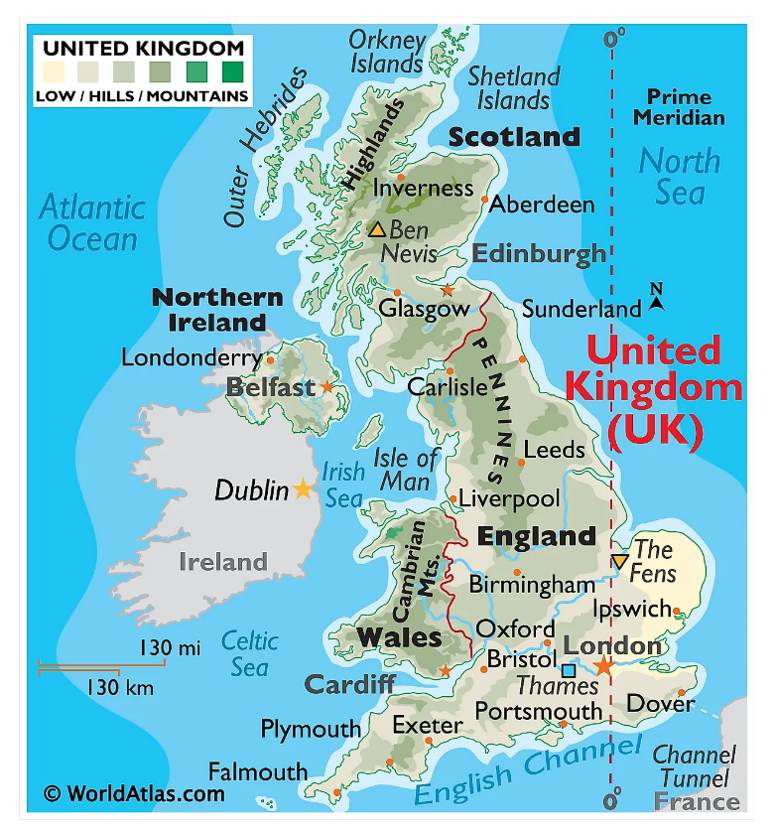
Source: Map of United Kingdom
Tip:
- Learn more about how UK cocoa buyers can import cocoa to the UK after Brexit. This information can help you understand the documents that UK buyers need. It also explains the practical steps needed to sell cocoa to the UK market, like the documents required to meet food safety rules and prove reliable quality before shipment.
2. What makes the United Kingdom an interesting market for cocoa?
People in the United Kingdom eat a lot of chocolate. There is a large retail sector that focuses on bulk cocoa, and limited but growing demand for premium and ethical chocolate. The country’s cocoa bean imports come mainly from producing countries, especially Côte d’Ivoire and Ghana.
UK buyers are paying more attention to traceability, certification and reliable supply because sustainability standards are becoming stricter. Exporters that can offer consistent quality, clear origin information and verified sustainable cocoa are in the best position to enter or grow in this market.
United Kingdom is a major cocoa market in Europe
While Europe accounts for more than 30% of global cocoa market revenue, the UK is still an important market alongside larger cocoa-processing countries, like Germany. The UK cocoa market was valued at around $1.09 billion (USD) in 2025. It will probably grow steadily at 2.83% annually from 2026 to 2035. Growth is supported by strong chocolate consumption, demand for premium products, and rising interest in ethical and sustainable cocoa products.
In 2022, the volume of cocoa beans imported by the UK from producing countries went up slightly compared to the volumes imported in 2021 (Figure 2). This showed a small recovery from a drop in 2021 due to disruptions linked to Covid-19 and post-Brexit trade adjustments. But in 2023, there was a small drop again due to global supply problems, which raised prices. In 2024, import volumes began to slightly rise again.
The sharp rise in import value between 2023 and 2025 reflected developments in the global cocoa market. Supply shortages pushed global cocoa prices to record levels in 2024 and 2025. However, cocoa prices declined by over 50% globally in 2026.
Import volumes will probably go up in the short term, supported by declining world market prices. This brings an opportunity for cooperatives and exporters, particularly for those that can supply high-quality cocoa beans that meet sustainability and ethical standards.
Source: ITC calculations based on UN COMTRADE and ITC statistics, 2026
United Kingdom buys most of its cocoa beans directly from West Africa
The United Kingdom imports most of its cocoa beans directly from producing countries (Figure 3). Côte d’Ivoire was clearly the biggest supplier between 2021 and 2025. The country supplied 50,000–59,000 tonnes per year. Its exports stayed high and relatively stable during that period. Ghana was the second largest supplier, with exports of 6,600–8,700 tonnes per year.
Nigeria supplied around 1,000 tonnes in 2021. It did not export cocoa beans to the United Kingdom between 2022 and 2024, but it looks like exports have risen again in 2025, to around 3,000 tonnes. Among the smaller suppliers, Ecuador recorded the most growth. Its exports went up from below 100 tonnes in 2021–2023 to around 700 tonnes in 2024 and 2025. This can be a sign of the UK’s growing interest in premium fine-flavour cocoa. Peru supplied consistently low volumes, falling from around 260 tonnes in 2021 to about 135 tonnes between 2022 and 2025.
While the UK cocoa market remains very dependent on large West African origins, there are also early signs of limited diversification into other African and Latin American origins. Ecuador’s growth can be a sign that smaller origins can grow if they offer quality, traceability and distinctive flavour profiles.
West African suppliers still have a strong position in the UK market. But buyers can look for additional origins to reduce supply risks and find different flavour profiles. Smaller suppliers can use this opportunity if they offer reliable volumes, clear traceability and consistent quality.
West Africa will probably be the most important region for the UK’s cocoa sourcing. But exporters from smaller origins can gain more space in premium, specialty and single-origin segments as demand for premium chocolate increases. To benefit from this, you have to understand the market dynamics, what buyers are looking for, build relationships and supply to meet buyers’ expectations.
Source: ITC calculations based on UN COMTRADE and ITC statistics, 2026
The United Kingdom is a small re-exporter of cocoa beans, but export volumes keep increasing
The United Kingdom is a relatively small re-exporter of cocoa beans. Most imports are used by its domestic processing and chocolate manufacturing industry. But Figure 4 shows that UK cocoa bean re-exports went up sharply between 2022 and 2025, although they were still small. In 2025, the United Kingdom re-exported about 8,400 tonnes of cocoa beans, more than 38 times the re-export quantities in 2022. In 2025, most re-exports went to Belgium, followed by Indonesia and the Netherlands. Trade data shows that the Netherlands has been a consistent and important re-export destination for the UK.
The low level of re-exports could be a sign that the United Kingdom mainly functions as a cocoa processing and chocolate-consuming market instead of a major cocoa trading hub, like the Netherlands and Belgium.
It looks like the United Kingdom will mostly remain a value-adding cocoa market focused on chocolate manufacturing and premium consumer products instead of large-scale cocoa bean re-exports. This can create opportunities for you to keep supplying to UK manufacturers and specialty chocolate makers directly.
Source: ITC calculations based on UN COMTRADE and ITC statistics, 2026
Source: ITC calculations based on UN COMTRADE and ITC statistics, 2026
The United Kingdom houses a strong chocolate-manufacturing industry
The United Kingdom has a large and well-developed chocolate manufacturing industry. This creates steady demand for imported cocoa beans and semi-finished cocoa products. Most large confectionery companies have their head offices outside the United Kingdom. But several multinational firms have large manufacturing and research facilities in the country.
Large chocolate manufacturing operations in the UK include:
- The Cadbury Bournville site in Birmingham, operated by Mondelēz International. Bournville is still one of the company’s main UK chocolate production and research locations. It produces products like Cadbury Dairy Milk.
- The Mars Wrigley Slough facility, operated by Mars Incorporated, produces brands like Snickers, Galaxy and Maltesers for the UK market.
- The Nestlé York factory is one of the company’s main UK confectionery plants. It manufactures products like KitKat.
Alongside multinational companies, the United Kingdom also has a growing premium and specialty chocolate segment. Companies like Hotel Chocolat, Pump Street Chocolate, Land Chocolate and Duffy’s Chocolate focus on premium, craft and bean to bar chocolate production. These companies often focus on flavour quality, traceability, sustainability and direct sourcing relationships.
For exporters, this industry structure creates different market opportunities. Large industrial manufacturers often require large volumes and standard cocoa quality. But premium and bean to bar chocolate makers often look for high quality cocoa beans, single-origin cocoa, unique flavour profiles and strong sustainability stories.
In the short and long term, the United Kingdom will remain an important chocolate manufacturing hub with a growing demand for sustainably sourced cocoa. Supply reliability, strict quality control and strong sustainability tracking will continue to be very important throughout this entire market.
Tips:
- Use the ITC Trade Map to study cocoa trade in Europe and the United Kingdom and to improve your export strategy. You can use product code 1801 and selecting the United Kingdom to track trade flows, major suppliers, new supplying countries and changes in direct and indirect imports.
- Read the CBI study on cocoa trade statistics for more information about the European cocoa bean market.
- Build long-term relationships with buyers. Whether you sell through an importer or to a UK chocolate company directly, strong business relationships are important. Long-term partnerships can help you reduce market risks, improve product quality and have a fair balance between price and quality. For more advice, read the CBI study on doing business with European cocoa buyers.
- Focus on investing in quality control, certification and flavour development to make it easier to access these higher-value market segments.
3. Which cocoa products offer the most opportunities on the British Market?
Conventional chocolate still dominates the UK cocoa market. It made up a market share of 65.45% in 2025. But there are high-growth opportunities for specialty suppliers, because of a very high demand for premium dark chocolate, single-origin and refined sugar-free options. To benefit, you need to offer clear traceability, unique flavour profiles and verified ethical standards. This focus on premium quality will help you build long-term partnerships with UK buyers.
Chocolate imports from low- and middle-income market economies keep growing
The United Kingdom chocolate market reached a value of $12.48 billion (USD) in 2025 and grew to $13.12 billion in early 2026. It will probably be up to $16.81 billion by 2031. Conventional chocolate produced mainly by large multinational chocolate companies was the largest category in the United Kingdom chocolate market in 2025, accounting for 65.5% of total market share.
But demand for single-origin chocolate is growing and will probably continue growing by 6.8% every year until 2031. This makes it one of the fastest-growing niche segments in the UK chocolate market. Figure 6 shows that the UK’s imports of chocolate and other food preparations containing cocoa from developing countries went up by a lot between 2021 and 2025.
Imports rose from about 6,500 tonnes in 2021 to around 14,000 tonnes in 2025. Growth was especially strong between 2024 and 2025. This showed rising demand for chocolate products sourced from developing countries. This growth was due to higher consumer interest in cocoa origin and unique flavour characteristics linked to specific producing regions.
The growing single-origin and premium chocolate segment creates opportunities, besides supplying raw cocoa beans, for exporters that can offer unique flavour profiles and strong sustainability documentation. For example, Divine Chocolate (Ghana) manufactures its Fairtrade chocolate at source and exports directly to the UK. Divine Chocolate is co-owned by Kuapa Kokoo, a cooperative of over 100,000 cocoa farmers in Ghana.
Source: ITC calculations based on UN COMTRADE and ITC statistics, 2026
Demand for premium dark chocolate is rising
Dark chocolate will probably be the fastest-growing product segment in the United Kingdom chocolate market, with expected annual growth of 6% until 2031. This growth is linked to changing consumer preferences for products with higher cocoa content, lower sugar levels and what people see as health benefits. Many consumers link dark chocolate with antioxidants, reduced sweetness and more premium quality.
Milk and white chocolate are often seen as being high in sugar and calories. Because of this, consumers often choose lower-sugar snacks and alternatives. The UK Government has said that the number of adults with type 2 diabetes aged 17 and over in England went up from 6.8% in March 2023 to 7% in March 2024.
This rise in diet-related health conditions has led to more regulation, public health campaigns and changes to products across the confectionery market. Major chocolate brands are responding to this health-related trend by producing premium dark chocolate. For example, KitKat UK started producing its 70% Dark chocolate bar again in 2024.
Premium dark chocolate needs to have a cocoa content of 55% or higher. It requires beans with clean, distinct flavour profiles, low astringency and high-quality fermentation to make sure it does not taste too bitter. To meet UK manufacturers’ demands, producers need to make sure that the beans are handled carefully after they are picked. Limiting slaty beans to a maximum of 3% to meet Grade 1 quality standards, like those of Ghana, is also important. Poor fermentation produces slaty beans. These beans result in high bitterness and astringency that cannot be removed by normal chocolate processing.
Developing and knowing the flavour profiles of your cocoa varieties gives you an important advantage in meeting the British chocolate makers’ needs. When cocoa beans are roasted, any flaws in the beans become very noticeable in the final product. This is because dark chocolate has very little sugar or milk to mask bad tastes.
This means that you need to show tight control over off-flavours like smoke, mould and too much acidity. Invest in good handling of the beans after harvest, including standardised fermentation, smoke-free drying and careful sorting. Finally, document your bean quality to prove to buyers that your cocoa is well-fermented with few defects. The CBI study 10 tips on how to do business with European cocoa buyers describes the documents you need to send your supplier about the quality of your cocoa.
Imports of semi-finished cocoa products from low- and middle-income countries are stable
The United Kingdom imports stable volumes of semi-finished cocoa products from developing market economies. These are cocoa butter, cocoa paste and cocoa powder. This shows stable demand from British chocolate, bakery and food-processing industries for processed cocoa ingredients and not only raw cocoa beans.
Figure 7 shows that cocoa butter, fat and oil were still the most imported semi-finished cocoa product between 2021 and 2025. Import volumes went up from about 17,500 tonnes in 2021 to a peak of around 28,000 tonnes in 2023. They went down again slightly in 2024 and 2025. Despite the drop after 2023, import volumes stayed above 2021 levels.
Imports of cocoa paste also went up during the same period. Volumes rose from around 6,000 tonnes in 2021 to over 11,000 tonnes in 2025. Although cocoa powder imports stayed much smaller than cocoa butter and cocoa paste, volumes also went up gradually over the period.
Source: ITC calculations based on UN COMTRADE and ITC statistics, 2026
The stability of semi-finished cocoa product imports could be a sign that UK manufacturers still source some processed cocoa ingredients from cocoa producing countries directly. This trend creates opportunities for exporters in developing countries to go further than raw cocoa bean exports and increase local value addition through cocoa processing.
The stable demand for cocoa paste and cocoa powder is also linked to product innovation in the UK food industry. This includes bakery products, beverages and plant-based foods. Manufacturers that want flexible ingredient sourcing and more efficient production systems use semi-finished cocoa products more often. This means buyers can have stricter specifications for semi-finished cocoa products. Examples are tighter limits on moisture content, fat composition, microbiological safety and contaminant thresholds.
You need to offer semi-finished cocoa products with full sustainability documentations, traceability and quality assurance. Also make sure that you deliver consistent quality for semi-finished products that meet buyer specifications. This will help you get multi-year contracts. This is particularly important because of prices in the cocoa market going up and down.
Plant-based chocolate is niche, but demand is rising
Plant-based chocolate alternatives are becoming one of the fastest-growing segments in the UK chocolate market. Growth is mainly happening because of rising interest in vegan, lactose-free and dairy-free diets. Another reason is rising consumer worries about environmental sustainability and animal welfare. The UK vegan chocolate market will probably grow by an average of 15.1% per year until 2028. By 2028, it will probably be worth about $80.3 million (USD). This plant-based segment is expected to grow at an annual rate of 6.1% through 2031.
Chocolate manufacturers are responding by developing products that use plant-based ingredients like oat, almond, coconut and cashew milk to replace dairy ingredients. Improvements in product formulations and textures are also helping to make plant-based chocolate products more appealing to mainstream consumers.
The plant-based trend puts a premium on raw bean quality and clean processing. Vegan chocolates use fewer artificial additives, so the natural flavour of the cocoa bean stands out. Suppliers that can provide fine-flavour beans with low astringency and guarantee segregated contamination-free supply chains for allergen-free certification have a good chance to do very well in the UK’s premium retail space. You can find out more about how to adapt your harvest for these niche premium buyers in the CBI study on cocoa trends.
Certified and sustainable cocoa products are becoming more important in the United Kingdom market
The United Kingdom is one of Europe’s largest markets for certified and sustainably sourced cocoa products. UK consumers are very aware of sustainability labels and expect chocolate products to meet environmental and social responsibility standards.
Rainforest Alliance (RA) is one of the most recognised sustainability labels in the UK food market. Consumer awareness is estimated to be around 58% according to a report from 2023. Fairtrade certification is also very important in the United Kingdom. Chocolate is one of the most popular Fairtrade-certified product categories in the country, together with coffee and bananas. The United Kingdom organic sector also reached a milestone of €4.31 billion (£3.7 billion) after over a decade of growth.
Many major UK supermarkets and chocolate brands now offer certified chocolate products, including Fairtrade, Rainforest Alliance and organic chocolate lines. Retailers like Tesco, Sainsbury’s and Waitrose are still growing their sustainability-focused product ranges. Cadbury and Divine Chocolate also focus on responsible cocoa sourcing and farmer welfare.
Like the EU market, sustainability discussions in the UK chocolate sector often pay more attention to social issues like farmer income, child labour prevention and ethical sourcing practices. At the same time, environmental concerns like deforestation, traceability and carbon emissions are becoming more important.
For exporters, this means that certification and sustainability systems are becoming more important for market access, especially in premium and retail-ready market segments. Buyers more often expect you to give them traceability information, certification records and evidence of responsible production practices.
Tips:
- Think carefully about your certifications. Make sure they match with buyers’ preferred schemes (Rainforest Alliance, Fairtrade,EU Organic) and check long-term demand before investing.
- Develop clear flavour profiles and origin stories to support ethical branding.
- Invest in post-harvest infrastructure to improve fermentation, drying and packaging.
- Learn more about the best vegan chocolates in the UK market and who makes them.
- Read the CBI studies on how to do business with European cocoa buyers, exporting certified cocoa to Europe, exporting speciality cocoa to Europe, requirements cocoa must meet for the European market and exporting semi-finished cocoa products to Europe.
4. Which trends offer opportunities or pose threats on the British cocoa market?
Several trends create opportunities and threats in the United Kingdom cocoa market. Premiumisation and health awareness are leading to more demand for high‑quality, traceable cocoa in dark and plant-based chocolates. Digital commerce is also growing quickly, opening new sales channels. At the same time, despite the United Kingdom leaving the European Union, strict environmental and due diligence rules are becoming essential for market access. This makes traceability and compliance a must for success.
Premiumisation is reshaping the United Kingdom chocolate market
Demand for chocolate in the United Kingdom is moving from mainstream chocolate to premium and high-value chocolate products more and more. The mainstream chocolate market still makes up most of the volume of the chocolate sold, with a market share of over 68%. This is due to its affordability, convenience and strong presence in supermarkets and discount retailers. But the speed of this growth has slowed compared to that of premium chocolate. Premium chocolate is now seen as a primary growth driver for the UK chocolate market. It is expected to grow at a CAGR of 6.45% between 2026 and 2031.
Many British consumers prefer to eat better-quality chocolate, even if they buy less of it. This has helped chocolate brands keep customers, even when cocoa prices rise. So, premium chocolate is still seen as a small, affordable treat. Mintel (2025) reports that 61% of British chocolate eaters, including people with less money to spend, say premium chocolate feels like an affordable luxury.
As more consumers choose premium chocolate, the demand for high-quality, traceable and ethically produced cocoa is growing. As a cooperative or exporter, you need to supply cocoa beans with a special flavour, good and consistent fermentation and strong sustainability standards. This can help you get better prices and stand out in the market.
Some exporters also add value by making the premium chocolate at origin and selling it on the UK market. For example, Pacari from Ecuador sells organic, fine-flavour, tree to bar chocolate. It uses Ecuador as the home of its cocoa to build a strong brand. In the same way, Marou from Vietnam has built a strong premium image by making bean to bar chocolate from cocoa grown in different parts of Vietnam. These companies show that you can do more than just sell raw cocoa beans. You can also compete in premium markets through quality, traceability, sustainability, origin storytelling and attractive branding.
Sustainability rules for cocoa are becoming stricter
The United Kingdom is introducing stronger sustainability and supply chain rules for cocoa imports. UK buyers will need to make sure that the cocoa and chocolate products they import are traceable, responsibly sourced and produced with lower environmental and social risks.
For environmental risk, the UK’s Environment Act 2021 does not allow companies to import cocoa produced through illegal land use or illegal deforestation. Companies need to do due diligence checks and report every year on how they manage these risks. Because of this, UK buyers will ask you to provide proof that your cocoa is produced legally.
Apart from UK’s Environmental Act, the European Union Deforestation Regulation (EUDR) also requires companies that put cocoa on the EU market to prove that it is not linked to deforestation. Although the UK is not in the European Union, many UK chocolate companies sell to European markets. This means European rules still affect UK sourcing practices. Buyers will ask for information, like farm locations, GPS coordinates, land ownership documents and traceability records.
UK retailers and chocolate brands are also setting net-zero targets. This is supported by the UK government’s net zero strategy for environmental sustainability. For cooperatives and exporters, this can lead to more questions about what type of energy they use and how much, transportation modes and distances, land use and processing emissions.
For social risks, laws like the Modern Slavery Act and new sustainability reporting standard are also putting UK companies under pressure to improve social sustainability. So, buyers will ask for information about labour conditions, child labour monitoring and environmental practices.
Major chocolate companies in the UK support these regulations. They argue that stronger sustainability standards can help protect forests, improve transparency and create more opportunities for smallholder farmers who adopt responsible production practices. For many British chocolate brands, sustainability is no longer seen only as a compliance issue but as a way to help their products stand out in the marketplace.
Companies that can demonstrate responsible sourcing, support for farmer livelihoods, transparency and deforestation-free supply chains are more often using these attributes to strengthen their brand reputation and attract ethically conscious consumers.
Strengthen your position by using farm mapping systems, GPS coordinates and traceability tools that track cocoa from farm to exporter. You should also improve systems for monitoring child labour, labour conditions and community engagement. Check out the CBI studies on tips to go green in the cocoa sector, tips on how to become EUDR-compliant in cocoa and tips to be socially responsible in the cocoa sector. These studies give details on how to set up these systems step by step, meet environmental and social sustainability requirements, and build fair and lasting relationships with farming communities.
Cocoa-free chocolate is emerging in the United Kingdom
Cocoa-free and lab-grown chocolate alternatives are slowly appearing on the UK market. They are often sold as sustainable new ideas. They are made from plants like fava beans, carob and sunflower seeds. According to reports by the BBC and Food Manufacture, an important reason for their emergence is the high cost of real chocolate.
These alternatives use clever methods. The UK firm Win-Win uses rice and koji fermentation to imitate the flavour of chocolate without using any cacao, and it has attracted outside investment. Cocoa-free chocolate focuses on sustainability, but it is hard to fully match the taste and cultural meaning of real cocoa, which also supports millions of small farmers.
There are clear signs this trend is gradually growing in the UK. The British producer Nukoko, which makes chocolate from fava beans, was recently bought by a large ingredients supplier. It is interesting that Nukoko began as a traditional UK chocolate business before it moved into alternatives. Consumer views are changing too. A research reported by Confectionery News found that 38% of people support cocoa made without traditional farming. Among adults aged 25–34, this number went up to 55%.
If cocoa-free chocolate continues to grow, it could lower demand for traditional cocoa and push prices further down. Ethical groups like Fairtrade have also noted that lab-grown cocoa cannot be certified, because it does not involve farmers.
As a cooperative or exporter, it is useful to understand this trend early so you can protect the value of real cocoa. To stay competitive, you should highlight the authenticity and heritage of real cocoa, use Fairtrade certification and connect buyers to farming communities using storytelling. Cocoa-free chocolate will probably not fully replace real cocoa soon, but it is a fast-growing trend. Acting early to reinforce the ethical value of real cocoa will help buyers keep seeing traditional chocolate as impossible to replace.
Tips:
- Use storytelling to improve your market position. Information about cocoa origin, farmer groups, agroforestry practices and post-harvest quality management help products to stand out in premium markets.
- Position yourself as a long-term compliance partner. Support buyers by offering regular sustainability and traceability information. Suppliers that help buyers meet UK and EU sustainability requirements have a good chance of building stronger long-term business relationships and getting access to premium market segments.
Amonarmah Consults carried out this study in partnership with Molgo Research on behalf of CBI.
Please read our market information disclaimer.
Search
Enter search terms to find market research
Do you have questions about this research?
Exporters should understand not only the quality of their own beans but also how they compare with cocoa from other origins. This helps them communicate their value more effectively to buyers.

Sophie Jewett, Managing Director at York Cocoa Works