
What is the impact of the EUDR on home decoration?

The European Union aims to be climate-neutral by 2050. An important step towards achieving this goal is the new Deforestation Regulation (EUDR). This regulation aims to reduce greenhouse gas emissions and biodiversity loss resulting from deforestation and forest degradation. Learn whether the EUDR applies to your products and how to prepare for its regulations.
What is the EUDR?
The European Union (EU) currently regulates the import of products such as wooden furniture through the Timber Regulation (EUTR). The EUTR prohibits the sale of illegally harvested timber products on the market. The EUDR will replace the EUTR and ensure that products bought by European consumers do not contribute to deforestation and forest degradation. Operators placing these products on the EU market must be able to trace them back to the plot where suppliers produced the raw materials.
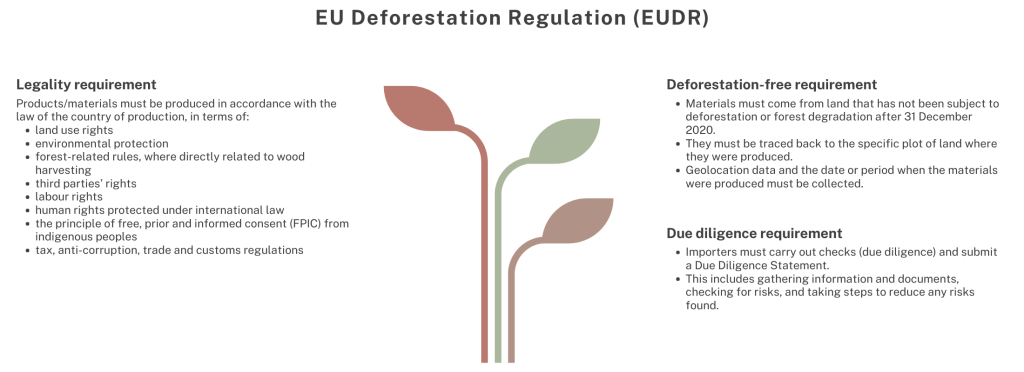
For the EU market, EUDR-covered products must be:
- Deforestation-free;
- Produced under the law of the country of production;
- Covered by a due diligence statement.
For more details, see our study on the buyer requirements for HDHT, chapter “From Timber Regulation to Deforestation Regulation”.
Figure 1: EUDR requirements
Source: Deforestation Regulation / Globally Cool
What products does EUDR apply to?
For home decoration, the EUDR mainly applies to wooden products such as:
- Furniture;
- Tableware and kitchenware;
- Statuettes and other ornaments;
- Picture frames, mirrors or similar objects; and
- Marquetry and inlaid wood. For example, jewellery or cutlery cases and similar articles.
You can find a list of exact products in Annex I. The European Commission has proposed clarifying that the EUDR also applies if manufacturers make products entirely of bamboo, rattan, and other wood-based materials.
How does the EUDR affect you, and what should you do?
Once the EUDR comes into effect, you must be able to provide your buyers with information such as geolocation data and proof that you meet national legislation. If you buy materials, work with suppliers who can provide the necessary documentation. If you produce materials, use tools such as Whisp or Meridia for geolocation. CBI offers a digital solutions factsheet on collecting and managing the info buyers need, and a digital solutions longlist with an overview of tools and providers for comparison. When selecting a tool, you can use the International Trade Centre (ITC) checklist.
Holding a certification for sustainable wood can help you to show you meet the EUDR. Meriam Wortel, coordinating specialist inspector at the Netherlands Food and Consumer Product Safety Authority (NVWA), explains: ““Certification can help you comply with the EUDR, if it aligns with the requirements of the legislation. The documentation and audits you need to become certified also make it easier for you to prove your legal compliance”. Certification programmes such as FSC and PEFC are closely aligned with the EUDR.
ITC’s EUDR Compliance Handbooks provide guidance on how small businesses can meet the new rules. Its Deforestation-Free Trade Gateway offers tools to collect and manage data, connect with buyers, and ensure EUDR compliance.
Maintaining close communication with your most important buyers is always the best strategy, as you share the goal of securing European market share.
When does EUDR apply?
The EUDR came into force in June 2023, but the European Council postponed its application. The regulation will now apply to large and medium enterprises from 30 December 2026, and to micro and small enterprises from 30 June 2027 (except for enterprises trading in furniture and frames). For timber products produced before 29 June 2023, the EUTR will continue to apply until 31 December 2028.
In December 2025, the EU adopted a targeted revision of the EUDR. The changes aim to simplify implementation, reduce unnecessary administrative burden, and ensure that all parties are well prepared before the regulation applies. The main changes are:
• Only the first operator to place products on the EU market must submit a due diligence statement. Following operators and traders must keep and pass along this information.
• Micro and small primary operators from low-risk countries need only to submit a simple, one-time declaration instead of periodic due diligence statements.
Learn more
Read more about the EUDR and stay up to date on its implementation. Also, study the European Commission's guidance document and FAQ for more details.
Globally Cool wrote this news article for CBI in collaboration with GO! GoodOpportunity and Remco Kemper.
Stay informed
To stay informed on the latest developments in the HDHT sector, subscribe to our newsletter.