
PUM and CBI: Collaborating for Morocco’s futureproof olive oil sector
Morocco’s olive oil production and exports are growing, offering strong potential for youth employment and sustainable economic growth. To sustain this growth, farmers must ensure their trees get enough water year-round. In collaboration with CBI and PUM, producer Mocard is pioneering in water management and causing a positive ripple effect across the sector.
Mocard’s irrigation challenge
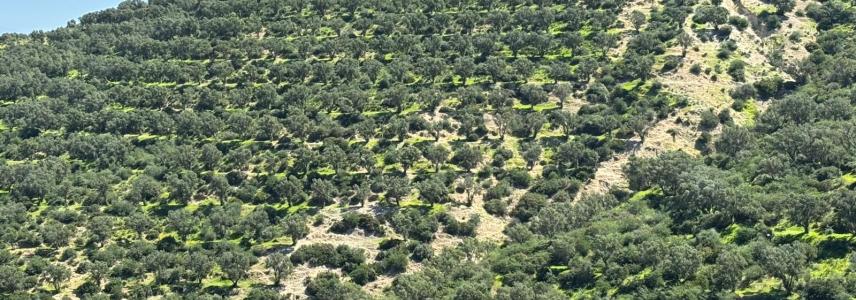
Mocard, the Moroccan Company for Agriculture and Rural Development, manages around 600 hectares of organic farmland in the Fes-Meknes region. In 1970, they planted between 45,000 and 50,000 Picholine Marocaine olive trees. Because the terrain is hilly, rising up to 250 metres above the Oued Ourgha River along the northern side of the plantation, irrigation has long been a challenge. “The farm has steadily produced olive oil for many years, but quantities are limited because the trees do not always get enough water,” says owner Youssef El Anssari.
Sharing insights: CBI’s AnMOON project
In 2025, Mocard connected with CBI through the AnMOON Morocco olive oil and youth project. Running from 2024 to 2028, this project unites stakeholders across Morocco's olive oil sector to build climate resilience and create jobs for young people. Alongside CBI and national partners, small and medium-sized enterprises (SMEs) are upgrading sustainable production practices, diversifying markets, and strengthening growth strategies and value chains with the Netherlands and Europe.
“One of CBI’s pathways to promoting sustainable production and trade is to scale innovations and solutions,” says CBI’s Moroccan project manager, Salma Takky. “Mocard’s irrigation challenge presented a clear opportunity. By developing a future-proof irrigation plan, the entire sector benefits from their shared insights.”
Improving irrigation techniques is fundamental to transform Morocco’s olive oil industry, helping companies like Mocard withstand climate impacts such as heat waves, droughts and unseasonal downpours and build more resilient businesses. As Salma explains, “For many of our olive oil producers, everything hinges on water.”
PUM’s commitment to impact
In projects like AnMOON, CBI collaborates with SMEs, national partners, and specialised knowledge partners in the Netherlands, Europe and partner countries. The market systems development (MSD) approach adopted by CBI focuses on addressing the root causes of environmental, social, and economic unsustainability within market systems. For Mocard’s challenge, this meant finding a partner specialised in agricultural technology, or agri-tech, and water management, an essential focus area of Dutch foreign trade and development policy.
That partner was PUM, a Dutch NGO connecting SMEs in 30 countries with a global network of 1,200 professionals who voluntary share their knowledge for the sustainable growth of entrepreneurs and their communities. PUM expert Harrie van Rosmalen, a veteran geotechnical and irrigation engineer, visited Mocard early 2026 to bring decades of hands-on experience. “I had just visited another water management project in Morocco and learnt a lot about their local conditions,” he recalls. “The day after I arrived, we went straight to the orchard- to assess the situation and collaborate on a solution.
From plans to practical design
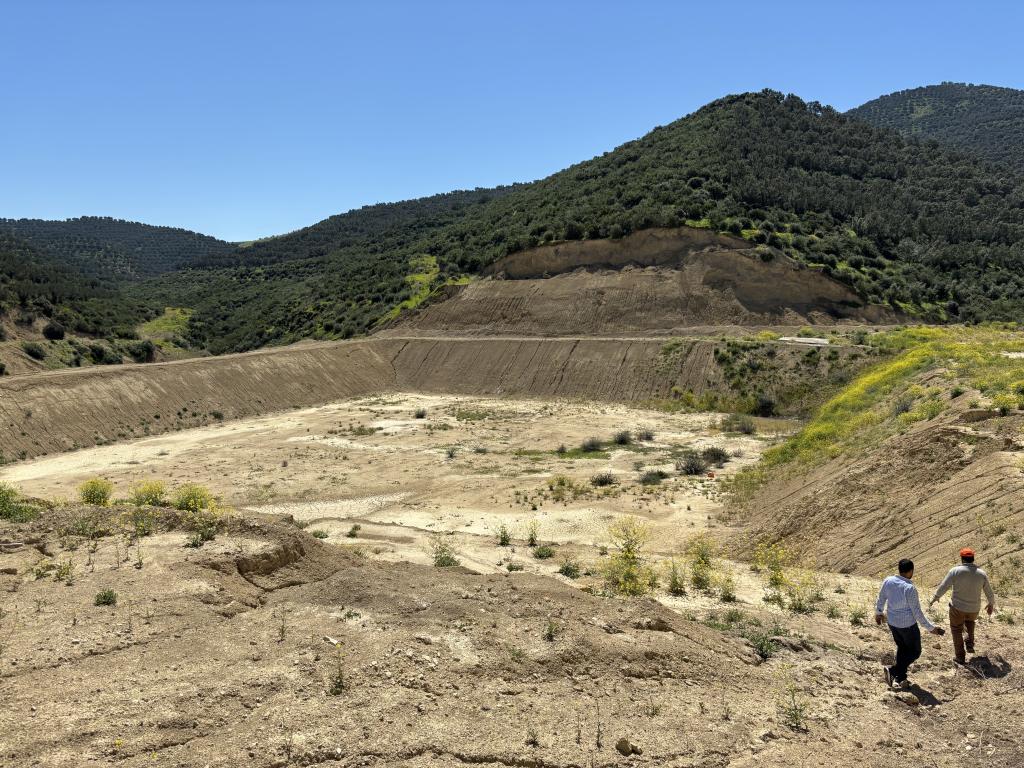
Photo: From reservoirs like this one, an irrigation network will distribute water across the Mocard plantation
Mocard’s main challenge is lifting water from the Oued Ourgha River at the right time and in the right quantities to the higher ground where the trees grow. They already had a plan in place to pump water uphill into a series of reservoirs. “From these reservoirs, an irrigation network will distribute water across the plantation,” explains El Anssari. “Two reservoirs are already completed, with 5 more planned to provide sufficient water storage for the mature olive trees.”
Harrie notes, “The overall concept was already in place. With specialised technical support, those plans could be turned into a practical design. The first question to address was: ‘How much water do we need to irrigate these 600 hectares for a complete growing season?’”
Calculating crop water needs
Based on 30 years of irrigation and water management data, PUM expert Harrie teamed up with Mocard to run detailed calculations. Together, they factored in every variable that might influence an irrigation plan: seasonal and annual rainfall, evaporation levels due to heat, the specific needs of Mocard’s tree species, and the local soil’s water retention capacity.
During the process, Harrie and the Mocard team utilised CROPWAT, a free water requirement tool developed by the United Nations’ Food and Agriculture Organization (FAO), along with the climate data tool CLIMWAT. ” In addition to CROPWAT’s information on the design of reservoirs, pumps, and piping, daily irrigation at Mocard will also rely on other data,” Harrie explains. “This includes satellite information and a weather station readings on rainfall, evaporation, temperature, and soil and tree humidity.”
This level of precision takes Mocard to the next level of water and crop management.
These calculations provide exact insight into the millimetres of water required per square metre for optimal irrigation year-round, broken down into ten-day slots. Salma emphasises the impact for the Mocard and similar companies in the region. “This level of precision takes Mocard to the next level of water and crop management. By introducing FAO tools through the project, which was new to some in the sector, Mocard and other olive-producing companies can now adopt them to reach similar improvements.”
An efficient drip system
Software and numbers alone are not enough. Harrie and Mocard converted the calculations into an efficient drip irrigation system designed to deliver the right amount of water to each tree, at the right time, throughout the year. This phase included determining the best hardware and equipment for the farm. “Water requirements and irrigation scheduling dictate the capacity of the pumps and the ideal pipe size,” Harrie explains. “For example, large pipes are expensive, but small pipes require heavier pumps. We also had to account for leakage risks, keeping in mind that pump pressure averages 30 bars for every 300 metres of elevation.”
Energy is another crucial condition for sustainable olive oil production at Mocard. “The region has a very high level of peak sun hours,” observes Harrie. “That is why we designed the Mocard system to use solar energy for pumping water into the reservoirs during daylight hours. Across other Moroccan plantations, hydropower could also be a strong solution for the sector, given the countries many rivers and mountains.”
A result-sharing workshop
The final phase of PUM’s involvement led to a result-sharing workshop in April 2026. In addition to Mocard’s staff and the CBI and PUM team, this session brought together government representatives, agronomists, and regional stakeholders. After Harrie presented his findings and recommendations, participants asked questions, shared experiences, and explored broader applications for the sector.
“It was an exceptional meeting,” Salma states. “Everyone gained highly valuable practical insights they can apply directly to improve water management and boost efficient organic production.”
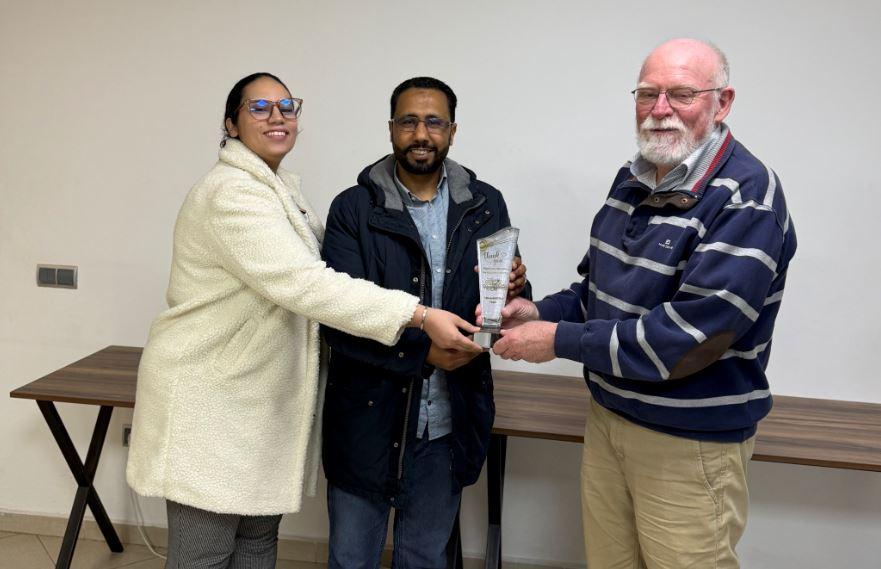
Photo: Workshop participants, from left to right: Salma Takky, Youssef el-Anssari, Harrie van Rosmalen
A huge ripple effect
Farm owner Youssef estimates that Mocard will be ready to implement the new plan within 1 or 2 years. “Our aim is to then double production to 2,000 tonnes of olive oil per year,” he says.
Through the AnMOON project, CBI collaborates with Mocard and other companies to support their access to Dutch and European markets. The increased and more reliable supply of olive oil from Morocco coffers an interesting new sourcing destination for sustainable, high quality olive oil for Dutch buyers. Salma observes that the ripple effect of Mocard’s progress is huge. “PUM’s approach enabled Harrie and Mocard to create a tailored solution that changes the game for the farm. Part of CBI’s role is to share successes like this across the wider market. That is why CBI continues to partner with Mocard, other companies in the Moroccan olive oil sector, agronomists, and government experts. By sharing knowledge and tools as partners rather than competitors, we pave the way for sustainable growth.’”
She adds that the ripple effect will also benefit young people in the region. “Optimised water management leads to higher, more stable production, creating opportunities to build sustainable trade relationships with buyers. With higher revenues and easier access to finance, companies like Mocard can offer young people decent employment. Developments like this will also open up exciting opportunities for youth entrepreneurship across Morocco’s olive oil sector.”
Creating a better future
Youssef notes that the CBI and PUM collaboration brought an important change to his farm. “Their technical support was practical, straightforward, and immediately applicable. Our company has been in operation for many years. With the specialised technical support during our collaboration with CBI and PUM, we finalised an improved irrigation plan and adopt efficient tools and methods to secure a better future.”
Salma adds, “Soon enough you will not just see Mocard’s olive oil on Dutch shop shelfs or on your kitchen table. You will see Moroccan olive oil taking a stronger position on the international market.”